in the 21st century Volume 33, 2011 83
Korthagen, f. a. J. (2004). in search of the essence of a good teacher: towards a more holistic approach in teacher education. Teaching and Teacher Education, 20, 77-97.
levin, t., & Wadmany, r. (2006). teachers’ beliefs and practices in technology-based classrooms: a developmental view. Journal of Research on Technology in Education, 39(2), 157-181.
liang, l. l., & Gabel, d. l. (2005). effectiveness of a constructivist approach to science instruction foreffectiveness of a constructivist approach to science instruction for prospective elementary teachers. International Journal of Science Education, 27(10), 1143-1162.
mattheoudakis, m. (2007). tracking changes in pre-service teacher beliefs in Greece: a longitudinal study. Teaching and Teacher Education, 23, 1272-1288.
parker, a., & brindley, r. (2008). exploring Graduate elementary education preservice teachers’ initial teaching beliefs. the professional educator, 32(2), 12–24.
phan, h. p. (2008). predicting change in epistemological beliefs, reflective thinking and learning styles: a longitudinal study. British Journal of Educational Psychology, 78, 75-93.
plourde, l. a., & alawiye, o. (2003). constructivism and elementary preserve science teacher preparation:constructivism and elementary preserve science teacher preparation: knowledge to application. College Student Journal, 37(3), 334-341.
pollock, J. e. (2007). Improving Student learning One Teacher at a Time. association for supervision & curriculum development, alexandria.Va. usa.
richardson, V. (2003). constructivist pedagogy. Teachers College Record, 105(9), 1623-1640.
rosenblatt, Z. (2004). skill flexibility and school change: a multi-national study. Journal of Educational Change, 5, 1-30.
schraw, G., & olafson, l. (2002). teachers’ epistemological world views and educational practices.
Issues in Education, 8(2), 99, 50p.
smith, K. (2005). teacher educators’ expertise: What do novice teachers and teacher educators say?
Teacher and Teacher Education, 21, 177-192.
Şeker, H. (2010). Applicability of the approaches-related beliefs of prospective teachers. Problems of Education in the 21st Century, Vol. 25, 138-150.
tierney, r. d. (2006). changing practices: influences on classroom assessment. Assessment in Education: Principles, Policy & Practice, 13 (3), 239-264.
Advised by Danuše Nezvalova, Palacky University, Czech Republic
received: May 12, 2011 accepted: June 12, 2011
Hasan Şeker Assoc. Profesor, Mugla University, Faculty of Education, Mugla, Turkey. E-mail: [email protected], [email protected]
Website: http://www. mu.edu.tr
TECHNOLOGY USE FOR COLLABORATION
IN BLENDED LEARNING
Lasma Ulmane-Ozolina
Liepaja University, Liepaja, Latvia E-mail: [email protected]
Abstract
E-learning traditionally is seen as individually oriented learning. The main effort was on creation of effective learning materials. Development of information and communication technologies (ICT) is bringing new possibilities for learning mainly on the area of collaboration. The idea of collaborative learning in e-learning becomes more popular. The main question for research is - is it possible or appropriate to use technology for collaborative learning in blended-learning settings at Liepaja University. Research based on partly structured interviews with lecturers about their experience and future view of usage of ICT as a tool for collaborative learning. Case studies of e-learning part of blended learning shows that lecturers still using e-learning tools mainly for content delivering. And for the future they still see e-learning as tool to make learning materials available.
Key words: blended learning, collaborative learning, e-learning, higher education, technology.
Introduction
in the very beginning of e-learning main effort was on learning materials. it was very logical way of action because e-learning roots are from distance education where one of the main “actor” of the learning process was learning material. e-learning as a continuum of distance education took best practices from distance education. one of the best practices was development of learning material. a lot of books are written about the best practices of development of the learning material, guides for developers, lecturers and so on. learning materials were in a very good quality but learners weren’t ready to learn independently. even the big emphasize on student support systems wasn’t solution. the lack of social interaction was critical for e-learning.
practice of pure e-learning showed that students and lecturers are not ready for that kind of learning. this also happened in latvia, particularly in liepaja university. pure e-learning course “social inclusion” “lived” only for 3 years. the course was developed for 20 weeks and that was too long time for students to stay in touch in virtual learning environment blackboard. one of the reasons – for students it was the only one e-learning course and they meet each other every day in other face-to-face courses. so it was hard to manage discussions and for tutor it was easier to meet students face-to-face.
collaboration is not something new in e-learning. discussion forums, chats, videoconferencing, whiteboards were and still are available technological tools in almost all course or learning management systems. today’s collaboration is socially new. it is brought from ideas that web 2.0 (World Wide Web new wave) brings to society and education. it is two-way collaboration, collaboration using social networking tools, communities of learners, social bookmarking, mush-ups, and reusability – ideas that follows web 2.0.
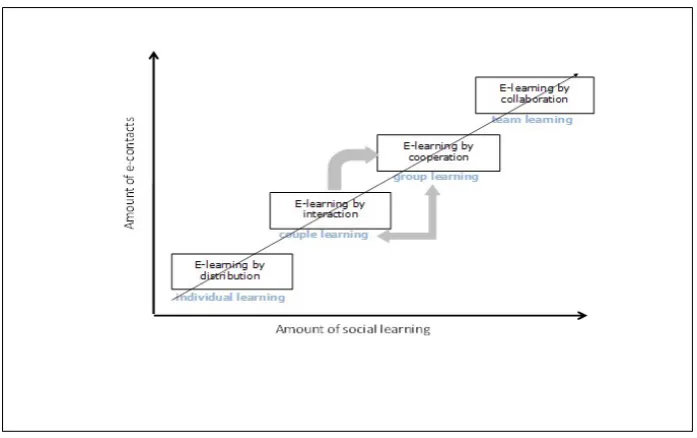
84 where accent put on interaction. then idea of cooperative learning in e-learning became popular and now researchers and practitioners talks about necessity to provide collaborative learning.
description of e-learning development is shown in figure 1 from o. muniz-solaris and c. coats (2009) adapted from albrecht and tillmann. authors show e-learning development based on amount of e-contacts and amount of social learning.
Figure 1: Knowledge construction by increasing social learning. Adapted from Albrecht and Tillmann (2004).
previous research shows, that a lot of students in their everyday life activities using information and communication technologies (ict) and they want to use it also for learning (it does not mean that they know how to use it in appropriate and purposeful way) (Kennedy et al, 2008; ulmane-ozolina et al, 2009).
the purpose of this research is to study ground for collaborative learning at liepaja university, in this case opinions of lecturers.
Blended-learning in Higher Education
development of new technological solutions and tools brought new challenges for e-learning. also learners became more and more technologically skilled. even if research shows that still there are learners with different technological skills – some are very skilled, but some very low skilled (Kennedy et al, 2008; ulmane-ozolina et al, 2009). tony Karrer in his blog elearningtech.blogspot.com meant these changes in e-learning. he describes changes using term e-learning 2.0 (see also downes, 2005). the main change is seen in tools used for e-learning, time duration from 60 minutes to 1 minute and it is learner driven and immediate.
Garrison and Vaughan describes blended-learning as thoughtful fusion of face-to-face and online learning experiences (Garrison and Vaughan, 2007, p.5). as main principle of blended-learning they call oral communication of face-to-face lectures and online written communication. but there is not only communication.
in the 21st century Volume 33, 2011 85
but also with approach that lets introduce e-learning by terms of what resources and tools can support learning and the ways of using them. it gives also possibilities to use new electronic media tools for learning (activities) and collaboration (for example, blogs, wiki).
technology has to transform education (somekh, 2007) “so that more students reach higher levels of achievements” (p.7). blended-learning gives more opportunity to involve students in learning process not only enhancing lectures (Garrison and Vaughan, 2007). it provides new experience of learning for students and asks more engagement from student and from teacher. the ideal use of e-learning tools (educational technology) engage student and allows to fulfill personally, and developing cognitive abilities such as critical thinking and discourse (Garrison and Vaughan, 2007; somekh, 2007). new tools like internet based audio and video communication, e-portfolios and social networking tools such as blog and wiki, allows mix online and face-to-face environments in more flexible way (stacey & Gerbic, 2008) and also engage students in new, attractive way.
Theoretical Perspectives for E-Learning Part in Blended-Learning
research in education field claims that main accent in learning must be on collaboration and interaction - not only in the face-to-face settings but also computer-supported collaboration and interaction. the idea of importance of interaction between students is grounded in sociocultural perspective that claims that learning occurs and happens in social interactions and environment (alexander, 2007; Greeno & van de sande, 2007). that means that knowledge and cognition are distributed and individual’s learning happens and changing according to learner’s participation (Greeno & van de sande, 2007). according to this there is need in blended-learning in higher education to promote purposeful discourse between learners (Garrison and Vaughan, 2007). teacher has to choose the most appropriate tool for communication whether it is face-to-face setting or e-learning tool.
Institutional Context
liepaja university (latvia) is state financed higher education institution. for long time main area of study there was teacher training. for last fifteen years university offers also other training programs in wide variety of interests.
liepaja university is regional university and that is why student numbers comparing with large universities are small – there were about 2600 students in the 2009. /2010. study year (information from liepaja university website). student groups consist from 10 to 40 students.
in 2002 the university started to use learning management system blackboard ml. one reason to choose this learning management system was participation in the socrates project where project result was e-learning course “social inclusion”. the other reason was because blackboard ml supports latvian language (Kapenieks, Zuga & ulmane-ozolina, 2003).
the course “social inclusion” was the first and the only one “pure” e-learning course at university. this course also was starting point to introduce university staff with possibilities of e-learning and learning management systems. university staff was not very open to design “pure” e-learning courses most of all because of lack of computer skills and work overflow. some problems occurred also that interface of learning management system was in english.
86 from the september of 2008 university changed learning management system ml blackboard to open source course management system moodle and there is opened about 130 “courses” (it is not always a course; it can be a place for collaboration between lecturer and students, it can be place for delivering study material (content) or even meeting place) and actively involved 22 lecturers. moodle supports latvian language and interface is in latvian also.
the most important thing about blended-learning is to see where it fits in institutional context (thorne, 2003). blended-learning fits in university very good because of following:
• the university is ready for changes;
• students are interested in new ways or not so traditional ways of learning at the university;
• academic staff wants to be modern and try out new possibilities; • about 50% of students are part-time students;
• large amount of students working and studding as full – time students in a time;
• the university has e-learning tools to use.
stacey and Gerbic (2008) for successfulness of blended learning from institutional point of view emphasizes that blended learning models has to respond to local, community and organizational needs. in the situation when most of liepaja university students have full time or part time work at time, blended-learning allows more flexible way of learning and to keep effectiveness of learning if students have difficulties fully participate in study process.
Methodology of Research
to found out how lecturers use collaboration in the learning process and what they think how lecturers use collaboration in the learning process and what they think about technology tools usage for this purpose, qualitative research based on partly structured interviews were conducted. eight lecturers were interviewed from different subject areas and with different technological skills. interview was chose based on similar research made by a. ellis and p. Goodyear (2010) and because of the problem that with term “collaborative learning” in latvian can be meant collaborative learning and cooperative learning. to avoid misunderstanding, interviews are the best way.
there were 10 questions in interview with possibility for questions to go in depth in lecturers meanings. lecturers were informed about anonymity of these interviews and data were recorded in written format. time for one interview was about 30 minutes.
Questions were constructed in categories – collaboration use in learning process, technology real and future usage for collaboration in learning process.
data analysis made based on these categories and in descriptive way. this is pilot research.
Ethical Considerations
in the 21st century Volume 33, 2011 87
lecturer 3: i know that i have to use moodle but i never have time for that. i am so busy. but i will come to you some day, will you show me how to do it?
answers of those lecturers who are not using moodle time by time seemed as “waited answers” not the real ones.
Results of Research
researcher conducted 8 partly structured interviews with lecturers at liepaja university to find out situation and lecturers’ views on collaborative learning in face-to-face lessons and e-learning (with condition that they use e-learning tools no matter if this is moodle or another technological solution) and their future view for ict usage for collaborative learning.
Collaborative Learning Use
all lecturers admit that they use collaboration in face-to-face settings, and most of all it is group work what they use. one lecturer (lecturer 4) says that she is using cooperative learning. interesting that lecturer 8 said that she does not like group work but she uses it because students like it.
lecturer 8: i don’t like group work, but i now that i have to use it. i am the person who likes to work independently and that is why i don’t like to work in group. and there are students who like to work independently as me. but in some assignment students have to work collaboratively.
such activities like discussions were mentioned only after researcher asked about some other kind of collaboration that happens in face-to-face lectures or in e-learning settings.
Technology Real Use in the Learning Process
interviews show that lecturers use technological tools (moodle, e-mail) for delivering content and assignments to students. five lecturers (lecturer 1, lecturer 2, lecturer 4, lecturer 5, and lecturer 7) use moodle in the learning process. for the question how they use moodle in the learning process, lecturers said that they use moodle for the delivery of the learning materials, assignments to use them in the time of face-to-face lecture, powerpoint presentations, tests. lecturer 1and lecturer 5 said that they try to use discussion forums but students are not responsive for that. lecturer 1 and lecturer 5 tried also wiki in the moodle. lecturer 1 found out that it is not clear for her how better use and for what purposes to use wiki. lecturer 5 admitted that sometimes students are active in wiki, but there are groups of students that are not active at all. and it is always a problem for her to be ready for that and to provide different versions of assignment.
88 Technology Future Use in the Learning Process
on question about how lecturers see future possibilities for technology usage to manage collaboration between students and students and teacher, one of the lecturers (lecturer 1) admits that she does not see such possibility. she explained it that technology usage for the group work brings the problem that often appears in the group work – one student do assignment for the rest of the group. she sees that if lecturer uses technology for group work then very important issues to think about are rules, scenario and student division in roles. but in the same time, she is very active moodle user for learning. also lecturer 7 talked about this issue.
about the future possibilities or ideas, or wishes on technology usage some lecturers has some ideas but one lecturer (lecturer 8) admitted that she has never thought about technology usage.
lecturer 2 mentioned skype as very potential for collaboration with students. she also mentions videoconference, recording of lecture that afterwards is available in archive. but the last one (lecture recording) is not seen as a tool for collaboration.
lecturer 3 could not say how she can use technology for collaboration because she prefers to collaborate in face-to-face with students. for this reason lecturer does not use moodle for learning. but she is very open to start to use it and made her first topic for students in moodle. also lecturer 6 and lecturer 8 mentioned the idea that they better like to collaborate with students in face-to-face settings. they also want to see student collaboration in group work because of assessment of group results. all three lecturers represents field of social sciences.
lecturer 6: i like to discuss issues in face-to-face. We play many role plays in lectures and it is impossible to play it online because it is hard for students to start to play a role. and it will be more difficult in online environment.
lecturer 4 uses moodle very active in the learning process. but not so much for collaboration with students because parallel to moodle she has face-to-face lectures.
lecturer 4: i use moodle to put theory on topic and assignments. then students have to take them to the lecture and we work with it. i don’t want to lose face-to-face lectures because in this way students can learn better. We have oral agreement that students before lecture have to learn from materials and in lectures we work mainly with exercises.
she also prefers communication and collaboration in face-to-face settings. but for future she sees possibility to use online shared document creation, for example, Google documents. Google documents were mentioned also by lecturer 5. lecturer 5 was the only one who proposed usage of the social networking tools for collaboration. for technological usage she meant creation and usage of educational video, simulations and educational games.
lecturer 6 said that she want to try moodle but not for collaboration, for content delivery. lecturer 7 mentioned interactive whiteboard what is not seen as traditional tool for collaboration.
Discussion
in the 21st century Volume 33, 2011 89
clear distinction between these two terms. probably it is because of language issue. but it also can be because liepaja university was very active player in popularizing cooperative learning in education field in latvia. and many of lecturers still uses some kind of cooperative learning (not pure cooperative learning) in teaching process. in time of interviews researcher had to explain what is meant by collaboration in this situation.
collaborative learning is not only group work. collaboration as term can be described in four ways according to p. dillenbourg (dillenbourg, 1999):
• as situation that is characterized as more or less collaborative; • as interaction between learners;
• as learning mechanisms are more intrinsically collaborative; • as effects of collaborative learning.
research shows that there is unclear division of collaboration as it. as first collaborativethere is unclear division of collaboration as it. as first collaborative is unclear division of collaboration as it. as first collaborative activity lecturers mentioned group work but according to muniz-solaris & coats (2009),muniz-solaris & coats (2009), collaboration in e-learning is connected with team work. according to dillenbourg group work according to dillenbourg group work can be described as learning mechanism or situation were collaboration can happen.
technology usage for collaborative learning is not popular. two lecturers mentioned that they use discussion forums and wiki but students are not willing to use them and also lecturers admit that they are not sure about ways to use these tools. probably forums and wiki are not used in meaningful way and there is need to analyze purposes for these tools in blended-learning. as Garrison and Vaughan (2007) meant that blended learning is about oral face-to-Garrison and Vaughan (2007) meant that blended learning is about oral face-to-face communication and written online communication. but communication does not mean the same as collaboration.
most of the lecturers said that they like to use collaboration in face-to-face lectures better than in e-learning settings. as there is not clear definition about in what proportions blended-learning can happen, one of the models can be that learning resources are delivered by e-learning tools and collaboration happens in face-to-face lectures. and in this model there is timesaving effect because lecturer does not have to take time from face-to-face session for theoretical issues but can use it for student collaboration and practices.
Conclusions
there are not clear models of how to better use blended-learning. Web 2.0 brought new look at learning, e-learning and blended-learning. some research demonstrates that students interaction with technology is changing – students use ict very active in their everyday life and that brings ideas that education field have to use these tools also. changes in technology usage and approaches to learning claims importance of collaborative learning.
main effort in collaborative learning is on collaboration between students and students and lecturer. to provide collaboration lecturer can use face-to-face environment but in blended-learning settings there are possibilities to use also technology. do lecturers use this possibility?
research made in liepaja university (latvia) shows that lecturers like to use collaboration in face-to-face settings and leave technological tools for delivering of learning resources and assignments. liepaja university is using open source course management system moodle to provide e-learning tools for lecturers and students. in interviews most of lecturers admitted that they use moodle for content delivery. only 2 out of 8 lecturers tried to use discussion forums and wiki but also with some failure.
90 Acknowledgements
the article is written with financial support of esf project “development of doctoral studies at liepaja university” project nr.2009/0127/1dp/1.1.2.1.2./09/ipia/Viaa/018.
References
alexander, p. a. (2007). bridging cognition and socioculturalism within conceptual change research: unnecessary foray or unachievable feat? [electronic Version]. Educational Psychologist, 42(1), 67-73.
clark, r. c. and mayer, r. e. (2003). E-learning and the science of instruction: proven guidelines for consumers and designers of multimedia learning. usa: pfeiffer.
dillenbourg, p. (1999). introduction: What do you mean by “collaborative learning”? [electronic version]. in p. dillenbourg (ed.), Collaborative learning. Cognitive and computational approaches. (pp. 1 – 19). oxford, uK: pergamon/elsevier science.
downes, s. (2005). e-learning 2.0. eLearn Magazine, october 16, no. 10., no. 10.
ellis, r., Goodyear, p. (2010). Students’ Experiences of e-Learning in Higher Education The Ecology of Sustainable Innovation. london, uK: routledge.
Garrison, r., Vaughan, n. (2007). Blended Learning in Higher Education: Framework, Principles, and Guidelines. usa: John Wiley and sons.
Greeno, J., van de sande, c. (2007). perspectival understanding of conceptions and conceptual growth in interaction [electronic Version]. Educational Psychologist, 42(1), 9-23.
Kapenieks, a., Zuga, b., ulmane-ozolina, l. (2003). pedagogical & technical report „social inclusion, community perspective” socrates minerva project 2000 „the use of ict/odl in promoting social inclusion” 87917-cp-1-2000-1-uK-minerVa-odl, riga technical university, latvia, 11.03.2003.
Karrer, t. (2006). elearning 1.0 vs. 2.0 – help needed. retrieved may 1, 2011 from http://elearningtech. blogspot.com/2006/09/elearning-10-vs-20-help-needed_07.html
Kennedy, e. G., Judd, t. s., churchward, a., Gray, K., Krause, K. (2008). first year students’ experiences with technology: are they really digital natives? [electronic Version]. Australasian Journal of Educational Technology, 24(1), 108-122.
littlejohn, a., pegler, c. (2007). Preparing for blended e-learning. london, uK: routledge.
somekh, b. (2007). pedagogy and Learning with ICT: Researching the Art of Innovation. london, uK: routledge.
stacey, e., Gerbic, p. (2008). Success factors for blended learning. paper presented at the proceedings of the 26th annual conference of the australasian society for computers in learning in tertiary education (ascilite), melbourne, australia.
thorne, K. (2003). Blended Learning: How to Integrate Online & Traditional Learning. london, uK: Kogan page publishers.
Ulmane-Ozolina, L., Kazakevica, M., Kulmane, V. (2010). Web 2.0 rīku izmantošana ikdienā un studiju procesā//Starptautiskā zinātniskā conference “Sabiedrība. Integrācija. Izglītība.” Rēzekne, Latvia,
in the 21st century Volume 33, 2011 91
Advised by Rita Ukstina, Liepaja University, Liepaja, Latvia
received: April 30, 2011 accepted: June 07, 2011
Lasma Ulmane-Ozolina PhD. Student, Methodologist, Liepaja University, Liela street 14, Liepaja, Latvia.