Response-Based and
Counterfactual Learning
for Sequence-to-Sequence Tasks in NLP
By
Carolin (Haas) Lawrence, M.A.
Supervisor & First Evaluator: Prof. Dr. Stefan Riezler
Second Evaluator: Prof. Dr. Artem Sokolov
Dissertation 26th November 2018
Submitted in Partial Fulfilment of the Requirements for the Degree of
Doktor der Philosophie (Dr. phil.)
in Computational Linguistics
at the Institute for Computational Linguistics at the Faculty of Modern Languages
at the Heidelberg University, Heidelberg, Germany, 2018. Hierbei handelt es sich um eine Heidelberger Dissertation.
We all need people who will give us feedback.
That’s how we improve.
Abstract
Many applications nowadays rely on statistical machine-learnt models, such as a rising number of virtual personal assistants. To train statistical models, typically large amounts of labelled data are required which are expensive and difficult to obtain. In this thesis, we investigate two approaches that alleviate the need for labelled data by leveraging feed-back to model outputs instead. Both scenarios are applied to two sequence-to-sequence tasks forNatural Language Processing (NLP): machine translation and semantic parsing for question-answering. Additionally, we define a new question-answering task based on the geographical databaseOpenStreetMap (OSM)and collect a corpus,
NLmaps v2, with
28,609 question-parse pairs. With the corpus, we build semantic parsers for subsequent ex-periments. Furthermore, we are the first to design a natural language interface toOSM, for which we specifically tailor a parser.The first approach to learn from feedback given to model outputs, considers a scenario where weak supervision is available by grounding the model in a downstream task for which labelled data has been collected. Feedback obtained from the downstream task is used to improve the model in a response-based on-policy learning setup. We apply this approach to improve a machine translation system, which is grounded in a multilingual semantic parsing task, by employing ramp loss objectives. Next, we improve a neural se-mantic parser where only gold answers, but not gold parses, are available, by lifting ramp loss objectives to non-linear neural networks. In the second approach to learn from feed-back, instead of collecting expensive labelled data, a model is deployed and user-model interactions are recorded in a log. This log is used to improve a model in a counterfactual off-policy learning setup. We first exemplify this approach on a domain adaptation task for machine translation. Here, we show that counterfactual learning can be applied to tasks with large output spaces and, in contrast to prevalent theory, deterministic logs can suc-cessfully be used on sequence-to-sequence tasks forNLP. Next, we demonstrate on a se-mantic parsing task that counterfactual learning can also be applied when the underlying model is a neural network and feedback is collected from human users. Applying both ap-proaches to the same semantic parsing task, allows us to draw a direct comparison between them. Response-based on-policy learning outperforms counterfactual off-policy learning, but requires expensive labelled data for the downstream task, whereas interaction logs for counterfactual learning can be easier to obtain in various scenarios.
Keywords:natural language processing, sequence-to-sequence learning, semantic parsing,
question-answering, machine translation, learning from feedback, response-based on-policy learning, grounded learning, counterfactual off-policy learning, off-policy reinforcement learning, bandit learning.
Kurzfassung
Viele Anwendungen basieren heutzutage auf statistischen, maschinell erlernten Modellen, wie z.B. eine steigende Anzahl von virtuellen persönlichen Assistenten. Um statistische Modelle zu trainieren, sind typischerweise große Mengen an parallelen Daten erforderlich, welche teuer und schwer zu beschaffen sind. In dieser Arbeit werden wir zwei Ansätze untersuchen, die den Bedarf an paral-lelen Daten verringert, indem stattdessen “Feedback” für Modellausgaben verwendet wird. Beide Szenarien werden auf zwei “Sequence-to-Sequence” Aufgaben für “Natural Language Processing (NLP)” angewendet: Maschinelle Übersetzung und semantisches Parsen für die Beantwortung von Fragen. Zusätzlich definieren wir eine neue Aufgabe für die Beantwortung von Fragen auf Basis der geographische DatenbankOpenStreetMap (OSM). Hierfür sammeln wir einen Korpus, NLmaps v2, mit 28.609 Frage-Parse Paaren. Mit dem Korpus bauen wir semantische Parser für spätere Experi-mente. Darüber hinaus sind wir die Ersten, die eine natürlichsprachliche Schnittstelle zuOSM en-twerfen, wofür wir speziell einen Parser anpassen.
Der erste Ansatz, um von “Feedback” für Modellausgaben zu lernen, sieht ein Szenario vor, bei dem ein schwaches Lernsignal vorhanden ist. Das Modell wird in einer nachfolgenden Aufgabe verankert für die parallele Daten vorhanden sind. Das “Feedback”, welches die nachfolgenden Aufgabe vergibt, wird zur Verbesserung des Modells in einem “response-based on-policy learning” Setup verwendet. Dieser Ansatz wird zunächst verwendet, um ein maschinelles Übersetzungssystem zu verbessern. Dieses ist in einem multilingualen semantischen Parsen Problem verankert und es werden “ramp loss objectives” zur Verbesserung des Systems verwendet. Als nächstes verbessern wir einen semantischen Parser für den nur Gold-Antworten, aber keine Gold-Parse, vorhanden sind, in dem wir “ramp loss ob-jectives” auf nicht-lineare neuronale Netzwerke anwenden. Im zweiten Ansatz, um aus “Feedback” zu lernen, wird, anstelle der Sammlung teurer paralleler Daten, ein Modell eingesetzt um Nutzer-Modell Interaktionen in einer Logdatei zu sammeln. Diese Log Datei wird verwendet, um ein Mod-ell in einem “counterfactual off-policy learning” Setup zu verbessern. Wir verwenden diesen Ansatz zunächst um ein maschinelles Übersetzungssystem an eine neue Domäne anzupassen. Hier zeigen wir, dass dieser Ansatz auf Aufgaben mit großen Ausgabemengen angewendet werden kann und, im Gegensatz zu gängiger Theorie, können deterministische Logdateien erfolgreich bei “Sequence-to-Sequence” Aufgaben für “NLP” eingesetzt werden. Als nächstes demonstrieren wir an Hand eines semantischen Parsers, dass der Ansatz auch dann angewendet werden kann, wenn das zugrunde liegende Modell ein neuronales Netzwerk ist und das “Feedback” von menschlichen Nutzern gesam-melt wurde. Die Anwendung beider Ansätze auf dasselbe Problem für semantisches Parsen, ermög-licht es uns einen direkten Vergleich zu ziehen. “Response-based on-policy learning” übertrifft “coun-terfactual off-policy learning”, aber es benötigt teure parallele Daten für die nachfolgende Aufgabe, während Logdateien von Nutzer-System Interakationen für “counterfactual off-policy learning” in verschiedenen Szenarien einfacher zu erhalten sind.
Table of Contents
List of Figures xv
List of Tables xvii
List of Algorithms xix
List of Abbreviations xxi
1 Introduction 1
1.1 A Natural Language Interface toOpenStreetMap (OSM) . . . 2
1.2 Response-Based On-Policy Learning . . . 3
1.3 Counterfactual Off-Policy Learning . . . 5
1.4 Summary of Contributions . . . 8
1.5 Structure . . . 9
2 Background 11 2.1 Structured Prediction . . . 11
2.2 Reinforcement Learning . . . 13
2.3 Phrase-Based Machine Translation . . . 16
2.4 Neural Networks for Sequence-to-Sequence Learning . . . 18
I.
A Natural Language Interface to OpenStreetMap
23
3 Question-Answering Task 25 3.1 The Geographical DatabaseOpenStreetMap (OSM) . . . 273.1.1 Search Tool: Nominatim . . . 28
3.1.2 Query Language: Overpass . . . 29
3.2 Definition of aMachine Readable Language (MRL) . . . 32
3.3 Corpus Creation: NLmaps . . . 37
3.3.1 Question-Parse Pair Generation . . . 37
3.3.2 Comparison to other Question-Answer Corpora . . . 37
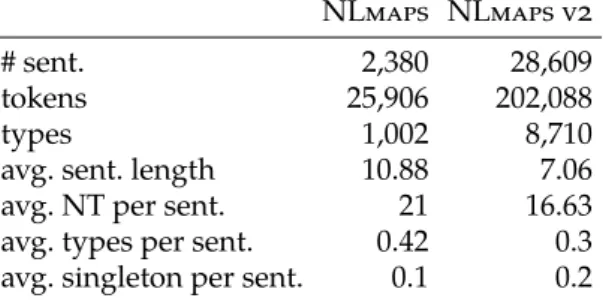
3.4 Corpus Extension: NLmaps v2 . . . 39
3.4.1 Search Engine Style Extension . . . 40
3.4.2 Automatic Extension . . . 40
4 Semantic Parsers 45
4.1 Linear Model: Phrase-Based Machine Translation . . . 47
4.1.1 Modifications for Semantic Parsing . . . 48
4.1.2 Empirical Results . . . 49
4.2 Extensions for a Web Interface . . . 50
4.2.1 Additional Components . . . 50
4.2.2 Empirical Results . . . 53
4.2.3 Feedback Form . . . 55
4.3 Neural Model: Sequence-to-Sequence Learning . . . 56
4.3.1 Empirical Results . . . 56
4.3.2 Error Analysis . . . 58
4.3.3 Empirical Validation of the Automatic Corpus Extension . . . 60
II.
Response-Based On-Policy Learning
63
5 Multilingual Question-Answering: Grounding Machine Translation in Task Feedback 65 5.1 Objectives . . . 685.1.1 Ramp . . . 71
5.1.2 Response-based Online Learning (Rebol) . . . 73
5.2 Empirical Results . . . 74
5.2.1 Error Analysis . . . 77
6 Question-Answering: Grounding Semantic Parsing in Answer Feedback 81 6.1 Objectives . . . 84
6.1.1 Minimum Risk Training (MRT). . . 84
6.1.2 Sequence-Level Ramp Loss . . . 84
6.1.3 Token-Level Ramp Loss . . . 87
6.2 Empirical Results . . . 87
6.2.1 Error Analysis . . . 91
III.
Counterfactual Off-Policy Learning
95
7 Machine Translation: Learning from Deterministic Logs with Bandit Feedback 97 7.1 Counterfactual Estimators . . . 1017.1.1 Inverse Propensity Scoring (IPS) . . . .102
7.1.2 Deterministic Propensity Matching (DPM) . . . .103
7.1.3 Multiplicative Control Variate: Reweighting . . . .103
7.1.4 Additive Control Variate:Direct Method (DM)Predictor . . . .104
7.2 Degeneracy Analysis . . . 108
7.2.1 IPS&DPM . . . .108
7.2.2 Reweighted Estimators . . . .110
7.3 Empirical Results . . . 112
7.3.1 Direct Method (DM)Predictor . . . .113
Table of Contents
7.3.3 Policy Learning . . . .115
7.3.4 Implicit Exploration . . . .117
8 Question-Answering: Learning from Human Bandit Feedback 121 8.1 Counterfactual Estimator Extensions . . . 124
8.1.1 One-Step-Late (OSL)Reweighting . . . .125
8.1.2 Incorporating Token-Level Feedback . . . .126
8.2 Collecting Human Feedback . . . 128
8.3 Empirical Results . . . 129
8.3.1 Learning from Human Feedback . . . .130
8.3.2 Learning from Large-Scale Simulated Feedback . . . .132
8.3.3 Error Analysis . . . .133
8.3.4 Comparison to Naive Reweighting . . . .134
8.3.5 Varying theOSLUpdate Frequency . . . .134
8.3.6 Comparison: Response-Based On-Policy & Counterfactual Off-Policy Learning . . . 135
Thesis Conclusion 139
Bibliography 143
Acknowledgments 155
Appendix
157
A Context Free Grammar of NLmaps 159
B Detailed Gradient Derivations 161
List of Figures
1.1 General setup of experiments conducted in this thesis. . . 2
2.1 Schematic view of reinforcement learning. . . 13
2.2 Visualisation of alignment weights between an English sentence and a French translation. Taken fromBahdanau et al.(2015), Part (a) of Figure 3. . . 21
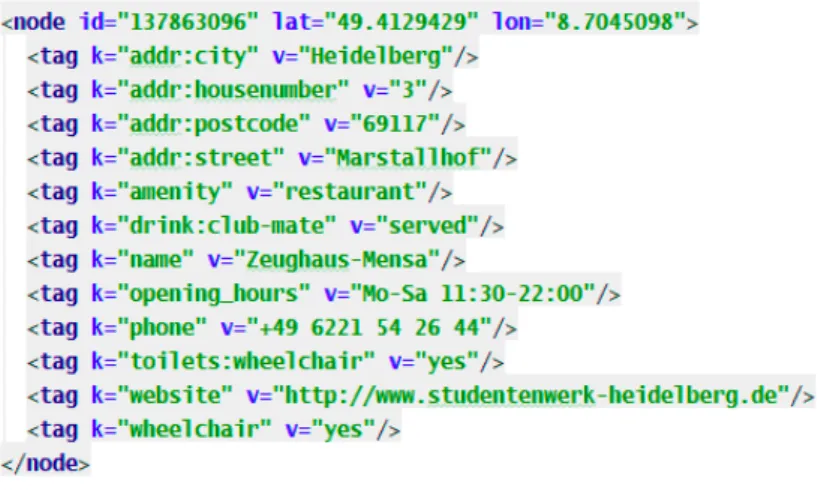
3.1 First database entry returned for the Overpass query from Listing3.2inXML format. . . 32
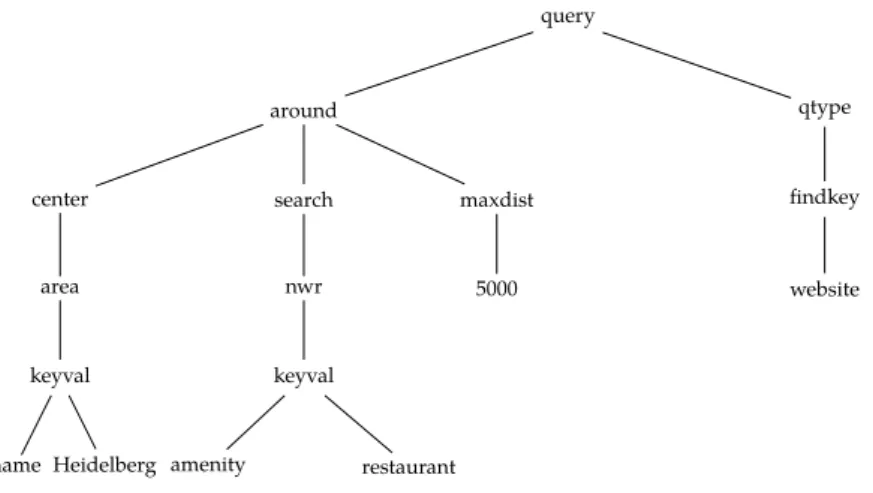
3.2 Example of a NLmaps parse represented as a tree. . . 36
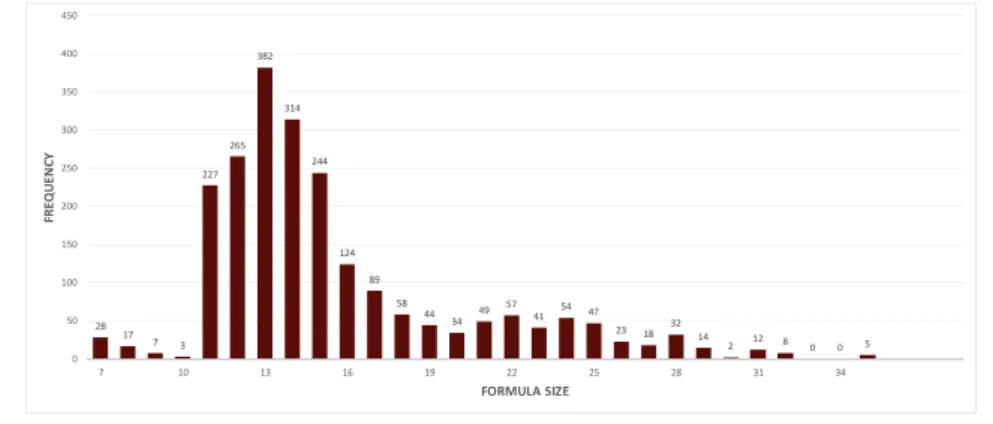
3.3 Histogram of the lengths of correct parses in the NLmaps corpus. . . 39
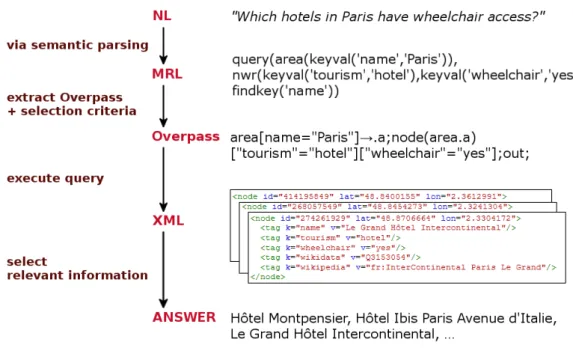
4.1 Pipeline for mapping a natural language question to an answer. . . 46
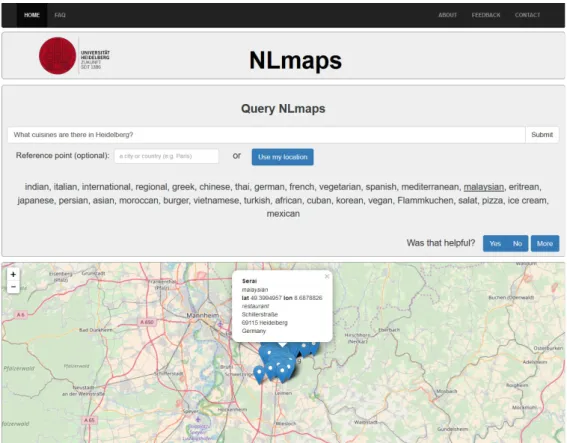
4.2 A screenshot of the NLmaps web interface. . . 52
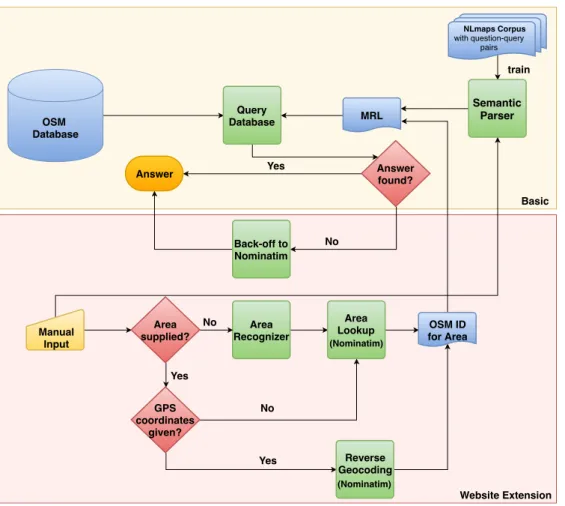
4.3 Program flow after the user entered a question in the input field for the nat-ural language interface toOSM. . . 53
4.4 A screenshot of the feedback form a user can fill in once a question has been processed and an answer presented. . . 55
4.5 Flowchart of the approach to handle named entities separately from the se-mantic parsing task. . . 57
5.1 Using extrinsic feedback from the downstream task to improve a machine translation system for a multilingualQuestion-Answering (QA)pipeline. . . 66
5.2 F1 performance on the test set after each epoch for various response-based on-policy objectives. . . 75
5.3 BLEU performance on the test set after each epoch for various response-based on-policy objectives. . . 76
6.1 Setup for training a semantic parser where gold answers are available but gold parses are missing. . . 82
6.2 F1 performance on the test set at the validation points for various response-based on-policy objectives. . . 90
7.1 Graphical view of on-policy learning. . . 98
7.2 Graphical view of off-policy learning. . . 98
7.4 Reweighted Inverse Propensity Scoring (IPS+R)estimates for a small toy log. 109 7.3 Inverse Propensity Scoring (IPS)estimates for a small toy log. . . 109
7.5 BLEU performance on the TED corpus test set after every iteration for various counterfactual objectives. . . .117 7.6 BLEU performance on the News corpus test set after every iteration for
vari-ous counterfactual objectives. . . .118 8.1 Google Translate interface for editing a translation which is “used to improve
the translation quality”, Screenshot taken on 1st September 2018. . . .122 8.2 Graphical overview of two semantic parsing setups, once with gold answers
available and once without. . . .123 8.3 The user interface for collecting feedback from humans with an example
question and a correctly filled out form. . . .129 8.4 Human Feedback: F1 performance on the test set at the validation points for
various counterfactual off-policy objectives. . . .131 8.5 Large-Scale Simulated Feedback: F1 performance on the test set at the
valid-ation points for various counterfactual off-policy objectives. . . .133 8.6 Decision tree to guide whether to employ response-based on-policy learning
or counterfactual off-policy learning for a given statistical model that is to be improved. . . .141
List of Tables
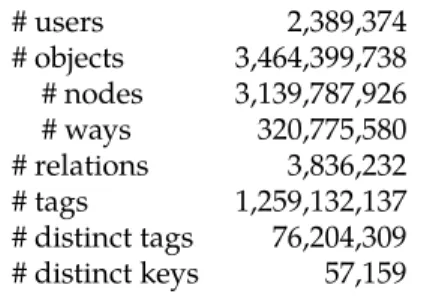
3.1 Statistics of theOSMdatabase as of December 14th, 2015. . . 28 3.2 Corpus statistics of the question-answering corpora NLmaps, Geoquery and
Free917. . . 38 3.3 All entries in the Nominatim list for a specific tag. . . 41 3.4 Corpus statistics of the question-answering corpora NLmaps and NLmaps v2. 43 4.1 F1 scores on the NLmaps test set for various linear semantic parser settings. . 50 4.2 F1 scores on the NLmaps and SE test sets for various web interface extensions. 54 4.3 F1 scores on the NLmaps v2 test set for various linear and neural semantic
parser settings. . . 58 4.4 Error analysis of the NLmaps v2 parsing models. . . 59 4.5 Error analysis of the NLmaps v2 parsing models with regards to the question
type. . . 59 4.6 F1 scores on the NLmaps and NLmaps v2 test sets for neural parsers trained on
NLmaps and NLmaps v2 training sets, respectively, to validate the automatic corpus extension. . . 60 5.1 F1 scores on the NLmaps v2 test set for various response-based on-policy
ob-jectives. . . 75 5.2 Error analysis of the different translation models and the error the semantic
parsing model makes on translated questions. . . 76 5.3 Example translations produced by baseline andRampwhere the former
re-ceives negative feedback and the latter positive, along with the original Eng-lish question. . . 78 5.4 Example translations produced byRampionandRebolwhere the former
re-ceives negative feedback and the latter positive, along with the original Eng-lish question. . . 79 6.1 Formulation of three ramp loss objectives for semantic parsing. . . 85 6.2 F1 scores on the NLmaps v2 test set for various response-based on-policy
ob-jectives. . . 88 6.3 F1 scores on the NLmaps v2 test set for further response-based on-policy
ob-jectives. . . 89 6.4 Error analysis of the baseline and the various response-based on-policy
ob-jectives. . . 90 7.1 Gradients of various counterfactual estimators. . . 107
7.2 Number of sentences for in-domain data splits of the train, development, and test data. . . .113 7.3 5-fold cross validation: Macro and micro difference for deterministic and
stoch-astic logging for a random forest regression model as theDMpredictor. . . .114 7.4 Policy Evaluation: Macro averaged difference between estimated and ground
truth BLEU on 10k stochastically logged data. . . .115 7.5 Policy Learning: BLEU increases over the out-of-domain baseline on dev and
test sets for various counterfactual objectives. . . .116 8.1 Gradients of various counterfactual estimators. . . 127 8.2 All possible statements types, which are used to transform a parse into a
human-understandable block of statements. . . .127 8.3 Human Feedback: F1 scores on the NLmaps v2 test set for various
counterfac-tual off-policy objectives. . . .131 8.4 Large-Scale Simulated Feedback: F1 scores on the NLmaps v2 test set for
vari-ous counterfactual off-policy objectives. . . .132 8.5 Error analysis of the baseline and theDPM+T+OSLmodels obtained using
counterfactual learning from both human and large-scale simulated feedback.133 8.6 Large-Scale Simulated Feedback: F1 scores on the NLmaps v2 test set for the
comparison betweenDPM+R,DPMandDPM+OSL. . . .134 8.7 Large-Scale Simulated Feedback: F1 scores on the NLmaps v2 test set using
varyingOSLupdate frequencies. . . .135 8.8 Comparison: F1 scores on the NLmaps v2 test set for the best response-based
on-policy learning objective and the best counterfactual off-policy learning objective. . . .136
List of Algorithms
1 Rampionalgorithm. . . 71
2 Rampalgorithm. . . 72
3 Rebolalgorithm. . . 73
4 Minimum Risk Training (MRT)algorithm. . . 85
5 Rampalgorithm with mini-batches. . . 86
6 Collecting stochastic logs. . . 99
7 Collecting deterministic logs. . . .100
8 Batch off-policy learning from logs. . . .102
9 Minibatch off-policy learning from logs withOne-Step-Late (OSL) reweight-ing. . . .126
List of Abbreviations
B2S Bandit-to-Supervised. ˆ cDC ˆcDoubly Controlled. ˆ cDR ˆcDoubly Robust. CFG Context-Free Grammar. CGI Common Gateway Interface. CSS Cascading Style Sheets. DC Doubly Controlled. DM Direct Method.DPM Deterministic Propensity Matching.
DPM+OSL One-Step-Late Reweighted Deterministic Propensity Matching. DPM+R Reweighted Deterministic Propensity Matching.
DPM+T Token-level Deterministic Propensity Matching.
DPM+T+OSL Token-Level One-Step-Late Reweighted Deterministic Propensity Matching. DR Doubly Robust.
EM Expectation-Maximisation. GRU Gated Recurrent Unit.
HTML Hypertext Markup Language. IPS Inverse Propensity Scoring.
IPS+R Inverse Propensity Scoring with Reweighting. JSON JavaScript Object Notation.
LSTM Long Short-Term Memory. MLE Maximum Likelihood Estimation. MRL Machine Readable Language.
MRT Minimum Risk Training.
MRT+neg Minimum Risk Training with negative rewards. NER Named Entity Recognition.
NLP Natural Language Processing. OSL One-Step-Late.
OSM OpenStreetMap. QA Question-Answering.
Ramp Ramp loss withy+andy−set according to an external metric.
Ramp+T Token-level Ramp loss withy+andy−set according to an external metric.
Ramp1 Ramp loss withy+= ˆyandy−set according to an external metric.
Ramp2 Ramp loss withy− = ˆyandy+set according to an external metric.
Rampion Rampion as defined byGimpel and Smith(2012). Rebol Response-based Online Learning.
RNN Recurrent Neural Network.
SCFG Synchronous Context-Free Grammar. SMT Statistical Machine Translation. XML Extensible Markup Language.
Chapter 1
Introduction
M
any applications nowadays are built upon machine-learnt statistical models which, given an input, produce an output that is presented to a user. For example, virtual personal assistants have been on the rise to help an increas-ing number of people with an increasincreas-ing number of everyday tasks, such as placing an order for a product online, navigating a music playlist or question-answering on various topics. The underlying statistical models are typically trained using fully supervised data where inputs are paired with corresponding gold targets, i.e. labelled data is available for direct supervision. However, the creation of such labelled data is often costly and time-consuming and thus it is fruitful to explore alternative learning methods. One option is to learn from weaker supervision signals instead, such as from feedback obtained for model outputs. This reduces the need for expensive gold targets. Additionally, there are often al-ternative outputs that are as good as the annotated gold target, but are never discovered if a model relies only on learning from annotated gold targets. Finally, learning from feed-back also enables models to continue improving over time and it is possible to personalise a model to specific user needs.Given model outputs and corresponding extrinsic feedback, we investigate how to improve sequence-to-sequence models inNatural Language Processing (NLP)tasks. This setup is visualised in Figure1.1. Given a pre-trained model, we explore two distinct approaches that leverage feedback given to model outputs to further improve a model. The two approaches are applied to two different tasks, machine translation and semantic parsing for question answering, and to two different model types, linear and non-linear. For both approaches we have a concrete application in mind. This application is the creation of a natural language in-terface to the geographical databaseOpenStreetMap (OSM). With two approaches to learn from feedback and one application, this thesis is comprised of three parts that we elaborate on in the following.
Input Pretrained Model World Ground Learn from Feedback Output
Figure 1.1.: General setup of experiments conducted in this thesis.
1.1. A Natural Language Interface to
OpenStreetMap
(OSM)
We introduce and define the task of building a natural language interface to OpenStreet-Map (OSM), which is a geographical database populated by volunteers with GPS coordin-ates and relevant facts about points of interests all over the world. The basis of the inter-face will be a semantic parser that maps natural language questions to parses that can be executed against theOSMdatabase. To achieve this goal, we first define an appropriate Ma-chine Readable Language (MRL)that can express natural language questions as semantic parses. Based on this, we create aQuestion-Answering (QA)corpus, named NLmaps, which consists of question-parse pairs. Corresponding answers can be obtained by executing the parses against theOSMdatabase. To the best of our knowledge, this constitutes the first publicly available corpus for semantic parsing in theOSMdomain. We compare both cor-pora to two similar question-parse corcor-pora, namely Geoquery (Wong and Mooney,2006) and Free917 (Cai and Yates,2013). Two extensions to the corpus lead to a larger corpus, referred to as NLmaps v2, which totals 28,609 question-parse pairs.
Using both versions of the NLmaps corpus, several semantic parsing models are built in a supervised manner which serve as baselines for various tasks throughout the thesis. We em-ploy two different frameworks for the different semantic parsing models. The first is Cdec (Dyer et al.,2010), a hierarchical phrase-basedStatistical Machine Translation (SMT) frame-work, which is modified to be suitable for semantic parsing. The second is a sequence-to-sequence framework based onRecurrent Neural Networks (RNNs), called Nematus (Sen-nrich et al.,2017).
Furthermore, we describe a specifically tailored graphical web interface that users can access online to pose natural language questions to theOSMdatabase. For this, we introduce a few modifications to the baseline models which aim to offer additional conveniences to users of the interface. This constitutes the application-oriented contribution of this thesis. In the following we turn to the two distinct approaches for learning from feedback to improve statistical models for sequence-to-sequence tasks inNLP.
1.2. Response-Based On-Policy Learning
1.2. Response-Based On-Policy Learning
The first approach that we explore isresponse-based on-policy learning. In some
situ-ations, it is more beneficial to learn from an indirect supervision signal rather than using directly supervised data. In grounded learning a system learns by viewing its outputs as actions in a downstream task and outputs are considered successful if they lead to correct task feedback. For response-based on-policy learning, we ground a model in a downstream task for which labelled data has been collected.
Grounded learning has several advantages over supervised learning. First, the indirect su-pervision signal might be easier or cheaper to obtain than directly supervised data. Second, it allows the model to search for suitable outputs within the its own output space. Third, it can alleviate the need for expensive gold targets because it is possible to find multiple, alternative outputs that lead to positive task feedback. Learning from multiple positive out-puts rather than the single gold target, can lead to a more robust system. Fourth, for some underlying models, it might not be possible to produce the annotated gold target. Response-based on-policy learning can instead identify a possible alternative that is close to the gold target, but can be produced by the system, and this alternative can serve as a pseudo-gold target.
We apply response-based on-policy learning to two different tasks. In the first task, we aim to tune a machine translation system in a multilingual semantic parsing pipeline for question-answering. A machine translation system is given a question in a source language and translates this question into a target language. We assume a semantic parser exists for this target language and it can map questions in the target language to a semantic parse. The parse can then be executed against a database to obtain an answer. The machine translation system is grounded in this final task of obtaining the correct answer given a question in the source language. With this grounding, the machine translation system learns to work better in conjunction with the semantic parser and this raises the overall final task performance. Concretely, we assume that the machine translation system is given questions in German from the NLmaps corpus and translates these questions into English. The English question is then handed to a semantic parser and the resulting parse is executed against theOSM database.
For this response-based learning scenario on multilingual semantic parsing, we introduce two algorithms. Both algorithms employ a ramp loss objective (Collobert et al.,2006) that identifies a hope translation, which we want to encourage, and a fear translation, which we want to discourage. For both algorithms, we require the existence of the gold answer to ob-tain feedback. This is advantageous because with an available gold answer, feedback can be obtained for arbitrarily many model outputs. The first response-based algorithm, called Ramp, solely utilises binary feedback obtained at the answer level. The second algorithm, Rebol, additionally leverages feedback derived from comparing the output of the machine translation system to a correct reference translation.ReboloutperformsRamp, but requires the existence of two gold structures, namely the gold answer and a gold reference trans-lation, which might be too expensive to obtain in praxis. The algorithms are inspired by Gimpel and Smith(2012), who use similar ramp loss objectives to tune a machine transla-tion system on the basis of available gold references, but they do not ground their system
in a final task. Executing a parse and obtaining feedback by comparing it to the gold result, is inspired byGoldwasser and Roth(2013), who used such a signal to improve a semantic parser.
In a second task, we directly improve a semantic parser based on the NLmaps v2 corpus and with an underlying neural network. We assume that an initial parser was trained using a small amount of supervised question-parse pairs as training data. Further data is only available in the form of question-answer pairs and the model is guided by comparing the answers obtained for model outputs to the gold answers. This is a prominent research topic in the semantic parsing community in recent years (Clarke et al.(2010);Berant et al.(2013); Pasupat and Liang(2015);Rajpurkar et al.(2016);inter alia) because for many domains it is significantly easier to obtain gold answers rather than gold parses. For neural semantic parsing from question-answer pairs, the use ofMRT(Liang et al.,2017;Guu et al.,2017), objectives inspired by the REINFORCE algorithm (Liang et al.,2017;Mou et al.,2017;Guu et al.,2017) or objectives based on classical structured prediction (Iyyer et al.,2017;Misra et al.,2018) have been explored.
We lift several ramp loss objectives (Gimpel and Smith,2012) to neural network models and compare them toMRT. In experiments we can show that it is crucial to carefully identify a hope parse and a fear parse which are encouraged and discourage, respectively. Addition-ally, we analyse why the best ramp loss objective,Ramp, outperforms the MRTobjective. Furthermore, we introduce a novel ramp loss objective,Ramp+T, that operates at the token level. It can outperform its sequence-level counterpartRampby more effectively contrasting tokens of the hope and fear parses against each other.
For both tasks, response-based on-policy learning requires the existence of at least one gold target for each input, albeit the weakly supervised gold targets of the downstream task might be cheaper to obtain than directly supervised gold targets. In the second approach to learn from feedback, we investigate how we can learn without any expensive gold targets by leveraging feedback collected for model outputs from user-system interactions instead.
Overview: Response-based On-Policy Learning
In the following we provide an overview of the novelties that our application of response-based on-policy learning introduces in this thesis and the advantages and disadvantages this approach offers.
Novelties
• Models are grounded in a downstream task. First, we ground a machine translation system in a semantic parser for a multilingual semantic parsing pipeline. Second, we improve a semantic parser using question-answer pairs rather than question-parse pairs.
• Ramp loss objectives are applied to non-linear neural networks. • Introduction of a token-level ramp loss objective.
1.3. Counterfactual Off-Policy Learning
Advantages
• It is possible to obtain feedback for arbitrarily many output structures.
• The approach allows us to find alternative outputs with positive task feedback, rather than only learning from one annotated gold target.
• For log-linear models, the gold target might not be reachable and this approach allows us to identify and promote an alternative pseudo-gold target.
• The need for expensive gold targets is alleviated because for some tasks it is easier to obtain a downstream task’s gold target than a gold target for direct supervision. This is for example the case in semantic parsing for question answering, where in certain domains gold answers are easier to obtain than gold parses.
Disadvantages
• Although the gold target might be easier to obtain for a downstream task, this ap-proach still requires at least one gold target per input.
• The approach is potentially slow because for each input several outputs have to be scored by the feedback function, which might be time consuming.
1.3. Counterfactual Off-Policy Learning
The second approach to learn from feedback iscounterfactual off-policy learning.
De-ployed applications can easily and cheaply collect logs of user-system interactions in large quantities. For such a log, we record the user input, the output of the application’s underly-ing statistical model and feedback for the presented output, which is elicited either explicitly or implicitly from the user. Learning from such a log is an interesting endeavour because the log collection does not incur any cost and the approach does not require the existence of expensive gold targets.
The log can be used to improve the logging model or any other model. Because the data in the collected log was not produced by the to-be-improved model, this leads to an off-policy learning setup (Sutton and Barto(2018), Section 13.3).1Such a more complex learning
scen-ario could be avoided by improving the logging model while deployed, but we opt against this course of action for several reasons. In such an approach, the model would be updated after every interaction, but this can be both dangerous and expensive. A model that evolves while deployed could degenerate without notice and this would lead to user dissatisfaction and monetary loss. Further, it could be very expensive or impossible to explore various hy-perparameters of the model while it is deployed, but this is easily possible for off-policy methods. Additionally, off-policy learning is safer because models can be validated on sep-arate test sets before deployment which prevents fielding potentially degenerate models. 1Note that even if we choose to improve the logging model, once a single update has been made to its parameters,
Due to the these advantages, we focus on off-policy learning from a previously collected log.
Off-policy learning from a collected log of user-system interactions is a complex learning scenario for several reasons. First, feedback exists only for the one output shown to the user. This is a bandit learning scenario, because it remains unknown what feedback would have been obtained if another output was chosen, i.e. other outputs cannot be judged. Second, the collected log is biased towards the choices of the deployed logging model. This leads to the following counterfactual question:How would the target model have performed if it had been in control during logging?Counterfactual estimators (Bottou et al.(2013);Swaminathan and Joachims(2015a);Thomas and Brunskill(2016);Dudik et al.(2011);inter alia) have been developed that attempt to answer this question by explicitly correcting the data bias. Further problems arise during the application of these estimators and these are outlined below.
Previously introduced counterfactual estimators have so far only been applied to structured prediction problems with modestly sized output spaces, but sequence-to-sequence NLP tasks typically have very large output spaces. We apply counterfactual learning to twoNLP tasks, namely machine translation and semantic parsing for question-answering, to show that it is possible to employ counterfactual estimators on tasks with large output spaces. Furthermore, theory suggests that the logging model needs to explore the output space sufficiently to correct the data bias, e.g. by sampling outputs from the model distribution. But such a setup is dangerous in commercialNLPapplications because sampling from the model distribution carries a high risk of presenting bad outputs to the user, which can lead to a monetary loss. Consequently, in commercial applications the user is always presented with the most likely output under the logging model. As a result the logging is deterministic and it is no longer possible to correct the data bias.
We present a simple estimator based on empirical risk minimisation for deterministic log-ging. This estimator is extended twice by using control variates which correct deficiencies in the previous estimators and reduce variance. To show that deterministic logging if feas-ible for sequence-to-sequence learning inNLP, we compare the deterministic estimators to stochastic counterparts. This is done on a domain adaptation task for machine translation where we simulate feedback to be able to draw direct comparisons between deterministic and stochastic estimators. The experiments show no significant difference between the best deterministic and the best stochastic estimators and we provide a possible explanation why deterministic logging is admissible for sequence-to-sequence learning inNLP. Furthermore, we also present mathematical proofs and intuitive explanations of the deficiencies in two counterfactual estimators for both their deterministic and stochastic instantiations.
On a semantic parsing task based on the NLmaps v2 corpus, we show that counterfactual learning is also applicable if the underlying model is a non-linear neural network. State-of-the-art neural networks for sequence-to-sequence learning are trained using stochastic gradient ascent2 with small minibatches. However, one important extension of the basic
2Because we formulate our counterfactual estimators asrewardestimators, we employ the term gradient ascent,
rather than gradient descent. By negating the rewards, we would recover equivalentriskestimators with which gradient descent could be performed.
1.3. Counterfactual Off-Policy Learning
counterfactual estimator relies on the use of large minibatches, which is not possible for neural networks due to hardware limitations. We offer an alternative estimator that pre-serves all important properties and can be applied to stochastic gradient ascent with small minibatches. Furthermore, we introduce a counterfactual estimator that can incorporate feedback at the token level. This enables blame assignment within a sequence and facilitates better learning.
Finally, it is necessary to show that counterfactual learning for sequence-to-sequence tasks is possible if the feedback in the log is collected from actual human users. Using our semantic parsing task based on the NLmaps v2 corpus, we set up a corresponding feedback collection form. Given a question, the semantic parser produces a parse, which is executed against a database to retrieve an answer and this answer is then shown to the user. However, in most cases, it will be impossible for the user to judge whether or not the given answer is correct or not. For example, for the question “How many hotels are there in Paris?”, we cannot expect a user to verify that “951” is the correct answer. Similarly, we cannot ask the user to verify a semantic parse because the underlyingMRLwill be unknown to everyday users. Instead, we propose to automatically convert the parse into a set of human-understandable statements that can be judged as correct or incorrect by non-expert users.
For this proposed feedback collection method, we recruit 9 human users and we can show that the collection method is very efficient with the majority of the feedback forms being filled out in 10 seconds or less. With this feedback, we can show that counterfactual learning is possible if feedback is collected from human users. Additionally, our proposed feedback collection method naturally allows us to obtain feedback at the token-level, which enables us to use superior token-level counterfactual estimators.
By employing the same semantic parsing tasks based on the NLmaps v2 corpus for both response-based on-policy and counterfactual off-policy learning, we can conclude by draw-ing a direct comparison between both approaches of learndraw-ing from feedback.
Overview: Counterfactual Off-Policy Learning
In the following we provide an overview of the novelties that our application of counterfac-tual off-policy learning introduces in this thesis and the advantages and disadvantages this approach offers.
Novelty
• First application of counterfactual learning to problems with large output spaces, namely to two sequence-to-sequence tasks inNLP: machine translation and semantic parsing for question-answering.
• Insight that deterministic logging is on par with stochastic logging for sequence-to-sequence tasks inNLP.
• Introduction of counterfactual estimators that can incorporate token-level feedback. • Modification of a counterfactual estimator to be suitable for stochastic minibatch
gradi-ent ascgradi-ent.
Advantages
• The approach is built upon theoretically well-understood policy gradient methods (see for example (Sutton and Barto,2018), Chapter 13).
• Gold targets are not required.
• Off-policy learning is safer, more hyperparameters can be explored and models can be validated against separate test sets before deployment.
Disadvantages
• Feedback is only available for one output structure; feedback for other output struc-tures cannot be obtained.
• Collected logs are biased towards the logging model, which complicates learning. • Simple counterfactual estimators suffer from degeneracies and high variance which
need to be countered with more sophisticated estimators.
1.4. Summary of Contributions
The contributions of this thesis can be grouped into three distinct categories and can be summarised as follows:
Semantic Parsing for Question-Answering
• A QA corpus, NLmaps, consisting of 2,380 question-parse pairs (Haas and Riezler, 2016) and an extension, NLmaps v2, with 28,609 question-parse pairs (Lawrence and Riezler,2018).
• A natural language web interface toOpenStreetMap (OSM)(Lawrence and Riezler, 2016).
• A method to automatically convert parses into a set of statements which can be easily and efficiently judged by human users as correct or incorrect (Lawrence and Riezler, 2018).
1.5. Structure
Grounded Learning
• Successful grounding of a machine translation system in its downstream task for a multilingual semantic parsing pipeline (Haas and Riezler,2016).
• Application of ramp loss objectives to non-linear neural networks, detailed evaluation and comparison toMRTobjectives for semantic parsing (Jehl et al.,2019).
• Introduction of a token-level ramp loss objective (Jehl et al.,2019).
Off-policy Reinforcement Learning
• Definition of deterministic counterfactual estimators:Deterministic Propensity Ma-tching (DPM),Reweighted Deterministic Propensity Matching (DPM+R), Doubly Controlled (DC)andˆcDoubly Controlled (ˆcDC)(Lawrence et al.,2017b).
• Empirical evidence and intuitive explanation that deterministic logging for counter-factual learning provides sufficient exploration on sequence-to-sequence tasks inNLP (Lawrence et al.,2017b;Lawrence and Riezler,2018).
• Empirical evidence that counterfactual learning can be applied to problems with large output spaces (Lawrence et al.,2017b;Lawrence and Riezler,2018).
• Empirical evidence that counterfactual learning can be applied to non-linear neural network models (Lawrence and Riezler,2018).
• Mathematical proofs and intuitive explanations of potential degeneracies in the coun-terfactual estimators:Inverse Propensity Scoring (IPS),Deterministic Propensity Ma-tching (DPM),Reweighted Inverse Propensity Scoring (IPS+R)andReweighted De-terministic Propensity Matching (DPM+R)(Lawrence et al.,2017a).
• Definition of the estimatorOne-Step-Late Reweighted Deterministic Propensity Ma-tching (DPM+OSL), which modifies theReweighted Deterministic Propensity Ma-tching (DPM+R)estimator to be applicable for stochastic (minibatch) gradient ascent (Lawrence and Riezler,2018).
• Definition of the counterfactual estimatorToken-level Deterministic Propensity Ma-tching (DPM+T), which allows rewards to be decomposed over the tokens of the out-put sequence (Lawrence and Riezler,2018).
1.5. Structure
This thesis is a cumulative effort. Consequently significant parts of this thesis have been previously published in peer-reviewed publications, co-authored with my supervisor and colleagues. Additionally some sections have previously appeared in my Master’s thesis. The papers are referenced in the introduction of the corresponding chapters of this thesis and work not done by my person is clearly marked.
Relevant background knowledge as well as notation used throughout this thesis is presen-ted in Chapter2. PartIpresents the question-answering task defined on the geographical database OpenStreetMap (OSM). Chapter 3 details the construction of the QA corpora NLmaps and NLmaps v2, both of which are used in subsequent chapters to demonstrate the effectiveness of various algorithms. Two semantic parsing frameworks and their exten-sions tailored for the NLmaps domain are introduced in Chapter4. The chapter also presents the graphical user interface constructed for the natural language interface toOSM, which connects to a semantic parser in the background.
The first approach to learn from feedback, response-based on-policy learning, is presented in PartII. It considers scenarios where models are grounded in a downstream task for which gold targets are available and which can provide a weak supervision signal. The approach is applied to two different model types, linear and non-linear, and to two different tasks. In Chapter5, we build a multilingual semantic parser by employing a machine translation sys-tem and a semantic parser in a pipeline setup. The machine translation syssys-tem is grounded in the semantic parsing task and is improved by leveraging final task feedback provided on the basis of gold answers. In a similar scenario, we assume that only gold answers but no gold parses are available to improve a semantic parser in Chapter6.
The second approach to learn from feedback, counterfactual off-policy learning, is presented in PartIII. It assumes that neither immediate gold targets are available, nor is it possible to ground the system in a task with available gold targets. Instead, we assume that a system has been deployed and users interacting with the system provide feedback for the one model output presented to the user. As with the previous approach, this approach is also applied to two different model types, linear and non-linear, and to two different tasks. In Chapter7we improve a machine translation system in this setup using both deterministic and stochastic logs which are created with simulated feedback. Chapter8presents an approach to improve a semantic parser by leveraging feedback provided by real human users. We conclude by drawing a direct comparison between the two approaches based on identical experimental setups in Chapter6and Chapter8.
Chapter 2
Background
S
emantic parsers and machine translation systems are the focus in this thesis. Both are sequence-to-sequence tasks and can be cast as structured prediction problems. Here we briefly introduce relevant terminology and background information. Sec-tion 2.1introduces general notation and a basic overview of the task of struc-tured prediction. An overview of phrase-basedSMTis given in Section2.3and an overview of recurrent neural networks for sequence-to-sequence learning in Section2.4. Section2.2 provides an overview of relevant reinforcement learning concepts.2.1. Structured Prediction
For the scope of this thesis, we are interested in the task of structured prediction conditioned on some input. Given an input sequencex=x1, x2, . . . x|x|∈ X, we assume the existence of a parametric modelπw(y|x)with parameters wthat defines a conditional probability distribution over all possible output sequencesy ∈Y(x), whereXandY(x)are the set of
all possible input and output values, respectively. The most likely output sequence under πw(y|x)is defined as
ˆ
y= arg max
y∈Y(x)
πw(y|x). (2.1)
The goal of a machine learning algorithm is to find a set of optimal parametersw, so that, given an inputx,πw(y|x)assigns the highest probability to the correct gold target sequence ¯
y= ¯y1,y¯2, . . .y¯|y|.¯
For an inputxand corresponding gold targety¯, we can define a loss functionL(ˆy,y¯))which
registers a penalty ifyˆ6= ¯y. Assuming a probability distributionp(x, y)that mapsX×Yto
the interval[0,1], the expected risk is defined as
Lexpected= Z x Z y L(ˆy,y¯))p(x, y)dxdy=E(x,y)∼p(x,y)[L(ˆy,y¯)]. (2.2)
Asp(x, y)is generally unknown, this distribution needs to be approximated. This can be
done using a training set of sizenthat is independent and identically distributed (i.i.d.) with a probability distributionp˜(x, y)and for each inputxta corresponding gold targetyt¯
has been collected. Thus the expected risk is approximated using the empirical risk,
Lempirical= 1 n n X t=1 L(ˆy,y¯t). (2.3)
The empirical risk will approach the expected risk asn→ ∞.
To improve a model, we can performempirical risk minimisation. Concretely, in this thesis
we modify the parameterswusing gradient descent. The parameters ofware adjusted by moving in the negative direction of the gradient that results from the differentiation of the loss function with regards tow. Thus for each input-output pair (x,y¯),w is updated as follows:
∆w=−η∇L(ˆy,y¯), (2.4) whereηis a learning rate to be set separately.
If we want to employ rewards rather than losses, we can define a reward function instead:
V(ˆy,y¯)) =−L(ˆy,y¯). (2.5) We then use the term gradient ascent instead, with the corresponding update defined as:
∆w=η∇V(ˆy,y¯). (2.6)
Instead of updating after each seen input-output pair(x, y), we can also operate in a batch
setup where we iterate over the entire training set of sizenand average the loss before per-forming an update. Batch algorithms more closely approximate the expected risk, however it can be expensive to compute because it requires an iteration over the whole training set before an update is performed. Alternatively, we utilise minibatches of sizem < n. While minibatches are less accurate due tom < n, it offers a trade-off between the two extremes. Repeatedly updatingwon the basis of the training set leads to the danger of overfitting to the training set, which results in bad performance on new, previously unseen data. To prevent this from occurring, we employ development sets. We periodically evaluate the performance on the development set and chose the set of parameterswwhere the performance on the development set is highest. The resulting modelπw(y|x)is then deployed on a test set and the resulting performance is used to judge the success ofπw(y|x).
We speak of full or direct supervision if data is available that pairs inputsxwith gold targets
¯
yfor the task. In the case of machine translation, an input sentence in a source language is paired with a reference translation in the target language. For semantic parsing, input ques-tions are paired with a correct parse that by definition executes to the correct answer. We
2.2. Reinforcement Learning
Agent Environment
Action Reward
Figure 2.1.: Schematic view of reinforcement learning.
speak of weak supervision if gold targets are not available and instead feedback to model outputsy are used as a learning signal. This is elaborated on further in the following sec-tion.
2.2. Reinforcement Learning
PartsIIandIIIof this thesis employ ideas from reinforcement learning. Here we present relevant concepts and terminology. For more details see (Sutton and Barto,2018), which serves as a basis for this short overview.
In fully supervised learning we are given a training set where inputsxare associated with gold targetsy¯. As described in Section2.1, if a system’s most likely outputyˆdoes not equal
the gold targety¯, we can measure a lossL(ˆy,y¯)and update the underlying parametric model
accordingly. In reinforcement learning, gold targetsy¯are not available. However, we assume
there is an environment or world, to which we can give a chosen model outputy, also called the action in reinforcement learning terms, and the world returns a rewardδ(y)or,
equival-ently, a loss∆(y) =−δ(y).3The environment is otherwise unknown to us and is treated as
a black box. The goal of reinforcement learning is to improve an agent so that the expected reward on a given task is maximised. See Figure2.1for a graphical overview.
We assume that the agent is fully specified by a parametric policyπw(y|x)that defines a
con-ditional probability distribution over all possible outputsy∈Y(x)for a givenx∈X.
Out-puts fromπw(y|x)can be generated either stochastically or deterministically. Astochastic policydraws samples from the output space, e.g. by sampling from the model distribution
πw(y|x). Adeterministic policyon the other hand always returns the same output given
the same input. The most straightforward option is to compute the most likely output under the current model, i.e.arg maxy∈Y(x)πw(y|x).
Given an output, we assume that the environment can return a reward for this output. If the environment can evaluate only one output per input and thus only return one reward, we 3Note that we use the terms loss and reward interchangeably in this thesis, whereas we assume that∆(y) =−δ(y)
refer to this as abanditsetup (Bubeck and Cesa-Bianchi,2012). The phrase “bandit” stems
from the analogy of having to choose a slot machine (colloquially referred to as “one-armed bandit”) amid others. Ideally, the chosen machine obtains the best reward compared to the reward that any other slot machine would have returned. However, once a machine (or output) is chosen, it will remain unknown if any of the other machines (or other outputs) would have led to a better reward. This scenario occurs frequently for deployed systems where only one output can be presented to a human user and thus feedback can only be collected for the one output.
To improve our agent, we would like to minimise the expected risk of the modelπw(y|x),
L(πw(y|x)) =Ep(x)Eπw(y|x)[∆(y)], (2.7)
wherep(x)is the probability distribution over inputsx. This is equivalent to maximising the expected reward,
V(πw(y|x)) =Ep(x)Eπw(y|x)[δ(y)]. (2.8)
We would like to increase the expected reward usingpolicy gradient techniques(Sutton
and Barto(2018), Chapter 13). Thus, we need to compute
∇wV(πw(y|x)) =∇wEp(x)Eπw(y|x)[δ(y)]. (2.9)
However, this is not directly possible because the reward functionδ(y)is unknown to us
and can consequently not be derived. This problem can be circumvented using thescore function gradient estimator(Fu,2006):
∇wV(πw(y|x)) =∇wEp(x)Eπw(y|x)[δ(y)] (2.10) =∇w Z x Z y δ(y)p(x)dx πw(y|x)dy = Z x Z y δ(y)p(x)dx∇wπw(y|x)dy = Z x Z y δ(y)p(x)dx∇w πw(y|x) πw(y|x)πw(y|x)dy = Z x Z y δ(y)p(x)dx∇wlogπw(y|x)πw(y|x)dy =Ep(x)Eπw(y|x)[δ(y)∇wlogπw(y|x)].
The final expectation of Equation2.10can be approximated using Monte Carlo simulation. Observing an inputx, we obtain a model outputyfromπw(y|x)and a corresponding
re-wardδ=δ(y). Based on this, we can formulate the following gradient ascent update rule,
2.2. Reinforcement Learning
∆w=η δ∇wlogπw(y|x), (2.11)
whereηis a learning rate to be set separately.
Due to obtaining only one sample, the algorithm can suffer from high variance which can be reduced by employingcontrol variates (Ross(2013), Chapter 9) and we consider this
further in Chapters7and8.
To effectively learn, a policy needs to explore the output space to find outputs that lead to high rewards. The most straightforward way to explore the output space is to sample from the model distribution. But such stochastic policies can be dangerous for real-world setups where a sampled bad output might lead to dissatisfied users and a monetary loss. The risk can be reduced by peaking the model distribution, which further increases the probability of high probability outputs. For example, for a log-linear model,
πw(y|x) = e
αwφ(x,y)
P
y∈Y(x)eαwφ(x,y)
, (2.12)
we can set a factorα∈R+so that asα→ ∞we approach a deterministic policy that chooses
the most likely output and thus exploits the current model. If a deterministic policy is used, learning might be limited because the policy does not have the chance to explore alternative, potentially better outputs. Such a deterministic policy would however greatly reduce the risk for deployed real-world systems. We are faced with the problem of finding a good
exploration-exploitationtrade-off. For sequence-to-sequence tasks of machine translation
and semantic parsing, the danger of exploring is particularly high because there are vastly more bad options to choose compared to an output that would lead to a good reward. In such setups, we would like to always choose the most likely output under the current model. We will investigate in Chapter7if deterministic policies are viable for machine translation or if their lack of explicit exploration poses a problem.
A further complication arises if we want to improve a policyπw(y|x), but outputsyand as-sociated rewardsδ(y)have been produced by another policyµ(y|x). In this scenario, there
is an inherent bias towards the policyµ(y|x)in the collected data. This leads to a
counter-factualsetup because we do not know what outputs and associated rewards would have
been collected ifπw(y|x)had been in charge during the data collection. This is also referred
to as anoff-policysetup in reinforcement learning terms. As a contrast to this, in an on-policysetup, the agent that is to be improved is also the agent that chooses the outputs.4In
PartIIwe are concerned with on-policy setups, whereas in Part aIIIwe consider off-policy scenarios.
2.3. Phrase-Based Machine Translation
We give a short introduction on phrase-based machine translation which is employed in Chapters4,5and 7. In particular, we use the hierarchical phrase-based framework Cdec (Dyer et al.,2010). For an extended discussion of the topic seeKoehn(2010), which is also the source upon which this summary is based.
Given a text segment in a languagex, the goal of a machine translation system is to output
the most likely translation of this text segment in languagey. For a segmentxin language x, the probability of translating it into a text segmentyin languageyisp(y|x). In machine
translation, a text segment typically equates a sentence. The probabilityp(y|x)can be
re-written using Bayes’ rule:
p(y|x) = p(x|y)p(y)
p(x) ∝p(x|y)p(y). (2.13)
The highest scoring translationyˆin the output spaceY(x), which contains all possible
sen-tences of languagey, can then be found using
ˆ
y= arg max
y∈Y(x)
p(x|y)p(y), (2.14)
where the division byp(x)may be omitted as it does not impact the ranking of translation
candidates. Note that calculating the probability for every elementy∈Y(x)is typically
in-feasible due to the size ofY(x). Thus2.14is generally approximated using a greedy search
or a beam search algorithm. The reformulation using Bayes’ rule allows a rudimentary ma-chine translation system to be split into two components:p(x|y)is the translation table that
assigns probabilities for translatingxintoy, andp(y)is the language model which judges
how likely sentenceyis for languagey.
Modelling an entire sentence is difficult, thus sentences are split into smaller units,x =
x1, x2, . . . x|x|andy =y1, y2, . . . y|y|. Units are typically words, but could also be sub-word
units (Sennrich et al.,2016). The translation table is thus typically decomposed into the chosen smaller unit (here assumed to be words):
p(x|y) =
|y|
Y
i=1
p(xi|ya(i)), (2.15)
wherea(i)is an alignment function that maps the target language word at positionito to a source language word at positionj, i.e.a:i→j. Word alignments are learnt in an unsu-pervised fashion from parallel corpora that have been aligned already at sentence level.
2.3. Phrase-Based Machine Translation
If either the word alignments or the word translation probabilities were known, it would be straightforward to estimate the other using maximum likelihood estimation. As neither are known, a different approach is necessary. Starting out with uniform probabilities of aligning a source word to any target word, theExpectation-Maximisation (EM)algorithm can be used to iteratively uncover word alignments and word translation probabilities. In its expectation step, the algorithm collects counts of co-occurrences between words of both lan-guages using the current word translation probabilities. In the maximisation step, the word translation probabilities are updated using the current counts. Once the algorithm has con-verged, the word translation probabilities and the most likely alignments can be extracted. This setup is referred to as the IBM 1 model (Brown et al.,1993). Latter extensions to the model led to further quality improvements, finally accumulating in the IBM 5 model (Brown et al.,1993). To obtain more robust alignments, it is also typical to run theEMalgorithm for both translation directions and to heuristically combine the resulting alignments. Various strategies are possible, for example, the intersection heuristic only retains alignment points that are present in both alignment directions.
The language modelp(y)is trained in an unsupervised fashion using monolingual data of
languagey. Given a sequence ofnwords (called ann-gram), maximum likelihood counts
on the monolingual data can assign a probability for the next wordyjgiven the history of
(n−1)words:
p(yj|yj−1, . . . , yj−(n−1)) =
count(yj−(n−1), . . . , yj−1, yj)
count(yj−(n−1), . . . , yj−1)
, (2.16)
where the function count(·)counts the number of occurrences in the given monolingual
data for(yj−(n−1), . . . , yj−1, yj)and(yj−(n−1), . . . , yj−1), respectively.
The choice ofnis crucial: smalln-grams might not take enough context into account but largen-grams might lead to unreliable estimates because longer sequences occur less fre-quently. One option is to employ a model with a largenbut back off to a model with(n−1)if
a prospectiven-gram is not contained in the larger model. Alternatively, the different mod-els can be interpolated. Additionally, a problem arises if a word has not been seen at all in the monolingual data because it will obtain a probability of 0. This can be counteracted by smoothing all counts with some small factorα. Further smoothing methods adjust the em-pirical counts to make them more robust, such as Kneser–Ney smoothing (Kneser and Ney, 1995).
Translating a sentence word-by-word can be suboptimal in many cases. For instance, one word in the source language might be translated into several words in the target language and vice versa. Alternatively, idiomatic phrases might not be translated correctly if the in-dividual words in the phrase are translated in isolation. Furthermore, phrases take context into account and can thus be helpful to resolve word ambiguities. Luckily, parallel phrases can be directly extracted from word alignments and this easily allows us to move from word-based models to phrase-word-based models.
A further extension to the phrase-based approach are hierarchical phrases (Chiang,2005). Hierarchical phrases are built from phrase pairs that contain several smaller phrase pairs.
One or several of the phrase pairs are removed and replaced by a special symbol, e.g.X. Such
discontinuous phrases can handle reordering elegantly. Based on these phrases, a Synchron-ous Context-Free Grammar (SCFG)can be extracted, which maps non-terminal symbols to two phrases, one in either language.
[X] → das [X_1] haus ||| the [X_1] house [X] → kleine ||| small
Listing 2.1: An example for a smallSCFG.
For example, given the input “das kleine haus” the grammar from Listing2.1can produce the translation “the small house” even if the phrase “das kleine haus” was never seen in the training data. In this thesis, we employSCFGsas part of the hierarchical phrase-based framework Cdec (Dyer et al.,2010).
The translation and language models are the backbone of any traditionalSMTsystem. Fur-ther features can be added by employing alog-linear model, also calledGibbs model,
πw(y|x) = e wφ(x,y) P y0∈Y(x)ewφ(x,y 0) ∝e wφ(x,y) , (2.17)
whereφis a feature vector with individual entries representing different feature functions, such asp(x|y)andp(y), and wis a weight vector that assigns importance weights to the different features. The weightsware typically tuned in a discriminative setup with the fi-nal evaluation metric in mind. The most commonly used evaluation metric is the BLEU (Papineni et al.,2002) score which we also employed in this thesis. It is a precision based metric that calculatesn-gram overlaps of a suggested translation with regards to one or more reference translations. The BLEU metric as introduced byPapineni et al.(2002) oper-ates on the corpus level. But for the tuning algorithms, we require sentence-level metrics. We specifically mention when we use a sentence-level approximation for BLEU (Nakov et al.,2012). However, final evaluation scores are always calculated using the corpus level metric.
We employ the tuning algorithms Mert (Och,2003), Mira (Crammer and Singer,2003) and Rampion (Gimpel and Smith,2012), but they all require that a gold reference translation is available. In Chapters5and7we present new algorithms which can incorporate feedback from other sources, such as from downstream tasks or human users.
2.4. Neural Networks for Sequence-to-Sequence Learning
State-of-the-art recurrent neural networks for both semantic parsing and machine transla-tion are employed in Chapters4,6 and8. In particular, we use the framework Nematus (Sennrich et al.,2017), which employs the fast computation framework Theano (Theano2.4. Neural Networks for Sequence-to-Sequence Learning
Development Team,2016). An extensive review of the topic can be found inCho(2015) or Goodfellow et al.(2016), both of which serve as the basis for this overview.
AssumeVxis the set of tokens in the source languagexandVy is the set of tokens in the target languagey. In each set, we include a special token that marks the end of a sequence
and a special token that is reserved for tokens not found inVxandVy, respectively. Each token inVx is assigned a unique index and a sequence of tokens1 in languagex can be
represented by a sequence of indicesx =x1, x2, . . . x|x|. Equivalently, each token inVyis assigned a unique index and a sequence in languageycan be represented by a sequence of
indicesy=y1, y2, . . . y|y|.
The neural networks employed in this thesis are based on an encoder-decoder setup (Cho et al.(2014),Sutskever et al.(2014)), augmented with an attention mechanism (Bahdanau et al.,2015). At the top level, a neural network can be understood as a parametric model πw(y|x), which assigns a probability of how likely it is to map an input sequencexto an output sequencey.
Initially, eachxiin the source sequencex=x1, x2, . . . x|x|is converted into a one-hot vector of length|Vx|where all entries are zero except the entry at positionxiwhich is one. Typically an additional dimension is added to the one-hot vector. This dimension is always one and acts as a bias term. For every token xi, aRecurrent Neural Network (RNN) recursively defines a hidden statehi, i.e.
hi=g(xi, hi−1), (2.18)
wheregis some non-linear function and the first stateh0is initialised with0.
In anRNN, the simplest option forgwould be:
hi=σ(W xi+U hi−1), (2.19)
whereσis typically the sigmoid function,W is a weight matrix of sizeH × |Vx|5withH in-dicating the number of hidden units andU is an additional weight matrix of sizeH × H
that can capture context from previous states. However, in state-of-the-art sequence-to-sequence neural networksg is typically either aLong Short-Term Memory (LSTM) (Ho-chreiter and Schmidhuber,1997) (e.g. inSutskever et al.(2014)) or aGated Recurrent Unit (GRU)(Chung et al.,2014) (e.g. inSennrich et al.(2017)). These are more complex units which are more adept at handling long distance dependencies and can prevent vanishing gradients (Cho(2015), Section 4.3.4). Here we introduceGRUswhich are used in Nematus (Sennrich et al.,2017), the framework employed in this thesis. Mathematically it is defined via the following equations:
r=σ(Wrxi+Urhi−1) (2.20)
u=σ(Wuxi+Uu(rhi−1))
˜
hi=σ(W xi+U(rhi−1))
hi= (1−u)hi−1+u˜hi,
wheresignifies element-wise multiplication andr, u ∈[0,1]H.ris referred to as a reset gate whereasuis called the update gate. Intuitively the largerris, the more information from the previous state is used. Similarly, the larger the value ofu, the more information will be kept from the current state. Thus, to capture long dependencies, a high value ofu can ensure that information is retained and a higher valuerwill indicate that it is time to use previously captured information.Wr, Ur, WuandUuare additional weight matrices of sizeH × H.
Once a hidden statehihas been computed for every inputxi, the hidden states can be com-pacted into a final representation of the entire input,
c=q({h1, . . . , h|x|}), (2.21) whereqcould simply be the last hidden state,q({h1, . . . , h|x|}) =h|x|(Sutskever et al.,2014), or it is defined to obtain an average,q({h1, . . . , h|x|}) = |x|1
P|x|
i=1hi, as is the case in Nematus.
The vectorcrepresents the encoded input sequence and is hence also referred to as a context vector. Often the sequence is also reversed, i.e.←−x =x|x|, . . . , x1, and encoded backwards,
leading to a second hidden vector for each tokenxi. In that case the hidden vectors from the forward pass are referred to via−→hiand the hidden vectors from the backward pass as
←−
hi. An overall hidden representation is then obtained via concatenation,hi= [−→hi;
←−
hi]. With the input sequence encoded, the decoderRNNcan output tokens in the target lan-guage. It is initialised by settings0=cand at each time stepτthe decoder state is updated
via
sτ =z(sτ−1, yτ−1, cτ), (2.22)
wherez is aGRUwith an attention mechanism andcτ is a context vector obtained from the attention mechanism (Bahdanau et al.,2015). With a context vectorcτfor each decoder state, it allows the decoder to attend to different parts of the input sequence with varying strength depending on its current state. The attention mechanism at each stepτis defined by cτ = |x| X i=1 ατ ihi, (2.23)
2.4. Neural Networks for Sequence-to-Sequence Learning ατ i= e(τ i) P|x| k=1e(τ k) (2.24) andτ i=a(sτ−1, hi)is the alignment model that quantifies how important a tokenxiis at
time stepτ. The functionaitself defines a further neural network, typically a feed-forward network, that is trained alongside the other elements in the network. Over all entriesiand τ,ατ idefines an alignment matrix over the sequence pair(x, y)once the translation is
com-pleted, whereατ irepresents the probability that tokenyτ is aligned to the tokenxi. This alignment can be visualised using a heat map. In a heat map the valuesατ imap to a col-our depending on their value, whereas colcol-ours shift from black to white as the values move from0to1. For an example see Figure2.2.
Figure 2.2.: Visualisation of alignment weights between an English sentence and a French translation. Taken fromBahdanau et al.(2015), Part (a) of Figure 3.
For each decoder state at time stepτ, we can now define a probability distributionYτover the output vocabularyVy:
πw(Yτ|y<j, x) = e(sτ)
P|Vy|
v=1 e(sτv)
, (2.25)
whereπwsymbolises the neural network model andwrepresents all parameters that have to be learnt andy<j =y1, y2. . . yj−1.πw(Yτ|y<j, x)is a vector of length|Vy|and each entryYτo
is the probability for translating the word that maps to the indexoin the output vocabulary
Vy. At timeτ, the probability of the token that is mapped to indexyjis thus:
πw(yj =τo|y&l