Abstract—Selection of a contractor is a key decision made by clients and the process of selection a contractor has become an important issue in construction projects. The opportunistic behavior of contractors in low-bids models has been detected from many researchers in various countries and many studies of low bids have found that for the best economic results and good quality, the lowest bid is not considered sufficient to ensure the desired results. A contractor selection problem is a multi-criteria problem. This paper aims to propose integrated model for determining criteria prequalification to select a contractor. The proposed integrated model contains three components. First, Non-parametric tests will use to deal with categorical variables for ranking alternatives. Second, ANN model will apply to determine the relationship between decision factors by using backpropagation multi-layer perceptron (MLP). Third, AHP model will assign the relative importance weightings of several evaluation factors by using Web-HIPRE software to rank the criteria. We hope that the result from proposed model will be encouraging.
Index Terms—Multi-criteria decision-making, AHP, selection criteria, web-HIPRE software, backpropagation multi-layer perceptron, prequalification contractor, non-parametric tests.
I. INTRODUCTION
Effective decision-making is so important especially when considering its irreversible nature, because decision-making possesses far-reaching consequences for the organization [1], [2]. A complex or unstructured problem is based on multi criteria not on a single criterion; therefore, the model has to deal with multi criteria simultaneously, and GDMs are required [3].
A correct decision-making is required for selecting the appropriate contractor for a construction project. Selection of a contractor is a key decision made by clients and the process of selection a contractor has become an important issue in construction projects [4]. Successful implementation of a construction project is influenced significantly by taking the appropriate decision at the appropriate time [5]. Often, the competitive bidding model in public projects based on the price for evaluating the bid is used around the world [6]. The low-bid method is also commonly used in the construction industry in many countries; generally it referred to as the competitive bidding method and is based the lowest bid being the winner [6], [7]. This method has been used since the nineteenth century. For example, in the United States New
Manuscript received August 15, 2013; revised December 30, 2013. The authors are with the Department of School of Computing, University Utara Malaysia, Malaysia (e-mail: [email protected], [email protected]).
York State has been using the lowest bid method for 150 years [8].
The opportunistic behavior of contractors in low-bids models has been detected from many researchers in various countries such as France and Portugal [9], the United States [10], and Taiwan [11], [12]. In this instance, the bid prize, which is initially given and considered to be the lowest cost for the execution of the program, does not end up being the actual cost to finish the project [6]. Many studies of low bids have found that for the best economic results and good quality, the lowest bid is not considered sufficient to ensure the desired results [13]. Finding a new route has become important to create the best model for contractor selection [6].
This paper aims to propose integrated model between AHP and ANN models for determining criteria prequalification to select a contractor.
II. PREQUALIFICATION PROCESS FOR SELECTION A CONTRACTOR
A contractor selection problem is a multi-criteria problem [3], [14]-[17]. Many multi-criteria techniques have been proposed and applied to such problems solution [3], [4], [16]-[20]. Generally, the process of contractor selection contains two stages, namely, prequalification and bid evaluation [4]. The first stage includes an invitation to a number of potential contractors to bid and who have been verified on the basis on the predefined criteria needed to get a short list, the second stage is the evaluation process to select the suitable contractor from the short list who is the winner of the bidding. The key objective of the governmental tendering or non-governmental tendering of a selection process of a contractor for allowing the exclusion of a contractor who suffers from a lack of efficiency, lack of funding, or does not have the necessary experience for a contract which reduces the problems that might occur in the work and also raises the quality and decreases effort and money.
III. CRITERIA PREQUALIFICATION OF CONSTRUCTION CONTRACTOR
Often, the bid price has been the most important criterion (or sometimes the sole criterion) in the selection of the contractor. However, the contractor's capability to fulfill the terms and conditions of the bid satisfactorily is an element more important now in awarding the tender [21].
Ng and Skitmore [22] highlighted the prequalification criteria of previous studies in the literature review. Previous studies showed that contractor selection should not be based
Integrated Model for Selection the Prequalification
Criteria of Contractor
Waled Alzober and Abdul Razak Yaakub
solely on obligations specified in the tender such as tender price but also on other criteria.
TABLEI:MAIN CRITERIA AND SUB-CRITERIA FOR CONTRACTOR PREQUALIFICATION
Criteria Sub-criteria
Financial stability Financial soundness Credit rating / Credit history Yearly turnover Leverage Liquidity Profitability
Management ability Management knowledge
Management capability Quality management system Project management system Risk management Technical capacity Qualification of staff
Experience of staff
Knowledge of particular construction method Contractor's IT knowledge
Qualification of contractor
Experience Type of past project completed
Size of past project completed Number of projects completed Experience in local area Overall experience
Proposed project time schedule
Past performance Quality level of projects performance (e.g., ISO: 1400)
Projects completed on time Projects completed on budget Past record of conflict and disputes Present workload and capability to support the current project
Lack of communication
Reputation Relationship with sub-contractors
Cooperation with contactors Client satisfaction Relationship with supplier Past failures in completed projects Number of years in construction Claims and litigation
Resources Labor and equipment
Number of staff
Adequacy of plant resources
Number of direct workers available for the project
Occupational health and safety
Management safety accountability Health and safety management system Health and safety records
Safety performance Insurance policy
Occupational safety and health administration rate (OSHAIR)
Quality Quality control
Quality assurance Tender quality Safety initiatives record Query response timeliness Environmental Waste disposal during construction
Environmental plan during construction Materials and substances used in the project Organization capability Age in business
Size of the company Company image Skilled manpower Organizational structure Planning and control Plant maintenance programs
Flexibility in the critical paths
Failure to comply with quality specifications Tender price and estimates
Control plan
The literature review by Hatush and Skitmore [23], and Topcu [24] shown that the most widely accepted criteria for prequalification of the contractor were: financial stability, management and technical ability, contractor’s experience, contractor’s performance, resources, quality management, plant and human resources, health and safety and environmental concerns.
Finding criteria based on the sub-criteria properly or establishing a model that includes prequalification processes by all their conditions has been difficult. There are many studies in many countries in this regard which have looked at main criteria and sub-criteria for contractor evaluation [3], [15]-[17], [25]-[36]. These studies have taken into account some criteria considered important for achieving more than one objective. An example of that is for a bank arrangement is important for both time and cost but less important for quality. Another example is management knowledge and project management organization are considered important for time and quality but less important for cost. On the other hand, some criteria are considered important for just one objective and much less to others., An example is that that technical personnel are just important for quality [17]. El-Sawalhi et al. [3], El-Sawalhi et al. [27] identified seven criteria present in the available literature and also added criterion that were important for qualification process in their e-mail questionnaire. There are seven factors extracted, which reflected the importance of contractors’ performance across time, cost and quality success objectives by using multiple regression analysis [37]. Doloi et al. [26] used structural equation modeling for studying 29 contractors’ qualification criteria, which had been identified in published literature [37]-[41] related with contractors’ performance in medium size construction projects in Australia. Both the expertise and performance of contactor had a significant role in successful delivery of a project [37]. The study found that technical planning and controlling expertise of contractor have major impact for achieving success in projects. The conclusion of the both studies of Doloi et al. [26], Doloi [37] , which focused on contractor success criteria to project success objectives, was that it remains unclear whether contractor success criteria were reported from an immediate post-construction evaluation or from long-term historical perception. According to Plebankiewicz [33] five main criteria and twenty-one sub-criteria could be distinguished from previous literature review. Financial standing, technical ability, management capability, health and safety, and reputation were the main criteria based on studies such as [17], [23], [42]-[45].
For saving costs and time, the online survey research is easier and faster because of survey authoring, software packages and online survey services [46]. Alzahrani and Emsley [25] used Survey Monkey web-based survey software to save on costs and time in contacting many respondents in a short amount of time. A questionnaire is one way to collect important data needed though the contractors’ answers in the style of the questionnaire probably will be skewed as much as possible to their advantage [15]. Therefore, though the questionnaire has some advantages, it also has major disadvantages so an approach must be developed to create a more an objective method in which a
database allows comparisons among the contractors equally, that is easy to use, that gives the owner an efficient mechanism for the analysis of the data which the contractor has submitted.
The criteria and sub-criteria for selection contractor will be adopted in this study based on the literature review surveys collected from previously published research and the rank of all adopted sub-criteria considered from the literature review as well. The literature review included the following: [3], [15]-[17], [22], [25]-[27], [30], [31], [33], [35], [37], [38], [47]-[52]. Adopted criteria and sub-criteria for selection contractor are shown in Table I.
IV. MODELS FOR SELECTION CRITERIA PREQUALIFICATION OF A CONTRACTOR
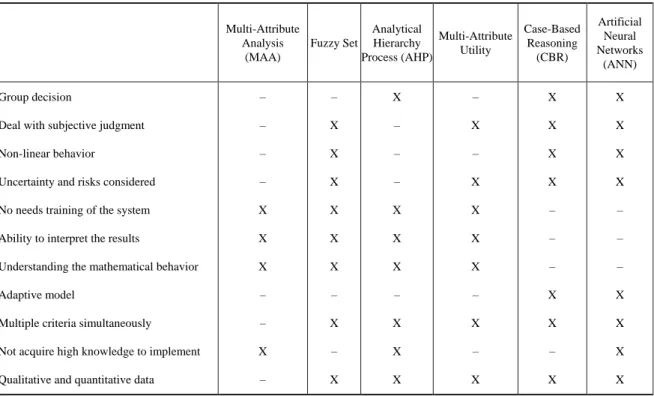
A lot of studies as mentioned above used many techniques for determining criteria prequalification for selection a contractor. The majority of last studies which deal with problem of a contractor selection as multi-criteria problem uses methods of decision analysis in their models or approaches, but their approaches consider time, quality and price as single main decision criteria to evaluate and choose a contractor.El-Sawalhi et al. [3] studied and compared between the published contractor pre-qualification models abilities. Comparison of these models is shown in Table II.
Table II clearly shows that each technique has own strengths and weaknesses; thus, there is an urgent need to integrate some models to cover these disadvantages. AHP is comprehensive method and the most used widely MCDM method or tool due to its simplicity, ease of use, and great
flexibility; [53]-[56]. Therefore, this method can be adopted in this study. According to Subramanian and Ramanathan [55], there is need to extend the use of AHP to areas regarding project management issues such as aircraft building, construction industries, manufacturing industries, etc; for most cases in project management, AHP has been used as a standalone methodology. Another finding from this comparison is that some issues (weaknesses) related to the AHP model, such as deal with subjective judgment, non-linear behaviour, uncertainty and risks considered, and adaptive model can be covered by using ANN model. In MCDM approaches, only a very limited number of decision alternatives can be compared by AHP method [57]. According to study of Ho [53], Subramanian and Ramanathan [55] reviewed published integrated AHP articles, there are decision tools such as data envelopment analysis; Strengths, Weaknesses, Threats and Opportunities (SWOT) analysis; meta-heuristics; and quality function deployment were commonly combined with AHP. Other tools as Mathematical programming considered too commonly combined with AHP [53]. Combined AHP with some meta-heuristics approaches such as ANN, GA, SA, and TS are suitable for solving the combinatorial optimization problems with multiple criteria, where the meta-heuristics have proved more efficient than the exact algorithms to solve hard optimization problems [53]. A combinatorial optimization problem is an optimization problem with discrete variables. Subsequently, combined AHP with some meta-heuristics approaches will be suitable to solve the problem of selecting criteria prequalification of contractor.
TABLEII:COMPARISONS BETWEEN PUBLISHED MCDMMODELS ABILITIES Multi-Attribute Analysis (MAA) Fuzzy Set Analytical Hierarchy Process (AHP) Multi-Attribute Utility Case-Based Reasoning (CBR) Artificial Neural Networks (ANN) Group decision
Deal with subjective judgment Non-linear behavior
Uncertainty and risks considered No needs training of the system Ability to interpret the results
Understanding the mathematical behavior Adaptive model
Multiple criteria simultaneously Not acquire high knowledge to implement Qualitative and quantitative data
– – – – X X X – – X – – X X X X X X – X – X X – – – X X X – X X X – X – X X X X – X – X X X X X – – – X X – X X X X X – – – X X X X V. PROPOSED MODEL
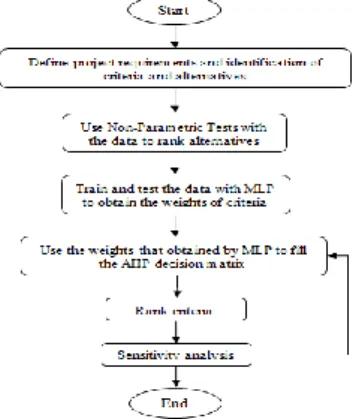
The proposed framework of this study as shown in figure 1 has three main stages as follow:
1) Usage non-parametric tests to rank alternatives.
2) Usage multilayer perceptron (MLP) algorithm to obtain the weights of criteria.
3) AHP model to get the final rank of criteria and check sensitivity analysis of output.
The adopted integrated model contains two models as Lecture Notes on Software Engineering, Vol. 2, No. 3, August 2014
following:
A. Non-Parametric Tests
The first stage of proposed framework starts with defines project requirements and identification of criteria and alternatives. Non-parametric tests will be used to deal with categorical variables to rank alternatives using Statistical Package for the Social Sciences (SPSS) 19.0.
Fig. 1. Framework of proposed integrated model.
B. Multilayer Perceptron (MLP) Algorithm
After ranking the alternatives the multilayer perceptron (MLP) algorithm will be used to obtain the weights of criteria using Statistical Package for the Social Sciences (SPSS) 19.0.
C. AHP Model
Usage AHP model is last stage in the proposed framework. The weights that obtained by MLP will be used by decision maker to fill the AHP decision matrix to obtain the final weights of criteria for ranking the criteria, apply sensitivity analysis to check the output.
This stage will be done by using Web-HIPRE software. There are tools of Web-based decision support for decision making [58]. Web-HIPRE software is one of these tools. Web-HIPRE released in 1998 which is a web version of the earlier HIPRE 3+ software developed by Hamalainen and Lauri in the mid-1900s, located on http://www.hipre.hut.fi [59], [60]. Fig. 2 shows Web-HIPRE on the DSS map.
Fig. 2. Web-HIPRE on the DSS-map.
VI. SCOPE AND LIMITATION OF STUDY
This study focuses to develop a framework for DSS by propose integrated model between AHP, ANN and Non-parametric tests to handle semi and unstructured problem.
The developed framework of DSS will be provided based on information collected. A contractor selection based on the tendering process in public Malaysian construction industry in which a real case study will be obtained from University Utara Malaysia (UUM) to be used to evaluate an applied
prototype to determine the accuracy and effectiveness of the framework’s performance by using the quantitative and qualitative approaches.
VII. CONCLUSION
A complex or unstructured problem is based on multi criteria not on a single criterion. A contractor selection problem is a multi-criteria problem. A correct decision-making is required for selecting the appropriate contractor for a construction project. Selection of a contractor is a key decision made by clients and the process of selection a contractor has become an important issue in construction projects. This paper aims to propose integrated model between AHP and ANN models for determining criteria prequalification to select a contractor. Data collection provided through tendering project in public Malaysian construction industry in which a real case study will be obtained from University Utara Malaysia (UUM). We think that the proposed model will provide a good and encouraging result for determining criteria prequalification to select a contractor.
REFERENCES
[1] S. B. Eom, Decision Support Systems Research and Reference Disciplines, 1970-2001: A Research Guide to the Literature and an
Unobtrusive Bibliography with Citation Frequency, Edwin Mellen
Press, 2003.
[2] E. Turban, R. Sharda, and D. Delen, Decision Support and Business
Intelligence Systems, Pearson, 2011.
[3] N. El-Sawalhi, D. Eaton, and R. Rustom, "Contractor pre-qualification model: State-of-the-art," International Journal of Project Management, vol. 25, pp. 465-474, 2007.
[4] M. Trivedi, M. Pandey, and S. Bhadoria, "Prequalification of Construction Contractor using a FAHP," International Journal of
Computer Applications, vol. 28, pp. 39-45, 2011.
[5] R. Mohemad, A. R. Hamdan, Z. A. Othman, and N. M. M. Noor, "Decision support systems (dss) in construction tendering processes," arXiv preprint arXiv:1004.3260,2010.
[6] P. G. Ioannou and R. E. Awwad, "Below-average bidding method,"
Journal of Construction Engineering and Management, vol. 136, pp.
936-946, 2010.
[7] D. D. Gransberg and M. A. Ellicott, "Best value contracting: Breaking the low-bid paradigm," 1996 AACE Transactions, 1996.
[8] Z. A. Hatush, "Contractor selection using the multiattribute utility theory," University of Salford, 1996.
[9] E. E. Henriod and J.-M. Lantran, "Trends in contracting practice for civil works," Task Force on Innovative Practice, World Bank, Washington, DC, 1988.
[10] L. G. Crowley and D. E. Hancher, "Evaluation of competitive bids,"
Journal of Construction Engineering and Management, vol. 121, pp.
238-245, 1995.
[11] W. Lo, C. Lin, and M. Yan, "Contractor’s opportunistic bidding behavior and equilibrium price level in the construction market,"
Journal of construction engineering and management, vol. 133, pp.
409-416, 2007.
[12] W.-C. Wang, H.-H. Wang, Y.-T. Lai, and J. C.-C. Li, "Unit-price-based model for evaluating competitive bids," International journal of
project management, vol. 24, pp. 156-166, 2006.
[13] W. Lo and M.-R. Yan, "Evaluating qualification-based selection system: a simulation approach," Journal of Construction Engineering
and Management, vol. 135, pp. 458-465, 2009.
[14] G. Holt, "Contractor selection innovation: examination of two decades' published research," Construction Innovation: Information, Process,
Management, vol. 10, pp. 304-328, 2010.
[15] X. Huang, "An analysis of the selection of project contractor in the construction management process," International Journal of Business
and Management, vol. 6, pp. 184, 2011.
[16] A. Nieto-Morote and F. Ruz-Vila, "A fuzzy multi-criteria decision-making model for construction contractor prequalification,"
[17] E. Plebankiewicz, "Contractor prequalification model using fuzzy sets," Journal of Civil Engineering and Management, vol. 15, pp. 377-385, 2009.
[18] E. Plebankiewicz, "A fuzzy sets based contractor prequalification procedure," Automation in Construction, vol. 22, pp. 433-443, March 2012.
[19] K. M. Al-Harbi, "Application of the AHP in project management,"
International journal of project management, vol. 19, pp. 19-27, 2001.
[20] Y.-K. Juan, Y.-H. Perng, D. Castro-Lacouture, and K.-S. Lu, "Housing refurbishment contractors selection based on a hybrid fuzzy-QFD approach," Automation in Construction, vol. 18, pp. 139-144, 2009. [21] P. S.-W. Fong and S. K.-Y. Choi, "Final contractor selection using the
analytical hierarchy process," Construction Management & Economics, vol. 18, pp. 547-557, 2000.
[22] S. T. Ng and R. M. Skitmore, "Contractor selection criteria: a cost-benefit analysis," Engineering Management, IEEE Transactions on, vol. 48, pp. 96-106, 2001.
[23] Z. Hatush and M. Skitmore, "Criteria for contractor selection,"
Construction Management & Economics, vol. 15, pp. 19-38, 1997.
[24] Y. I. Topcu, "A decision model proposal for construction contractor selection in Turkey," Building and Environment, vol. 39, pp. 469-481, 2004.
[25] J. I. Alzahrani and M. W. Emsley, "The impact of contractors’ attributes on construction project success: A post construction evaluation," International Journal of Project Management, 2012. [26] H. Doloi, K. Iyer, and A. Sawhney, "Structural equation model for
assessing impacts of contractor's performance on project success," International Journal of Project Management, vol. 29, pp. 687-695, 2011.
[27] N. El-Sawalhi, D. Eaton, and R. Rustom, "Forecasting contractor performance using a neural network and genetic algorithm in a pre-qualification model," Construction Innovation: Information,
Process, Management, vol. 8, pp. 280-298, 2008.
[28] P. Jennings and G. D. Holt, "Prequalification and multi-criteria selection: a measure of contractors' opinions," Construction
Management & Economics, vol. 16, pp. 651-660, 1998.
[29] K. Lam, T. Hu, S. Thomas Ng, M. Skitmore, and S. Cheung, "A fuzzy neural network approach for contractor prequalification," Construction
Management & Economics, vol. 19, pp. 175-188, 2001.
[30] K. Lam and C. Yu, "A multiple kernel learning-based decision support model for contractor pre-qualification," Automation in Construction, vol. 20, pp. 531-536, 2011.
[31] I. M. Mahdi, M. J. Riley, S. M. Fereig, and A. P. Alex, "A multi‐criteria approach to contractor selection," Engineering Construction and
Architectural Management, vol. 9, pp. 29-37, 2002.
[32] S. Mitkus and E. Trinkūniene, "Analysis of criteria system model for construction contract evaluation," Technological and Economic
Development of Economy, vol. 13, pp. 244-252, 2007.
[33] E. Plebankiewicz, "Construction contractor prequalification from Polish clients’ perspective," Journal of civil engineering and
management, vol. 16, pp. 57-64, 2010.
[34] J. S. Russell, D. E. Hancher, and M. J. Skibniewski, "Contractor prequalification data for construction owners," Construction
Management and Economics, vol. 10, pp. 117-135, 1992.
[35] D. Singh et al., "Contractor selection criteria: investigation of opinions of Singapore construction practitioners," Journal of construction
engineering and management, vol. 132, pp. 998-1008, 2006.
[36] F. Waara and J. Bröchner, "Price and nonprice criteria for contractor selection," Journal of construction engineering and management, vol. 132, pp. 797-804, 2006.
[37] H. Doloi, "Analysis of pre‐qualification criteria in contractor selection and their impacts on project success," Construction Management and
Economics, vol. 27, pp. 1245-1263, 2009.
[38] Z. Hatush and M. Skitmore, "Evaluating contractor prequalification data: selection criteria and project success factors," Construction
Management and Economics, vol. 15, pp. 129-147, 1997.
[39] M. M. Kumaraswamy and J. D. Matthews, "Improved subcontractor selection employing partnering principles," Journal of management in engineering, vol. 16, pp. 47-57, 2000.
[40] M. Okoroh and V. Torrance, "A model for subcontractor selection in refurbishment projects," Construction Management & Economics, vol. 17, pp. 315-327, 1999.
[41] E. Palaneeswaran and M. Kumaraswamy, "Recent advances and proposed improvements in contractor prequalification methodologies,"
Building and Environment, vol. 36, pp. 73-87, 2001.
[42] A. A. Bubshait and K. H. Al-Gobali, "Contractor prequalification in Saudi Arabia," Journal of management in Engineering, vol. 12, pp. 50-54, 1996.
[43] Z. Hatush and M. Skitmore, "Assessment and evaluation of contractor data against client goals using PERT approach," Construction
Management & Economics, vol. 15, pp. 327-340, 1997.
[44] G. D. Holt, "Applying cluster analysis to construction contractor classification," Building and Environment, vol. 31, pp. 557-568, 1996. [45] F. Khosrowshahi, "Neural network model for contractors’ prequalification for local authority projects," Engineering
Construction and Architectural Management, vol. 6, pp. 315-328,
1999.
[46] K. B. Wright, "Researching Internet‐based populations: Advantages and disadvantages of online survey research, online questionnaire authoring software packages, and web survey services," Journal of
Computer‐Mediated Communication, vol. 10, pp. 00-00, 2005.
[47] H. Doloi, A. Sawhney, K. Iyer, and S. Rentala, "Analysing factors affecting delays in Indian construction projects," International Journal
of Project Management, vol. 30, pp. 479-489, 2012.
[48] M. Jaafar, A. R. A. Aziz, and A. Ismail, "Non Price Factors (Npf) And Contractors Selection: An Application In The Public Sector In Malaysia," 2006.
[49] Y. Li, X. Nie, and S. Chen, "Fuzzy approach to prequalifying construction contractors," Journal of Construction Engineering and Management, vol. 133, pp. 40-49, 2007.
[50] S. T. Ng and R. M. Skitmore, "Client and consultant perspectives of prequalification criteria," Building and Environment, vol. 34, pp. 607-621, 1999.
[51] M. Sönmez, G. Holt, J. Yang, and G. Graham, "Applying evidential reasoning to prequalifying construction contractors," Journal of
Management in Engineering, vol. 18, pp. 111-119, 2002.
[52] H. P. Tserng, G.-F. Lin, L. K. Tsai, and P.-C. Chen, "An enforced support vector machine model for construction contractor default prediction," Automation in Construction, vol. 20, pp. 1242-1249, 2011. [53] W. Ho, "Integrated analytic hierarchy process and its applications–A literature review," European Journal of Operational Research, vol. 186, pp. 211-228, 2008.
[54] I. B. Huang, J. Keisler, and I. Linkov, "Multi-criteria decision analysis in environmental sciences: Ten years of applications and trends,"
Science of The Total Environment, vol. 409, pp. 3578-3594, 2011.
[55] N. Subramanian and R. Ramanathan, "A review of applications of Analytic Hierarchy Process in operations management," International
Journal of Production Economics, vol. 138, pp. 215-241, 2012.
[56] J.-J. Wang, Y.-Y. Jing, C.-F. Zhang, and J.-H. Zhao, "Review on multi-criteria decision analysis aid in sustainable energy decision-making," Renewable and Sustainable Energy Reviews, vol. 13, pp. 2263-2278, 2009.
[57] S. Sipahi and M. Timor, "The analytic hierarchy process and analytic network process: an overview of applications," Management Decision, vol. 48, pp. 775-808, 2010.
[58] H. K. Bhargava, D. J. Power, and D. Sun, "Progress in Web-based decision support technologies," Decision Support Systems, vol. 43, pp. 1083-1095, Aug 2007.
[59] J. Mustajoki, R. P. Hamalainen, and M. Marttunen, "Participatory multicriteria decision analysis with Web-HIPRE: a case of lake regulation policy," Environmental Modelling & Software, vol. 19, pp. 537-547, 2004.
[60] W. Singhirunnusorn, "An appropriate wastewater treatment system in developing countries: Thailand as a case study," Ph.D, University of California, United States 2009.
Lecture Notes on Software Engineering, Vol. 2, No. 3, August 2014
Waled Abubakr Abdelrahman received his BSc from Sebha University, Libya in 2004, in computer secince, MSc from University Utara Malaysia, Malaysia in 2010, in information technology.
Currently, his Ph.D. research interests are in areas of decision support system.
Abd Razak Yaakubreceived his Ph.D. degree in scientific computing from Loughborough University, UK.
Currently, he is a professor of scientific computing; and member of University Senate in University Utara Malaysia.