Molecular and morphological evidences place the extinct New Zealand endemic
Turnagra capensis
in the Oriolidae
Dario Zuccon
a,⇑
, Per G.P. Ericson
b aDario Zuccon, Molecular Systematics Laboratory, Swedish Museum of Natural History, Box 50007, SE-104 05 Stockholm, Sweden b
Department of Vertebrate Zoology and Laboratory of Molecular Systematics, Swedish Museum of Natural History, Box 50007, SE-104 05 Stockholm, Sweden
a r t i c l e
i n f o
Article history: Received 30 June 2011 Revised 24 September 2011 Accepted 17 October 2011 Available online 25 October 2011
Keywords: Dispersal Osteology Extinct birds Turnagra Oriolidae Archival DNA
a b s t r a c t
The affinities of PiopioTurnagra capensis, an extinct New Zealand passerine, remain poorly known. It has been included into or associated with several bird families (Calleatidae, Cracticidae, Pachycephalidae, Ptilonorhynchidae, Turdidae), often on tenuous grounds. We reassessedTurnagraphylogenetic relation-ships using nuclear and mitochondrial sequences and a set of morphological and behavioural traits. Molecular and phenotypic characters strongly suggest a novel hypothesis, congruently placingTurnagra in Oriolidae, a highly dispersive corvoid family distributed from the Austro-Papuan landmass to Eurasia and Africa, but missing from the Pacific islands. We show also that the published molecular support to linkTurnagrawith Ptilonorhynchidae was biased by the use of incorrect genetic data and weak analyses.
Ó2011 Elsevier Inc. All rights reserved.
1. Introduction
New Zealand and its offshore islands host a peculiar avifauna
with high endemicity (
OSNZ, 2010
). The origin of New Zealand
birds appears to be complex, with some taxa possibly representing
vicariants deriving from the Gondwana break-up, while most
lin-eages are more recent colonists (
Trewick and Gibb, 2010; Lanfear
and Bromham, in press
).
The native passerines comprise 27–38 species-level taxa
(depending on the taxonomic treatment, see
Trewick and Gibb,
2010
and references therein). Some species are the result of local
radiations and are currently classified as endemic families or
ende-mic genera (Acanthisittidae, Callaeidae–Notiomystidae,
Mohoua
,
Turnagra
), but most species are closely related to non-New Zealand
taxa. The molecular data identify 14 vicariance or dispersal events
responsible for the build-up of the native passerine avifauna
(
Trewick and Gibb, 2010
). The sister taxon of most passerine
lineages have been clarified, either suggesting a vicariant origin
(Acanthisittidae:
Barker et al., 2002; Ericson et al., 2002a
) or
providing information on the time and direction of dispersal (e.g.
Callaeidae:
Barker et al., 2004
; Meliphagidae:
Driskell and Christidis,
2004
; Petroicidae:
Miller and Lambert, 2006
). Some species have
never been included in molecular studies, but are nonetheless
placed confidently in Australasian (
Gerygone
) or cosmopolitan
(
Corvus
) genera based on morphological evidences (
OSNZ, 2010
).
But the affinities of the endemic and now extinct
Turnagra capensis
remain poorly understood and several hypotheses were put
forward.
At the time of human contact
Turnagra. capensis
inhabited the
entire New Zealand and some offshore islets (
Worthy and
Holdaway, 2002
). Morphologically distinct forms existed in the
South and North Islands, usually ranked at the subspecies level
(
T. capensis capensis
and
T. capensis tanagra
, respectively). It was a
still common forest bird at the time of European settlement, but
disappeared shortly after 1900, probably due to the predation by
introduced mammals (
Tennyson and Martinson, 2006
). In size,
shape and colour
Turnagra
bears a vague resemblance to some
Turdus
thrushes, hence the common name of New Zealand thrush
given by the first European settlers. The complex taxonomic
history of
Turnagra
has been revised in detail by
Olson et al.
(1983)
. The species has been associated with no less than six
passerine families: Calleatidae (
Finsch, 1872
), Cracticidae (
Oliver,
1945
), Pachycephalidae (
Mayr and Amadon, 1951; Mayr, 1967
),
Ptilonorhynchidae (
Sundevall, 1872; Finsch, 1874
), Timaliidae
(
Sharpe, 1883
), Turdidae (
Buller, 1869; Sharpe, 1903
), or
segre-gated in the monotypic Turnagridae (
Buller, 1887; Oliver, 1930
;
OSNZ, 1953, 1970
).
Olson et al. (1983)
reassessed the
Turnagra
affinities using a
wide set of morphological characters, including general shape,
plumage colour and structure, bill shape, development of rictal
1055-7903/$ - see front matterÓ2011 Elsevier Inc. All rights reserved.doi:10.1016/j.ympev.2011.10.013
⇑
Corresponding author. Present address: UMS 2700, Service de Systématique Moléculaire, Département Systématique et Evolution, Muséum National d’Histoire Naturelle, 57 rue Cuvier CP 26, 75231 Paris Cedex 05, France.E-mail addresses:[email protected](D. Zuccon),[email protected](P.G.P. Ericson).
Contents lists available at
SciVerse ScienceDirect
Molecular Phylogenetics and Evolution
j o u r n a l h o m e p a g e : w w w . e l s e v i e r . c o m / l o c a t e / y m p e v
bristles, tarsal scutellation, pterylosis, myology, osteology. They
concluded that
Turnagra
was unrelated to the Pachycephalidae,
but likely ‘‘the most primitive member of the bird-of-paradise/
bowerbird assemblage’’. Olson et al.’s conclusions were, however,
based on morphological similarity, without a formal cladistic
anal-ysis. A further problem with Olson et al.’s conclusion is represented
by the polyphyly in the supposed ‘‘bird-of-paradise/bowerbird
assemblage’’. While the bowerbirds (Ptilonorhynchidae) belong
to one of the most basal Oscine lineages, the typical
birds-of-para-dise (Paradisaeidae) are nested within the Core Corvoidea and the
cnemophiline birds-of-paradise (Cnemophilidae) are at the base of
the Passerida radiation (
Barker et al., 2004; Irestedt and Ohlson,
2008
). Nonetheless a mitochondrial molecular phylogeny seems
to lend support to Olson et al.’ hypothesis (
Christidis et al.,
1996a
), recovering
Turnagra
sister to the Ptilonorhynchidae.
How-ever the use of a single, fast evolving gene (cytochrome
b
) and the
lack of representatives of the Paradisaeidae, the Cnemophilidae
and many other passerine lineages make Christidis et al.’s finding
in need of validation with a more robust dataset. In the present
pa-per we revise
Turnagra
relationships using a multi-locus dataset
and comprehensive taxon sampling. We also discuss its
morpho-logical and behavioural similarities with other bird lineages in
the light of molecular findings.
2. Materials and methods
2.1. Taxon sampling strategy
We tested the phylogenetic hypotheses about the relationships
of
Turnagra. capensis
analysing a comprehensive dataset that
in-cludes representatives of all taxa associated with it in the past:
Turdidae, Pachycephalidae, Ptilonorhynchidae, Cnemophilidae
and Cracticidae. We included also representatives of all other
pas-serine lineages that are or were known to occur in New Zealand:
Acanthisittidae, Acanthizidae, Meliphagidae,
Mohoua
,
Rhipiduri-dae, CorviRhipiduri-dae, CallaeiRhipiduri-dae,
Notiomystis
, Petroicidae, Hirundinidae,
Locustellidae, Zosteropidae and Motacillidae (
Trewick and Gibb,
2010
). From the results of several comprehensive passerine
phy-logenies (
Barker et al., 2004; Alström et al., 2006; Jønsson and
Fjeldså, 2006; Johansson et al., 2008; Norman et al., 2009
) we
se-lected representatives of all other deeper lineages, with special
emphasis on the Core Corvoidea (
sensu
Barker et al., 2004
). The tree
was rooted with two parrots and two falcons as these are the sister
lineages to the Passeriformes (
Ericson et al., 2006a
;
Hackett et al.,
2008
). The dataset includes 81 species (77 ingroup and 4 outgroup
taxa).
Table 1
provides the list of included taxa with sample accession
numbers and the Genbank accession numbers of analyzed
sequences. The
Turnagra
toepad was obtained from a specimen of
the South Island form
Turnagra capensis capensis
housed in the
Museo di Zoologia dell’Università di Torino (accession number
MZUT Av2962).
2.2. DNA isolation and sequencing
Fresh tissue samples were extracted using the Qiagen DNA Mini
Kit, following the manufacturer’s protocol. We used the Qiagen
DNA Mini Kit for the toe-pad samples with a modified protocol
as described in
Zuccon (2005)
and
Irestedt et al. (2006)
.
We selected six nuclear (two exons and four introns) and
three mitochondrial genes that are widely used in bird
phyloge-netic studies: the interphotoreceptor retinol-binding protein
(IRBP), the zink finger protein (ZENK), intron 11 of the
glyceral-dehyde-3-phosphodehydrogenase (GAPDH), intron 2 of the
myoglobin gene, introns 6 and 7 of the ornithine decarboxylase
(ODC) gene, intron 9 of the phosphoenolpyruvate carboxykinase
(PEPCK), cytochrome
b
(cytb), NADH dehydrogenase II and III
genes (ND2 and ND3). The nine loci were amplified and
sequenced using standard primers and amplification profiles as
described in
Fjeldså et al. (2010)
for IRBP,
Chubb (2004)
for ZENK,
Fjeldså et al. (2003)
for GAPDH,
Irestedt et al. (2002)
for
myoglobin,
Allen and Omland (2003)
for ODC,
Sorenson et al.
(2003)
for PEPCK,
Zuccon and Ericson (2010b)
for cytb,
Zuccon
et al. (2006)
for ND2 and
Chesser (1999)
for ND3. The toe-pad
samples were amplified in a series of short, overlapping
frag-ments of 200–300 bp, using a large set of internal primers (see
Suppl. Material).
2.3. Gene characterisation and phylogenetic analyses
The nine loci were concatenated in a partitioned dataset. We
excluded three long autapomorphic insertions for reducing the
computational time: 630 bp in intron 6 of ODC in
Anthus
, 83 bp
in intron 7 of ODC in
Rhipidura
, and 177 bp of PEPCK in
Acanthisitta
.
Another 62 character positions that proved impossible to align
unambiguously were excluded as well: 12 bp in ZENK, 31 bp in
GADPH, 16 bp in ODC, 3 bp in PEPCK. The final dataset, consisting
of 7348 bp, was analyzed under the Bayesian inference and the
maximum likelihood criteria.
Bayesian inference was carried out using MrBayes 3.1.2
(
Ronquist and Huelsenbeck, 2003
), implemented on the freely
available Bioportal (www.bioportal.uio.no). A mixed model
approach was implemented to account for the potential differences
in evolutionary model parameters between the data partitions
corresponding to the nine genes. The models best fitting the data
were obtained with MrModelTest (
Nylander, 2004
), using the AIC
criterion, in conjunction with PAUP
⁄(
Swofford, 2003
). We assumed
uniform interval priors for the parameters, except for base
frequen-cies, which were assigned a Dirichlet prior (
Huelsenbeck and
Ronquist, 2001
). Two independent runs of four incrementally
heated Metropolis-coupled MCMC chains for 20 million
genera-tions were run, with sampling every 1000 generagenera-tions, yielding
20,000 trees. We used the online version of AWTY (
Nylander
et al., 2008
) to assess the convergence of the MCMC chains and
to estimate the number of generations to discard as ‘‘burn-in’’
(15,000 trees).
Maximum likelihood searches of the partitioned dataset were
conducted with RAxML v. 7.0.3 (
Stamatakis, 2006
) using a
GTR +
C
+ I model and random starting tree, with
a
-shape
param-eters, GTR-rates and empirical base frequencies optimised for each
partition. Nodal support was estimated using 100 bootstrap
replicates.
Datasets including only the mitochondrial and the nuclear
genes, respectively, were also analyzed under the Bayesian
infer-ence criterion using the same analytical parameters indicated above.
We explored the effect of missing data on the phylogenetic
reconstruction under the Bayesian inference criterion. We
ana-lyzed a reduced dataset where we included only the species for
which all gene were sequenced or only a single gene was missing
(four species).
We compared alternative phylogenetic hypotheses using the
Shimodaira–Hasegawa test (SH-test,
Shimodaira and Hasegawa,
1999
), as implemented in RAxML v. 7.0.3 (
Stamatakis, 2006
). The
tested topologies were obtained enforcing
Turnagra
forming a
monophyletic clade with selected taxa in the maximum likelihood
searches in RAxML.
2.4. Morphological and behavioural characters
We scanned all the relevant literature on
Turnagra
and possibly
related taxa and identified a series of morphological characters
Table 1
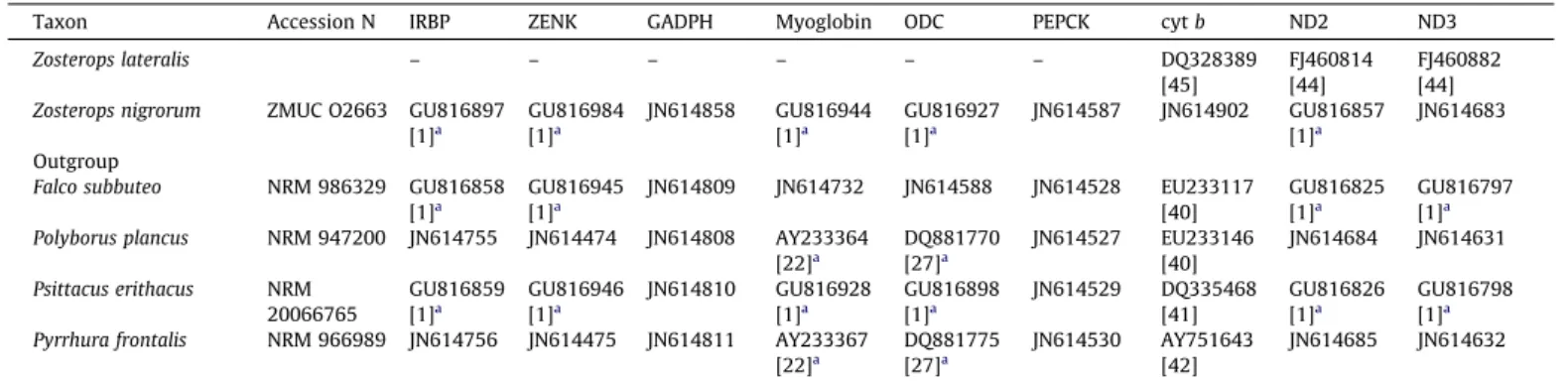
Samples and sequences included in the phylogenetic analysis with museum accession numbers. The nomenclature followsDickinson (2003). GenBank accession numbers of sequences published previously are followed by their references. Museum acronyms: AM Australian Museum, Sydney; FMNH Field Museum of Natural History, Chicago; LSU Louisiana State University Museum of Natural History, Baton Rouge; MV Museum of Victoria, Melbourne; MZUT Museo di Zoologia dell’Università di Torino (now stored in Museo Regionale di Scienze Naturali, Torino); NRM Swedish Museum of Natural History, Stockholm; UWBM University of Washington, Burke Museum, Seattle; ZMUC Zoological Museum, University of Copenhagen. References: [1]:Fjeldså et al. (2010); [2]:Irestedt et al. (2008); [3]:Fjeldså et al. (2003); [4]:Irestedt and Ohlson (2008); [5]:Jønsson et al. (2010a); [6]:Fjeldså et al. (2005); [7]:Jønsson et al. (2010b); [8]:Fuchs et al. (2006); [9]:Fuchs et al. (2007); [10]:Jønsson et al. (2008a); [11]:Irestedt et al. (2006); [12]:Zuccon and Ericson (2010a); [13]:Fuchs et al. (2004); [14]:Ericson et al. (2002b); [15]:Norman et al. (2009); [16]:Johansson and Ericson (2003); [17]:Zuccon et al. (2006); [18]:Ericson and Johansson (2003); [19]:Alström et al. (2006); [20]:Jønsson et al. (2007); [21]:Irestedt et al. (2002); [22]:Mayr et al. (2003); [23]:Ericson et al. (2006b); [24]:Zuccon and Ericson (2010c); [25]:Johansson et al. (2008); [26]:Jønsson et al. (2008b); [27]:Ericson et al. (2006a); [28]:Harrison et al. (2004); [29]:Christidis et al. (1996b); [30]:Shepherd and Lambert (2007); [31]:Dor et al. (2010); [32]:Cracraft and Feinstein (2000); [33]:Alström et al. (2011); [34]:Cibois et al. (1999); [35]:Miller and Lambert (2006); [36]:Barker et al. (2004); [37]:Dumbacher et al. (2008); [38]:Driskell and Christidis (2004); [39]:Zuccon and Ericson (2010b); [40]: Wink et al. unpub.; [41]:Melo and O’Ryan (2007); [42]:
Ribas et al. (2006); [43]: Hauber and Chong unpub.; [44]:Moyle et al. (2009); [45]:Warren et al. (2006).
Taxon Accession N IRBP ZENK GADPH Myoglobin ODC PEPCK cytb ND2 ND3
Acanthisitta chloris NRM 569989b GU816860 [1]a GU816947 [1]a EU726202 [2]a EU726212 [2]a EU726220 [2]a XXX JN614531 AY325307 [28] AY325307 [28] AY325307 [28] Acanthiza pusilla Cockburn No.1 JN614765 JN614484 JN614818 JN614736 JN614595 JN614542 JN614867 JN614695 JN614643 Ailuroedus crassirostris AM O65212 JN614761 JN614480 JN614814 JN614735 JN614591 JN614538 JN614865 JN614691 JN614639
Anthornis melanura – – – – – – – HM159185 [43] – Anthus campestris DZC 20020427.01 JN614804 JN614523 JN614854 JN614754 JN614630 JN614583 JN614900 JN614730 JN614680 Artamus leucorynchus MV S3010 JN614773 JN614492 JN614825 FJ821079 [15]a JN614602 JN614551 JN614874 JN614701 JN614651 Batis crypta ZMUC O2953 JN614776 JN614495 JN614828 JN614739 JN614605 JN614554 JN614877 JN614704 JN614654 Callaeas cinerea Mapara
196126
JN614800 JN614519 JN614849 JN614751 JN614626 JN614578 JN614896 JN614726 JN614676 Campephaga flava ZMUC O11 GU816864
[1]a GU816951 [1]a AY336585 [3]a AY165803 [16]a GU816899 [1]a JN614547 JN614872 GU816829 [1]a GU816800 [1]a Certhia familiaris NRM 976184 GU816892
[1]a GU816979 [1]a JN614855 DQ466821 [17]a GU816924 [1]a JN614584 DQ008524 [19]a DQ466857 [17]a GU816820 [1]a Climacteris rufa MV 155 JN614762 JN614481 JN614815 AY064733
[14]a
JN614592 JN614539 U58501 [29] JN614692 JN614640 Cnemophilus loriae NRM 569572b JN614798 JN614517 EU272096
[4]a EU272107 [4]a EU272126 [4]a JN614576 – JN614724 JN614674 Colluricincla harmonica MV 1422 JN614783 JN614502 JN614834 JN614743 JN614611 JN614561 JN614883 JN614710 GQ494125 [5]a Colluricincla megarhyncha – – GQ494038 [5] GQ494067 [5] GQ494050 [5] – EF592220 [37] GQ494093 [5] GQ494127 [5] Coracina lineata MV JCW073 JN614770 JN614489 JN614822 EU273398
[10]a JN614599 JN614548 FJ821115 [15]a EF052776 [9] JN614648 Corcorax melanorhamphos AM LAB1059 JN614793 JN614512 JN614844 AY064737 [14]a JN614621 JN614571 AY064274 [14]a JN614719 JN614669 Cormobates placens MV E309 JN614763 JN614482 JN614816 AY064731
[14]a
JN614593 JN614540 JN614866 JN614693 JN614641 Corvus cornix NRM 986167 JN614796 JN614515 JN614847 AY228327
[18]a JN614624 JN614574 AY228087 [18]a JN614722 JN614672 Cyclarhis gujanensis NRM 966964 JN614789 JN614508 JN614840 JN614745 JN614617 JN614567 JN614889 JN614715 JN614665 Dicrurus remifer NRM 20086565 JN614792 JN614511 JN614843 JN614748 JN614620 JN614570 JN614892 JN614718 JN614668 Eopsaltria australis MV 1390 JN614802 JN614521 JN614851 AY064732
[14]a
JN614628 JN614580 AY064273 [14]a
JN614728 JN614678 Epimachus albertisi MV C148 JN614794 JN614513 JN614845 AY064735
[14]a JN614622 JN614572 JN614893 JN614720 JN614670 Erpornis zantholeuca NRM 947312 JN614788 JN614507 JN614839 JN614744 JN614616 JN614566 JN614888 – JN614664 Falcunculus frontatus MV 1393 JN614787 JN614506 JN614838 FJ821086 [15]a JN614615 JN614565 JN614887 JN614714 JN614663 Furnarius cristatus NRM 966772 JN614759 JN614478 AY590066
[6]a AY064255 [14]a DQ435482 [23]a JN614534 JN614861 JN614688 JN614635 Gerygone igata – – – – – – – HM159175 [43] – Gymnorhina tibicen AM LAB1107 JN614774 JN614493 JN614826 JN614737 JN614603 JN614552 JN614875 JN614702 JN614652
Heteralocha acutirostris – – – – – – DQ469300
[30]
DQ469296 [30]
–
Hirundo neoxena – – – – – – GU460230
[31]
GU460295 [31]
– Hirundo rustica NRM 976238 JN614806 JN614525 JN614856 AY064258
[14]a GQ242149 [24]a JN614585 JN614901 GQ242090 [24]a JN614682 Lanius excubitor NRM 996541 JN614797 JN614516 JN614848 JN614750 JN614625 JN614575 JN614895 JN614723 JN614673 Loboparadisaea sericea NRM 566737b JN614799 JN614518 EU272095 [4]a EU272106 [4]a EU272125 [4]a JN614577 AF197843 [32] JN614725 JN614675 Malurus amabilis MV C803 JN614764 JN614483 JN614817 AY064729
[14]a JN614594 JN614541 AY228088 [18]a JN614694 JN614642 Megalurus palustris NRM 20046786 JN614807 JN614526 JN614857 DQ008529 [19]a EU680741 [25]a JN614586 DQ008477 [19]a JN614731 – Megalurus punctatus – – – – – – HQ706173 [33] – –
Table 1(continued)
Taxon Accession N IRBP ZENK GADPH Myoglobin ODC PEPCK cytb ND2 ND3
Menura novaehollandiae AM LAB1112 GU816863 [1]a
GU816950 [1]a
JN614812 JN614733 JN614589 JN614536 JN614863 JN614689 JN614637 Microeca fascinans UWBM 60797 JN614803 JN614522 JN614852 JN614753 JN614629 JN614581 JN614898 JN614729 JN614679 Mohoua albicilla JN614772 JN614491 JN614824 FJ821091 [15] JN614601 JN614550 FJ821127 [15] JN614700 JN614650 Mohoua novaeseelandiae – – – – – – – HM159174 [43] – Mohoua ochrocephala – – – – – – – HM159168 [43] – Notiomystis cincta NRM JN614801 JN614520 JN614850 JN614752 JN614627 JN614579 JN614897 JN614727 JN614677 Oreoica gutturalis MV W055 JN614771 JN614490 JN614823 FJ821094 [15]a JN614600 JN614549 JN614873 JN614699 JN614649 Oriolus brachyrhynchus – – GQ901791 [7] – GQ901709 [7] – – GQ901762 [7] GQ901733 [7] Oriolus flavocinctus MV 1603 JN614780 JN614499 JN614831 EF441258
[20]a EF441243 [20]a JN614558 JN614880 JN614708 GQ901728 [7]a Oriolus larvatus – – GQ901796 [7] – GQ901714 [7] – – GQ901767 [7] GQ901738 [7] Oriolus oriolus NRM 20036563 JN614781 JN614500 JN614832 JN614742 JN614609 JN614559 JN614881 EF052693 [9] JN614658 Oriolus xanthonotus – – GQ901794 [7] – GQ901712 [7] – – GQ901765 [7] GQ901736 [7] Oriolus xanthornus – – DQ406645 [8] AY529929 [13] EU272111 [4] – AF094615 [34] AY529964 [13] – Orthonyx temminckii MV B831 JN614767 JN614486 JN614820 AY064728
[14]a
JN614597 JN614544 JN614869 JN614697 JN614645 Pachycephala olivacea MV B761 JN614785 JN614504 JN614836 FJ821097
[15]a
JN614613 JN614563 JN614885 JN614712 JN614661 Pachycephala pectoralis MV 1419 JN614786 JN614505 JN614837 AY064727
[14]a
JN614614 JN614564 JN614886 JN614713 JN614662 Pericrocotus divaricatus NRM
20016234
JN614769 JN614488 EF052818 [9] EF052843 [9] EU380450 [26] JN614546 JN614871 EF052788 [9] JN614647 Petroica australis – – – – – – DQ469301 [30] DQ469299 [30] – Petroica macrocephala – – – – – – DQ359082 [35] HM159177 [43] – Philepitta castanea ZMUC S458 JN614757 JN614476 AY336591
[3]a AY065790 [21]a DQ785938 [11]a JN614532 JN614859 JN614686 JN614633 Philesturnus carunculatus – – – – – – DQ469303 [30] DQ469297 [30] – Picathartes gymnocephalus LSU B19213 GU816866 [1]a GU816953 [1]a JN614853 AY228314 [18]a GU816900 [1]a JN614582 JN614899 GU816831 [1]a GU816802 [1]a
Pitohui cristatus – – EU273389
[10] EU273411 [10] EU273370 [10] – AY443257 [36] GQ494087 [5] GQ494121 [5] Pitohui dichrous NRM 71252 JN614778 JN614497 EU273390
[10]
JN614740 JN614607 JN614556 EF592249 [37]
JN614706 JN614656 Pitohui ferrugineus MV E611 JN614782 JN614501 JN614833 FJ821101
[15]a
JN614610 JN614560 JN614882 JN614709 JN614659
Pitohui kirhocephalus – – EU273392
[10] EU273414 [10] – – EF592256 [37] GQ494100 [5] GQ494134 [5] Pitohui nigrescens MV E246 JN614784 JN614503 JN614835 EU273415
[10]a JN614612 JN614562 JN614884 JN614711 JN614660 Pitta erythrogaster FMNH 358346 JN614758 JN614477 DQ785909 [11]a DQ785984 [11]a DQ785948 [11]a JN614533 JN614860 JN614687 JN614634 Pomatostomus temporalisMV D257 JN614768 JN614487 JN614821 AY064730
[14]a JN614598 JN614545 JN614870 JN614698 JN614646 Prosthemadera novaeseelandiae – – – – – – AY488380 [38] AY488305 [38] – Ptilonorhynchus violaceusAM LAB1099 JN614760 JN614479 JN614813 JN614734 JN614590 JN614537 JN614864 JN614690 JN614638 Ptiloprora plumbea MV C173 JN614766 JN614485 JN614819 AY064736
[14]a JN614596 JN614543 JN614868 JN614696 JN614644 Rhipidura albicollis NRM 20046755 JN614790 JN614509 JN614841 JN614746 JN614618 JN614568 JN614890 JN614716 JN614666 Rhipidura fuliginosa MV 1396 JN614791 JN614510 JN614842 JN614747 JN614619 JN614569 JN614891 JN614717 JN614667 Sphecotheres viridis MV C398 JN614777 JN614496 JN614829 FJ821107 [15]a JN614606 JN614555 JN614878 JN614705 JN614655 Telophorus sulfureopectusNRM 20066991 JN614775 JN614494 JN614827 JN614738 JN614604 JN614553 JN614876 JN614703 JN614653 Terpsiphone viridis ZMUC O1062 JN614795 JN614514 JN614846 JN614749 JN614623 JN614573 JN614894 JN614721 JN614671 Turdus philomelos NRM 20036737 JN614805 JN614524 GU359037 [12]a DQ466848 [17]a GU358902 [12]a GU358965 [12]a GU237100 [39]a DQ466886 [17]a JN614681 Turnagra capensis MZUT
Av2962b
JN614779 JN614498 JN614830 JN614741 JN614608 JN614557 JN614879 JN614707 JN614657 Tyrannus savana NRM 976722 GU816862
[1]a GU816949 [1]a AY336579 [3]a AY165826 [16]a DQ435507 [23]a JN614535 JN614862 GU816828 [1]a JN614636
that were used to assess
Turnagra
relationships (
Clench, 1985;
Frith and Frith, 2004; Olson et al., 1983; Schodde and Mason,
1999; Worthy and Holdaway, 2002
). These include eleven external
characters (plumage, bill, wings and feet) and nine characters from
internal morphology (
Table 4
).
Parsimony analyses were performed in PAUP
⁄v. 4.0b10
(Swofford, 2003). Taxa in which two or more states have been
observed were interpreted as polymorphic. All characters were
treated as unordered in the analyses. The searches were performed
under the branch-and-bound option in PAUP
⁄and the estimated
bootstrap support values are based on 10,000 replicates.
Ptilonorhynchidae was used to root the tree as this taxon is
pre-sumed to be phylogenetically basal to the others (
Ericson et al.,
2002a, 2002b
).
We also summarised some behavioural and ecological
charac-ters, including nest, eggs, mating systems, diet, vocalisation,
over-water dispersal ability (
Table 5
). These characters are not
eas-ily scored for a formal cladistic analysis and they will be discussed
below. The morphological characters, nests structure and eggs
col-our were re-assessed using the collections at the Natural History
Museum, Tring.
3. Results
3.1. Molecular evidences
We obtained almost full sequences for all taxa that we
se-quenced, but included partial sequences from GenBank for few
species for which we had no samples (
Table 1
). The amplification
of fragmented DNA from old museum samples may increase the
risk of amplifying contaminants. The
Turnagra
sequences were
carefully inspected: the sequences were found to be unique (not
identical to any other passerines amplified in our lab); no
mis-matches in overlapping regions of adjacent fragments or unusual
mutations in coding regions were found; the codon variable
positions in coding genes follow the usual frequency pattern
(2nd < 1st < 3rd). The mitochondrial genes and the introns of
Myoglobin and ODC were re-sequenced after several weeks or
months, producing identical sequences. Based on these
observa-tions we are confident that the
Turnagra
sequences are correct.
Table 2
presents a summary of the molecular properties of each
gene and the substitution models that were considered optimal
according to the AIC criterion.
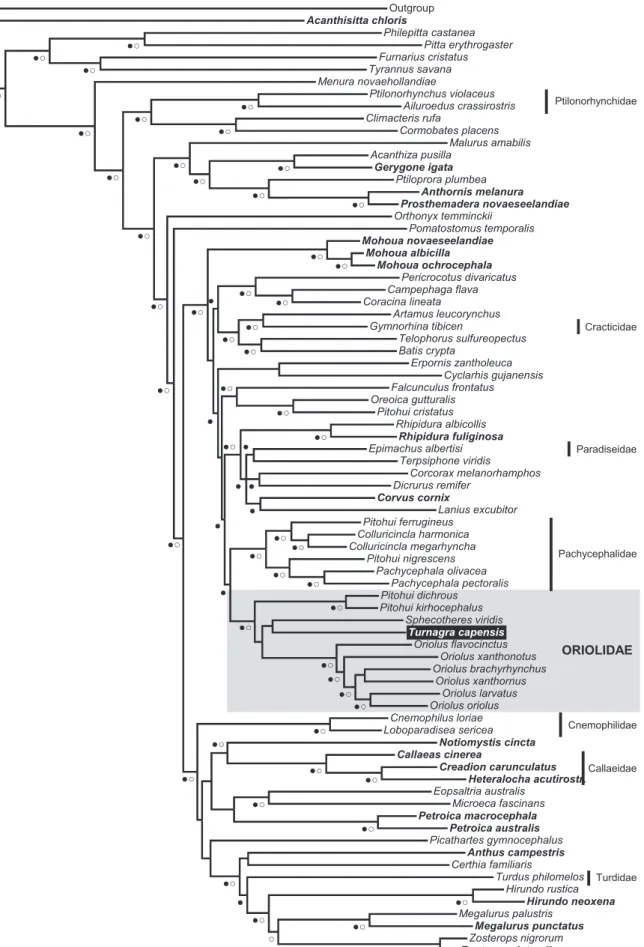
Bayesian and the Maximum Likelihood topologies obtained
from the concatenated dataset are almost identical (
Fig. 1
). The
major branching pattern agrees with current understanding of
the passerine radiation that has been identified by several
inde-pendent studies:
Acanthisitta
is basal to the major division
Subos-cines–Oscines, followed by the Basal Corvoidea lineages (
Menura
,
Ptilonorhynchidae–Climacteridae, the Meliphagoidea clade,
Orth-onyx
and
Pomatostomus
), the Crown Corvoidea and Passerida
clades. Crown Corvoidea as a whole is poorly resolved, with most
basal nodes receiving very low support values. On the other hand
several subclades are strongly supported:
Mohoua
,
Erpornis
with
Cyclarhis
,
Falcunculus
–
Oreoica
–
Pitohui cristatus
, Oriolidae (
sensu
Jønsson et al., 2010a
), Pachycephalidae (
sensu
Jønsson et al.,
2010b
), Campephagidae, the ‘‘African’’ corvoid lineage (
sensu
Fuchs
Table 1(continued)
Taxon Accession N IRBP ZENK GADPH Myoglobin ODC PEPCK cytb ND2 ND3
Zosterops lateralis – – – – – – DQ328389 [45] FJ460814 [44] FJ460882 [44] Zosterops nigrorum ZMUC O2663 GU816897
[1]a GU816984 [1]a JN614858 GU816944 [1]a GU816927 [1]a JN614587 JN614902 GU816857 [1]a JN614683 Outgroup
Falco subbuteo NRM 986329 GU816858 [1]a GU816945 [1]a JN614809 JN614732 JN614588 JN614528 EU233117 [40] GU816825 [1]a GU816797 [1]a Polyborus plancus NRM 947200 JN614755 JN614474 JN614808 AY233364
[22]a DQ881770 [27]a JN614527 EU233146 [40] JN614684 JN614631 Psittacus erithacus NRM 20066765 GU816859 [1]a GU816946 [1]a JN614810 GU816928 [1]a GU816898 [1]a JN614529 DQ335468 [41] GU816826 [1]a GU816798 [1]a Pyrrhura frontalis NRM 966989 JN614756 JN614475 JN614811 AY233367
[22]a DQ881775 [27]a JN614530 AY751643 [42] JN614685 JN614632 a
Published sequence obtained from the same sample used in this study. b
Toepad samples.
Table 2
Sequence characteristics of the loci analyzed. The numbers of variable and parsimony informative bases are calculated for the ingroup only. Three long synapomorphic insertions in ODC and PEPCK and 62 character positions impossible to align unambiguously have been excluded from the computation, see text for details.
Gene region IRBP ZENK GADPH Myoglobin ODC PEPCK cytb ND2 ND3
Alignment length 1074 1158 467 768 839 677 972 1041 352
Number of variable bases (%) 497 (46.3%) 438 (37.8%) 279 (59.7%) 497 (64.7%) 464 (56.1%) 401 (59.2%) 487 (50.1%) 708 (68%) 212 (60.2%) Number of parsimony informative bases (%) 278 (25.9%) 241 (20.8%) 190 (40.7%) 278 (36.2%) 297 (35.9%) 207 (30.6%) 448 (46.1%) 652 (62.6%) 195 (55.4%) % A nucleotides (range) 25.9 (25.0– 27.3) 23.7 (20.9– 24.8) 21.3 (19.3– 23.9) 27.9 (26.7– 29.4) 28.0 (26.5– 29.1) 29.8 (28.5– 31.5) 28.1 (25.0– 31.0) 30.2 (27.5– 34.0) 27.9 (25.1– 31.6) % C (range) 24.1 (23.3– 24.7) 35.8 (34.9– 39.1) 19.0 (16.8– 21.4) 22.3 (20.8– 23.3) 17.2 (16.1– 18.6) 19.8 (17.3– 21.1) 33.1 (29.1– 37.1) 33.6 (26.3– 37.2) 32.8 (28.5– 37.0) % G (range) 27.1 (25.4– 27.9) 18.9 (17.8– 21.4) 34.7 (32.1– 37.0) 23.6 (21.8– 25.7) 20.7 (19.6– 22.5) 18.5 (16.8– 20.9) 14.0 (10.5– 15.2) 11.3 (9.5– 14.2) 12.8 (8.5– 15.1) % T (range) 23.0 (22.2– 23.7) 21.7 (18.7– 22.4) 25.0 (22.3– 28.0) 26.2 (23.9– 27.4) 34.1 (32.6– 35.6) 31.9 (29.8– 33.3) 24.7 (21.6– 27.5) 24.8 (22.9– 30.1) 26.5 (22.6– 29.9) Selected substitution model K80 + I +C GTR + I +C GTR +C SYM +C GTR +C+ I K80 +C GTR + I +C GTR + I +C GTR + I +C
ORIOLIDAE
Outgroup Acanthisitta chloris Philepitta castanea Pitta erythrogaster Furnarius cristatus Tyrannus savana Menura novaehollandiae Ptilonorhynchus violaceus Ailuroedus crassirostris Climacteris rufa Cormobates placens Malurus amabilis Acanthiza pusilla Gerygone igata Ptiloprora plumbea Anthornis melanura Prosthemadera novaeseelandiae Orthonyx temminckii Pomatostomus temporalis Pericrocotus divaricatus Campephaga flava Coracina lineata Artamus leucorynchus Gymnorhina tibicen Telophorus sulfureopectus Batis crypta Oreoica gutturalis Pitohui cristatus Falcunculus frontatus Sphecotheres viridis Turnagra capensis Oriolus flavocinctus Oriolus brachyrhynchus Oriolus xanthornus Oriolus larvatus Oriolus oriolus Oriolus xanthonotus Pitohui dichrous Pitohui kirhocephalus Pitohui ferrugineus Colluricincla harmonica Colluricincla megarhyncha Pitohui nigrescens Pachycephala olivacea Pachycephala pectoralis Rhipidura albicollis Rhipidura fuliginosa Dicrurus remifer Corcorax melanorhamphos Epimachus albertisi Terpsiphone viridis Corvus cornix Lanius excubitor Erpornis zantholeuca Cyclarhis gujanensis Mohoua albicilla Mohoua ochrocephala Mohoua novaeseelandiae Cnemophilus loriae Loboparadisea sericea Callaeas cinerea Creadion carunculatus Heteralocha acutirostr. Notiomystis cincta Eopsaltria australis Microeca fascinans Petroica macrocephala Petroica australis Picathartes gymnocephalus Anthus campestris Certhia familiaris Turdus philomelos Hirundo rustica Hirundo neoxena Megalurus palustris Megalurus punctatus Zosterops nigrorum Zosterops lateralis Ptilonorhynchidae Pachycephalidae Callaeidae Turdidae Paradiseidae Cnemophilidae Cracticidae ©MrE n tFig. 1.The majority-rule consensus tree obtained from the mixed-model Bayesian analysis of the concatenated dataset. The posterior probability values (threshold 0.70) and the bootstrap support values (threshold 70%) obtained from the maximum likelihood analysis are indicated at the node with a black and white dot, respectively. New Zealand native taxa are in bold.Corvus coroneis used as lineage representative of the extinctCorvus antipodum, known only from fossil remains (OSNZ, 2010).Anthus campestrisis used as lineage representative ofAnthus novaeseelandiae. The black bars indicate the families associated in the past withTurnagra. The Oriolidae clade is highlighted in grey. The tree was edited in MrEnt v.2.2 (Zuccon and Zuccon, 2010).
Outgroup
1.00Acanthisitta chloris
0.99 1.00 1.00Philepitta castanea
Pitta erythrogaster
1.00Furnarius cristatus
Tyrannus savana
1.00Menura novaehollandiae
1.00 1.00 1.00Ptilonorhynchus violaceus
Ailuroedus crassirostris
1.00Climacteris rufa
Cormobates placens
1.00 1.00Malurus amabilis
1.00Acanthiza pusilla
Ptiloprora plumbea
1.00Orthonyx temminckii
Pomatostomus temporalis
0.90 1.00 1.00Pericrocotus divaricatus
1.00Campephaga flava
Coracina lineata
1.00 1.00Artamus leucorynchus
Gymnorhina tibicen
1.00Telophorus sulfureopectus
Batis crypta
1.00Oreoica gutturalis
Pitohui cristatus
Falcunculus frontatus
Mohoua albicilla
1.00Sphecotheres viridis
1.00Oriolus flavocinctus
0.98 0.99Oriolus brachyrhynchus
Oriolus larvatus
Oriolus oriolus
Oriolus xanthornus
Oriolus xanthonotus
Turnagra capensis
1.00Pitohui dichrous
Pitohui kirhocephalus
1.00 1.00Pitohui ferrugineus
1.00Colluricincla harmonica
Colluricincla megarhyncha
1.00Pitohui nigrescens
1.00Pachycephala olivacea
Pachycephala pectoralis
1.00Erpornis zantholeuca
Cyclarhis gujanensis
1.00 1.00Rhipidura albicollis
Rhipidura fuliginosa
0.93Dicrurus remifer
0.98Corvus cornix
Lanius excubitor
0.95Epimachus albertisi
Terpsiphone viridis
Corcorax melanorhamphos
1.00 1.00Cnemophilus loriae
Loboparadisea sericea
1.00 1.00Callaeas cinerea
Notiomystis cincta
1.00Eopsaltria australis
Microeca fascinans
Picathartes gymnocephalus
1.00Anthus campestris
Certhia familiaris
0.98Turdus philomelos
1.00Hirundo rustica
Megalurus palustris
Zosterops nigrorum
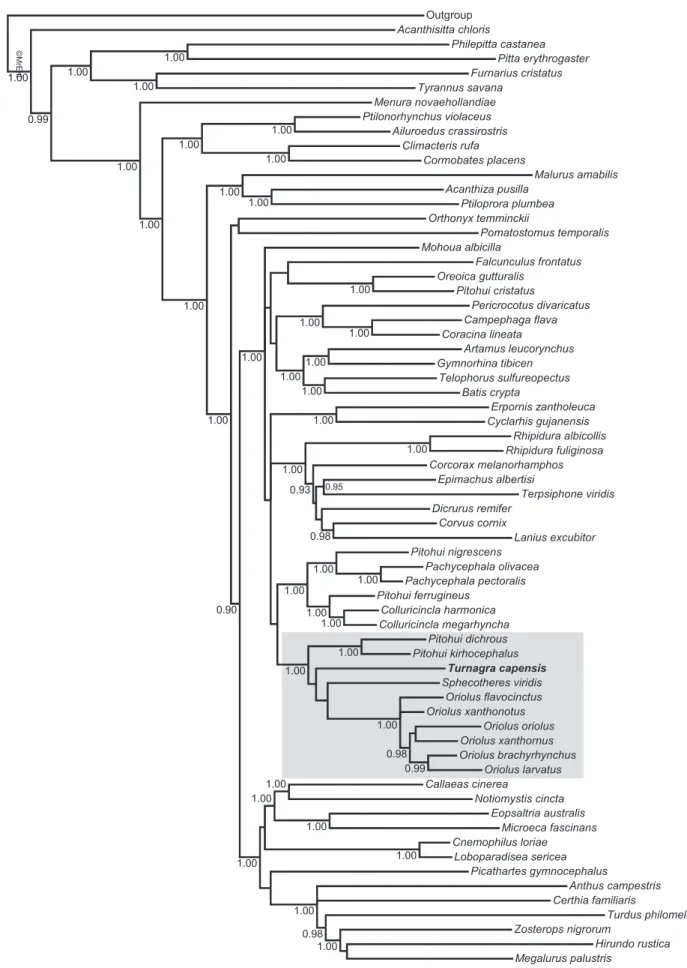
©MrE n tFig. 2.The majority-rule consensus tree obtained from the mixed-model Bayesian analysis of the nuclear dataset. The posterior probability values (threshold 0.90) are indicated at the node. The Oriolidae clade is highlighted in grey.
Outgroup 1.00 Acanthisitta chloris 0.99 1.00 1.00 Philepitta castanea Pitta erythrogaster Furnarius cristatus Tyrannus savana 1.00 Menura novaehollandiae 1.00 1.00 Ptilonorhynchus violaceus Ailuroedus crassirostris 1.00 Climacteris rufa Cormobates placens 1.00 Malurus amabilis 1.00 Acanthiza pusilla Gerygone igata 1.00 Ptiloprora plumbea 1.00 Anthornis melanura Prosthemadera novaeseelandiae Pomatostomus temporalis Orthonyx temminckii 1.00 0.90 0.92 0.96 0.99 Pericrocotus divaricatus 1.00 Campephaga flava Coracina lineata Erpornis zantholeuca Cyclarhis gujanensis Corcorax melanorhamphos 1.00 Rhipidura albicollis Rhipidura fuliginosa Corvus cornix 0.93 0.98 1.00 Oreoica gutturalis Pitohui cristatus Falcunculus frontatus 1.00 1.00 Pitohui ferrugineus 1.00 Colluricincla harmonica Colluricincla megarhyncha 1.00 Pitohui nigrescens 1.00 Pachycephala olivacea Pachycephala pectoralis 1.00 Epimachus albertisi Terpsiphone viridis Lanius excubitor 0.97 Sphecotheres viridis Turnagra capensis 1.00 Pitohui dichrous Pitohui kirhocephalus 1.00 Oriolus flavocinctus 0.92 Oriolus brachyrhynchus Oriolus xanthornus 1.00 Oriolus larvatus Oriolus oriolus Oriolus xanthonotus 1.00 1.00 Artamus leucorynchus Gymnorhina tibicen 1.00 Telophorus sulfureopectus Batis crypta Dicrurus remifer 1.00 1.00 Mohoua albicilla Mohoua ochrocephala Mohoua novaeseelandiae 1.00 Cnemophilus loriae Loboparadisea sericea Notiomystis cincta 1.00 Callaeas cinerea 1.00 Creadion carunculatus Heteralocha acutirostris 1.00 Eopsaltria australis Microeca fascinans 1.00 Petroica macrocephala Petroica australis Turdus philomelos Picathartes gymnocephalus Certhia familiaris Anthus campestris 1.00 1.00 Hirundo rustica Hirundo neoxena 0.99 1.00 Megalurus palustris Megalurus punctatus 1.00 Zosterops nigrorum Zosterops lateralis ©MrE n t
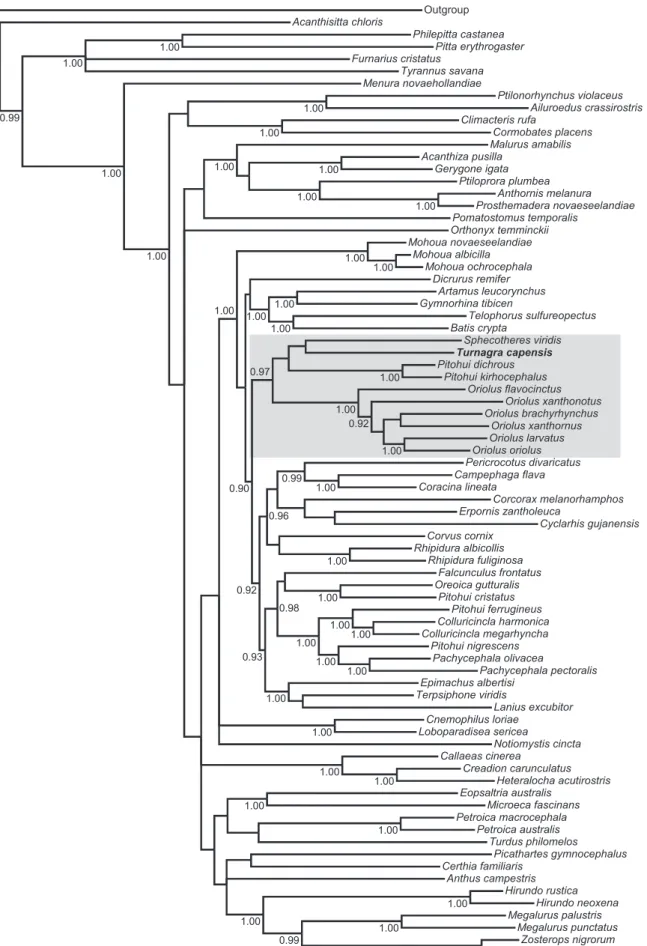
Fig. 3.The majority-rule consensus tree obtained from the mixed-model Bayesian analysis of the mitochondrial dataset. The posterior probability values (threshold 0.90) are indicated at the node. The Oriolidae clade is highlighted in grey.
et al., 2006
:
Artamus
,
Gymnorhina
,
Telophorus
,
Batis
) and the clade
including
Rhipidura
,
Corvus
,
Lanius
,
Dicrurus
,
Epimachus
,
Corcorax
and
Terpsiphone
.
The
analyses
strongly
support
placing
Turnagra
within
Oriolidae, where it forms a clade with
Sphecotheres
.
The separate analyses of the mitochondrial and nuclear genes
recover less resolved trees, with poorer resolution in the basal
nodes of the Corvoidea and Passeroidea lineages, but
Turnagra
re-mains firmly nested within Oriolidae (
Figs. 2 and 3
). The inclusion
of only some genes for few species obtained from Genbank had no
effect on the phylogenetic recontruction. The topology obtained
from the reduced dataset is almost identical, with minor
rear-rangements in the branching order within the Passeroidea clade.
The position of
Turnagra
within Oriolidae and the nodes in the
Corvida clade are not affected (
Fig. S3
).
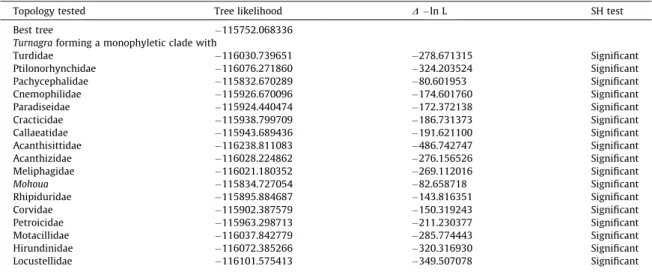
All the traditional hypotheses about the taxonomic affinities of
Turnagra
have been rejected by the SH-test, as well any
relation-ships with the other lineages of New Zealand passerines
(
Table 3
).
Our cytochrome
b
sequence and that published by
Christidis
et al. (1996a)
are too different to belong to the same species. A
carefull inspection of Christidis et al.’ sequence suggests that it
does not represent a true
Turnagra
sequence (see
Suppl. Material
).
Moreover, a re-analysis of Christidis et al.’s dataset also reveals
that the association of their
Turnagra
sequence to the
Ptylonorhyn-chidae is not supported (
Fig. S2
).
3.2. Morphological evidence
Most of the morphological characters included in the
phyloge-netic analysis exhibit a considerable degree of plasticity and
homologies are difficult to ascertain. Thus the parsimony analysis
of these characters did not result in a well-resolved phylogeny,
and only two clades received bootstrap support exceeding 50%
(
Fig. 4
). The first consists of Parasidaeidae, Oriolidae and
Turnagra
,
which group together with a 53% bootstrap support. The other
clade includes
Turnagra
and Oriolidae, a group that receives a
64% support. No unambiguous synapomorphies exist for these
clades, however. A comparison of overall resemblance shows that
Turnagra
shares the same character states for many morphological
characters with Oriolidae. The pars dorsalis of the pteryla spinalis
is densely feathered in
Turnagra
and the Oriolidae, but much less
so in the most corvoid families (
Olson et al., 1983; Clench, 1985
).
Also,
Turnagra
and Oriolidae lack the small apterium between the
pars dorsalis and the pars pelvica of the pteryla spinalis, a
condi-tion shared only with Cnemophilidae among the families
consid-ered here (
Table 4
). While most passerines have only nine
secondaries (
Jenni and Winkler, 1994
),
Pitohui
and
Sphecotheres
have 10 secondaries and 10–11 secondaries occur in
Oriolus
(
Schodde and Mason, 1999; Higgins et al., 2006
).
Turnagra
has 10
secondaries as well. The alcoholic specimen in the Natural History
Museum, used to re-assess this character, was heavily dissected in
a previous study. Both wings are disarticulated from the body and
the number of secondaries was easy to ascertain. The lower
num-ber reported by
Frith and Frith (2004: eight secondaries)
and
Schodde and Mason (1999: nine secondaries)
might be due to
the difficulty of counting the innermost secondaries in a folded
wing as it is usually prepared in round skins. The close similarity
in morphology is also paralleled in many behavioural characters,
as mating system, nest placement, and vocalisation. The tightly
woven
Turnagra
nest and its eggs are also similar to those found
in Oriolidae, and to a lesser degree to those of Pachycephalidae.
4. Discussion
A new bird family must be added to the New Zealand
avi-fauna:
Turnagra
is an oriolid. This new hypothesis is strongly
supported by molecular and morphological evidence and
contra-dicts all previous ideas about
Turnagra
affinity. The Oriolidae
occur over most of the Old World, but the centre of origin lays
Table 3Comparison of alternative phylogenetic hypotheses using the Shimodaira–Hasegawa test performed with RAxML.D ln L: difference in tree likelihood compared to the best tree. Significant: significantly worse than the best topology,p< 0.05.
Topology tested Tree likelihood D ln L SH test
Best tree 115752.068336
Turnagraforming a monophyletic clade with
Turdidae 116030.739651 278.671315 Significant Ptilonorhynchidae 116076.271860 324.203524 Significant Pachycephalidae 115832.670289 80.601953 Significant Cnemophilidae 115926.670096 174.601760 Significant Paradiseidae 115924.440474 172.372138 Significant Cracticidae 115938.799709 186.731373 Significant Callaeatidae 115943.689436 191.621100 Significant Acanthisittidae 116238.811083 486.742747 Significant Acanthizidae 116028.224862 276.156526 Significant Meliphagidae 116021.180352 269.112016 Significant Mohoua 115834.727054 82.658718 Significant Rhipiduridae 115895.884687 143.816351 Significant Corvidae 115902.387579 150.319243 Significant Petroicidae 115963.298713 211.230377 Significant Motacillidae 116037.842779 285.774443 Significant Hirundinidae 116072.385266 320.316930 Significant Locustellidae 116101.575413 349.507078 Significant Cracticidae Pachycephalidae Callaeidae Paradisaeidae Turnagra Oreolidae Cnemophilidae Turdidae Ptilonorhynchidae ©MrEnt
Fig. 4.The strict consensus tree (36 steps long, C.I. = 0.61, R.I. = 0.58) calculated from the 20 morphological characters inTable 4.
in Autralasia, with
Sphecotheres
and
Pitohui
and the basal
Oriolus
lineages restricted to Australia and New Guinea (
Jønsson et al.,
2010a
). The family is known for its bright yellow, green or red
plumages, at odds with the brown, quite non-descript
Turnagra
.
However,
Turnagra
plumage resembles the females of some
Oriolus
species. The loss of plumage dimorphism in island taxa
is a well known pattern and is attributed to the combination
of reduced sexual selection to avoid heterospecific mating and
the effect of natural selection, favouring a less conspicuous,
female-like plumages (
Newton, 2003
).
The oriolids are clearly a dispersive group that colonised most
of the Old World (
Jønsson et al., 2010a
). Several oriolids form
for-aging flocks, especially
Sphecotheres
, the
Turnagra
sister lineage.
Flocking behaviour is one of the factors assumed to favour the
col-onisation of oceanic islands (
Bock, 1960
). Nonetheless
Turnagra
has
been the only oriolid lineage that colonised the Pacific east of the
Australo-Papuan continental shelf.
Historical hypotheses on
Turnagra
relationships tried to
establish a connection with lineages endemic to New Zealand
(Callaeidae) or occurring in the Australasian region (Turdidae,
Table 4Data matrix used in the parsimony analysis of the morphological characters inTurnagraand some passerine families. For ease of presentation the matrix has been transposed. Oriolidae and Pachycephalidae aresensuJønsson et al. (2010a)andJønsson et al. (2010b), respectively. The character states were either scored using the collection of the Natural History Museum, Tring, or obtained from the literature (references indicated in square brackets), or both. References: [1]:Higgins et al. (2006); [2]:Oliver (1955); [3]:Olson et al. (1983); [4]:Worthy and Holdaway (2002); [5]:del Hoyo et al. (2008); [6]:Schodde and Mason (1999); [7]:Clench (1985); [8]:Higgins and Peter (2002); [9]:McEvey (1976); [10]:
Frith and Beehler (1998); [11]:Clench (1992); [12]:Jenni and Winkler (1994).
Turnagra Oriolidae Pachycephalidae Cracticidae Paradisaeidae Cnemophilidae Ptilonorhynchidae Callaeidae Turdidae Sex dimorphism, plumage (0
– dimorphic; 1 – monomorphic) [1,5,6,8,10]
1 0 0 1 0/1 0 0/1 1 0/1
Juvenile plumage like adults (0 – absent; 1 – present) [1,5,6,8,10]
1 1 1 0 1 0 1 1 0
Legs and feet (0 – weak; 1 – strong) [1,6,10] 1 1 1 1 1 0 1 1 1 Tarsal scutellation (0 – booted; 1 – scuttelated) [2,6] 1 1 0/1 1 0/1 0 0/1 0 0
Bill shape stout, notch upper tomium (0 – absent; 1 – present) [1,6,10]
1 1 1 0 0 0 1 0 0
Bristles (0 – absent; or only poorly developed; 1 – well-developed) [1]
1 1 1 1 0 0 0 0 0
Tail length (0 – short; 1 – long) [1,6]
1 1 1 1 0/1 0 0/1 0/1 1
Tail shape (0 – pointed; 1 – squared) [1,6]
1 1 1 1 0/1 0/1 1 0 1
Wing shape (0 – long; pointed; 1 – broad; rounded) [1,6] 1 0/1 1 0/1 1 1 1 1 0 Number of secondaries (0–9 or less; 1–10; 2–11; 3–12 or more) [1,6,12] 1 1/2 0 1/2 1/2/3 3 2/3 0 0
Dorsal pterylosis, basal gap (0 – absent; 1 – present) [3,6,7,11]
0 0 1 1 1 0 1 1 ?
Skull, nasal region (0 – ossified; 1 – non-ossified) [3,6,12] 0 0 0 0 0 1 1 1 1 Skull, maxillopalatines (0 – reduced; 1 – expanded) [1,9,12] 1 1 1 ? 0 1 1 1 0
Skull, transpalatine process (0 – pointed; 1 – truncated) [1,3,6,12]
1 0/1 0 0 1 0 0 1 0
Skull, lacrymal (0 – absent; 1 – present) [1,3,6,12]
0 0 0 0 0/1 0 1 1 0
Skull, ectethmoid foramen (0 – single; 1 – double) [1,6,9]
0 0 0 0 0/1 0 0 1 1
Skull, postorbital and zygomatic process (0 – poorly developed; 1 – well-developed) [3,6,12]
1 1 0 1 1 0 1 0 0
Temporal fossa (0 – small; 1 – medium; 2 – large) [1,6,12]
1 1 0 2 1 0 2 2 0
Humeral fossa (0 – single; 1 – double) [1,6]
0 0 0 0 0 ? 0 0 1
Proximal caudal foramen in the femur (0 – absent; 1 – present) [4]
Callaeidae,
Ptilonorhynchidae,
Cracticidae,
Pachycephalidae).
However, among these only the Turdidae and the Pachycephalidae
are clearly dispersive groups with wide Pacific distributions, while
the other families are confined to the Australo-Papuan continental
plate, apparently unable to cross water stretches (
del Hoyo et al.,
2008, 2009
). The alleged molecular support for a
Turnagra
–
Ptilonorhynchidae link was indeed interpreted by
Christidis et al.
(1996a)
as evidence of an undetected case of bowerbird dispersal
outside the Australian-New Guinean landmass.
Mistaken phylogenetic relationships have often been ascribed to
cases of extreme morphological divergence among related taxa (e.g.
drepanids,
Pratt, 2005
) or to cases of phenotypic convergence of
unrelated lineages (e.g. ‘‘coerebids’’,
Remsen, 2003
).
Turnagra
does
not fit either case: although not so ‘‘oriole-like’’ in plumage colour,
the analysis of the anatomical traits clearly links it to Oriolidae.
Despite extensive investigations (
Olson et al., 1983; Schodde and
Mason, 1999; Frith and Frith, 2004; Higgins et al., 2006
) all
compar-isons were post hoc driven: only those families that were assumed to
be likely relatives were included in comparative analyses.
Mayr and Amadon (1951)
acknowledged that
Turnagra
was
clearly not a thrush, following Oliver’s study of the palate (
Oliver,
1945
), and suggested a possible link with Pachycephalidae. At that
time Pachycephalidae was a loose assemblage of passerines at least
in part insectivorous, characterised by a bill with a tomial notch, a
rather unspecialized morphology and a general Australasian
distri-bution.
Turnagra
would have fit well within such a group. However,
while
Pachycephala
,
Colluricincla
and part of
Pitohui
do form a
monophyletic clade (
Jønsson et al., 2010b
), the other, mostly
monotypic genera (
Hylocitrea
,
Rhagologus
,
Eulacestoma
,
Falcunculus
,
Oreoica
:
Spellman et al., 2008; Norman et al., 2009
) proved to
be-long elsewhere.
A perceived similarity between
Turnagra capensis capensis
and
the bowerbird
Scenopoeetes dentirostris
guided Olson et al.’s
(1983) reappraisal. The two taxa are indeed surprisingly similar
in general shape and plumage pattern. In birds with striped
breast the feathers have a typical pale background with a darker
central stripe. In the South Island form of
Turnagra
and in
Sceno-poeetes
the pattern is reversed, with a cream central stripe on a
dark brown feather. Olson et al. identified a number of
similari-ties between
Turnagra
and the Ptilonorhynchidae, but failed to
appreciate that the two taxa differ in several other traits and
none of the similarities can be regarded as an unambiguous
syn-apomorphy. Regrettably the Ptilonorhynchidae hypothesis was
strengthened by a biased molecular phylogeny (
Christidis et al.,
1996a
), and these results were readily included in checklists
and major taxonomic works (e.g.
Heather and Robinson, 2005
;
OSNZ, 2010
).
However, more thorough evaluations of the same
morphologi-cal characters used by Olson et al. questioned the
Ptilonorhynchi-dae hypothesis (
Schodde and Mason, 1999; Frith and Frith, 2004;
Higgins et al., 2006
). Although these authors recognised a better
match with the Pachycephalidae, the lack of a thorough
Table 5Ecological and behavioural characters inTurnagraand some passerine families. Oriolidae and Pachycephalidae aresensuJønsson et al. (2010a)andJønsson et al. (2010b), respectively. The character states were either scored using the collection of The Natural History Museum, Tring (indicated by !), or obtained from the literature (reference indicated in square brackets), or both. References: [1]:Higgins et al. (2006); [2]:Buller (1887); [3]:del Hoyo et al. (2008); [4]:Schodde and Mason (1999); [5]:North (1901– 1904); [6]:Higgins and Peter (2002); [7]:del Hoyo et al. (2007); [8]:Frith and Beehler (1998); [9]:del Hoyo et al. (2009); [10]:Frith and Frith (2004); [11]:del Hoyo et al. (2005).
Taxon Turnagra Oriolidae Pachycephalidae Cracticidae Paradisaeidae Cnemophilidae Ptilonorhynchidae Callaeidae Turdidae
Diet Fruits and
insects [1] Mostly frugivorous plus insects [3] Insectivorous [9] Mostly insectivorous or scavenger [9] Omnivorous [8] Obbligate frugivorous [8]
Fruits, shoots and leaves [10] Omnivorous [1] Insectivorous, frugivorous or omnivorous [11] Nest structure Compact
deep cup at a tree fork; mostly grasses, almost no leaves, finer lining inside [!,1]
Deep cup at a tree fork; compact structure, tightly woven to the branches, made mostly of grasses (Oriolus) or more loose structure of vinelets and few twigs
(Sphecotheres) [!,3,5]
Deep cup at a tree fork; rather coarsely woven, made of twigs and bark, with some leaves and roots [4] Rather coarse and flimsy cup-shaped nest in outer tree forks [4] Rather loose cup of tree leaves within an exterior of fresh green material and lined with fine stems of epiphytic orchids, roots and mosses [!,8] Domed, made of mosses and ferns, lined with stems of epiphytic orchids and few sticks [8]
Rough bulky cup-shaped nest of twigs [!,4] Large cup-shaped nest loosely constructed, among branches, in tree or epiphyte hollows or on ground [1] Bulky fibrous cup-shaped nest, in shrubbery or crevices [4] Clutch size 2–3 [1] 2–3 [1] 2–3 [6] 2–4 [1] 1–2 [8] 1 [9] 1–2 [4] 2–3 [1] 2–6 [1] Eggs, background colour
Whitish [!] Whitish, cream or pale pinkish, but bluish in Sphecotheres[!] Mostly whitish, pale pinkish or pale buff [!] Brown, greenish or greyish [!] Dark cream or pinkish or brownish [!]
Pale pinkish [!] Cream, pale grey or pale brown [!] Greysh or brownish [!] Variable, brown, grey, greenish or blue [!] Eggs, marking Small
black or brown blotching, mostly at the blunt end [!] Small to medium blotching with black, brown or rusty, mostly at the blunt end [!]
Blotching with black, brown, olive green or grey over most of the surface, more intense at the blunt end [!]
Freckled or vermiculated over most of the surface with brown, rufous or black [!] Strong marking, with blotch, spot or streaks, with dark brown and grey [!] Finely blotched in rufous and purple, with denser marking at the blunt end [!] Variable: unmarked, vermiculated or bolding blotched in grey, brown or black [!] Blotching with brown or olive green [!] Variable, from plain or faintly spotted to heavily marked or vermiculated [!]
Mating system Presumed monogamy [1]
Monogamy [4] Monogamy [4] Monogamy, but polygyny in Gymnorhina [1] Monogamy or polygyny [8]
Polygyny [8] Polygyny (but monogamy in Ailuroedus) [4]
Monogamy [1]
Monogamy [4]
Song Musical [1] Musical [3] Musical [7] Musical [1] Harsh [9] Harsh [8] Harsh [9] Musical [1] Musical [11] Song mimicry Yes [2] Yes [3] Yes [6] Yes [1] Not recorded
[9]
Not recorded [9]
Yes [4] Yes [1] Yes [11] Over-water
dispersal
comparison with a wider selection of corvoid groups precluded the
placement of
Turnagra
in Oriolidae.
Acknowledgments
We are grateful to E. Gavetti and M. Pavia (Museo Regionale di
Scienze Naturali, Torino) for supplying us with the toe-pad of
Turnagra capensis
used in this study. Additional samples were
provided by Australian Museum (W. Boles), Australian National
University (A. Cockburn), Burke Museum, University of Washington
(S. Birks), Field Museum of Natural History (D. Willard), Louisiana
State University Museum of Natural Sciences (D. Dittmann),
Museum of Victoria (J. Norman), Swedish Museum of Natural
History (G. Frisk), Zoological Museum University of Copenhagen
(J. Fjeldså, J.B. Kristensen). M. Adams, J. Cooper, H. van Grouw,
R. Prys-Jones, D. Russell granted access to the collections in their care
during a visit to the Natural History Museum in Tring. P. Grandcolas
made useful suggestions for the cladistic analysis of the
morpholog-ical data. The Swedish Research Council provided financial support
(Grant No. 621-2007-5280 to PE).
Appendix A. Supplementary material
Supplementary data associated with this article can be found, in
the online version, at
doi:10.1016/j.ympev.2011.10.013
.
References
Allen, E.S., Omland, K.E., 2003. Novel intron phylogeny (ODC) supports plumage convergence in orioles (Icterus). Auk 120, 961–969.
Alström, P., Ericson, P.G.P., Olsson, U., Sundberg, P., 2006. Phylogeny and classification of the avian superfamily Sylvioidea, based on nuclear and mitochondrial sequence data. Mol. Phylogenet. Evol. 41, 381–397.
Alström, P., Fregin, S., Norman, J.A., Ericson, P.G.P., Christidis, L., Olsson, U., 2011. Multilocus analysis of a taxonomically densely sampled dataset reveal extensive non-monophyly in the avian family Locustellidae. Mol. Phylogenet. Evol. 58, 513–526.
Barker, K.F., Barrowclough, G.F., Groth, J.G., 2002. A phylogenetic analysis for passerine birds: taxonomic and biogeographic implications of an analysis of nuclear DNA sequence data. Proc. Roy. Soc. Lond. B 269, 295–305.
Barker, F.K., Cibois, A., Schikler, P., Feinstein, J., Cracraft, J., 2004. Phylogeny and diversification of the largest avian radiation. Proc. Natl. Acad. Sci. USA 101, 11040–11045.
Bock, W.J., 1960. The palatine process of the premaxilla in the Passeres. Bull. Mus. Comp. Zool. 122, 361–488.
Buller, W.L., 1869. On some new species of New Zealand birds. Ibis Ser. 2 (5), 37–42. Buller, W.L., 1887. A History of the Birds of New Zealand, vol. 1. The Author, London. Chesser, R.T., 1999. Molecular systematics of the rhinocryptid genusPteroptochos.
Condor 101, 439–446.
Christidis, L., Leeton, P.R., Westerman, M., 1996a. Were bowerbirds part of the New Zealand fauna? Proc. Natl. Acad. Sci. USA 93, 3898–3901.
Christidis, L., Norman, J.A., Scott, I.A.W., Westerman, M., 1996b. Molecular perspectives on the phylogenetic affinities of lyrebirds (Menuridae) and treecreepers (Climacteridae). Australian J. Zool. 44, 215–222.
Chubb, A.L., 2004. New nuclear evidence for the oldest divergence among neognath birds: the phylogenetic utility of ZENK (i). Mol. Phylogenet. Evol. 30, 140–151. Cibois, A., Pasquet, E., Schulenberg, T.S., 1999. Molecular systematics of the Malagasy babblers (Passeriformes: Timaliidae) and warblers (Passeriformes: Sylviidae), based on cytochrome b and 16S rRNA sequences. Mol. Phylogenet. Evol. 13, 581–595.
Clench, M.H., 1985. Body pterylosis ofAtrichornis,Menura, the ‘Corvid Assemblage’ and other possibly related passerines (Aves: Passeriformes). Records Australian Mus. 37, 115–142.
Clench, M.H., 1992. Pterylography of birds-of-paradise and the systematic position of Macgregor’s Bird-of-paradise (Macgregoria pulchra). Auk 109, 923–928. Cracraft, J., Feinstein, J., 2000. What is not a bird of paradise? Molecular and
morphological evidence places Macgregoria in the Meliphagidae and the Cnemophilinae near the base of the corvoid tree. Proc. Roy. Soc. B 267, 233–241. del Hoyo, J., Elliot, A., Sargatal, J. (Eds.), 2005. Handbook of the Birds of the World,
Cuckoo-shrikes to Thrushes, vol. 10. Lynx Edicions, Barcelona.
del Hoyo, J., Elliot, A., Christie, D. (Eds.), 2007. Handbook of the Birds of the World, Picathartes to Tits and Chickadees, vol. 12. Lynx Edicions, Barcelona. del Hoyo, J., Elliot, A., Sargatal, J. (Eds.), 2008. Handbook of the Birds of the World,
Penduline-tits to Shrikes, vol. 13. Lynx Edicions, Barcelona.
del Hoyo, J., Elliot, A., Sargatal, J. (Eds.), 2009. Handbook of the Birds of the World, Bush-shrikes to Old World Sparrows, vol. 14. Lynx Edicions, Barcelona.
Dickinson, E.C. (Ed.), 2003. The Howard and Moore Complete Checklist of the Birds of the World, 3rd ed. Princeton University Press, Princeton.
Dor, R., Safran, R.J., Sheldon, F.H., Winkler, D.W., Lovette, I.J., 2010. Phylogeny of the genusHirundoand the Barn Swallow subspecies complex. Mol. Phylogenet. Evol. 56, 409–418.
Driskell, A.C., Christidis, L., 2004. Phylogeny and evolution of the Australo-Papuan honeyeaters (Passeriformes, Meliphagidae). Mol. Phylogenet. Evol. 31, 943–960. Dumbacher, J.P., Deiner, K., Thompson, L., Fleischer, R.C., 2008. Phylogeny of the avian genusPitohuiand the evolution of toxicity in birds. Mol. Phylogenet. Evol. 49, 774–781.
Ericson, P.G.P., Johansson, U.S., 2003. Phylogeny of Passerida (Aves: Passeriformes) based on nuclear and mitochondrial sequence data. Mol. Phylogenet. Evol. 29, 126–138.
Ericson, P.G.P., Christidis, L., Cooper, A., Irestedt, M., Jackson, J., Johansson, U.S., Norman, J.A., 2002a. A Gondwanan origin of passerine birds supported by DNA sequences of the endemic New Zealand wrens. Proc. Roy. Soc. B 269, 235–241.
Ericson, P.G.P., Christidis, L., Irestedt, M., Norman, J.A., 2002b. Systematic affinities of the lyrebirds (Passeriformes:Menura), with a novel classification of the major groups of passerine birds. Mol. Phylogenet. Evol. 25, 53–62.
Ericson, P.G.P., Anderson, C.L., Britton, T., Elzanowski, A., Johansson, U.S., Kallersjö, M., Ohlson, J.I., Parsons, T.J., Zuccon, D., Mayr, G., 2006a. Diversification of Neoaves: integration of molecular sequence data and fossils. Biol. Lett. 2, 543–547. Ericson, P.G.P., Zuccon, D., Johansson, U.S., Alvarenga, H., Prum, R.O., 2006b.
Higher-level phylogeny and morphological evolution of tyrant flycatchers, cotingas, manakins, and their allies (Aves: Tyrannida). Mol. Phylogenet. Evol. 40, 471–483. Finsch, O., 1872. Revision der Vogel Neuseelands. J. Orn. 20, 161–188.
Finsch, O., 1874. Zusatze und Berichtigungen zur Revision der Vogel Neuseelands. J. Orn. 22, 167–224.
Fjeldså, J., Zuccon, D., Irestedt, M., Johansson, U.S., Ericson, P.G.P., 2003.Sapayoa aenigma: a New World representative of ‘Old World suboscines’. Proc. Roy. Soc. 270 (Suppl.), S238–S241.
Fjeldså, J., Irestedt, M., Ericson, P.G.P., 2005. Molecular data reveal some major adaptational shifts in the early evolution of the most diverse avian family, the Furnariidae. J. Orn. 146, 1–13.
Fjeldså, J., Irested, M., Ericson, P.G.P., Zuccon, D., 2010. The Cinnamon Ibon Hypocryptadius cinnamomeusis a forest canopy sparrow. Ibis 152, 747–760. Frith, C.B., Beehler, B.M., 1998. The Birds of Paradise. Oxford University Press,
Oxford.
Frith, C.B., Frith, D.W., 2004. The bowerbirds. Oxford University Press, Oxford. Fuchs, J., Bowie, R.C.K., Fjeldså, J., Pasquet, E., 2004. Phylogenetic relationships of the
African bush-shrikes and helmet-shrikes (Passeriformes: Malaconotidae). Mol. Phylogenet. Evol. 33, 428–439.
Fuchs, J., Fjeldså, J., Pasquet, E., 2006. An ancient African radiation of corvoid birds (Aves: Passeriformes) detected by mitochondrial and nuclear sequence data. Zool. Scr. 35, 375–385.
Fuchs, J., Cruaud, C., Couloux, A., Pasquet, E., 2007. Complex biogeographic history of the cuckoo-shrikes and allies (Passeriformes: Campephagidae) revealed by mitochondrial and nuclear sequence data. Mol. Phylogenet. Evol. 44, 138–153.
Hackett, S.J., Kimball, R.T., Reddy, S., Bowie, R.C.K., Braun, E.L., Braun, M.J., Chojnowski, J.L., Cox, W.A., Han, K.-L., Harshman, J., Huddleston, C.J., Marks, B.D., Miglia, K.J., Moore, W.S., Sheldon, F.H., Steadman, D.W., Witt, C.C., Yuri, T., 2008. A phylogenomic study of birds reveals their evolutionary history. Science 320, 1763–1768.
Harrison, G.L., McLenachan, P.A., Phillips, M.J., Slack, K.E., Cooper, A., Penny, D., 2004. Four new avian mitochondrial genomes help get to basic evolutionary questions in the late cretaceous. Mol. Biol. Evol. 21, 974–983.
Heather, B.D., Robinson, H.A., 2005. Field Guide to the Birds of New Zealand. Revised edition. Viking Press, Auckland.
Higgins, P.J., Peter, J.M. (Eds.), 2002. Handbook of Australian, New Zealand and Antarctic Birds Pardalotes to shrike-thrushes, vol. 6. Oxford University Press, Melbourne.
Higgins, P.J., Peter, J.M., Cowling, S.J. (Eds.), 2006. Handbook of Australian, New Zealand and Antarctic birds: Boatbill to starlings, vol. 7. Oxford University Press, Melbourne.
Huelsenbeck, J.P., Ronquist, F., 2001. MrBayes: Bayesian inference of phylogeny. Biometrics 17, 754–755.
Irestedt, M., Ohlson, J.I., 2008. The division of the major songbird radiation into Passerida and ‘‘core Corvoidea’’ (Aves: Passeriformes) – the species tree versus gene trees. Zool. Scr. 37, 305–313.
Irestedt, M., Fjeldså, J., Johansson, U.S., Ericson, P.G.P., 2002. Systematic relationships and biogeography of the tracheophone suboscines (Aves: Passeriformes). Mol. Phylogenet. Evol. 23, 499–512.
Irestedt, M., Ohlson, J.I., Zuccon, D., Källersjö, M., Ericson, P.G.P., 2006. Nuclear DNA from old collections of avian study skins reveals the evolutionary history of the Old World suboscines (Aves, Passeriformes). Zool. Scr. 35, 567–580. Irestedt, M., Fuchs, J., Jønsson, K.A., Ohlson, J.I., Pasquet, E., Ericson, P.G.P., 2008. The
systematic affinity of the enigmaticLamprolia victoriae(Aves: Passeriformes) – an example of avian dispersal between New Guinea and Fiji over Miocene intermittent land bridges? Mol. Phylogenet. Evol. 48, 1218–1222.
Jenni, L., Winkler, R., 1994. Moult and ageing of European Passerines. Academic Press, London.
Johansson, U.S., Ericson, P.G.P., 2003. Molecular support for a sister group relationship between Pici and Galbulae (PiciformessensuWetmore 1960). J. Avian Biol. 34, 185–197.
Johansson, U.S., Fjeldså, J., Bowie, R.C.K., 2008. Phylogenetic relationships within Passerida (Aves: Passeriformes): a review and a new molecular phygeny based on three nuclear intron markers. Mol. Phylogenet. Evol. 48, 858–876. Jønsson, K.A., Fjeldså, J., 2006. A phylogenetic supertree of oscine passerine birds
(Aves: Passeri). Zool. Scr. 35, 149–186.
Jønsson, K.A., Fjeldså, J., Ericson, P.G.P., Irestedt, M., 2007. Systematic placement of an enigmatic Southeast Asian taxonEupetes macrocerusand implications for the biogeography of a main songbird radiation, the Passerida. Biol. Lett. 3, 323–326. Jønsson, K.A., Bowie, R.C.K., Norman, J.A., Christidis, L., Fjeldså, J., 2008a. Polyphyletic origin of toxicPitohuibirds suggests widespread occurrence of toxicity in corvoid birds. Biol. Lett. 4, 71–74.
Jønsson, K.A., Irestedt, M., Fuchs, J., Ericson, P.G.P., Christidis, L., Bowie, R.C.K., Norman, J.A., Pasquet, E., Fjeldså, J., 2008b. Explosive Avian Radiations and Multi-directional Dispersal across Wallacea: evidence from the Campephagidae and other Crown Corvida (Aves). Mol. Phylogenet. Evol. 47, 221–236. Jønsson, K.A., Bowie, R.C.K., Moyle, R.G., Christidis, L., Norman, J.A., Benz, B.R.,
Fjeldså, J., 2010a. Historical biogeography of an Indo-Pacific passerine bird family: Pachycephalidae: different colonization patterns in the Indonesian and Melanesian archipelagos. J. Biogeogr. 37, 245–257.
Jønsson, K.A., Bowie, R.C.K., Moyle, R.G., Irestedt, M., Christidis, L., Norman, J.A., Fjeldså, J., 2010b. Phylogeny and biogeography of Oriolidae (Aves: Passeriformes). Ecography 33, 232–241.
Lanfear, R., Bromham, L., in press. Estimating phylogenies for species assemblages: A complete phylogeny for the past and present native birds of New Zealand. Mol. Phylogenet. Evol.
Mayr, E., 1967. Genus Incertae Sedis. In: Paynter, R.A. (Ed.), Chech-List of the Birds of the World, vol. 12. Museum of Comparative Zoology, Cambridge, Mass., p. 52. Mayr, E., Amadon, D., 1951. A classification of recent birds. Am. Mus. Novitates
1496, 1–42.
Mayr, G., Manegold, A., Johansson, U.S., 2003. Monophyletic groups within ‘higher land birds’ – comparison of morphological and molecular data. J. Zool. Syst. Evol. Res. 41, 233–248.
McEvey, A., 1976. Osteological notes on Grallinidae, Cracticidae and Artamidae. In: Frith, H.J., Calaby, J.H. (Eds.), Proceedings of the 16th International Ornithological Congress. Blackwell Publishing Ltd, Canberra, Australia, pp. 150–160.
Melo, M., O’Ryan, C., 2007. Genetic differentiation between Príncipe Island and mainland populations of the grey parrot (Psittacus erithacus), and implications for conservation. Mol. Ecol. 16, 1673–1685.
Miller, H.C., Lambert, D.M., 2006. A molecular phylogeny of New Zealand’sPetroica (Aves: Petroicidae) species based on mitochondrial DNA sequences. Mol. Phylogenet. Evol. 40, 844–855.
Moyle, R.G., Filardi, C.E., Smith, C.E., Diamond, J., 2009. Explosive Pleistocene diversification and hemispheric expansion of a ‘‘great speciator’’. Proc. Natl. Acad. Sci. USA 106, 1863–1868.
Newton, I., 2003. Speciation and Biogeography of Birds. Academic Press, London. Norman, J.A., Ericson, P.G.P., Jønsson, K.A., Fjeldså, J., Christidis, L., 2009. A multigene
phylogeny reveals novel relationships for aberrant genera of Australo-Papuan core Corvoidea and polyphyly of the Pachycephalidae and Psophodidae (Aves: Passeriformes). Mol. Phylogenet. Evol. 52, 488–497.
North, A.J., 1901–1904. Nests and Eggs of Birds Found Breeding in Australia and Tasmania, vol. I. Trustees of the Australian Museum, Sydney.
Nylander, J.A.A., 2004. MrModeltest v.2.2. [Program distributed by the author]. Uppsala University, Uppsala: Department of Systematic Zoology. <http:// www.abc.se/~nylander/>.
Nylander, J.A.A., Wilgenbush, J.C., Warren, D.L., Swofford, D.L., 2008. AWTY (Are We There Yet?): a system for graphical exploration of MCMC convergence in Bayesian phylogenetics. Bioinformatics 24, 581–583.
OSNZ, 1953. New Zealand Birds. AH AW Reed, Wellington.
OSNZ, 1970. Annotated Checklist of New Zealand Birds. AH & AW Reed, Wellington. OSNZ, 2010. Checklist of the Birds of New Zealand, Norfolk and Macquarie Islands,
and the Ross Dependency, Antarctica, fourth ed. Te Papa Press, Wellington. Oliver, W.R.B., 1930. New Zealand Birds. Fine Arts Ltd, Wellington.
Oliver, W.R.B., 1945. Avian evolution in New Zealand and Australia. Part II. Emu 45, 119–152.
Oliver, W.R.B., 1955. New Zealand Birds, third ed. AH AW Reed, Wellington. Olson, S.L., Parkes, K.C., Clench, M.H., Borecky, S.R., 1983. The affinities of the New
Zealand passerine genusTurnagra. Notornis 30, 319–336.
Pratt, H.D., 2005. The Hawaiian Honeycreepers. Oxford University Press, Oxford. Remsen, J.V., 2003. The ‘‘Coerebidae’’: a polyphyletic taxon that dramatizes
historical over-emphasis on bill shape as a taxonomic character. J. Avian Biol. 34, 321–323.
Ribas, C.C., Joseph, L., Myiaki, C.Y., 2006. Molecular systematics and patterns of diversification in Pyrrhura(Psittacidae), with special reference to the picta-leucotis complex. Auk 123, 660–680.
Ronquist, F., Huelsenbeck, J.P., 2003. MRBAYES 3: Bayesian phylogenetic inference under mixed models. Bioinformatics 19, 1572–1574.
Schodde, R., Mason, I.J., 1999. The Directory of Australian Birds: Passerines. CSIRO Publishing, Collingwood.
Sharpe, R.B., 1883. Catalogue of the Passeriformes or Perching Birds in the Collections of the British Museum, vol. 7. Trustees of the British Museum, London.
Sharpe, R.B., 1903. A Hand-list of the Genera and Species of Birds, vol. IV. British Museum (Natural History), London.
Shepherd, L.D., Lambert, D.M., 2007. The relationships and origins of the New Zealand wattlebirds (Passeriformes, Callaeatidae) from DNA sequence analyses. Mol. Phylogenet. Evol. 43, 480–492.
Shimodaira, H., Hasegawa, M., 1999. Multiple comparisons of log-likelihoods with applications to phylogenetic inference. Mol. Biol. Evol. 16, 1114–1116. Sorenson, M.D., Oneal, E., García-Moreno, J., Mindell, D.P., 2003. More taxa, more
characters: the hoatzin problem is still unresolved. Mol. Biol. Evol. 20, 1484– 1499.
Spellman, G.M., Cibois, A., Moyle, R.G., Winker, K., Barker, F.K., 2008. Clarifying the systematics of an enigmatic avian lineage: What is a Bombycillid? Mol. Phylogenet. Evol. 49, 1036–1040.
Stamatakis, A., 2006. RAxML-VI-HPC: maximum likelihood-based phylogenetic analyses with thousands of taxa and mixed models. Bioinformatics 22, 2688– 2690.
Sundevall, C.J., 1872. Methodi naturalis avium disponendarum tentamen. Stockholm.
Swofford, D.L., 2003. PAUP⁄. Phylogenetic Analysis Using Parsimony (⁄and Other Methods), Version 4. Sinauer Associates, Sunderland, Massachusetts. Tennyson, A.J.D., Martinson, P., 2006. Extinct Birds of New Zealand. Te Papa Press,
Wellington.
Trewick, S.A., Gibb, G.C., 2010. Vicars, tramps and assembly of the New Zealand avifauna: a review of molecular phylogenetic evidence. Ibis 152, 226–253. Warren, B.H., Bermingham, E., Prys-Jones, R.P., Thebaud, C., 2006. Immigration,
species radiation and extinction in a highly diverse songbird lineage: white-eyes on Indian Ocean islands. Mol. Ecol. 15, 3769–3786.
Worthy, T.H., Holdaway, R.N., 2002. Lost world of the Moa: prehistoric life of New Zealand. Indiana University Press, Bloomington, Indiana.
Zuccon, D., 2005. A molecular phylogeny of starlings (Aves: Sturnini): evolution, biogeography and diversification in a passerine family. Ph.D. Thesis, Università degli