,{
DEC PDP-11 Family Communications Capabilities
,
(/
Digital's PDP 11/23. shown above. represents the versatility of the entire product line. It can be implemented for use as a communications processor. local network node. or other dedicated communications application.
MANAGEMENT SUMMARY
Digital Equipment Corporation's all time leader in both
longevity and revenues generated is the PDP-II
minicomputer family. Initially introduced in 1970 as a
minicomputer for OEM use, DEC has now installed over
320,000 units making it by far the DEC earnings
cham-pion. Continued DEC communications enhancements have
permitted the PDP-II to evolve from a slab of "iron" for
OEMs it was a decade ago to a system on which many
users now depend to perform dedicated communications
functions. Its versatility is demonstrated by its ability to
act as a front-end or communications processor, local or
remote network node, or distributed processor.
The PDP-II family employs various internal
architec-tures. The 1l/03L and the ii/23 both use an LSI-ll bus
architecture. The 11/23 Plus uses an Extended LSI-II
bus structure and the 11/24, 11/ 34A, 11/44, and 11/70
all utilize the Unibus architecture. Our feeling is that the
newer Extended LSI-II bus will eventually be used for
future small PDP-II systems and replace the LSI-II bus.
These busses include expansion slots which are
extensions of the PDP-Irs bus and electrical
connec-tions. When a compatible interface card is plugged into
one of these slots, it acts as part of the computer system.
OEMs and independents especially appreciate this
capability and many offer their own PDP-II add-ons.
DEC provides a wide variety of synchronous and
asynchronous communications interfaces to accommo-
I>
A family of minicomputers which can be used as distributed processing systems. local or remote network nodes. or communication processors.
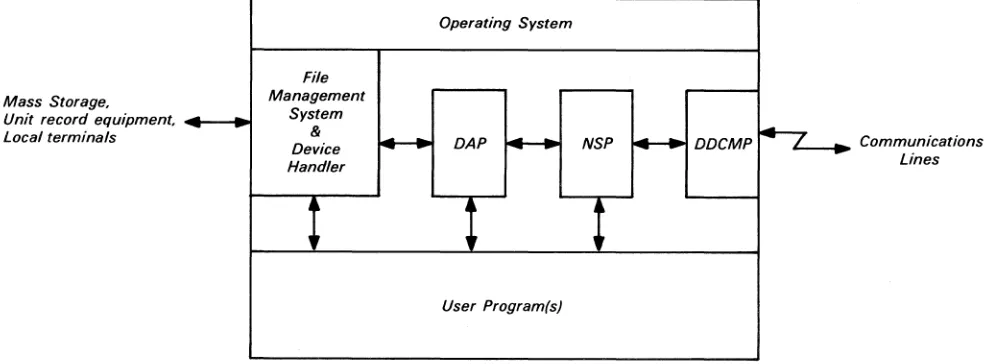
Seven models are currently being marketed. with user memory capacities ranging from 64K bytes to four megabytes. These seven models are supported by four operating systems which offer a wide range of communications support. All models now support DECnet. which allows PDP-11 s to share resources with other DEC computers. such as VAX. using public facilities. Depend-ing upon model and configuration. PDP-11s can communicate with an IBM host in batch or interactive modes and can participate in an SNA environment. They can also com-municate with CDC and Univac hosts.
A typical PDP-11/44 processor running under the RSTSIE operating system with 512K bytes of memory. two asynchronous line interfaces. disk and tape drives with controllers; printer. Cobol. and DECnet costs $106.500. Monthly maintenance for this configuration is $508.
CHARACTERISTICS
VENDOR: Digital Equipment Corporation, 129 Parker Street, Maynard, Massachusetts 01754. Telephone (617) 897-5111.
DATE OF FIRST ANNOUNCEMENT: March 1970. DATE OF FIRST DELIVERY: August 1970.
NUMBER DELIVERED TO DATE: Over 320,000 PDP-11 processors (estimate for all models).
SERVICED BY: Digital Equipment Corporation.
MODELS AND CONFIGURATION
The original PDP-11 family of 16-bit minicomputers began in 1970 with the 11/20 model, and its closely related but stripped-down version, the 11/15. Both of these contained about 19 boards and some 600 integrated circuits. In 1971, the 11/05 and 11/45 were introduced, and marketed as more cost effective replacements to the 11/15 and 11/20. These processors consisted of two boards and about 200 integrated circuits. The 11/45, like the other PDP-lis, was a core-only machine, but included memory management circuitry that raised the maximum memory capacity from 56K bytes to 248K bytes.
Although these models all contained a Unibus-type of I/O channel, it was not until MOS memory was introduced that the high-speed Unibus architecture that is prevalent today was introduced. Subsequent models used both core and ~
C13-384-102
Processors
DEC PDP-"
Family Communications Capabilities
}:::::.. date and execute most communications applications.
Communications interfaces are placed in slots on the
PDP-II bus. Some of these interfaces include enough
built-in, microprocessor-supplied intelligence to help with
processing burdens from the PDP-II when acting as a
front-end or communications processor. Others can be
used to support and mUltiplex up to 16 asynchronous
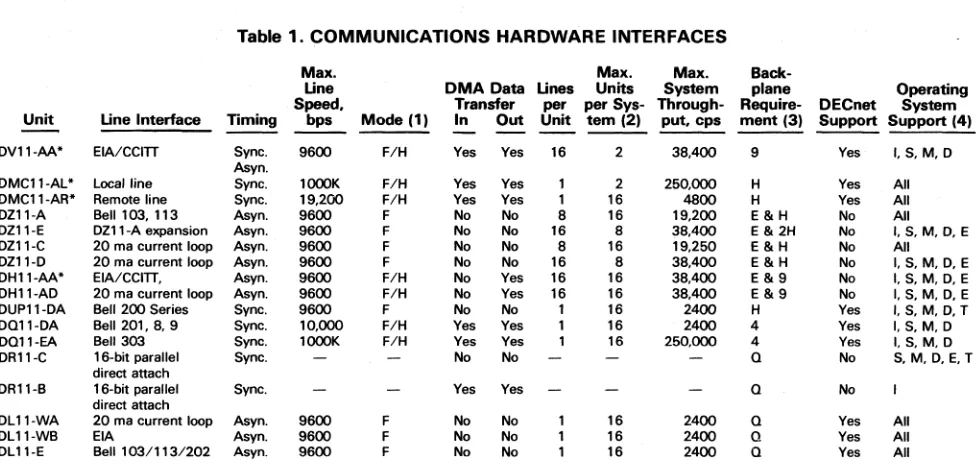
communications lines. Tables I, 2, and 3 provide a
complete description of all DEC supplied
communica-tions interfaces.
The PDP-II communications capabilities may be divided
into two distinct categories: DEC-to-DEC
communica-tions and DEC-to-non-DEC communicacommunica-tions.
Digital Equipment Corporation uses its Digital Network
Architecture (DNA) to interconnect dissimilar DEC
computer products. DECnet is the software which
implements DNA on all current PDP-II family
computers.
Itallows users file access and transfer through
non-adjacent nodes, downline loading, upline dumping,
task-to-task communications, and other resource sharing
procedures.
DECnet Phase III is available for all systems now. In the
Spring of 1984, DECnet Phase IV will link Unibus-based
PDP-lIs running under RSX-IIM and RSX-IIM-Plus
with Professional 300 Series personal computers,
DECSYSTEM-20 mainframes, and VAX superminis.
Digital Data Communications Message Protocol
(DDCMP) will be supported. Phase III users will also be
able to communicate with Phase IV users and vice versa.
Phase IV implementation will allow 1000 supporting
nodes while Phase III currently only supports 250.
In addition to remote communications of DEC-to-DEC
products, several interfaces allow the PDP-II family to
participate in a cable connected local network. The most
interesting of these interfaces is not yet available. DEC
has promised that by early 1984, Ethernet local network
interfaces will be available for PDP-II s using aU nibus or
Extended LSI-II bus running under RSX family
operating systems. Ethernet under DECnet control will
allow a local network participant to access any of the long
haul network gateways of DECnet Phase IV. Tables 1,2,
and 3 supply complete characteristics of currently
available Local Network Link Modules.
DEC also supports a large number of DEC-to-non-DEC
communications packages for PDP-II processors. With
appropriate operating system support, PDP-II
proces-sors can be made to appear as an IBM RJE( HASP
workstation, 2780/3780 batch processor, or 3271
interactive terminal to an IBM System/370 or other
compatible host. Univac 1004 and CDC Cyber 6000
emulation programs are also offered.
One of the most significant aspects of DECnet Phase IV
is its ability to provide a gateway into IBM's Systems
Network Architecture (SN A), which will enable all
DECnet users to participate in an SNA environment.
This should be available in early 1983.
l>-~ MOS memory, until the transition from core to MOS was completed.
Models 11/40, 11/35, and 11/04 were subsequently introduced that offered increasing price performance until 1975, when DEC announced the low-end, OEM-oriented LSI-ll microcomputer, and the high-end 11/70. The 11/70 was said to deliver 75 percent of the throughput of an IBM 370/158. It contained cache memory and memory management which permitted addressing of up to 4 million bytes.
The LSI-ll was subsequently marketed in a packaged version as the 11/03. In order to keep prices low, DEC left out the Unibus structure from this model.
In 1976, the 11/34 was announced, 50 percent faster than its predecessor model, the 11/04. Along with its cache memory brother, the 11/34A, main memory was supported to 248K bytes.
In 1977, the mid-range 11/60 was announced, with performance levels between the 11/34 and 11/70. It included cache memory, main memory to 256K bytes, and user-accessible microprogramming.
In March of 1979, the PDP-11/23 was announced. It featured low-end price/performance improvements over previous models and included the by-then established LSI-11 bus. Later in the year, the 11/44 was introduced. It uses improved MOS memory over previous models, and features built-in ECC logic and cache memory.
In March of 1981, DEC introduced the 11/24, the lowest priced PDP-11 model with Unibus architecture. In / November of 1981, the 11/23 Plus was introduced. The,,_ 11/23 Plus is similar to the existing 11/23, but extends memory up to one megabyte and has an Extended LSI-II Bus.
Each new announcement has contributed attributes to the entire product line. The current PDP-ll processor family consists of the 11/03L, 11/23, 11/23 Plus, 11/24, 11/34A, 11/44, and 11/70.
The foundation of the PDP-11/24, 11/34A, 11/44, and 11/70 hardware architecture is a standard I/O bus that DEC calls the Unibus. All elements of the system are connected to the Unibus, including the central processor, main memory, I/O hardware interfaces, and communications interfaces. With certain exceptions, data is transferred between the elements of the system only by passing through the Unibus. I/O interfaces normally transfer data to and from memory via central processor interrupts, but several communications interfaces do have direct memory access without processor intervention. Central processors with cache memory (PDP 11/44, 11/70) have direct access to all types of memory without having to go through the Unibus. Additionally, high-speed mass storage units have direct access to cache memory and thus can bypass the Unibus when transferring data to and from memory.
Connections to the Unibus are via the backplane, printed circuit board with sockets. The backplane that is provided with the central processor consists of nine rows of sockets. Each row, called a slot, has six records. Two slots have two sockets reserved. This results in seven slots of six sockets per /'-slot (Hex /'-slot) and two /'-slots offour sockets (Quad /'-slot) per
slot. To connect most I/O interfaces require six sockets, four ',,_ sockets, or multiples thereof. The combination of devices is
limited to the mix of sockets and slots required. Slots as well as sockets must be taken into consideration. A Hex or six-socket interface requirement could not use two Quad slots even though eight sockets are available. ~
© 1982 DATAPRO RESEARCH CORPORATION, DELRAN, NJ 08075 USA REPRODUCTION PROHIBITED
DEC PDP-11 Family Communications Capabilities
, - t:>
Ethernet and CCITT X.25 protocols have been
"
incorporated into DECnet Phase IV. This will allow
Extended LSI-II and Unibus based PDP-II processors
running an RSX family operating system to distribute
communications activity either locally or via long haul
networks to other similarly supported non-DEC devices.
DEC's X.25 has been certified by GTE Telenet for
domestic use. In addition to providing an iriternational
gateway with higher level functions, Ethernet PDP-II
processor users can also access X.25 and SNA networks
from local origins.
In an age when technology brings new advancements
daily, the PDP-II family has demonstrated unparalleled
staying power. DECnet Phase IV guarantees its life at
least into the mid or late 1980s when it can proudly
be replaced by the VAX. From humble beginnings, the
PDP-I I has graduated into perhaps the most
sophisti-cated communicating minicomputer in the industry.
USER REACTION
Datapro's first Network Users Survey was conducted in
November and December of 1981 in conjunction with
Data Communications magazine. The survey yielded 12
PO P- I I users representing a total of 36 systems being
used as dedicated communications devices. The ratings of
the PDP-I I users are shown as follows:
Excellent Good Fair Poor W A
*
Overall satisfaction 7 4 I 0 3.5
Ease of installation 5 4 3 0 3.2
Throughput 2 5 5 0 2.8
Hardware reliability 6 3 3 0 3.3
Promptness of manufac- 2 5 4 0 2.6
turer's maintenance
Quality of manufacturer's 2 5 4 0 2.6
maintenance
Manufacturer's software I 5 2 2 2.1
Manufacturer's technical 0 4 5 I 1.9
support
*Weighted Average based on a scale of 4.0 for Excellent.
As these responses reflect, DEC PDP-II users are
generally very satisfied with their equipment despite
sub-average hardware and software support. This serves as
testimonial to the performance and reliability of the
PDP-II family, but confirms that the PDP-II remains
oriented towards users who have the sophistication to be
able to perform at least some trouble-shooting,
maintenance service, and software development in-house,
or who deal through an OEM or system builder who can
perform these functions for them.O
~ Two expansion panels are available. One expansion panel provides four slots (two Hex and two Quad) and another expansion panel provides nine slots (seven Hex and two Quad).
Memory cycle time for PDP-II processors is 0.45 or 0.3 microseconds for MOS memory, and 0.3 microseconds for bipolar memory. The top of the PDP-II line can support up to 3.5M bytes of memory plus an 8K bipolar cache memory with a cycle time of 0.24 microseconds. The PDP-ll word consists of 16 bits. However, the PDP-1l/70 utilizes an extended Unibus that transfers data in 32-bit words.
All four Unibus-based models have four automatic hardware priority level interrupts. They can also use any of seven programmable software-supported additional interrupt levels; these have an automatic vectoring instruction held in a reserved main storage location. Each of the interrupt levels can accommodate independently prioritized peripheral devices.
The priority of any device connected to the Unibus is determined by its physical position; hence, the processor is normally attached so as to give it the highest priority. There is no logical limit to the number of devices that can be attached to the Unibus, with bus access and control handled by the interrupt system.
The theoretical maximum Unibus data transfer rate is five million bytes per second, and attached components communicate in a master/slave manner. The typical transfer rate, however, including average bus delays, is two million bytes per second. On the 11/70, the 32-bit bus is fast enough to permit overlapped use by the CPU, Unibus, and/or several mass storage units, the fastest of which can presently operate at I million bytes per second.
The LSI-ll bus used on the PDP-1I/03L and 1I/23, and the Extended LSI/II bus used on the 11/23 Plus each have a maximum data transfer rate of two million bytes per second.
DEC offers a vast array of PDP-ll family equipment, and it is beyond the scope of this report to present more than generalized information regarding the physical specifications of the processors. Please note that all cabinet-mounting components fit in standard (19-inch) cabinet interiors, and that the cabinets generally measure 21 inches wide, 30 inches deep, and 72 or 50 inches high. A 19-inch rack-mounted version is available for OEMs.
TRANSMISSION SPECIFICATIONS
Communications lines are attached directly to DEC communications interfaces. Single-line, 4-line, 8-line, and 16-line interfaces are available with asynchronous speeds up to 9600 bps and synchronous speeds up to 1M bps. EIA, CCITT, and 20mA interfaces are supported. Some of the interfaces include microprocessors with direct memory access for outgoing and incoming data. Processing throughput, rather than physical restrictions (backplane socket availability) usually limits the number of lines that can be supported. For instance, a maximum of 32 asynchronous lines can operate simultaneously at a 9600 bps rate. However if the data rate is lower, a proportionate number of additional lines can be added to the system.
Data communications control for all PDP-II s is supplied on the interface board. A number of variants and options are available, so that PDP-lis can be connected to almost any type of communication channel (private phone, dial-up phone, 20-mA line, telegraph line), almost any type of terminal, or almost any type of modem. Supplementing these interfaces is additional data communications hardware to provide flexibility in unique situations.
C13-384-104 Processors
DEC PDP-"
Family Communications Capabilities
TABLE ,. PDP-" COMMUNICATIONS INTERFACE CHARACTERISTICS
Synchronous Transmission Mode Single Line Options
Model Multi-Drop Half-Full Max. Line Line Master Duplex Speed (bps) Interface
Mode
DUP11-DA No H/F 9,600 RS-232-CN.24
DMC11-AR/DA No H/F 19200 RS-232-CN.24
DMC11-AR/FA No H/F 250,000 V.35/DDS
9,600 ISO 4902
DMR11-AA No H/F 19,200 RS-232-CN.24
20,000 RS-449
56000 RS-423-A
DMR11-AB No H/F 100(1000' ISO 25931V.35
DMR11-AC No H/F 1000000' Intearal Modem
DMR11-AE No H/F 1,000,000' RS-422-A
DPV11-DB No H/F 56,000 RS-232-C
DMP11-AA Yes H/F 19,200 RS-232-CN.24N.28
56,000 RS-423-A
DMP11-AB Yes H/F 56,000 CCITTV.35
DMP11-AC Yes Full 500,000 Integral Modem
Half 1,000,000 Integral Modem
DMP11-AE Yes Half Full 1,000,000 5()(,Q()( RS-422-A RS-422-A
192Ul
RS-232-DMV11-AA Yes H/F 19200 V.241V.2B
56,000 RS-423-A
DMV11-AB Yes H/F 56,000 V.35/DDS
DMV11-AC Yes H/F 56,000 Integral Modem
PCL11-B Yes Full 1,000,000 Local cable connect
'Speed is dependent upon modem. "LSI-11 bus or Extended LSI-11 bus.
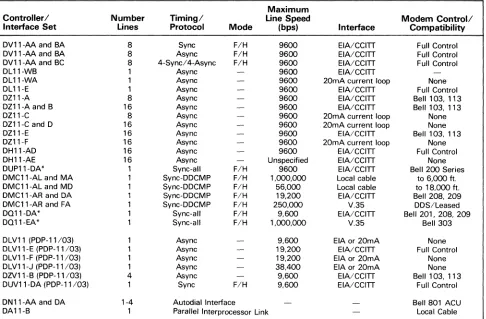
~ The characteristics of the available interfaces are summa-rized in the Communications Interface .Characteristics Tables 1, 2, and 3.
Unibus Communications Interfaces (for
PDP-11/24. 11/34A. 11/44. and 11170)
The DLl1-WB Asynchronous Serial Line Interface provides full- or half-duplex EIA/CITT line control, changeable under program control. Mode changing, however, is the only programmed change that can be made to this unit. All other characteristics are set when the device is ordered, usually by straps on the board. Those features include a choice of 13 standard data rates between 50 and 9600 bits per second, choice of character size (5, 6, 7, or 8 bits) and stop element size (1, 1.5, or 2 bits), and selection of parity (odd, even, or none). Appropriate parity is appended to outgoing characters, and parity is checked on incoming characters. The unit contains independent two-character buffers (one to transmit data and one to receive data), permitting longer delays between interrupt servicing without annoying rate errors. The DLll-WB can operate with different input and output line speeds. The DLll-WB is contained on one board.
The DLlI-WC Asynchronous Serial Line Interface is the same as the DLll-WB except that it includes 100foot cable for connection to a modem instead of a 25-foot cable.· The DLlI-WA Asynchronous Serial Line Interface is the same as the DLll-WB, except that it is intended for 20mA use and does not have a modem cable.
The DLlI-E Asynchronous Serial Line Interface is the same as the DLll-WB, except data rate is not switch-selectable.
Bus Slot Requirements CRC Direct
Support Error Memory
Correction Access
Unibus 1 Hex Slot Yes No
Unibus 1 Hex Slot Yes Yes
Unibus 1 Hex Slot Yes Ye"
Unibus Yes Yes
Unibus
2 Hex Slots Yes Yes
Unibus Yes Yes
Unibus Yes Yes
Unibus 2 Hex Slots Yes Yes
Unibus 2 Hex Slots Yes Yes
Unibus 2 Hex Slots Yes Yes
LSI-11 bus 1 Double Slot Yes No
Unibus 1 Hex Slot Yes Yes
Unibus 1 Hex Slot Yes Yes
Unibus
1 Hex Slot Yes Yes
Unibus Yes Yes
nibus Hex ~Iot Yes Yes
Unibus 1 Hex Slot Yes Yes
** 1 Quad Slot Yes Yes
** 1 Quad Slot Yes Yes
..
1 Quad Slot Yes YesUnibus 2 Expansion Slots Yes Yes
The DZlI-A Asynchronous Eight-Line Multiplexer allows each of up to eight lines or terminals to be individually programmed through software control at speeds up to 9600 bps. The DZll-A is a lower-cost, reduced-performance multiplexer and does not have DMA facilities. However, the DZll-A includes enough modem controls to operate a 300-bps data set. Interrupts can be programmed to occur for each character or after 16 characters. The DZll-A supports asynchronous EIA or CCITT lines and is generally transparent to data, but can report parity errors and framing errors. Input characters are buffered with identification hardware in a first-in/first-out (FIFO) buffer or "silo" (in DEC terms).
The DZlI-B Eight-Line Expansion Multiplexer is an eight-line expansion for the DZll-A which extends eight-line capabilities to 16.
The DZlI-C Asynchronous Eight-Line Multiplexer is the same as the DZll-A, except it is intended for 20mA current loop use only.
The DZlI-D Eight-Line Expansion Multiplexer is an eight-line expansion for the DZll-C.
The DZlI-E Asynchronous Multiplexer can support up to 16 EIA/CCITT terminals or lines. It features programmable speeds up to 9600 bps and formats on a per-line basis. It operates at full- or haH-duplex and is compatible with Bell Series 100 modems or equivalents.
The DZlI-F Asynchronous Multiplexer is the same as the DZll-E, except it is intended for 20mA current loop use
only. ~
© 1982 DATAPRO RESEARCH CORPORATION, DELRAN, NJ 08075 USA
RFPROntJ(~TION PROHIRITFn
DEC PDP-11 Family Communications Capabilities
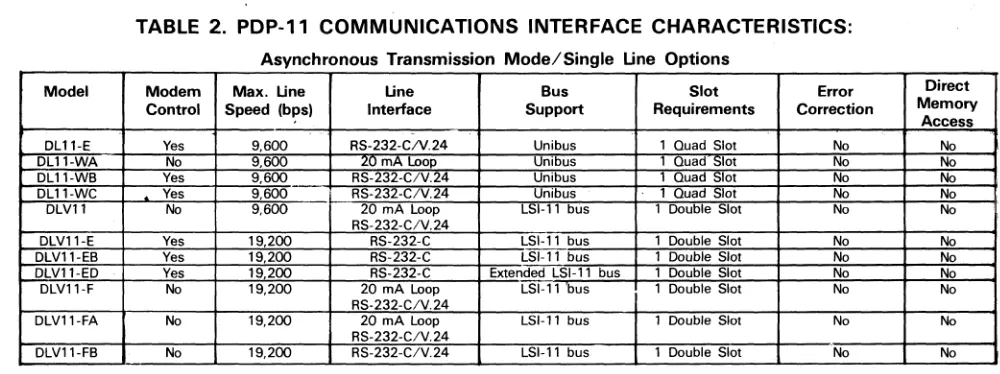
TABLE 2. PDP-11 COMMUNICATIONS INTERFACE CHARACTERISTICS:
Asynchronous Transmission Mode/Single Une Options
Model Modem Max. Une Une
Control Speed (bps) Interface
-DL11-E Yes 9.600 RS-232-CIV.24
DL11-WA No 9,600 ;tU rnA lOOp
DL11-WB Yes 9,600 RS-232-C/V.24
DL11-WC Yes 9,600 RS-232-CIV.24
DLV11 No 9,600 20 rnA Loop
RS-232-CIV.24
DLV11-E Yes 19,200 RS-232-C
DLV11-EB Yes 19,200 RS-232-C
DLV11-ED Yes 19200 RS-232-C
DLV11-F No 19,200 20 rnA Loop
RS-232-CIV.24
DLV11-FA No 19,200 20 rnA Loop
RS-232-CIV.24
DLV11-FB No 19,200 RS-232-CIV.24
~ The DHll-AD Programmable 16-Line Asynchronous Multiplexer provides programmed selection of nearly all parameters that are switch-selectable on the D LII-data rate, character and stop element size, and parity check/ generation on receive and transmit lines. The DUll-AD offers a choice of 14 data rates plus 2 special rates of the user's choice. Each of the 16 lines can operate independently at any speed. Receive characters for each line are buffered in a US-byte buffer to reduce CPU loads. Transmit characters can be sent directly in blocks from memory (DMA). The DUll-AD has 16 separate DMA transmitters, each with its own hardware byte count and address registers. Also, special hardware to detect data breaks and to generate program-controlled breaks is provided. The DUll-AD supports EIA RS-232-C connections.
The DHll-AE Programmable 16-Line Asynchronous Multiplexer provides the same capabilities as the DUll-AD, except it does not support modems. It is for local connection only.
The DUP-ll-DA Synchronous Line Interface is a single-line, program-controlled, double-buffered controller capable of handling both byte-oriented protocols, such as binary synchronous and DEC's DDCMP, and bit-oriented protocols, such as SDLC and UDLC. The DUP-ll-DA is restricted to 8-bit characters. Bit- or byte-oriented operations are software-selectable. Modem controls are provided, permitting operation with Bell 200 Series or equivalent synchronous data sets at speeds up to %00 bps.
Additional features of the DUP-ll-DA include calculating and checking of CRC-16 block check characters and bit stuffmg. The latter is engaged when using DDCMP and CRC/CCITT bit-oriented protocols to preclude data characters from being confused with control characters. Specifically, the DUP-ll-DA inserts "0" bits in bit streams containing five or more consecutive "I" bits so that the receiving device will not interpret this stream as a FLAG control character.
The DMCll Network Link Modules interconnect PDP-ll computers similarly equipped in a remote network. They operate in full or half duplex. They interface to Bell 200 Series or equivalent modems at speeds up to 19.2K bps or Bell 500 Series or equivalents at 250K bps. The DMClls can be used to communicate over common carrier facilities to other DMCIls or to a synchronous interface with software implementation of DDCMP Version 3.2.
The DMCIl Network Link Modules include:
• The DMCIl-AR, which is designed to be used for DDCMP operations with a DMClI-DA or DMCll-FA line unit.
Bus Slot Error Direct
Support Requirements Correction Memory
Access
Unibus 1 Quad Slot No No
niDUS 1 Quad Slot No No
Unibus 1 Quad ~Iot No No
Unibus Quad Slot No No
LSI-ll bus 1 Double Slot No No
LSI-11 bus 1 Double Slot No No
LSI-11 bus 1 Double Slot No No
Extended LSI-11 bus 1 Double Slot No No
LSI-11 bus 1 Double Slot No No
LSI-ll bus 1 Double Slot No No
LSI-11 bus 1 Double Slot No No
• The DMCIl-DA, a network line unit designed for remote use with RS-232-C and CCITT devices at up to 19.2K bps.
• The DMClI-FA, which interfaces to CCITT modems (Bell 500 Series or equivalent) at speeds up to 250K bps.
The DMPll Multipoint Network Link Modules provide multipoint or point-to-point connections. They operate at full or half-duplex. The DMPlls can be used over common carrier facilities to other D MPII s or equivalent synchronous interface with software implementation of DDCMP Version 3.1 or 4.0. Depending upon the operating system, the DMPlls will support up to 32 tributaries. RS-232-C data rates of up to 19.2K bps are supported.
The DMPll Multipoint Modules include:
• The DMPll-AA, which supports up to 32 tributaries at full or half-duplex. Data rate is 56K bps for RS-423-A and 19.2K bps for RS-232-C. In multipoint operation, the complementary device must be either a DMPll or DMVll operating in the same mode.
• The DMPlI-AB, which is the same as DMPlI-AA, except it supports a CCITT V.35 interface only at a data of 56K bps, and it includes a 25 foot modem cable. • The DMPlI-AC, which supports up to 32 tributaries in a
local network. Maximum speeds are 1M bps for half-duplex and 500K bps for full-half-duplex. An integral modem is included. Complementary devices must be DMPlls or DMVlls.
• The DMPll-AE, which is the same as the DMPll-AC, except that instead of having an integral modem, it provides an RS-422-A interface.
The DMRll-AA Network Link Module supports speeds up to 56K bps in a full or half-duplex mode. The DMRlI-AA includes a built-in modem, provides ISO 4902, RS-232-C, RS-449, RS-423-A, or CCITT V.24 interfaces, and requires a DMRlI or DMClI as a complementary device, The DMRll-AB Network Link Module is the same as the DMRlI-AA but can also communicate locally at speeds up to 1M bps. Interfaces can be ISO 2593 or CCITT V.35. The DMRll-AE Network Link Module is the same as the DMRlI-AB, except that it supports an RS-422-A interface . The DMRll-AC Network Link Module interconnects PDP-II computers in local network applications and provide a ~
[image:5.612.47.547.74.261.2]C13:384-106 Processors
DEC PDP-11 Family Communications Capabilities
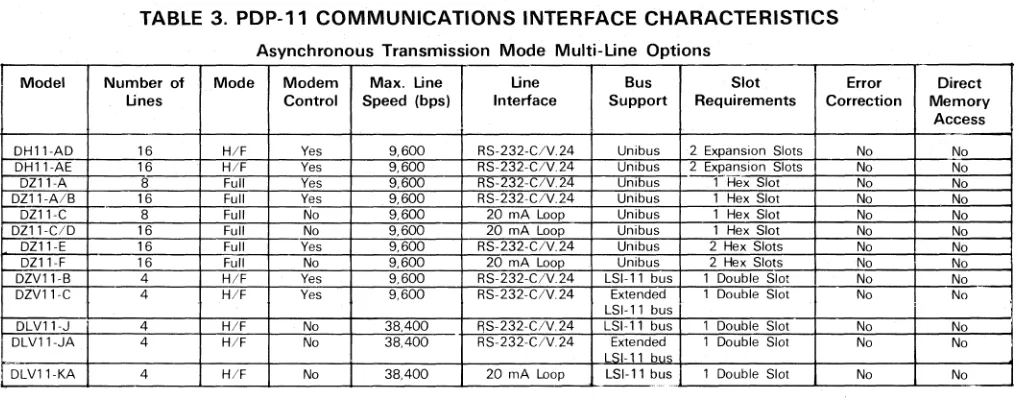
TABLE 3. PDP-11 COMMUNICATIONS INTERFACE CHARACTERISTICS
Asynchronous Transmission Mode Multi-Line Options
Model Number of Mode Modem Max. Une Une Bus Slot Error Direct
Unes Control Speed (bps) Interface Support Requirements Correction Memory
Access
DH11-AD 16 H/F Yes 9,600 RS-232-C/V.24 Unibus 2 Expansion Slots No No
DH11-AE 16 H/F Yes 9,600 RS-232-C/V.24 Unibus 2 Expansion Slots No No
DZ11-A 8 Full Yes 9,00 R::;-232-CIV.24 Unibus 1-Hex Slot No No
DZ11-A/B 16 Full Yes 9,600 RS-232-C/V.24 Unibus 1 Hex Slot No No
DZ11-C 8 Full No 9,600 20 mA Loop Unibus 1 Hex Slot No No
DZ11-C/D 16 Full No 9,600 20 mA Loop Unibus 1 Hex Slot No No
DZ11-E 16 Full Yes 9,600 RS-232-CIV.24 Unibus 2 Hex Slots No No
DZ11-F 16 Full No 9,600 20 mA Loop Unibus 2 Hex Slots No No
DZV11-B 4 H/F Yes 9,600 RS-232-C/V.24 LSI-11 bus 1 Double Slot No No
DZV11-C 4 H/F Yes 9,600 RS-232-CIV.24 Extended 1 Double Slot No No
LSI-11 bus
DLV11-J 4 H/F No 38,400 f1S-232-CIV.24 LSI-11 bus 1 Double Slot No No
DLV11-JA 4 H/F No 38,400 RS-232-CIV.24 Extended 1 Double Slot No No
LSI-11 bus
DLV11-KA 4 H/F No 38,400 20 mA Loop LSI-11 bus 1 Double Slot No No
~.-~ ..
~ connection to other DMRll-AC modules using twin-axial, co-axial, or tri-axial cables up to 18,000 feet long. It operates at full~duplex with two cable and half-duplex with a single cable. Switch-selectable speeds range from 56K bps to 1M bps.
Character formats are seven or eight data bits with one or two stop bits. Parity is even, odd, or none. This unit does not provide modem control.
The PCLlJ-B Multidrop DDP Network Link is used to connect up to 16 processors in a local distributed processing network. It transmits data in a block mode via a time division multiplexed bus. Total bus bandwidth ranges up to 1M bps. The total bandwidth between any transmitter and receiver is 500K bps or less depending upon the percentage of bandwidth that is allocated to the transmitter. Data is transmitted at full-duplex with CRC error detection support. The KGlJ-A Communications Arithmetic Error Connector computes cyclic redundancy check (CRC), longitudinal redundancy check (LRC), and block check characters (BCC).
lSI-11 Bus Communications Interfaces (for PDP-11 I03l and 11123)
The DLVlJ Serial Interface Unit operates at full or half-duplex for 20mA connections at data rates up to 9600 bps. This unit does not provide modem control. Support is provided for a single line only.
The DL VlJ-E Asynchronous Line Interface Module operates at full or half-duplex with data rates of up to 19,200 bps. It provides modem control for Bell 100 and 200 Series or compatible modems.
The DL VII-EB Asynchronous Line Interface Module is the same as the DLVll-E, but includes a modem cable. The DL VlJ-F Asynchronous Line Interface Module operates at full or half-duplex with data rates from 50 to 19.2K bps. This unit supports a 20mA current loop and does not provide modem control.
The DLVII-FA Asynchronous Line Interface Module is the same as the DLVll-F but includes a cable.
The DL VlJ-FB EIAjCCITT Asynchronous Line Interface Module operates at full or half-duplex at data rates up to 19.2K bps but does not provide modem control. It supports EIA/CCITT interface levels.
The DLVlJ.J Four-Line Asynchronous Line Uni/. operates at full or half-duplex at data rates up to 38.4K bps.
The DL Vll-KA Four-Line Asynchronous Line Unit converts the DLVll-J to 20mA current loop use. The DZVll-B Four-Line Asynchronous Multiplexer provides per line speed programmability for data rates between 50 and 9600 bps. The DZVII-B supports Bell 103 or compatible modems.
The DPVlJ-DB Single-Line Synchronous Interface is used to connect the LSI-II bus to Bell 201 or compatible modems. It supports data rates up to 56K bps for full or half-duplex operation.
The DMVlJ-AA Intelligent Synchronous Line Controller is a microprocessor based device that supports multipoint or point-to-point DMA data transfers for a maximum of 12 tributaries. It handles all DDCMP protocol processing. In a point-to-point operation, the DMVJI-AA can communicate with a DMCll, DMRII, DMPll, or DMVII. For multipoint communication, the complementary device must be either a DMPII or DMVll. Maximum data rate is 56K bps for RS-423-A interface and 19.2K bps for RS-232-C interface.
The DMVlJ-AB Synchronous Line Controller is the same as the DMVII-AA, except it only supports CCITT V.35 operation at 56K bps.
The DMVlJ-AC Intelligent Synchronous Line Controller has the same capabilities as the DMVII-AA above, but includes a built-in modem.
Extended lSI-11 Bus Communications Interfaces (for PDP-11 123 Plus)
The DL VlJ-ED Single Line Asynchronous Interface operates at full or half-duplex with data rates from 50 to 19.2K bps. It supports Bell 100 or 200 Series or compatible modems.
The DL VII.JA Four-Line Asynchronous Interface operates at full or half-duplex with data rates from 150 to 38.4K bps. Character formats of seven or eight bits with even, odd, or no parity. This unit does not include modem control. The DMVlJ-AA Intelligent Synchronous Line Controller supports point-to-point or multipoint DMA data transfers ~
© 1982 DATAPRO RESEARCH CORPORATION, DELRAN, NJ 08075 USA REPRODUCTION PROHIBITED
[image:6.612.57.566.76.276.2]DEC PDP-11 Family Communications Capabilities
TABLE 4. PDP-11 OPERATING SYSTEM SUPPORT
RT-11
Minimum Memory (K bytes)
Currently Marketed Machines:
PDP-11/03L PDP-11123 PDP-11123 PI us PDP-11/24 PDP-11/34A PDP-ll/44 PDP-11170
~ for up to 12 mUltipoint tributaries. It handles all DDCMP protocol processing. In point-to-point operation, the DMVll-AA can communicate with a DMCII, DMRII, DMPII, or DMVII. In mUltipoint communications, the complementary device must be either a DMPII or a DMVII. The maximum data rate is56K bps for RS-423-A and 19.2K bps for RS-2332-C interface.
The DMVII-AB Synchronous Line Controller is the same as the DMVII-AA, except it only supports CCITT V.35 operation at 56K bps.
The DMVll-AC Intelligent Synchronous Line Controller provides the same capabilities as the DMVII-AA, but includes a built-in modem.
The DZVll-C Asynchronous Four-Line Multiplexer provides programmable line speed on a per-line basis for speeds up to 9600 bps. It supports Bell 103 or compatible modems.
SOFTWARE
Four functionally different operating systems are available from DEC for the PDP-II family. Not all of these operating systems are capable of running on all ofthe PDP-II models. Table 4 provides a comparison of these operating systems and the machine models on which they run.
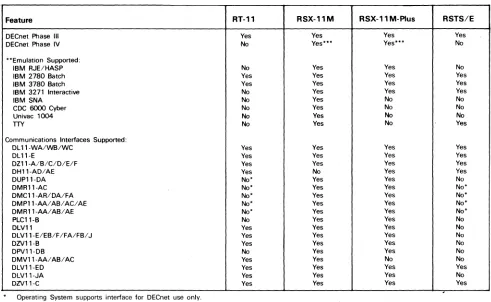
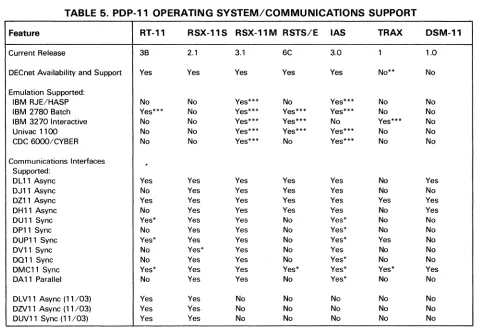
The operating systems differ not only in function, but also in the degree and type of data communications supported. Table 5 depicts these operating systems and the communica-tions support each provide.
All of the current operating systems support DECnet Phase III. In the not too distant past, this was not the case. Now any PDP-II family processor can be linked to the entire DEC communications network.
All DEC networks will typically use DECnet, but DECnet is not a turnkey solution. At the very least, customers must purchase communications links such as a telephone line or private wire, one or more of DEC's communications interfaces for each computer in the network, and often a modem for each end of every link. Some of the more complicated applications will .require considerable program-ming, as well.
DECnet allows customers to:
• Transmit data files across a room or around the world, with less expense and greater speed than is generally possible through other media.
• Share expensive peripherals among Several CPUs, .some of which may be remote.
• Use another tool in the creation of high-availability (super-reliable) systems, adding to the Unibus links and multi-port options that Digital already supplies.
64
Yes Yes No Yes Yes No No
RSX-11M RSTS/E RSX-11 M-Plus
128 256 256
No No No
Yes No No
Yes Yes Yes
Yes Yes Yes
Yes Yes No
Yes Yes Yes
Yes Yes Yes
The Digital Data Communications Message Protocol (DDCMP), the link protocol for DNA/DECnet, performs the physical line control for most of the synchronous communications hardware interfaces noted in Tables I, 2, and 3.
. DDCMP performs line scanning, error detection and error recovery. On half-duplex lines, DDCMP controls the direction of traffic, while on full-duplex lines, DDCMP controls bidirectional traffic; on multi-point lines DDCMP performs the polling function. Outgoing transmissions are enveloped with control characters mainly to enable the receiving device to perform error detection. The CRC-16 polynomial checking technique is employed in creating an error detection code. Incoming transmissions are stripped of control characters after passing error detection checks. To accommodate for the relatively long transit time for satellite destined messages, DDCMP can support the transmitting up to 255 messages before halting transmissions to await acknowledgements for the previously transmitted messages. DECnet software to handle the DDCMP protocol line handling is intended for use with medium speed communica-tions systems. The software will perform the function for both the program-interrupt and the DMA types of communications hardware interfaces. When volume increases substantially and begins to consume too much central processor overhead or when high-speed communica-tions lines are used, the DMCII interface can be employed. Containing a dedicated microprocessor, the DMCII will perform, via firmware, the line handling function, thus relieving the central processor's DECnet software of this time-costly burden. With the DMCII, a user could employ DDCMP protocol without using the other functions of DECnet.
See Report #CII-384-101 in Section CII for more details on DECnet.
The RT-ll Operating System is a disk-based, real-time operating system typically designed for a smaller and even single user. It may be implemented on Models 1I/03L, 11/23, 11/24, and 1I/34A.
Special communications software programs supported by RT-ll are listed below:
• DECnet-RT (QJ687) is a Phase III network product that allows an RT-II based system to participate as a non-routing node in a DEC computer network.
• RT-Il 2780/3780 Protocol Emulator (QJD59) permits an RT -II system to emulate an IBM 2780 or 3780 remote batch terminal. A DUVll or DlJPll Synchronous Interface is required.
RSTS/E (Resource Sharing Timesharing System/Extend-ed) is a timesharing system designed to accommodate large numbers of interactive users. RSTS/E can run on a PDP 11/23 Plus, 11/24, 1l/34A, 11/44, or 11/70 and supports a •
C13-384-108 Processors
DEC PDP-11 Family Communications Capabilities
PDP-"
Bale c.bInet I I I I- I I
I I
---~
I I I I
Me""", IDMAI
Double Po"" Expansion
Single Po.,.. Expansion
I I
1
UNIBUSUNIBUS
I
I
UNIBUS
Configuration
9-$101
110
--9-SIol 1/0 Interface
4-SIoI
1/0
Int_
Communications
Lines-and/or
Peripher ...
Communic8ticJns li ... •
end/or
Peripher."
~
Communicllttona
Lines-and/or
... ri ... l.
'Throughput considerations determine line configuration alternatives; see Tables 1. 2. and 3 for specifications.
~ wide range of communications interfaces for local and remote terminals with varying characteristics.
Special communications software programs supported by RSTS/E are as follows:
• RSTS/E-2780 (QPDIO) is a software package which permits RSTS/E systems to act as an IBM 2780 device.
• DECnet/E (QP692) allows a RSTS/E system to participate as a routing or non-routing node in a DEC computer network.
• RSTS/E High Performance 2780/3780 Emulator (QRD06) is a program which permits an RSTS/E system to appear as an IBM 2780 or 3780 to an IBM System 370, 303X, or other mainframe processor. It requires a DUPII-KA and a compatible communications proces-sor.
• RSTS/E 3271 Protocol Emulator (QRD05) permits RSTS/E system jobs to communicate interactively with tasks running on an IBM 370, 303Xor other host supporting the 3271 protocol. The IBM program must run under IMS/VS or CICS/VS systems. It requires a DUPll-DA and a compatible communications proces-sor.
• DX/RSTS (QJ703) is a software package that makes asynchronous communications possible between RSTS/ E systems and DEC word processors and personal computers.
The RSX-llM Operating System is realtime programming system designed for a wide range of applications. Consequently, it supports all current PDP-ll family processors except the 1l/03L. Communications software support is just as broad and includes the following packages: • DECnet-llM (QJ684) allows RSX-IIM systems to participate as a routing or non-routing node in a DEC computer network.
• MUX200/RSX-IAS Multiterminal Emulator (QJ070) is a software program that provides communications with a CDC 6000 Cyber Series computer or other system using the 200 UT -mode 4A protocol.
• RSX-IIM/IAS RJE/HASP (QJS60) is a software package for performing the standard functions of an IBM HASP remote job entry workstation.
• RSX-llM/SNA Protocol Emulator (QJD69) provides an RSX-IIM system the ability to participate in an IBM Systems Network Architecture network. It sU' ,:.orts half-or full-duplex transmissions at speeds up .; 9600 bps when used with the prerequisite DUPIl_
• RSX-ll 2780/3780 Emulator (QJD82) emulates the ( communications protocol of an IBM 2780/3780 device
<
while running a job under RSX-IIM or RSX-llM-Plus-systems.• RSX-ll/3271 Protocol Emulator (QJD76) permits jobs running under RSX-llM or RSX-llM-Plus systems to ....
© 1982 DATAPRO RESEARCH CORPORATION, DELRAN, NJ 08075 USA REPRODUCTION PROHIBITED
JULY 1982
(
DEC PDP-11 Family Communications Capabilities
TABLE 5. PDP-11 OPERATING SYSTEM COMMUNICATIONS SUPPORT**
Feature RT-11 RSX-11M RSX-11 M-Plus RSTS/E
DECnet Phase III Yes Yes Yes Yes
DECne! Phase IV No Ves*** Yes*** No
""Emulation Supported:
IBM RJE/HASP No Yes Yes No
IBM 2780 Batch Yes Yes Yes Yes
IBM 3780 Batch Yes Yes Yes Yes
IBM 3271 Interactive No Yes Yes Yes
IBM SNA No Yes No No
CDC 6000 Cyber No Yes No No
Univac 1004 No Yes No No
nv
No Yes No YesCommunications Interfaces Supported:
DL11-WA/WB/WC Yes Yes Yes Yes
DL11-E Yes Yes Yes Yes
DZ11-A/B/C/D/E/F Yes Yes Yes Yes
DH11-AD/AE Yes No Yes Yes
DUP11-DA No" Yes Yes No
DMR11-AC No" Yes Yes No"
DMC11-AR/DAIFA No" Yes Yes No"
DMP11-AA/AB/AC/AE No" Yes Yes No"
DMR11-AA/AB/AE No" Yes Yes No"
PLC11-B No Yes Yes No
DLV11 Yes Yes Yes No
DLV11-E/EB/F/FA/FBI J Yes Yes Yes No
DZV11-B Yes Yes Yes No
DPV11-DB No Yes Yes No
DMV11-AAI ABI AC Yes Yes No No
DLV11-ED Yes Yes Yes Yes
DLV11-JA Yes Yes Yes No
DZV11-C Yes Yes Yes Yes
,
Operating System supports interface for DECnet use only.
This Table shows software offered by DEC only. Independent vendors may offer additional emulation software support . ••• Not yet available. Delivery is promised for early 1984.
~ communicate interactively with jobs running on an IBM 370, 303X, or other compatible host.
• UNI004/RSX/Univac 1004 Terminal Emulator (QJI70) provides communications between an RSX-llM system and a Univac 1100 series or other system using the Univac 1004 RMS-l protocol.
• DX/11M (QJ704) is a software program that allows asynchronous communications between an RSX-llM and a DEC word processor or personal computer. RSX-llM-Plus is the fourth current operating system in the PDP-11 family. RSX-11M-Plus is a higher performance superset of the RSX-llM. It is a disk-based system and supports the larger PDP-lls: 11/23 Plus, 11/24, 11/44, and 11/70.
Special communications software support for RSX-IlM-Plus is provided by the following software:
• DECnet-11M-Plus (QR580) allows an RSX-IlM-Plus system to participate as a routing or non-routing node in DEC computer networks using Digital Network Architecture (DNA) protocols.
• RSX-11 2780/3780 Emulator (QJD82) emulates the communications protocol of an IBM 2780/3780 device while running a job under RSX-IlM or RSX-11M-Plus systems.
• RSX-11/3271 Protocol Emulator (QJD76) permits jobs running under RSX-IlM or RSX-llM-Plus systems to communicate interactively with jobs running on an IBM 370, 303X, or other compatible host.
• RSX-11M/IAS RJE/HASP (QJS62) is a software program that allows an RSX-11M-Plus system to perform functions of an IBM HASP remote job entry workstation.
PRICING
DEC generally provides the PDP-ll minicomputers on a purchase basis, with separately priced maintenance agreements. Leases are also available from DEC. Lease rates vary with the prime interest rate, the customer's volume of business with DEC, and the value of the equipment being leased.
Software maintenance is offered through several levels of optional service, ranging from a periodic software newsletter to automatic updates of software and manuals (software subscription service). In addition, software components, including documents and updates, can be purchased separately from Digital's Software Distribution Center.
The Digital Equipment Computer Users Society (DECUS) is a voluntary, non-profit users'group supported by DEC. DECUS provides an extensive program library, users' groups, special interest groups, and workshops/symposia.
Field maintenance services are offered on several levels which vary depending on specific customer needs. The monthly charges shown are for the 8 hour/5 day on-site Basic Service Agreement, and include all parts and labor required for system maintenance. Software license fees are for single system use, include basic support, and may vary
slightly depending on medium. ~
[image:9.612.57.548.115.417.2]....
C13-384-110 Processors SR-VXSSB-BA SM-WXMMA-BA SE-RXMMB-CA SE-FXHHA-CA SM-30MMB-BA SE-40UAC-CA SE-70DBA-CA DL11-WB DL11-WC DL11-WA DL11-E DZll-A DZll-B DZll-C DZll-D DZ11-E DZll-F DH11-AD DHll-AE DUPll-DA DMRll-AC DMC11-AR DMC11-DA DMC11-FA DMPll-AA DMP11-AB DMPll-AC DMRll-AA DMR11-AB DMRll-AE DMPll-AE PLCll-B KGll-A DLVll DLV11-E DLV11-EB DLV11-F DLVll-FA DLV11-FB DLVll-J DLV11-KA DZV11-B DPV11-DB DMVll-AA DMVll-AB DMVll-AC DLV11-ED DLV11-JA DZVll-CDEC PDP-11 Family Communications Capabilities
Typical Processor Configurations
PDP-ll/03L CPU with 64K bytes of memory, RT-ll operating system, four line asynchronous interface, two 500K byte diskette drives and controller, and a video display
PDP-11123 CPU with 128K bytes of memory, RSX-l1 M operating system, four line asynchronous interface, two 10.4M byte cartridge disk drives and controller, and a video display
PDP-11123 Plus CPU with 256K bytes of memory, RSTS/E operating system, two 10.4M byte disk drives and controller, and a 180 cps printer
PDP-11124 CPU with 256K bytes of memory, RSTS/E operating system, two line asynchronous interface, two 2817 byte disk drives and controlier, and a 180 cps printer
PDP-11/34A CPU with 128K bytes of memory, RSX-ll M operating system, single line asynchronous interface, two 10.4M byte disk drives and controller, and a video display terminal
PDP-11/44 CPU with 512K bytes of memory, RSTS/E operating system, Cobol programming language, two single line asynchronous interfaces, two 256K byte cartridge tape drives, one 67M byte disk drive and controller, one mag tape drive, and a 180 cps printer
PDP-11170 CPU with 512K bytes of memory, RSTS/E operating system, single line asynchronous interface, one 256M byte disk drive and controller, 800/1600 bpi tape drive, and a 180 cps printer
PDP-11/24. 11/34A. 11/44. and 11/70 Communications Options EIA/CCITI Single Line Asynchronous Interface
Asynchronous Serial Interface Asynchronous 20mA Seria I Interface Single Drive Asynchronous Interface
EIA/CCITI Eight-Line Asynchronous Multiplexer
EIA/CCITI Eight-Line Asynchronous Expansion Multiplexer Eight Line Asynchronous Multiplexer
Eight Line Asynchronous Expansion Multiplexer EIA/CCITI Asynchronous 16-Line Multiplexer Asynchronous 16-Line Multiplexer
Programmable EIA/CCITI 16-Line Multiplexer Programmable 16-Line Multiplexer
Single Line Synchronous Interface Local Network Link Line Unit DDCMP Network Link Module Remote Network Link Module Remote Network Link Module Multipoint Network Link Module Multipoint Network Link Module Local Network Link Module Network Link Module with Modem Local Network Link Module Network Link Module Remote Network Link Line Unit Multidrop DDP Network Link
Communications Arithmetic Error Correction Option
PDP-11/03L and PDP-11/23 Communications Options Serial Interface Unit
Asynchronous Line Interface Module Asynchronous Line Interface Module Asynchronous Line Interface Module Asynchronous Line Interface Module
EIA/CCITI Asynchronous Line Interface Module Four Line Asynchronous Line Unit
20mA Current Loop Converter Four Line Asynchronous Multiplexer Single Line Synchronous Interface Intelligent Synchronous Line Controller Intelligent Synchronous Line Controller
Intelligent Synchronous Line Controller With Integral Modem
PDP-11/23 Plus Communications Options Si ngle Line Asynchronous Interface
Four Line Asynchronous Interface Asynchronous Four Line Multiplexer
© 1982 DATAPRO RESEARCH CORPORATION, DELRAN, NJ 08075 USA REPRODUCTION PROHIBITED
/ "
"
Purchase Monthly Price Milintenan~.
$ 14,700 $141
26,100 247
32,900 247
62,700 447
37,100 250
102,200 508
178,300 932
950 7
950 7
990 7
1,170 8
2,700 33
2,150 28
3,000 33
2,310 28
4,350 56
5,000 56
8,950 68
7,950 57
1,575 12 ./
6,900 74
2,130 21
1,500 7
1,880 7
6,900 74
6,900 74
6,900 74
4,400 39
4,400 39
4,400 39
6,900 74
7,750 66
1,350 7
525 6
440 8
550 8
440 8
550 8
670 8
580 11
190 7
1,100 11
770 13
2,200 39
2,300 39
2,000 39
490 8
650 10
1,100 10 ~
, ~
(
(
~ OJ687
OJD59 OPD10 OP692 ORD06 ORD05 OJ703 OJ684 OJ070 OJS60 OJD69 OJD82 OJD76 OJ170 OJ704 OR580 OJS62
DEC PDP-11 Family Communications Capabilities
DECnet-RT RT-l1 2780/3780
RSTS/E-2780 DECnet/E
SOFTWARE
RSTS/E High Performance 2780/3780 Emulator RSTS/E 3271 Protocol Emulator
DX/RSTS DECnet-llM
MUX200/RSX-IAS Mult:terminal Emulator RSX-ll MilAS RJE/HASP
RSX-ll M/SNA Protocol Emulator RSX-ll 2780/3780
RSX-11/3271 Protocol Emulator
UN1004/RSX/Univac 1004 Terminal Emulator DX/llM
DECnet-ll M-Plus RSX-ll MilAS RJE/HASP
'Includes software support .•
JULY 1982 © 1982 DATAPRO RESEARCH CORPORATION, DELRAN, NJ 08075 USA REPRODUCTION PROHIBITED
license Fee*
f
DEC PDP-11 Family Communications Capabilities
MANAGEMENT SUMMARY
Datapro estimates that something on the order of
60,000 PDP-II processors have been delivered by
DEC, and many are involved in communications
applications to some extent.
The extremely versatile PDP-II line of minicomputers
has been continually enhanced throughout its
ten-year history. (A thumbnail sketch of the past and
present models is provided in Table
1.)As of this
publication, there are five model groups actively
marketed by DEC and, with the exception of the
low-end PDP-lIf03, all share a common internal
design called the UNIBUS. The UNIBUS design
permits the user to connect any DEC If 0 devices
to any of the PDP-ll models.
Over twenty different line controller and interface sets are
available from DEC which effectively handle local, remote
and interprocessor communications. Virtually all modes
and types of data communications, protocols and
facilities, are supported. Seven functionally different
operating systems are available from DEC, along with
numerous emulation software packages which permit
PDP-ll interconnection with IBM, Univac and CDC
mainframes.
There are basically two groups of communications
interfaces available from DEC, differentiated primarily in
their effect on processor utilization. The DMCIl, for
example, contains communications processing microcode
which greatly reduces the amount of communications
processing that the host processor must perform. These
"controllers" generally feature Direct Memory Access
t:>
A family of minicomputers which may be effectively implemented as front-end com-munications processors, as remote proc-essors in a distributed network, as remote network nodesl controllers, or in a combina-tion of these funccombina-tions.
A user may choose from among five current-ly-marketed PDP-11 models with memory ranging from 16K bytes to four megabytes. Seven operating systems are available from DEC which offer extensive and widely varying communications capabilities. In addition, DEC offers dozens of communica-tions opcommunica-tions including DECnet and emula-tion software for use with IBM, Univac and CDC mainframes.
A typical PDP-11
134
processor running the RSX-11 M operating system with DECnet, 64K bytes of memory, disk storage, and interfaces for eight asynchronous and two synchronous -lines can be purchased for $39,500. Monthly maintenance for this configuration is $298.CHARACTERISTICS
VENDOR: Digital Equipment Corporation, 146 Main Street, Maynard, Massachusetts 01754. Telephone (617) 897-5111.
DATE OF FIRST ANNOUNCEMENT: March 1970.
DATE OF FIRST DELIVERY: August 1970. ~
The largest member of the PDP-II line, the 11/70, features memory management hardware capable of addressing up to four million bytes of memory, and 0.24-microsecond cache memory. The II /70 configura-tion shown in the photo contains 512K bytes of memory, two magnetic tape transports, two I-megabyte fixed-head disk drives (right of magnetic tape units), two 88-megabyte disk pack drives (right rear), five user terminals (foreground), a 300-lpm line printer (left), and two communications sub-systems (stand-alone center and rear), which contain communications con-trollers and interfaces.
C13-384-102
Processors
DEC PDP-11 Family Communications Capabilities
TABLE'. PDP-" MODEL SUMMARY
LSI- 11/34.
11/60
LSI-11 11/03 11/04 11106- 11110- 11/1.6-
11120-11134A 11/35' 11/40- 11/45' 11166 11
no
1112
Date AMounc:ed 1/78 2175 12175 11/74 10/71 1173 4171 3170 2176 10173 8172 10171 12175 3177 2175
First Delivery 3178 5/75
-
7/75 2/72 2173 6171 8/70 3176 1174 1/73 4172 3/76 5/77 5175Typical Purchase'- $l.lK $1.61< $lOK $17.3K
-
-
-
-
$20.91< $29.91<-
$41.8K $66.2K $4OK $1001<Number Installed '"
-
29.000 9,100 11.000 4,250 750 8,000 3,000 400 1100• System IS no longer actively marketed.
--Includes memory and 1/0 configurations; quantity prices are shown for the LSI-ll and LSI-11/2.
"'Estimated, as of 1978.
I:>
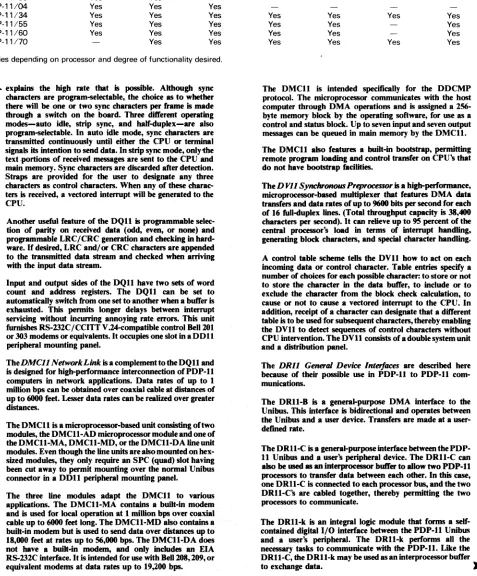
(0MA) for the messages and data they handle. The others
operate on a character-interrupt basis (including, for
example, the DUPll), and require substantial processor
involvement
in
communications handling (i.e., protocol
and code conversion, error handling, and so on).
Many independent vendors have jumped on the
bandwagon in the manufacture of communications
interfaces for the popular PDP-II family. Among the
most notable is Digital Communications Associates,
Inc. (DCA), of Norcross, Georgia. DCA markets
turnkey network systems, and specializes in PDP-II
UNIBUS-compatible controllers. The DCA System
205/ II, for example, is a UNIBUS adapter capable of
supporting up to 128 asynchronous terminals.
Itis
essentially a statistical multiplexer that can reportedly
replace up to 16 DEC DZII interfaces at a considerable
cost saving. Another DZII replacement is offered by
COMDESIGN, Inc., of Goleta, California. Its TC-3 plugs
into a UNIBUS and works with similar remote devices. In
; addition to other functions, it off-loads error detection and
l>correction from the host, thereby increasing throughput.
As a front-end, DEC markets several
specially-modified PDP-Il's to front end DEC mainframes,
specifically the DECsystems-1O and -20. The DN87,
for example, is a specialized PDP-II/40 which
front ends most of the DECsystem-1O models. It may
contain up to 64K bytes of memory and handle up to
128 communications lines. The DN20 front end is
actually a newer PDP-II / 34A which performs
front-end communications processing for the later
DECsystem-10 models, and the DECsystem-20. When front-ending
DEC mainframes, the PDP-II is loaded with a portion of
the host's operating system dedicated to communications
handling; TOPS-IO or TOPS-20, depending on the host.
DEC also markets a specialized PDP-II to perform as
a remote node in large DEC mainframe networks. The
DN200 is a PDP-II/34A which supports up to two
synchronous or 32 asynchronous communications
lines. Functioning as a remote concentrator, the
DN200 optionally supports a character printer and
card reader. Software for this remote node is likewise
included with the mainframe package.
Some of DEC's communications features for the
PDP-II are available on a specialty basis only, and
t>
. . . NUMBER DELIVERED TO DATE: Over 60,000 PDP-11 processors (all models-1978 estimate).
SERVICED BY: Digital Equipment Corporation.
CONFIGURATION
The original PDP-11 family of 16-bit minicomputers began in 1970 with the 11/20 model, and its closely related but stripped-down version, the 11/15. Both of these contained about 19 boards and some 600 integrated circuits. In 1971, the
11/05 and 11/45 were introduced, and marketed as more cost
effective replacements to the 11/15 and 11/20. These processors consisted of two boards and about 200 integrated circuits. The 11/45, like the other PDP-It's, was a core-only machine, but included memory management circuitry that raised the maximum memory capacity from 56K bytes to 248K bytes.
Although these models aU contained a UNIBUS-type ofI/O channel, it was not until MOS memory was introduced (with the 11/50) that the high-speed UNIBUS that is prevalent today was introduced. Subsequent models used both core and MOS memory, and DEC tumed its attention to packaged systems and software support.
Subsequent models (the 11/40, 11/35 and 11/04) were introduced that offered increasing price performance until 1975, when DEC announced the low-end, OEM-oriented LSI-11 microcomputer, and the high-end 11/10. The 11/10 was said to deliver 75 percent of the throughput of 1m IBM 370/158. It contained cache memory and memory management which permitted· addressing of up to 4 million bytes.
The LSI-II was subsequently marketed in a packaged version as the 11/03. In order to keep prices low, DEC left out the UNIBUS structure from these models.
In 1976, the 11/34 was announced, 50 percent faster than its predecessor model, the 11/04. Along with its cache memory brother, the 11/34A, main memory (either core or MOS) is supported to 248K bytes.
In 1977, the mid-range 11/60 was announced, with performance levels between the 11/34 and 11/70. It includes cache memory, main memory to 256K bytes, and user-accessible microprogramming.
The foundation of the PDP-11 hardware architecture is a standard I/O bus that DEC calls the UNIBUS. AU elements of the system are connected to the UNIBUS, including the central processor, main memory, I/O hardware interfaces, and communications interfaces. With certain exceptions, data is transferred between the elements of the system only
by passing through the UNIBUS. One exception is memory. ./ Central processors without cache memory have access to
core memory through the UNIBUS, but semiconductor ,,1.,. memory can be attached so that the central processor also
has direct access. I/O interfaces normaUy transfer data to and from memory via central processor interrupts, but several •
© 1979 DATAPRO RESEARCH CORPORATION. DELRAN. NJ 08075 USA
(
(
DEC PDP-11 Family Communications Capabilities
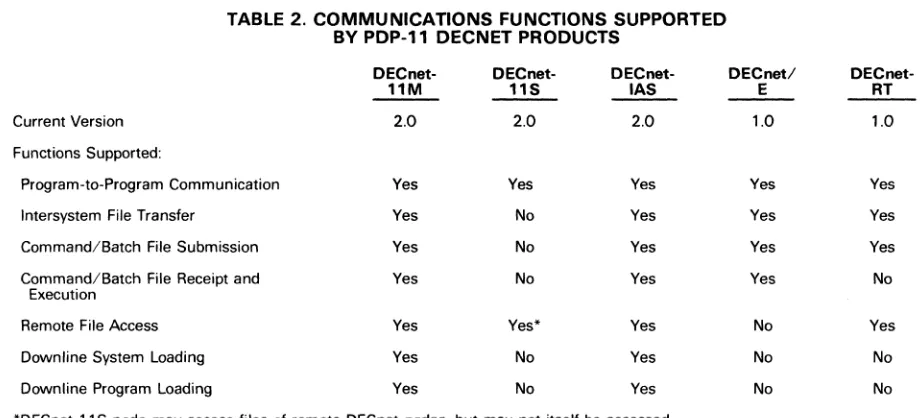
TABLE 2. COMMUNICATIONS FUNCTIONS SUPPORTED BY PDP-" DECNET PRODUCTS
DECnet- DECnet- DECnet- DECnet/ DEC
net-11M 11S lAS E RT
Current Version 2.0 2.0 2.0 1.0 1.0
Functions Supported:
Program-to-Program Communication Yes Yes Yes Yes Yes
Intersystem File Transfer Yes No Yes Yes Yes
Command/Batch File Submission Yes No Yes Yes Yes
Command/Batch File Receipt and Yes No Yes Yes No
Execution
Remote File Access Yes Yes* Yes No Yes
Downline System Loading Yes No Yes No No
Downline Program Loading Yes No Yes No No
*DECnet-11 S node may access files of remote DECnet nodes, but may not itself be accessed.
t:>
are not considered standard features or options.
These include, for example, channel adapters for
IBM 360/370 or Univac 1100 mainframes, whiCh
permit the PDP-II to front end these non-DEC hosts.
Other special packages include PDP-II's in
packet-switching, message-routing, or network-controlling
applications. Still others include PDP-II's as RJE
terminals to IBM, CDC, Univac and other non-DEC
computers.
Numerous OEM's, such as ASI Teleprocessing, Inc.,
of Watertown, Massachusetts, and Racal-Milgo, of
Miami, Florida, specialize in PDP-II-based
com-munications systems, and market configurations
which include many of these special features.
ASI markets three PDP-II based communications
systems; the Nucleus 4000, 4010, and 4100. These are
a family of front-end and network node processors
which are compatible with IBM, NCR, Data General
and Burroughs computers and terminals. Turnkey
systems are offered which feature PDP-II's with up
to 256K bytes of memory, and proprietary, bundled
ASI software. Numerous options, including
packet-switching software, are available.
Racal-Milgo markets the PDP-II in its
Communica-tions Management Series; the System 200 Network
Management System, and its recently-announced
eMS System 2000. The System 200 includes a PDP-II /
04 or 11/05 with up to 64K bytes of memory, and
provides for the control and monitoring of up to 64
communications lines, with up to 255 terminal devices
per line. The CMS System 2000 can
reportedly
manage up to 256 lines and up to 65,280 terminal
devices.
Itincludes a PDP-II running under the
RSX-II M operating system.
DNA AND DECNET
No discussion of the PDP-II's communications
capabilities would be complete without mentioning
1:>
~ communications interfaces do have direct memory access without processor intervention. Central processors with cache memory (PDP-ll/60, 70) have direct access to all types of memory without having to go through the UNIBUS. Additionally, high-speed mass storage units have direct access to cache memory and thus can bypass the UNIBUS when transferring data to and from memory. Connections to the UNIBUS are via the backplane, a printed circuit board with sockets. The backplane that is provided with the central processor consists of nine rows of sockets. Each row, called a slot, has six records. Two slots have two sockets reserved. This results in seven slots of six sockets per slot (Hex slot) and two slots of four sockets (Quad slot) per slot. To connect most I/O interfaces require six sockets, four sockets, or multiples thereof. The combination of devices is limited to the mix of sockets and slots required. Slots as well as sockets must be taken into consideration. A Hex or six-socket interface requirement could not use two Quad slots even though eight sockets are available.
Two expansion panels are available. One expansion panel provides four slots (two Hex and two Quad) and another expansion panel provides nine slots (seven Hex and two Quad).
Memory cycle time for PDP-ll processors is 1.2 microseconds for core memory, 0.45 or 0.3 microseconds for MOS memory, and 0.3 microseconds for bipolar memory. The top ofthe PDP-ll line can support up to 1.024K words of memory plus a lK bipolar cache memory with a cycle time of 0.24 microseconds. The PDP-ll word consists of 16 bits.
All models except the LSI-ll and 11/03 have four automatic hardware priority level interrupts. The 11/45, 11/55, 11/60, and 11/10 can also use any of seven programmable software-supported additional interrupt levels; these have an automatic vectoring instruction held in a reserved main storage location. Each of the interrupt levels can accommodate independently prioritized peripheral devices.
The priority of any device connected to the Unibus is determined by its physical position; hence, the processor is normally attached so as to give it the highest priority. There is no logical limit to the number of devices that can be attached to the Unibus, with bus access and control handled by the interrupt system.
The theoretical maximum Unibus data transfer rate is 5 million bytes per second, and attached components ~
[image:15.612.75.535.71.280.2]