information.
Author(s):Kang, Miao; Palmer-Brown, Dominic
Title:Combining neural modes of learning for handwritten digit recognition Year of publication:2008
Citation: Kang, M. and Palmer-Brown, D. (2008) ‘Combining neural modes of learning for handwritten digit recognition’ Proceedings of Advances in Computing and Technology, (AC&T) The School of Computing and Technology 3rd Annual
Conference, University of East London, pp.99-107 Link to published version:
COMBINING NEURAL MODES OF LEARNING FOR
HANDWRITTEN DIGIT RECOGNITION
Miao Kang, Dominic Palmer-Brown
School of Computing and Technology, University of East London, UK [email protected], [email protected]
Abstract: An ADaptive Function Neural Network (ADFUNN) is combined with the on-line snap-drift learning method in this paper to perform optical and pen-based recognition of handwritten digits. Snap-Drift employs the complementary concepts of minimalist common feature learning (snap) and vector quantization (drift towards the input patterns), and is a fast unsupervised method suitable for real-time learning and non-stationary environments where new patterns are continually introduced. The ADaptive FUction Neural Network (ADFUNN) is based on a linear piecewise neuron activation function that is modified by a gradient descent supervised learning algorithm. It has previously been applied to the Iris dataset, and a natural language phrase recognition problem, exhibiting impressive generalisation classification ability without the hidden neurons that are usually required for linearly inseparable data. The unsupervised single layer Snap-Drift is effective in extracting distinct features from the complex cursive-letter datasets, and the supervised single layer ADFUNN is capable of solving linearly inseparable problems rapidly. In combination within one network (SADFUNN), these two methods are more powerful and yet simpler than MLPs (a standard neural network), at least on this problem domain. The optical and pen-based handwritten digits data are from UCI machine learning repository. The classifications are learned rapidly and produce higher generalisation results than a MLP with standard learning methods.
1. Motivation:
Artificial neural network learning is typically accomplished via adaptation between neurons. The computational assumption has tended to be that the internal neural mechanism is fixed. However, there are good computational and biological reasons for examining the internal neural mechanisms of learning. Recent neuroscience suggests that neuromodulators play a role in learning by modifying the neuron’s activation function [Scheler, 2004a and 2004b] and with an adaptive function approach it is possible to learn linearly inseparable problems fast, even without hidden nodes. In this paper we describe an adaptive function neural network (ADFUNN) and combine it with an unsupervised learning method. Previously, we applied ADFUNN to
several linearly inseparable problems, including the popular linearly inseparable Iris problem and it was solved by a 3 x 4 ADFUNN [Palmer-Brown and Kang, 2005a] network without any hidden neuron. Natural language phrase recognition on a set of phrases from the Lancaster Parsed Corpus (LPC) [Palmer-Brown and Kang, 2005b] was also demonstrated by a 735 x 41 ADFUNN network with no hidden node. Generalisation rises to 100% with 200 training patterns (out of a total of 254) within 400 epochs.
harnesses the complementary strengths of these two forms of learning which are dynamically combined.
This unsupervised single layer Snap-Drift is very effective in extracting distinct features from the complex cursive-letter datasets, and it helps the supervised single layer ADFUNN to solve these linearly inseparable problems rapidly without any hidden neurons. Experimental results show that in combination within one network (SADFUNN), these two methods are more powerful and yet simpler than MLPs
2. A single layer adaptive function
network (ADFUNN):
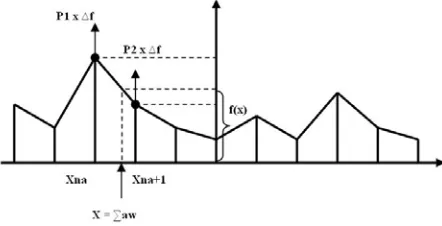
[image:3.595.77.298.448.561.2]We provide a means of solving linearly inseparable problems using a simple adaptive function neural network (ADFUNN), based on a single layer of linear piecewise function neurons, as shown in figure 1.
Figure 1. Adapting the linear piecewise neuronal activation function in ADFUNN
We calculate ∑aw, and find the two neighbouring f-points that bound ∑aw. Two proximal f-points are adapted separately, on a proximal-proportional basis. The proximal-proportional value P1 is (Xna+1 - x)/(Xna+1 – Xna) and value P2 is (x - Xna)/(Xna+1 - Xna). Thus, the change to each point will be in proportion
error and adapt the two proximal f-points separately, using a function modifying version of the delta rule, as outlined in following to calculate ∆f.
The following is a general learning rule for ADFUNN:
The weights and activation functions are adapted in parallel, using the following algorithm:
A = input node activation, E = output node error.
WL, FL: learning rates for weights and functions.
Step1: calculate output error, E, for input, A.
Step2: adapt weights to each output neuron:
∆w = WL x Fslope x A x E w' = w + ∆w
weights normalisation
Step3: adapt function for each output neuron:
∆f (∑aw) = FL x E
f'1 = f1 + ∆f x P1, f'2 = f2 + ∆f x P2 Step4: f (∑aw) = f' (∑aw);
w = w'.
Step5: randomly select a pattern to train Step6: repeat step 1 to step 5 until the output error tends to a steady state.
3. The Snap-Drift Algorithm:
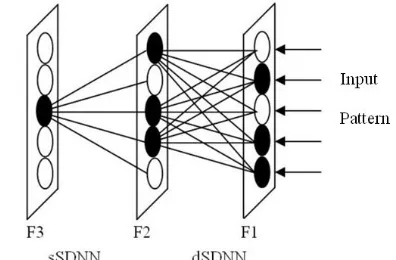
[Palmer-Brown and Lee, 2004, 2006a and 2006b]. It is shown in figure 2. The first layer, a distributed snap-drift neural network (dSDNN) learns to group the input patterns according to their features. In this case, 10 F1 nodes (only 3 shown in figure 2), whose weight prototypes best match the current input pattern, are used as the input data to a selection snap-drift neural network (sSDNN) module for feature classification. In the dSDNN module, the output nodes with the highest net input are accepted as winners. In the sSDNN module, a quality assurance threshold is introduced. If the net input of a sSDNN node is above the threshold, the output node is accepted as the winner; otherwise a new uncommitted output node will be selected as the new winner and initialised with the current input pattern. In general terms, the snap-drift algorithm can be stated as:w=α(snap)+σ(drift), whereα and σ are toggled between (0, 1) and (1, 0) at the end of each epoch. The point of this is to perform two complementary forms of feature discovery within one system.
In this study the neural network is unsupervised Snap-Drift (SDNN). One of the strengths of the SDNN is the ability to adapt rapidly in a non-stationary environment where new patterns are introduced over time. The learning process utilises a novel algorithm that performs a combination of fast, convergent, minimalist learning (snap) and more cautious learning (drift) to capture both precise sub-features in the data and more general holistic features. Snap and drift learning phases are combined within a learning system (Figure 2) that toggles its learning style between the two modes. On presentation of input data patterns at the input layer, the distributed SDNN
[image:4.595.326.524.343.473.2](dSDNN) will learn to group them according to their features using snap-drift [Palmer-Brown and Lee, 2004, 2006a and 2006b]. The neurons whose weight prototypes result in them receiving the highest activations are adapted. Weights are normalised weights so that in effect only the angle of the weight vector is adapted, meaning that a recognised feature is based on a particular ratio of values, rather than absolute values. The output winning neurons from dSDNN act as input data to the selection SDNN (sSDNN) module for the purpose of feature grouping and this layer is also subject to snap-drift learning.
Figure 2. Snap-Drift Network
The learning process is unlike error minimisation and maximum likelihood methods in MLPs and other kinds of networks. Those methods perform optimisation for classification by pushing features in the direction that minimizes error, without any requirement for the feature to be statistically significant within the input data. In contrast, SDNN toggles its learning mode to find a rich set of features in the data and uses them to group the data into categories.
drifting gives the average angle of the patterns grouped under the neuron. Snapping essentially provides an anchor vector pointing at the ‘bottom left hand corner’ of the pattern group for which the neuron wins. This represents a feature common to all the patterns in the group and gives a high probability of rapid (in terms of epochs) convergence (both snap and drift are convergent, but snap is faster). Drifting tilts the vector towards the centroid angle of the group and ensures that an average, generalised feature is included in the final vector. The angular range of the pattern-group membership depends on the proximity of neighbouring groups (competition), but can also be controlled by adjusting a threshold on the weighted sum of inputs to the neurons. The following is a summary of the steps that occurs in SDNN:
Find the D (D = 10) winning nodes at F2 with the largest net input.
Weights of dSDNN adapted according to the current learning mode
Process the winning nodes as input pattern (width D) of sSDNN
Find the node at F3 with the largest net input
Test the threshold condition:
IF (the net input of the node is greater than the threshold)
THEN Weights of the sSDNN output node adapted according to the current learning mode
ELSE An uncommitted sSDNN output node is selected and its weights are
mode .
Select the alternative learning mode (snap or drift) as the current mode at the end of each learning epoch.
4. Snap-drift ADaptive FUnction
Neural Network (SADFUNN) on
Optical and Pen-Based Recognition
of Handwritten Digits:
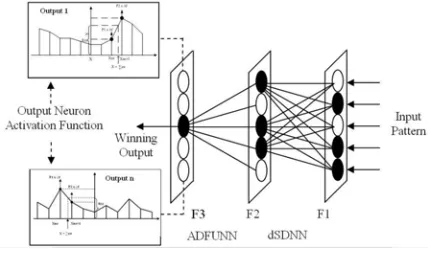
[image:5.595.316.530.477.608.2]SADFUNN is shown in figure 3. Input patterns are introduced at the input layer F1, the distributed SDNN (dSDNN) learns to group them. The winning F2 nodes, whose prototypes best match the current input pattern, are used as the input data to ADFUNN. For each output class neuron in F3, there is a linear piecewise function. Functions and weights and are adapted in parallel. We obtain the output error and adapt the two nearest f-points separately, using a function modifying version of the delta rule on a proximal-proportional basis.
Figure 3. Architecture of the SADFUNN network
4.1. Optical and Pen-Based Recognition of Handwritten Digits Datasets:
by Alpaydin et. al[2000, 2001]. They are two different representations of the same handwritten digits. 250 samples per person are collected from 44 people who filled in forms which were then randomly divided into two sets: 30 forms for training and 14 forms by distinct writers for writer-independent test.
The optical one was generated by using the set of programs available from NIST [Garris et. al, 1991] to extract normalized bitmaps of handwritten digits from a pre-printed form. Its representation is a static image of the pen tip movement that have occurred as in a normal scanned image. It is an 8 x 8 matrix of elements in the range of 0 to 16 which gives 64 dimensions. There are 3823 training patterns and 1797 writer-independent testing patterns in this dataset.
The Pen-Based dataset is a dynamic representation where the movement of the pen as the digit is written on a pressure-sensitive tablet. It is generated by a WACOM PL-100V pressure sensitive tablet with an integrated LCD display and a cordless stylus. The raw data consists of integer values between 0 and 500 at the tablet input box resolution, and they are normalised to the range 0 to 100. This dataset’s representation has eight(x, y) coordinates and thus 16 dimensions are needed. There are 7494 training patterns and 3498 writer-independent testing patterns.
4.2. Snap-drift ADaptive FUnction Neural Network (SADFUNN) on Optical and Pen-Based Recognition of Handwritten Digits:
In ADFUNN, weights and activation functions are adapted in parallel using a function modifying version of delta rule. If Snap-Drift and ADFUNN run at the same
time, the initial learning in ADFUNN will be redundant, since it can only optimise once Snap-Drift has converged.
All the inputs are scaled from the range of {0, 16} to {0, 1} for the optical dataset and
Figure 4. The processing of converting the dynamic (pen-based) and static (optical)
representations
training patterns are introduced to dSDNN again but without learning. The winning F2 nodes, whose prototypes best match the current input pattern, are used as the input data to ADFUNN.
[image:7.595.310.532.103.536.2]In this single layer ADFUNN, the 10 digits are the output classes. Weights are initialised to 0. F-points are initialised to 0.5. Each F point is simply the value of the activation function for a given input sum. F points are equally spaced, and the function value between points is on the straight line joining them. A weight limiter is also applied to ensure that the adaptation to weights will not be too large in order to ensure stability. The two learning rates FL and WL are equal to 0.1 and 0.000001 respectively. These training patterns’ ∑awj has a known range of [-1, 1]. It has a precision of 0.01, so 2001 points encode all training patterns for output.
Figure 5. Digit 1 learned function in optical dataset using SADFUNN
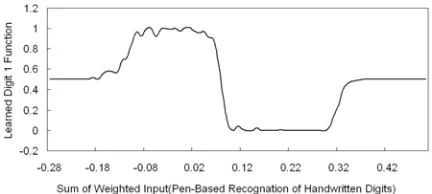
Fig. 6. Digit 1 learned function in pen-based dataset using SADFUNN
[image:7.595.72.301.427.529.2]the general learning rule of ADFUNN outlined in section 2. By varying the number of snap-drift neurons (features) and winning features number in F2, within 200 epochs in each run, about 99.53% and 99.2% correct classifications for the best can be achieved for the training data for the optical and pen-based datasets respectively. We get the following output neuron functions (only a few learned functions listed here due to space limitation):
Fig. 7. Digit 8 learned function in optical dataset using SADFUNN
Fig. 8. Digit 8 learned function in pen-based dataset using SADFUNN
5. Results:
[image:7.595.72.288.584.681.2]snap-drift neurons (features) and the number of winning features.
[image:8.595.314.533.107.174.2]A large total number of features has a positive effect on the overall performance, however too many may limit generalisation if there is too much memorisation. The following performance charts show how the generalisation changes along with the total number of features.
Fig. 9. The performance of training and testing for optical dataset using SADFUNN
Fig. 10. The performance of training and testing for pen-based dataset using SADFUNN
The following are examples of some misclassified patterns from SADFUNN for optical recognition case.
Fig. 11. Digit 9 misclassified to digit 5
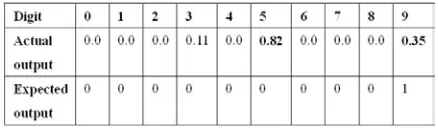
[image:8.595.72.296.265.383.2]As we can see above a digit 9 pattern was misclassified to digit 5 whose got the largest output. The upper part of digit 5 is almost looped, making the 5 similar to a 9.
[image:8.595.316.533.381.446.2]Fig. 12. Digit 2 misclassified to digit 8
Fig. 13. Digit 3 misclassified to digit 9
Figures 12 and 13 illustrate similar confusions
6. Related Work:
[image:8.595.71.299.445.559.2]the writer-independent test data are not classified by the MLP. They will be passed to k-NN to give a second classification. In our single network combination of a single layer Snap-Drift and a single layer ADFUNN (SADFUNN) network only 5.01% patterns were not classified on the testing data. SADFUNN proves to be a highly effective network with fast feature extraction and pattern recognition ability. Similarly, with the pen-based recognition task, 30% of the writer-independent test data are rejected by the MLP, whereas only 5.4% of these patterns were misclassified by SADFUNN.
Their original intention was to combine multiple representations (dynamic pen-based recognition data and static optical recognition data) of a handwritten digit to increase classification accuracy without increasing the system’s complexity and recognition time. By combing the two datasets, they get 98.3% accuracy on the writer-independent testing data. However, we don’t experiment with this on SADFUNN because they have already proved the combination of multiple presentations work better than single one, and also because SADFUNN has already exhibited extremely high generalisation ability compared to a MLP, and it is easy and fast to train and implement.
Zhang and Li [Zhang and Li, 2005] propose an adaptive nonlinear auto-associative modelling (ANAM) based on Locally Linear Embedding (LLE) for learning both intrinsic principal features of each concept separately. LLE algorithm is a modified k-NN to preserve local neighbourhood relation of data in both the embedded Euclidean space and the intrinsic one. In ANAMs, training samples are projected into the corresponding subspaces. Based on the evaluation of
parameters of inverse mapping matrices of each ANAM are adaptively obtained. And then that of the forward mapping matrices are calculated based on a similar framework. 1.28% and 4.26% error rates can be obtained by ANAM for optical recognition and pen-based recognition respectively. However, given its complex calculation of forward mapping and inverse mapping matrices, many subspaces are needed and also suboptimal auto-associate models need to be generated. SADFUNN is computationally much more efficient, simpler and achieves similar results. It will be a straight forward process to apply it to many other domains.
7. Conclusions:
8. References:
[1] Lee S. W., Palmer-Brown D., Roadknight C. M., “Performance-guided Neural Network for Rapidly Self-Organising Active Network Management
(Invited Paper)”, Journal of
Neurocomputing, 61C, 2004, pp. 5 – 20.
[2] Palmer-Brown D., Kang M., “ADFUNN: An adaptive function neural network”, the 7th International Conference on Adaptive and Natural Computing Algorithms (ICANNGA05), Coimbra, Portugal, 2005.
[3] Kang M., Palmer-Brown D., “An Adaptive Function Neural Network (ADFUNN) for Phrase Recognition”, the International Joint Conference on Neural Networks (IJCNN05), Montréal, Canada, 2005.
[4] Alpaydin E., Alimoglu F., for Optical Recognition of Handwritten Digits and Alpaydin E., Kaynak C., for Pen-Based Recognition of Handwritten Digits
http://www.ics.uci.edu/~mlearn/databases/ optdigits/
http://www.ics.uci.edu/~mlearn/databases/ pendigits/
[5] Scheler G., “Regulation of neuromodulator efficacy: Implications for whole-neuron and synaptic plasticity”,
Progress in Neurobiology, Vol.72, No.6, 2004.
[6] Scheler G., “Memorization in a neural network with adjustable transfer function and conditional gating”, Quantitative Biology, Vol.1, 2004.
[7] Lee S. W., Palmer-Brown D., “Phonetic Feature Discovery in Speech
using Snap-Drift. International Conference on Artificial Neural Networks”,
ICANN'2006, Athens, Greece, 10th - 14th September 2006, pp. 952 – 962.
[8] Lee S. W., Palmer-Brown D., “Modal Learning in A Neural Network”, 1st Conference in Advances in Computing and Technology, London, United Kingdom, 24th January 2006, pp. 42 - 47.
[9] Kohonen T., “Improved Versions of Learning Vector Quantization”, Proc. IJCNN’90, 1990, pp.545 – 550.
[10] Alpaydin E., Kaynak C., Alimoglu F., “Cascading Multiple Classifiers and Representations for Optical and Pen-Based Handwritten Digit Recognition”, IWFHR,
Amsterdam, The Netherlands, September 2000.
[11] Alimoglu F., Alpaydin E., “Combining Multiple Representations for Pen-based Handwritten Digit Recognition”, ELEKTRIK: Turkish Journal of Electrical Engineering and Computer Sciences, 9(1), 2001, pp.1-12.
[12] Garris M.D., et al, NIST Form-Based Handprint Recognition System, NISTIR
5469, 1991.