IJPSR (2019), Volume 10, Issue 2 (Research Article)
Received on 01 June 2018; received in revised form, 01 August 2018; accepted, 07 August 2018; published 01 February 2019
DESIGN AND EVALUATION OF FAST DISSOLVING TABLETS OF ROFLUMILAST SOLID DISPERSIONS
Sk. Arifa Begum * 1, V. Madhuri 2 and K. Padmalatha 3
Department of Pharmaceutics 1, Chalapathi Institute of Pharmaceutical Sciences, Chalapathi Nagar, Lam, Guntur - 522034, Andhra Pradesh, India.
Department of Pharmaceutics 2, Department of Pharmacology 3, Vijaya Institute of Pharmaceutical Sciences for Women, Enikepadu, Vijayawada - 521108, Andhra Pradesh, India.
ABSTRACT: The main objective of the present investigation was to formulate and evaluate fast dissolving tablets of Roflumilast solid dispersions using a direct compression method. Roflumilast solid dispersions were prepared by solvent evaporation as well as melting method. Roflumilast is a selective, long-acting inhibitor of the enzyme PDE-4 and has anti-inflammatory effects. It is used orally in the treatment of chronic obstructive pulmonary disease (COPD). The roflumilast drug belongs to BCS class II drugs that have low solubility and high permeability. The current research work was focused on improving the aqueous solubility of Roflumilast using solid dispersion technique and enhancing the dissolution rate. Based on the results of solubility analysis, phosphate buffer pH 6.8 was chosen as the dissolution medium. The powder blend of Roflumilast solid dispersions was evaluated for flow characteristics. The fast dissolving tablets of Roflumilast solid dispersions were subjected to post-compression parameters such as weight variation, hardness, thickness, friability, drug content, wetting time, water absorption ratio, in-vitro dispersion time and in-vitro disintegration time and the results were found to be within the acceptable limits. Based on FT-IR spectra obtained, it was evident that there was no significant interaction of Roflumilast with carriers and other excipients. From the results of dissolution study, SD1 and SD18 formulations were considered as best formulations.
INTRODUCTION: Drug administration by the oral route is a widely accepted route of drug administration which is occupying up to 50-60% of total dosage forms available. Solid dosage forms have been popular due to the accuracy of dosage, ease of administration, pain avoidance, self-medication as well as patient compliance. Tablets and capsules are being the most commonly used solid dosage forms. The main drawback of such dosage forms in case of few patients is the difficulty in swallowing.
QUICK RESPONSE CODE
DOI:
10.13040/IJPSR.0975-8232.10(2).599-11
The article can be accessed online on
www.ijpsr.com
DOI link: http://dx.doi.org/10.13040/IJPSR.0975-8232.10(2).599-11
Drinking water is important in the swallowing of oral solid dosage forms. People experience inconvenience in swallowing tablets when water is unavailable as in case of motion sickness (kinetosis) and sudden episodes of coughing during the common cold, bronchitis and other allergic conditions 1. Therefore, nowadays, there have been growing interests in the development of tablets that can rapidly disintegrate or dissolve in the oral cavity. Orodispersible tablets are not only advantageous for people who have difficulty in swallowing but at the same time, they are also suitable for active people. Fast dissolving tablets are also known as orodispersible tablets, mouth-dissolving tablets, porous tablets, melt-in-mouth tablets and quick dissolving tablets 2. Roflumilast is a drug that acts as a selective, long-acting inhibitor of the enzyme PDE-4.
Keywords:
Solid dispersions, Fast dissolving tablet, Roflumilast, Solvent evaporation, Melting method
Correspondence to Author: Sk. Arifa Begum
Associate Professor,
Department of Pharmaceutics, Chalapathi Institute of Pharmaceutical Sciences, Chalapathi Nagar, Lam, Guntur - 522034, Andhra Pradesh, India.
It has anti-inflammatory effects and is used as an orally administered drug for the treatment of inflammatory conditions of the lungs such as chronic obstructive pulmonary disease (COPD) 3. Roflumilast is a lipophilic, highly permeable molecule that exhibits rapid and nearly complete absorption after oral administration. The absolute bioavailability of Roflumilast after a 500 µg oral dose is approximately 80%, and it appears to be affected primarily by gut and hepatic first-pass metabolism 4. Roflumilast undergoes extensive hepatic metabolism by both phase 1 (cytochrome P450 [CYP]) and phase 2 (conjugation) reaction. Protein binding is approximately 99%.
Roflumilast belongs to BCS class II drugs which have low solubility and high permeability. For BCS class II drugs, dissolution is the rate-limiting step. The drugs that have poor aqueous solubility often show poor oral bioavailability due to the low levels of absorption. In case of drugs that undergo dissolution rate limited absorption, the dissolution rate of such drugs can be increased by size reduction, but this leads to aggregation of particles and poor wettability. The bioavailability of poorly aqueous soluble drugs can be increased using various other approaches such as the use of solubility enhancers, salt formation, micronization and complexation with cyclodextrin; but such approaches have several drawbacks.
Development of solid dispersions of poorly water-soluble drugs overcame the limitations of the previous approaches. When the solid dispersion comes in contact with the aqueous medium, the inert carrier dissolves, and the drug is released, the
increased surface area produces a higher
dissolution rate thus increasing the bioavailability of the poorly soluble drug. The present study was aimed to design and evaluate the fast dissolving tablets of Roflumilast solid dispersions by direct compression method. The objective of the present research was to develop an oral patient-friendly fast dissolving tablet formulation of Roflumilast with rapid dissolution and improved bioavailability.
MATERIALS AND METHODS: Roflumilast was obtained as a gift sample from Hetero Drugs Pvt. Ltd., Hyderabad, India. Polyethylene glycol
(PEG) 4000, PEG 6000, hydroxypropyl
methylcellulose (HPMC K15M), microcrystalline
cellulose were purchased from Rolex Chemical., Mumbai. PVP K30 and Magnesium stearate were
obtained from Loba Chemie, Tarapur.
Croscarmellose sodium (CCS) and crospovidone (CP) were received as gift samples from Ciron Drugs and Pharmaceuticals, Palghar. Talc was purchased from Oxford Laboratory, Mumbai. Sodium hydroxide and potassium dihydrogen phosphate were purchased from Loba Chemie.
Drug-Carrier-Excipients Compatibility Testing:
The drug and the excipients interaction studies were done out by checking the physical appearance and using FT-IR analytical technique. The interaction studies were carried out to ascertain any interaction of the drug with the excipients used in the preparation of fast dissolving tablets of Roflumilast solid dispersions.
Fourier Transform Infra Red (FTIR) Analysis: 5
An FT-IR spectrophotometer was used for infrared analysis of samples. About 4-5 mg of sample was mixed with dry potassium bromide (KBr), and the sample was examined at transmission mode over the wave number range of 4000 - 400 cm-1.
Formulation Development:
Calibration of Standard Curve of Roflumilast: Determination of Wavelength: 10 mg of Roflumilast pure drug was dissolved in 10 ml of ethanol (Primary stock). From this primary stock solution, 1 ml was taken in a 10 ml volumetric flask, and the volume was made up to 10 ml with pH 6.8 phosphate buffer (Secondary stock- 100μg/ml). From secondary stock solution, 1 ml was taken, and volume made up to 10 ml with pH 6.8 phosphate buffer (Working stock - 10 μg/ml). The final concentration prepared was scanned between 200 nm to 400 nm on spectrum mode using UV-visible spectrophotometer to determine the λmax of Roflumilast.
obtained λmax for roflumilast using phosphate
buffer, pH 6.8 as blank.
Solubility Analysis of Roflumilast: An excess quantity of Roflumilast pure drug was added to 10 ml of water, propylene glycol, polyethylene glycol 400, 0.1 N HCl and pH 6.8 phosphate buffer in screw-capped bottles. The samples were shaken in an orbital shaker for 48 h at room temperature. Subsequently, the obtained suspensions were filtered through Whatman filter paper no. 0.22 μ. The filtered solutions were suitably diluted using respective solvents and further analyzed by UV –
visible spectrophotometer at the maximum
wavelength of Roflumilast.
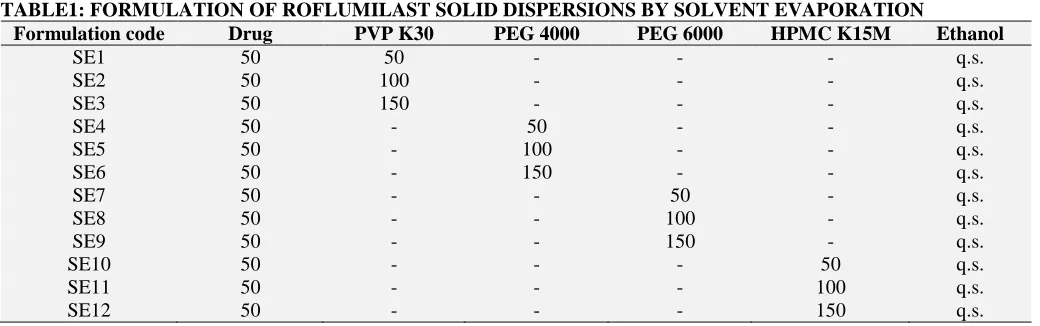
Preparation of Roflumilast Solid Dispersions Solvent Evaporation Method: Twelve formulations of Roflumilast solid dispersions were prepared using different carriers in various proportions, i.e., 1:1, 1:2, 1:3 (Drug: Carrier) as shown in Table 1. The drug and carrier were dissolved in ethanol followed by trituration in a dry mortar till the solvent was completely evaporated, and a clear dry mixture of drug and carrier was obtained. Roflumilast SD thus obtained was scraped off using a spatula. Solid dispersions were pulverized in a mortar with pestle and sieved through # 60 sieve and packed in an airtight container.
TABLE1: FORMULATION OF ROFLUMILAST SOLID DISPERSIONS BY SOLVENT EVAPORATION
Formulation code Drug PVP K30 PEG 4000 PEG 6000 HPMC K15M Ethanol
SE1 50 50 - - - q.s.
SE2 50 100 - - - q.s.
SE3 50 150 - - - q.s.
SE4 50 - 50 - - q.s.
SE5 50 - 100 - - q.s.
SE6 50 - 150 - - q.s.
SE7 50 - - 50 - q.s.
SE8 50 - - 100 - q.s.
SE9 50 - - 150 - q.s.
SE10 50 - - - 50 q.s.
SE11 50 - - - 100 q.s.
SE12 50 - - - 150 q.s.
Melting Method: Roflumilast solid dispersions of 12 formulations were prepared by melting method using different carriers in 1:1, 1:2, 1:3 (Drug: Carrier) proportions as mentioned in Table 2. Carrier was melted at 40 ºC. The drug was dispersed in the molten carrier and then kept aside
[image:3.612.48.568.269.432.2]for cooling. After solidification, the obtained SD was scraped off using a spatula. SDs were further subjected to milling in a mortar with pestle and passed through a 45 μm sieve before packing in an airtight container.
TABLE 2: FORMULATION OF ROFLUMILAST SOLID DISPERSIONS BY MELTING METHOD
Formulation code Drug PVP K30 PEG 4000 PEG 6000 HPMC K15M Ethanol
M1 50 50 - - - q.s.
M2 50 100 - - - q.s.
M3 50 150 - - - q.s.
M4 50 - 50 - - q.s.
M5 50 - 100 - - q.s.
M6 50 - 150 - - q.s.
M7 50 - - 50 - q.s.
M8 50 - - 100 - q.s.
M9 50 - - 150 - q.s.
M10 50 - - - 50 q.s.
M11 50 - - - 100 q.s.
M12 50 - - - 150 q.s.
Selection of Super-disintegrants: Placebo tablets were prepared using different super-disintegrants with 5% for a total weight of the tablets and a
The compressed placebo tablets were placed in 10 ml of water to assess the superdisintegrant which would be disintegrated within a short time. The
selected superdisintegrant was used in the formulation of fast dissolving tablets of Roflumilast solid dispersion.
TABLE 3: FORMULATION OF PLACEBO TABLETS FOR SELECTION OF SUPERDISINTEGRANT Formulation
code
CCS (mg)
CP (mg)
Magnesium stearate (mg)
Talc (mg)
Mannitol (mg)
Total weight (mg)
PT1 4 - 1 1 q.s. 80
PT2 - 4 1 1 q.s. 80
Evaluation of Roflumilast Powder Blends: Pre-compression Parameters for Solid Dispersions:
Bulk Density (Db): 6 It is the ratio of the total mass of powder to the bulk volume of powder. It was measured by pouring the weight powder (passed through standard sieve # 20) into a measuring cylinder, and initial weight was noted. This initial volume is called the bulk volume. From this, the bulk density is calculated according to the formula mentioned below. It is expressed in g/ml and is given by,
Db = M / Vb
Where M is the mass of powder, Vb is the bulk
volume of the powder.
Tapped Density (Dt): 7 It is the ratio of the total mass of the powder to the tapped volume of the powder. Volume was measured by tapping the powder 750 times, and the tapped volume was noted if the difference between these two volumes is less than 2%. If it is more than 2%, tapping is continued for 1250 times, and tapped volume was noted. Tapping was continued until the difference between successive volumes is less than 2% (in a bulk density apparatus). It is expressed in g/ml and is given by,
Dt = M / Vt
Where M is the mass of powder, Vt is the tapped
volume of the powder.
Carr’s Index or % Compressibility: 8, 9
It indicates powder flow properties. It is expressed in percentage and is given as,
I = (Dt – Db) / Dt × 100
Dt has tapped density of the powder, Db is the bulk
density of the powder.
Hausner’s Ratio: 10Hausner’s ratio is an indirect
index of ease of powder flow. It is calculated by the following formula,
Hausner’s ratio = Dt / Db
Where Dt is tapped density, Db is bulk density.
Lower Hausner’s ratio (< 1.25) indicates better flow properties than higher ones (> 1.25).
The angle of Repose (Ɵ): 11 The friction forces in a loose powder can be measured by the angle of repose (Ɵ). It is indicative of the flow properties of the powder. It is defined as the maximum angle possible between the surface of the pile of powder and the horizontal plane.
Ө = tan-1 (h / r)
Where “Ө” is the angle of repose, “h” is height in cm, “r” is radius in cm.
The powder mixture was allowed to flow through funnel fixed to a stand at definite height (h). The angle of repose was then calculated by measuring the height and radius of the heap of the powder formed.
% Practical Yield for Solid Dispersion:
Percentage of practical yield was calculated to know about percent yield or efficiency of any method; thus it helps in the selection of the
appropriate method of production. Solid
dispersions were collected and weighed to determine practical yield using the following equation,
% Practical Yield = Practical mass (Solid dispersion) / Theoretical mass (Drug + Carrier) × 100
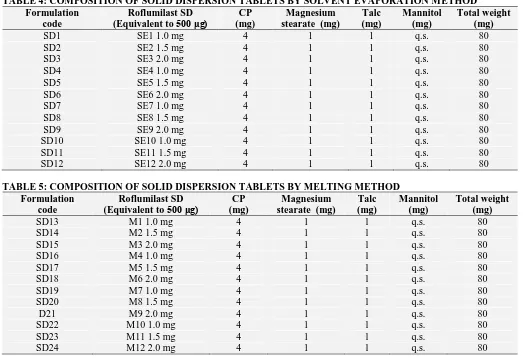
TABLE 4: COMPOSITION OF SOLID DISPERSION TABLETS BY SOLVENT EVAPORATION METHOD Formulation
code
Roflumilast SD (Equivalent to 500 μg)
CP (mg)
Magnesium stearate (mg)
Talc (mg)
Mannitol (mg)
Total weight (mg)
SD1 SE1 1.0 mg 4 1 1 q.s. 80
SD2 SE2 1.5 mg 4 1 1 q.s. 80
SD3 SE3 2.0 mg 4 1 1 q.s. 80
SD4 SE4 1.0 mg 4 1 1 q.s. 80
SD5 SE5 1.5 mg 4 1 1 q.s. 80
SD6 SE6 2.0 mg 4 1 1 q.s. 80
SD7 SE7 1.0 mg 4 1 1 q.s. 80
SD8 SE8 1.5 mg 4 1 1 q.s. 80
SD9 SE9 2.0 mg 4 1 1 q.s. 80
SD10 SE10 1.0 mg 4 1 1 q.s. 80
SD11 SE11 1.5 mg 4 1 1 q.s. 80
SD12 SE12 2.0 mg 4 1 1 q.s. 80
TABLE 5: COMPOSITION OF SOLID DISPERSION TABLETS BY MELTING METHOD Formulation
code
Roflumilast SD (Equivalent to 500 μg)
CP (mg)
Magnesium stearate (mg)
Talc (mg)
Mannitol (mg)
Total weight (mg)
SD13 M1 1.0 mg 4 1 1 q.s. 80
SD14 M2 1.5 mg 4 1 1 q.s. 80
SD15 M3 2.0 mg 4 1 1 q.s. 80
SD16 M4 1.0 mg 4 1 1 q.s. 80
SD17 M5 1.5 mg 4 1 1 q.s. 80
SD18 M6 2.0 mg 4 1 1 q.s. 80
SD19 M7 1.0 mg 4 1 1 q.s. 80
SD20 M8 1.5 mg 4 1 1 q.s. 80
D21 M9 2.0 mg 4 1 1 q.s. 80
SD22 M10 1.0 mg 4 1 1 q.s. 80
SD23 M11 1.5 mg 4 1 1 q.s. 80
SD24 M12 2.0 mg 4 1 1 q.s. 80
Evaluation of Fast Dissolving Tablets:
Weight Variation: 12 10 tablets were selected randomly from the lot and weighted individually to check for weight variation. Weight variation specification was considered as per I.P.
Hardness: 13 Tablet crushing strength or hardness is the force required to break a tablet in a diametric compression. Monsanto tablet hardness tester was used to measure the hardness of tablets, and the values were expressed in kg/cm 2.
Thickness: 3 tablets were selected randomly from each formulation, and the thickness of tablets was measured using a Vernier caliper.
Friability: 14 Friability of the tablet was determined using Roche friabilator. In Roche friabilator, the tablets were subjected to the combined effect of both abrasions as well as shock in a plastic chamber which was revolved at 25 rpm and the tablets were dropped at the height of 6 inches in each revolution. Pre-weighed a sample of Roflumilast tablets from each formulation was placed in the friabilator and then subjected to the
hundred revolutions. The tablets after friability test were dusted by using a soft muslin cloth and then reweighed. The formula gave the friability,
Initial weight – Final weight
Initial weight
Drug Content: Three tablets were selected randomly, weighed and then finely powdered. A quantity of the powder equivalent to 1 tablet was added to 100 ml of phosphate buffer, pH 6.8 in a conical flask. The conical flask was then kept on a rotary shaker. An aliquot of the solution was subjected to centrifugation, and the supernatant was filtered through a 0.22 μ filter. The absorbance of the resultant solution was measured using UV - visible spectrophotometer at the λmax of Roflumilast
against phosphate buffer, pH 6.8 as blank. Concentrations, as well as the amount of Roflumilast contained in one tablet, were determined using the calibration curve.
Wetting Time and Water Absorption Ratio: 15A piece of tissue paper folded twice was kept in a small Petri plate (i.d. = 6.5 cm) consisting 6 ml of
phosphate buffer, pH 6.8. A tablet was kept on the wet tissue paper and the time taken for complete wetting was determined with the help of a stopwatch. Then, the wetted tablet was re-weighed. Water absorption ratio (R) was calculated using the below-mentioned equation,
R= 100 × (Wa – Wb / Wb)
Wa = Weight of the tablet after water absorption,
Wb = Weight of the tablet before water absorption.
In-vitro Dispersion Time: For the determination of in-vitro dispersion time of prepared tablets, 10 ml measuring cylinder was taken in which 6 ml of phosphate buffer, pH 6.8 was added, and the tablet was dropped in the measuring cylinder. The time taken for the complete dispersion was determined.
In-vitro Disintegration Time: In-vitro
disintegration time was determined by using disintegration test apparatus (Lab India). Three tablets were selected randomly from each
formulation for determining the time of
disintegration.
In-vitro Dissolution Time: In-vitro dissolution test was performed by using USP dissolution test apparatus (type II). Phosphate buffer, pH 6.8 was used as the dissolution medium (900 ml), the agitation speed of the paddle was 50 rpm and the temperature was maintained at 37 ºC ± 1 ºC. 5 ml samples were withdrawn at pre-determined
intervals, i.e., 5, 10, 15, 20, 30, 45 and 60 min, filtered and then replaced with 5 ml of the fresh dissolution medium to maintain the sink conditions. The samples collected were diluted suitably with phosphate buffer, pH 6.8, where ever necessary. Finally, the samples were analyzed for Roflumilast at the λmax using UV-visible spectrophotometer.
Each dissolution study was carried out in triplicate, and the mean values were calculated.
Stability Studies: The stability studies were carried out on the optimized formulation as per the International Conference on Harmonization (ICH) guidelines. The optimized formulation packed in aluminum foil was subjected to accelerated stability testing for 3 months according to ICH norms at a temperature of 40 ºC ± 2 ºC and relative humidity of 75% RH ± 5%. The samples were taken at regular time intervals of one month throughout three months and analyzed for any change in the physical appearance and drug content (assay) as per the procedure stated earlier. Any changes in evaluation parameters, if observed were noted down. The tests were performed three times and the mean value of the observed values was noted along with the standard deviation.
RESULTS AND DISCUSSION:
Drug-polymer-excipients Compatibility Testing:
The compatibility studies were performed to ascertain interaction if any drug with the excipients and polymers used in the preparation of tablets.
FIG. 1: FT-IR SPECTRA FOR ROFLUMILAST FIG. 2: FT-IR SPECTRA FOR ROFLUMILAST + PVP K30
FIG. 5: FT-IR SPECTRA FOR OPTIMIZED FORMULATION SD1
FT-IR studies were conducted to know the possible interactions between selected drug Roflumilast; carriers (PVP K30, PEG 4000, PEG 6000 and HPMC K15M) and other excipients. FT-IR of Roflumilast+PVP K30, Roflumilast+PEG 4000, Roflumilast+PEG 6000 and Formulation SD1 showed similar peaks as that of Roflumilast pure drug. Based on FT-IR spectra obtained, it was evident that there was no significant interaction of Roflumilast with carriers and other excipients.
Formulation Development:
Roflumilast Spectrophotometric Determination:
Estimation of Roflumilast was done using a UV - visible spectrophotometric method in phosphate buffer, pH 6.8. The standard concentration was scanned over a range of 400 nm - 200 nm and resulted in a peak at the wavelength of 250 nm, and it was considered as absorption maxima (λmax) for
Roflumilast.
[image:7.612.175.437.56.175.2]Calibration Graph for Roflumilast: The calibration curve of Roflumilast in phosphate buffer, pH 6.8 was constructed by making the solutions of 5 µg/ml, 10 µg/ml, 15 µg/ml, 20µg/ml, 25 µg/ml and 30 µg/ml concentrations.
TABLE 6: CALIBRATION GRAPH OF ROFLUMILAST Concentration
(µg/ml)
Absorbance at 250.0 nm (in phosphate buffer, pH6.8)
0 0
5 0.148
10 0.301
15 0.455
20 0.616
25 0.779
30 0.935
The absorbance of the solutions was measured using UV-visible spectrophotometer at the λmax of
250 nm. The calibration graph was plotted by taking the concentrations on X-axis and absorbance
on Y-axis. Roflumilast concentration and
absorbance followed a linear relationship and the
correlation coefficient (R2) value in phosphate buffer; pH6.8 was observed to be 0.999.
FIG. 6: CALIBRATION CURVE OF ROFLUMILAST IN PHOSPHATE BUFFER, pH 6.8
Solubility Studies: The solubility of Roflumilast was determined in different solvents separately and was mentioned in Table 7. The solubility of Roflumilast contributes to the molecular dispersion which will further improve the dissolution rate. Based on the solubility data obtained, phosphate buffer pH 6.8 was chosen as the dissolution medium. As per USFDA also, phosphate buffer pH 6.8 was used as the dissolution medium for Roflumilast.
TABLE 7: SOLUBILITY STUDY OF ROFLUMILAST IN DIFFERENT MEDIA
Solvent Solubility (mg/ml)
0.1N HCl 0.006
Phosphate buffer pH 6.8 0.012
Water 0.007
Solubility Studies of Roflumilast Solid Dispersion in Phosphate Buffer pH 6.8:
[image:7.612.314.566.227.338.2]The results were shown in Table 8 and Table 9. The solubility of Roflumilast pure drug - 0.012 mg/ml. Solubility of formulation SD1 (Roflumilast with PVP K30 in 1:1 ratio) - 0.119 mg/ml (for solvent evaporation method). Solubility of formulation SD18 (Roflumilast with PEG 4000 in 1:3 ratio) - 0.115mg/ml (for fusion method). The results revealed that in case of Roflumilast solid dispersions prepared by a solvent evaporation method, the solubility of Roflumilast was found to decrease with the increasing concentrations of PVP K30, i.e., the maximum solubility of the drug was achieved with 1:1 drug: carrier ratio.
TABLE 8: SOLUBILITY STUDIES OF SOLID DISPERSION BY SOLVENT EVAPORATION METHOD
Formulation Solubility (mg/ml)
SD1 0.119 ± 0.04
SD2 0.110 ± 0.01
SD3 0.104 ± 0.02
SD4 0.094 ± 0.02
SD5 0.174 ± 0.07
SD6 0.082 ± 0.06
SD7 0.099 ± 0.05
SD8 0.186 ± 0.01
SD9 0.076 ± 0.08
SD10 0.202 ± 0.01
SD11 0.215 ± 0.03
SD12 0.224 ± 0.06
TABLE 9: SOLUBILITY STUDIES OF SOLID DISPERSION BY MELTING (FUSION) METHOD
Formulation Solubility (mg/ml)
SD13 0.082 ± 0.01
SD14 0.098 ± 0.05
SD15 0.110 ± 0.02
SD16 0.084 ± 0.06
SD17 0.092 ± 0.02
SD18 0.115 ± 0.03
SD19 0.086 ± 0.03
SD20 0.113 ± 0.04
SD21 0.097 ± 0.04
SD22 0.242 ± 0.02
SD23 0.280 ± 0.09
SD24 0.231 ± 0.02
Further, the results obtained for solubility studies of Roflumilast solid dispersions prepared by melting method suggested that the solubility of the drug was observed to increase with the increasing concentrations of both PVP K30 and PEG 4000. In all 24 formulations, there was a significant increase in solubility of Roflumilast SDs compared to that of its pure drug.
% Practical Yield: The % practical yield for all the 12 formulations developed by solvent evaporation
[image:8.612.315.564.152.304.2]technique was observed to be 90.14% to 95.23% as mentioned in Table 10. The 12 formulations prepared by melting method were found to be 85.92% to 94.87% as depicted in Table 11.
TABLE 10: % PRACTICAL YIELD FOR ROFLUMILAST SOLID DISPERSIONS BY SOLVENT EVAPORATION METHOD
Formulation Percentage yield (%)
SD1 95.23
SD2 92.15
SD3 93.22
SD4 90.14
SD5 91.07
SD6 91.47
SD7 90.19
SD8 91.32
SD9 92.05
SD10 91.08
SD11 93.12
SD12 91.42
TABLE 11: % PRACTICAL YIELD FOR ROFLUMILAST SOLID DISPERSIONS BY MELTING METHOD
Formulation Percentage yield (%)
SD13 91.48
SD14 92.81
SD15 91.13
SD16 87.48
SD17 86.05
SD18 94.87
SD19 88.12
SD20 87.49
SD21 85.92
SD22 92.26
SD23 90.14
SD24 92.32
Evaluation of Pre-compression Parameters of Powder Blend:
Pre-Compression Parameters for Solid Dispersion Blend Prepared by Solvent Evaporation Technique: The powder blends of various formulations were evaluated for bulk density, tapped density, Carr's index, the angle of repose and Hausner's ratio and values obtained were represented in Table 12.
[image:8.612.45.299.339.592.2]TABLE 12: PRE-COMPRESSION PARAMETERS FOR SOLID DISPERSION BLEND PREPARED BY SOLVENT EVAPORATION METHOD
Formulation Bulk Density (g/cc) Tapped density (g/cc) Carr's index (%) Angle of repose (o) Hausner’s ratio
SD1 0.58 ± 0.04 0.64 ± 0.07 09.37 ± 0.06 25.01 ± 0.07 1.10 ± 0.07
SD2 0.53 ± 0.07 0.60 ± 0.06 11.66 ± 0.02 26.49 ± 0.05 1.13 ± 0.05
SD3 0.51 ± 0.05 0.58 ± 0.04 12.06 ± 0.02 28.10 ± 0.03 1.13 ± 0.03
SD4 0.50 ± 0.06 0.58 ± 0.05 13.79 ± 0.08 27.32 ± 0.03 1.16 ± 0.09
SD5 0.51 ± 0.07 0.61 ± 0.04 16.39 ± 0.04 25.42 ± 0.06 1.19 ± 0.04
SD6 0.44 ± 0.04 0.53 ± 0.08 16.98 ± 0.03 26.82 ± 0.09 1.14 ± 0.06
SD7 0.48 ± 0.05 0.56 ± 0.02 14.28 ± 0.05 28.64 ± 0.05 1.17 ± 0.05
SD8 0.54 ± 0.07 0.62 ± 0.04 12.90 ± 0.03 25.10 ± 0.08 1.15 ± 0.03
SD9 0.52 ± 0.05 0.60 ± 0.08 13.33 ± 0.07 26.84 ± 0.03 1.15 ± 0.02
SD10 0.27 ± 0.08 0.32 ± 0.06 15.62 ± 0.06 26.38 ± 0.08 1.18 ± 0.07
SD11 0.36 ± 0.03 0.43 ± 0.07 16.27 ± 0.02 27.29 ± 0.05 1.19 ± 0.04
SD12 0.56 ± 0.06 0.64 ± 0.05 12.50 ± 0.04 29.05 ± 0.06 1.14 ± 0.08
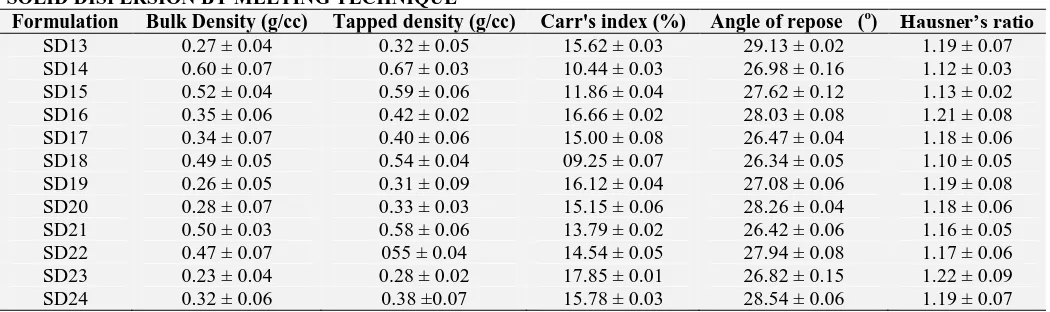
Pre-compression Parameters for Solid Dispersion Blend by Melting Method: The powder mixtures of different Roflumilast solid dispersion formulations were evaluated for the flow properties, and the results were mentioned in Table 13. The bulk densities and tapped densities of all the 12 powder solid dispersion formulations of Roflumilast prepared by melting method were
[image:9.612.50.569.77.230.2]found to be in the range of 0.23 ± 0.04 to 0.60 ± 0.07 and 0.28 ± 0.02 to 0.67 ± 0.03, respectively. The Carr’s index values of all formulation blends were in the range of 09.25 ± 0.07 to 17.85 ± 0.01. The Hausner’s ratios were found to be below 1.22, and angle of repose values was observed to be < 30o which indicated that the powder blends had good flow properties.
TABLE 13: EVALUATION OF PRE-COMPRESSION PARAMETERS OF POWDER BLEND FOR ROFLUMILAST SOLID DISPERSION BY MELTING TECHNIQUE
Formulation Bulk Density (g/cc) Tapped density (g/cc) Carr's index (%) Angle of repose (o) Hausner’s ratio
SD13 0.27 ± 0.04 0.32 ± 0.05 15.62 ± 0.03 29.13 ± 0.02 1.19 ± 0.07
SD14 0.60 ± 0.07 0.67 ± 0.03 10.44 ± 0.03 26.98 ± 0.16 1.12 ± 0.03
SD15 0.52 ± 0.04 0.59 ± 0.06 11.86 ± 0.04 27.62 ± 0.12 1.13 ± 0.02
SD16 0.35 ± 0.06 0.42 ± 0.02 16.66 ± 0.02 28.03 ± 0.08 1.21 ± 0.08
SD17 0.34 ± 0.07 0.40 ± 0.06 15.00 ± 0.08 26.47 ± 0.04 1.18 ± 0.06
SD18 0.49 ± 0.05 0.54 ± 0.04 09.25 ± 0.07 26.34 ± 0.05 1.10 ± 0.05
SD19 0.26 ± 0.05 0.31 ± 0.09 16.12 ± 0.04 27.08 ± 0.06 1.19 ± 0.08
SD20 0.28 ± 0.07 0.33 ± 0.03 15.15 ± 0.06 28.26 ± 0.04 1.18 ± 0.06
SD21 0.50 ± 0.03 0.58 ± 0.06 13.79 ± 0.02 26.42 ± 0.06 1.16 ± 0.05
SD22 0.47 ± 0.07 055 ± 0.04 14.54 ± 0.05 27.94 ± 0.08 1.17 ± 0.06
SD23 0.23 ± 0.04 0.28 ± 0.02 17.85 ± 0.01 26.82 ± 0.15 1.22 ± 0.09
SD24 0.32 ± 0.06 0.38 ±0.07 15.78 ± 0.03 28.54 ± 0.06 1.19 ± 0.07
Evaluation of Post-compression Parameters: All the developed formulations of fast dissolving tablets from Roflumilast solid dispersions by both solvent evaporation as well as melting method were subjected to post-compression analysis and values were observed to be within limits.
Friability and Drug Content: Friability for all the developed formulations by solvent evaporation and melting methods was observed to be in the range of 0.15% ± 0.03 - 0.30% ± 0.01 and 0.16% ± 0.08 - 0.30% ± 0.16 respectively. The drug content values for the formulations SD1 to SD12 and SD13 to SD24 were in the range of 99.46% ± 0.51 - 100.29% ± 0.48 and 98.36% ± 0.53 - 99.79% ±
0.62 respectively, indicating that the values obtained complied with the Pharmacopoeial limits
16
.
Wetting Time and Water Absorption Ratio: The wetting time of tablet formulations prepared by a solvent evaporation method and melting methods was observed to be in the range of 33 sec ± 1.19 to 94 sec ± 1.20 and 34 sec ± 1.12 to 92 sec ± 0.92
respectively. Water absorption ratios of
formulations SD1 to SD12 and SD13 to SD24 were found to be in the range of 138 ± 1.29 to 200 ± 1.35 to 136 ± 1.75 to 205 ± 1.15, respectively. The
results were shown in Table 16 and 17
[image:9.612.45.570.378.534.2]TABLE 14: POST-COMPRESSION PARAMETERS FOR FAST DISSOLVING TABLETS OF ROFLUMILAST SOLID DISPERSIONS PREPARED BY SOLVENT EVAPORATION TECHNIQUE
Formulation Weight variation (mg)
Hardness (kg/cm2 )
Thickness (mm)
Friability (%)
Drug content (%)
SD1 79.28 ± 0.15 3.1 ± 0.2 2.1 ± 0.54 0.20 ± 0.03 100.29 ± 0.48
SD2 81.43 ± 0.05 3.0 ± 0.1 2.4 ± 0.45 0.19 ± 0.06 99.14 ± 0.28
SD3 78.17 ± 0.15 3.2 ± 0.2 2.3 ± 0.14 0.23 ± 0.09 99.02 ± 0.44
SD4 77.32 ± 0.21 3.5 ± 0.1 2.7 ± 0.21 0.16 ± 0.08 98.93 ± 0.70
SD5 80.28 ± 0.58 3.3 ± 0.3 2.5 ± 0.15 0.22 ± 0.06 98.77 ± 0.55
SD6 75.92 ± 0.39 3.1 ± 0.4 2.2 ± 0.33 0.27 ± 0.04 99.46 ± 0.51
SD7 79.92 ± 0.14 3.0 ± 0.1 2.8 ± 0.84 0.21 ± 0.02 99.21 ± 0.53
SD8 82.43 ± 0.21 3.2 ± 0.2 2.1 ± 0.54 0.19 ± 0.03 99.35 ± 0.51
SD9 81.65 ± 0.33 3.4 ± 0.2 2.3 ± 0.14 0.25 ± 0.08 99.29 ± 0.53
SD10 84.71 ± 0.18 3.2 ± 0.1 2.4 ± 0.45 0.30 ± 0.01 98.86 ± 0.60
SD11 79.13 ± 0.12 3.4 ± 0.2 2.7 ± 0.41 0.29 ± 0.02 98.64 ± 0.88
SD12 75.63 ± 0.43 3.1 ± 0.2 2.6 ± 0.58 0.20 ± 0.04 98.20 ± 0.55
TABLE 15: POST-COMPRESSION PARAMETERS FOR FAST DISSOLVING TABLETS OF ROFLUMILAST SOLID DISPERSIONS PREPARED BY MELTING METHOD
Formulation Weight variation (mg)
Hardness (kg/cm2 )
Thickness (mm)
Friability (%)
Drug content (%)
SD13 76.13 ± 0.37 3.0 ± 0.1 2.2 ± 0.33 0.16 ± 0.08 99.27 ± 0.88
SD14 79.82 ± 0.57 3.2 ± 0.1 2.4 ± 0.45 0.17 ± 0.05 99.52 ± 0.49
SD15 82.13 ± 0.44 3.4 ± 0.2 2.6 ± 0.54 0.23 ± 0.07 99.79 ± 0.62
SD16 84.71 ± 0.83 3.3 ± 0.1 2.8 ± 0.81 0.20 ± 0.08 98.36 ± 0.53
SD17 79.43 ± 0.50 3.5 ± 0.2 2.1 ± 0.17 0.24 ± 0.12 98.64 ± 0.71
SD18 76.12 ± 0.59 3.1 ± 0.4 2.5 ± 0.43 0.23 ± 0.09 99.71 ± 0.64
SD19 80.73 ± 0.68 3.3 ± 0.3 2.7 ± 0.44 0.21 ± 0.05 99.29 ± 0.62
SD20 83.42 ± 0.43 3.2 ± 0.1 2.8 ± 0.82 0.28 ± 0.10 99.18 ± 0.66
SD21 78.29 ± 0.50 3.4 ± 0.2 2.3 ± 0.14 0.30 ± 0.16 99.41 ± 0.65
SD22 84.26 ± 0.57 3.2 ± 0.1 2.6 ± 0.45 0.27 ± 0.14 99.25 ± 0.57
SD23 77.43 ± 0.43 3.3 ± 0.3 2.5 ± 0.21 0.17 ± 0.05 99.06 ± 0.60
SD24 81.92 ± 0.45 3.5 ± 0.2 2.7 ± 0.18 0.23 ± 0.07 99.16 ± 0.52
TABLE 16: WETTING TIME AND WATER ABSORPTION RATIOS OF ROFLUMILAST FDTS PREPARED BY SOLVENT EVAPORATION METHOD
Formulation Wetting time (sec)
Water absorption ratio
In-vitro dispersion time (sec)
In-vitro disintegration time (sec)
SD1 33 ± 1.19 138 ± 1.29 24 ± 1.89 90 ± 1.60
SD2 36 ± 1.18 156 ± 1.75 29 ± 1.63 96 ± 1.53
SD3 89 ± 1.24 166 ± 1.23 27 ± 1.14 111 ± 1.10
SD4 92 ± 1.96 179 ± 1.57 33 ± 1.52 124 ± 1.78
SD5 78 ± 1.03 147 ± 1.22 47 ± 1.15 119 ± 2.78
SD6 52 ± 1.29 156 ± 1.77 30 ± 1.74 124 ± 1.78
SD7 94 ± 1.20 166 ± 1.48 44 ± 1.57 133 ± 1.32
SD8 34 ± 1.12 176 ± 1.45 29 ± 1.63 111 ± 1.10
SD9 59 ± 1.77 198 ± 1.02 36 ± 1.18 115 ± 1.24
SD10 94 ± 2.01 158 ± 1.87 52 ± 1.29 117 ± 1.00
SD11 62 ± 1.98 169 ± 1.92 34 ± 1.12 120 ± 2.20
SD12 80 ± 0.92 200 ± 1.35 48 ± 1.89 136 ± 1.36
TABLE 17: WETTING TIME AND WATER ABSORPTION RATIOS OF ROFLUMILAST FDTS PREPARED BY MELTING METHOD
Formulation Wetting time (sec)
Water absorption ratio
In-vitro dispersion time (sec)
In-vitro disintegration time (sec)
SD13 34 ± 1.12 154 ± 1.57 32 ± 1.69 132 ± 1.30
SD14 36 ± 1.18 136 ± 1.75 47 ± 1.46 115 ± 1.83
SD15 52 ± 1.29 205 ± 1.15 44 ± 1.54 119 ± 1.12
SD16 89 ± 1.24 116 ± 0.25 28 ± 1.62 126 ± 1.48
[image:10.612.53.567.74.241.2] [image:10.612.45.565.271.437.2] [image:10.612.53.565.461.631.2] [image:10.612.49.565.660.746.2]SD18 76 ± 1.49 178 ± 1.75 40 ± 1.84 90 ± 1.68
SD19 33 ± 1.20 164 ± 1.24 48 ± 1.87 96 ± 1.34
SD20 59 ± 1.19 186 ± 1.45 39 ± 1.26 117 ± 1.40
SD21 64 ± 1.37 152 ± 1.02 42 ± 1.16 125 ± 1.64
SD22 86 ± 1.48 172 ± 1.92 27 ± 1.26 132 ± 1.40
SD23 58 ± 1.12 179 ± 1.65 46 ± 1.08 127 ± 1.20
SD24 92 ± 0.92 192± 1.87 42 ± 1.89 132 ± 1.16
In-vitro Dispersion Time and in-vitro
Disintegration Time: The in-vitro dispersion time and in-vitro disintegration time in all 12 formulations (SD1 to SD12) were found to be in the range of 24 sec ± 1.89 to 52 sec ± 1.29 and 90sec ± 1.60 to 136 sec ± 1.36, respectively. The results obtained were represented in Table 16. The in-vitro dispersion time and in-vitro disintegration time in all formulations (SD13 to SD24) were found to be in the range of 27 sec ± 1.26 to 48 sec ± 1.87 and 115 sec ± 1.38 to 132 sec ± 1.30 respectively as shown in Table 17.
In-vitro Drug Release Studies: The dissolution test conditions employed in order to study the drug release from the prepared fast dissolving tablet formulations of Roflumilast solid dispersions were: Dissolution medium used: phosphate buffer, pH 6.8, volume of dissolution medium: 900 ml,
dissolution apparatus type: type II (Paddle type), paddle stirring speed: 50 rpm, temperature: 37 ºC ± 1 ºC, sampling intervals: 5, 10, 20, 30, 45 and 60min, sample volume withdrawn: 5 ml.
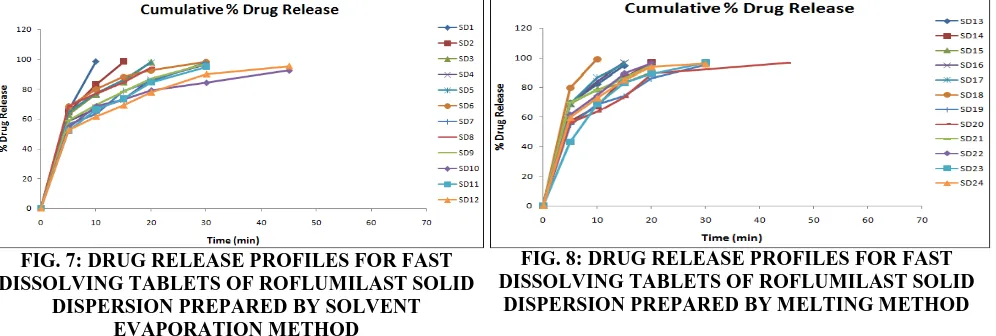
The in-vitro dissolution studies of all formulations (SD1 to SD12) were conducted, and the results were represented in Table 18 and Fig. 7. The amount of drug release from different formulations SD1, SD2, SD3, SD4, SD5, SD6, SD7, SD8, SD9, SD10, SD11 and SD12 at end of 60 min were 98.69%, 98.45%, 98.25%, 96.54%, 97.84%, 98.16%, 97.89%, 94.56%, 96.86%, 92.48%, 94.84% and 95.32% respectively. In the case of formulation SD1, in which the carrier used was PVP K30 (drug: carrier 1: 1 ratio), the maximum percentage of drug release was observed within 10 min.
TABLE 18: IN-VITRO DRUG RELEASE STUDIES FOR ROFLUMILAST SOLID DISPERSION BY SOLVENT EVAPORATION METHOD
Time (min) SD1 SD2 SD3 SD4 SD5 SD6 SD7 SD8 SD9 SD10 SD11 SD12
0 0 0 0 0 0 0 0 0 0 0 0 0
5 65.33 ±
0.50 64.84 ± 0.56 62.92 ± 0.34 58.62 ± 0.51 64.75 ± 0.61 68.15 ± 0.50 56.16 ± 0.58 68.54 ± 0.12 58.92 ± 0.45 54.23 ± 0.82 52.16 ± 0.61 52.52 ± 0.47 10 98.69 ±
0.44 82.95 ± 0.40 76.49 ± 0.61 66.94 ± 0.72
76.98 ± 0.42 79.84 ± 0.26 63.48 ± 0.71 76.95 ± 0.54 69.16 ± 0.36 68.47 ± 0.52 66.23 ± 0.23 61.45 ± 0.58
15 - 98.45 ±
0.55 84.75 ± 0.50 73.12 ± 0.49 85.92 ± 0.32 88.23 ± 0.15 78.56 ± 0.64 84.28 ± 0.36 78.28 ± 0.64 72.98 ± 0.35 73.28 ± 0.52 68.98 ± 0.61
20 - - 98.25
± 0.48 86.43 ± 0.25 97.84 ± 0.45 92.46 ± 0.45 85.15 ± 0.51 94.56 ± 0.58 86.92 ± 0.52 79.13 ± 0.26 84.36± 0.64 77.69 ± 0.25
30 - - - 96.54
± 0.43
- 98.16 ± 0.34
97.89 ± 0.34
- 96.86 ± 0.21 84.26 ± 0.52 94.84± 0.47 89.98 ± 0.35
45 - - - 92.48 ±
0.56
- 95.32 ± 0.46
[image:11.612.46.566.55.138.2]60 - - - -
TABLE 19: IN-VITRO DRUG RELEASE STUDIES FOR ROFLUMILAST SOLID DISPERSION BY MELTING METHOD Time (min) SD13 SD14 SD15 SD16 SD17 SD18 SD19 SD20 SD21 SD22 SD23 SD24
0 0 0 0 0 0 0 0 0 0 0 0 0
5 69.58
±0.6 56.98 ±0.25 68.92 ±0.52 68.95 ±0.36 69.12 ±0.65 79.58 ±0.65 54.58 ±0.32 56.12 ±0.62 69.92 ±0.58 61.38 ±0.24 43.11 ±0.24 59.47 ±0.35
10 82.13
±0.42 67.29 ±0.45 78.82 ±0.26 84.26 ±0.35 86.45 ±0.52 99.02 ±0.46 68.49 ±0.24 63.58 ±0.48 78.46 ±0.43 74.46 ±0.39 68.78 ±0.45 72.84 ±0.54
15 94.58
±0.75 86.43 ±0.36 83.13 ±0.12 96.82 ±0.62 96.13 ±0.34
- 74.13 ±0.38 73.59 ±0.59 86.13 ±0.38 89.42 ±0.62 83.04 ±0.64 84.95 ±0.62
20 - 96.58
±0.40
90.15 ±0.72
- - - 86.15
±0.16 89.32 ±0.38 94.59 ±0.61 96.16 ±0.78 89.39 ±0.79 93.84 ±0.75
30 - - 96.98
±0.79
- - - 95.23
±0.68
92.13 ±0.28
- - 96.72
±0.84
95.92 ±0.84
45 - - - 96.48
±0.62
- - - -
[image:11.612.48.566.432.753.2]All Roflumilast solid dispersions prepared using PVP K30 showed ≥ 85% of drug release within 15min. Formulations SD4 to SD12 showed maximum % of drug release within 45 min. Hence, in the case of Roflumilast solid dispersions prepared by the solvent evaporation method, SD1 was considered as the optimized formulation. The in-vitro dissolution studies of formulations SD13 to SD24 were carried out, and the results were depicted in Table 19 and Fig. 8. In case of formulation SD18, in which the carrier used was PEG 4000 (drug: carrier 1: 3 ratio), the maximum percentage of drug release was observed within 10 min, i.e., 99.02%. All Roflumilast solid dispersions developed using PEG 4000 showed ≥ 85% of drug release within 15 min. All the formulations showed
a maximum % of drug release within 45 min. Hence, in the case of Roflumilast solid dispersions prepared by melting method, SD18 was considered as the optimized formulation.
Accelerated Stability Studies: The optimized formulations were subjected for the accelerated stability studies. The optimized formulations SD1 and SD18 were analyzed for drug content for every month up to 3 months. Results of the accelerated stability studies revealed that there was no significant change in the physical appearance and drug content values of the optimized formulations as shown in Table 20 and Table 21 respectively, which mean that optimized formulations had good stability for a period of up to 3 months.
TABLE 20: ACCELERATED STABILITY STUDIES OF OPTIMIZED FORMULATION SD1
Test parameter Initial After 1 month After 2 months After 3 months
Physical appearance No change No change No change No change
Drug content (%) 99.98 ± 0.33 99.42 ± 0.54 99.38 ± 0.67 99.27 ± 0.42
TABLE 21: ACCELERATED STABILITY STUDIES OF OPTIMIZED FORMULATION SD18
Test parameter Initial After 1 month After 2 months After 3 months
Physical appearance No change No change No change No change
Drug content (%) 99.84 ± 0.25 99.68 ± 0.63 99.59 ± 0.72 99.41 ± 0.91
CONCLUSION: Fast dissolving tablets of Roflumilast solid dispersions were successfully prepared using different carriers (PVP K30, PEG 4000, PEG 6000 and HPMC K15M) by a solvent evaporation method and melting method. The maximum percentage of drug release was observed within 10 min in case of formulation SD1, in which the carrier used was PVP K30 (drug: carrier 1: 1 ratio). All Roflumilast solid dispersions prepared using PVP K30 showed ≥ 85% of drug release within 15 min. Formulations SD4 to SD12 showed maximum % of drug release within 45 min.
Hence, in the case of Roflumilast solid dispersions prepared by the solvent evaporation method, SD1 was considered as the optimized formulation. The maximum percentage of drug release was observed within 10min, i.e., 99.02% in case of formulation SD18, in which the carrier used was PEG 4000 (drug: carrier 1: 3 ratio). All Roflumilast solid dispersions developed using PEG 4000 also showed ≥ 85% of drug release within 15 min. All the formulations showed a maximum % of drug release within 45 min. Therefore, SD18 was considered as the optimized formulation among FIG. 7: DRUG RELEASE PROFILES FOR FAST
DISSOLVING TABLETS OF ROFLUMILAST SOLID DISPERSION PREPARED BY SOLVENT
[image:12.612.60.558.55.223.2]EVAPORATION METHOD
FIG. 8: DRUG RELEASE PROFILES FOR FAST DISSOLVING TABLETS OF ROFLUMILAST SOLID
Roflumilast solid dispersions prepared by melting method.
ACKNOWLEDGEMENT: The authors are thankful to the Principal and Management of Vijaya Institute of Pharmaceutical Sciences for Women, Enikepadu, Vijayawada for providing the necessary facilities to carry out the research work.
CONFLICT OF INTEREST: The authors declare that they have no conflicts of interest.
REFERENCES:
1. Debjit B, Chiranjib B, and Augsburger L: Fast dissolving tablets: an overview. Journal of Chemical and Pharmaceutical Research 2009; 1(1): 163-177.
2. Hirani JJ, Rathod DA and Vadalia KR: Orally disintegrating tablets: a review. Tropical Journal of Pharmaceutical Research 2009; 8(2): 161-172.
3. Daliresp (roflumilast) tablets, prescribing information. New York: Forest; 2011. Available at: www.frx.com/pi/ Daliresp_pi.pdf
4. Bethke TD and Lahu G: High absolute bioavailability of the new oral phosphodiesterase-4 inhibitor Roflumilast. International Journal of Pharmacology and Therapeutics 2011; 49(1): 51-57.
5. Torrado JJ and Augsberger LL: Tableting of multi-particulate modified release systems. In: pharmaceutical dosage forms-tablets. Rational design and formulation. Informa Healthcare, London, Edition 3rd, Vol. 2, 2008: 509-533.
6. Sharma D, Kumar D, Singh M, Singh G and Rathore MS: Fast disintegrating tablets: a new era in novel drug delivery system and new market opportunities. Journal of Drug Delivery and Therapeutics 2012; 2(3): 74-86. 7. Deshmukh VN: Mouth is dissolving drug delivery system:
A review. International Journal of Pharm Tech Research 2012; 4(1): 412-421.
8. Patel ST and Sengupta M: Fast dissolving tablet technology - a review. World Journal of Pharmacy and Pharmaceutical Sciences 2013; 2(2): 485-508.
9. Bi Y: Preparation and evaluation of a compressed tablet rapidly disintegrating in the oral cavity. Chemical and Pharmaceutical Bulletin 1996; 44: 2121-2127.
10. Jeong SH, Takaishi Y and Park K: Material properties for making fast dissolving tablets by a compression method. Journal of Material Chemistry 2008; 18: 3527-3535. 11. Patel MS and Patel NM: Flowability testing of directly
compressible excipients according to British Pharmacopeia. Jou of Pharm Res 2009; 8: 66-69.
12. Kumar S, Gupta S and Sharma P: A review of recent trends in oral drug delivery-fast dissolving formulation. Advances in Biological Research 2012; 6(1): 6-13. 13. Hindustan AA, Suresh KC, Kishore KR, Anil KB,
Chandra SA, Sushma K, Sairam T and Sivaji S: A novel technique in formulation and evaluation of mouth dissolving nimesulide tablets. Journal of Advances in Pharmaceutical Research 2010; 1(2): 101-107.
14. Bhupendra GP and Nayan R: A review on recent patents on fast-dissolving drug delivery system. International Journal of Pharm Tech Research 2009; 1(3): 790-798. 15. Gohel MC, Bansal G and Bhatt N: Formulation and
evaluation of orodispersible taste masked tablets of famotidine. Pharma-Bio World 2005, 3: 75-80.
16. Indian Pharmacopoeia, Vo. 3, 2018: 3137-3138.
All © 2013 are reserved by International Journal of Pharmaceutical Sciences and Research. This Journal licensed under a Creative Commons Attribution-NonCommercial-ShareAlike 3.0 Unported License. This article can be downloaded to Android OS based mobile. Scan QR Code using Code/Bar Scanner from your mobile. (Scanners are available on Google Play store)
How to cite this article: