© 2015, IRJET ISO 9001:2008 Certified Journal
Page 470
ECONOMIC LOAD DISPATCH CONTAINING LOSS COEFFICIENT
Harpreet Kaur
1, Manpreet Singh
2, Harnam Singh Farwaha
31
Assistant Professor, Computer Engineering Department, Guru Nanak Dev Polytechnic College, Punjab, India
2Assistant Professor, Information Technology Department, Guru Nanak Dev Engg. College, Punjab, India
3Assistant Professor, Mechanical Engineering Department, Guru Nanak Dev Engg. College, Punjab, India
---***---Abstract - The main focus of this research work is on
solving the Economic Load Dispatch problem in order to operate an electric thermal power station within estimated load demand limits. The major purpose of economic load dispatch is to maintain the balance between the total generated energy and total energy that is delivered to the load by reducing the fuel cost and transmission loss. The economic load dispatch is achieved by taking in account the various equality and inequality constraints.
Genetic Algorithm is adopted to attain the solution of Economic Load Dispatch problem. Genetic Algorithm is employed to minimize the objective function. This technique provides accurate and feasible solution
within reasonable computational time. Genetic
Algorithm is implemented in MAT LAB software. On the basis of GA, programming is done to obtain the desire solution for load dispatch. The effectiveness of the developed program is tested for six generator system. It has been found that GA is giving more accurate and better results than Lambda Iteration Method. GA proves itself as fast algorithm that find out optimum solution to minimize the total generation cost of thermal power plant while meeting the total load demand plus transmission losses within the generation limits. The Economic Load Dispatch problem has been solved successfully with the help of Genetic Algorithm.
Key Words:
Economic Load Dispatch; Genetic
Algorithm; Lambda Iteration Method; Fuel cost.
1. INTRODUCTION
The major purpose of power system operation and control is Economic load dispatch. In order to operate an electric power structure approach most economically within its security limits, Economic load demand is one of the best
approach to schedule the generator output over a confirmed period of time with estimated load demands. To minimize the cost of operation Economic load dispatch is the efficient approach which is the process of allocating the indispensable load demand between the accessible generating units. The chief goal of economic load is to transmit the electrical energy from the generating stations to the customers economically. To achieve this goal the electricity must be generated at the lowest cost without any loss.
Economic dispatch is a strategy which tries to maintain the balance between the total generated energy and the total energy that is delivered to the load by reducing the fuel cost and transmission loss.
2. FORMULATION OF ELD PROBLEM
© 2015, IRJET ISO 9001:2008 Certified Journal
Page 471
that the result of such computer program is implementedinto practical model in order to minimize the total cost of generation.
From the literature review it is clear that several already existing techniques faced difficulty in solving Economic Load Dispatch problem. In this present work, this difficulty is eliminated by using genetic algorithm. Genetic algorithm becomes more popular for optimization operations because of its productivity and efficiency.
2.1 Fuel Cost Function
The most simplified fuel cost function of each generator can be show in the given quadratic equation.
Rs/h (2.1)
Where
Pi is the output power of the ith power plant.
ai, bi, , ci, are the cost coefficients of ith generating units.
F is the total fuel cost.
2.2 Equality Constraints
In order to create a balance between supply and demand, the total generated power should be equal to total system demand plus network transmission losses. Therefore, equality constraint can be stated as:
(2.2)
Where PD = Total power demand in MW. Pi = Real power generation by ith generator in MW.
PL = Transmission losses in the system in MW.
N = Total number of generators.
The loss formula can be written as
(2.3)
Where Pi and Pj are source loadings, Bij is the transmission
loss coefficient.
2.3 Inequality Constraints
The generating output of each unit should be between its maximum and minimum limits i.e. the following inequality constraint should be satisfied for each generating unit. Pi min ≤ Pi ≤ Pi max (2.4)
Where Pi min, Pi max are the minimum and maximum
output of ith generator.
3. GENETIC ALGORITHM
The main approach used in evolutionary process is recognized as genetic algorithm. Genetic algorithms are evolved by Goldberg that was influenced by Darwin's theory regarding evolution.
Darwin's evolutionary theory declares that the existence of creature is influenced from the prescription "the strongest species that survives". He also revealed that the continuation of life of living being can be retained by the process of reproduction, crossover and mutation. This process is also implemented to search the result of several other problems. The result of above declared process is also known as chromosome. Population is basically the cluster of different chromosome which retain any value like binary code, special symbols etc. These can be evaluated for the acceptability of the result produced by the Genetic Algorithm.
Genetic algorithm has been employed to handle the situations which are difficult to solve. One of the examples of such a problem is NP-hard problems. Genetic algorithms are very straightforward and not much difficult to handle as during the implementation of GA, generate a new chromosome in order to solve the problem. Computational time of GA is one of the biggest problem of genetic algorithm. The computational speed of the genetic algorithm is slower than the remaining methods. But in these days with the help of modern computers computational time is not so much considerable problem.
© 2015, IRJET ISO 9001:2008 Certified Journal
Page 472
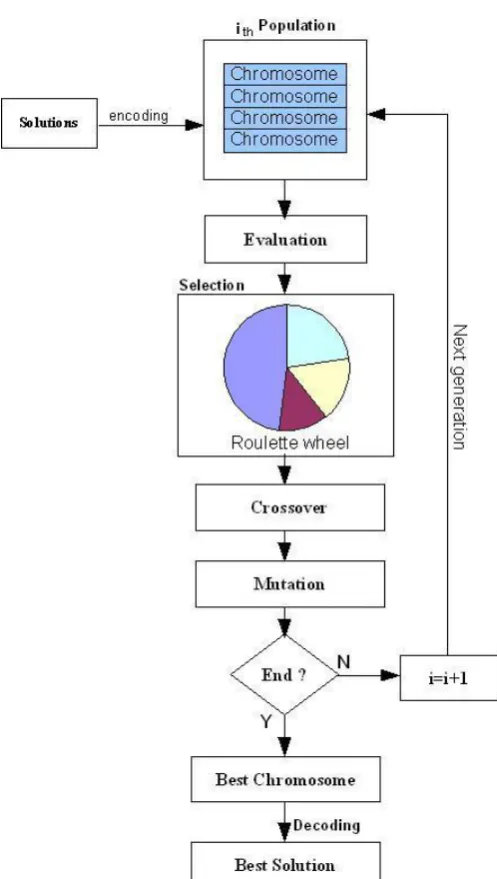
solutions are extracted which are used to create a newchromosomes. The main role of the process of extracting a solution from the previous population is that there is a perception for getting a better population.
Selection of the population that is recommended for the creation of new population is based on the fitness percentage of the initial population. The best fit solution attains high probability for the reproduction process. The repetition of the whole process is done to find the best result.
3.1 Search Space
When we are observing for some solution, which will be the best in the middle of others solutions for solving some problem then it is recognized as a location where all the economical results are placed in the middle of the other results. Such a location is considered as search space. Example of search space is shown in fig. 1. At this location each spot is a representative of an economical result. This economical result is recognized by some quantity. Searching for result is equivalent to searching for the best value which is either minimum or maximum.
At the time of searching of a result search space is located then after that as the procedure of finding solution continues we are generating other points from it.
Fig -1: Search Space
[image:3.595.308.557.208.648.2]At this location it is very hard to find the result because there is no previous knowledge of the starting point that provide information about where to look for the result. So the method of search space for locating the result is very is very complicated.
Fig -2: Flow chart of Genetic Algorithm
3. RESULT AND DISCUSSIONS
[image:3.595.37.288.476.727.2]© 2015, IRJET ISO 9001:2008 Certified Journal
Page 473
to implement the program. The main purpose of using GAis to reduce the generation cost of power plant. The performance is evaluated by considering losses using six generator experimentation systems, whose input data are given in Table 1.
TABLE -1:Specifications of Experimentation
Unit
a
ib
ic
iP
imin P
imax
1
0.007
7
240
100
500
2
0.0095
10
200
50
200
3
0.009
8.5
220
80
300
4
0.009
11
200
50
150
5
0.008
10.5
220
50
200
6
0.0075
12
120
50
120
SIX-GENERATOR SYSTEM
The cost function is:
f = F1 + F2 + F3 + F4 + F5 + F6
The six generating units are having different characteristics. The cost functions of each unit are given by the following equations respectively:
F1 = 0.007 P12 + 7 P1 + 240
F2 = 0.0095 P22 + 10P2 + 200
F3 = 0.009 P32 + 8.5 P3 + 220
F4 = 0.009 P42 + 11 P4 + 200
F5 = 0.008 P52 + 10.5 P5 + 220
F6 = 0.0075 P62 + 12 P6 + 120
The operating ranges of the respective generating units are:
100 MW ≤ P1 ≤ 500 MW
50 MW≤ P2 ≤ 200 MW
80 MW ≤ P3 ≤ 300 MW
50 MW ≤ P4 ≤ 150 MW
50 MW ≤ P5 ≤ 200 MW
50 MW ≤ P6 ≤ 120 MW
Power Demand for this problem is taken as, Pd = 700 MW
Bij=1e-4*[0.14 0.17 0.15 0.19 0.26 0.22
0.17 0.6 0.13 0.16 0.15 0.2
0.15 0.13 0.65 0.17 0.24 0.19
0.19 0.16 0.17 0.71 0.3 0.25
0.26 0.15 0.24 0.3 0.69 0.32
0.22 0.2 0.19 0.25 0.32 0.85];
© 2015, IRJET ISO 9001:2008 Certified Journal
Page 474
Optimization terminated: average change in the fitnessvalue less than options. Tol Fun.
F =
8.3808e+03
P1 =
304.0544 80.7068 130.2837 68.5099 77.4077 50.0661
Pl =
11.0287
3. CONCLUSION
The present work relates to the implementation of Genetic Algorithm in order to find the optimum result of load dispatch issue. The experimental success of GA for the solution of ELD problem has made them an exceptionally distinctive optimization approach. The operation of this model is based on the correct selection of GA approach, fitness function and the method which is used for the presentation of the problem.
The success of developed program is evaluated for six generator systems. It has been observed that GA is providing more accurate and effective results with fast convergence characteristics than LIM. With the huge change in load with respect to time, it is not possible to serve the load dispatch for every load demand because there is no such technique that finds out the optimum solution of economic load dispatches. This is place where GA plays an important role for providing optimum solution in few seconds. By providing better results than Lambda Iteration method, GA proves itself as fast algorithm that find out optimum generation of both operating cost and transmission losses of the power system.
In this research work, the issue of economic load dispatch has been resolved successfully with the implementation of GA. The experimental conclusion provides the minimum operating cost. GA produces more efficient results as compare to other methods. It was concluded that GA revolution is more capable and effectual to provide the solution for the problem of
economic power dispatch.
REFERENCES
[1] A .J. Wood and B.F. Wollenberg, “Power
generation, operation, and control,” John Wiley and Sons., New York, 1984.
[2] B.H. Choudhary and S. Rahman, “ A review of recent advances in economic dispatch”, IEEE Trans Power Syst.,1990, Vol. 5, No. 4, pp. 1248– 59.
[3] D. N. Jeyakumar, T. Jayabarathi and T.
Raghunathan, “Particle swarm optimization for various types of economic dispatch problems,” Elec. Power Energy Syst, 28, 2006, pp. 36-42. [4] D. Walters and G.B. Sheble, “Genetic algorithm
solution of economic dispatch with valve point loading”, IEEE Trans. on Power Systems, Vol 8, No. 3, pp. 1325-1331, 1993.
[5] J. Tippayachai,W. Ongsakul and I. Ngamroo, “Parallel micro genetic algorithm for constrained economic dispatch,” IEEE Trans. Power Syst., 17 August (3), 2003, PP. 790-797.
[6] Rahul Dogra, Nikita Gupta, Harsha
Saroa,“Economic load dispatch problem and MATLAB programming of different methods,” International Conference of Advanced Research and Innovation (ICARI-2014).