Full Length Research Article
DRIVER DROWSINESS DETECTION TECHNIQUE USING RASPBERRY PI
*Tejasweeni Musale and Pansambal, B.H.
Bhivarabai Sawant College of Engineering and Reasearch, Narhe,Pune,India
ARTICLE INFO ABSTRACT
This paper presents a real-time driver drowsiness detection system for driving safety. Based on computervision techniques , the driver’s face is located from a color video captured in a car. Then, face detection is employed to locate the regions of the driver’s eyes, which are used as the templates for eye tracking in subsequent frames. Finally, the tracked eye’s images are used for drowsiness detection in order to generate warning alarms. The proposed approach has three phases: Face, Eye detection and drowsiness detection. The role of image processing is to recognize the face of the driver and then extracts the image of the eyes of the driver for detection of drowsiness. The Haar face detection algorithm takes captured frames of image as input and then the detected face as output. Next, CHT is used to tracking eyes from the detected face. If the eyes are closed for a predefined period of time the eyes of the driver will be considered closed and hence an alarm will be started to alert the driver. The proposed system was tested on a Raspberry pi 3 Model B with 1GB RAM with use of Logitech HD Webcam C270. The experimental results appears quite encouraging and promising. The system could reach more than 15 frames per second for face and eye tracking, and the average correct rate for eye location and tracking could achieve 99.0% on some test videos. Thus, it can be concluded that the proposed approach is a low cost and effective solution method for a real-time of driver drowsiness detection.
Copyright©2017,Tejasweeni Musale, and Pansambal. This is an open access article distributed under the Creative Commons Attribution License, which permits unrestricted use, distribution, and reproduction in any medium, provided the original work is properly cited.
INTRODUCTION
Drowsy driving is one of the major causes behind fatal road accidents. One of the recent study shows that one out of five road accidents are caused by drowsy driving which is roughly around 21% of road accidents, and this percentage is increasing every year as per global status report on road safety 2015, based on the data from 180 different countries. This certainly highlights the fact that across the world the total numbers of road traffic deaths are very high due to driver’s drowsiness. Driver fatigue, drink-and-drive and carelessness are coming forward as major reasons behind such road accidents. Many lives and families are getting affected due to this across various countries. All this led to the development of Intelligent Driver Assistance Systems (Srinivasu Batchu, 2015). Real time drowsy driving detection is one of the best possible major that can be implemented to assist drivers to make them aware of drowsy driving conditions. Such driver behavioral state detection system can help in catching the driver drowsy conditions early and can possibly avoid mishaps.
*Corresponding author: Tejasweeni Musale
Bhivarabai Sawant College of Engineering and Reasearch, Narhe,Pune,India
Among these the major cause is due to driver errors and recklessness. Driver fatigue is cause behind such mishaps. Heavy traffic, increasing automotive population, adverse driving conditions, tight commute time requirements and the work loads are few major reasons behind such fatigue. With this paper, we are presenting technique to detect driver drowsiness using of Open CV, raspberry pi and image processing (Wei Zhang, 2012). Several studies have shown various possible techniques that can detect the driver drowsiness. Such driver drowsiness detection can be measured using physiological measures, ocular measure and performance measure (Mario, 2015 and Mayank Chauhan, 2014). Among these physiological measure and ocular measure can give more accurate results. Physiological measure includes brain waves, heart rate, pulse rate measurements and these requires some sort of physical connection with the driver such as connecting electrode to the driver body. But this leads to discomfartable driving conditions. But ocular measure can be done without physical connection. Ocular measure to detect driver eye condition and possible vision based on eye closure is well suited for real world driving conditions, since it can detect the eyes open/ closed state non-intrusively using a camera (Ralph Oyini Mbouna, 2013). In Real Time Driver Drowsiness System using Image Processing, capturing drivers
ISSN: 2230-9926
International Journal of Development Research
Vol. 07, Issue, 02, pp.11499-11503, February, 2017
International Journal of
DEVELOPMENT RESEARCH
Article History:
Received 19thNovember, 2016
Received in revised form 17thDecember, 2016
Accepted 24thJanuary, 2017 Published online 28thFebruary, 2017
Available online at http://www.journalijdr.com
Key Words:
Drowsiness,
eye state using computer vision based drowsiness detection systems have been done by analyzing the interval of eye closure and developing an algorithm to detect the driver’s drowsiness in advance and to warn the driver by in vehicles alarm. Methodologies that are used for detection of Real Time Drivers drowsiness are introduced in Section II. This section motivates how face is detected and how eye detection is performed for automotive application and their detection is necessary for assessing driver drowsiness. Also this section discusses the system architecture and introduces detection approach. Section III contains different experimentations. Results evaluating the approach are presented in Section IV. Finally, this study will be concluded in Section V.
The Proposed Driver Fatigue Detection System
[image:2.595.308.560.82.396.2]The system architecture of the proposed system is represented in Fig.1
Fig. 1. Proposed System Architecture
Fig 1. showcases the various important blocks in the proposed system and their interaction. It can be seen that the system consists of distinct modules like video acquisition, Face/ eye detection and drowsiness detection. In addition to these there are external hardware components namely, Camera mounted on the dash board of a car to capture the images of the driver for video acquisition, Raspberry Pi is a credit card sized single-board computer for implementation and an audio alarm system for drowsiness detection and correction. The flow chart of the proposed system shows in Figure 2, describes the overall methodology that was used. In the proposed system, first video acquisition is achieved by camera placed in front of the driver. The acquired video is then converted into a series of frames/images. The next step is to detect the driver's face, in each and every frame extracted from the video. Next we make use of CHT for eye detection, and detect the eyes by processing only the region of interest. Once the eyes have been detected, the next step is to determine whether the eyes are in open/closed state. Monitoring each frame for pupil detection if the eyes are detected to be open, no action is taken. But, if eyes are detected to be closed continuously and it is above threshold value then it means that the automobile driver is
feeling drowsy and a sound alarm is triggered. The detailed steps are described in the following subsections.
Fig. 1. Methodology flowchart
Face Detection
The proposed system will start by capturing the video frames one by one. OpenCV provides extensive support for processing live videos.The system will detect the face in the frame image for each frame. This system uses Viola-Jones object detector which is a machine learning approach for visual object detection (Paul Viola, 2004 and Paul Viola, 2001). This is achieved by making use of the Haar algorithm for face detection.
Haarcascade is a well-known robust feature-based algorithm that can detect the face image efficiently. With the use of uses of cascade of stages Haar algorithm able to remove the candidates that are non-face. And each stage consists of combination of different Haar features and each feature in turn is classified by a Haar feature classifier.The inbuilt OpenCV xml “haarcascade_frontalface_alt2.xml” file is used to search and detect the face in individual frames. This file contains a number of features of the face and constructed by using a number of positive and negative samples. First load the cascade file then pass the acquired frame to an edge detection function, which detects all the possible objects of different sizes in the frame. Since the face of the driver occupies a large part of the image, instead of detecting objects of all possible sizes, specify the edge detector to detect only objects of a particular size i.e for face region. Next, the output the edge detector is stored and this output is compared with the cascade file to identify the face in the frame. The output of this module is a frame with face detected in it. Only disadvantage in Haar algorithm is that it cannot extrapolate and does not work appropriately when the face is not in front of the camera axis. Once the face detection function has detected the face of the eye state using computer vision based drowsiness detection
systems have been done by analyzing the interval of eye closure and developing an algorithm to detect the driver’s drowsiness in advance and to warn the driver by in vehicles alarm. Methodologies that are used for detection of Real Time Drivers drowsiness are introduced in Section II. This section motivates how face is detected and how eye detection is performed for automotive application and their detection is necessary for assessing driver drowsiness. Also this section discusses the system architecture and introduces detection approach. Section III contains different experimentations. Results evaluating the approach are presented in Section IV. Finally, this study will be concluded in Section V.
The Proposed Driver Fatigue Detection System
[image:2.595.40.284.271.513.2]The system architecture of the proposed system is represented in Fig.1
Fig. 1. Proposed System Architecture
Fig 1. showcases the various important blocks in the proposed system and their interaction. It can be seen that the system consists of distinct modules like video acquisition, Face/ eye detection and drowsiness detection. In addition to these there are external hardware components namely, Camera mounted on the dash board of a car to capture the images of the driver for video acquisition, Raspberry Pi is a credit card sized single-board computer for implementation and an audio alarm system for drowsiness detection and correction. The flow chart of the proposed system shows in Figure 2, describes the overall methodology that was used. In the proposed system, first video acquisition is achieved by camera placed in front of the driver. The acquired video is then converted into a series of frames/images. The next step is to detect the driver's face, in each and every frame extracted from the video. Next we make use of CHT for eye detection, and detect the eyes by processing only the region of interest. Once the eyes have been detected, the next step is to determine whether the eyes are in open/closed state. Monitoring each frame for pupil detection if the eyes are detected to be open, no action is taken. But, if eyes are detected to be closed continuously and it is above threshold value then it means that the automobile driver is
feeling drowsy and a sound alarm is triggered. The detailed steps are described in the following subsections.
Fig. 1. Methodology flowchart
Face Detection
The proposed system will start by capturing the video frames one by one. OpenCV provides extensive support for processing live videos.The system will detect the face in the frame image for each frame. This system uses Viola-Jones object detector which is a machine learning approach for visual object detection (Paul Viola, 2004 and Paul Viola, 2001). This is achieved by making use of the Haar algorithm for face detection.
Haarcascade is a well-known robust feature-based algorithm that can detect the face image efficiently. With the use of uses of cascade of stages Haar algorithm able to remove the candidates that are non-face. And each stage consists of combination of different Haar features and each feature in turn is classified by a Haar feature classifier.The inbuilt OpenCV xml “haarcascade_frontalface_alt2.xml” file is used to search and detect the face in individual frames. This file contains a number of features of the face and constructed by using a number of positive and negative samples. First load the cascade file then pass the acquired frame to an edge detection function, which detects all the possible objects of different sizes in the frame. Since the face of the driver occupies a large part of the image, instead of detecting objects of all possible sizes, specify the edge detector to detect only objects of a particular size i.e for face region. Next, the output the edge detector is stored and this output is compared with the cascade file to identify the face in the frame. The output of this module is a frame with face detected in it. Only disadvantage in Haar algorithm is that it cannot extrapolate and does not work appropriately when the face is not in front of the camera axis. Once the face detection function has detected the face of the eye state using computer vision based drowsiness detection
systems have been done by analyzing the interval of eye closure and developing an algorithm to detect the driver’s drowsiness in advance and to warn the driver by in vehicles alarm. Methodologies that are used for detection of Real Time Drivers drowsiness are introduced in Section II. This section motivates how face is detected and how eye detection is performed for automotive application and their detection is necessary for assessing driver drowsiness. Also this section discusses the system architecture and introduces detection approach. Section III contains different experimentations. Results evaluating the approach are presented in Section IV. Finally, this study will be concluded in Section V.
The Proposed Driver Fatigue Detection System
The system architecture of the proposed system is represented in Fig.1
Fig. 1. Proposed System Architecture
Fig 1. showcases the various important blocks in the proposed system and their interaction. It can be seen that the system consists of distinct modules like video acquisition, Face/ eye detection and drowsiness detection. In addition to these there are external hardware components namely, Camera mounted on the dash board of a car to capture the images of the driver for video acquisition, Raspberry Pi is a credit card sized single-board computer for implementation and an audio alarm system for drowsiness detection and correction. The flow chart of the proposed system shows in Figure 2, describes the overall methodology that was used. In the proposed system, first video acquisition is achieved by camera placed in front of the driver. The acquired video is then converted into a series of frames/images. The next step is to detect the driver's face, in each and every frame extracted from the video. Next we make use of CHT for eye detection, and detect the eyes by processing only the region of interest. Once the eyes have been detected, the next step is to determine whether the eyes are in open/closed state. Monitoring each frame for pupil detection if the eyes are detected to be open, no action is taken. But, if eyes are detected to be closed continuously and it is above threshold value then it means that the automobile driver is
feeling drowsy and a sound alarm is triggered. The detailed steps are described in the following subsections.
Fig. 1. Methodology flowchart
Face Detection
The proposed system will start by capturing the video frames one by one. OpenCV provides extensive support for processing live videos.The system will detect the face in the frame image for each frame. This system uses Viola-Jones object detector which is a machine learning approach for visual object detection (Paul Viola, 2004 and Paul Viola, 2001). This is achieved by making use of the Haar algorithm for face detection.
driver, the eyes detection function tries to detect the driver's eyes.
Eye detection
Once the face detection function has detected the face of the driver, the eyes detection function tries to detect the automobile driver's eyes. After face detection find eye region by considering eyes are present only in upper part of the face and from top edge of the face, extract eyes Region Of Interest (ROI) by cropping mouth and hair, we mark it the region of interest. By considering the region of interest it is possible to reduce the amount of processing required and also speeds up the processing for getting exact eyes. After the region of interest is marked, the edge detection technique is applied only on the region of interest .Then search for eyes in ROI, Circular Hough Transformation is used here to find shape of eyes (Rhody Chester, 2005). The main advantage of the Hough transform technique is that it is liberal to gaps in feature boundary descriptions and is relatively unaffected by image noise, unlike edge detectors. The OpenCV function HoughCircles () is used to detect circles in an eye image. CHT ensure that at most two eyes found. With the eye detection technique we will only be able to detect the open state of eyes.
Drowsiness Detection
After getting eyes the algorithm then counts the number of open eyes form each frame and determines the drowsiness. If the criteria are satisfied, then the driver is said to be drowsy. The buzzer connected to the system performs actions to correct the driver abnormal behavior. For this system, the eye and the face classifiers are required. The HARR Classifier Cascade files built-in there with the Open CV contains different classifiers for the face and eye detection. The inbuilt Open CV
xml “haarcascade_frontalface_alt2.xml”and function
“Houghcircles ()” is used to search and detect the face followed by in individual frames (http://www.opencv.org/) The face detection and open eye detection have been carried out on each frame of the driver’s captured facial image. The variable Eyestotal is assigned to store the number of open eyes found in each frame. A variable will store the number of successive frames in which the eyes found to be closed with the values like 0, 1, 2, 3… etc. Initially, this variable is set to 0. When both the eyes are open, then Drowsycount will be 0. Drowsycount will increase when Eyestotal < 2. For an eye blink, Drowsycount value be raised by 1. If the eyeblinks in more than 4 frames, i.e. variable count is greater than or equal to 4, then the condition for drowsiness is met and an alarm will be signaled at real time.
Experimentation
The very first step in our system is to detect the Face, Eye region and the Eye through OpenCV libraries, live video as a input to the system and get output as frame with face and region of interest, simulating the estimated result before actually implementing it to the hardware. The tests were conducted in various conditions including:
Different lighting conditions.
Drivers with spectacles
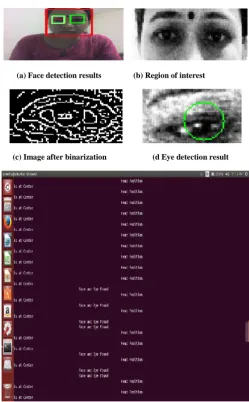
As shown in Fig 3, when there is ambient amount of light, the automobile driver's face and eyes are successfully detected.
Test case 2: When driver is wearing spectacles
(a) Face detection results (b) Region of interest
(c) Image after binarization (d Eye detection result
[image:3.595.308.558.69.472.2](e) Face and Eye detection result
Fig. 3. Test Scenario #1–Ambient lighting
As shown in Fig 3, when there is ambient amount of light, the automobile driver's face and eyes are successfully detected.
(a) Face detection results (b) Region of interest
c) Image after binarization (d) Eye detection result
Fig. 4. Test Scenario #2–Driver with spectacles
As shown in Fig 4, when driver is wearing spectacles, the face, eye was successfully detected.
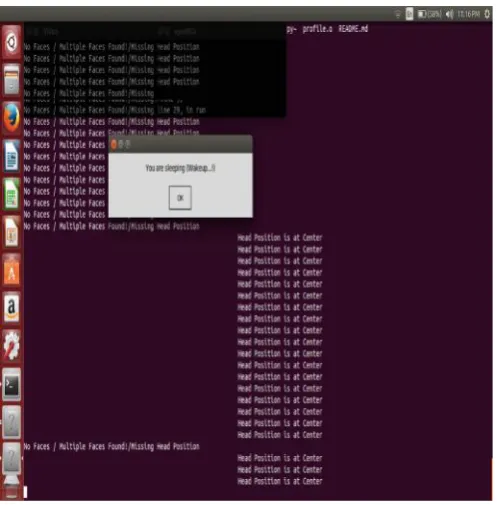
[image:3.595.311.557.554.722.2]Test case 3 :When the driver is sleeping
Fig. 5. Test Scenario #3–Example of driver drowsiness
Fig 5, is a screenshot when drowsiness is successfully detected.
Test case 4: Whenthe driver’s head tilted/positioned at the
[image:4.595.321.544.271.352.2]right or left
Fig. 6. Test Scenario #4– Example of driver’s head position
Fig 6, is a screen snapshot when face is not at the center position, it was observed that the detection of face and eyes failed.
CONCLUSION AND RESULT
The Table 1 describes the results of the proposed system in this study for six test instances ,each experiment instance has
been conducted by a different user. The following terms describe the used measures in the experiments:
Total frame means the total number of frames in each produced experiment instance
Detection failure means the count of drowsiness detection failures
Correct rate of drowsiness detection is defined as ratio of (total frame–detection failure ) to total frame
= −
As described in Table 1, the correct rate of drowsiness detection is higher than 92.2% and the average correct rate can achieve 99.45%.
Table 1. Experiment instances
Instances Total frames
Detection failure
Correct rate %
Average
Instance 1 4000 19 99.5 Instance 2 3500 18 99.4
Instance 3 3800 15 99.6 99.45
Instance 4 4300 22 99.4 Instance 5
Instance 6 3100 4200
12 30
99.6 99.2
As described in Table 1, the correct rate of drowsiness detection is higher than 99.2% and the average correct rate can achieve 99.45%. Figure 6.1 represents the calculated values of the correct rate for each tested instance. Furthermore, the training data play the main role in indicating the performance of the system. The performance directly proportional with quantity (number of the eye images) and the quality (variety of eye images) of the training data.
The result varies with respect to the following factors:
No. of captured frames
Size of the eye
Eye clearance (with or without eyeglass)
With 99%accuracy, it is obvious that our driver’s drowsiness and fatigue detection system is robust.
REFERENCES
Rhody Chester, H. F. ‘’Hough Circle Transform‘’, Carlson Center for Imaging Science Rochester Institute of Technology October 11, 2005
http://www.opencv.org/
Mario I Chacon-MurguiaClaudia Prieto-Resendiz,”Detecting Driver Drowsiness-A survey of system designs and
technology,” IEEE Consumer Electronics Magazine,
pp.107-108,October 2015.
Mayank Chauhan, Mukesh Sakle”Study & Analysis of Different Face Detection Techniqes ” International Journal of Computer Science and Information Technologies, Vol. 5 (2) , pp 1615-1618,2014.
Paul Viola and Michael j. Jones,” Rapid Object Detection using a Boosted Cascade of Simple Features,”International Journal of Computer Vision 57(2), pp 137–154, 2001. Paul Viola and Michael j. Jones,” Robust Real-Time Face
[image:4.595.41.286.422.675.2]Ralph Oyini Mbouna, Seong G. Kong, “Visual Analysis of Eye State and Head Pose for Driver Alertness Monitoring” Ieee Transactions On Intelligent Transportation Systems, Vol. 14, No. 3, September 2013.
Srinivasu Batchu, S. Praveen Kumar,” Driver Drowsiness Detection to Reduce the Major Road Accidents in Automotive Vehicles,” International Research Journal of Engineering and Technology (IRJET) e-ISSN: 2395 -0056 Volume: 02 Issue: 01 | April-2015.
Wei Zhang, Bo Cheng, Yingzi Lin,” Driver Drowsiness Recognition Based on Computer Vision Technology,” Tsinghua Science And Technology, pp354-362,Volume 17, Number 3, June 2012.