A Comparative Analysis between Two System
Calendars in Islamic Banking System
Kunthi Herma Dwidayati
1, Noralfishah Sulaiman
2, Tono Saksono
3Centre of Estate and Facilities Management1 Faculty of Technology Management and Business, UTHM
Johor, Malaysia [email protected]
Centre of Estate and Facilities Management2 Faculty of Technology Management and Business, UTHM
Johor, Malaysia [email protected]
Centre of Estate and Facilities Management3 Faculty of Civil and Environmental Engineering, UTHM
Johor, Malaysia [email protected]
Abstract—Islamic Banking (IBg) in Malaysia continues to grow rapidly and Malaysia is considered to be one of the most advance developed countries among the other Muslim countries that employs this banking system. Concurrently, Islamic Housing Finance (IHF) in Malaysia has been running almost 30 years, began when Bank Islam Malaysia Berhad (BIMB) was established in 1983. Then it allowed other Islamic banks (IB) such as Bank Muamalat Malaysia Berhad (BMMB), Maybank Islamic, CIMB Islamic, AmIslamic Bank and so forth to employ the same concept. However, the practices of IHF still have some issues on compliance with Islamic principles such as riba (usury), maysir (gambling),and gharar (uncertainty). Actually, the other issue is on calendar as a basis of accounting system. Quran Surah At-Taubah: 36-37 depicts that there is a clear guidance for Muslims to use the Islamic Calendar (IC) for his or her mundane and spiritual lives. Contextually, calendar is a system to organising days for religious, social, commercial or administrative purposes. During this time, all IB in Malaysia are using Gregorian Calendar (GC) as the basis of accounting system. GC is a solar year, has 365 days and leap years to the days of 366. Meanwhile, IC is a lunar year and has 354 or 355 days. Interestingly, IC is shorter than GC and this would affect the loan particularly mortgage repayment of Islamic Housing Finance (IHF). Therefore, this paper will discuss and compare IHF in IC and GC particularly to those who taking loan by mortgaging the property.
Keywords—Islamic Calendar (IC); Gregorian Calendar (GC); Islamic Banking (IBg);
I.
Introduction
Nowadays, Islamic Finance (IF) is growing in multiple dimensions and not in one sector but also spreading in other financial sectors such as structured finance, mutual funds, project finance, insurance, investment banking, etc. There are
two relevant principles of Islam according Ranjbar & Pahlevan [2], namely shariah and muamalah. According to Al Hafizh [3], muamalah is referred to the term of Islamic bank, includes buying and selling activities (bai’), receivables (qara'ah), pledge (rahn), transferring debt (hawalah), for profit in the trade (ijarah), assurance (dhaman), fellowship (syirkah), and others. Jobst [4] defines the shariah is “frequently characterised as Islamic religious law, which is binding upon Muslims as a matter of religious mandate and also may be incorporated into the secular law of a given jurisdiction”. The shariah concept is derived from the Qur’an and being the Islamic law of human conduct. The shariah prohibits what is called “Riba”. Riba literally means (Arabic) is the excess or increase. In Quran, Al Baqarah 275 [1] describes: “Those who consume interest cannot stand (on the Day of Resurrection) except as one stands that is being beaten by Satan into insanity. That is because they say, “Trade is (just) like interest. “ But Allah has permitted trade and has forbidden interest. So whoever has received an admonition from his Lord and desists may have what is past, and his affair rests with Allah. But whoever returns to (dealing in interest or usury) those are the companions of the fire; they will abide eternally therein.”
0.00 10,000.00 20,000.00 30,000.00 40,000.00 50,000.00 60,000.00
Des 2007
Des 2008
Des 2009
Des 2010
Des 2011
Des 2012
IHF in Islamic Banks
IHF in Islamic Banks IC for use in modern business [26]. Hence, Islamic Banking
System (IBS) in Malaysia prefers using Gregorian Calendar (GC) than IC. GC is a solar calendar consists of 365 days in a year and also known as a leap year. IC or lunar calendar is system calendars consist of 29 or 30 days a month and it is 11.5 days shorter than GC. Therefore the difference days between IC and GC in term of days would affect the calculation of loan repayment (IHF). In order to understand the impact of IC towards loan for IHF, Bank Muamalat Malaysia Berhad has been chosen as a case study for this research. Therefore, this paper will review and compare the differences of two calendars, IC and GC in IHF.
II.
Objectives
The objectives of this research are: To identify differences between Islamic Housing Finance (IHF) calculation in Gregorian Calendar (GC) and Islamic Calendar (IC);
To analyse effect of employing Gregorian Calendar (GC); Islamic Calendar (IC) in Islamic Housing Finance (IHF).
III.
Literature Review
A. Islamic Banking (IBg)Islamic Banking (IBg) is a bank that operates based on muamalah procedure or accordance with sharia law [6]. IBg is merely another form of conventional banking minus the interest element, or a mere play of semantics by replacing the word "interest" with "profit" [2]. IB as one of financial industries also the fastest growing of the credit market in Muslim countries. Geographically, IBg has grown from Middle East to Europe and in South East Asian market as well [7]
IBg can be classified into two categories [3], namely:
(1)In Respect of Ownership
IB is divided into three owners there are owned by government, private sector and internationally
(2)In Respect of Business Motive
IB is divided into two classifications: commercial bank and development bank
The main goal of IBg and financial system [2] are:
(1)Implement the value system of the Quran and the Sunnah (tradition or practice of Prophet Muhammad in the realm of the Muslim socioeconomic system;
(2)Foster the growth of the economy of Muslim nation by developing financial markets institutions and instruments. A well-developed capital market, with efficiency institutions offering diverse financial facilities, can reduce to overall cost of capital; and
(3)Dampen the shocks of extreme economic output by promoting risk sharing instruments whose payoffs are strictly contingent on the profitability of a firm or project at a micro level. Financial facilities with fixed costs can severely strain the resources of the economy.
Islamic Financial Industry (IFI) in Malaysia has been growing since 1963 when the Malaysian Pilgrims Fund Board (Tabung Haji) established. In 1983, Malaysia applied dual banking system whereby operates in parallel with the conventional banking [3]. Today, Malaysia has one of the world's most sophisticated IBg environments with a well-developed financial market [8]. Figure 1 shows the statistic of IHF in Malaysia IB.
In this regards, IHF in Malaysia have shown a significant growth. From Figure 1, the numbers of customers in some IB are increased from year to year. IHF development in this case, has a variety of products such as: murabaha, bai 'bithamin ajil, tawarruq, musharakah mutanaqisah, istishna', and ijara. Below are some explanations of the IHF products that have been widely used in Malaysia:
(1) Bai’ Bithamin Ajil
Bai Bithamin Ajil (BBA) is a transaction selling and buying by deferred payment [10]. Ahmad [11] defines BBA with three components, namely Al-Bai '(sale and purchase), Al-Murabahah (sale with the added advantage) and Al Taqsit (sales with deferred payments). Mechanisms of BBA according to Bank Negara Malaysia (BNM) [12] are:
Customer identifies the asset to be purchased.
Bank determines the requirements of the customer, in relation to the financing period and nature of repayment. Bank purchases the assets concerned.
Bank subsequently sells the relevant asset/property to the customer at an agreed price, which consist of: Actual cost of the asset to the bank i.e. financing amount; bank’s profit margin; customer is to settle the payment by installment payment throughout the financing /period.
(2) Musharakah Mutanaqisah (MM)
Musharakah Mutanaqisah (MM) is a contract of partnership between two parties, where one partners gradually buying all parts of the property [13]. According to BNM [14], the general concepts of the stages of IHF products based on Musharakah Mutanaqisah (MM) are:
[image:2.595.308.566.160.306.2] A customer who wants to buy a real property applies for financing from the Islamic financial institution;
The Islamic financial institution and the customer will jointly purchase the real property based on a determined share, depending on the amount of financing requested; The deposit paid by the customer is deemed as his initial
share of ownership;
The Islamic financial institution's share of ownership will be leased (based on. Ijarah ) to the customer; and
The monthly instalment by the customer will be used to gradually purchase the share of the Islamic financial institution until the entire share of the Islamic financial institution is fully purchased by the customer
(3) Tawarruq
Tawarruq is a sale and purchase transaction in which the seller sells the goods to a third party [15]. BNM [16] explains that tawarruq is divided into two stages of transaction, namely: the buyer will purchase an asset on credit from the original seller, and the buyer will then sell the asset on cash basis to a third party.
However, Solehudin [17] asserts IB also faced a lot of problems such as:
Still fixated on the concept of development regardless the dynamics of human resources. In addition, the practitioners of IB have not fully understood about the understanding and awareness of the principles in Islamic economics;
Lack of instruments and products that provided by IB. These cause the customer does not freely choose the instrument as needed; and
Lack of communication and socialisation.
B. Calendar as a Basis of Accounting System
Calendar according Oxford Dictionary [18] is chart or series of pages that showing the days, weeks, months and year. The function of calendar primarily used to [5]:
(1) Identify days;
(2) Be informed about and or to agree on a future event;
(3) Record an event that has happened;
(4) Help people manage their personal schedules, time and activities, particularly when individuals have numerous work, school and family commitments;
(5) As part of a complete timekeeping system, date and time of day and time of day together specify a moment in time; and
(6) As the advent of accurate clocks has made it possible to record time independently of astronomical events.
There are many type of calendar system nowadays. Several type of calendar system widely used in the world:
(1) Gregorian Calendar (GC)
Gregorian Calendar (GC) is a calendar that commonly used worldwide. GC was first used in 1582 AD with the aim to replace the Julian calendar which at that time found a lot of errors in dates calculation. GC can be determined with several criteria as every year that is exactly divisible by 4 is a leap
year, except for years that are exactly divisible by 100; these centurial years are leap years only if they are exactly divisible by 400 [19].
(2) Islamic Calendar (IC)
Islamic Calendar (IC) or Hijri calendar is a lunar calendar which consists of 12 months and 354-355 days per year. IC was first used in 622 AD. First day IC was used is during the pilgrimage of Prophet Muhammad from Mecca to Medina. IC ever since then was officially used in Saudi Arabia though it was not accepted by many other Islamic countries. Most of the other Islamic countries preferably employ GC as their daily calendar [5].
(3)Hindu Calendar
Hindu Calendar (HC) is one of the most ancient calendars in the world. This calendar was first used when 78 CE and standardised Indian national calendar which based on Saka era. HC has 29 or 30 days per month and insert an additional 13th month (by repeating a month twice in that year) in every few years to synchronize with solar calendar [5].
(4)Chinese Calendar
Chinese calendar (CC) is a lunisolar calendar which consists of 12 months (an ordinary year) and 13 months (a leap year). A leap month inserted once every three years [20]. This calendar used for selecting the day of a wedding or funeral, for opening a venture, or relocation [5].
As this research is trying to analyse IC and GC, therefore
Table 1 below shows the differences between IC and GC and also the criteria of these calendars.
Differences identified between the two calendars give impact, not only for the religious rituals but also for the social and economic aspects across the country [21]. Generally, most of the countries in the world are using GC as the basis of their accounting system and daily calendar. Similarly, most of the IB also uses GC as a substitute for the absence of IC.
Criteria IC and GC Islamic Calendar
(IC)
Gregorian Calendar (GC) Criteria of IC:
(1) Saudi Arabia (official calendar)
(2) Makkah calendar (3) Local sighting (Rukyat) (4) Calculation (Hisab)
Criteria of GC: (1) Every year that is
evenly divisible by four is a leap year; (2) Of those years, if it can
be evenly divided by 100, it is not a leap year, unless
(3) The year is evenly divisible by 400. Then it is a leap year.
Lunar (based on synodic of a
moon)
Solar (based on sun movement)
354-355 days/year 365-366 days/year The beginning of
the day will take place at night (sunset), the start
of the day is determined after
sunset in the western horizon
The beginning of the day will take place at
midnight
12 months 12 months
First used 622 AD First used 1582 AD No leap year Insert leap year (extra
day every 4 years on February)
Source: The Researcher (2013) Table 1. The Differences between Islamic Calendar (IC)
0 2000 4000 6000 8000 10000 12000
1 year
5 year
10 year
20 year
30 year
IC Difference GC IV.
Methodology
This research employs quantitative and qualitative approaches. Primary and secondary data are collected for this research. Primary data is obtained from expert interview, meanwhile secondary data is obtained from books, journals, articles and other related documents. However, Al Quran and hadith are always being the main of secondary sources out of other sources of secondary data.
Various theories discussing IHF were taken into account in literature review section. In order to answer the identified objectives, four websites-based softwares for analysing IC were chosen namely; (1) Accurate Times, (2) Mooncalc, (3) Islamic Finder and (4) Timeanddate.com. However, due to previous research and the most accurate functions for calculating IC, therefore this research employed Accurate Times as the basis of IHF calculation.
BBA is the most popular product for IHF in Malaysia. Therefore, using this product available in Bank Muamalat Malaysia Berhad (BMMB) is one of the ways for the researcher to collect primary and secondary data for the study. Out of 59 branches of BMMB in Malaysia, UTHM’s BMMB is chosen for the case study.
V.
Comparative Analysis
Comparative Analysis (CA) is the comparison of two or more processes such as sets of data, products, qualifications, system and comparable alternatives or the likes [22]. Moreover, comparative analysis also defined as a method to identify new trends or used to compare the outcomes of alternative solution or processes applied in similar circumstances [23].
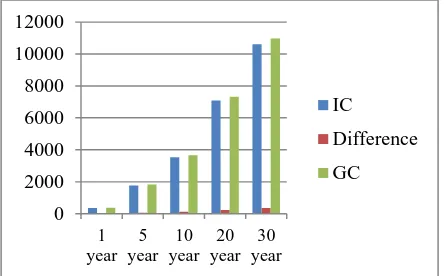
[image:4.595.301.576.80.182.2] [image:4.595.54.277.597.735.2]This paper is trying to compare two system calendars in IB system. Saksono [24] indicates that God does not like the use of a calendar with intercalation day in each month. In fact, GC inserts day to 30 or 31 days in each month, and 29 days in leap years. The difference 11.5 days between IC and GC will also affect the calculation of loan mortgage repayment. The period of IHF repayment can be up to a long term period, hence when the loan repayment reach 30 years then the differences between IC and GC would be up to one year. Figure 2 below shows the multiple differences between IC and GC in 30 years of IHF repayment period. Result for this analysis is shown in
Table 2 below.
Results in Table 2 above shows differences calculation of IHF repayment between IC and GC. Calculation made for this sample is based on secondary data received from chosen BMMB. Table 2 also depicts that the value of total repayment using GC is higher than IC; MYR 213,069.6 and MYR 210,063.5 respectively. In this case, it can be concluded that IC offers a better value for those who are seeking for taking loan for their IHF.
Additionally, there are two implications received by both IB and its customer as below:
(1)Islamic Bank
Concussively, profit earned by the bank using IC in IHF is lesser than profit earned by using GC. Ideally, when applying IC in the banking system, the calculation would be more lower for the zakat payment. This is because the calculation of zakat is shorter than in IC compared to GC. Indeed, using IC for the basis of zakat payment is more appropriate due to shariah compliant procedures in yearly zakat calculation. As explained by Saksono [25], the practice of Islamic finance nowadays is actually flawed because it ignores the IC as the basis of accounting and zakat calculation. The issue zakat deficit payment have become a serious problem and to Muslims, it is a spiritual debt to the Al Mighty. This is a collective debt which Muslims have to pay and unfortunately it is not well aware globally.
(2) Customer
As mentioned in Table 2, employing IC would benefit the customer. The total amount to be paid is definitely lower than using GC as the basis of loan repayment.
VI.
Conclusion
This paper has discussed the comparison between IC and GC in IBg system. Calendar as a basis of accounting system has a very important role in the sustainability of IHF calculations. Moreover, in the financial institutions particularly the IB in Islamic muamalat, they should for instance the efforts towards promote using IC as the basis of accounting system. Although there are still many challenges and impediments facing by the players in IBg sector, effort towards the unification of using IC should not be neglected. This research has proven that IC would bring a better value to the customer of IHF, particularly the Muslims borrower.
Period (year)
Rate Monthly
installment (GC) MYR
Monthly Installment
(IC) MYR
Total Repayment
(GC) MYR
Total Repayment
(IC) MYR
5 5.88 1,927.71 1,958.40 115,662.6 115,349.8
10 5.88 1,104.19 1,119.36 132,502.5 131,860.6
15 5.88 837.39 847.00 150,730.2 149,749.6
20 5.88 709.53 716.39 170,287.2 168,853.1
25 5.88 636.99 642.16 191,097 189,180.3
30 5.88 591.86 595.86 213,069.6 210,063.5
Table 2. The Comparison Repayment of IHF using Islamic Calendar (IC) and Gregorian Calendar (GC)
Acknowledgment
First of all, praise is due to Al Mighty Allah to His compassion and mercifulness to allow me completes this paper. The author gratefully acknowledges the full support of the University Tun Hussein Onn Malaysia (UTHM) and Faculty Technology Management and Business. The author would like to thank Dr. Noralfishah Sulaiman for her support and encouragement for my research. Also PM.Tono Saksono for support and sharing his knowledge’s especially in calendar system. Appreciation also goes to everyone involved directly or indirectly towards the compilation of this paper.
Definition of Term
The following terminologies are used while conducting this research. As this research employs various Calendar Systems, IF and IHF terminologies, thus the following definition of terms can be used to assist the audience of this research paper.
IBg Islamic Banking
IB Islamic Bank
IC Islamic Calendar
GC Gregorian Calendar
IHF Islamic Housing Finance
BIMB Bank Islam Malaysia Berhad
IF Islamic Finance
IBS Islamic Banking System
BBA Bai’ Bithamin Ajil
BNM Bank Negara Malaysia
MM Musharakah Mutanaqisah
HC Hindu Calendar
CC Chinese Calendar
AD Anno Domini
CE Common Era
BMMB Bank Muamalat Malaysia Berhad UTHM Universiti Tun Hussein Onn Malaysia
References
[1] Al Quran[2] Ranjbar, Amir and Pahlevan Sharif, Saeed, (2008) Islamic Banking Selection Criteria: An Imperical Study in
Malaysia. Retrieved on October 20, 2013, from http://ssrn.com
[3] Referensi Makalah (2013). Pengertian Bank Islam. Retrieved on October 15, 2013, from
http://www.referensimakalah.com
[4] Jobst, Andreas A (2007). Derivatives in Islamic Finance. Islamic Economic Studies. Vol. 15, No. 1. Retrieved on October 20, 2013, from http://ssrn.com/abstract=1015615
[5] Wikipedia (2013). Calendar. Retrieved October 15, 2013, from http://wikipedia.com
[6] Banking Info (2009). What is Islamic bank? Retrieved on September, 2012, from http://bankinginfo.com.my
[7] Shaikh, Salman Ahmed. (2010), A Brief Review & Introduction to Practiced Islamic Banking & Finance. Retrieved on October 20,2013 from http://ssrn.com
[8] Bank Negara Malaysia (2013). Malaysia: World Islamic Finance Marketplace. Retrieved on October 25, 2013, from http://bnm.com.my
[9] Bank Negara Malaysia (2013). Sistem Perbankan Islam: Pembiayaan Mengikut Jenis. Retrieved on October 20, 2013, from http://bnm.com.my
[10] Aris, et. al. (2012). Islamic House Financing Comparison between Bai’ Bithamin Ajil (BBA) and Musharakah Mutanaqisah (MM). African Journal of Business
Management Vol 6(1). Retrieved September 26,2012. from
p: 266-273. at http://www.academicjournals.org
[11] Ahmad, F. A. (2003). Pembiayaan Perumahan Secara Islam. Kuala Lumpur: Utusan Publications & Distributors Sdn Bhd.
[12]Bank Negara Malaysia (2012). FAQ on Bai’ Bithaman Ajil (BBA) Financing. Retrieved on September, 2012, from http://www.kantakji.com
[13] Osmani, N. M., & Abdullah, M. F. (2010). Musharakah Mutanaqisah Home Financing: A Review of Literatures and Practices of Islamic Banks in Malaysia. International Review of Business Research Papers , Pp. 272-282.
[14] Bank Negara Malaysia (2013). Resolution of Shariah Advisory Council of Bank Negara Malaysia. Retrieved on October 22, 2013, from http://bnm.com.my
[15] Financial Islam-Islamic Finance. (2013). Tawarruq. Retrieved on December, 2012, from
http://www.financialislam.com
[16] Bank Negara Malaysia. (2013). Shariah Resolutions in Islamic finance. Retrieved on May, 2013, from http://bnm.com.my
[17] Solehudin, Cecep Haji. (2008). Peluang dan Tantangan Bank Syariah di Indonesia. Retrieved on October 20, 2013, from http://konsultasimuamalat.me
[18] Oxford Dictionaries. (2013). Definition of calendar in English. Retrieved on July, 2012, from
http://www.oxforddictionaries.com
[19] Dogget, L.E. (2013). Calendars. Retrieved on August, 2012, from http://astro.nmsu.edu
[20] Time and Date. (2013). The Chinese Calendar. Retrieved on September, 2013, from http:// timeanddate.com
[21] Abdurrouf, Mauludi A. Pamungkas (2013). Accurate Hijri Calculator 2.2 Sebagai Piranti Hisab Penentuan Awal Bulan Hijriah Berdasarkan Kriteria Visibilitas Hilal Nasional dan Internasional. Physics Student Journal Volume 1 no 1. Retrieved October 20, 2013 at http://physics.studentjournal.ub.ac.id
[22] Business Dictionary. (2013). Comparative Analysis. Retrieved on October, 20, 2013, from
http://www.businessdictionary.com
[24] Saksono, T. (2007). Mengkompromikan Rukyat dan Hisab. Jakarta: PT Amythas Publicita.
[25] Saksono, T., & Martin, D. (2012). Undisclosed Potential of Zakat Payment Deficit. 2nd Global Islamic Marketing Conference, Abu Dhabi , pp: 7.
![Figure 1. Statistic Housing Finance in Islamic Banks Malaysia [9]](https://thumb-us.123doks.com/thumbv2/123dok_us/8772504.899638/2.595.308.566.160.306/figure-statistic-housing-finance-islamic-banks-malaysia.webp)