Design and Implementation of Automatic Aircraft
Recognition System by using Image Processing
Nilar Oo*
*Lecturer, Avionics Department, Myanmar Aerospace Engineering University
Abstract- The majority of the aircraft recognition methods assume the successful isolation of the aircraft silhouette from the background. In this system, image processing techniques are first employed to perform the image preprocessing tasks, such as image quality enhancement, noise removal, edge detection and automatic recognition. This system is the specific study of pattern recognition system based on aircraft shape such as wing, tail, nose of vehicle, morphological properties and color based properties. Although various types of automatic aircraft recognition system can be used, image processing with Matlab programming language is used to recognize aircraft. It is to make the system more flexible and refers to the task of selecting, detecting and successfully identifying different potential targets from simple scenes to complex scenes.
Index Terms- Aircraft Recognition, Image Processing, Neural Network, Matlab programming DOI: 10.29322/IJSRP.8.8.2018.p8023
http://dx.doi.org/10.29322/IJSRP.8.8.2018.p8023
1. INTRODUCTION
Recognition of modern world aircrafts with the use of manual binoculars in real time is a difficult and risky task. The task of reliably detecting and recognizing an aircraft from single images remains a challenging problem despite advance made in computing technology, image processing and computer vision. Aircraft recognition performance suffers considerably under non-ideal conditions where various forms of image degradation or occlusion are present. Different Automatic Target Recognition System can be classified on the basis of parameters such as input data, sensors and its applications. Aircraft recognition techniques have been reported using a variety of methods. The main subject is to implement software for recognition aircrafts by using image processing. Image processing techniques are used for image analysis. To implement this system, artificial neural network is applied. Matlab programming language, like any other computer vision software, implements the use of the training patterns or the training sets to test the performance of a specific geometric pattern recognition approach. In this system, the programming language is mainly applied.
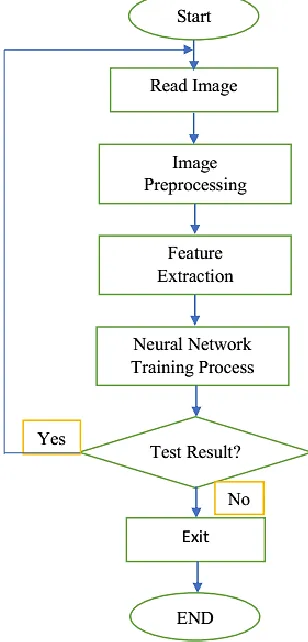
Figure 1: Block Diagram of Automatic Aircraft Recognition Process 2. RESEARCH RELATED TO IMAGE PROCESSING
Many researchers have tried various image processing methods, working in different environments; however, most of the work has been done indoors with controlled illumination and an adequate setup for the acquisition of high quality images. In image processing, segmentation is a fundamental method used in many areas. Segmentation is the process of separating an image into distinct regions. Image thresholding and segmentation for feature extraction are the most common. For many features, thresholding operations typically occur first to remove the background from the object of interest and then new thresholds are used to segment regions of interest from clear image areas. The images are thresholded to convert the gray scale information to binary scale information.
Low level processing consists of image filtering and intermediate processing to extract boundaries and regions of interest. At this level, regions of interest are formed and measures describing these regions are collected. High level processing utilizes various methods to classify the regions based on the measures extracted by the low level processing.
In general the largest discriminating power corresponds to morphological features. Color features are not particularly good as classification parameters since many species are light to dark brownish or black. On the other hand, texture characteristics are even less reliable than color ones for classification purposes. Furthermore, if one combines any two sets of features, it was found that morphology plus color features have an edge over the combined use of morphology and texture characteristics. However, it would be enough to consider black and white images, which constitutes an important simplification in system’s operation and leads to a reduction in cost. In fact, color images require a much better control of illumination conditions than black and white ones and the required acquisition hardware (RGB camera, frame grabber, etc.) is substantially more expensive.
3. SOFTWARE IMPLEMENTATION
[image:2.612.227.381.387.708.2]Matlab programming language, like any other computer vision software, implements the use of the training patterns or the training sets to test the performance of a specific geometric pattern recognition approach, is applied mainly. The flow chart for automatic aircraft recognition system is shown in Figure 2.
3.1 Image Acquisition
In the first step, aircraft images are acquired using a digital camera (Canon EOS 40D) with resolution of 4000 pixels×3000 pixels was used to record images. Another way is downloading from internet database. They are saved in computer hard disk and kept for training and testing the software. The training database consists of 20 aircraft images and 20 non-aircraft images which may be birds or some photos taking from the sky.
3.2 Image Preprocessing
Image preprocessing is required to be able to prepare the raw images to get same size and to get sharpened image.
3.3 Feature Extraction
Feature Extraction is implemented by two ways: - Edge detection
- Boundary detection
3.4 Neural Network Creation
After feature extraction process, they have to input to Neural Network. The final design of Neural Network depends on application area. Neural Network are composed of simple elements operating in parallel, so to train the network the numbers of neurons in each network layer need to be fixed. Feed forward Neural Network is used according to the problem. The number of neuron in inputs and output layers of Neural Network is fixed as 120 and 36 neurons.
Neural Network must be trained to classify the correct output using learning rules. Each layer’s output the Network is approximated with a sigmoid function (hardlin). Network is trained by a network training function that updates weight and bias values according to gradient descent momentum and an adaptive learning rate. Network architecture was trained with various SSE values for the different learning rate at each time to obtain fair and independent results. In network architecture, maximum of epochs is 3000, the network saves the information for 20 epochs. The training parameters are as follows:
- Number of input neurons = 120 - Number of output neurons = 36
- Type of transfer function in each layer = hardlin - Performance function = Mean square error - Performance goal = 0.001
- Maximum number of epochs to train = 3000 - Epochs between displays = 20
4. TEST and RESULT
Before running the program, the images are collected firstly. Image from any sources could be used in the program. To test the feasibility of the program, two different groups of images are used. These two groups are aircraft images and non-aircraft images. Twenty aircraft images can be used as input for the program. Here, fighter and commercial aircraft images are chosen. The images of birds are used as the type of non-aircraft because the images of birds can be confused with aircraft images on the sky. The range of original images size for all image are between 100~300.
Table 1: Classification of Input Data
Aircraft Image Non-Aircraft Image
Number of Images 20 20
Resize of Images 150 x 200 150 x 200
Type of Aircraft Fighter and commercial Birds
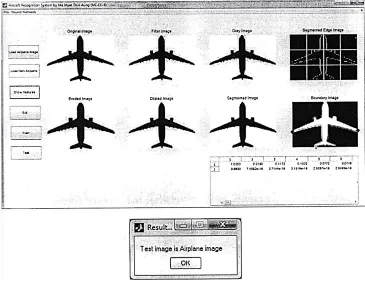
After running the preprocessing part, the program is automatically continued to feature extraction processes. In the feature extraction part,
- While erosion removes pixels on objects boundaries in an image. - Dilation adds pixels to the boundaries of objects in an image - Segmentation is applied to separate the object and the background.
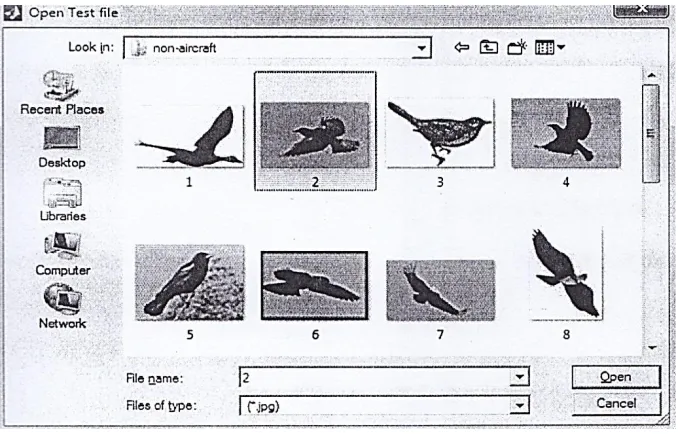
Figure 3: User Select Non-Aircraft Image Menu
The image number two is taken from the open test file and the result is appeared in the text box.
Figure 5: User Select Aircraft Image Menu
The image number five is taken from the open test file and the result is appeared in the text box.
[image:5.612.139.504.409.694.2]
Table 2: System Performance Test
No. of Train Files Test (Airplane) Test (No airplane)
Airplane Non -airplane Test file % Correct Test file % Correct
18 18 10 90% 10 80%
5. CONCLUSION
Matlab is used as the main implementation tool for recognizing automatic aircrafts using Neural Networks. Matlab is a high performance language for technical computing. It can solve complex numerical problems in a fraction of time required with a programming language such as FORTRAN or C. The software implementation of automatic aircraft recognition system includes five steps.
- Image acquisition - Image preprocessing - Feature extraction
- Training in Neural Network - Testing the system
In this system, various types of aircrafts can be recognized for only below 5000 ft because of using canon camera (EOS 40D). If other devices (eg. radar, satellite, intelligent video automatic target recognition system (IVATRs), etc) are applied, various types of aircrafts can be recognized for above 5000 ft and the system accuracy can be achieved higher than the system which takes the images by cameras.
REFERENCES
[1] W.H. Licata, S. Principal, and S. Engineer, Automatic Target Recogniton (ART) Beyond the Year 2000,2001.
[2] B. Bhanu and Y. Lin, “Genetic algorithm based feature selection for target detection in SAR images, “Image and Vision Computing, vol. 21, 2003, pp. 591-608. [3] G. Pasquariello, G. Satalino and F. Spilotros, “Automatic target recognition for naval traffic control using NN, “Image (Rochester, N.Y), vol. 16, 1998, pp. 67-73. [4] N.R. Howe and C. Science, “Silhouette Lookup for Automatic Pose Tracking”, Pattern Recognition, 2004, pp. 0-7.
[5] B. Li, R. Chellapa, and Q. Zheng, “Experimental Evaluation of FLIR ATR Approaches- A Comparative Study, “Computer Vision and Image Understanding , vol.24, 2001,pp. 5-24.
[6] R.S. Choras, “Image Feature Extraction Teniques and Their Applications for CBIR and Biometrics Systems,” International Journel of Biology and Biomedical Engineering , vol.1,2007.
[7] O.L. Mangasarian, “A feature selection Newton Method for Support Vector Machine Classification,” Science-New York, 2004,pp.185-202 [8] J.L.Mundy and A.Zisserman, Geometric Invariance in Computer Vision, The MIT press,Cambridge, Massachusetts, 1992
[9] B.S.Song, I.D. Yun, and S.U.Lee,"A target recognition technique employing.
[10] A. Toumi, B. Hoelt Zener, A. Khenchaf, and B. France, “Using Watersheds segmentation on ISAR image for automatic target recognition,"Image (Rochester,N.Y),2007,pp.1-6.
AUTHORS