DEVELOPING AND EFFECTIVENESS OF THE COMPUTER
ASSISTED INSTRUCTION IN PROGRAMMING LANGUAGES
BASE ON ANDROID TABLETS DEVICES.
1SATIEN JANPLA
1Computer Science, Science and Technology, Suan Sunandha Rajabhat University, Bangkok,THAILAND
E-mail: [email protected]
ABSTRACT
The Objective of this research was to develop and study the effectiveness of the computer assisted instruction in programming languages base on android tablets devices. The example of this research is first year students in computer science department, faculty of Science and Technology, Suan Sunandha Rajabhat University. The research methodology is experimental research by using One-Group Pretest-Posttest Design. The results of this research showed that the computer assisted instruction in programming languages has an efficiency, the students had Posttest scores higher than Pretest scores in significance at .05 and the computer assisted instruction on programming languages subject has the highest satisfaction towards the use of instruction.
Keywords: Computer assisted instruction,Programming Languages,Tablets Devices
1. INTRODUCTION
Many students entering to computer science major in university need further preparation in computer programming subject to successfully meet their educational and career path. Many universities offer developmental programming courses and other services to prepare these students for university level. Traditional teaching strategies have produced low passing rates in developmental computer programming subject. Universities are trying alternative instructional approaches to improve the teaching of developmental computer programming with the goal of increasing the number of students who have the skills and knowledge required for computer science major and for the twenty-first century workforce. [1-3]
Computers make possible new methods of delivering instruction so students will have choices of when, where, and how they learn computer programming. This study will investigate whether there are differences in the academic achievement
of students enrolled in a developmental
programming languages 1 course using traditional instruction, traditional instruction supplemented with computer-assisted instruction. It will also
investigate factor differences in learning
programming languages achievement. [4-5]
The use of computer in the classroom has given rise to Computer assisted instruction software
packages for classroom instructional purposes. According to Computer assisted instruction is a program of instruction or package presented as computer software for instructional purpose. Therefore, the position of programming languages subject makes it necessary for the use of innovative pedagogical strategy that will enable teachers meet the challenges of teaching and learning of the subject especially in this era of information age. Several researches have shown that using Computer assisted instruction has a positive effect on students achievement compared to traditional methods. Computer-Assisted Instruction has been used in university to teach various subjects.[5-6]
Computer assisted instruction can applies information technology within education using teaching materials, which can be further developed as an interactive multimedia computer-assisted instruction. Hence, students can self-learn anytime, anywhere. This student-centred learning material is more attractive and understandable. Therefore, the teachers can pay more attention to presenting the content through multiple channels, which can obtain more attention from the students and be
more easily understood. The programming
learning. This should lead to a more effective application of the know-how in programming practice. [6-8]
2. OBJECTIVE AND HYPOTHESES
Objective
1. To compare student achievement before and after learning the computer assisted instruction software packages of programming languages for undergraduate students.
2. The satisfaction of the learners using
computer assisted instruction designed for
undergraduate students.
Hypotheses
1. The achievement outcomes of students with computer assisted instruction program for undergraduate students were higher than the previous.
2. Satisfaction with the course of computer assisted instruction designed for undergraduate students at a high level.
3. METHODOLOGY
The research design adopted for this study is the pretest-posttest experimental control group design. The population for the study was made up of the first year students in computer science department in faculty of Science and Technology, Suan Sunandha Rajabhat University. The sample constitutes 30 students who were randomly selected from population and choose from students with lower pretest results.
The research instrument was made up of programming languages Achievement Test. It was jointly developed by the researchers , teacher and a computer programmer. The courseware was developing focus on programming language skill for first year students in computer science department. The second term scheme of work of senor secondary school was used. The fourty item multiple choice objective test that made up the achievement test were validated and its reliability determined as 0.80.
The teaching was done for eight weeks with control group being taught with conventional method and the experimental group with computer assisted instruction package. The test questions were administered to the students before and after treatment. Each of the tests was marked and scored accordingly. The research questions were answered
[image:2.595.307.509.160.314.2]using mean and standard deviations and t-test for the hypotheses at 0.05 level of significance.
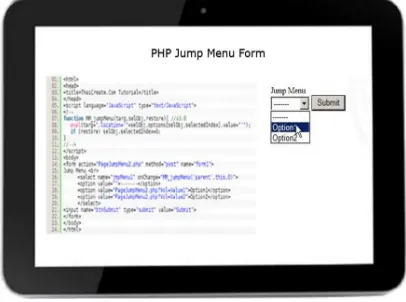
[image:2.595.310.513.348.499.2]Figure 1: Screenshot of Computer assisted instruction
Figure 2: Screenshot of content
[image:2.595.310.512.527.696.2]4. RESEARCH STATISTICAL
The statistics used in this research the use of statistics to analyze the data.[4-10]
Mean - The mean is the most common measure of central tendency and the one that can be mathematically manipulated. It is defined as the average of a distribution is equal to the . Simply, the mean is computed by summing all the scores in the distribution ( ) and dividing that
sum by the total number of scores (N). The mean is
the balance point in a distribution such that if you subtract each value in the distribution from the mean and sum all of these deviation scores, the result will be zero.
Mean
=
N
x
∑
(1)
Standard Deviation - The standard deviation gives an idea of how close the entire set of data is to the average value. Data sets with a small standard deviation have tightly grouped, precise data. Data sets with large standard deviations have data spread out over a wide range of values. The formula for standard deviation is given below as equation.
S.D. =
)
1
(
)
(
22
−
−
∑
∑
N
N
X
X
N
(2)
Pretest-posttest designs are widely used in behavioral research, primarily for the purpose of comparing groups and/or measuring change resulting from experimental treatments. The focus of this article is on comparing groups with pretest and posttest data and related reliability issues. In rehabilitation research, change is commonly measured in such dependent variables as learning
achievement, employment status, income,
empowerment, assertiveness, self-advocacy skills, and etc.
A paired sample t-test is used to determine whether there is a significant difference between the average values of the same measurement made under two different conditions. Both measurements are made on each unit in a sample, and the test is based on the paired differences between these two values. The usual null hypothesis is that the difference in the mean values is zero. For example,
achievement of student gives a significantly greater yield than the other. The null hypothesis for the
paired sample t-test is H0: d = µ1 - µ2 = 0,for t-test
is given below as equation.
t =
1
)
(
22
−
−
∑
∑
∑
n
D
D
n
D
df = n-1
(3)A quality assessment of the computer assisted instruction lessons used a query scale estimation with 5 - very high, 4 - good quality, 3 - fair quality; less than 3 is a failure and the Computer assisted instruction should be updated. Query learner satisfaction was determined using a Likert’s five-level scale (Rating Scale) with 4.50 to 5.00 -extremely satisfied, 3.50 to 4.49 - quite satisfied, 2.50 to 3.49 - moderate satisfaction, 1.50 to 2.49 - little satisfaction, and 1.00 to 1.49 - no satisfaction.
5. RESULT
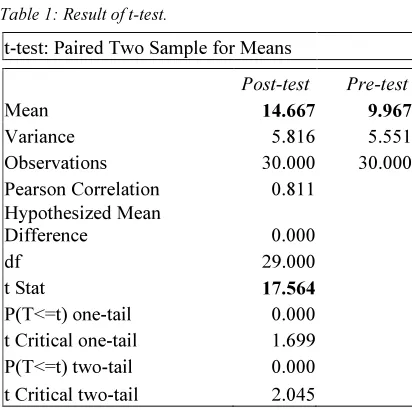
The experimental research shows the t-test comparison of the post test mean scores of the experimental group. The calculated t-value (t calculator =17.56) is higher than the critical t-value (t critical 1.699). This indicates that there is statistical significant difference in the mean scores
of Post-test (X =14.667) and Pre-test (9.967) at
0.05 level of significance (t calculator =17.56, df 29, P >0.05). This experimental shows the achievement of students learning computer assisted instruction to be significantly higher than before. ∑NX
Table 1: Result oft-test.
t-test: Paired Two Sample for Means
Post-test Pre-test
Mean 14.667 9.967
Variance 5.816 5.551
Observations 30.000 30.000
Pearson Correlation 0.811
Hypothesized Mean
Difference 0.000
df 29.000
t Stat 17.564
P(T<=t) one-tail 0.000
t Critical one-tail 1.699
P(T<=t) two-tail 0.000
t Critical two-tail 2.045
The students satisfaction towards this is computer assisted instruction extremely satisfied. Therefore, it can be concluded that this developed computer assisted instruction for programming languages course could be utilized as an effective self-learning tool.
Table 2: Result oflevelsatisfaction.
Topic Mean S.D. Level
1. Content and narrative
4.46 0.57 quite
satisfied 2. Image and
language
4.51 0.55 extremely
satisfied
3. Font and color 4.58 0.53 extremely
satisfied
4. Quiz 4.42 0.70 quite
satisfied 5. Management
lessons
4.55 0.60 extremely
satisfied
Average 4.50 0.59 extremely
satisfied
6. CONCLUSION
The Objective of this research was to develop and study the effectiveness of the computer assisted instruction in programming languages base on android tablets devices, to compare learning achievement between before and after learning. The study also investigated their satisfaction towards Computer assisted instruction.
The research sample subjects were 30 students of the first year computer science department, faculty of Science and Technology, Suan Sunandha Rajabhat University. The study
conducted in first semester of the academic year 2014 by using the stratified random sampling. Research instruments were computer assisted instruction on programming languages subject, a
4-multiple-choice examination satisfaction
questionnaire, created in 5 rating scale evaluation pattern. Data analysis was percentage, mean and t-test dependent implemented in comparing to learning achievement between before and after learning with web based instruction.
The findings show those effective Computer assisted instruction were post-test scores increased significantly after being learned with Computer assisted instruction. Moreover, the subject had the highest satisfaction towards the use of Computer
assisted instruction (X=4.50). Therefore, it can be
concluded that this developed computer assisted instruction for programming languages course could be utilized as an effective self-learning tool. The contribution of this research was to develop the computer-assisted instruction base on thai student classroom environment and to improve the effectiveness learning in programming practice.
The findings of this research is to build a powerful computer-assisted instruction will come from the animation and sound design (hypermedia) and have interactive navigation with the students classroom instead of using still images or text in the presentation programming practice only. It was found that the students are motivated to learn and interested in learning practice more.
The computer-assisted instruction lessons were designed based on the learning needs of the students are recognized hierarchical content from easy to difficult on programming practice. As well as creating the appropriate environment using the multimedia navigation and makes programming practice to learning to have fun and enjoy learning without feeling tired and critical, learners can
review lessons on their every time because it was
designed for tablet devices. The results of this research will lead to the creation computer-assisted instruction on tablet devices for teaching more effectiveness.
REFRENCES:
[1] Anobi, C. S and Uwandu J., “Towards Effective Technology Education”, Journal of Technology Education, Vol .12(1), 2007.
[2] Karper, C., Robinson, E. H.& Casado-Kehoe,
M., “Computer-assisted instruction and
[image:4.595.86.295.432.586.2][3] Duncan, N. C., “Evaluation of instructional
software: Design considerations and
recommendations”, Behavioral Research
Methods, Instruments & Computers, Vol. 23, 1993.
[4] Garfield, J. B., & Gal, I., “Assessment and statistics education: Current challenges and directions”, International Statistical Review, Vol. 67 (1), 1999.
[5] Basturk, R., “The effectiveness of Computer-Assisted Instruction in teaching introductory statistics”, Educational Technology and Society, Vol. 8 (2), 2005.
[6] Dantala, N. M., “Effect of Computer-Assisted Instruction (CAI) package for individualized learning of history in the senior secondary school in Niger State, Nigeria”, An unpublished
M. Tech. Thesis, Science Education
Department, Federal University of Technology, Minna, 2006.
[7] Ramani,R and Patadia, H., “Computer assisted instruction in Teaching of Mathematics”, Journal of Humanities and Social Science ,Vol. 2, 2012.
[8] Helaiya, S., “Developing and Implementation of CAI package for teaching statistics to B.Ed. Students”, An unpublished M.Ed. dissertation. The Maharaja Sayajirao University of Baroda, India, 2004.
[9] T.Basoz and F. Cubukcu., “The effectiveness of computer assisted instruction on vocabulary achievement”, Mevlana International Journal of Education (MIJE). ,Vol. 4(1), 2014.