RESOURCE MEDIAN MULTICAST ROUTING PROTOCOL
FOR ENERGY CONTROLLED MULTIPATH
COMMUNICATION IN WIRELESS AD-HOC NETWORK
SHANMUGASUNDARAM1, CHANDRASEKAR2
1 Research Scholar, Computer Science department, Karpagam University,
Eachanari Post, Coimbatore, Tamilnadu, India. 2 Associate Professor, Computer Science department,
Periyar University, Salem, Tamilnadu, India.
E-mail: [email protected], [email protected]
ABSTRACT
Many applications in network consisting of scattered interactive method, software improvements and replica model for distributed database envisages optimized routing, scheduling and data dispersal schemes. A large wireless ad-hoc network broadcast messages from the source to all the elements in a multicast group. Certain research works based on the leader election model (DSLE) focus on the incentives in the form of reputations ensuring security to participate in the election process. With the application of DSLE, the consumption of resources was balanced during the detection of intrusion whereas the detection service through routing was not effective. In order to discover the path the method Channel-Aware Ad hoc On-Demand Multipath Distance Vector (CA-AOMDV) chooses the stable links and also predicts the path failure for improving the routing decisions. To improve the routing decision, CA-AOMDV uses the channel average non-fading period as a routing metric but maximal energy was consumed for obtaining the channel state information in wireless ad-hoc network. To handle the communication using multi-path routing path effectively, Resource Median Multicast Routing (RMMR) Protocol is designed. The protocol RMMR adapt to any form of wireless ad-hoc network with median multicast tree for effective routing service. The initial connection between the wireless nodes is counted and computation effort is minimized using the median multicast trees. Median Multicast employs Energy Controlled Active Multicast (ECAM) algorithm which constructs a multicast tree with minimal energy consumption while transferring the information. ECAM algorithm uses the idling concept to reduce the energy consumption while performing the multipath communication in wireless ad-hoc network. The simulation metric taken for experimenting the RMMR Protocol are the factors such as energy consumption on multipath communication, routing control overhead, packet delivery ratio on wireless nodes, throughput based on mobility speed.
Keywords: Resource Median Multicast Routing, Wireless Ad-hoc Network, Active Multicast, Idling, Routing Protocol, Channel State Information
I.INTRODUCTION
WANET typically involves wireless nodes that cooperatively form a network without any intervention of administrator. However, WANET allows an arbitrary collection of nodes to create a network on demand. A node in the WANET can either be a laptop, autonomous agent, or a sensor. The goal of WANET is routing the packet information between neighbors and thus helps in safe guarding the connectivity in wireless network. There are abundant scenarios that do not have an obtainable wireless network infrastructure which benefit from the creation of a wireless ad hoc network.
significantly creating problems on the interference
surroundings.
Traffic allocation as a lossy network flow optimization problem using portfolio selection theory as shown in [18] solved complexity using a distributed algorithm based on decomposition in Network Utility Maximization (NUM). Independence assumption throughout NUM work fails in yielding a practicable approximation to the complex actuality of correlated random variables, and the case of in-network inference of the relevant correlation was not achieved.
The work of HIDENETS elaborated in [17] was designed on the principle of abstraction and decomposition. HIDENETS developed the interactions in the middle of different evaluation techniques include analytical, simulative, and experimental measurement approaches to supervise system complexity. Reputation based protocol for black holes detection maintains the standing of forwarding nodes as shown in [20]. Followed by it the next forwarding node is selected, protocol chooses the node with maximum reputation and effectively controls black holes without any additional overhead.
With the increasing surge in the occurrence of traffic follows in the network, ProgME in [6] suggested the problems related to scalability. The core of architecture in ProgME was based on the programmable array of processing elements and each mapped to a flow set. The flow set provide the mapping and counting task for the flow set. Cluster-based QoS routing algorithm for mobile ad hoc networks as described in [9] provide the fault tolerant system. The source node negotiated its demands with the cluster-heads of all clusters to make use of then and then waited for responses from these cluster-heads. The fault-tolerant algorithm introduced in the cluster-based QoS routing algorithm significantly reduced the time required to reestablish a connection.
In order to perform the retransmission for a minimum amount of period the Connected Dominating Set (CDS) in [13] used a shorter waiting period. During the time of termination, a vehicle retransmits if it is aware of the neighbor node whenever it is in need of the message. To address irregular connectivity and appearance of new neighbors, the evaluation timer was again restarted. But at the same time CDS failed in incorporating the retransmission time-out with
respect to the delay constraint which made the protocol significantly used for delay-tolerant applications.
Many network monitoring applications examine traffic from the network layer to allow connection-oriented analysis, and achieve resilience during the evasion attempts. The use of accepted rate adaptation algorithms as presented in [4] considerably degraded the network performance. The suitable tuning of the carrier sensing threshold allowed the transmitter to send packets until it gets jammed and enabled a receiver to detain the desired signal. Distributed coordination function (DCF) as explained in [14] with mounting node velocity disparity occurs among the MAC and the transient high-throughput connectivity. The DCF was combined with the node mobility moving in a higher rate but was observed that the collision rate was observed to be of higher resulting in low throughput rate.
The Design-Based Secure Leader Election (DSLE) Model as described in [1] offered the election process. DSLE Model follows the dominant strategy among all nodes whereas detection service through routing was not effective. The key characteristics related to the mobility patterns were observed regularly using the framework of Continuous Time Random Walk (CTRW) Framework as explained in [3]. The mobile nodes diffusion behavior eventually extracted the network protocols whereas the routing associates between the nodes were not noted.
In this work, Resource Median Multicast Routing (RMMR) protocol is planned for effective routing services in wireless ad-hoc network. The RMMR protocol constructs the multicast routing tree with the help of CONNECT/DEPART message. The two network points in the RMMR protocol are denoted by smn-point and imn-point. The CONNECT message of RMMR protocol connects the message and is send to the smn-point whenever it is connected whereas the DEPART message is sent to the smn-point when the node is moved out of the range. Energy Controlled Active Multicast (ECAM) algorithm is planned to construct the idling based carrier sensing for minimal energy consumption structure during packet transmission in WANET.
their limitations. In Section 2, the Resource Median
Multicast Routing is demonstrated. Multicast routing tree and Energy Controlled Active Multicast are illustrated in the subsections. Section 3 explains the ns-2 simulator and conduct simulation studies to verify the analytical results with parametric factor description. Section 4 Provides table and graph based results. Section 5 illustrates the related work and finally concluded the work in section 6.
2. RESOURCE MEDIAN MULTICAST ROUTING PROTOCOL IN WIRELESS AD-HOC NETWORK
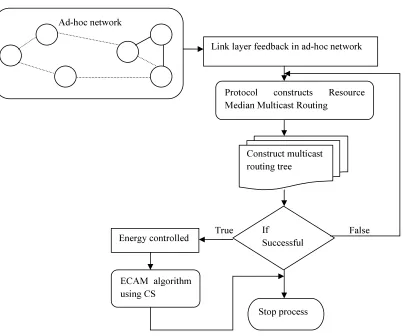
This section discusses in detail about the designing of the resource median multicast routing protocol in wireless ad-hoc network with the help of a neat flow diagram in fig 1. The objective behind the Resource Median Multicast Routing (RMMR) protocol is to attain flexible multicast outing services and efficient communication system in the wireless ad-hoc network. The energy controlled communication in wireless network uses the Energy Controlled Active Multicast (ECAM) algorithm. The ECAM algorithm uses the idling concept to reduce the energy on the multipath with the help of Carrier Sensing (CS). ECAM algorithm using CS on the specified channel state information improves the throughput on the wireless ad-hoc network.
[image:3.595.89.494.387.723.2]True False
Fig 1 Flow Chart Of RMMR Protocol With ECAM In Wireless Ad-Hoc Network
Ad-hoc network
Link layer feedback in ad-hoc network
Protocol constructs Resource Median Multicast Routing
Construct multicast routing tree
If
Successful Energy controlled
ECAM algorithm using CS
The RMMR protocol with ECAM in wireless ad-hoc network (WANET) easily broadcast the information on multiple paths. The information related to multi path such as packet acquisition, simulated file system is transferred through group of wireless nodes. WANET based routing protocols easily attains the feedback of the link layer. The link layer feedback is used to choose the effective next hop node for the sake of forwarding of packets. Multicasting with RMMR protocol is one of the most important group communications in the wireless nodes that achieve throughput, greater efficiency and concurrence.
As illustrated in the figure, once the link layer feedback in wireless ad-hoc network is analyzed, communication for multi path takes place using the median resources in Resource Median Multicast Routing (RMMR) protocol. RMMR allows wide range of sophisticated wireless ad-hoc network routing and in addition constructs median multicast trees. As soon as the network point is informed in its subnet, the router sends a CONNECT/DEPART request message using RMMR protocol. In addition to the CONNECT/DEPART request message, the RMMR protocol also indicates the group ID and the IP address of the network point for effective packet forwarding towards its destination.
Followed by packet forwarding, multicast routing tree is generated with the help of collected
wireless topology points and node connection information in RMMR protocol. The multicast tree generated is represented in the physical structure of the domain. The network point on the RMMR protocol updates the table according to the generated multicast routing tree. In RMMR protocol, transmission packet ‘Trans-packet’ contains the complete information about the sub tree (i.e.,) transmitted nodes of the multicast routing tree. With the successful formation of the multicast routing tree with the sub nodes, the energy factor is computed. As the last stage, to stabilize the energy consumption, idling concept is developed using RMMR protocol in WANET. Further the energy consumption is reduced using the Energy Controlled Active Multicast (ECAM) algorithm with Carrier Sensing.
1.1 RMMR protocol Network Points
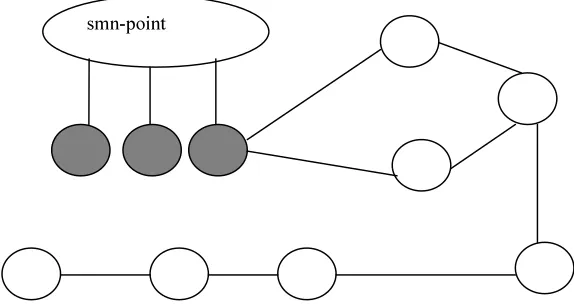
[image:4.595.131.418.514.666.2]The construction of RMMR protocol starts with the formation of network points that is divided into two types of network points namely, start median network point (smn-point) and intermediate median network point (imn-point). The network point, smn-point in RMRR protocol is responsible for providing resources (i.e.,) services on the multiple paths in the WANET whereas the network point, imn-point in RMMR protocol is responsible for forwarding the packets to the next hop node.
Fig 2 Start And Intermediate Median Network Point Representation In RMMR Protocol
- Start Median network point
Fig 2 represents the start and intermediate
median network point representation in RMMR protocol. During the transmission of packets, the RMMR protocol uses the sophisticated resources in the wireless ad-hoc network to easily improve the throughput. Based on the resource information and smn-point, the first step in the design of RMMR protocol is to select the correct start path and to transmit the packets on WANET. The multicasting of packets chooses the resources information as the median for transferring of packets using RMMR protocol.
The RMMR protocol also plays an important role in the multicast-routing as it also handles multicast related path by forwarding the packets to the next hop node with balanced energy using the imn-point. The RMMR protocol avoids the traffic around the imn-point, which is capable of handling multipath communication simultaneously
and also forward the heavy multicast traffic efficiently. Many paths in the imn-point manage the multicast connection by generating the multicast routing tree in wireless ad-hoc network.
1.2 Resource Median Multicast Routing Tree Development
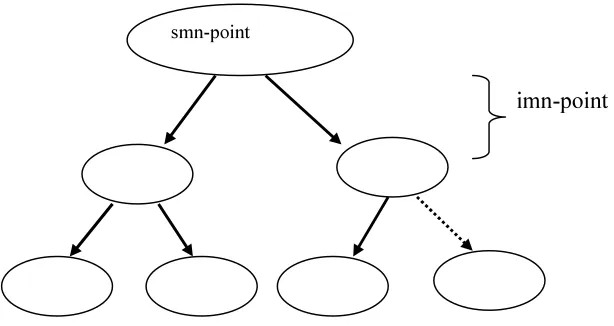
After the formation of network points for providing resources and forwarding the packets to the next hop node, in RMMR protocol, multi-cast routing tree transmit the data packets from the upstream nodes to the downstream node. The upstream wireless node in the RMMR protocol sends the ‘trans-packet’ to each node in the downstream list. RMMR protocol stops transmitting the data packets to the downstream nodes when the nodes move out of the transmission range (i.e.,) multicast tree path. The RMMR based multicast tree is shown in diagrammatic form.
[image:5.595.145.452.388.551.2]imn-point
Fig 3 Multicast Routing Tree
Fig 3 shows the multiple path communication in wireless network through the representation of tree. Accordingly, RMMR protocol updates the table according to the generated multicast routing tree. In fig 3, smn-point sends the Trans-packet to the sub tree ‘S1’ and ‘S2’. The imn-point is used to forward the packets to the sub tree ‘SS1’, ‘SS2’, ‘SS3’. Since the ‘SS4’ is moved out of the transmission range, as a result the packets are not transmitted to that node in wireless ad-hoc network.
Once the development of the multicast routing tree is accomplished, the request messages
CONNECT/DEPART is implemented in RMMR protocol to easily update the table. The nodes which are involved in the multipath communication establishes the communication by sending the CONNECT message to the smn-point. The multipath communication is updated in the routing table with the group ID and the IP address of the network point. The nodes that are moved out of the transmission range are removed from the table by sending the DEPART message to the smn-point.
denotes the set of edges (i.e.,) directed points. The
wireless nodes ‘V’ in multicast tree represent the routers in the WANET and edges ‘E’ represent the communication links once the feedback is achieved for connecting the routers. The communication link ‘E’ in RMMR protocol is represented in the commutative algebra function form.
→ , (1)
Where ‘R’ denotes the real functions used for the commutative functions evaluation whereas ‘X’ denotes the arbitrary set of nodes in the WANET. In RMMR protocol, Multicast Tree ‘MT’ linking with wireless nodes is computed as,
∑∈, , … . . (2)
Multicast routing tree communication through indicates the effective linking in WANET with channel state information.
, … … represent the links between the
wireless nodes for the packet forwarding through the nodes. The multicast tree communication is
!" ∪ (3)
A multicast tree routing combines the start median network point and the link communication respectively.
1.3 Energy Controlled Active Multicast (ECAM) Algorithm
Finally, the energy controlled multicasting in RMMP protocol is developed using the ECAM algorithm with Carrier Sensing in WANET. Here the active multicast denotes the energy controlling in the dynamic system with idling concept. The idling concept in RMMR protocol is the mechanism with carrier sensing that actively control the energy in WANET by forwarding packets. In RMMR protocol, when a node receives the CS signal, it immediately forces the switching to the lower energy idling.
ECAM get the energy information through two interfaces. The first interface is to control the duration of data packet sending with controlling of time resulting in the minimization of energy during packet forwarding using RMMR protocol. The second interface using RMMR protocol addresses the carrier sensing which overcomes the node
movement to the outer transmission range. The idling concept with CS eventually identifies the maximal energy consumption and reduces the energy level in WANET. ECAM algorithm actively controls the energy consumption and there exist the multi path communication among all the connected nodes in WANET. ECAM algorithmic step is described as,
// Energy Controlled Active Multicast Start
Step 1 : Wireless network nodes ‘n’, Step 2 : Link layer feedback analyzing,
→ ,
Step 3 : Constructs Resource Median Multicast trees
Step 3.1 : smn-point selects the correct start path to transmit the packets
Step 3.2 : imn-point forward the packets to the sub tree nodes
Step 4 : Multicast Routing Tree with CONNECT/DEPART request message
Step 4.1 : Establish communication by sending the CONNECT message to the smn-point Step 4.2 : DEPART message to the smn-point when node moved out of range
Step 5 : If successful multicast tree constructed
Step 5.1 : Interface1: Control the data packet sending duration
Step 5.2 : Control time, reduce energy consumption
Step 5.3 : Interface2: Address idling concept with carrier sensing
Step 5.4 : Overcome node movable to out of bound
End
4 SIMULATOR DESCRIPTION WITH
PARAMETRIC FACTORS
Resource Median Multicast Routing (RMMR) Protocol in Wireless Ad-hoc Network uses the ns-2 network simulator. The ns2 simulator uses the random surrounding data path of 1000 ×1100 size. The wireless nodes hold 25 simulation milliseconds. The wireless networks continue for an effective detection of the intrusions with qualitative performance. Distance Vector Routing (DSR) is performed in MANET with predefined information with a packet size of about 500 Kilo bits per second (Kbps). The transmission speed of packet transfer from the smn-point to the imn-point is measured in 2.0 milliseconds (ms) whereas the node movement velocity is about 5 Bytes per unit time.
In the Random Way Point (RWM) model, each wireless node shift to an erratically chosen location. The RWM uses standard number of wireless nodes for multi path transmission. The chosen location with a randomly selected speed contains a predefined amount and speed count. Resource Median Multicast Routing with Energy Controlled Active Multicast (ECAM) algorithm contains approximately of about 100 neighboring mobile nodes. The randomly selected position with a randomly selected velocity provides a predefined speed. The random progression is constant during the simulation period of the wireless sensor network.
The experiment is conducted on the factors such as energy consumption on multipath communication, routing control overhead, packet delivery ratio on wireless nodes, throughput based on mobility speed, and wireless network lifetime. The energy consumption in RMMR is measured with CS and it denotes the amount of energy consumed to transfer the data packets through multiple paths. The multi-path communication energy consumption is measured in Kilo Joules, where
# "
# ∗ %& (4)
Minimal carrier sensing energy in WANET starts from 120 Joules in RMMR protocol with the control overhead denoting the routing path transparency. The nodes which moved out of the transmission range is measured in terms of percentage and that which control the factor is called routing control overhead. The packet delivery ratio is defined as the ratio of the number of delivered data packet to the destination through the intermediate median network point in RMMR protocol. The RMMR protocol data delivery ratio is measured against the DSLE model [1] and CA-AOMDV [2].
' ( )#
∑ .
∑ . (5)
The summation of data receive from the set of packets send through !" denotes the packet delivery ratio. Throughput based on mobility speed performs the measurement of speed to transfer packets from the source to destination. Throughput in WANET is measured in terms of packets per seconds (packets/sec).
5 NS2 RESULT ANALYSIS OF RMMR PROTOCOL
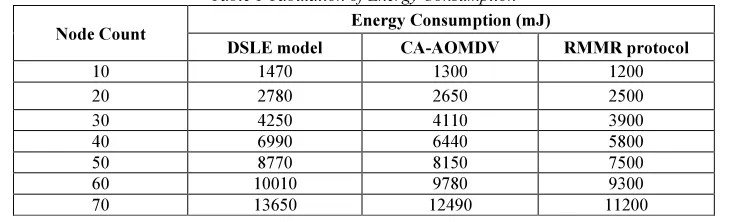
[image:7.595.116.486.627.738.2]Resource Median Multicast Routing (RMMR) protocol in Wireless Ad-hoc Network with ECAM algorithm is compared against the existing Design-Based Secure Leader Election (DSLE) Model and Channel-Aware Ad hoc On-Demand Multipath Distance Vector (CA-AOMDV). The table values denote the simulation result of the each parameter. The graph points are plotted with the help of the table values in the diagrams given below.
Table 1 Tabulation of Energy Consumption
Node Count Energy Consumption (mJ)
DSLE model CA-AOMDV RMMR protocol
10 1470 1300 1200
20 2780 2650 2500
30 4250 4110 3900
40 6990 6440 5800
50 8770 8150 7500
60 10010 9780 9300
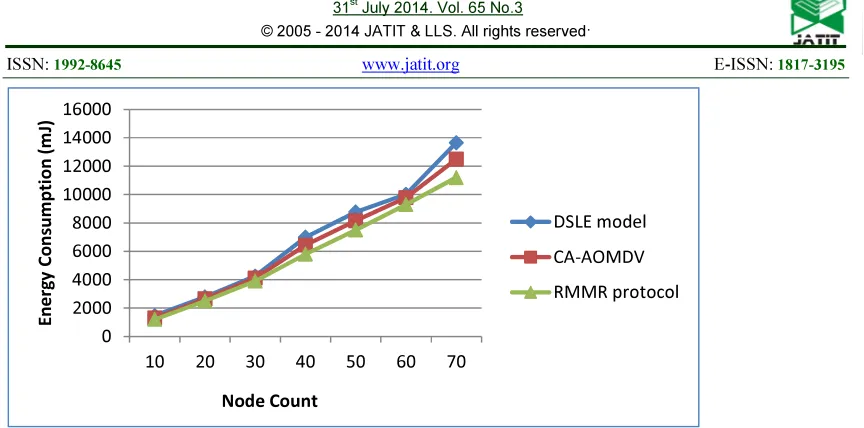
Fig 4 Performance of Energy Consumption
Table 1 and Fig 4 illustrate the energy consumption on multipath communication in wireless ad-hoc network with respect to node count ranging from 10 to 70. The energy consumption controls the duration of data packet sending in the first interface. The controlling of data packet
[image:8.595.123.472.430.570.2]duration reduces the energy consumption in RMMR protocol by 7 – 18 % when compared to the DSLE model [1]. CS eventually identifies the maximal energy consumption and reduces the energy actively by 4 – 10 % in WANET when compared with the CA-AOMDV [2].
Table 2 Tabulation For Routing Control Overhead
Time (sec)
Routing Control Overhead (%)
DSLE model
CA-AOMDV RMMR protocol
100 78 84 87
200 69 70 76
300 74 76 80
400 63 65 72
500 78 83 86
600 75 78 84
700 82 88 91
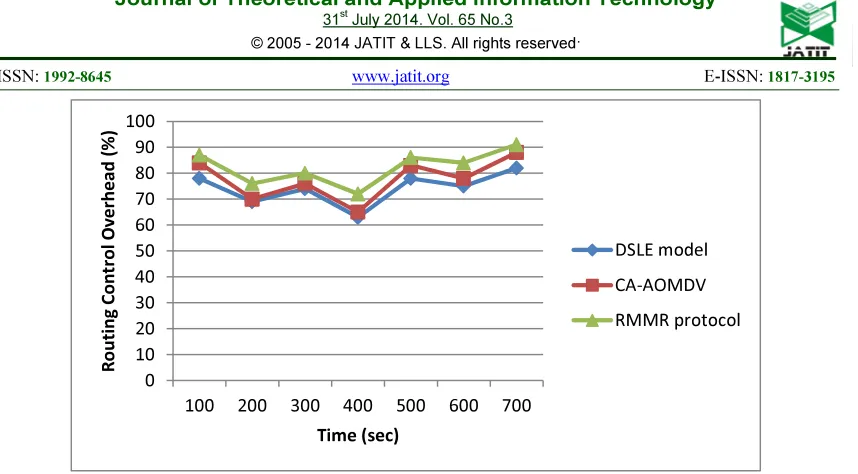
Table 2 describes the routing control overhead based on the simulation time in ns2 simulator. The simulation time experimented on each 100 simulation seconds and the values are plotted in the Fig 5.
0 2000 4000 6000 8000 10000 12000 14000 16000
10 20 30 40 50 60 70
E
ne
rg
y
Con
su
mp
tio
n
(
m
J)
Node Count
DSLE model
CA-AOMDV
Fig 5 Routing Control Overhead Measure
Fig 5 describes the routing control overhead of the existing DSLE model and CA-AOMDV against the RMMR protocol with respect to time. The communication of multicast routing tree through indicates the effective linking in WANET with channel state information, so that the
[image:9.595.113.484.465.603.2]overhead is reduced in the RMMR protocol. The communication linking reduces the overhead by 8 – 14 % in RMMR protocol when compared with the DSLE model [1]. The RMMR protocol also reduces the routing overhead by 3 – 9 % when compared with the CA-AOMDV [2].
Table 3 Tabulation Of Packet Delivery Ratio
Packet Rate (packets/sec)
Packet Delivery Ratio (%)
DSLE model
CA-AOMDV RMMR protocol
5 0.71 0.75 0.8
10 0.73 0.79 0.85
15 0.75 0.78 0.86
20 0.78 0.80 0.85
25 0.70 0.72 0.80
30 0.80 0.83 0.90
35 0.77 0.82 0.88
0 10 20 30 40 50 60 70 80 90 100
100 200 300 400 500 600 700
R
o
u
tin
g
Co
nt
ro
l
O
v
e
rh
e
ad
(
%
)
Time (sec)
DSLE model
CA-AOMDV
Fig 6 Measure Of Packet Delivery Ratio
Fig 6 illustrates the packet delivery ratio based on the packet rate. The development of the multicast routing tree with CONNECT/DEPART request message improves the packet delivery ratio. The multipath communication establish the communication by sending the CONNECT
[image:10.595.119.478.428.562.2]message and remove the node from the routing table through DEPART message. The usage of message system in wireless ad-hoc network improves the RMMR protocol by 8 – 16 % when compared with the DSLE model [1] and 6 – 11 % when compared with the CA-AOMDV [2].
Table 4 Throughput Tabulation
Node mobility
(m/s)
Throughput (packets)
DSLE model CA-AOMDV RMMR protocol
1 2700 3100 3600
2 2650 3120 3550
3 2800 3200 3660
4 2750 3180 3700
5 3100 3200 3850
6 2900 3300 3700
7 2850 3150 3600
0 0.1 0.2 0.3 0.4 0.5 0.6 0.7 0.8 0.9 1
5 10 15 20 25 30 35
Pack
e
t
D
e
li
v
e
ry
R
at
io
(
%
)
Packet Rate (packets/sec)
DSLE model
CA-AOMDV
Fig 7 Throughput Measure
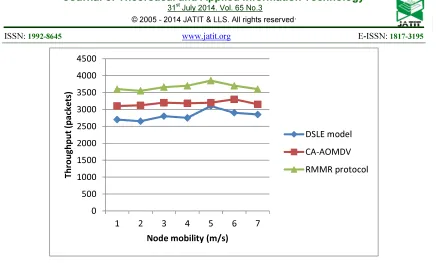
Fig 7 describes the throughput measure based on the node mobility with the node mobility rate measured in meter per seconds. RMMR protocol with ECAM algorithm introduces smn-point that select the correct start path to transmit the packets. The usage of smn-point improves the throughput by
[image:11.595.131.464.457.726.2]24 – 34 % when compared with the DSLE model [1]. The multicasting chooses the resources information as the median for the transferring of the packets in RMMR protocol and improve throughput by 12 – 20 % when compared with the CA-AOMDV [2].
Table 5 Network Security Tabulation
Technique Network Security (%)
DSLE model 89
CA-AOMDV 93
RMMR protocol 95
Fig 8 Network Security Measure
0 500 1000 1500 2000 2500 3000 3500 4000 4500
1 2 3 4 5 6 7
Th
ro
u
g
hp
u
t
(p
ack
e
ts
)
Node mobility (m/s)
DSLE model
CA-AOMDV
RMMR protocol
86 88 90 92 94 96 DSLE model
CA-AOMDV RMMR protocol
Network Security (%)
Te
ch
n
iq
u
e
The network security of DSLE model [1],
CA-AOMDV [2] is compared against the RMMR protocol in terms of network security measured in percentage. The imn-point in RMMR protocol plays the important role in improving the network security because it handles most multicast related path by forwarding the packets to the next hop node with balanced energy. The RMMR protocol is approximately 6 % improved when compared with the DSLE model [1] and 2 % improved when compared with the CA-AOMDV [2].
Finally, RMMR adapt to wireless ad-hoc network with median multicast tree for effective routing service. Resource Median Multicast employs the Energy Controlled Active Multicast algorithm with minimal energy consumption while transferring the information. ECAM algorithm reduces the overhead while performing the multipath communication in wireless ad-hoc network.
6 RELATED WORK
WANET have been a major focus of research in the past few years. The wireless ad-hoc network environment is created with limited range and broadcast through radio frequency wireless communications. There are many challenges in the creation of a wireless ad-hoc network such as routing challenges, less security, higher error rates, frequent disconnections, andportability challenges. The bit error ratio (BER) and frame drop ratio (FDR) were addressed in an elaborate manner in Code Division Multiple Accesses (CDMA) in [12] at the physical layer and at the medium access control layer respectively. Cross-layer optimization method is not significant for conducting time varying physical channels and variable bit rate multimedia traffic in wireless communication systems.
The solution to address to the problem of network’s heterogeneity was addressed using graph-based solution as mentioned in [16] using a mixed-line-rate auxiliary (MLR-AUX) graph. Additionally, an assignment approach based on the weight was also designed using the MLR-AUX which allowed routing to be cost-efficient. The bidirectional coupling of network simulation in [11] provided solution with the help of road traffic micro simulation estimate IVC protocols. Integrated model for CO2 emission allows not only the effects IVC on the road traffic, but also on the
environment to decide whether the compensation for drivers will have a senior force on the surroundings or not.
The path optimality between a source and destination pair for providing QoS architecture was presented in a uni-cast mode in [15]. With the application of QoS architecture there arise no interior admission control but still provides the QoS guarantees. In QoS architecture, as long as each node does not admit a prescribed amount of traffic, it does not result in link congestion. The formation-theoretic framework which uses the received signal strength (RSS) from a network of base-stations in [20] delivers near-optimality under sensible risk conditions.
The discovery of path in CA-AOMDV [2] with route handoff selected stable links and with this both the CA-AOMDV and AOMDV improved the decisions regarding routing by accurately predicting the path failure. For different types of applications, the duration of average channel fading was used to identify the path effectiveness. The routing metric used by CA-AOMDV for effective path identification was the channel average non-fading period metric but maximum of energy was consumed by using the channel state information.
Realistic interference model based on the Signal-to-Interference-and-Noise Ratio (SINR) as demonstrated in [8] was considered frequently. SINR statistically inferred the results of wireless transmissions results by offering several insights into the interaction in the middle of throughput, lifetime, and transmit power. The optimization method called as the cross-layer optimization was mainly considered as the important methods for performing time difference physical channels and variable bit rate multimedia traffic in wireless communication systems. Randomization framework for input line up switches to an SINR rate-based interference model widens the network with multi-hop traffic and multiple channels [10].
OPDMAC protocol failed in getting into insight
grabbing the opportunity for the transmission of other outstanding packets in a multipath environment
.
7 CONCLUSION
Resource Median Multicast Routing (RMMR) Protocol develops effective routing services in wireless ad-hoc network. The connection between the wireless nodes is counted and energy utilization effort is minimized using the median multicast trees. RMMR protocol constructs the multicast routing tree with the CONNECT/DEPART message system. Median Multicast employs the Energy Controlled Active Multicast (ECAM) algorithm with carrier sensing to control the energy on the active set of nodes in WANET. RMMR protocol contains the smn-point and imn-point for easy construction of the multicast routing tree. Idling with CS in ECAM algorithm reduces energy in wireless interfaces and improves the network lifetime. Theoretical analysis and experimental results show that, RMMR protocol attains the minimal energy consumption on multipath communication, and routing control overhead. ECAM algorithm effectively achieves averagely 8.232 % improved packet delivery ratio on wireless nodes, network lifetime and throughput based on mobility speed.
REFERENCES
[1] Noman Mohammed., Hadi Otrok., Lingyu Wang., Mourad Debbabi., and Prabir Bhattacharya., “Mechanism Design-Based Secure Leader Election Model for Intrusion
Detection in MANET,” IEEE
TRANSACTIONS ON DEPENDABLE AND SECURE COMPUTING, VOL. 8, NO. 1, JANUARY-FEBRUARY 2011
[2] Xiaoqin Chen., Haley M. Jones., and Dhammika Jayalath., “Channel-Aware Routing in MANETs with Route Handoff,” IEEE TRANSACTIONS ON MOBILE COMPUTING, VOL. 10, NO. 1, JANUARY 2011
[3] Sungwon Kim., Chul-Ho Lee., and Do Young Eun., “Superdiffusive Behavior of Mobile Nodes and Its Impact on Routing Protocol Performance,” IEEE TRANSACTIONS ON MOBILE COMPUTING, VOL. 9, NO. 2, FEBRUARY 2010
[4] Konstantinos Pelechrinis., Ioannis Broustis., Srikanth V. Krishnamurthy., and Christos Gkantsidis., “A Measurement-Driven Anti-Jamming System for 802.11 Networks,”
IEEE/ACM TRANSACTIONS ON
NETWORKING, VOL. 19, NO. 4, AUGUST 2011
[5] Osama Bazan., and Muhammad Jaseemuddin., “On the Design of Opportunistic MAC Protocols for Multihop Wireless Networks with Beamforming Antennas,” IEEE
TRANSACTIONS ON MOBILE
COMPUTING, VOL. 10, NO. 3, MARCH 2011
[6] Lihua Yuan., Chen-Nee Chuah., and Prasant Mohapatra., “ProgME: Towards Programmable Network Measurement,”
IEEE/ACM TRANSACTIONS ON
NETWORKING, VOL. 19, NO. 1, FEBRUARY 2011
[7] X. Xiang., X. Wang., and Y. Yang., “Supporting Efficient and Scalable Multicasting over Mobile Ad Hoc Networks,” IEEE TRANSACTIONS ON MOBILE COMPUTING, VOL. 10, NO. 5, APRIL 2011 [8] Jun Luo., Aravind Iyer, and Catherine Rosenberg., “Throughput-Lifetime Trade-Offs in Multihop Wireless Networks under an SINR-Based Interference Model,” IEEE
TRANSACTIONS ON MOBILE
COMPUTING, VOL. 10, NO. 3, MARCH 2011
[9] Larry C. Llewellyn., Kenneth M. Hopkinson., and Scott R. Graham., “Distributed Fault-Tolerant Quality of Wireless Networks,” IEEE TRANSACTIONS ON MOBILE COMPUTING, VOL. 10, NO. 2, FEBRUARY 2011
[10] Hyang-Won Lee., Eytan Modiano., and Long Bao Le., “Distributed Throughput Maximization in Wireless Networks via Random Power Allocation,” IEEE Transactions on Mobile Computing, Volume:11 , Issue: 4, 2012
[11] Christoph Sommer., Reinhard German, and Falko Dressler., “Bidirectionally Coupled Network and Road Traffic Simulation for Improved IVC Analysis,” IEEE
TRANSACTIONS ON MOBILE
COMPUTING, VOL. 10, NO. 1, JANUARY 2011
MOBILE COMPUTING, VOL. 10, NO. 6,
JUNE 2011
[13] Francisco Javier Ros., Pedro Miguel Ruiz., and Ivan Stojmenovic., “Acknowledgment-Based Broadcast Protocol for Reliable and Efficient Data Dissemination in Vehicular Ad Hoc Networks,” IEEE TRANSACTIONS ON MOBILE COMPUTING, VOL. 11, NO. 1, JANUARY 2012
[14] Tom H. Luan., Xinhua Ling., and Xuemin (Sherman) Shen., “MAC in Motion: Impact of Mobility on the MAC of Drive-Thru Internet,” IEEE TRANSACTIONS ON MOBILE COMPUTING, 2011
[15] Yuanzhe Xuan., and Chin-Tau Lea., “Network-Coding Multicast Networks With
QoS Guarantees,” IEEE/ACM
TRANSACTIONS ON NETWORKING, VOL. 19, NO. 1, FEBRUARY 2011
[16] Marwan Batayneh., Dominic A. Schupke., Marco Hoffmann, Andreas Kirstaedter, and Biswanath Mukherjee., “On Routing and Transmission-Range Determination of Multi-Bit-Rate Signals Over Mixed-Line-Rate WDM Optical Networks for Carrier Ethernet,” IEEE/ACM TRANSACTIONS ON NETWORKING, VOL. 19, NO. 5, OCTOBER 2011
[17] Andrea Bondavalli., Ossama Hamouda, Mohamed Kaaniche., Paolo Lollini, Istvan Majzik, and Hans-Peter Schwefel., “The HIDENETS Holistic Approach for the Analysis of Large Critical Mobile Systems,” IEEE TRANSACTIONS ON MOBILE COMPUTING, VOL. 10, NO. 6, JUNE 2011 [18] Patrick Tague., Sidharth Nabar., James A.
Ritcey., and Radha Poovendran., “Jamming-Aware Traffic Allocation for Multiple-Path Routing Using Portfolio Selection,”
IEEE/ACM TRANSACTIONS ON
NETWORKING, VOL. 19, NO. 1, FEBRUARY 2011
[19] Gianluca Dini., Angelica Lo Duca., “Towards a reputation-based routing protocol to contrast black holes in a delay tolerant network,” Ad Hoc Networks., Elsevier Journal., 2012 [20] Shihao Yan., Robert Malaney., Ido Nevat., and