INQUIRY LEARNING IN THE VIRTUAL-ACTUAL FUSION
ENVIRONMENT AND ITS APPLICATION IN
ENVIRONMENTAL EDUCATION
1 ZHANG JIANPING, 2 XU WEI
1
Institute of Education Technology, Zhejiang University, Hangzhou, China
E-mail: [email protected] , [email protected]
ABSTRACT
With the rapid development of information technology, higher attention is paid on the cultivation of innovative talents. Inquiry learning activities carried out in traditional learning environment which is based on pure “real” environment inside and outside the school or the ones entirely depending on the pure network “virtual” environment have gradually revealed their shortcomings. The “virtual-actual fusion environment” is proposed for the current status of inquiry learning environment. This study will firstly identify the conception and typical characteristics of this kind environment, constructing a “learning environment—learning model” coordinate system to discuss inquiry learning in the fusion environment. And then the paper will introduce the application in Environmental education by taking CEIS (Campus Environment Information System) project for example. At last, it proposes several important points for follow-up study.
Keywords: Learning Environment; Inquiry Learning; Learning Model; Environmental Education; CEIS
(Campus Environment Information System)
1.
OVERVIEWInternet and multimedia technology has developed rapidly in recent decades, causing greatly change in the educational field. An increasing number of teaching activities have been moved from realistic classroom space to online virtual platform. As a result, learning environment is transformed from “actual” to “virtual”. Such transformation not only refers to the physical space where teaching and learning were carrying out, but involves the teaching procedures and instructional resources supported by internet technology.
Inquiry learning is a typical model that pays close attention to cultivate learners’ autonomous learning ability, problem-solving skills and creative thinking, with basic purpose of improving learners’ scientific attitude and promoting their scientific literacy. Learning environment supported by internet technology is different from traditional classroom space. Abundant resources online and asynchronous interactive system could improve teaching efficiency and makes up the deficiency of traditional classroom instruction. With constant attempts and successful practices, the attitude people hold toward internet however, has turned from acceptance to dependence, and then its disadvantages of which have also gradually
exposed. For example, learners’ real experience with circumstance could not always be satisfied in learning process of scientific knowledge; and abundant information online would fail to improve learners’ learning efficiency but increase their cognitive load instead.
The concept of “Virtual-Actual Fusion Environment” is put forward in view of these questions, as combining the “realistic” learning context with the “virtual” learning support online. Besides, it balances learners’ real experience with autonomous learning activities supported by information technology at the same time. In this learning environment, it is beneficial for learners to reach the goal of inquiry learning and construct their own knowledge structure in the process of learning experience within the virtual-actual fusion environment.
2.
INQUIRY LEARNING IN THEVISUAL-ACTUAL FUSION ENVIRONMENT
2.1 What Is The “Virtual-Actual Fusion Environment”?
place of learning activity in realistic circumstance. He has proposed the “Inquiry learning Situation in Virtual-Actual Fusion Environment”, believing that the so-called “Virtual-Actual Fusion” means combining virtual learning situation with realistic learning situation as a whole. The former refers to the learning situation in the network environment, while the latter is the learning situation in the physical space. Later on, “constructing a rich learning environment by means of fusing virtual and actual situation together” was discussed in the final report of School-based Practice Research on Constructing Primary School Science Course in the Virtual-Actual Fusion Environment, the educational science research of Shanghai in 2004. According to the report, the learning environment is a combination of learning platform supported by information technology and micro-environment for learning in real situation. In such environment, learners will not only experience learning in the realistic situation (such as in laboratory), but also search for extracurricular knowledge online.
Different from the above mentioned, the “Virtual-Actual Fusion Environment” proposed Professor Zhang Jianping, an e-learning scholar in Zhejiang University of China, means that combining the real world with virtual network into a whole mainly depending on the Internet of Things (IOT) represented by sensor technology, which can transmit the information in the real circumstance into the virtual platform, making inquiry learning much more convenient and efficient, rather than separating the both. By using of sensor technology, the information data in the real situation such like real-time meteorological information is transmitted into database through wireless sensors, and then updating online presented in the portal. Learners thus could carry out learning activities utilizing the digital information of real situation and explore the mysteries of science. These information resources which can’t be directly obtained without technology are essential for scientific inquiry learning. What’s more, they are of great importance in cultivating learners’ scientific attitude and critical thinking.
Consequently, the conception of “Virtual-Actual Fusion Environment” is defined as: it is such a learning environment which fusions the real situation and virtual situation as a whole, using for developing subject-based inquiry learning. In this environment, website portal is used to provide various digital information and some reliable resources, the former is reflecting the real situation and mainly depends on sensor technology, and the latter is filtered and selected by instructors. With
the abundant digital information and various learning tools, subject-based inquiry learning may be more scientific and challenging. Meantime, learners can also obtain their actual feeling during personal experience. Therefore, the learning performance of scientific inquiry activities will be improved more effectively.
2.2 Inquiry Learning In The Virtual-Actual Fusion Environment
Currently, inquiry learning environment is mainly carried out in two situations: the “real world” based on the both inside and outside the classroom and the “virtual world” which is based on the internet technology. In the “learning environment—learning model” coordinate system seen as figure 1, the traditional classroom teaching and inquiry learning are located respectively in the quadrant A and quadrant D, while the inquiry learning based on information technology is in the quadrant C, including some typical models, such as Webquest, WISE (Web-Based Inquiry Science Environment), Big6 and so on. These kinds of models have their own advantages. For example, learners can be organized to carry out inquiry learning motivated by problem solving through making best use of abundant resources online. Thus learning activities can be accomplished under the guidance of instructors. Learners’ systemic scientific knowledge would be constructed through participating in the whole process, with problem-solving skills being improved at the same time. Nevertheless, the presence and experience learners could obtain in the virtual cyberspace is not as well as that in the real world. Otherwise, they are prone to get lost in the learning process while facing the abundant digital information. As a result, their learning efficiency is always hard to be guaranteed.
The virtual-actual fusion environment integrates the advantages of both. This fusion environment balances dominant role of instructors and autonomic learning among learner at the same time. Its characteristics are discussed as follows:
1)The integration of the virtual and real environment is organic, rather than a simple superposition.
room and submission system to improve students’ learning efficiency. With technology supporting, the fusion environment have integrated both as a whole. The technology of “internet of things” represented by kinds of sensors could sense various information in real situation. And then, information sensed by sensors is transmitted into digital
information which can be essential for inquiry learning. Therefore, online learning platform not only supports the inquiry learning with learning tools, but provides scientific and authoritative learning resources, all of which are integrated into a unified system to support inquiry learning activities.
Figure1 Inquiry Learning——Learning Environment And Learning Models
2)The description scope of the learning environment has been extended, taking the learning process as a unified system.
Traditional description of learning environment is restricted in physical space and learning resource, while the fusion environment is extending it. Information technology has greatly changed the teaching and learning process, extending it to a large content. For example, the physic space in traditional learning environment which teaching and learning are taken place is extended into the “learning context” constructed for promoting students’ learning with a concrete theme in a real situation and supported effectively by virtual tools. And the knowledge, which was owned by teachers as an existing object waiting for students to learn before, now is becoming a constructed process by the learning community through communication among all of them. Teaching and learning process are acted as a unified system in the fusion
environment with extending the scope of learning environment.
3)The fusion environment balances dominant role of instructors and automatic learning among instructors.
will be always within learning context of the theme set by the fusion environment. Such realistic and authoritative information not only stimulates learners’ motivation, but also cultivates their divergent thinking, which definitely can’t be realized in either traditional classroom situation or virtual online environment.
4)Making full use of the website to share and interact with each other and developing distributed collaborative learning.
The internet technology not only breaks through the restriction of space-time, but makes learners more closely. Inquiry learning carried out in the fusion environment pays more attention to the
objectivity and authenticity of teaching resources. Through sharing resources and using collective wits, these inquiry learning are developing distributed collaborative learning. Online virtual environment is beneficial for organizing cross-regional scientific inquiries learning which is not only restricted to discussion and brainstorms, but can based on real information and carry out scientific research. Supported by realistic and objective data, learners’ analytical skills can be improved through discussing objectively. All these will contribute to carry out cross-regional inquiry learning which will balance the educational development worldwide.
Figure2 Frameworks Of CEIS
3.
APPLICATION IN ENVIRONMENTALEDUCATION——TAKE CEIS FOR EXAMPLE
The virtual-actual fusion environment referred to in this paper is mainly based on the internet of things, which is mainly consisted of kinds of sensors and website portal. CEIS (Campus Environment Information System) is a public application program of Zhejiang Province launched in 2011, which is being carried out by Modern Educational Technology Centre of Zhejiang
University. Now we take it for example to introduce the fusion environment applied in Environmental education.
3.1 The Framework Of CEIS
parts of hardware and software. The hardware involves the sensors and wireless transmission system using for sensing and transmitting. And the software is the information portal based on website technology for presenting information and integrating learning tools to support and promote inquiry learning on environmental-themed.
As showed in figure2 (Yang Jinzhong, Zhang Jianping, 2012), the information system is based on the internet technology, which receives digital information from sensors system and provides query service and learning tools for learners inside and outside schools. Kinds of sensors for detecting the environmental elements, wireless information terminal using for transmitting information without physical space limits and environment data acquisition as the connection with database online, is placed in campus or community for detecting regional environment of real-time. There are kinds of sensors to sense environmental elements, such like temperature, humidity, wind speed, wind direction, air pressure and solar radiation, noise, air quality and so on. The other important component is the information portal, which provides query service and integrates learning tools for students in campus & community or learners in society. The portal with web server and database server not only provides of environmental digital information presented by graphic charts, but also query service for citizens using online service by mobile devices. According to the massive online resource, which may mislead learners, information in the portal is filtered elaborately and thoroughly by instructos to make it more authoritative and reliable. For example, the national meteorological database and environmental database are linked with it to provide authoritative and micro level data.
3.2 The Fusion Environment Of Ceis
Integration of hardware and software constructs a fusion environment for inquiry learning on environmental-themed, seen as figure3.
[image:5.612.316.523.74.259.2]Environmental elements information of real-time and regional is detected by kinds of sensors. These resources are receiving from real situation, being transmitted to digital information and presented online, while it is hardly collected and supported for learning in traditional learning environment. Virtual environment here is the information portal (http://ceis.hancnc.com/) to presenting resources and supporting learning effectively.
Figure 3 The Fusion Environment Of CEIS
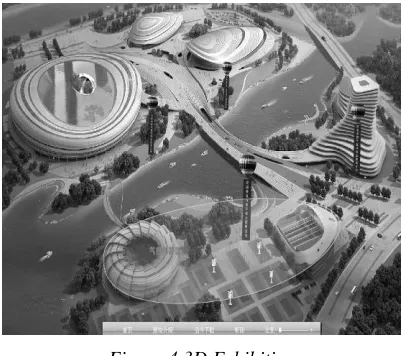
By using it, Learners can query real-time environmental data, including synthesized data, and analyzed data with openly downloading. Besides, the portal is also designed for environmental popularization. Learners in society can inquiry in the 3D exhibition room (seen as figure 4), experiencing it by personal. The exhibition room is designed on subject-based, including water resource room, meteorological popularization room and atmosphere room.
Figure 4 3D Exhibition
[image:5.612.317.518.400.578.2]environment to carry out inquiry learning by using of its functional modules, such like chatting room, resource list. Instructors pick up relevant theme and make instructional design.
In the fusion environment, it integrates sensors, portal and learning platform as a whole, all around the inquiry learning on environmental-themed. Based on the analysis above, four characteristics of CEIS are as follows:
1)Integrating software and hardware as a whole, supporting inquiry activities in all directions.
CEIS is a system which possesses systematical software platform, hardware equipment, including front-end sensors detecting environmental data, wireless transmission used for transferring, website database, information sharing platform, portal etc. there are a series of functional modules, ranging from the acquisition, transformation and display of data to simple graphic analysis. Furthermore, learners can download historical data online. All in all, the system provides a virtual-actual fusion environment for learners to carry out inquiry activities
2)This system can be used universally, not only applying on campus, but also taking popularization in community education and life-long learning.
The environmental popularization should not be restricted on campus, but the whole society should pay attention to. Current environmental monitoring stations are placed dispersedly, which is not beneficial for regional research. Fortunately, the CEIS as an integrated system can be installed anywhere. Besides, the open portal makes it convenient to carry out collaborative research inside and outside school. The popularization of environment and relevant knowledge about environmental protection also become easy to take.
3)The system integrates various learning tools, which is beneficial for supporting kind of inquiry activities online.
The software includes portal and learning platform of various learning tools such as video conference, collaborative writing, resources sharing, information pushing, etc. Kinds of online inquiry activities can be supported effectively by them, such as the co-construction of environment knowledge, experiment simulation, online debate and so on. Through these activities, learners will improve the analytical ability and problem-solving ability. What’s more, learners’ scientific attitude would be thus enhanced.
4)The system can be expanded easily, and the project also can be developed extensively
The wireless sensors interface can be expanded freely. Sensors can be added to the reserved interfaces according to the development of the research, detecting any information except for environmental data, such as water pollution, soil acidity and alkalinity, etc. Meanwhile, the research can be developed properly based on the original hardware and software, promoting to a higher level from the living environment to the ecological environment. Therefore, the project will be developed continually and sustainably.
4.
CONCLUSION AND PROSPECTWith the application of the internet of things in educational field, the advantages of the virtual-actual fusion environment will increasingly distinguish itself from others. It not only satisfies learners’ personal experience, but also makes the best use of virtual network, integrating various learning tools. The teaching efficiency is thus improved. Besides, the new environment promotes learners’ autonomic learning, constructing knowledge systematically in depth, cultivates learners’ scientific attitude and improves their scientific literacy.
Based on the original researches, the study on the inquiry learning in the virtual-actual fusion environment will lay more emphases on:
• Whether it serves to form scientific attitude of learner or improve their scientific literacy? Does this inquiry learning activity superior to those ones depending on the network entirely?
• What kinds of knowledge are suitable to be carried out in the way of inquiry learning? And whether learners’ motivation is derived from the new environment or other elements?
• As to research methods, we should lay emphasis on the design-based research. More attention should be paid to the changes of external interventions, so that researchers can adjust the project design timely. New theoretical construction and problem solutions should be sought in the process of repetition iteration
this can learners make use of technology rationally and effectively, thus contributing to accomplishing the educational goals.
ACKNOWLEDGMENT
This paper has been sponsored by two programs as follows: (1) Science and Technology Bureau Program in Zhejiang province: “Environmental Information Observation System and Its Application in Education Based on Community/Campus” ( 2011—2012 ) ;( 2) Department of social cultivation project in Zhejiang university: “The Visual-Actual Fusion Environment and Its Learning Activities Research” (2012— 2013).
REFERENCES
[1] Zhang Jianping, Xiong Caiping. (2006). Integration of information technology and curriculum, Zhejiang University Publishing House.
[2] Xu Xuefu, (2002). Analyze the connotation of inquiry learning, Education Science. (3),33–36. [3] Yuan Weixin. (2003). Science instruction models
based on construction theory broad. Comparative Education Review.(8),50–54. [4] Fu Zhiwen, Wu Dongxing. (2009). Designation
and development of science inquiry platform based on meteorological theme. E-education Research. (3), 67–79.
[5] Wang Jianming, Chen Shipin, Diao Yongfeng. (2011). Program analysis and its idea of multiple users virtual learning environment River City. E-education Research. (7),61–66. [6] Bai Xiaojing, Ding Xingfu. (2006). Designation
and organization of distance collaborative learning program——a case study of GLOBE at night, Modern Distance Education. (5),10–13. [7] Fisher.F, Bruhn.J, Grasel C, Mandl.H. (2002).
Fostering collaborative knowledge construction with visualizationtools. Learning and Instruction. (12), 212–232.
[8] Ketelhut DJ, NelsonB, DedeC&ClarkeJ. (2006).Inquiry learning in multi-user virtual environments. San Francisco, the National Association for Research in Science Teaching. [9] M.Kapur, C.K.Kinzer. (2007). Examining, the
effect of problem type in a synchronous
computer-supported collaborative learning(CSCL) environment. Educational
Technology Research & Development.(5), 440.