DESIGN AND ANALYSIS OF ANALYTICAL MODEL OF
NOVEL ENERGY CONSTRAINED COOPERATIVE MAC
PROTOCOL FOR AD-HOC NETWORKS
* 1ELLAMMAL C, 2 SUDHA SADASIVAM G
1
Associate Professor, Department of Electronics & Communication Engineering, Dr. NGP Institute of Technology, Coimbatore, India.
2Professor, Department of Computer Science Engineering, PSG College of Technology, Coimbatore, India
E-mail: [email protected], [email protected]
*Author for correspondence
ABSTRACT
Relay assisted cooperative wireless communication has been shown to have significant performance gains over the legacy direct transmission scheme for Ad-hoc network. An efficient cooperative Medium Access Control Scheme (MAC) is needed to solve the difficulties induced by relaying and cooperative computing. Another challenging issue is the extension of network lifetime of an Ad-hoc network with regards to small battery capacity and self sustained operation. So, designing energy constrained cooperative MAC for improving the network lifetime is a challenging task. Yet, only less attention has been paid for cooperative MAC scheme and its potential for lifetime extension. In this paper, we propose a novel Energy Constrained Cooperative MAC protocol namely ECC-MAC for Ad-hoc networks with the objective of maximizing the network lifetime and achieving high throughput. Furthermore, we presents an analytical model for network lifetime aware cooperative MAC scheme which identify the best possible relay based on both residual energy and data rate. We show that the proposed model seeks to optimize the tradeoff between network lifetime and throughput.
Keywords: Cooperative Communication, Medium Access Control, Ad-Hoc Network, Throughput, Network Lifetime.
1. INTRODUCTION
Mobile Ad-hoc Network (MANET) is a self configured network of mobile terminals connected by wireless links. Mobile terminals such as cell phones, portable gaming devices, PDAs and tablets all have wireless networking capabilities. By participating in MANETs, these terminals may reach the internet when they are not in the range of Wi-Fi access points or cellular base stations, or communicate with each other when no networking infrastructure is available. MANETs can also be utilized in the disaster rescue and recovery. One primary issue with continuous participation in MANETs is the network lifetime, because the aforementioned wireless terminals are battery powered, and energy is a scarce resource.
Cooperative communication techniques have been shown to improve network performance by combining the transmission powers of multiple users. While most of the attention has been on improving signal-to-noise ratio in the physical layer, research focus has also been devoted to
exploiting cooperative diversity at the MAC layer. Existing work on cooperation in the MAC layer can be broadly divided into proactive and reactive strategies. Proactive strategies involve making use of relays to improve the transmission quality between stations where the channel condition is low. In case of reactive strategies, intermediate nodes wait for an indication of incorrect reception of data from the receiver, following which they retransmit cached copies of the original data with the objective of reducing the number of retransmissions.
The IEEE 802.11 standard lists five modes for a network interface to operate: transmit, receive, idle, sleep and switch off. While the power consumption values for the first three states do not differs by much, a node can go into a low power sleep state to save energy, though it cannot transmit and receive data in this state.
61 attention is needed for the selection of potential relay in cooperative communication.
In this paper, we detail a cooperation frame work for the MAC layer which seeks to optimize the tradeoff between network lifetime and throughput. Our algorithm ECC-MAC seeks to enhance cooperation by identifying the best possible relay while being sensitive to the network lifetime. We show that this can help to obtain a balance between achieving high network throughput and maintaining a high network lifetime.
2. RELATED WORKS
Some existing proactive strategies focus on multi-rate networks where low rate stations can obtain help from high rate ones. Two such mechanisms were outlined in rDCF [1] and Coop MAC [2] in which the source chooses from a list of relays for cooperation. Liu et al. have proposed a CoopMAC to exploit the multirate capability and aimed at mitigating the throughput bottleneck caused by the low arte nodes, so that the throughput can be increased. With the similar goal, Zhu et al. have proposed a CMAC protocol for wireless ad-hoc network. However, beneficial cooperation considering signaling overhead is not addressed.
More recently, [3] proposed a cross-layer design by combining information from the physical layer to achieve cooperation at the MAC layer. As shown in the above mentioned papers, cooperation in multi-rate networks can help overcome the negative effect of low rate stations on the network throughput [4]. However, relaying would imply additional energy consumption for the relay mode. As the transmission duration is shortened for the low rate transmission, the power consumed by the relay node is lower than the power it would have consumed by staying idle for the entire duration of a low rate transmission.
A busy tone based cross l
ayer CMAC
protocol [5]
has been designed to use busy tonesto help avoiding collisions in the cooperative scenario at the cost of transmitting power, spectrum and implementation complexity. A reactive network coding aware CMAC protocol ha
s been
proposed by [6]
in which the relay node canforward the data for the source node, while delivering its own data simultaneously. But the network lifetime is not addressed. A distributed CMAC protocol
[7]
has been proposed to improve the lifetime of wireless sensor networks, but it is based on the assumption that every node canconnect to the base station within one hop, which is impractical for most applications. A CMAC protocol for vehicular networks, particularly for gateway downloading scenarios, has been designed by [8]. A drawback is that it can only be utilized in the scenario that all the vehicles are interested in the same information. Moreover, Moh et al. [9] have designed a CMAC protocol named CD-MAC which lets the relay transmit simultaneously with the source using space-time coding technique. Shan et al. [10] have explored a concept of cooperation region, whereby beneficial cooperation can be identified. However, energy consumption is not evaluated for both of them.
The existing CMAC protocols mainly focus on the throughput enhancement while failing to investigate the energy efficiency or network lifetime. While the works on energy efficiency and network lifetime generally fixate on physical layer [11] and network layer [12]. Net Coop MAC is proposed by Banerjee et al., [13] for improving network lifetime but is not applicable for ad-hoc network. DEL-CMAC protocol is proposed by [14] but multiple relay are not considered for improving throughput.
Our work focuses on the MAC layer, and is distinguished from previous protocols by considering a practical energy model with the goal to enhance energy efficiency and extend network lifetime.
We summarize our contribution as follows.
• We propose ECC-MAC that focuses on the network lifetime extension
• Analytical modeling of the cooperative energy constrained MAC
• Maximizing network lifetime while focusing on maintaining a high network throughput by considering multiple data rates supported by particular node.
• A distributed energy-aware data rate based best relay selection strategy
The rest of this paper is organized as follows. We present preliminaries and mathematical model in section 3. In section 4, we describe proposed ECC-MAC protocol with example scenario in detail. In section 5, we present numerical results and discussions and section 7 concludes the paper.
3. ANALYTICAL MODEL
3.1 Preliminaries
one of the following states and power consumption differs for each state:
Transmit: Node transmits packet with the
transmission power Pt.
Receive: Node receives packet with receiving power Pr.
Idle: Node neither sends nor receives
packet but listens to the wireless channel with power Pidle
Sleep: Node enters into sleep state and consumes power Psleep
Energy consumed by a node during particular amount of time is computed as follows:
Energy =Power*Time
Thus, energy consumed during transmission is
Et= Pt*Tt
where,
Tt= Transmission time
Similarly, energy consumed during reception is
Er= Pr*Tr
where,
Tr= Reception time
We use the power consumption values of the Lucent IEEE 802.11 WaveLAN card which consumes 1.65 W,1.4 W,1.15 W and 0.045 W in the transmit, receive, idle and sleep modes respectively.The energy consumption for a wireless network interface in the active state for the receive and idle modes is not much lower than that consumed in the transmit mode, though the energy consumption in the sleep mode is much lower.
We adopt a design where a node enters the sleep mode upon overhearing an RTS/CTS exchange for a transmission not involving itself, waking up after the specified duration. Earlier papers have raised concerns about the transition time of 250 µs between the doze and awake states. However, considering an 802.11b network, the transmission time for a 2 KB packet at the maximum transmission rate of 11Mbps would take around 1.5ms within which this transition could comfortably be achieved twice, i.e. for the node to enter the doze state and wake up again. Also, given the performance benefits of the sleep mode, we expect future wireless interfaces to have better support for this state with shorter transition times.
As shown in Figure 1, a multi-hop Ad-Hoc network with randomly deployed mobile terminals
is considered, where all terminals have the capability to relay. To come up with a reasonable system model, we assume that data connections among terminals are randomly generated and the routes are established by running Ad hoc On-demand Distance Vector (AODV) which is a widely used conventional routing protocol for Ad-hoc network. In the system model, AODV builds the route in a proactive manner by selecting the routing relay terminals firstly. When a route is established, ECC-MAC initiates the cooperation in a hop-by-hop manner by selecting the cooperative relay terminals. In this paper, the source and destination terminals are referred to the terminals at MAC layer and the relay terminal indicate the cooperative relay terminal.
Figure 1: Multihop Ad-hoc Network Scenario
3.2 Energy Model
Since in a cooperative scenario, a node participates in transmissions from other nodes in addition to its owntransmissions, its lifetime would depend on the energy consumed due to both. Hence we define the lifetime of a node in terms of energy consumption per unit time.
Let Eint be initial energy of a node and ei
be energy consumption per unit time for node i. Then, the lifetime of a node i could be expressed as
(1)
63
(2)
Cooperation should increase the energy consumption per unit time for the relay nodes, and thereby limit the lifetime of the entire network; we look to maximize the same while focusing on maintaining a high network throughput. We summarize our objectives as follows,
max f (
(3)
where Si denotes the throughput of a node
i and the function f could be a weighted average of the two parameters.
Thus, we aim to design a cooperative MAC protocol which gives better network lifetime than direct transmission. This can, in turn, be interpreted as, given a source s , destination d and a potential relay , the minimum residual energy for direct transmission i is less than that of cooperative transmission. We can formulate this as
(4)
where,
q = [e(s), e(i), e(d)]
e(s) = residual energy of a source e(d) = residual energy of a destination e(i) = residual energy of a relay
3.3 Transmission Decision Factor (δ)
When a station has a packet, it computes transmission decision factor δ each possible mode of transmission based on the potential throughput improvement as well as the effect on the energy consumption of the node. Source always chooses the mode of transmission with minimum value of δ. The transmission decision factor δ for node is function of the following parameters,
δi = tx_factor( i, r1, r2, tdir, L) (5)
where,
i = Node number r1 = First hop data rate
r2 = Second hop data rate
tdir = Time taken for direct transmission
L = Packet Length
The transmission time for node i using co-operative communication is
(6)
Source transmits packet to relay with data rate r1 and relay re-transmit the packet to
destination using the data rate r2.
Energy consumption of a node using cooperative communication is given by
(7)
where,
Pt = Power taken for transmission Pr = Power taken for reception
Let Eres,i be residual energy of a node i.
Then, the fraction of energy consumed by cooperative communication from residual energy is,
(8)
The node having highest Qi will have lowest
residual energy. So, node with lowest Qi is chosen to increase network lifetime.
High data rate relay stations will always take less transmission time. Throughput factor Si
decreases with reduction in transmission time as follows,
(9)
The node having highest Si will have low data rate.
So, always choose node with lowest Si for
increasing throughput.
Transmission Decision Factor δi for node i
is computed as follows,
δi = Qi* Si (10)
In order to optimize the tradeoff between network lifetime and throughput, the node with lowest transmission decision factor δi is chosen as relay for
cooperative communication.
4. PROPOSED ECC-MAC PROTOCOL
4.1 Distributed Coordination Function
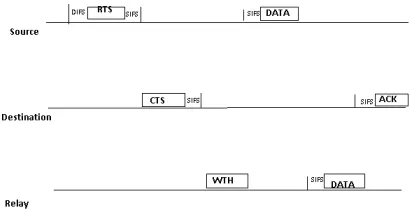
64 transmitting terminal senses an idle channel for a duration of Distributed Inter Frame Space (DIFS), it backs off for a time period that is chosen from 0 to its Contention Window (CW). After the backoff timer expires, the well-known RTS-CTS-DATA-ACK procedure is carried out as shown in Figure 2. Any terminal overhearing either the RTS or the CTS extracts the information contained in the MAC frame header, and sets its NAV to imply the time period during which the channel is busy.
Figure 2: Frame Exchanging Process of ECC-MAC
When a source wants to initiate the data transmission with payload length L bytes, it first senses the channel to check whether it is idle. If the channel is idle for DIFS, the source chooses a random backoff timer between 0 and CW. When the back-off counter reaches zero, the source sends out a RTS to reserve the channel. Unlike DCF, the residual energy of the source and relay request message with corresponding relay address are also carried in the RTS packet, which are used for cooperative communication.
Upon receiving the RTS, the destination sends a CTS back after Short Inter Frame Space (SIFS). The CTS contains the residual energy of the destination which is updated by all nodes hearing CTS. If the source does not receive CTS within Trts+Tcts+SIFS, a retransmission process will be performed. Otherwise, upon receiving CTS message from destination, the source waits for willing to Help (WTH) message from relay. When a node accepts relay request, it sends WTH message to source. Then, the source sends data packet to relay using first hop data rate and relay forwards it to the destination with second hop data rate. If the destination can decode the combined signals correctly, it sends back an ACK. Otherwise, it just lets the source timeout and retransmit. If the source fails to receive WTH packet, it performs RTS-CTS procedure again for relay request from
node next lowest transmission decision factor.
Comparing with IEEE 802.11 DCF, the proposed scheme needs extra fields for RTS and CTS packet to carry relay request and residual energy. The RTS, CTS and WTH packets for proposed scheme are given in Figure 3.
Bytes 2 2 6 6 6 4 Frame
control Dura tion
R id
T id
Relay id Energy
CR C RTS Packet
Bytes 2 2 6 6 4 Frame
control Dura tion
R id
Energy CR C CTS Packet
Bytes 2 2 6 2 2 4 Frame
control Dura tion
T id
Sta
[image:5.612.98.303.235.341.2]tus Energy CR C WTH Packet
Figure 3: RTS, CTS and WTH Packet Format for ECC-MAC Protocol
4.2 ECC-MAC Algorithm
In this section with the objective of prolonging network lifetime and increasing network throughput, we present a novel ECC-MAC protocol for multihop Ad-hoc networks. We base our design on that of the Coop MAC protocol. Every station maintains a table recording the data rate between other pairs of stations by overhearing the exchange of control messages and packet headers. Unlike Coop MAC, however, stations switch to the sleep mode for transmissions not meant for itself. Additionally, stations periodically update their neighboring stations with their residual battery life. This is included as a separate field in the RTS message. A station which acts as a relay also includes it when it replies with a Willing to Help (WTH) message used to accept relaying. Subsequently, all neighbors overhearing the exchange of these control messages update their tables listing potential relays with their respective values of the residual battery life.
1. SOURCE:
65
Figure 4: ECC-MAC Algorithm
When a station wants to send data, it computes a transmission decision factor δ for each possible mode of transmission based on the potential throughput improvement as well as the effect on the energy consumption of the node. Subsequently, it chooses the mode of transmission with the minimum value of δ. If a relay is chosen, it similarly computes its own value of δ as well as that of the source. It accepts the relay request if δi<δ of source. However, since the source chooses the mode of transmission with the minimum value of δ, a relay would be chosen if this condition is satisfied. Hence, equilibrium is reached and a node chosen as the relay would always accept. The
proposed ECC-MAC algorithm is given in Figure 4.
4.3 An Example Scenario
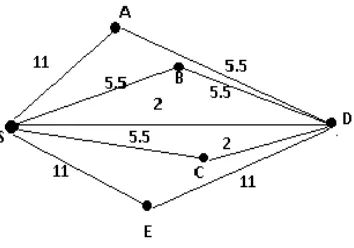
[image:6.612.350.527.309.433.2]Figure 5 shows an example scenario for ECC-MAC algorithm. Here, S is the source with a 2 Mbps data rate to the destination D. The source can get help from any of the possible relays A, B, C and E. Each possible relay has various first and second hop data rates as shown in Figure 5. For example, node A has first hop data rate of 11 Mbps from source and second hop data rate of 5.5 Mbps to destination. Each node has different residual energies. The residual energies in Joules for node S, A, B, C and E are 4,5,6,1.5 and 2 respectively.
Figure 5: Illustration of ECC-MAC strategy
When a source has data packet, it computes transmission decision factor δi of each
neighboring node. Source chooses node with lowest transmission factor as relay and embed address of relay node chosen in RTS packet.
The ECC-MAC algorithm can be thought of as applying a dual filter to the choice of relay by choosing a node on the basis of both the throughput improvement as well as energy constraints. It can easily be followed that the objective in equation (3) is also satisfied. In case of direct transmission, the source always transmits at the direct transmission rate which results in the same energy consumption irrespective of the residual energy.
In case of ECC-MAC, the source actively chooses the mode of transmission which is affected least due to relaying. Thus, if a particular node is low on residual energy, the source would look for a different option which results in lower effective loss of energy.
In this section, we evaluate the performance of ECC-MAC algorithm via numerical analysis of example scenario shown in Figure 5. Since the purpose of our scheme is to prolong the network lifetime and increasing the energy efficiency, the evaluation metrics in this paper are the total energy consumption, network lifetime and aggregated throughput. The transmitting power denotes the power consumed at transmit amplifier (without the power consumed at transmit circuitry).The total energy consumption is the summation of the transmitting (including both transmit amplifier and circuitry) and receiving energy cost at the source, destination and relay. The lifetime is defined as the duration from the network initialization to the time that the first terminal runs out of power.
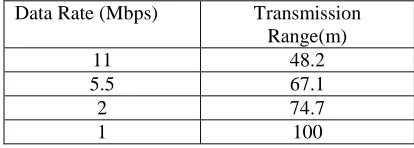
For the network setup, nodes are placed randomly in a square region of side 200 metres. Each node supports one of possible data rates: 11Mbps, 5Mbps,2 Mbps and 1Mbps. The transmission ranges for different bit rates are the same as those used in [14] as shown in Table I. We assume that all nodes start with identical battery capacities. The initial battery life in terms of energy can be varied from 5J to 60J. A fixed payload size (L) of 1024 bytes is considered. All stations operate
Table 1: Transmission Range for Different Data Rates
Data Rate (Mbps) Transmission Range(m)
11 48.2
5.5 67.1
2 74.7
1 100
under saturation conditions and always have a packet ready to send.
The simulation settings and parameters are listed in Table 2. RTS and CTS packets are transmitted with a rate of 1Mbps and data packets are transmitted with variable rate.
Table 2: Simulation Parameters
RTS 32 bytes
CTS 20 bytes
ACK 14 bytes
WTH 18 bytes
PHY header 192 bits MAC header 272 bits Packet Payload 1024 bytes
Unit time 0.1ms
Initial Energy 10 J
Noise power -60dBm
Transmitting Power 10dBm
Source S computes transmission decision factor δi for all possible relay nodes based on
residual energy and data rate supported by particular node. The transmission decision factor computed for the given scenario is given in Table 3.
Table 3: Numerical Results of ECC-MAC
Node Eres,i Qi Si δi
A 5 0.0042 0.537 0.0022 B 6 0.0044 0.728 0.00325 C 1.5 0.035 1.36 0.0481 E 2 0.0067 0.364 0.0024
S 4 0.0102 1 0.01024
The transmission decision factors computed for various nodes are shown in Figure 5. Here, node numbers 1,2,3,4 and 5 represents nodes A, B, C, E and S respectively.
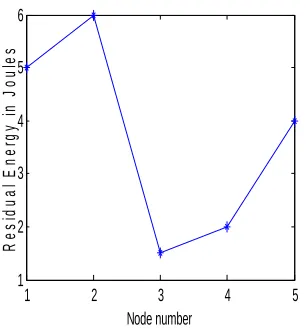
The residual energies of various nodes are shown in Figure 6. From the given results, it can be interpreted that node A is chosen as relay as it has lowest transmission decision factor all other nodes. Even node B has highest residual energy than A, since A has lowest transmission factor owing to its residual as well as data rate, node A is chosen as relay. If energy efficient schemes based on IEEE 802.11 are used, then node B will be selected as relay as it has high residual energy. However, throughput falls because of low data rate supported by B. Thus, even if network lifetime increases, throughput falls which is not a desired one.
1 1.5 2 2.5 3 3.5 4 4.5 5
0 0.005 0.01 0.015 0.02 0.025 0.03 0.035 0.04 0.045 0.05
Node number
T
ra
n
s
m
is
s
io
n
D
e
c
is
io
n
F
a
c
to
[image:7.612.97.304.449.523.2]r
67 The proposed ECC-MAC algorithm chooses node A as relay based on transmission decision factor which maximizes network lifetime
1 2 3 4 5
1 2 3 4 5 6
Node number
R
e
s
id
u
a
l
E
n
e
rg
y
i
n
J
o
u
le
[image:8.612.123.276.134.299.2]s
Figure 6: Residual Energy Vs Node Number
without sacrificing the throughput. Thus, the proposed algorithm optimizes tradeoff between network lifetime and throughput.
6. CONCLUSION
In this paper, we proposed the design of a energy constrained cooperative MAC protocol ECC-MAC protocol based on a cooperation framework which seeks to optimize the tradeoff between network throughput and network lifetime. An detailed analytical frame work is given for the computation of transmission decision factor based on which best possible relay is chosen. Our results show that ECC-MAC maximizes network lifetime without sacrificing the throughput. Thus, optimizes tradeoff between network lifetime and throughput.
As part of our future work, we will investigate our ECC-MAC for multirelay cooperation for larger scale network size and with high mobility. Also, we foresee a more suitable scenario for multi-relay cooperation in 802.11a/g networks which support a larger set of data rates than 802.11b.
REFERENCES:
[1] H. Zhu and G. Cao, “rDCF: A Relay-enabled Medium Access Control Protocol for Wireless Ad-Hoc Networks,” IEEE Trans Mobile Computing ,vol. 5, no. 9, pp. 1201-1214, Sep. 2006.
[2] P. Liu, Z. Tao, S. Narayanan, T Korakis and S S Panwar, “CoopMAC:A Cooperative MAC for Wireless LANs,”IEEE J. Selected Areas in Communications , vol.25, No.2, pp. 340-354, Feb. 2007.
[3] H. Shan, W. Zhuang and Z. Wang, “Distributed cooperative MAC for multihop wireless networks,” IEEE Comm. Magazine , vol. 47, no. 2, pp.126-133, Feb. 2009.
[4] M. Heusse, F. Rousseau, G. Berger-Sabbatel and A. Duda, “Performance anomaly of 802.11b,” in Proc. 22nd Annu. Joint Conf. of the IEEE Computer and Communications Soc.
(INFOCOM) , Mar. 2003, pp. 836-843. [5]
H.Shan,P.Wang,W.Zhuang,andZ.Wang,“Cross-layercooperative triple busy tone multiple access for wireless networks,” Proc. IEEE Globecom , pp.1-5, Dec. 2008.
[6] X. Wang, J. Li, and M. Guizani,“NCAC-MAC: Network Coding Aware Cooperateive Medium Access Control for Wireless Networks,”Proc. IEEE WCNC , pp. 1646-1651, Apr. 2012. [7] C. Zhai, J. Liu, L. Zheng, and H. Xu, “Lifetime
maximization via a new cooperative MAC protocol in wireless sensor networks,” Proc. IEEE Globecom , pp.1-6, Dec. 2009.
[8] J. Zhang, Q. Zhang, and W. Jia, “VC-MAC: A Cooperative MAC Protocol in Vehicular Networks,” IEEE Trans. Vehicular Tech. pp.1561-1571, Mar. 2009.
[9] S. Moh, and C. Yu, “A Cooperative Diversity-based Robust MAC Protocol in Wireless Ad Hoc Networks,” IEEE Trans. Parallel and Distributed Systems , vol.99, May. 2010. [10]H.Shan,H.Cheng,andW.Zhuang,“Cross-Layer
Cooperative MAC Protocol in Distributed Wireless Networks,” IEEE Trans. Wireless Commun. , vol.10, no.8, pp.2603-2615, Aug. 2011.
[11] A. K. Sadek, W. Yi, and K. J. R. Liu, “On the energy efficiency of cooperative communications in wireless sensor networks,” ACM Trans. Sensor Networks, vol. 6, no.1, Dec. 2009.
[12] T. Himsoon, W. P. Siriwongpairat, Z. Han, and K. J. R. Liu, “Life-time Maximization via Cooperative Nodes and Relay Deployment in WirelessNetworks,” IEEE J. Selected Areas in Commun. ,vol.25,pp.307-317, Feb. 2007. [13] Ahik Banerjee, C.H. Foh, C.K.Yeo and
Wireless Networks”, proc. Of IEEE CCNC, 2010.
[14] P. Liu, Z. Tao, S. Narayanan, T Korakis and S S Panwar, “CoopMAC:A Cooperative MAC for Wireless LANs,”IEEE J. Selected Areas in Communications , vol.25, No.2, pp. 340-354, Feb. 2007.
[15]http://www.scalable-networks.co/products/