ISSN Online: 2161-7198 ISSN Print: 2161-718X
DOI: 10.4236/ojs.2016.65075 October 24, 2016
Study of University Dropout Reason Based on
Survival Model
Juan C. Juajibioy
Fundación Universidad Autónoma de Colombia, Bogotá, Colombia
Abstract
In this paper, we introduce the survival modelling methodology in order to identify some factors which may be influencing the university dropout. By using the data base provided by the Fundación Universidad Autónoma de Colombia and the semi parametric proportional hazard Cox model, we have been able to identify these risk factors.
Keywords
Dropout, Survival Models
1. Introduction
According to SPADIES1 in Colombian Institutions Higher Education, around 20% of students beginning an undergraduate program drop out at first year. That is a global phenomenon: usually the group of graduates is smaller respect to the number of begin-ners. That is due to variables of academic, social or economic type and several studies have been realized about it. From this global phenomenon arose two big questions:
• What are the factors influencing the student drop out? • How long take a student to drop out university?
The most literature about the first question is divided in two branches: Tinto’s stu-dent integration model and Bean and Metzner’s stustu-dent attrition model (1985). The first one refers to the student’s integration process and the second one refers to the student’s individual variables, see [1] [2] and references therein for a detailed descrip-tion.
Respect to the second question, the survival models have been amply developed, and typically focused on time to event data.
1Sistema para Prevención de la Deserción de la Educación Superior
How to cite this paper: Juajibioy, J.C. (2016) Study of University Dropout Reason Based on Survival Model. Open Journal of Statis-tics, 6, 908-916.
http://dx.doi.org/10.4236/ojs.2016.65075
Received: July 28, 2016 Accepted: October 21, 2016 Published: October 24, 2016
Copyright © 2016 by author and Scientific Research Publishing Inc. This work is licensed under the Creative Commons Attribution International License (CC BY 4.0).
2. Discrete Duration Analysis
Following [3] [4] we introduce the necessary background. Let T be the discrete variable representing the duration of studies (by semester from 1 until 12). The survival func-tion is defined as
( )
(
)
.S t =P T>t
(1)
Since p t
( )
k =P T(
=tk)
we have( )
(
)
( )
.k
t t
S t P T t p t
>
= > =
∑
(2)The Hazard function is defined as
( )
(
1)
( )
( )
1
| k .
k k k
k
p t h t P T t T t
S t
−
−
= = > = (3)
Notice that P T
(
≥tk)
=S t( )
k−1 , since p t( )
k =S t( ) ( )
k−1 −S tk , by using (3) we have( )
( )
1( )
1 , k k k S t h t
S t − = − (4)
so, the survival function can be written as
( )
(
1( )
)
k
t t
S t h t
≤
=
∏
− (5)2.1. The Nonparametric Kaplan-Meyer Estimator
Let ti the failure time, di the number of events that occur at time ti and ni the
number of individuals at risk of experiencing the event immediately prior to tj, then the product limit estimator of survival function is
( )
ˆ .
j
j j
t t j
n d S t n < − =
∏
(6)An interesting representation is given in [3] by using the following table
j
t nj mj S tˆ
( )
j0 0
t = n0 0 1
k
t nk mk S tˆ( )k where n0 is the initial population.
2.2. The Nonparametric Cox’s Proportional Hazard Model
The Cox’s proportional hazard model really gives a semi parametric method to the es-timate the hazard function at time t given a baseline hazard that’s modified by a set of covariates:
(
|)
0( )
exp(
1 1 n n)
0( )
exp(
)
where h t0
( )
is the non-parametric baseline hazard function X =(
X1,,Xn)
is a setof explanatory variables
3. Data and Descriptive Analysis
In this section we defined the principal explanatory variables and consider some de-scriptive aspects of these variables. We take a set that belong a cohort of students that began the studies in the first semester of 2010 in the University Fundación Universidad Autónoma de Colombia. In order to differentiate the group of students, we consider the following groups
• Group 1, Graduated Students: Student which finished successful their studies before
12 semesters.
• Group 2, Active students: In the dataset in second semester of 2015.
• Group 3, Inactive Students: Students who did not register for more than three con-secutive semesters in the dataset.
In our analysis the following covariates were collected, grouped by individuals and academics. We consider the following individual variables
Variables Individuals Gender Age Social status Location
0 for female and 1 for male.
Age of the student when beginning his studies. In Colombia there are six class of social status. Location of student’s home.
academics
P1 P2 P3 Picfes
Grade point average at first semester. Grade point average at second semester. Grade point average at second semester. Score in icfes tests.
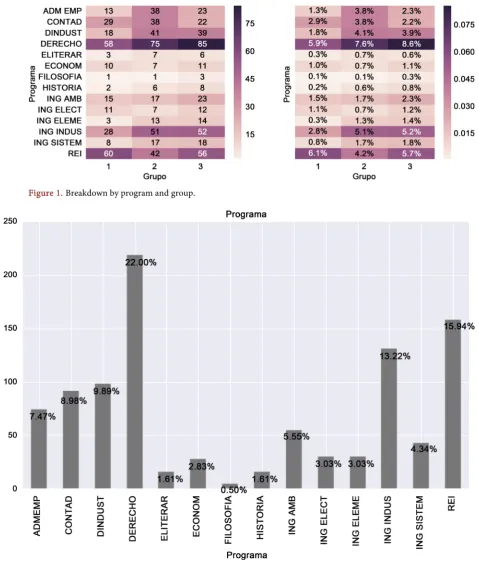
A breakdown by program and group is given in Figure 1. And in Figure 2, we show the percent of students by program.
In Figure 2 we present the percent of students that began their studies at first seme-ster of 2010.
4. Duration Analysis
[image:4.595.77.557.127.690.2]In this section we looking for the relationship between the student’s decision to com-plete or abandon, opposite to the decision of prolong their permanence at university.
Figure 1. Breakdown by program and group.
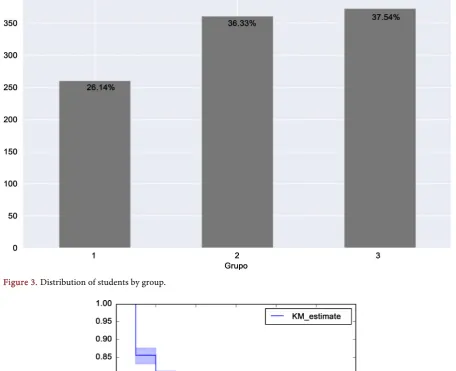
Figure 3. Distribution of students by group.
Figure 4. Kaplan Meier estimate for Survival function.
Initially we used the nonparametric Kaplan-Meier estimator 2.6, the results are given in Table 1 (See Appendix)
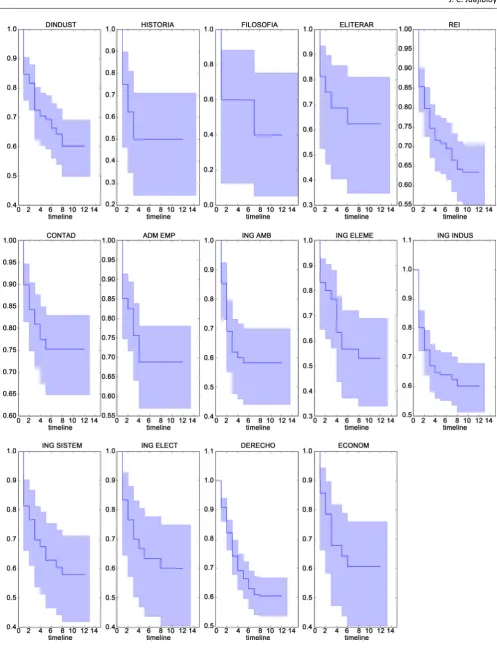
In Figure 4 it can see that the bigger drooping out rate occurs during the four initial semesters. In Figure 5 it is possible see the dynamics of survival in all programs that university offers
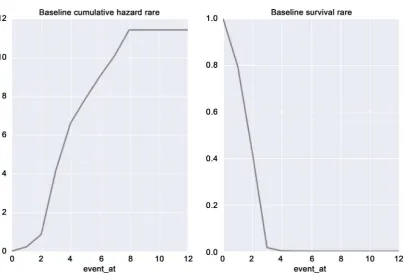
Figure 6. Baseline cumulative hazard and survival rate.
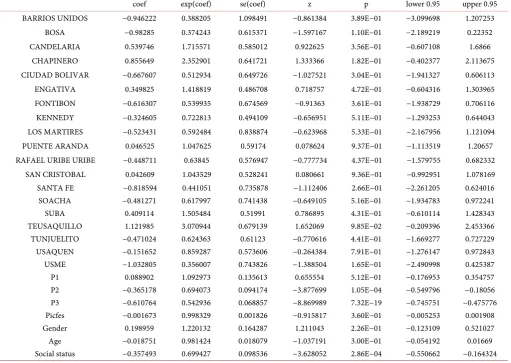
results can see in Table 2 (See Appendix)
The baseline cumulative hazard H t
( )
=∑
tj<th t0( )
it can see in Figure 6, notice in the left side the rapidly increasing rate, meaning that the hazard increase during the four first semesters.5. Conclusion
In this work, we use the nonparametric survival model in order to estimate the risk factors for the university drop out, factors such that grade point average at first seme-ster, gender and location are most significant in our study, remember that a positive es-timate in the coefficient indicates an increased hazard meaning shorter expected sur-vival time. By gender, the male population has more hazards to sursur-vival than female population. Finally after accounting for age, sex, grade point average and location there are no statistically significant associations between Icfes score and Social status and all- cause drop out.
Acknowledgements
This research was supported by SUI: Sistema Universitario de Investigación, Fundación Universidad Autónoma de Colombia.
Conflict of Interest
References
[1] Montoya Diaz, M. (1999) Extended Stay at University: An Application of Multinomial Logit and Duration Models. Applied Economics, 31, 1411-1422.
http://dx.doi.org/10.1080/000368499323292
[2] Giovagnoli, P. (2005) Determinants in University Desertion and Graduation: An Applica-tion Using DuraApplica-tion Models. Ecónomica LI, No. 1, 60-90.
[3] Kleinbaum, D. and Klein, M. (2005) Survival Analysis: A Self-Learning Text. Springer. [4] Pintilie, M. (2006) Competing Risks: A Practical Perspective. Wiley.
Appendix
Table 1. KM Estima for survival function.
j
t S tˆ
( )
j0 1.000000
1 0.855701
2 0.788093
3 0.722503
4 0.686176
5 0.667850
6 0.653172
7 0.637957
8 0.622397
9 0.621255
10 0.621255
11 0.621255
12 0.621255
Table 2. Hazard ratios.
coef exp(coef) se(coef) z p lower 0.95 upper 0.95
BARRIOS UNIDOS −0.946222 0.388205 1.098491 −0.861384 3.89E−01 −3.099698 1.207253
BOSA −0.98285 0.374243 0.615371 −1.597167 1.10E−01 −2.189219 0.22352
CANDELARIA 0.539746 1.715571 0.585012 0.922625 3.56E−01 −0.607108 1.6866
CHAPINERO 0.855649 2.352901 0.641721 1.333366 1.82E−01 −0.402377 2.113675
CIUDAD BOLIVAR −0.667607 0.512934 0.649726 −1.027521 3.04E−01 −1.941327 0.606113
ENGATIVA 0.349825 1.418819 0.486708 0.718757 4.72E−01 −0.604316 1.303965
FONTIBON −0.616307 0.539935 0.674569 −0.91363 3.61E−01 −1.938729 0.706116
KENNEDY −0.324605 0.722813 0.494109 −0.656951 5.11E−01 −1.293253 0.644043
LOS MARTIRES −0.523431 0.592484 0.838874 −0.623968 5.33E−01 −2.167956 1.121094
PUENTE ARANDA 0.046525 1.047625 0.59174 0.078624 9.37E−01 −1.113519 1.20657
RAFAEL URIBE URIBE −0.448711 0.63845 0.576947 −0.777734 4.37E−01 −1.579755 0.682332
SAN CRISTOBAL 0.042609 1.043529 0.528241 0.080661 9.36E−01 −0.992951 1.078169
SANTA FE −0.818594 0.441051 0.735878 −1.112406 2.66E−01 −2.261205 0.624016
SOACHA −0.481271 0.617997 0.741438 −0.649105 5.16E−01 −1.934783 0.972241
SUBA 0.409114 1.505484 0.51991 0.786895 4.31E−01 −0.610114 1.428343
TEUSAQUILLO 1.121985 3.070944 0.679139 1.652069 9.85E−02 −0.209396 2.453366
TUNJUELITO −0.471024 0.624363 0.61123 −0.770616 4.41E−01 −1.669277 0.727229
USAQUEN −0.151652 0.859287 0.573606 −0.264384 7.91E−01 −1.276147 0.972843
USME −1.032805 0.356007 0.743826 −1.388504 1.65E−01 −2.490998 0.425387
P1 0.088902 1.092973 0.135613 0.655554 5.12E−01 −0.176953 0.354757
P2 −0.365178 0.694073 0.094174 −3.877699 1.05E−04 −0.549796 −0.18056
P3 −0.610764 0.542936 0.068857 −8.869989 7.32E−19 −0.745751 −0.475776
Picfes −0.001673 0.998329 0.001826 −0.915817 3.60E−01 −0.005253 0.001908
Gender 0.198959 1.220132 0.164287 1.211043 2.26E−01 −0.123109 0.521027
Age −0.018751 0.981424 0.018079 −1.037191 3.00E−01 −0.054192 0.01669
[image:9.595.44.556.346.709.2]