Volume 78 – No.2, September 2013
Effect of Lewis Number on Double-diffusive Natural
Convection in a Triangular Cavity
Kazi Anowar Hussain
1, Md. Arifur Rahman Mazumder
2, Rifat Jahan
3and Sharmin Akter
41,2
Department of Mathematics, World University of Bangladesh, Dhanmondi, Dhaka-1205, Bangladesh
3
Department of Mathematics, Siddheswari university college Dhaka- 1217, Bangladesh
4
Department of Computer Science & Engineering, World University of Bangladesh, Dhanmondi, Dhaka-1205, Bangladesh
ABSTRACT
This paper concerned with the numerical study of thermal and mass diffusive natural convection flow inside a triangular shape solar collector using finite element method for the governing equations expressing the velocity pressure formulation along with the energy and concentration balance equations. In the solution procedure, the isothermal and iso-concentration boundary conditions are assumed at the absorber and covers of collector. Local and mean heat and mass transfer rates for the thermal Rayleigh number and Lewis number are presented. Streamlines, isotherms and iso-concentration are also presented for the aforesaid parameters. The result found in this study fully agreed with the previous published work. But this result will be profitable for the design of the collector.
Keywords
Solar collector; natural convection; finite element method; absorber.
1.
INTRODUCTION
Finite element method techniques are widely used in problems of consisting of complex geometry and partial differential equations. In this method of analysis, the considered domain is discretized into simple geometric shapes called finite elements. The materials property and the governing relationships are considered over these elements and expressed in terms of unknown values at element corner. An assembly process duly considering the loading and constraints, results in a set of equations. Solution of these equations gives us the approximate behavior of the continuum. Thompson [1] discusses solution of partial differential equations involved in areas such as Fluid Mechanics, Elasticity and Electromagnetic Field by using FEM. Details about fluid mechanics and heat transfer problems and their solution can be found in [2]. A more complex transient heat conduction equation is discussed in Winget and Hughes [3].
Natural convection flow and heat transfer in different geometrical enclosures such as triangular, square, rectangular and trapezoidal enclosures etc. which are the main piece of solar energy system, have been the topic of many research engineering studies. These studies consist of various technological applications such as solar collectors, building heating and ventilation, cooling electronically devices [4-6]. Double-diffusive natural convection occurs within the solar
collector, owing to the collective thermal and mass diffusion buoyancy effects as well as the temperature difference between cover and absorber. Nowadays, the study of solar collectors is one of the most significant works to progress their performance with a competitive price [7]. Numerical solution has the advantage over an experimental investigation in that the important parameters, such as geometrical dimensions, glass thickness and covenant location may be simply changed. Therefore, its persuading on the overall heat and mass transfer can be studied at a low price. Numerical investigation is also helpful in testing the performance of solar collectors for different components.
Several experiments and theoretical investigations have been undertaken in this region. Boukar and Harmim [8] experimentally investigated design parameters of an indirect vertical solar still. Omri et al. [9] examined the thermal exchange by natural convection and effect of buoyancy force on flow structure. The authors provided useful information on the flow structure sensitivity to the governing parameters, the Rayleigh number and the tilt angle on the thermal exchange. Omri [10] numerically studied the flow characteristics inside an asymmetrical triangular still for the configuration optimization. Gao et al. [11] performed a study on natural convection inside the wavy and inclined solar collectors, but they did not consider flow behavior and thermal fields. A numerical experiment is performed for inclined solar collectors by Varol and Oztop [12].
Volume 78 – No.2, September 2013
18
Nomenclature
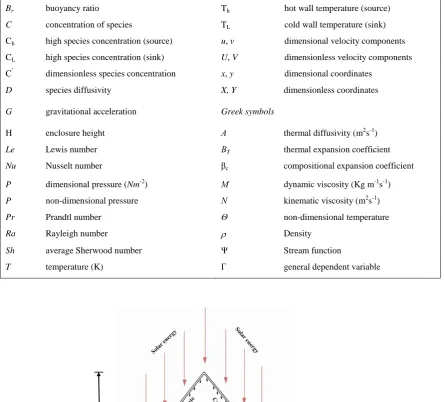
Br buoyancy ratio Th hot wall temperature (source)
C concentration of species TL cold wall temperature (sink)
Ch high species concentration (source) u, v dimensional velocity components CL high species concentration (sink) U, V dimensionless velocity components C’ dimensionless species concentration x, y dimensional coordinates
D species diffusivity X, Y dimensionless coordinates
G gravitational acceleration Greek symbols
H enclosure height Α thermal diffusivity (m2s-1)
Le Lewis number ΒT thermal expansion coefficient
Nu Nusselt number βc compositional expansion coefficient
P dimensional pressure (Nm-2) Μ dynamic viscosity (Kg m-1s-1)
P non-dimensional pressure Ν kinematic viscosity (m2s-1)
Pr Prandtl number Θ non-dimensional temperature
Ra Rayleigh number Density
Sh average Sherwood number Ψ Stream function
T temperature (K) Γ general dependent variable
2.
PROBLEM STATEMENT
2.1
Physical description
The physical phenomenon of the considered domain is shown below. A triangular shaped solar collector is considered here. The enclosed space consists mostly of an absorber plate and two inclined glass covers that form a cavity. The absorber plate is represented by a horizontal bottom wall kept to a constant temperature Th while the inclined walls are considered transparent and maintained at a constant temperature TL with Th > TL.
2.2
Mathematical formulation
The governing equations for the problem under consideration are based on the balance laws of mass, momentum and
thermal energy in two dimensions. Following the previous assumptions, these equations can be written in non-dimensional form as:
0
Y V X
U
(1)
2 2 2 2 P r
Y U X
U X
P Y U V X U
U (2)
) P r(
P r 2
2 2 2
BrC Ra
Y V X
V Y P Y V V X V
U T
(3)
2 2 2 2
Y X
Y V X U
(4)
2 2 2 2 1
Y C
X C Le Y C V X C U
(5)
Fig. 1. Schematic diagram for the problem
[image:2.595.77.523.86.488.2]Volume 78 – No.2, September 2013 where the dimensionless variables are introduced as:
L h L L h L c c c c C T T T T H y Y H x X
, ,U=uH,V=vH,P=(p+ gy)H , , 2 2
(6)
The variables have their usual sense in fluid mechanics and heat transfer as listed in the nomenclature. It can be seen from the Eqs. (2) - (5), five parameters that preside over this problem are the Prandtl number (Pr), the thermal Rayleigh number (RaT), Lewis number (Le) and buoyancy ratio (Br), which are defined respectively as
) ( ) ( , , ) ( , P r 3 L h T L h c L h T T T T c c Br D Le H T T g Ra
(7)
The dimensionless boundary conditions corresponding to the considered problem are as follows
on the bottom wall: U V0,C1 on the inclined walls: UV0,C0
The local heat and mass transfer rates on the surface of heat and contaminant sources are defined respectively as
0 ) ( Y Y
Nu and x( )Y0
Y c Sh
The average heat and mass transfer rates on the surface of heat and contaminant sources can be evaluated by the average Nusselt and Sherwood numbers, which are defined respectively as d X Y Nu
1 0 (8)
and dX Y c Sh
1 0 (9)The stream function is calculated from
X V Y U
, (10)
3.
NUMERICAL SOLUTION
3.1
Solution procedure
The Gelarkin weighted residual technique of finite element method is used in this task. In the finite element method, the region of interest can be discretized using different types of element shapes and sizes, called elements. The dependent variables are then approximate over these elements. In this study, the triangular element is considered. Using FEM, the governing Eqs (2-5) are transferred into a set of algebraic equations. The system of algebraic equations is solved using iterative method. The iterative process is continuing until the
following convergence condition is satisfied:
1 10 6
i i
where i is the number of iteration and Γ is the general dependent variable.
3.2
Grid refinement checks and code
validation
In FEM solution procedure, the accuracy of the numerical result can be enhanced by using either higher order elements or increasing the number of elements. The number of elements is increased to get the desired accuracy as well as to get the grid independent solution of this study. A trial calculation is made using various non-uniform grids of triangular elements: 1486, 3396, 4590 and 5112 in order to obtain the desired grid independent solutions. The calculation of average Nusselt number and Sherwood numbers are carried
out using RaT = 6
10
, Pr = 0.71 and Br = 10.0 for these fivenon-uniform grid. Finally, the grid size of about 3396 elements was chosen through this study for the balance between the calculation accuracy and the speed. The study is compared with an earlier work performed by Kent et al. [20] and found a good agreement which ensure the code validation of this analysis. The comparison result is shown in fig-2.
4.
RESULTS AND DISCUSSION
A computational analysis has been performed to investigate the effects of Lewis number on natural convection inside an isosceles triangular solar collector using Gelarkin weighted residual finite element technique. Air was used inside the cavity as a working fluid with Pr = 0.71.The effective
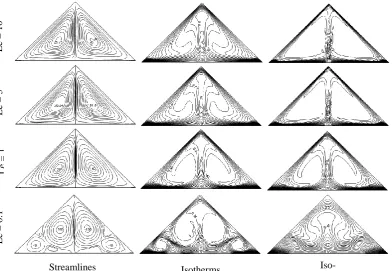
parameters are buoyancy ratio, Rayleigh number, Lewis number etc. The buoyancy ratio and Rayleigh number were considered fixed at Br=10 and Ra = 106 throughout this analysis.Fig-3 demonstrates the effect of Lewis number on streamline, isotherm and iso-concentration. As seen from the figures, symmetric flow distribution is observed inside the cavity according to the middle axis of the triangle. In the case
Fig-2. Comparison of the (a) present model with (b) the results of Kent [20] for natural convection inside a isosceles triangular enclosure for five different base angles.
Volume 78 – No.2, September 2013
[image:4.595.90.483.178.449.2]20
Fig. 3. Effect of Lewis number on streamlines, isotherms and iso-concentration, while Ra = 105
L
e
=
0
.1
L
e
=
1
0
L
e
=
5
L
e
=
1
Isotherms
Streamlines
Iso-concentration
of stream lines for low Lewis number, the number of circular cell trends to increase. But due to the increase of Lewis number from 1.0 to 10.0, there are only two circular cells inside enclosure and the strength of flow increases. The left cell rotates counterclockwise while the right cell rotates clockwise. In the case of temperature distribution, convective distortion of the isotherms occurs throughout the cavity due to the strong influence of the convective current in the cavity. It is evident that flow of the temperature increases with increase
of Lewis number. A similar distribution of iso-concentration exhibits with increase of Lewis number.
Fig-4 illustrates the average heat transfer rate with the increase of Lewis and Rayleigh number. Average heat transfer increases from 0.1 to 1.0 and shows decreasing trends from 1.0 to 10 with increase of Lewis and Rayleigh number. But in the case of average mass transfer, it exhibits speedily increases with increase of Lewis and Rayleigh number which shows in fig-5.
5.
CONCLUSIONS
This numerical study concerned with the fluid flow, heat transfer and mass transfer inside triangular shaped solar collectors. The results are obtained for different values of Lewis and Rayleigh numbers. It is observed that mass transfer increases with increase of Lewis and Rayleigh numbers and formed symmetric flow field, temperature distribution and
mass distribution according to the middle axis of the triangular cavity. But the heat transfer at first increases and then decreases with the increases of Lewis and Rayleigh numbers and formed symmetric flow field, temperature distribution and mass distribution according to the middle axis of the triangular cavity.
[image:4.595.103.475.485.626.2]Volume 78 – No.2, September 2013
6.
REFERENCES
[1] Thompson, Erik G., Introduction to the Finite Element Method: Theory Programming and Applications, John Wiley & Sons Inc, 2004
[2] Bejan A, Convection Heat transfer, John Wiley and Sons Inc, 1984
[3] Winget J. M, Hughes T.J.R., Solution algorithms for nonlinear transient heat conduction analysis employing element by-element iterative strategies, Computer Methods in Applied Mechanics and Engineering, 1985; 52:711–815.
[4] B. Gebhart, Y. Jaluria, R.L. Mahajan, B. Sammakia, Buoyancy induced Flows and Transport, Hemisphere, Washington, DC, 1988.
[5] G. De Vahl Davis, I.P. Jones, Natural convection of air in a square cavity: a comparison exercise, Int. J. Numer. Methods Fluids 3 (1983) 227–248.
[6] S. Ostrach, Natural convection in enclosures, J. Heat Transfer 110 (1988) 1175–1190.
[7] M. M. Rahman et al, Double-diffusive natural convection in a triangular solar collector, International Communications in Heat and Mass Transfer 39 (2012) 264–269
[8] M. Boukar, A. Harmim, Design parameters and preliminary experimental investigation of an indirect vertical solar still, Desalination 203 (2007) 444–454. [9] A. Omri, J. Orfi, S.B. Nasrallah, Natural convection
effects in solar stills, Desalination 183 (2005) 173–178. [10] A. Omri, Numerical investigation on optimization of a
solar distiller dimensions, Desalination 206 (2007) 373– 379.
[11] W. Gao, W. Lin, E. Lu, Numerical study on natural convection inside the channel between the flat-plate cover and sin-wave absorber of a cross-corrugated solar air heater, Energy Conversion Management 41 (2000) 145–151.
[12] Y. Varol, H.F. Oztop, Buoyancy induced heat transfer and fluid flow inside a tilled wavy solar collector, Building and Environment 42 (2007) 2062–2071. [13] G.N. Tiwari, A. Kupfermann, S. Agrawal, A new design
of double condensing chamber solar still, Desalination 114 (1997) 153–164.
[14] J.P. Coffey, Vertical solar distillation, Solar Energy 17 (1975) 375–378.
[15] S. Suneja, G.N. Tiwari, Optimization of number of effects for higher yields from an inverted absorber solar still using the Runge–Kutta method, Desalination 120 (1999) 197–209.
[16] H. Tanaka, T. Nosoko, T. Nagata, Parametric investigation of a basin type multiple effect coupled solar still, Desalination 130 (2000) 295–304.
[17] Y. Varol, A. Koca, H.F. Oztop, Natural convection in a
triangle enclosure with flush mounted heater on the wall, International Communications in Heat and Mass Transfer 33 (2006) 951–958.
[18] Y. Varol, H.F. Oztop, I. Pop, Entropy generation due to natural convection in non-uniformly heated porous isosceles triangular enclosures at different positions, International Journal of Heat and Mass Transfer 52 (2009) 1193–1205.
[19] Y. Varol, H.F. Oztop, I. Pop, Influence of inclination angle on buoyancy-driven convection in triangular enclosure filled with a fluid-saturated porous medium, Heat Mass Transfer, 44, Springer, 2008, pp. 617–624. [20] E.F. Kent, Numerical analysis of laminar natural
convection in isosceles triangular enclosures for cold base and hot inclined walls, Mechanics Research Communications 36 (2009) 497–508.
7.
AUTHORS PROFILE
Kazi Anowar Hussain obtained his M.Sc degree in Mathematics from Jahangir Nagar University (JU), Savar, Dhaka, Bangladesh in 2008. Currently he is doing M.Phil in Mathematics in Bangladesh University of Engineering & Technology (BUET), Dhaka, Bangladesh. He is currently appointed as a full-time faculty member of the Mathematics department at World University of Bangladesh. His research interest is mainly focused on Fluid dynamics, Operation management, Classical Mechanics & Partial differential equation. At present he is working with an Operational management project.
Md. Arifur Rahman Mazumderobtained his M.Sc degree in Mathematics from University of Chittagong, Bangladesh in 2007. He is currently appointed as a full-time faculty member of the Mathematics department at World University of Bangladesh. His research interest is mainly focused on Fluid dynamics, Operation management, Classical Mechanics. At present he is working with an Operational management project.
Rifat Jahan obtained her M.Sc degree in Mathematics from Jahangir Nagar University (JU), Savar, Dhaka, Bangladesh in 2008. She is currently appointed as a full-time faculty member of the Mathematics department at Siddheswari University College, Bangladesh. Her research interest is mainly focused on Fluid dynamics, Operation management, Classical Mechanics & Partial differential equation. At present she is working with an Operational management project.