2018 3rd International Conference on Information Technology and Industrial Automation (ICITIA 2018) ISBN: 978-1-60595-607-7
Research on LAK Algorithm for Short Text
Topic Detection
Aijun Li and Tong Chang
ABSTRACT
In the process of topic detection for short text, the accuracy of topic detection is affected because of the limited length of short text, sparse features and lack of semantics. In this paper, we propose a LAK algorithm for short text topic detection. In the algorithm, the probability distribution of topic-words is obtained by the Latent Dirichlet Allocation model. Moreover, LAK algorithm which combining AGNES (Agglomerative Nesting) and K-means algorithm is chose to cluster the data, in order to compensate for the subjective randomness of means algorithm for K-value selection and the ignorance of semantics when calculating feature weights with TF-IDF. The effectiveness of LAK algorithm in topic detection is proved by experiments.1
INTRODUCTION
The emergence of new Internet media has promoted the development of self-Media social platforms, such as WeChat, weibo, BBS, etc. These platforms generate massive amounts of data every day, which are short, freely written, sparsely featured, large in volume, but few useful. Through the topic detection of large amounts of short text data, it tries to lay a foundation for further hot topics discovering, and network public opinion analysis.
At present, the clustering methods used in the topic detection research include KNN algorithm, K-means algorithm, and single channel algorithm and so on. KNN algorithm is an inert algorithm that does not require training model. It only needs to find the nearest k neighbors. The key of the k-means algorithm is also very simple, which is to set the value of K artificially, but this has certain subjective randomness.
1
The clustering effectiveness of the two above methods depends on the selection of K value. Single-channel algorithm is an incremental clustering algorithm, which is sensitive to the order of data input. In subsequent studies, Xie Jing[1], Li Lei[2] and Sun Shengping[3] and others improved the above methods. Then Yin J et al. proposed a new clustering topic detection method, which divided the topic detection into two stages: local topic phase and global topic phase, and used the global topic model to perform topic mining and then form a theme library [4]. Chen Z et al. improved the calculation method of topic similarity, and the experiment showed that this method had a good effect when the data set was small, but poor effect on the large data set [5].
In the original study, TF-IDF was used to calculate word weight values in text, but this method only considered the frequency of words that appeared in the document, ignoring the semantic relationship between words. Therefore, in this paper, LDA topic model is used for text feature extraction, combining AGNES clustering algorithm and K-means algorithm for topic clustering, which effectively solves the problem of neglecting semantic information and subjective randomness of K value selection in text mining, and improves the accuracy of topic detection.
RELATED WORKS
Latent Dirichlet Allocation Model
In this paper, the LDA (Latent Dirichlet Allocation) model is used instead of VSM to extract text features, which avoids the feature sparse problem. LDA model is an unsupervised three-tier Bayesian model, which distributes the topic and the feature words in each document in the form of probability distribution. It does not need to divide the training set, but only requires to give the number of document sets and topics.It can be represented by such a chain relationship (1).
P(word|document)= P(word|topic) P(topic|document) (1)
The probability that a word will appear in a document is the product of the probability of a word appears in a topic and the probability that a topic appears in a document.
K-Means Algorithm
Given a sample set D=x1, x2, ⋯, xm, K-means algorithm divides the sample set into clusters C=C1, C2, ⋯, Ck, This algorithm can minimize the squared error.
E=∑𝑖=1𝑘 ∑𝑥∈𝐶𝑖‖𝑥 − 𝜇𝑖‖22 (2)
Here, 𝜇𝑖=|𝐶1
smaller the E value is, the more similar the samples are within the cluster.
However, it is not easy to obtain such a minimized solution, so the k-means algorithm is approximated by a greedy algorithm.
The steps is as follows:
a. According to the pre-selected k-values, K initial values in the original samples are randomly selected as K initial clustering centers.
b. For all points 1, 2 and m, calculate the distance between each point and the k centers.
c. Each point can get k distances, select the nearest distance, and classify this point into the category.
d. Recalculate the centroid of each cluster and then update the centers of these k clusters.
e. Determine whether the iteration condition is met. If the condition is not met, repeat the above steps.
Agnes Clustering Algorithm
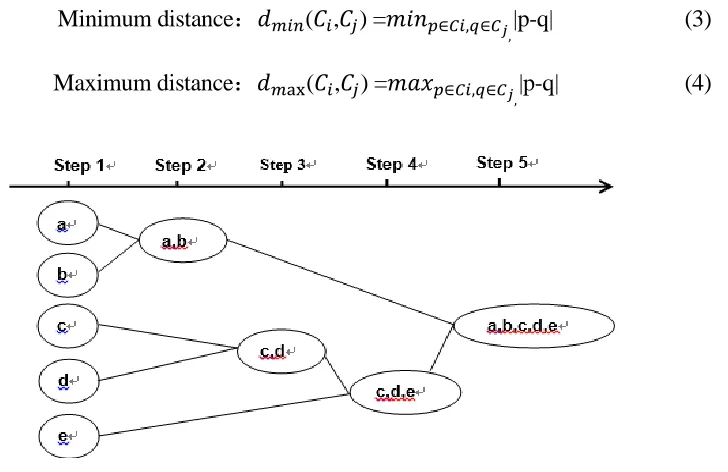
AGNES clustering algorithm is a hierarchical clustering algorithm that treats each object as a cluster and then merges them step by step according to some bottom-up criteria. As shown in Figure 1. There are many different ways of calculating the similarity between two clusters. Iterate the merge process until all objects are finally clustered into one class. The key of the algorithm is to calculate the distance between clusters and define clusters. The cluster 𝐶𝑖and 𝐶j are defined. The distance between the two clusters can be obtained by the following formula:
Minimum distance:𝑑𝑚𝑖𝑛(𝐶𝑖,𝐶𝑗) =𝑚𝑖𝑛𝑝∈𝐶𝑖,𝑞∈𝐶
𝑗,|p-q| (3)
Maximum distance:𝑑𝑚ax(𝐶𝑖,𝐶𝑗) =𝑚𝑎𝑥𝑝∈𝐶𝑖,𝑞∈𝐶
[image:3.612.139.503.426.662.2]𝑗,|p-q| (4)
The AGNES clustering algorithm is not sensitive to noise points. It has a good processing effect for clusters of any shape. It obtains the entire clustering process at one time. The whole process is to establish a tree structure, but the process is irreversible, and the merge that has been done cannot be withdrawn. Objects cannot be exchanged between classes and are not applicable to large data sets. K-means algorithm is sensitive to noise points, and it is difficult to converge for data sets which are not convex sets. It also needs to determine K values and initial clustering centers by oneself. However, its time complexity is low. Therefore, this paper combines the two algorithms into LAK algorithm to compensate for each other’s weakness and proves the accuracy of the LAK algorithm comparing with the AGNES and K-means algorithms in the topic detection.
LAK CLUSTERINGALGORITHM
Basic Thought
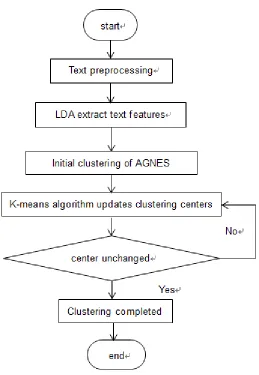
Short text topic detection aims to discover new topics in the media information flow. To accomplish this task, it is necessary to solve the problem of clustering strategy formulation. Clustering [6] clusters similar objects together by a specific strategy. In this paper, the LAK algorithm is used to cluster the texts that have been preprocessed and vectorized. Then K-means algorithm is used to cluster, if the new clustering center is the same as the initial clustering center, the clustering center will remain unchanged; if it is different from the initial clustering center, then we update the clustering center, and the LAK algorithm detects the topic detection process as shown in Figure 2.
Processing Flow
DATA PREPARATION
The data used in this experiment came from the Sina Weibo platform, and was collected by the Octopus Collector. Collected 10991 original microblogs about the topic"Shanxi tourism" before June 30, 2018.After manual screening, the symbols such as //, @ and URL address in the text and the text length of the blog was less than 5 were removed. Finally, there are 9648 left.
Figure 2. Flow chart of LAK clustering algorithm.
FEATUREEXTRACTIONANDSIMILARITYMEASUREOFTEXT
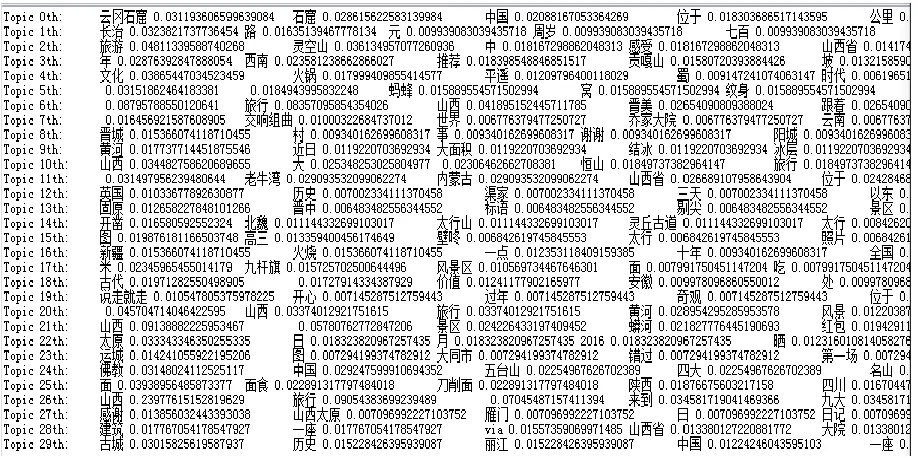
In the process of clustering, the similarity of texts is judged. LDA topic model is used to extract topic features. The topic of each document is given in the form of probability distribution. By analyzing the topic distribution of the document, topic clustering can be carried out. Figure 4 is the distribution of topics and vocabulary in some documents.
After the above process, the word vector space of the text is mapped to the topic vector space of the text, as the input of text similarity calculation. The similarity between the two texts is calculated by computing the corresponding probability distribution of the topic. Because the topic is a mixed distribution of word vectors, the JS (Jensen-Shannon) distance is used as a similarity calculation method.
𝐷js(𝑝, 𝑞)=12[𝐷𝐾𝐿(𝑝,𝑝+𝑞2 ) + 𝐷𝐾𝐿(𝑞,𝑝+𝑞2 ) (5)
𝐷KL(𝑝, 𝑞)=∑𝑇𝑗=1𝑝𝑗ln𝑝𝑝𝑖
𝑗 (6)
[image:6.612.99.558.383.612.2]The range of JS distance is [0, 1]. As the value getting close to 0, the similarity the sample increase.
EXPERIMENTALRESULTSANDEVALUATION
Evaluation Indicator
In this paper, we use three commonly used evaluation indicators: precision, recall and F value to evaluate the results of topic discovery.
a. precision: P=𝑛𝑛𝑖𝑗
𝑗 (7)
b.recall:R=𝑛𝑛𝑖𝑗
𝑖 (8)
c.F value:F=2∗P∗R 𝑃+𝑅 (9)
n𝑗 represents the total number of individuals j identified in the experiment; 𝑛𝑖 represents the total number of individuals present in the test set; 𝑛𝑖𝑗 represents the
total number of individuals correctly identified.
Analysis of Results
This paper use AGNES clustering algorithm, traditional K-means algorithm, the method of vector space model based on TF-IDF and improved LAK algorithm to test the performance of the improved algorithm. The experimental results are shown in Table 1.
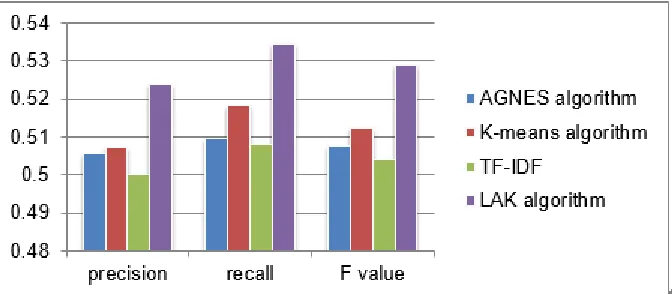
[image:7.612.92.501.616.680.2]The performance comparison of the topic detection algorithm is shown in Figure 6. As can be seen from Figure 6, the LAK algorithm proposed in this paper is better than the AGNES clustering algorithm, tradition K-means algorithm and the method of vector space model based on TF-IDF in the short text topic detection. The LAK algorithm compensates for the inapplicability of AGNES clustering algorithm to large data sets and the sensitivity of K-means algorithm to the selection of initial clustering centers. By using this method, stable initial clustering centers can be obtained. Compared with the method of vector space model based on TF-IDF, it is proved that the intrinsic semantic relationship of text is considered can improve the accuracy of text clustering in topic detection., and the experiments above verify the effectiveness of the proposed LAK algorithm in improving the performance of topic detection.
TABLE I.COMPARISONOFFOURALGORITHM RUNNING RESULTS.
algorithm Precision Recall F value
AGNES algorithm 0.5056 0.5098 0.5077
K-means algorithm 0.5071 0.5182 0.5125
The method of vector space model based on TF-IDF 0.5003 0.5079 0.5041
Figure 5. Comparison of four algorithm running results.
CONCLUSIONS
In this paper, we preprocess the microblog text firstly, use the LDA model to extract the topic-vocabulary distribution, and then use the LAK algorithm proposed in this paper to cluster the text to find the topic. It makes up for the shortcomings of AGNES clustering algorithm, traditional K-means algorithm and the method of vector space model based on TF-IDF, and improves the accuracy of topic detection. However, in the study we only considered the text information in short text ignoring the expressions, symbols and other information will affect the accuracy of topic detection. Moreover, the number of data sets used is small, and in the way, the efficiency of the improved algorithm in processing large data sets cannot be determined. It will be the direction that can be further studied and improved in the future.
REFERENCES
1. Jing Xie, Topic Detection and Tweet’s Trends Warning for Chinese Microblog, Shanghai:Shanghai Jiao Tong University, 2013.
2. Lei Li, Research and Implementation of Hot Topic Discovery System Based on Sina Micro-Blog. Shanghai: Fudan University, 2012.
3. Shengping Sun, Research on Hot Topic Detection and Tracking Technology in Chinese Microblog, Beijing: Beijing Jiaotong University, 2011.
4. J Yin, J Wang.A Dirichlet Multinomial Mixture Modle-Based Approach for Short Text Clustering, ACM SIGKDD International Conference on Knowledge Discovery and Data Mining. ACM, 2014:233-242.
5. Z Chen, Mukherjee A, B Liu, et al. Discovering Coherent Topics Using General Knowledge, Proceedings of the 22nd ACM International Conference on Information &Knowledge Management.ACM,2013:209-218.