© 2016, IRJET | Impact Factor value: 4.45 | ISO 9001:2008 Certified Journal | Page 1755
A Review on ZigBee Based Remote Sensing and Controlling System
Khursheed Ahmad Rather
1, Manish Kansal
21
M.Tech (ECE), Panchkula Engineering College, Haryana, India
2
A.P. (ECE), Panchkula Engineering College, Haryana, India
---***---Abstract -
The efficient outline and execution of WSN(Wireless Sensor Networks) has turned into a rising zone of research as of late. In this paper a remote detecting and controlling framework for ongoing elements has been proposed. Variety in the temperature is recorded in the GUI window and appropriate controlling move is made appropriately. The decision of programmed and in addition manual control has been added to the configuration. A 8-bit AVR microcontroller has been utilized to interface the temperature sensor utilizing the IEEE 802.15.4 standard, ZigBee convention. ZigBee has the qualities of low power utilization, minimal effort and self arranging highlights. Another methodology of correspondence re-join calculation has been utilized to guarantee dependable transmission of information.
Key Words: Wireless Sensor Network (WSN), ZigBee, IEEE
802.15.4.
1. INTRODUCTION
A wireless sensor network is a network which consists of a
number of sensor nodes that are wirelessly connected to
each other. This small, low-cost, low-power, multifunctional
sensor nodes can communicate in short distances. Each
sensor node consists of sensing, data processing, and
communication components. A large number of these sensor
nodes collaborate form wireless sensor networks [1]. A WSN
usually consists of tens to thousands of such nodes that
communicate through wireless channels for information
sharing and cooperative processing. To ensure scalability
and to increase the efficiency of the network operation,
sensor nodes are often grouped into clusters [2][3]. The
sensors must be set in careful areas, since there are a
predetermined number of hubs extricating data from the
earth. Besides, sending of these hubs and links is expensive
and unbalanced, obliging helicopters to transport the
framework and bulldozers to guarantee the sensors can be
set in accurate positions. There would be expansive financial
and natural increases if these substantial, cumbersome,
costly large scale sensor hubs could be supplanted with
several modest small scale sensor hubs that can be
effortlessly sent. This would spare critical expenses in the
hubs themselves and additionally in the sending of these
hubs. These small scale sensor systems would be flaw
tolerant, as their sheer number of hubs can guarantee that
there is sufficient repetition in information procurement that
not all hubs should be practical. Utilizing remote
correspondence between the hubs would wipe out the
requirement for a settled framework.
Remote smaller scale sensor systems speak to another
worldview for removing information from nature.
Traditional frameworks utilize expansive, costly large scale
sensors that are frequently wired specifically to an
end-client and should be precisely set to acquire the information.
For instance, the oil business utilizes vast varieties of
geophone sensors joined to colossal links to perform seismic
investigation for oil. These sensor hubs are extremely costly
and require a lot of vitality for operation. The most
troublesome asset limitation to meet is force utilization in
remote sensor systems. The utilization of remote sensor
systems is expanding step by step and in the meantime it
confronts the issue of vitality limitations as far as
constrained battery lifetime. As every hub relies on upon
vitality for its exercises, this has turned into a noteworthy
issue in remote sensor systems. The disappointment of one
hub can intrude on the whole framework or application.
© 2016, IRJET | Impact Factor value: 4.45 | ISO 9001:2008 Certified Journal | Page 1756
modes. In dynamic mode, hubs devour vitality when gettingor transmitting information. Out of gear mode, the hubs
devour just about the same measure of vitality as in dynamic
mode. While in rest mode, the hubs shutdown the radio to
spare the vitality. Vitality requirements wind up making
computational and capacity constraints that prompt another
arrangement of structural issues. A remote sensor system
stage must give backing to a suite of utilization particular
conventions that definitely lessen hub size, cost, and power
utilization for their objective application.
The accompanying strides can be taken to spare vitality
brought on by correspondence in remote sensor systems. 1) To schedule the state of the nodes (i.e. transmitting,
receiving, idle or sleep).
2) Changing the transmission range between the sensing nodes.
3) Using efficient routing and data collecting methods. 4) Avoiding the handling of unwanted data as in the case of
overhearing.
2. ZIGBEE/IEEE 802.15.4
The primary point of this paper is to outline a minimal effort
remote detecting and controlling remote framework utilizing
[image:2.595.319.548.426.721.2]ZigBee innovation.
Figure 1: ZigBee Topology Model.
ZigBee innovation is extremely favorable in this exploration
since it is a practical, models based remote systems
administration arrangement that backings low information
rates, low power utilization, security, and unwavering
quality for satisfying the business sector needs [1], [3], [5].
The ZigBee innovation detail is expected to be less costly and
less complex than different Wireless Personal Area
Networks (WPANs). The ZigBee system bolsters three sorts
of system topologies that are star topology, network
topology and mixture (bunch tree) topology [5].
3. ZIGBEE OPERATION
ZigBee is a product convention that in light of IEEE 802.15.4
ZigBee remote interface. ZigBee is fit for shaping expansive
systems of hubs and gloats propelled components, for
example, network organizing, straightforward tending to
structures, course recognition, course repair, ensured
conveyance and low power operation modes.
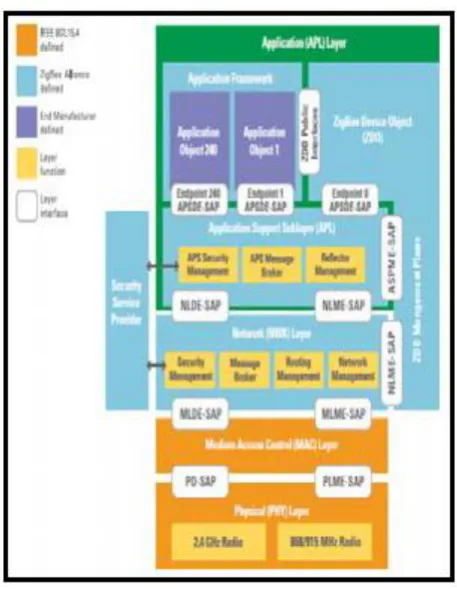
Figure 2: ZigBee Protocol Stack.
ZigBee sensors offer the capacity to give continuous
[image:2.595.49.275.535.760.2]© 2016, IRJET | Impact Factor value: 4.45 | ISO 9001:2008 Certified Journal | Page 1757
temperature, dampness, wind) in a solitary answer forremote correspondence over a ZigBee base. ZigBee utilizes
the PHY and MAC layers characterized by the IEEE 802.15.4
standard for short separation remote interchanges. The
system layer, the security administration and the application
interface have all been characterized by the ZigBee
partnership. The particular application is keep running in
the upper stack level [3]. The ZigBee works at 2.4GHz which
is in the ISM (Industrial, Scientific, and Medical) recurrence
band at the information rate of 250kbps, 868 MHz European
Band at the information rate of 20kbps and 915 MHz North
American Band at the information rate of 40kbps [1], [3],
[12]. ZigBee Wireless Module is designed with either a XBee
or XBee-Pro handset. The distinction between these two
modules is the measure of force expended (1mW versus
60mW) and signal reach. .For the XBee the urban extent is
100 feet (30m) and outside reach is 300 feet (100m) and for
the XBee-Pro design, the indoor and urban reach is up to 300
feet (100m) and open air viewable pathway is up to 1 mile
(1500m). Choice of the reception apparatus sort and
arrangement majorly affects the reach.
4. LITERATURE REVIEW
The exploration on target markets of ZigBee innovation that
have been executed for the diverse applications like Home
Automation, Personal Healthcare, PC Peripherals, Industrial
and Commercial and so forth. Applications incorporate
remote electrical meters, light switches inside home
presentations, and other shopper and modern gear that
require generally low rates at the short-go remote exchange
of information. The ZigBee (IEEE 802.15.4) is another
innovation that allows the execution of Wireless Personal
Area Networks (WPAN) [1], [3]. WSN utilizing ZigBee is for
crisis reaction warning for climate station checking
framework. The framework is utilized to quantify
parameters, for example, test temperature, pneumatic stress,
vibration and so on. These parameters will change
contingent upon the prerequisite of the reconnaissance
framework [1]. In another framework, the whole system
utilizing the ZigBee innovation control and screen by a
solitary individual. The mix of both wired and remote
innovations can be utilized as a part of this framework i.e.
(Controller Area Network) CAN transport system with the
ZigBee innovation for controlling the distinctive ecological
parameters like temperature, dampness, light and gas [2].
The ZigBee innovation is additionally utilized as a
developing innovation for the building mechanization. The
ZigBee convention can deal with the information messages
directing, affirmations and retries inside the radios. The
system can self-recuperate utilizing ZigBee and WPAN
innovation. The new way would be utilized for information
message directing from source hub to destination hub in the
system if any of the radio was evacuated in light of some
reason [3]. The one of the framework takes a shot at to check
and control the nursery impact in agribusiness as for
temperature, mugginess and light parameters [15], [16] and
afterward record climate insights for arranging and
improvement utilizing the innovation of
ZigBee/IEEE802.15.4 with remote sensor systems and
Arduino microcontroller [5]. There are additionally some
different strategies like SCADA framework utilized with
ZigBee for the climate estimating, observing and control the
diverse climate parameters like temperature, moistness,
light, wind speed, wind heading and sunlight based
radiations [4]. In the examination the one of the new
strategy for measuring overhead conductor temperature and
list elements utilizing GSM SMS and ZigBee innovation [7].
Here the hang component and conductor temperature
checked at continuous furthermore enhances the
transmission limit of the dynamic controls, for example,
summer and winter, shady and sunny day and night under
the diverse natural conditions. The continuous direct
estimation of the parameters required for the operation of
the transmission framework without middle of the road
estimation of conductor pressure and surrounding climate
conditions, the raised temperature can be dodged and a few
mishaps created by the expanded temperature can be kept
© 2016, IRJET | Impact Factor value: 4.45 | ISO 9001:2008 Certified Journal | Page 1758
5. CONCLUSION
The proposed research work can be utilized as a part of
different application regions. Because of long battery life, it
can be utilized as a part of the remote territories where
battery utilization is a noteworthy issue. Different
application ranges incorporate modern checking, nuclear
power plant checking. In these application ranges, a little
variety in temperature can bring about genuine mischances.
So temperature should be controlled opportune. Other
application territories can be greenhouse checking, checking
and bio medical applications. Utilization of ZigBee
professional arrangement builds the scope of
correspondence and correspondence re-join calculation
helps in relinking the correspondence if there is any
breakage of correspondence due to power variance or loss of
information byte.
REFERENCES
1) David Egan, "The emergence of ZigBee in building automation and industrial controls”. IEE Computing
and Control Engineering. pp 14-19, April,May 2005.
2) Dr. S.S.Riaz Ahamed. “Role of Zigbee technology in future data communication system”. Journal of
Theoretical and Applied Information Technology, Vol.5
No. 2, pp 129-135, 2005.
3) Elber CEO Jeff Grammer. “ZigBee starts to buzz” IEEE review, IET journal, Vol. 50, No. 11, pp-17, November
2004.
4) David Geer. “Users make a Beeline for ZigBee Sensor Technology”. IEEE Computer Society. Vol. 38, No. 12, pp
16-19, December 2009.
5) Jaun A. Fraile, Javier Bajo, Juan M. Corchando and Ajith Abraham. “Applying wearable solutions in dependent
environments”. IEEE Transaction on Information
Technology in Biomedicine, Vol. 14, No. 6, pp 1459-
1467, November 2010.
6) Sang-Joong Jung, Tae -Ha Kwon, Wan-Young Chung. “A New Approach to Design Ambient Sensor Network for
Real Time Healthcare Monitoring System”. IEEE
Sensors Conference, pp 576- 580, 2009.
7) LIU Yumei, ZHANG Changli, ZHU Ping. “Design and Implementation of nodes based on CC2430 for
Agricultural Information Wireless Monitoring”. ICCAE
2nd International Conference of IEEE, Vol.5, pp
255-258, 2010.
8) Khushvinder Gill, Shuang-Hua Yang,Fang Yao and Xin Lu. “A ZigBee- Based Home Automation System”. IEEE
Transactions on Consumers Electronics, Vol. 55, No. 2,
May 2009.
9) Chagitha Ranhotigamage and Subhas Chandera Mukhopadhyay. “Field trials and performance
monitoring of distributed solar panels using a low- cost
wireless sensors network for domestic applications”.
IEEE Sensors Journal, Vol. 11, No.10, pp 2583-2590,
October 2011.
10) Hainan Long, Leyang Zhang, Jiao Pang, Caixia Li, Tierui Song. “Design of Substation Temperature Monitoring
System Based on Wireless Sensor Networks”. Advance
Computer Control (ICACC), 2010 2nd International
Conference on, Vol. 1, pp- 127-130, 2010.
11) Khalid Parveez, “A Smart Zigbee Based Wireless
Weather Station Monitoring System”, International
Conference on Computing and Control Engineering
(ICCCE 2012), 12 & 13 April, 2012.
12) Dr. Boyina. S. Rao, Deepa K, Abarna I, Arthika S, Hemavathi G, Mohanapriya D “Controller Area Network
© 2016, IRJET | Impact Factor value: 4.45 | ISO 9001:2008 Certified Journal | Page 1759
13) Parameters Using Zigbee Communication”International Journal of Advanced Engineering
Technology E-ISSN 0976-3945 IJAET, Vol.III, Issue II,
April-June, 2012/34- 36.
14) Archana R. Raut, Dr. L. G. Malik, “ZigBee: The Emerging Technology in Building Automation” Archana R. Raut et
al./International Journal on Computer Science and
Engineering (IJCSE) ISSN : 0975-3397 Vol. 3 No. 4 April
2011.
15) BABS Adam, “Weather-based and conductor state measurement methods applied for dynamic line rating
forecasting” 2011The International Conference on
Advanced Power System Automation and Protection,
978-1-4244-9621-1/11.
16) CholatipYawut and Sathapath Kilaso, “A Wireless Sensor Network for Weather and Disaster Alarm
Systems” 2011 International Conference on
Information and Electronics Engineering IPCSIT vol.6
(2011), Singapore.
17) Yao Wang and Banavar Sridhar, NASA Ames Research Center, Moffett Field, California “Conective Weather
Forcast Accuracy Analysis At Center And Sector Levels”,
29th Digital Avionics Systems Conference October 3-7,
2010.
18) Eduardo R. Rodrigues, Celso L. Mendes, Philippe O. A. Navaux, Jairo Panetta, Alvaro Fazenda, Laxmikant V.
Kale, “A Comparative Analysis of Load Balancing
Algorithms Applied to a Weather Forecast Model” 2010
22nd International Symposium on Computer
Architecture and High Performance Computing(2010).
19)
M.V. Vijaya Saradhi et al. “Development of a Low-Cost
ZIGBEE and GSM SMS-Based Conductor Temperatureand Sag Monitoring System” International Journal of
Engineering Science and Technology Vol. 2(4), 2010,