6
I
January 2018
Design and Simulation of Rectangular Micro strip
Monopole Antenna for L- Band Applications
Ravi Prajapati1, Ashish Duvey2 1, 2
Department of electronics& Communication, Shri Ram College of Engineering & Management, Gwalior- 476444, India
Abstract: This paper, presents the design and simulation of wide band micro strip antenna for L-band application .It is designed for band 1.11 GHz to 2.18 GHz. Proposed design consist of rectangular which is truncated from all the corners and triangular slot. It is designed on dielectric epoxy glass (FR4 lossy) substrate with relative permittivity (ɛr) of 4.3, thickness of 1.6 mm, a rectangular monopole antenna is feeded via a single feeding strip. It has a gain of 2.6db and -36db return loss.
Keywords: Wide band, Monopole, L-band, Truncated Square .
I. INTRODUCTION
Modern and future wireless world are placing greater demands on antenna designs. Printed monopole antennas are widely used in the wideband communication systems. Among printed monopole antennas of various shapes like circular, rectangular, square etc. [1-3], rectangular monopole antenna are the easy in design and their radiation patterns are Omni-directional with wide impedance bandwidth. Antennas, which can work operate in more than one frequency region either for transmitting or receiving electromagnetic (EM) waves, are named as Multiband antennas. Such antennas are usually tri-band, penta-band etc. Multi-band antennas are much more complex than the single band antennas in their design, structures and operations [1]. In this paper, L-band rectangular monopole antenna with feeding line and etched ground plane is presented which is actually a single band antenna in the 1.1-2.18 GHz frequency bands. The antenna corners has been truncated on each corner and slotted in middle to enhance the bandwidth [2].
In this paper, L-band rectangular monopole antenna with feeding line and etched ground plane is presented which is actually a single band antenna in the 1.1-2.18 GHz frequency bands. The antenna corners has been truncated on each corner and slotted in middle to enhance the bandwidth [2]. The proposed printed rectangular monopole antenna is a simple configuration.. The properties of the antenna such as return loss, radiation patterns, directivity and gain are determined via a simulation process using CST (Computer Simulation Technology) Microwave Studio Software. Printed rectangular monopole antenna can be optimizing to provide extremely wide impedance bandwidths with acceptable radiation performance. They can be developed to cover several operating frequency bands of wireless communication from DCS: 1.71-1.88 GHz, Personal Communication System (PCS 1.85-1.99 GHz, Universal Mobile Telecommunication System (UMTS 1.92-2.17 GHZ), IMT-2000 [3].
CST MICROWAVE STUDIO is a fully featured software package for electromagnetic analysis and design in the high frequency range. The software contains four different simulation techniques (transient solver, frequency domain solver, Eigen mode solver, modal analysis solver) which best fit their particular applications. The most flexible tool is the transient solver, which can obtain the entire broadband frequency behavior of the simulated device from only one calculation run (in contrast to the frequency stepping approach of many other simulators). This solver is very efficient for most kinds of high frequency applications such as connectors, transmission lines, filters, antennas and many more.
Planar monopole antennas has an interesting design due to their wideband matching characteristic, Omni-directional radiation pattern, high radiation efficiency and compact size.
II. DESIGNING OF MONO POLE ANTENNA
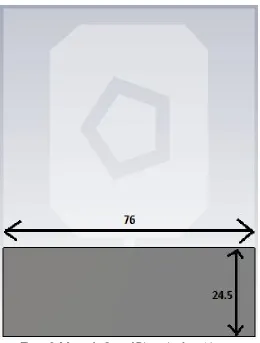
The proposed antenna is made by using double sided printed circuit board (PCB). Elements are designed on a 1.6 mm thick glassy epoxy (FR-4 lossy) substrate and refractive index of ɛr=4.3.first of all rectangular patch is designed and then it is truncated from all the corners. And then triangular slot is also etched and pentagonal slot is made on patch as shown in fig. 1. Dimension of patch are shown in figure1,Dimention of ground plan is shown in figure 2,Simulated Return loss ,VSWR and Radiation pattern with gain is
Figure 1: Monopole antenna Dimension layout in mm
[image:3.612.178.438.381.724.2]Figure 3: Simulated return loss of mono pole antenna
Figure 4: Simulated VSWR of mono pole antenna
[image:4.612.155.460.508.715.2]III. RESULT
Configuration of printed rectangular monopole antenna with a pentagonal-shaped slot on the FR4 lossy substrate with an etched ground plane has been investigated for the L frequency band application. It is simulated using the CST Microwave Software. Figure 3 shows the simulated return loss of the proposed antenna from0 to 3 GHz. Using a 50_ SMA (Sub Miniature version A) connector at the port 1. Theachieved simulated return loss of the Proposed Antenna with truncated corners and pentagonal shaped slots on the Etched ground plane is -36dB at a frequency 1.326GHz having the lower frequency (fL) and higher frequency (fH) of the bandwidth is 1.11GHz and 2.18 GHz respectively and obtaina bandwidth of proposed antenna is 1.07 GHz.
IV. CONCLUSION
Monopole patch antenna is designed for band 1.11 GHz to 2.18 GHz. Its response is improved by truncating the corners and providing the triangular slot in the patch. Here proposed Design has been simulated with -36db return loss and which has the good recorded radiation efficiency of 98%.
REFRENCES [1] CA Balanis, Antenna Theory Analysis and Design (John Wiley & Sons Inc, 2nd edition,
1997).
[2] S. Muzahir Abbas, Istaqlal Ahmed, Hamza Nawaz, IlyasSaleem, Meandered Corner Planar Monopole Antenna for UWB Applications, Scientific & Academic Publishing,Vol. 2, No. 3, 2012, 147-151.
[3] JyotiRanjan Panda, Rakesh Singh Kshetrimayum, Parametric Study of Printed Rectangular Monopole Antennas, International Journal of Recent Trends in Engineering,
[4] N. Suresh Babu, Design of Compact Printed Rectangular Monopole Antenna and UShaped Monopole Antenna for L-Band and S-Band Applications, International Journal of Electronics Signal and System, Vol. 1, No. 3, 2012, 106-110.
[5] N.P. Agarwall, G. Kumar, K. Ray, Wide-Band Planar Monopole, IEEE Transaction and Antenna Propagation, Vol. 46, No. 2, 1998, 294-295. [6] K.P. Ray, Y. Ranga, Printed Rectangular Monopole Antenna, Antenna and propagation Society International Symposium IEEE, 2006, 1693-1696. [7] CST (Computer Simulation Technology) Microwave Studio 2010.