Technology (IJRASET)
Effect of Crumb Rubber in Bitumen Using
Marshal Stability Test
Shinde. S. S.1, Waychal. A. A.2, Patil. S. B3, Kadam. S. R4
Department of Civil Engineering, Sanjay Ghodawat Institute, Atigre, Maharashtra, India
Abstract – Construction of highway involves huge outlay of investment. Smooth transport and Road networks plays vital role in the development of country. The total pavement structure "bends" or "deflects" due to traffic loads. Tire pressure and axle load increases mean that the bituminous layer near the pavement surface is exposed to higher stresses. . Suitable material combinations and modified bituminous binders have been found to result longer life for wearing courses depending upon the percentage of filler and type of fillers used. The polymer coated aggregate bitumen mix forms better material for flexible pavement construction as the mix shows higher Marshall Stability value and suitable Marshall Coefficient. Hence the use of waste plastic for flexible pavement is one of the best methods for easy disposal of waste plastic. Moreover the polymer coated aggregate helps to use crumb rubber modified bitumen resulting in better result. The study indicates the possibility of using crumb rubber as filler in bituminous mix
Key Words: Crumb Rubber, Bituminous Paving Mixes, Filler, Marshall Mix Design, Asphalt, VMA, VFB
I. INTRODUCTION
Rubber from discarded tyres has been used in various highway applications for over 50 years. Generally, the tyre rubber is ground to a particulate or crumb prior to adding it to bitumen. This form of the tyre rubber is called Crumb Rubber Modifier (CRM). When CRM is added to bitumen, the resulting product is called Crumb Rubber Modified Bitumen (CRMB). This filler tends to stiffen the pavement mix by getting finely dispersed in it. The training emphasized the importance of stringent quality control requirements right from the production of the CRMB at or in close proximity of hot mix bituminous plant; transportation of CRMB from production site to bituminous mix plant; storage of CRMB in contractor’s plant; and final testing of CRMB just prior to adding it aggregates in bituminous plant pug mill or drum.
II. MATERIALS
Bituminous mixture is normally composed of aggregate and bitumen. The aggregates are generally divided into coarse, fine and filler fractions according to the size of the particles. The following sections include the description of the coarse aggregate, fine aggregate, mineral fillers and bitumen used in this study
A. Aggregate
Coarse aggregate for bituminous mix has been defined as that portion of the mixture which passed from 20 mm and retained on 10 mm sieve according to the Asphalt Institute. Basalt rock was used as coarse aggregate. It was crushed manually and brought to the sizes 20.0 mm or less. The aggregates were then sieved using I.S. standard sieves and separated out in different fractions. Fine aggregate for bituminous mix has been defined as that portion of the mixture which passed from 10 mm and retained on 2.36 mm sieve according to the Asphalt Institute. It was crushed manually and brought to the sizes 10.0 mm or less. The aggregates were then sieved using I.S. standard sieves. Aggregate passing through 2.36 mm sieve and retained on 0.090+ mm sieve was selected as Sand. River sand was the source of sand
B. Cement
Ordinary Portland cement of 53 grade is used. The specific gravity of cement 3.15
C. Bitumen
Bitumen materials have been known and used in building and road construction since ancient times. In this study 80 – 100 grade bitumen was used same bitumen was used for all the mixes so the type and grade of binder would be constant.
Technology (IJRASET)
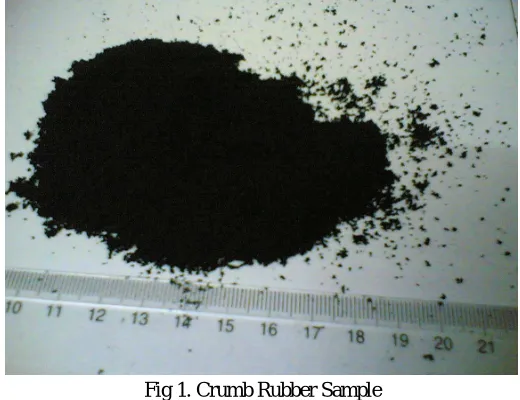
[image:3.612.175.435.104.304.2]create environmental concerns. Crumb Rubber Modified Bitumen (CRMB) is hydrocarbon binder obtained through physical and chemical interaction of crumb rubber (produced by recycling of used tyres) with bitumen and some specific additives.
Fig 1. Crumb Rubber Sample
III. TESTRESULTSFOR MATERIALS
A. Aggregates
Coarse aggregates consisted of stone chips collected from a local source, up to 4.75 mm IS sieve size. Its specific gravity was found as 2.75. Fine aggregates, consisting of stone crusher dusts were collected from a local crusher with fractions passing 4.75 mm and retained on 0.075 mm IS sieve. Its specific gravity was found as 2.6. Standard tests were conducted as per IS:2386(PART IV) to determine their physical properties as summarized in table their result and conclusion as follows:
Table 1. Mix Type Selection Guide for Perpetual Pavements
TEST RESULTS
SPECIFIC GRAVITY 2.75(CA), 2.6(FA)
IMPACTVALUE TEST 15.15%
WATER ABSORPTION TEST 1.9%
ABRASION TEST 21.60%
B. Bitumen
[image:3.612.152.461.567.714.2]Standard tests were conducted to determine their physical properties as summarized in table their result and conclusion as follows:
Table 2. Mix Type Selection Guide for Perpetual Pavements
TEST RESULTS
PENETRATION TEST 89 (80/100 Grade)
DUCTILITY TEST 75.4cm
SOFTENING POINT 51.5oC
VISCOSITY TEST 65sec
Technology (IJRASET)
C. Crumb Rubber Modified Bitumen
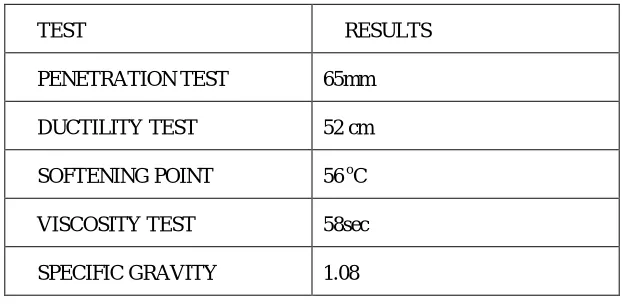
Standard tests were carried out on modified bitumen to determine its properties. The ratio of bitumen and crumb rubber was 85:15) i.e. 15% of crumb rubber by its weight was used to carry out the tests. The test results are as follows:
Table 3. Mix Type Selection Guide for Perpetual Pavements
TEST RESULTS
PENETRATION TEST 65mm
DUCTILITY TEST 52 cm
SOFTENING POINT 56 oC
VISCOSITY TEST 58sec
SPECIFIC GRAVITY 1.08
IV. MARSHALSTABILITYTEST
This test procedure is used in designing and evaluating bituminous paving mixes and is extensively used in routine test programmes for the paving jobs. There are two major features of the Marshall method of designing mixes namely, density – voids analysis and stability – flow test.
Strength is measured in terms of the ‘Marshall’s Stability’ of the mix following the specification ASTM D 1559 (2004), which is defined as the maximum load carried by a compacted specimen at a standard test temperature of 60°C. In this test compressive loading was applied on the specimen at the rate of 50.8 mm/min till it was broken. The temperature 60°C represents the weakest condition for a bituminous pavement.
The flexibility is measured in terms of the ‘flow value’ which is measured by the change in diameter of the sample in the direction of load application between the start of loading and at the time of maximum load. During the loading, an attached dial gauge measures the specimen's plastic flow (deformation) due to the loading. The associated plastic flow of specimen at material failure is called flow value. The density- voids analysis is done using the volumetric properties of the mix, which will be described in the following sub sections.
A. Marshall Stability Test Results
[image:4.612.150.461.138.290.2]Tests were performed by replacing 80/100 penetration grade bitumen by crumb rubber in proportion of 0%, 10 %, 15 % , 20 % with respect to original weight 60gm(5%) .
Table 4. Observation table for Marshall Stability tests on CRMB mix
Sr.no Crumb
rubber
Bitumen
% density
Max.
Th.sp.gravity
(mm)
Air
voids % VMA % VFB %
Corrected
stability (kg)
Flow
(mm)
1 0 5.5 2.47 2.59 4.65 14.29 77.72 1123,60 4.6
2 10 5.0 2.49 2.61 4.92 15.80 75.55 1405.13 4.1
3 15 4.5 2.54 2.62 5.33 15.49 74.15 1717.04 3.9
Technology (IJRASET)
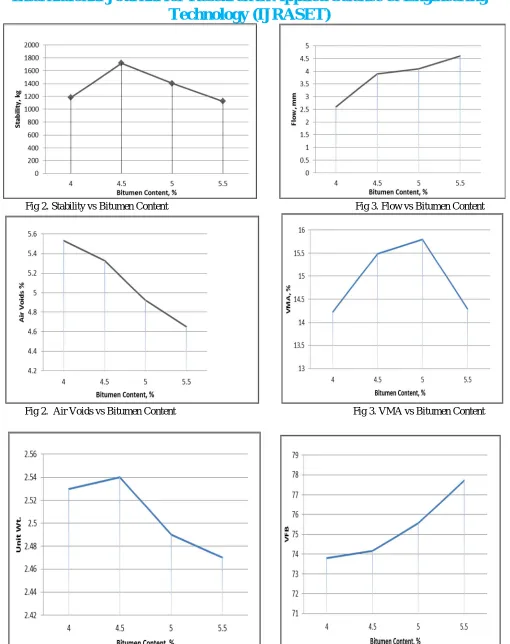
Fig 2. Stability vs Bitumen Content Fig 3. Flow vs Bitumen Content
[image:5.612.57.567.53.697.2]
Fig 2. Air Voids vs Bitumen Content Fig 3. VMA vs Bitumen Content
Technology (IJRASET)
V. CONCLUSION
By studying the test results of laboratory tests on plain bitumen and crumb rubber modified bitumen it is concluded that the penetration values and softening points of plain bitumen can be improved significantly by modifying it with addition of crumb rubber which is a major environment pollutant.
After careful evaluation of the properties and taking various tests as per standards the results shown by 4.5% addition of rubber crumbs has best suitability for blending it with bitumen. This will help to dispose the waste tire rubber in a proper way and solve the problem of environmental concerns up to a certain extent. Crumb rubber gives the satisfactory results by using it in 4.5% of proportion to replace the bitumen for various tests of bitumen & bitumen mix. Crumb rubber gives the Marshall Stability value of 1717.04 kg by using 4.5% of crumb rubber powder with bitumen mix.
REFERENCES
[1] Abdelrahman MA, Carpenter SH (1999). “Mechanism of interaction of asphalt cement with crumb rubber modifier”. Transportation Research Record: J. Transport. Res. Board, 1661: 106-113.
[2] Goodrich J.L., (1998) “Bitumen and polymer modified Bitumen properties related to the performance of Bitumen concrete mixes”, Journal of the Association of Bitumen Pavement Technologists, Volume 57, pp.116-160.
[3] HarpalsinhRaol, AbhijitsinhParmar, Dhaval Patel, JitendraJayswal: Effect Of The Use Of Crumb Rubber In Conventional Bitumen On The Marshall Stability Value : ISSN: 2319-1163 | pISSN: 2321-7308.
[4] Nuha S. Mashaan*, Asim H. Ali, Mohamed RehanKarim and MahrezAbdelaziz, “Effect of crumb rubber concentration on the physical and rheological properties of rubberised bitumen binders”18 February, 2011
[5] Niraj D. Baraiya: Use of Waste Rubber Tyres in Construction of Bituminous Road – An Overview: Volume 2, Issue 7, July 2013
[6] K. Rajesh Kumar, Dr. N. Mahendran, “ Experimental Studies on Modified Bituminous Mixes Using Waste HDPE and Crump Rubber” Volume 4, Issue 4, April 2014
[7] MohdRasdan Ibrahim, HerdaYatiKatman, Mohamed RehanKarim, SuhanaKoting and Nuha S. Mashaan: A Review on the Effect of Crumb Rubber Addition to the Rheology of Crumb Rubber Modified Bitumen: Volume 2013 (2013)
[8] Dr. M. Satyakumar And Surya S. Nair “Reusability of waste tires as an additive in binder for flexible pavement construction” January 28-29, 2011 [9] IRC SP: 53-2002, 2004, 2010 “Guidelines on use of Polymer and Crumb Rubber Modified binders”.