© 2018, IRJET | Impact Factor value: 6.171 | ISO 9001:2008 Certified Journal | Page 3109
Research paper On Sentiment Analyzer By Using A Supervised Joint
Topic Modeling Approach
Samruddhi S. Raut
1, Dr. Hemant R. Deshmukh
2, Asst Prof. Ankit R.Mune
31,2,3 CSE, D.R.G.I.T. & R. AMRAVATI
---***--- Abstract: In this work, we focus on modeling user-generated
feedback and overall rating pairs, and aim to identify semantic aspects and aspect-level sentiments from user feedback data as well as to predict overall sentiments of user feedbacks. We propose a novel probabilistic supervised joint aspect and sentiment model (SJASM) to deal with the problems. SJASM represents each user feedback document in the form of opinion pairs, and can simultaneously model aspect terms and corresponding opinion words of the user feedback for hidden aspect and sentiment detection. It also leverages sentimental overall ratings, which often comes with online user feedbacks, as supervision data, and can infer the semantic aspects and aspect-level sentiments that are not only meaningful but also predictive of overall sentiments of user feedbacks. Moreover, we also develop efficient inference method for parameter estimation of SJASM based on collapsed Gibbs sampling. We evaluate SJASM extensively on real-world user feedback data, and experimental results demonstrate that the proposed model outperforms seven well-established baseline methods for sentiment analysis tasks. Generally, sentiments and opinions can be analyzed at different levels of granularity. We call the sentiment expressed in a whole piece of text, e.g., review document or sentence, overall sentiment. The task of analyzing overall sentiments of texts is typically formulated as classification problem, e.g., classifying a review document into positive or negative sentiment. Then, a variety of machine learning methods trained using different types of indicators (features) have been employed for overall sentiment analysis.
Generally, sentiments and opinions can be analyzed at different levels of granularity. We call the sentiment expressed in a whole piece of text, e.g., review document or sentence, overall sentiment. The task of analyzing overall sentiments of texts is typically formulated as classification problem, e.g., classifying a review document into positive or negative sentiment. Then, a variety of machine learning methods trained using different types of indicators (features) have been employed for overall sentiment analysis. However, analyzing the overall sentiment expressed in a whole piece of text alone (e.g., review document), does not discover what specifically people like or dislike in the text. In reality, the fine-grained sentiments may very well tip the balance in purchase decisions. For example, savvy consumers nowadays are no longer satisfied with just overall sentiment/rating given to a product in a review; They are often eager to see why it receives
that rating, which positive or negative attributes (aspects) contribute to the particular rating of the product.
1 INTRODUCTION
With the increase in the popularity of social networking, micro-blogging and blogging websites, a huge quantity of data is generated. We know that the internet is the collection of networks. The age of the internet has changed the way people express their thoughts and feelings. The people are connecting with each other with the help of the internet through the blog post, online conversation forums, and many more .online user-generated reviews are of great practical use, because: 1) They have become an inevitable part of decision making process of consumers on product purchases, hotel bookings, etc. 2) They collectively form a lowcost and efficient feedback channel, which helps businesses to keep track of their reputations and to improve the quality of their products and services. As a matter of fact, online reviews are constantly growing in quantity, while varying largely in content quality. To support users in digesting the huge amount of raw review data, many sentiment analysis techniques have been developed for past years [1]. sentiments and opinions can be analyzed at different levels of granularity. We call the sentiment expressed in a whole piece of text, e.g., review document or sentence, overall sentiment. The task of analyzing overall sentiments of texts is typically formulated as classification problem, e.g., classifying a review document into positive or negative sentiment. Then, a variety of machine learning methods trained using different types of indicators (features) have been employed for overall sentiment analysis [2], [3], [4], [5], [6], [7]. Sentiment analysis is mainly concerned with the identification and classification of opinions or emotions of each tweet. Sentiment analysis is broadly classified in the two types first one is a feature or aspect based sentiment analysis and the other is objectivity based sentiment analysis. For eg. The tweets related to movie reviews come under the category of the feature based sentiment analysis. Objectivity based sentiment analysis does the exploration of the tweets which are related to the emotions like hate, miss, love etc.
© 2018, IRJET | Impact Factor value: 6.171 | ISO 9001:2008 Certified Journal | Page 3110 and aspect-level sentiments from user feedback data as well
[image:2.612.51.278.116.287.2]as to predict overall sentiments of user feedbacks.
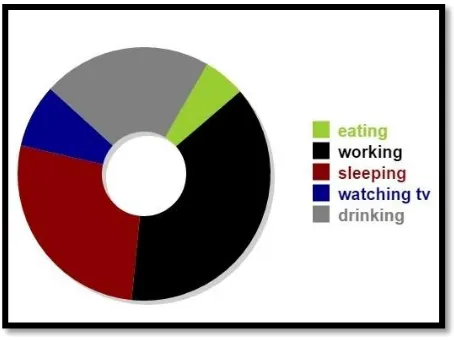
Figure: Graphical view of results
We propose a novel probabilistic supervised joint aspect and sentiment model (SJASM) to deal with the problems. SJASM represents each user feedback document in the form of opinion pairs, and can simultaneously model aspect terms and corresponding opinion words of the user feedback for hidden aspect and sentiment detection. It also leverages sentimental overall ratings, which often comes with online user feedbacks, as supervision data, and can infer the semantic aspects and aspect-level sentiments that are not only meaningful but also predictive of overall sentiments of user feedbacks .moreover we also generated the graphical view of results develop by sentiment analyzer.
2. RELATED WORK
In [2] authors built supervised models on standard n-gram text features to classify review documents into positive or negative sentiments. Moreover, to prevent a sentiment classifier from considering non-subjective sentences, In [3] authors used a subjectivity detector to filter out non-subjective sentences of each review, and then applied the classifier to resulting subjectivity extracts for sentiment prediction. A similar two-stage method was also proposed in [4] for document-level sentiment analysis. A variety of features (indicators) have been evaluated for overall sentiment classification tasks. To analyze overall sentiments of blog (and review) documents, In [5] authors incorporated background/prior lexical knowledge based on a pre-compiled sentiment lexicon into a supervised pooling multinomial text classification model. In [6] authors combined sentimental consistency and emotional contagion with supervised learning for sentiment classification in micro blogging. Unsupervised linguistic methods rely on
developing syntactic rules or dependency patterns to cope with fine grained sentiment analysis problem
3. PROPOSED WORK
Proposed architecture is design as below
Statement collection from ecommerce site
Pre-processing of reviews.
Extracting objective from statement.
Polarity of reviews .
In this approach the reviews from ecommerce website is used and analyzed it. The preprocessing of reviews is done through Natural Language Processing. A pattern matching technique is done to compare the emoticons with textual data for the evaluation of sentiments. After applying tagging the filtering of topic is done through a Foreground and Background Latent Dirichlet Allocation (FB-LDA) Algorithm. A result is obtained in terms of polarity and ranking of reviews. We model online user-generated review and overall rating pairs, and aim to identify semantic aspects and aspect-level sentiments from review texts as well as to predict overall sentiments of reviews.
4. SYSTEM IMPLEMENTATION
The main aim of sentiment analysis is to find the opinion of the user. So the sentiment analysis result is to find the review is positive or negative. The reviews comments are taken form the blog, dataset. It is splitted into separate sentences and the sentiment for each sentence is calculated and from that the opinions are extracted and it is stored in the opinion verb dictionary. By this process the reviews can be classified into positive or negative The three sentiment analysis tasks as follows.
Semantic aspect detection. This task aims at detecting hidden semantic aspects of an opinionated entity from the given review documents, where each aspect would be represented in the form of a hidden semantic cluster.
Aspect- level sentiment identification. For this task, the aim is to identify fine-grained semantic sentiment orientation, e.g., positive or negative, expressed towards each detected semantic aspect.
© 2018, IRJET | Impact Factor value: 6.171 | ISO 9001:2008 Certified Journal | Page 3111 reviews are different from ordinary text documents. For
example, when people read a product review, they often care about which specific aspects of the product are commented on, and what sentiment orientations(e.g., positive or negative) have been expressed on the aspects. Instead of employing bag-of-words representation, which is typically adopted for processing usual text documents, The review is represented in the form of opinion pairs. where each opinion pair consists of an aspect term and related opinion word in the review. To propose a novel supervised joint aspect and sentiment model (SJASM), which can cope with the overall and aspect-based sentiment analysis problems in one go under a unified framework. Probabilistic topic models, notably latent Dirichlet allocation (LDA) [8], have been widely used for analyzing semantic topical structure of text data. Based on the basic LDA, we introduce an additional aspect-level sentiment identification layer, and construct a probabilistic joint aspect and senti-ment framework to model the textual bag-of-opinion-pair data.
5. RESULT
This section presents the screenshots of the working system in order to demonstrate the complete process of the system. In project, there is one e-commerce website and that website have its own Admin and various users.admin have authority to upload products, manage dictionary e.g submission of keywords, manage details of user. Sometimes user have details information about specific product such as quality, performance, display, battery etc. so in this project we developed aspect based sentiment analyser. Aspect based gives detailed feedback and aspect based sentiment graph about that specific product and that graph represent positive, neutral, negative status.There are two modules
1) User 2) Admin
Screenshot 5.1 : Homepage
Screenshot 5.2: User login page
Screenshot 5.2: Product Details
© 2018, IRJET | Impact Factor value: 6.171 | ISO 9001:2008 Certified Journal | Page 3112 Screenshot 5.4: List of TABs
Screenshot5.5 List of Mobile Phones
Screenshot5.6: Overall graph for mail
Screenshot5.7: Aspect Based and Overall graph page
Screenshot5.8 Home page on Admin side
© 2018, IRJET | Impact Factor value: 6.171 | ISO 9001:2008 Certified Journal | Page 3113 6. CONCLUSIONS
In this work, we focus on modeling online user-generated review data, and aim to identify hidden semantic aspects and sentiments on the aspects, as well as to predict overall ratings/sentiments of reviews. We have developed a novel supervised joint aspect and sentiment model (SJASM) to deal with the problems in one go under a unified framework. SJASM treats review documents in the form of opinion pairs, and can simultaneously model aspect terms and their corresponding opinion words of the reviews for semantic aspect and sentiment detection. Moreover, SJASM also leverages overall ratings of reviews as supervision and constraint data, and can jointly infer hidden aspects and sentiments that are not only meaningful but also predictive of overall sentiments of the review documents.
7.REFERENCES
[1] B. Liu, “Sentiment analysis and opinion mining,” Synthesis Lectures on Human Language Technologies, vol. 5, no. 1, pp. 1–167, May 2012.
[2] B. Pang, L. Lee, and S. Vaithyanathan, “Thumbs up?: sentiment classification using machine learning techniques,” in Proceedings of the ACL-02 conference on Empirical methods in natural language processing - Volume 10, ser. EMNLP’02. Stroudsburg, PA, USA: Association for Computational Linguistics, 2002, pp. 79–86.
[3] V. Ng, S. Dasgupta, and S. M. N. Arifin, “Examining the role of linguistic knowledge sources in the automatic identification and classification of reviews,” in Proceedings of the COLING/ACL on Main Conference Poster Sessions, ser. COLING-ACL ’06. Stroudsburg, PA, USA: Association for Computational Linguistics, 2006, pp. 611–618.
[4] J. Zhao, K. Liu, and G. Wang, “Adding redundant features for crfs-based sentence sentiment classification,” in Proceedings of the Conference on Empirical Methods in Natural Language Processing, ser. EMNLP ’08. Stroudsburg, PA, USA: Association for Computational Linguistics, 2008, pp. 117–126.
[5] P. Melville, W. Gryc, and R. D. Lawrence, “Sentiment analysis of blogs by combining lexical knowledge with text classification,” in Proceedings of the 15th ACM SIGKDD International Conference on Knowledge Discovery and Data Mining, ser. KDD’09. New York, NY, USA: ACM, 2009, pp. 1275–1284.
[6] A. L. Maas, R. E. Daly, P. T. Pham, D. Huang, A. Y. Ng, and C. Potts, “Learning word vectors for sentiment analysis,” in Proceedings of the 49th Annual Meeting of the Association for Computational Linguistics: Human Language Technologies - Volume 1, ser. HLT’11. Stroudsburg, PA, USA: Association for Computational Linguistics, 2011, pp. 142– 150.
[7] B. Yang and C. Cardie, “Context-aware learning for sentence-level sentiment analysis with posterior regularization,” in Proceedings of the 52nd Annual Meeting of the Association for Computational Linguistics, ACL 2014, June 22-27, 2014, Baltimore, MD, USA, Volume 1: Long Papers, 2014, pp. 325–335.
[8] D. M. Blei, A. Y. Ng, and M. I. Jordan, “Latent dirichlet allocation,” J. Mach. Learn. Res., vol. 3, pp. 993–1022, March 2003. 1041-4347 (c) 2016 IEEE. Personal use is permitted, but republication/redistribution requires IEEE permission. See