London School of Economics and Political Sciences
Inter-Sector Partnerships: Complex
Dynamics and Patterns of Behaviour
Silvia López Herrero
A thesis submitted to the Department of Social Policy at the London
School of Economics for the degree of Doctor of Philosophy, London,
Declaration of Authorship
I certify that the thesis I have presented for examination for the MPhil/PhD degree of
the London School of Economics and Political Sciences is solely my own work other
than where I have clearly indicated that it is the work of others (in which case the
extend of any work carried out jointly by me and any other person is clearly identified
in it).
The copyright of this thesis rests with the author. Quotation from it is permitted
provided that full acknowledgement is made. This thesis may not be reproduced
without my prior written consent.
I warrant that this authorisation does not, to the best of my belief, infringe the rights
of any third party.
I declare that my thesis consists of 94,718 words.
Statement of use of third party for editorial help
I can confirm that my thesis was copy edited for conventions of language, spelling
and grammar by Transformat Ltd.
Thesis Abstract
This thesis examines inter-sector partnership processes from a complex dynamical
systems perspective. Inter-sector partnerships is increasingly researched both as new
forms of government and policy making, and in the sustainability field. The theories
traditionally used to analyse this topic fail to confront their dynamics as a whole.
Recent approaches draw on complexity theory but, by pre-defining the principles for
analysis, constrain the complete understanding of these phenomena. This thesis
combines an inductive and deductive approach to explore the complex principles that
drive agents’ interactions both at an emergent level (macro), process level (meso) and
a causality level (micro). This aims at 1) providing a theoretical and methodological
framework to study inter-sector partnerships as complex dynamical processes; and 2)
advancing the understanding of social dynamics in the field of complexity theory.
This work is based on two case studies collected during fieldwork in Brazil and
Ecuador using participatory inquiry and semi-structured interviews to account for the
multiple agents, perspectives and components of these processes. These experiences
reflect dissimilar topics of collaboration and context conditions intended to provide
various scenarios of work and highlight regularities through cross-examination.
The results show that, despite the differences, a common pattern of behaviour governs
the creation and evolution of multi-stakeholder processes in both case studies. This
pattern shows five stages driven by different complex principles: 1) the creation of
niche opportunities; 2) the occupation of this niche by a new agent; 3) the emergence
of collective behaviour and inter-sector partnerships; 4) the influence of the
collaborative process in the system dynamic; and 5) the expansion of a new dynamic
in the system. The results provide new insights into the functioning of complex social
systems and show that multi-stakeholder processes represent (1) a phase transition in
the system dynamics; and 2) a poised state in the system dynamic at the complex
regime or edge of chaos, state where the system optimises its capacity to adapt to
change, innovate and perform complex tasks. These findings have a direct practical
implication by providing practitioners and policy makers with a tool (qualitative
dynamical modelling) to promote or reinforce inter-sector partnerships, and to drive
Acknowledgements
Anthony Hall from the Department of Social Policy and Eve Mitleton-Kelly Director
of the Complexity Research Programme, both at the London School of Economics
and Political Science (LSE), for supervising and guiding my work. Sarabajaya Kumar
from the LSE Teaching and Learning Centre for giving me the support for
completion.
AVINA Stiftung for the resources to make this thesis more than an academic work.
Stephan Schmidheiny for his courage to ‘walk the talk’ of Sustainability and his
generosity to society. Finally, I am deeply grateful to Peter Fuchs for sharing his
wisdon on social change and encouranging me to follow my ideas.
All the informants from the four case studies collected for this work, even if just two
appear here due to academic constraints. These are: the Mandú Alliance (Piauí State,
Brazil), the FONAG (Quito, Ecuador), Primeira Infancia (Pedro Leopoldo, MG,
Brazil), and First Agrarian Contract of the Biosphere Reserve (Menorca, Spain).
The innumerable people that try to make a difference in their parts of the world, who
over the years, have shaped my ideas and inspired this work. This research comes
from your strength and aims to reinforce your efforts.
Most of all, I would like to thank my family, both from France and Spain, who have
travelled to London so many times over the years to help me to complete this work:
Merci beaucoup, Muchas Gracias. An eternal thank you to my friends for their
constant support. The most special thanks goes to Thomas, Louis and Simon for being
my loves.
To all of you and those who search for more sustainable pathways in society, I
Table of Contents
Declaration of Authorship 2
Abstract 3
Acknowledgments 4
Acronyms 9
Introduction 11
Chapter 2 - Complexity Theory 29
2.1. Complexity Theory and Social Sciences 32
2.1.1. First Wave 32
2.1.2. Second Wave 33
2.1.3. Third Wave 36
2.1.4. Criticism to this Theoretical Transfer 38
2.2. Complex Dynamical Systems Theory 40
2.2.1. The Emergence of Spontaneous Behaviour 42
2.2.2. Types of Complex Behaviour 48
2.2.3. Co-Evolution: the Meta-Dynamics of Selection and Evolution 52
2.2.4. Self-Organised Criticality 54
2.3. Properties of Complex Adaptive Systems (CAS) 57
Conclusions 62
Chapter 3 - Methodology 66
3.1. Methodology Design 70
3.1.1. Selection of Case Studies 70
3.1.2. Methods for Data Collection 73
3.2. Data Collection 75
3.3. Data Processing and Analysis 81
3.4. Risks and Limitations of the Methodology 84
Chapter 4 - Case Study Description: ‘The Mandú Alliance’, Piauí, Brazil 91
4.1. The Multi-Stakeholder Process: Main Events and Causes 95
4.1.1. A Call for Collective Action 95
4.1.2. First Inter-Sector Dialogue and Alignment 96
4.1.3. Competition for Space 98
4.1.4. Community Engagement 98
4.1.5. The Formalisation of the Mandú Alliance 99 4.1.6. Project Layout - Shift to a ‘System’ Approach 100 4.1.7. Complementary Roles and Institutional Independence 101 4.1.8. Alliance Internal Functioning 102 4.1.9. Shift of Leadership: from Individual to Institutional 104 4.2. Perspectives and Challenges of Collaborative Work at an Organisational
and Individual Level 107
4.2.1. CARE Brazil 107
4.2.2. EMBRAPA 109
4.2.3. Piauí Federal University (UFPI) 111
4.2.4. Flora Vida Institute 112
4.2.5. Young People from the Communities 115
Conclusions 117
Chapter 5 - Case Study Analysis: ‘The Mandú Alliance’, Piauí, Brazil 120
5.1. The Dynamics of the Multi-Stakeholder Process at a Macro Level 122 5.1.1. Featuring the Nature of the System 122
5.1.2. Niche Opportunity 124
5.1.3. Self-Organisation Process 127
5.1.4. Co-Evolutionary Dynamics 129
5.1.5. The Emergence of the Mandú Alliance 132 5.1.6. The Mandú Alliance as a Poised State 136 5.1.7. The Mandú Alliance as a New Attractor 137
5.2. Micro Level Dynamics 140
5.2.1. Institutional Adaptation at a Micro Level 141 5.3. Resilience Building by Inter-Sector Collaborations 147
Conclusions 149
Chapter 6 - Case Study Description: ‘An Integrated Water Management
Plan’, Quito, Ecuador 152
6.1.2. The Support of the Nature Conservancy 157
6.1.3. Creation of the FONAG 157
6.1.4. Training on Integrated Basin Management 159
6.1.5. Strategic Alliance 160
6.1.6. Legal Reforms 161
6.1.7. The Design of the Multi-Stakeholder Process 162 6.1.8. Multi-Stakeholder Workshops 163 6.1.9. The Revision of the New Water Law 164 6.2. Perspectives, Challenges and Dynamics at a Micro Level 165 6.2.1. Community-Based Agents and Local Level Dynamics 166
Corporation Randi Group 167
Salesian University 169
6.2.2. Public Sector and Dynamics at the National and Regional Level 170
Water Secretariat – SENAGUA 172
Secretariat for the Environment 172
Public Enterprise for Water Supply in Quito- EMAAP-Q 173 Ministry of Urban Development and Habitation- MIDUVI 176
The El Pisque Water Council 177
The Ayora Drinking Water Council 178
Mejia Municipality 179
6.2.3. Private Sector- Flower Companies 180
Conclusion 181
Chapter 7 - Case Study Analysis: ‘An Integrated Water Management
Plan’, Quito, Ecuador 183
7.1. The Dynamics of the Multi-Stakeholder Process at a Macro Level 184 7.1.1. Featuring the Nature of the System 184
7.1.2. Niche Opportunity 187
7.1.3. The Emergence of a New Agent in the System – FONAG 190 7.1.4. The Specialisation Process of the New Agent 191 7.1.5. The Construction of a Multi-Agent as a Unified Entity 193 7.1.6. The Creation of a New Dynamic in the System 194
7.1.7. Co-Evolutionary Dynamics 198
7.1.8. Self-Organised Criticality (SOC) 199 7.1.9. Changes in the System Structure 201 7.2. Multi-Stakeholder Process at a Micro or Agent Level 206
7.2.2. Community Representatives 209
7.2.3. Private Sector 211
Conclusions 212
Chapter 8 - Case Studies Comparative Analysis 215
8.1. Regularities of Complex Behaviour at a Macro Level 216 8.1.1. Gap Formation and Niche Opportunity 216 8.1.2. The Emergence of Inter-connectivity 222 8.1.3. Path-Dependence and Historicity in the System Dynamic 224
8.1.4. Co-Evolutionary Dynamics 225
8.1.5. Collaborative Dynamics as a Poised State 229 8.1.6. Properties at the Edge of Chaos: Resilience and Robustness 231 8.1.7. Emergence - a Dynamical Construct and a Phase Transition 232 8.1.8. Self-Organised Criticality (SOC) 237
8.2. Complex Dynamics at a Micro Level 239
8.2.1. Selective Evolution at an Agent Level - ‘Specialisation Process’ 240
Conclusion 243
Chapter 9 - Conclusion 249
Answers to the Research Questions and Practical Implications 255 Practical Implications of this Research Approach at a Policy Level 267
Limitations of this Research 269
Lines for Future Research 271
Appendices 273
Appendix 1- Example of Questionnaire for Participatory Inquiry 273 Appendix 2 - Example of Questionnaire for Semi-Structure Interview 274 Appendix 3 - Common Process of Collaboration: Mandú Alliance Case Study 275 Appendix 4 - Common Process of Collaboration: Quito Case Study 276 Appendix 5 - Interviews Agenda and Methods: Mandú Alliance Case Study 279 Appendix 6 - Interviews Agenda and Methods: Quito Case Study 280
Appendix 7 - Pictures from Fieldwork 281
Appendix 8 - Organizational Chart of Agents: Mandú Alliance Case Study 287 Appendix 9 - Organizational Chart of Agents: Quito Case Study 288
Appendix 10 - The Indigenous Movement in Ecuador 289
Appendix 11- Summary Multiple Dimensions & Initial Conditions: Quito CS 291
ACRONYMS
ABDL Brazilian Association for Leadership Development
BID Inter-American Development Bank
CAS Complex Adaptive Systems
CI CARE International
CSR Corporate Social Responsibility
COSUDE Swiss Development Cooperation
CONAIE Pan-Ecuadorian Indigenous Nations Confederation
DFID Department for International Development (UK)
EEQ Electric Power Company of Quito
EMAAP-Q Quito Public Enterprise for Water Supply
EMBRAPA Brazilian Public Enterprise for Agricultural and Livestock Research
FFLA Foundation for the Future of Latin America
FONAG Fund for the Preservation of Water Resources
GTZ Deutsche Gesellschaft fur Technische Zusammenarbeit (German
Bilateral Cooperation Agency).
HDI Human Development Index
INAMI Hydro-Meteorological Institute
IMF International Monetary Fund
ISP Inter-sector partnerships
IOR Inter-Organization Relationship
IWMP Integrated Water Management Plan
MIDUVI Ministry of Urban Development and Habitation
NGO Non-for-profit Organization
IUCN International Union for the Conservation of Nature
UEP Parnaiba Research Unit
UN United Nations
UFPI Piauí Federal University
PPSJ Susana Jacobs Childcare Post
PSA Environmental Sanitary Unit
SEMAR Brazil’s Environment and Hydrological Resources Secretary
TNC The Nature Conservancy
Chapter 1
Introduction
The rise of inter-sector partnerships as an international phenomenon results from
several factors stemming from the different fields of socio-political life (Seddon et al.
2004; Robinson et al. 2000). Inter-sector partnerships are generally understood as a process that brings together actors from the State, market and civil society to achieve
mutual agreement on an issue, and to negotiate and implement mutually agreeable
plans for tackling that issue (Brown and Kalegaonkar 2000; Waddell 1999; Brown
and Waddell 1997).
Extensive literature from social and political theory relates the emergence of
inter-sector partnerships with the crisis of the modernity paradigm and the failure of
the roles assigned to state and market to provide social services (De Souza Santos
2003; Edwards 2004; Giddens 2008). According to De Souza Santos (2003) none of
the regulatory principles, neither the market nor the state or community, seem to be
capable of regulating the social contract separately. As a result, the traditional
sectorial boundaries have become blurred and choice policies have variable effects
across sectors, organisations and individuals (Anderson 1994; Seddon et al. 2004) From a governmental perspective, debates in the academic and public
management worlds are currently emphasising the benefits that collaborative,
inter-agency partnerships can offer as a means of achieving public policy goals. This
theoretical work coming from public management and governance theories reflects
the interest of the social science community in shifting the governing model.
Following this rationale, Huxham and Vangen (2005) present the idea of
‘collaborative advantage’ to represent an alternative strategy to the quasi-market and
contractual-based relationships that have dominated the public management
movement internationally in the past decade. It also encourages further progress away
from the large-scale, bureaucratic and paternalistic public organisations, which were
developed to deliver welfare state programmes in the third quarter of this century
These ideas, stemming from public management theory, also have their
equivalents in governance theory. A governance1 perspective not only recognises increasing complicated systems of government, it also draws attention to a shift in
responsibility, a stepping back of the State and a transfer of responsibilities to the
private and voluntary sectors and, more broadly, citizens (Stoker 1998; Rhodes 1997;
Brunner et al. 2005). In the words of Kooiman and Van Vliet (1993: 64), “the concept of governance points to the creation of a structure or an order which cannot be
externally imposed but is the result of the interaction of a multiplicity of governing
and each other influencing actors”. In practical terms, governance recognises the
interdependence of public, private and voluntary sectors in an interactive process that
involves various forms of partnerships (Stoker 1998; Ostrom and Ostrom 1965).
Moving away from the State to civil society or the third sector, there are
several trends that explain the rise of inter-sector partnerships as an international
phenomenon. The first ideas of civil society start to appear between 1750 and 1850 in response to a perceived crisis in the ruling social order. At national and local level,
networks of intermediary associations act as a counterweight to vested interests,
promote institutional accountability among states and markets, and negotiate the
social contract between governments and citizens. At a transnational level, a ‘global
civil society’ arises as a mechanism by which new global norms are developed and
cemented around notions of universal human rights, international cooperation and the
peaceful resolution of differences in the global arena (Edwards 2004).
In the private for-profit sector, the rise of philanthropy and Corporate Social
Responsibility (CSR) as social services providers also reflects changes in the role of
the private sector. In the nineteenth century, the idea of community philanthropy
emerged in parallel with industrialisation as an ideological movement intended to
legitimise the power of large corporations. Literature in this field claims the lack of a
clear definition of CSR. However, both managers and researchers often agree that
community philanthropy represents the obligation a business assumes towards
society, while to be socially responsible is more than the provision of goods to worthy
causes. The concept of community philanthropy also maximises positive effects on
society and minimises negative ones, as well as finding creative ways to improve the
1
quality of life of the firm’s employees and the local community (Capoava 2005;
Fisher and Falconer 1999; Austin 2000).
In the last two decades, new concepts such as ‘good governance’, ‘social
action’, ‘sustainability index’ and ‘partnerships’ have determined corporations’ CSR
agendas. Furthermore, as a response to mass mobilisation around social issues and the
crisis of trust by the string of corporate scandals in the USA and elsewhere,
corporations have developed more community-linked partnerships (Kamel and Wood
2004). At the same time, developing partnerships with civil society groups has
become a common strategy for both State and corporate interest, which use the
sector’s positive public image to clean up their reputation (Robinson et al. 2000). Within the international aid field, relationships between bilateral donors and
government departments are developing in many places into forms of concerted donor
action around commonly agreed approaches. This can be seen as a shift from
aid-based to rules-aid-based development, which requires the involvement of many parties
and in which skills of negotiation become more significant (Rihani 2002; Leach et al.
2010; Robinson et al. 2000). The provision of funds from aid projects has taken a backseat as donors, governments and increasingly, other partners, move their focus to
defining sector-wide programmes and stimulating macro-level change.
Most of the international development agencies state their belief in partnership
as a collaborative effort that enables developing countries to increase their capacities
to do things by themselves (OECD 1996; Department of International Development
(DFID) 1997). Nevertheless, several authors argue that the widespread use of
‘partnership’ in current development discourse and the ways language twists, has not
only eroded the usefulness of the term but current trends toward contracting in the aid
systems are turning NGDOs [non-governmental development organisations] away
from the concept (Robinson et al. 2000).
Brazil and Ecuador are clear examples where all these factors are behind the
emergence of inter-sector partnerships. Since their independence from Portugal and
Spain in 1822 and 1830, respectively, changes in the political context have
determined the relationship between the different social agents. In the 1980s and
1990s, the increase of civil participation and private investment in social affairs led to
a new non-governmental public dimension, the so-called Third Sector, which
contributed towards a re-definition of State and market roles. In the 1990s,
foundations and institutes, becoming a ‘social investor’ and a ‘development agent’
both at national and local level, which made the State take a back seat in attending
social issues. It is in this context that ISPs arose in these countries, particularly in
Brazil, in search of coordinating efforts and as a way to counter vested interests to
tackle social needs (Fisher and Falconer 1999; Fisher et al. 1998; Capoava 2005). The more recent left-orientated governments in these countries, from Lula da Silva in
Brazil and Rafael Correa in Ecuador, have also boosted the expansion of ISPs at all
administration levels.
Therefore, these two countries contain two main criteria to undertake this
research: 1) ISPs have been taking place in these countries for enough time to be able
to study their ‘processes’ of construction and evolution; and 2) the countries offer a
diversity of context conditions (political, environmental, social, cultural and the like)
to allow for the examination of the interrelation between context conditions and ISP’s
dynamics. According to these criteria, the case studies selected are first, a
multi-stakeholder process to create an integrated water management scheme in the Quito
metropolitan area (Ecuador). The second case study presents the process that led to
the creation of the Mandú Alliance as a means of delivering more effective actions in
relation to the professional opportunities young people have in several coastal
communities in the Parnaiba region (Brazil).
These case studies represent two different processes of inter-sector
collaboration, which attends to another key criterion of this research, to examine
different topics of collaboration. In this sense, the Mandú Alliance (Piauí - Brazil)
case study reflects a process where a multiplicity of social agents stemming from a
variety of social sectors (public research centre, academy, international foundation,
local communities, local NGOS, business companies, etc) respond to a shared
opportunity, i.e. the entrance of international funds in the region. This case study
illustrates how by working collaboratively, the Alliance members benefit both
individually and collectively from providing a social service to a vulnerable social
group, i.e. young people from coastal communities.
Differently, the Quito case study represents a collective effort to respond to a
common threat, the outlook of a major water crisis. This case study reflects the
multiple interactions that stem not only from the interaction of multiple social sectors
but also from the variety of levels of the system involved in the process. Both case
effectively by a single agent. Consequently, collaborative actions can provide more
innovative and effective solutions to social issues at the same time that they provide a
crucial added value, i.e. social capital. Other criteria used for the selection of case
studies are presented in Chapter 3.
The multiplicity of factors, forms, purposes and levels of occurrence under
which inter-organisational partnerships can manifest themselves, as partially
represented by the case study selected for this research, is discussed in the literature
(Gray and Wood 1991; Huxham and Vangen 2005; Brown and Waddell 1997). This
versatility explains the plurality of descriptive terminology found in the literature to
refer to partnerships: collaborative or cooperative relationships, inter-organisational
relationships (IOR), strategic alliance, multi-stakeholder partnerships, federations,
networks, and so on. Related to the elements of interaction, there are also different
terms present in the literature to refer to them, such as sector (public, private and civil
society), actors (state, corporations and NGOs), agencies (political, economic and
social), and institution (state, market and civil society).
Brown and Waddell (1997) discuss how inter-organisational cooperation can
take two forms. The first form of partnership involves the exchange of information
and resources as the main reason for one organisation to join with a third organisation,
to strengthen the partners’ individual activities. A second form involves the creation
of a new organisation to develop a specific activity. This may require activities quite
different from the core activities of either partner and to take on a more formal
structure with a separate legal entity. There are many variations and combinations of
these forms.
In relation to the driving forces or motivations behind inter-organisation
partnerships, Lowndes and Skelcher (1998) discuss different kinds. The first type
arises in response to threats from competitors - current or potential - a perceived
opportunity to expand domains, and to extend influence and secure new resources.
The second type can be a particularly well-suited strategy for solving development
problems at political, economic and social dimensions, as many of these problems are
too complex for any single agency to tackle effectively (Brown and Waddell 1997).
On many occasions the idea of inter-sectoral collaboration emerges from frustration
and lack of success with other approaches by a sector or organisation acting
independently. Additionally, Brown and Kalegaonkar (2000) note how inter-sectoral
catalytic effect that results in broader and more sustainable social change, creating
multi-sector social capital. The two case studies in this research belong to this last
source of action, as further discussed in Chapters 4 and 6.
Regarding the institutional costs that inter-organisational cooperation may
involve, Schermerhorn (1975) notes three main potential costs that managers must be
aware of: 1) a loss of decision-making autonomy; 2) unfavourable ramifications for
organisational image or identity; and 3) the direct expenditure of scarce organisational
resources (Lowndes and Skelcher 1998).
The outcomes that arise from collaboration among the sectors reflect roles and
levels of influence that is impossible for them working independently, such as:
coordination of efforts and activities aiming for common goals, greater innovation
and unusually creative solutions. These outcomes reflect the synergic nature of
inter-organisational collaborations, where the whole is more than the sum of the parts
(Lowndes and Skelcher 1998; Brown and Kalegaonkar 2000; Edwards 2004; Huxham
1996).
An analysis across this multiplicity of manifestations of inter-organisational
collaboration without the lenses of a particular theoretical framework- i.e.
governance, policy-making or development strategies - shows some generic features
of these processes: they are adaptive, as they respond to a multiplicity of contextual conditions and goals; synergic, as they produce outcomes that go beyond the contribution of the parts; and dynamic, as they change and adapt over time.
This research argues that these features and the synergistic nature of
inter-sectoral collaborations noted above, reflect the fact that societies behave as complex
adaptive systems (Sawyer 2005; Luhmann 1995; Buckleys 1998; Bertalanffy 1968;
Castells 2011; Cilliers 2002; Maturana and Varela 1980); then, this research argues
that inter-sectoral collaboration represents a process, a dynamical construct, within
the complex adaptive systems or society where these are 2embedded.
Brinkerhoff’s (2002a) definition of partnership provides another example to
illustrate how inter-organisation collaborations display features of complex adaptive
systems:
2
“Partnership is a dynamic relationship amongst diverse actors, based on mutuality agreed objectives, pursued through a shared understanding of the most rational division of labour based on the respective comparative advantages of each partner. Partnership encompasses mutual influence with a careful balance between synergy and respective autonomy, mutual respect, equal participation in decision-making and mutual accountability and transparency.” (p. 21).
The reference to the “dynamical relationship” in this definition based on ‘mutually agreed objectives, pursued through a shared understanding’, notes the
collective construct of inter-sector or multi-stakeholder partnerships, one of their main
features; ‘rational division of labour based on the respective comparative advantages of each partner’ points to the distribution of roles in the partnership, which enables to
optimise the individual capacities in the benefit of the collective goals (fitness
distribution); ‘Partnership encompasses mutual influence’ hints at the co-evolutionary nature of these dynamics; ‘with a careful balance between synergy and respective autonomy’, notes the property of ‘multi-functionality’; and ‘mutual respect, equal
participation in decision-making and mutual accountability and transparency’ point to
building blocks of sustained collective action.
This definition illustrates how the processes of collaboration exhibit various
features and mechanisms of complex dynamical systems, such as those stemming
from Brinkerhoff’s (2002) definition: dynamical construct, dynamical process or
phase transition, co-evolution, fitness distribution, multi-functionality and building
blocks (Kauffman 1993; Holland 1995; Goldstein 1999; Loorbach 2007; Leach et al.
2007). Is this enough to illustrate that the processes of inter-sector partnerships are
driven by complex dynamics? This research defines ‘complex dynamic’ as a property
of the society as a social system and not an adjective to describe it.
An analysis of the theoretical frameworks that have most influenced the study
of inter-sector collaborations according to Robinson and co-workers (2000) also
provides another argument that sustains this working hypothesis. Nevertheless, it is
important to note that the majority of academic research on partnerships until very
recently has focused primarily on bi-sector partnerships between business and
non-profits (Bendell 2000; Sagawa and Segal 2000), the construct (Austin 2000),
partnership stages and typologies, and practitioner interests (Nelson 2002).
Given the prominence of collaboration, it is not surprising that it has been
economics, economic geography, public policy, politics and management. These
disciplines are derived from a large number of theoretical frameworks including
institutional theory, social network analysis, evolutionary theory,
resource-dependence theory, transaction-cost economics and critical management studies
(Huxham and Vangen 2005).
In the particular domain of inter-organisational collaboration, the locus of this
research, organisational sociology theory and resource dependence theory provide an
understanding of how environmental conditions influence inter-organisational
collaborations. The first theoretical framework examines the environmental situation
and contingent factors that explain the formation and structure of cooperative inter-organisational relationships (Aldrich and Whetten 1981; Galaskiewicz 1985; Oliver
1990; Van de Ven 1976; authors cited in Robinson et al. 2000). The latter focuses on minimising inter-organisational dependencies to achieve stability and reduce uncertainty with respect to the environment without increasing dependence on other
organisations (Gray and Wood 1991). From a complex systems approach, while
organisational sociology theory provides useful insights into how the contextual
conditions determine the emergence of inter-organisational collaborations; resource dependence theory recognises the connectivity and dependence of these relationships within their context and on other agents and how these processes can be tuned to
reduce variability.
Although these two theories make a meaningful contribution to understanding
the network structure of IORs and the dynamics of interrelation within the context in
which they are embedded, they fail to address the core questions of these processes,
such as how do they emerge? How do they evolve? And how do they influence the
context? These questions relate to the mechanisms of historicity, path-dependence,
co-evolution, self-organisation, emergence and self-organised criticality, as discussed
in Chapter 8 of this dissertation.
From these two theoretical approaches, alliances between organisations arise
in response to current or potential threats from competitors, and to perceived
opportunities to expand influence and secure new resources (Alter and Hage 1993).
These ideas refer to possible path-dependence and internal structures that can drive
the complex nature of collaborative dynamics. They reflect, however, just a possible
configuration of a system, and cannot be considered a generic feature of all
In contrast to the competitive imperatives implicit in resource dependence
theory, collaboration theory is characterised by a notion of synergetic gain and
programme enhancement from sharing resources, risks and rewards and the
prioritising of collaborative rather than collective advantage (Huxham 1996). From a
complex systemic perspective to IORs, both resource dependence theory and
collaboration theory provide interesting insights for understanding the positive and
negative feedback that characterise these processes. Nevertheless, according to
Juarrero (2000: 37) “an important feature that defines the complex dynamic of social
systems is that their current state is in part dependent on their prior states, so feedback
processes incorporate the past into the system’s present structure”. Hence,
collaboration theory fails to explain how past events influence the dynamics of the
partnership process though the mechanisms of historicity and path-dependence.
Robinson et al (2000) note that the most influential theoretical perspective so
far in the study of inter-sector partnerships has been transaction cost economy theory.
This theory is based on the transaction decisions for a single transaction between two
firms. Both options have two transition costs: price and overheads. Making such
choices, then, is based on a calculation of what is the lowest-cost option. Other
theories closely related to transaction cost theory are industrial economics and
organisational economics. The first is based on the analysis of economies of scale,
scope, specialisation and experience to explain incomplete forms of vertical and
horizontal integration in firms and in the process of internationalisation of firms.
Organisational economics, on the other hand, stresses the reduction in costs of
governance in inter-organisational relationships that hybrid forms of market and
hierarchy can obtain under certain circumstances
These theories contribute to understanding the complex nature of inter-sector
partnerships by revealing another variable (transaction cost) that influences the flow
of resources within a collaboration, and reinforces the importance of efficiency as a
governing principal of agents’ behaviour. Their main focus, however, is on the
analysis of firms and economic variables, which fail to tackle other variables that also
influence the complex dynamics of inter-sector collaborations.
A final major advancement at a theoretical level is the shift from transition
cost theory to the recognition of the network structure behind inter-sector interactions,
made by network theory. While the former reflects a hierarchical perspective
collaborations, the latter examines issues such as how economic exchange is
correlated with social exchange based on unspecified trust. Additionally, network
theory stresses the importance of resource development over time such as access to
and use of information, learning and social capital, in state of the one-off
arrangements of transaction cost theory. Robinson et al. (2000: 61) discuss the fact that network theory provides key arguments about “how networks are a distinctive
form to be added to the established forms of market and hierarchy, and how these two
aspects are incomplete specifications of the real world”. Although network theory has
been an influential framework in the study of system dynamics, it fails to explain
other important features of complex social systems such as self-organisation,
co-evolution and emergence.
The relevance of considering the various institutional backgrounds for the
analysis of inter-sector partnerships has been noted in the literature (Gray and Wood
1991). In this regard, strategic alliance theory represents a good example of a sector’s
perspective (firm perspective) in the study of inter-organisational dynamics. Although
this theory is an extension of transaction cost economics, as market and hierarchy are
still viewed as the key forms of transactions governance (Robinson et al. 2000), it approaches strategic alliances as voluntary, enduring relationships that involve
resource sharing and joint decision making. This theory, part of orthodox
management thinking, provides an interesting analysis of the inter-organisational
process dynamics (Chilc and Faulkner 1998; Gray 1989; Kanter 1994; authors cited in
Austin 2000). However, its focus on the firm’s perspective fails to provide a
comprehensive explanatory framework for the analysis of other sectoral journeys to
the inter-sector processes.
This analysis shows how these theoretical frameworks underline various
features of complex adaptive systems without a specific reference to this
conceptualisation. These are: network structure; the interconnectivity and
inter-dependence between agents; the influence of the context conditions; how the agents’
internal configuration and background shape their dynamics; and the implication that
all these elements have in the flow of resources between agents, additionally to the
transaction cost noted by traditional theories. Despite this, that inter-organisational
relations are complex is often noted in the literature of this field (Stoker 1998; Wood
communalities across the main concepts around inter-organisational cooperation.
Similarly, Ostrom and Ostrom already claimed the need for a systemic approach to
study of inter-organisational relationships in 1965.
However, while some authors have applied a systemic approach to this topic
(Stewart 2002; Stoker 1998; Rhodes 1996, 1997), these theoretical approaches and
works have failed to explain the emergent (synergistic) and complex dynamic of these
processes. Therefore, questions arise such as how do inter-sector partnerships work?
What forces drive their complex dynamic and evolution? How are its synergic
outcomes created? They still fail to have a complete answer. This research does not
claim that these approaches are wrong or unnecessary, however, as they advance the
knowledge of specific components of inter-organisational collaboration. The claim is
that a conceptual framework is needed which is capable of tackling the complex,
systemic and dynamical nature of inter-sector partnerships; that is, a framework
capable of addressing these elements not just as adjectives to qualify their
functioning, but as properties and governing principles for analysis.
This research claims that the interactions behind inter-sector collaborations
that aim to deliver integrated social policies exhibit a specific complex dynamic that
has not yet been revealed. This research proposes that the advance of complexity
theory in recent decades has provided a new set of ideas and theories potentially
capable of exploring the dynamics of these collaborative processes. This theory
claims that the idea of a system as interrelated parts emphasises that while all systems
can be analytically broken down for the purposes of scientific study, their essence can
only be identified when the system is viewed as a whole. This is because the
interdependence of the parts produces features and characteristics that are unique to
the system as a whole (Holland 1995; Buckley 1998; Hatch 1997).
Complexity theory is fundamentally different from former and traditional
theoretical approaches to the study of inter-sector organisations, as instead of
searching for laws that apply to any reality; complexity theory provides rules of
interaction between the individual entities comprising a reality or system according to
its specific context conditions (Stacey, 2003). This shift in the paradigm of theorising
reflects the fact that no miracle hand controls collective behaviour from outside the
system, as do deterministic theories (Arthur 1997, 2013; Robinson et al. 2000; Leach
rise to macro patterns of interaction. The science or theory of complexity focuses on
these interactions, how they work, the different types and the dynamical patterns they
exhibit.
Various reasons explain why the new science of complexity has had little
influence on current sociology, however, as discussed in Chapter 2. Despite the
intricate journey that these ideas have had within social sciences, two works require
special attention for being closer to this research approach and topic: Loorbach’s
theory of transition management (2007) and Leach and co-workers’ pathways
approach to sustainable development (2010).
Loorbach (2007) proposes transition management as a framework for
long-term structural changes as the basis for governance of any societal system and
particularly to guide transitions towards sustainability. The authors refer to these
periods of change as ‘transitions’. Loorbach’s (2007: 22) work presents itself as “a
new area of explorative research closely link to innovative practice”, as he takes
general patterns of complex systems dynamics and a systemic approach to the
analysis of the complex dynamics of transitions.
While this research shares Loorbach’s (2007) new research approach, it
presents two major differences. First, the research subject is different. While
Loorbach explores governance processes, this research examines collaborative
processes. While inter-sector or multi-stakeholder collaborations could be seen as a
form of governance, the opposite it is not true. Secondly, these works also differ in
the analytical approach. Loorbach's work explores the complex dynamics of
governance processes as ‘phase transitions’ in the system (societal) behaviour.
Differently to this, this research explores inter-sector partnerships collaborations as
‘dynamical constructs’. While there is an overlap in these concepts as they are part of
the same phenomenon, the former has a broader focus on the role and influence of
these processes in the systems where they are embedded; and the latter takes a deeper
and more detailed look at the internal dynamics of collaboration.
A second major contribution in the use of complexity theory to the analysis of
social dynamics under the perspective of social change is the work of Leach et al.
(2010). These authors create a pathway3 approach to sustainability based on the understanding that an adaptive and flexible approach to action is needed to take
3
account of the dynamic nature and complex behaviour of society. In their work, they
draw on four case studies to show the contradictions between dominant approaches
and the dynamic realities of these experiences. They argue how a pathway approach
provides new questions, unpacks problems and identifies alternative ways forward in
these cases.
This book and the work of the STEPS Centre are a reference point for the shift
of paradigm in the understanding of sustainability - its appraisal, governance, design
and influence on policy-making - and its re-conceptualisation from a complex
dynamics perspective. Despite the convergence in research approach and
conceptualisation of sustainability, this research provides an additional dimension to
the discussion; it offers two examples of the use of complexity theory as an
explanatory and analytical framework of the complex dynamics of the social process.
This research provides two innovations. First, it provides a reference to the ‘route-map’ of complex principles or mechanisms that can guide inter-sector partnerships in
different contexts, to advance further research and practice. Second, it contributes to a
better understanding of the complex behaviour of social systems both though the
particular scenarios of two empirical case studies and through a discussion of how the
main complex mechanism present in these cases functions. Finally, this research also
offers an additional insight and discussion, which is how inter-sector collaborations
help to bring social systems to a state of maximum innovation and responsive
capacity, the edge of chaos or complex regime (Kauffman 1993).
The present research proposes a different approach to the study of inter-sector
partnerships. It departs from the assumption that the behaviour of societies as
complex dynamical systems determines the complex behaviour observed behind
organisational collaboration processes. Thus, this research sets out to explore
inter-sector partnership processes as a dynamical construct of complex social systems.
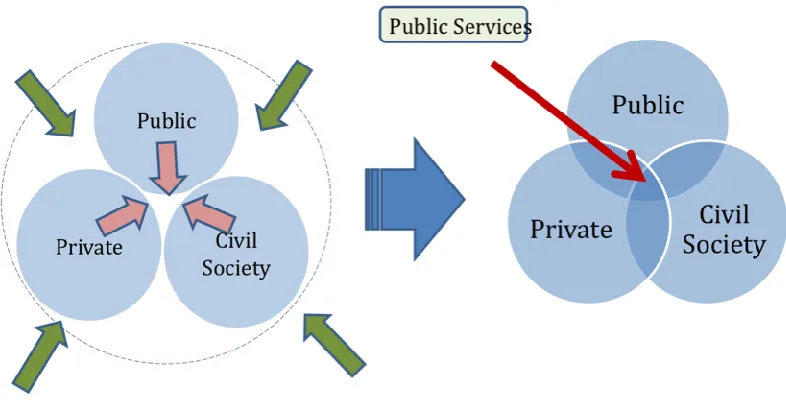
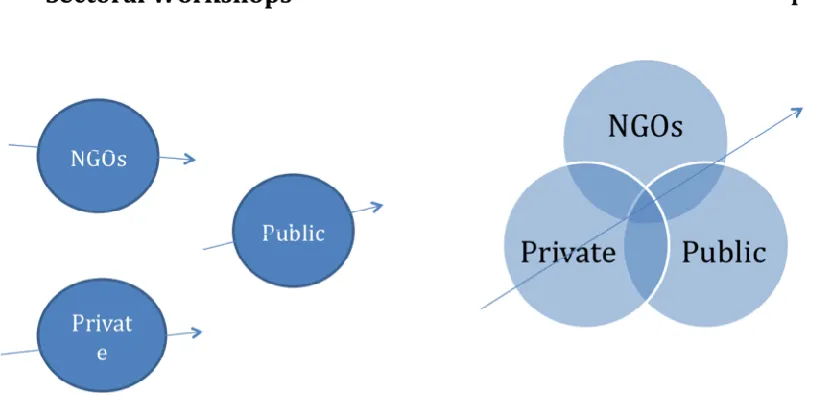
Figure 1- Process of study: the transition from individual or sector work, to collective work, as a complex dynamical construct.
To explore this assumption, this research uses a complex dynamical systems
theory approach, and related ideas from complexity theory, as an analytical and
explanatory framework for the study of inter-sector partnership processes. The
application of this framework addresses three research questions. The first research
question is: what are the complex dynamics behind the inter-sector collaboration
process of each case of study? This question aims to explore the applicability of a
complex dynamic systems approach as an explanatory framework of two different
empirical processes of collaboration. Additionally, the aim of this question is to
provide two examples of scenarios that describe the mechanisms and processes that
drive the complex dynamics of these experiences. A subsidiary question is: how do
the various agents institutional backgrounds4 involved in these processes influence their journeys towards collaboration? This question attempts to address both the
processes common to all types of agents involved in the collaborative process as well
as the specificities of each type of agent. The second research question is: what are
the generic principles that contribute to the construction of inter-sector partnerships
from a complex dynamical systems approach? This question aims to draw out both a
common construction and evolution process of inter-sector collaborations among the
4
cases of study, and the common complex mechanisms and principles behind this
pattern.
This research is based on the analysis of two empirical case studies that reflect
two different processes of inter-sector collaboration in two different countries. To
understand the patterns underlying a particular complex behaviour, dissimilar features
need to be considered for the purpose of comparison (Holland 1995). The ultimate
goal of this research is to provide a reference point that contributes to advancing the
understanding and appraising of social change as complex dynamical systems. Here
social change is understood in a broad sense, as social processes of any kind and not
just in terms of sustainability. Furthermore, this research aims to provide an
innovation approach to existing research by bringing more comprehensive answers to
current challenges of our societies.
The thesis moves from this introductory discussion to presenting complex
dynamical systems theory and related ideas from complexity theory in Chapter 2. This
section starts offering a definition of what a ‘complex system’ is, the different terms
used in the literature and the various disciplines that have shaped this interdisciplinary
field of enquiry. An overview of the various waves that systems’ ideas have had in the
domain of social science is presented. In this chapter the main concepts of complex
dynamical system theory and related ideas that drive the dynamics of change in the
two social systems of study are presented. These are: self-organisation, emergence,
co-evolution and self-organised criticality. Finally, this section describes the various
types of complex behaviour – ordered regime, chaotic behaviour and edge of chaos -
and introduces the main properties of complex adaptive systems according to John
Holland. Examples of how these concepts serve to explain the behaviour observed in
the empirical data are provided. The major criticisms that the transfer of ideas from
the sciences of complexity to the social arena are also noted in this chapter; and the
innovations that this research includes to overcome them are presented.
Chapter 3 introduces the methodology design and strategy used in undertaking
this research. This chapter argues that a new methodology approach is necessary, one
that moves away from both the discipline approaches traditionally used to study
inter-organisation collaboration and the modelling tools normally used in the field of
complexity sciences. This chapter presents and argues that a qualitative approach in
the use of complexity theory that includes some specific innovations seems the most
methodology strategy based on various stages of inductive and deductive work, case
studies and empirical research is then presented. This work refers to this methodology
strategy as ‘qualitative dynamical modelling’. The selection of the methods for data
collection, participatory inquiry and semi-structured interviews, is discussed. The
analytical framework and structure for data processing and analysis based on various
levels of analysis and cross-examination of case studies is introduced. Finally, this
chapter examines the difficulties and limitations of this methodological approach and
reviews the ethical issues involved in undertaking this research.
The fourth chapter presents the first case study, the creation and evolution
process of the Mandú Alliance in Brazil. This chapter presents the Mandú Alliance as
a multi-stakeholder collaboration between the Piauí Federal University, EMBRAPA5, Flora Vida Institute6 and CARE Brazil7. This inter-sector partnership was created to promote professional opportunities for young people in the coastal communities of
Piauí State, northeast Brazil. This chapter presents the background information of this
cases study and examines the main events that have enabled or hindered the
collaboration process, and their causes. The journey and challenges that the
institutions from the various sectors involved (public, private and non-for-profit)
faced when engaging in collaborative work are included. Ultimately, this chapter
presents empirical evidence of how this collaborative process increases the
adaptability of the community to change.
Chapter 5 presents the Mandú Alliance case study from a complex dynamical
systems perspective. This chapter is structured in two parts. The first part presents the
analysis of the dynamics behind the emergence of the Mandú Alliance and its
collective behaviour at a macro level within the system. This section starts featuring
the starting conditions of the system that enabled this collaborative process to emerge.
It then investigates the various mechanisms that allow this research to explain the
emergence of the Mandú Alliance: self-organisation, co-evolution and emergence,
and how they are intertwined. The second part examines the dynamics at a micro level
or agent level. Here, the adaptation process, changes in the agents’ internal
5
EMBRAPA is the Brazilian Public Research Enterprise for Agricultural and Livestock.
6
The Flora Vida Institute is the local branch of the chemical company Vege Flora Group.
7
configuration (attributes and attitudes), and changes in the organisation structure and
dynamic are analysed for each agent. Finally, this chapter analyses what capacity the
new regime (inter-sector partnership) has built into the system both at an agent and
community level.
Chapter 6 introduces the second case study, the multi-stakeholder process to
build an integrated water management plan for the Quito Metropolitan Area (QMQ),
in Ecuador. It describes the creation of the Fund for the Protection of Water
Resources (FONAG) and the effort made by multiple water users to collectively
construct a new governance model and plans to better manage water resources in this
region. The main participants in this process are the created Fund for the Preservation
of Water Resources (FONAG), government agencies at a national level (SENAGUA-
Water Secretariat; Secretariat for the Environment; MIDUVI- Ministry of Urban
Development and Habitation), the public enterprise for water provision in the urban
area of Quito (EMAAP-Q); local level structures of water management
(Municipalities, Water Councils; Drinking Water Councils); intermediate
organisations (FFLA, Randi Group), and the academy (Salesian University).
Chapter 7 presents the analysis of the Quito experience in creating an
integrated water management plan presented in the former chapter from a complex
dynamical systems perspective. Similarly to the former analytical chapter (5), this
chapter is spilt in two parts. The first part explores the mechanisms and procedures
that explain the process of interaction and collective construction presented in the
former chapter. The second part examines the mechanisms and sub-processes that lie
behind agents’ interactions at a lower level (micro level) and that explain the process
(meso level) and the properties observed at a macro level. This chapter, unlike the
former analytical chapter, examines the dynamics by social sector. These are: public
sector, community representatives and private sector. Here, the two elements of
analysis are what the changes are occurring in the sector dynamic and structure during
the process of study, how the connectivity of the sector with the rest of the system has
shifted, and what changes have happened in the governance model of each sector.
The following Chapter (8) presents a cross-comparison of the two case studies
explored above. This comparative analysis examines the similarities and differences
between the two processes studied. This aims at identifying both common patterns in
relation to the dynamics of collaboration and also to the complex principles that lie
analytical chapters. First, it gives an overview of the mechanisms that explain the
emergence of collective properties in the systems studied. Here the mechanisms
examined are: gap formation and niche opportunity, the emergence of
inter-connectivity, the influence of path-dependence and historicity in the systems’
dynamics, co-evolutionary dynamics, inter-sector partnerships as a poised state,
properties of the complex regime (resilience and robustness), emergence as a
dynamical construct and a phase transition and self-organised criticality. The second
part explores the similarities and differences elements from a micro level or agent
perspective. In this section, the elements discussed are the agents’ specialisation
process, the agents’ distribution in the system network, and the influence of the
institutional background in the fitness distribution.
A final chapter, the conclusion, summarises the main arguments and insights
from each chapter. This section also examines the answers that the research outcomes
provide to the research questions. Additionally, unexpected outcomes from this
research relevant to a better understanding of the former insights and complex social
behaviour are also presented. This section also analyses the applicability and
limitations of complex dynamical systems theory as an explanatory framework for
studying the dynamics of social change such as inter-sector collaboration processes.
Finally, the main practical implications of this research approach and research work
Chapter 2
Complexity Theory
Introduction
No one really knows how a community of social entities - such as ants, termites, and
human beings - come together to collectively build an elaborate structure that
increases the probability of survival for the community as a whole. Equally unknown
is how the intricate machinery of the immune system fights disease; how a group of
cells organises itself to be an eye or a brain; how independent members of an
economy, each working chiefly for his/her own gain produce complex but structured
global markets; or, most mysteriously, how the phenomena we call ‘intelligence’ and ‘consciousness’ emerge from non-intelligent, non-conscious material substrates
(Mitchell 2009).
These topics are the focus of the interdisciplinary field of research known as
complexity theory. This theory seeks to explain complex systems - how large
numbers of relatively simpler entities organise themselves without the benefit of any
central controller into a collective whole that uses information, creates patterns and, in
some cases, evolves and learns (Kauffman 1995; Castellani and Hafferty 2009;
Mitchell 2009). According to Mitchell (2009: 4), “the word complex comes from the Latin root plectere: to weave, entwine”. The concept of system is defined by Buckley (1998: 35) as “a complex of elements or components directly or indirectly related in a
network of interrelations of various kinds, such that it constitutes a dynamic whole
with emergent properties”. In complex systems, many simple parts are irreducibly
entwined, and the field of complexity is itself an entwining of many different fields
(Lewin 1999: Waldrop 1992, Mitchell 2009).
While there is not a unified definition of a complex system, Melanie Mitchell,
author of the first effort to encompass the main ideas of complexity in her book
components included in other definitions: “a complex system is a system in which
large networks of components with no central control and simple rules operation give
rise to complex collective behaviour, sophisticated information processing, and
adaptation via learning or evolution”.
Literature in this field sometimes uses indistinctively the terms complex
adaptive systems, complex evolving system or complex co-evolving systems to refer to the same system. This indicates the strategy that the system plays in the response to
environmental changes: adaptation, evolution and co-evolution (Mitchell 2009,
Castellani and Hafferty 2009). There are other kinds of complex systems that do not
show any particular strategy in response to their environment, such as hurricane or
turbulent rushing rivers. These systems are called non-adaptive complex systems. These kinds of systems are not the focus of this research; hence their functioning is
not considered in this chapter.
This range of names to refer to complex systems reflects the range of concepts
and terms that encompass complexity theory. In fact, as emphasised by several
authors, there is not one single theory of complexity but several theories arising from
various disciplines of natural sciences studying complex systems, such as physics,
biology, mathematics, chemistry (Castellani and Hafferty 2009, Mitleton-Kelly
2003a, Sawyer 2005). The main core ideas of the so-called complexity theory stems
mainly from the work undertaken over the past five decades by scientists associated
with the Santa Fe Institute (Santa Fe, New Mexico, USA) and particularly that of
Stuart Kauffman (1993, 1995, 2000), John Holland (1995, 1998), Chris Langton
(Waldrop 1992) and Murray Gell-Mann (1994) on complex adaptive systems.
Although this is considered the birthplace of complexity science (Lewin 1992;
Waldrop 1992), the ideas of complexity theory build upon the former development of
general system theory and cybernetics, back in the 1940s and 1950s (for a map with
the chronology of complexity science see Castellani and Hafferty 2009).
Scholars from Europe, however, have also made a significant contribution to
the development of complexity theory. The main example of this is the Nobel Prize
work of Ilya Prigogine on dissipative structures; Humberto Maturana, Francisco
Varela and Niklaus Luhmann’s (1995) research on autopoeisis; the work of Gleick (1987) on chaos theory; Brian Arthur’s contribution to economics (1994, 1997, 2013)
illustrate the role that not just scientists from the natural sciences play, but also that of
those from the social sciences and the important role that they have played in the
advance of complexity science, as explained below in this chapter. This also reflects
the increasing number of scholars that consider the advances of complex dynamic
system theory as a well-suited theoretical framework for sociological explanation
(Luhmann 1995; Maturana and Varela 1980; Sawyer 2005; Mitleton-Kelly 2003a;
Allen 1998; Castellani and Hafferty 2009; Marion, 1999).
The general picture of inter-sector partnerships (ISPs) drawn in the
Introduction shows how these collaborative processes exhibit features of complex
systems, as per the evidence provided by the theories traditionally used for their
study. These theories, however, have failed not just to address the study of ISPs
considering all these variables together and their interactions, but also to take into
account the own nature of society as a complex system and how its dynamic shapes
these collaborative processes. This research seeks to advance the use of complexity
theory in the field of social science by considering society as a complex dynamical
system and using complex dynamic system theory and other related ideas from the
field of complexity theory, to study the construction and evolution process of
inter-sector partnerships.
To achieve this goal, this chapter outlines first the history of complexity
theory in social science. Secondly it reviews the major criticisms made of this transfer
of ideas and the main considerations that this research has included to overcome such
criticisms. A third section frames the main ideas of so called ‘Complex Adaptive Systems Theory’ or ‘Complex Dynamic Systems Theory’, mainly through the work of its main theoretical author, Stuart Kauffman (1993, 1995, 2000). This section also
introduces other ideas stemming from the field of complexity theory that were
relevant to explain the complex behaviour observed in the two case studies that
comprise this research. A final section presents the most comprehensive compilation
of properties common to all complex adaptive systems that also support the analysis
of the empirical data as presented in the three analytical chapters of this research