Staphylococcus pseudintermedius
from Dogs and Cats
Kristina Kadlec,aStefan Schwarz,aRichard V. Goering,bJ. Scott Weesec
Institute of Farm Animal Genetics, Friedrich-Loeffler-Institut, Neustadt-Mariensee, Germanya; Department of Medical Microbiology and Immunology, Creighton University School of Medicine, Omaha, Nebraska, USAb; Department of Pathobiology, University of Guelph, Guelph, Ontario, Canadac
Methicillin-resistantStaphylococcus pseudintermedius(MRSP) has emerged in a remarkable manner as an important problem in dogs and cats. However, limited molecular epidemiological information is available. The aims of this study were to apply di-rect repeat unit (dru) typing in a large collection of well-characterized MRSP isolates and to usedrutyping to analyze a collection of previously uncharacterized MRSP isolates. Two collections of MRSP isolates from dogs and cats were included in this study. The first collection comprised 115 well-characterized MRSP isolates from North America and Europe. The data for these isolates included multilocus sequence typing (MLST) and staphylococcal protein A gene (spa)typing results as well as SmaI macro-restriction patterns after pulsed-field gel electrophoresis (PFGE). The second collection was a convenience sample of 360 isolates from North America. Thedruregion was amplified by PCR, sequenced, and analyzed. For the first collection, the discriminatory indices of the typing methods were calculated. All isolates were successfullydrutyped. The discriminatory power fordrutyping (Dⴝ0.423) was comparable to that ofspatyping (Dⴝ0.445) and of MLST (Dⴝ0.417) in the first collection. Occasionally,dru
typing was able to further discriminate between isolates that shared the samespatype. Among all 475 isolates, 26 differentdru
types were identified, with 2 predominant types (dt9a and dt11a) among 349 (73.4%) isolates. The results of this study underline thatdrutyping is a useful tool for MRSP typing, being an objective, standardized, sequence-based method that is relatively cost-efficient and easy to perform.
M
ethicillin-resistantStaphylococcus pseudintermedius(MRSP) is a canine-adapted, multidrug-resistant opportunistic patho-gen that has emerged and disseminated internationally in recent years (1–3). First reported in the mid 1990s as methicillin-resistantStaph-ylococcus intermedius(4), MRSP is now a leading cause of
oppor-tunistic infections, such as pyoderma, otitis, and surgical site in-fections, in dogs in many geographical regions (5–7).
To date, only limited molecular epidemiological information is available. For MRSP, different typing methods have been used (1, 8), with no consensus approach. Ideally, a sequence-based method that can be standardized across laboratories and that is discriminatory, repeatable, objective, economically viable, and practical would be used. Multilocus sequence typing (MLST) ofS.
pseudintermedius(9) is sometimes used, as it is standardized and
provides good discriminatory power, but it is costly and time con-suming. Pulsed-field gel electrophoresis (PFGE) (1,10) is a pat-tern-based method that not only requires expensive equipment and laboratory skills but also has limitations in interlaboratory comparison and throughput. Sequence analysis of the X region of the staphylococcal protein A gene (spatyping) (11,12) has advan-tages in objectivity and interlaboratory comparison, yet there are problems with its ability to type all isolates and with the current lack of an automated system to interpret sequences. More re-cently, sequence analysis of the direct repeat unit (dru), a variable-number-of-tandem-repeats region, which consists of mostly 40-bpdrurepeats and is located downstream of themecAgene and adjacent to IS431 in SCCmec elements of methicillin-resistant staphylococci, has been described (13). This sequence-based method has advantages of ease of performance, low cost, inter-laboratory reproducibility, objectivity, automated sequence anal-ysis, and no need for reference strains. Therefore, it could be a useful tool for typing of MRSP.
The objectives of this study were to test the usefulness ofdru
typing of MRSP by application of this method to a well-character-ized collection of MRSP isolates and to usedrutyping for the comparative analysis of a larger collection of uncharacterized MRSP isolates.
MATERIALS AND METHODS
Bacterial isolates.Two test collections were used for this study. The first collection to investigate whetherdrutyping is a suitable typing method for MRSP comprised 115 well-characterized MRSP isolates from dogs (n⫽
103) and cats (n⫽12). These 115 MRSP isolates from North America and Europe had previously been characterized by SCCmectyping, MLST,spa
typing, and PFGE of SmaI-digested whole-cell DNA (1,2). The second collection was a convenience sample of 360 MRSP isolates from Canada (n⫽287) or the United States (n⫽73). They originated from dogs (n⫽
352) or cats (n⫽8) and were from colonizations (n⫽198; mainly rectal [n⫽98] or nasal [n⫽94] swabs) or from infections (n⫽162; mainly skin infections [n⫽105]).
Methods.Isolates were characterized bydrutyping, as previously de-scribed (13,14). In brief, performance ofdrutyping is similar to that ofspa
typing, with PCR amplification of the variabledruregion followed by sequence analysis of thedruamplicon and identification of thedrurepeat order. Thedrurepeat order determines thedrutype. Adrudatabase (http:
Received8 July 2015 Returned for modification6 August 2015
Accepted6 September 2015
Accepted manuscript posted online16 September 2015
CitationKadlec K, Schwarz S, Goering RV, Weese JS. 2015. Direct repeat unit (dru) typing of methicillin-resistantStaphylococcus pseudintermediusfrom dogs and cats. J Clin Microbiol 53:3760 –3765.doi:10.1128/JCM.01850-15.
Editor:B. W. Fenwick
Address correspondence to Kristina Kadlec, [email protected].
Copyright © 2015, American Society for Microbiology. All Rights Reserved.
doi:10.1128/JCM.01850-15
on May 16, 2020 by guest
http://jcm.asm.org/
//dru-typing.org) was established and enables comparisons with thedru
sequences anddrutypes stored in this database.
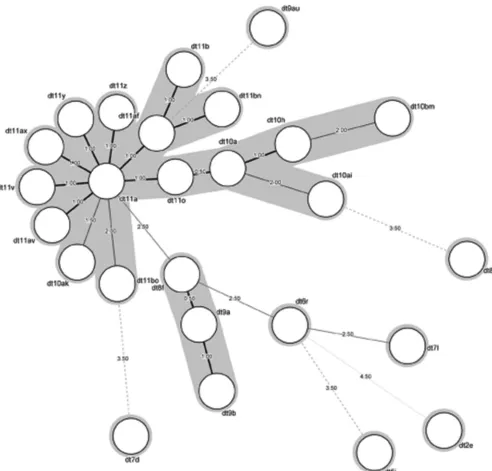
The discriminatory indices for the different typing methods used for the first collection of isolates were calculated as previously described (15). A minimum spanning tree (MST) was generated using BioNumerics v6.6 (Applied Maths, Austin, TX, USA) and the tandem-repeat sequence typ-ing (TRST) plugin. Distance intervals were created ustyp-ing a bin distance of 1.0%. Thedrutypes separated by a MST distance ofⱕ2 repeats (⬎98.5% similarity) were considered closely related and assigned to the same clus-ter. The root node was assigned to the multilocus sequence type (ST) with the greatest number of isolates. Descriptive statistics were applied. Cate-gorical comparisons were performed using Fisher’s exact test or the chi-square test. APvalue of⬍0.05 was considered significant.
RESULTS
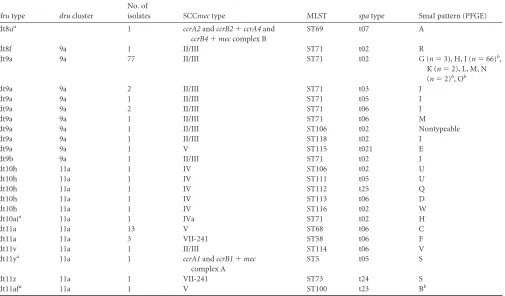
MRSP collection 1.All 115 isolates were successfullydrutyped, and 11 differentdrutypes were identified: dt8u, dt8f, dt9a, dt9b, dt10h, dt10ai, dt11a, dt11v, dt11y, dt11z, and dt11af. Among them, four noveldrutypes (dt8u, dt10ai, dt11y and dt11af) were detected and added to thedrutyping database (Table 1). In addi-tion, dt10ai harbored two noveldrurepeats. Thedrutypes dt9a (n⫽86; 74.8%) and dt11a (n⫽16; 13.9%) were most common. The
drutype dt9a was mainly detected in isolates from Europe with the characteristics II-III(SCCmec)-ST71(MLST)-t02(spa type)-J(S-maI-PFGE) (n⫽66; 57.4%)—representing the European clone— but also were detected in single isolates with other MLST types (ST106, ST118) orspatypes (t03, t05, t06) or PFGE patterns (G, K, H, L, M, N, O) as well as in one isolate with V-ST115-t021-E (1,2).
Single isolates belonging to the most common clone, II-III-ST71-t02-J, harboreddrutypes dt8f or dt9b. In contrast, all 13 isolates belonging to the North American clone with V-ST68-t06-C har-bored dt11a. Thisdrutype was only present in three additional isolates, all of which were VII-241-ST58-t06-F. Thedrutype dt10h was present in five isolates with SCCmectype IV elements and with different MLST, spa, and PFGE types (ST106-t02-U, ST111-t05-U, ST112-t25-Q, ST113-t06-D, ST116-t02-W). The remain-ingdrutypes were present only in single isolates with individual characteristics. The 12 MRSP isolates from cats belonged to the European clone withdrutype dt9a (n⫽9) or had only other PFGE types (N, O;n⫽1 each), with the same characteristics (II-III-ST71-t02-dt9a) (2). A single feline isolate with V-ST100-t23-B had the noveldrutype dt11af. The remaining three novel types were found in single isolates with individual characteristics, in-cluding two nontypeable SCCmeccassettes (ccrA1andccrB1⫹ mectype A andccrA2andccrB2⫹ccrA4andccrB4⫹mectype B)
(Table 1).
Two maindruclusters were identified and were designated clus-ters 9a and 11a, as dt9a and dt11a, respectively, formed the root nodes. Cluster 9a consisted of the types dt9a, dt9b, and dt8f, whereas sixdrutypes belonged to the cluster 11a (Table 1). There was a signif-icant association betweendru cluster and MLST type; ST71 ac-counted for 85 of 88 (95.6%) cluster 9a isolates and only 1 of 27 (3.7%) noncluster 9a isolates (P⬍0.0001). This single ST71 isolate withdrutype dt10ai belonged to cluster 11a. There was more
vari-TABLE 1Characteristics of collection 1 of canine and feline methicillin-resistantStaphylococcus pseudintermediusisolates (n⫽115)
drutype drucluster
No. of
isolates SCCmectype MLST spatype SmaI pattern (PFGE)
dt8ua 1 ccrA2andccrB2⫹ccrA4and
ccrB4⫹meccomplex B
ST69 t07 A
dt8f 9a 1 II/III ST71 t02 R
dt9a 9a 77 II/III ST71 t02 G (n⫽3), H, J (n⫽66)b,
K (n⫽2), L, M, N (n⫽2)b, Ob
dt9a 9a 2 II/III ST71 t03 J
dt9a 9a 1 II/III ST71 t05 J
dt9a 9a 2 II/III ST71 t06 J
dt9a 9a 1 II/III ST71 t06 M
dt9a 9a 1 II/III ST106 t02 Nontypeable
dt9a 9a 1 II/III ST118 t02 J
dt9a 9a 1 V ST115 t021 E
dt9b 9a 1 II/III ST71 t02 J
dt10h 11a 1 IV ST106 t02 U
dt10h 11a 1 IV ST111 t05 U
dt10h 11a 1 IV ST112 t25 Q
dt10h 11a 1 IV ST113 t06 D
dt10h 11a 1 IV ST116 t02 W
dt10aia 11a 1 IVa ST71 t02 H
dt11a 11a 13 V ST68 t06 C
dt11a 11a 3 VII-241 ST58 t06 F
dt11v 11a 1 II/III ST114 t06 V
dt11ya 11a 1 ccrA1andccrB1⫹mec
complex A
ST5 t05 S
dt11z 11a 1 VII-241 ST73 t24 S
dt11afa 11a 1 V ST100 t23 Bb
aThese were noveldrutypes, detected for the first time within this study. b
The feline MRSP isolates belonged to these types, with nine isolates showing II-III(SCCmec)-ST71(MLST)-t02(spatype)-J(SmaI-PFGE) and single isolates with the same characteristics but displaying SmaI patterns L, M, N, and O.
on May 16, 2020 by guest
http://jcm.asm.org/
[image:2.585.42.547.79.375.2]ability within cluster 11a, but there was a significant association with ST68, as ST68 accounted for 13 of 26 (50.0%) cluster 11a isolates and for no noncluster 11a isolates (P⬍0.0001).
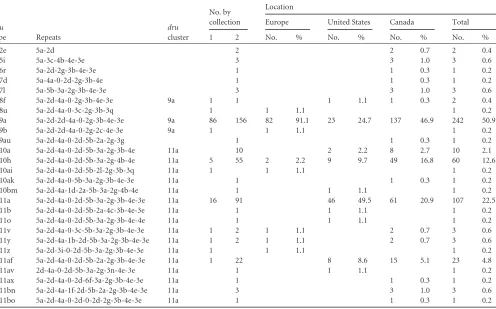
The discriminatory power of dru typing was 0.423, which means that two randomly selected isolates from this test popula-tion could be assigned to differentdrutypes with a probability of 42.3%. In comparison, the discriminatory indices of the other sequence-based typing methods were 0.445 forspa typing and 0.417 for MLST. In contrast, SCCmectyping had a discriminatory power of 0.397, and SmaI digestion with subsequent PFGE, 0.635. MRSP collection 2. Among the isolates collected in North America from cats (n⫽8) or dogs (n⫽352), 22 differentdru
types were identified (Table 2). The drutypes dt9a (n ⫽ 156; 43.3%) and dt11a (n⫽91; 25.3%) were most frequent, and dt10h (n⫽55; 15.3%), dt11af (n⫽22; 6.1%), and dt10a (n⫽10; 2.8%) accounted for other relatively common types. In contrast, few isolates had dt5i (n⫽3), dt7l (n⫽3), dt11bn (n⫽3), dt2e (n⫽
2), dt11y (n⫽2), or dt11v (n⫽2); the remaining 11drutypes (dt6r, dt7d, dt8f, dt9au, dt10ak, dt10bm, dt11av, dt11ax, dt11b, dt11bo, and dt11o) were detected only in single isolates.
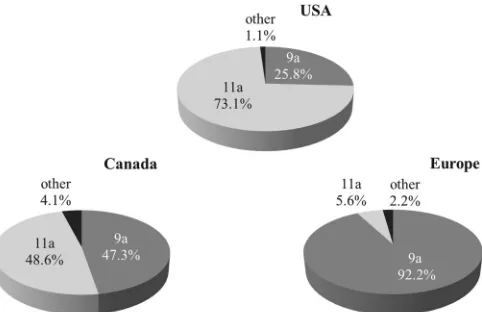
Combined collections.When looking at isolates from both collections, 26 differentdrutypes were identified, with two pre-dominant types (dt9a and dt11a) accounting for 349 (73.4%) of the 475 isolates. The twodruclusters, 9a and 11a, accounted for 460 (96.9%) isolates (Fig. 1). There were significant differences in the distribution ofdrutypes between regions, with cluster 9a pre-dominating in Europe, cluster 11a prepre-dominating in the United States, and a similar distribution of the two clusters in Canada
(Fig. 2). The second-most-commondrutype in cluster 11a was
dt10h, adrutype that was overrepresented in Canada. Forty-nine of 60 (81.7%) dt10h isolates were from Canada, with nine from the United States and two from Europe. The prevalence of thisdru
type in Canada (49 of 292; 16.8%) far exceeded that elsewhere (11 of 183; 6.0%;P⬍0.001). Except for a singledrutype (dt9au), the majordrutypes seen in canine isolates, dt11a and dt9a, were also present among the feline MRSP isolates (n⫽5 andn⫽2, respec-tively). No significant differences between thedrutypes found in dogs versus cats were detectable (P⫽0.17).
DISCUSSION
Molecular typing is an important tool for studying the emergence and dissemination of pathogens, from local to international levels. Various typing methods are available for bacterial pathogens, with differences in discriminatory power, reproducibility, cost, ease of performance, and objectivity. An ideal method would be a rapid, low-cost method that is able to type all isolates, provides repeat-able results, is objective (e.g., does not rely on visual assessment of DNA fragment patterns), and allows multiple laboratories to gen-erate the same results without the need to exchange reference strains. Based on the results of this study,drutyping appears to be a convenient, objective, and discriminatory typing method for MRSP. All isolates were successfully typed, allowing for good dis-criminatory power, with 26 differentdrutypes identified in the entire study population.
[image:3.585.48.544.78.387.2]Although much higher discriminatory indices (D) were rec-ommended by Hunter and Gaston (15), the comparison of results
TABLE 2Distribution ofdrutypes among all canine and feline methicillin-resistantStaphylococcus pseudintermediusisolates (n⫽475)
dru
type Repeats
dru
cluster
No. by collection
Location
Europe United States Canada Total 1 2 No. % No. % No. % No. %
dt2e 5a-2d 2 2 0.7 2 0.4
dt5i 5a-3c-4b-4e-3e 3 3 1.0 3 0.6
dt6r 5a-2d-2g-3b-4e-3e 1 1 0.3 1 0.2
dt7d 5a-4a-0-2d-2g-3b-4e 1 1 0.3 1 0.2
dt7l 5a-5b-3a-2g-3b-4e-3e 3 3 1.0 3 0.6
dt8f 5a-2d-4a-0-2g-3b-4e-3e 9a 1 1 1 1.1 1 0.3 2 0.4
dt8u 5a-2d-4a-0-3c-2g-3b-3q 1 1 1.1 1 0.2
dt9a 5a-2d-2d-4a-0-2g-3b-4e-3e 9a 86 156 82 91.1 23 24.7 137 46.9 242 50.9 dt9b 5a-2d-2d-4a-0-2g-2c-4e-3e 9a 1 1 1.1 1 0.2 dt9au 5a-2d-4a-0-2d-5b-2a-2g-3g 1 1 0.3 1 0.2 dt10a 5a-2d-4a-0-2d-5b-3a-2g-3b-4e 11a 10 2 2.2 8 2.7 10 2.1 dt10h 5a-2d-4a-0-2d-5b-3a-2g-4b-4e 11a 5 55 2 2.2 9 9.7 49 16.8 60 12.6 dt10ai 5a-2d-4a-0-2d-5b-2l-2g-3b-3q 11a 1 1 1.1 1 0.2 dt10ak 5a-2d-4a-0-5b-3a-2g-3b-4e-3e 11a 1 1 0.3 1 0.2 dt10bm 5a-2d-4a-1d-2a-5b-3a-2g-4b-4e 11a 1 1 1.1 1 0.2 dt11a 5a-2d-4a-0-2d-5b-3a-2g-3b-4e-3e 11a 16 91 46 49.5 61 20.9 107 22.5 dt11b 5a-2d-4a-0-2d-5b-2a-4c-3b-4e-3e 11a 1 1 1.1 1 0.2 dt11o 5a-2d-4a-0-2d-5b-3a-2g-3b-4e-4e 11a 1 1 1.1 1 0.2 dt11v 5a-2d-4a-0-3c-5b-3a-2g-3b-4e-3e 11a 1 2 1 1.1 2 0.7 3 0.6 dt11y 5a-2d-4a-1b-2d-5b-3a-2g-3b-4e-3e 11a 1 2 1 1.1 2 0.7 3 0.6 dt11z 5a-2d-3i-0-2d-5b-3a-2g-3b-4e-3e 11a 1 1 1.1 1 0.2 dt11af 5a-2d-4a-0-2d-5b-2a-2g-3b-4e-3e 11a 1 22 8 8.6 15 5.1 23 4.8 dt11av 2d-4a-0-2d-5b-3a-2g-3n-4e-3e 11a 1 1 1.1 1 0.2 dt11ax 5a-2d-4a-0-2d-6f-3a-2g-3b-4e-3e 11a 1 1 0.3 1 0.2 dt11bn 5a-2d-4a-1f-2d-5b-2a-2g-3b-4e-3e 11a 3 3 1.0 3 0.6 dt11bo 5a-2d-4a-0-2d-0-2d-2g-3b-4e-3e 11a 1 1 0.3 1 0.2
on May 16, 2020 by guest
http://jcm.asm.org/
with other methods is important both to compare discriminatory power and to identify discrepancies that might indicate the poten-tial for misleading results. This is of particular concern as the target ofdrutyping is part of a mobile genetic element, although the mobile element in this case (SCCmec) does not actually appear to be highly mobile given its large size and the apparent clonal dissemination of MRSP. In this study, thedrutype dt9a was iden-tified mainly with SCCmectype II-III and in a single MRSP isolate with SCCmectype V, whereas the samedrutype was reported to be present with SCCmectype V inStaphylococcus aureus(16). In ad-dition, dt11a was present solely in methicillin-resistantS. aureus
with SCCmectype V (17,18); while it was predominantly found in MRSP with SCCmectype V, it was also present in three MRSP isolates with SCCmectype VII-241.
The presence of two main clones is consistent with recent re-ports (1-3,19), and, although there were clear differences in the regional distribution, data indicate that designating separate North American and European clones (1) may not be completely accurate. While these data indicate that the ST71-associated 9a cluster is dominant among European isolates, the ST68-associated 11a cluster was not equally dominant in North America. Indeed, clusters 11a and 9a were equally prevalent in Canada, with the Canadian distribution representing a hybrid of American-domi-nant and European-domiAmerican-domi-nant strains. Considering the wide-spread distribution of the ST71-associateddrucluster 9a, it may be more appropriately termed an international clone rather than a European clone.
The difference between Canadian and American isolates is
in-FIG 1Minimum spanning tree (MST) of the 26drutypes identified in methicillin-resistantStaphylococcus pseudintermediusfrom dogs and cats (n⫽475).
on May 16, 2020 by guest
http://jcm.asm.org/
[image:4.585.45.537.64.535.2]teresting, and more differences are noted whendrutypes within cluster 11a are evaluated individually, based on the commonness of dt10h (49 of 292; 16.8%) and the relatively low prevalence of dt11a (61 of 292; 20.9%) in Canada compared to the United States (46 of 93; 49.5%). Type dt10h is somewhat of an outlier in cluster 11a, being only approximately 97.5% related to dt11a and the majority of cluster 11adrutypes, and one could argue that dt10h, along with dt10a and dt11o, should be classified as a separate group. If more discriminatory MST settings are applied (e.g., MST distance of 1) or if the population is assessed without the interme-diary dt10a/dt11o group, dt10h is removed from the 11a cluster. The variable MLST results from the small number of dt10h iso-lates that were tested also suggest that this type could be consid-ered separate from the 11a cluster.
It is interesting to see how widely thedrucluster 9a was dissem-inated among isolates from Canada, the United States, Denmark, Germany, Switzerland, Italy, the Netherlands, and Sweden. While less widely distributed, isolates of thedrucluster 11a were found in Canada, the United States, Denmark, the Netherlands, Germany, and Switzerland, and, with a recent report, from Australia (20). The apparent greater genetic variability among cluster 11a isolates than cluster 9a isolates was interesting, with 13 differentdrutypes among 207 cluster 11a isolates from six countries compared to only threedru types among 246 cluster 9a isolates from eight countries. The evolutionary biology of MRSP has received limited investigation, but a broader study of the population structure ofS.
pseudintermediusindicated that ST71 resided within a group of
linked STs, while ST68 was a singleton not closely related to any other ST (9). This suggests that ST68 may be a rather distinct and perhaps more genetically stable type compared to ST71, although a broader study of the population structure and evolutionary bi-ology of MRSP is needed.
While MLST was only performed on a subset of isolates, there was good agreement betweendrutyping and MLST. To determine the role ofdrutyping, broader studies incorporating epidemiolog-ical data need to be performed. However, this study shows thatdru
typing may be a potentially useful tool for MRSP typing, being an objective, standardized, sequence-based method that is relatively easy and cost-effective to perform.
This study is subject to some limitations. A large international
collection of isolates was studied, but, nonetheless, this is a popu-lation of convenience, and it is unclear whether it truly represents the broader population. Only a subset of the additional North American isolates was typed by MLST; however, adequate num-bers were evaluated to demonstrate an association between ST68 anddrucluster 11a, and between ST71 anddrucluster 9a.
Conclusion.The critical importance of MRSP as a canine pathogen, its apparently rapid international emergence, and the potential (albeit perhaps low) for zoonotic transmission (21–23) indicate a need for good molecular epidemiological studies at lo-cal, regional, and international levels. This requires a rapid, objec-tive, high-throughput, and cost-effective approach that can be applied in different laboratories without the need to exchange reference strains. The combination of the ability to successfully type all isolates, good discriminatory power, relative ease in per-formance, low cost, and objectivity (as a sequence-based method) makesdrutyping a potentially useful tool for MRSP research.
ACKNOWLEDGMENTS
We thank the MRSP enthusiasts—Vincent Perreten, Ulrika Grönlund Andersson, Maria Finn, Christina Greko, Arshnee Moodley, Stephen A. Kania, Linda A. Frank, David A. Bemis, Alessia Franco, Manuela Iurescia, Antonio Battisti, Birgitta Duim, Jaap A. Wagenaar, Engeline van Duijk-eren, J. Ross Fitzgerald, Alexandra Rossano, and Luca Guardabassi—for allowing us to use the collection of isolates, for helpful discussions, and for their enthusiasm.
We declare no conflicts of interest.
REFERENCES
1.Perreten V, Kadlec K, Schwarz S, Grönlund Andersson U, Finn M, Greko C, Moodley A, Kania SA, Frank LA, Bemis DA, Franco A, Iurescia M, Battisti A, Duim B, Wagenaar JA, van Duijkeren E, Weese JS, Fitzgerald JR, Rossano A, Guardabassi L.2010. Clonal spread of methicillin-resistant Staphylococcus pseudintermediusin Europe and North America: an international multicentre study. J Antimicrob Che-mother65:1145–1154.http://dx.doi.org/10.1093/jac/dkq078.
2.Kadlec K, Schwarz S, Perreten V, Grönlund Andersson U, Finn M, Greko C, Moodley A, Kania SA, Frank LA, Bemis DA, Franco A, Iurescia M, Battisti A, Duim B, Wagenaar JA, van Duijkeren E, Weese JS, Fitzgerald JR, Rossano A, Guardabassi L.2010. Molecular analysis of methicillin-resistantStaphylococcus pseudintermediusof feline origin from different European countries and North America. J Antimicrob Che-mother65:1826 –1828.http://dx.doi.org/10.1093/jac/dkq203.
3.Ruscher C, Lübke-Becker A, Semmler T, Wleklinski CG, Paasch A, Soba A, Stamm I, Kopp P, Wieler LH, Walther B.2010. Widespread rapid emergence of a distinct methicillin- and multidrug-resistant Staphylococ-cus pseudintermedius(MRSP) genetic lineage in Europe. Vet Microbiol
144:340 –346.http://dx.doi.org/10.1016/j.vetmic.2010.01.008.
4.Piriz S, de la Fuente R, Valle J, Mateos E, Hurtado MA, Cid D, Ruiz-Santaquiteria JA, Vadillo S.1995. Comparativein vitroactivity of 11-lactam antibiotics against 91Staphylococcus intermediusstrains iso-lated from staphylococcal dermatitis in dogs. Zentralbl Veterinärmed B
42:293–300.
5.Beck KM, Waisglass SE, Dick HLN, Weese JS. 2012. Prevalence of meticillin-resistantStaphylococcus pseudintermedius(MRSP) from skin and carriage sites of dogs after treatment of their methicillin-resistant or methicillin-sensitive staphylococcal pyoderma. Vet Dermatol23:369 – 375.http://dx.doi.org/10.1111/j.1365-3164.2012.01035.x.
6.Bryan J, Frank LA, Rohrbach BW, Burgette LJ, Cain CL, Bemis DA.
2012. Treatment outcome of dogs with methicillin-resistant and methicil-lin-susceptibleStaphylococcus pseudintermediuspyoderma. Vet Dermatol
23:361–368.http://dx.doi.org/10.1111/j.1365-3164.2012.01034.x. 7.Turk R, Singh A, Weese J.2015. Prospective surgical site infection
surveil-lance in dogs. Vet Surg44:2– 8.http://dx.doi.org/10.1111/j.1532-950X.2014 .12241.x.
8.van Duijkeren E, Vatry B, Greko C, Moreno MA, Pomba MC, Pyörälä S, Ruzauskas M, Sanders P, Threlfall EJ, Torren-Edo J, Törneke K, FIG 2Assignment to the two maindruclusters among the
methicillin-resis-tantStaphylococcus pseudintermediusisolates from Canada (n⫽292), the United States (n⫽93), and Europe (n⫽90).
on May 16, 2020 by guest
http://jcm.asm.org/
[image:5.585.44.285.66.222.2]Scientific Advisory group on Antimicrobials (SAGAM).2011. Review on methicillin-resistantStaphylococcus pseudintermedius. J Antimicrob Che-mother66:2705–2714.http://dx.doi.org/10.1093/jac/dkr367.
9.Bannoehr J, Ben Zakour NL, Waller AS, Guardabassi L, Thoday KL, van den Broek AH, Fitzgerald JR.2007. Population genetic structure of theStaphylococcus intermediusgroup: insights intoagrdiversification and the emergence of methicillin-resistant strains. J Bacteriol189:8685– 8692.
http://dx.doi.org/10.1128/JB.01150-07.
10. Kadlec K, van Duijkeren E, Wagenaar JA, Schwarz S.2011. Molecular basis of rifampicin resistance in methicillin-resistantStaphylococcus pseudintermediusisolates from dogs. J Antimicrob Chemother66:1236 – 1242.http://dx.doi.org/10.1093/jac/dkr118.
11. Moodley A, Stegger M, Ben Zakour NL, Fitzgerald JR, Guardabassi L.
2009. Tandem repeat sequence analysis of staphylococcal protein A (spa) gene in methicillin-resistantStaphylococcus pseudintermedius. Vet Micro-biol135:320 –326.http://dx.doi.org/10.1016/j.vetmic.2008.09.070. 12. Nienhoff U, Kadlec K, Chaberny IF, Verspohl J, Gerlach GF,
Kreien-brock L, Schwarz S, Simon D, Nolte I.2011. Methicillin-resistant Staph-ylococcus pseudintermediusamong dogs admitted to a small animal hospi-tal. Vet Microbiol150:191–197.http://dx.doi.org/10.1016/j.vetmic.2010 .12.018.
13. Goering RV, Morrison D, Al-Doori Z, Edwards GF, Gemmell CG.2008. Usefulness ofmec-associated direct repeat unit (dru) typing in the epide-miological analysis of highly clonal methicillin-resistantStaphylococcus aureusin Scotland. Clin Microbiol Infect14:964 –969.http://dx.doi.org /10.1111/j.1469-0691.2008.02073.x.
14. Nienhoff U, Kadlec K, Chaberny IF, Verspohl J, Gerlach GF, Schwarz S, Kreienbrock L, Nolte I, Simon D.2011. Methicillin-resistant Staphy-lococcus pseudintermediusamong cats admitted to a veterinary teaching hospital. Vet Microbiol153:414 – 416.http://dx.doi.org/10.1016/j.vetmic .2011.05.045.
15. Hunter PR, Gaston MA.1988. Numerical index of the discriminatory ability of typing systems: an application of Simpson’s index of diversity. J Clin Microbiol26:2465–2466.
16. Bartels MD, Boye K, Oliveira DC, Worning P, Goering R, Westh H.
2013. Associations betweendrutypes and SCCmeccassettes. PLoS One
8:e61860.http://dx.doi.org/10.1371/journal.pone.0061860.
17. Feßler AT, Kadlec K, Hassel M, Hauschild T, Eidam C, Ehricht R, Monecke S, Schwarz S.2011. Characterization of methicillin-resistant
Staphylococcus aureusisolates from food and food products of poultry origin in Germany. Appl Environ Microbiol77:7151–7157.http://dx.doi .org/10.1128/AEM.00561-11.
18. Wendlandt S, Kadlec K, Feßler AT, Mevius D, van Essen-Zandbergen A, Hengeveld PD, Bosch T, Schouls L, Schwarz S, van Duijkeren E.
2013. Transmission of methicillin-resistantStaphylococcus aureusisolates on broiler farms. Vet Microbiol167:632– 637.http://dx.doi.org/10.1016/j .vetmic.2013.09.019.
19. Weese JS, Sweetman K, Edson H, Rousseau J.2013. Evaluation of minocy-cline susceptibility of methicillin-resistantStaphylococcus pseudintermedius. Vet Microbiol162:968 –971.http://dx.doi.org/10.1016/j.vetmic.2012.10 .002.
20. Siak M, Burrows AK, Coombs GW, Khazandi M, Abraham S, Norris JM, Weese JS, Trott DJ.2014. Characterization of methicillin-resistant and methicillin-susceptible isolates ofStaphylococcus pseudintermedius
from cases of canine pyoderma in Australia. J Med Microbiol63:1228 – 1233.http://dx.doi.org/10.1099/jmm.0.076117-0.
21. Kempker R, Mangalat D, Kongphet-Tran T, Eaton M.2009. Beware of the pet dog: a case ofStaphylococcus intermediusinfection. Am J Med Sci
338:425– 427.http://dx.doi.org/10.1097/MAJ.0b013e3181b0baa9. 22. van Duijkeren E, Kamphuis M, van der Mije IC, Laarhoven LM, Duim
B, Wagenaar JA, Houwers DJ. 2011. Transmission of methicillin-resistantStaphylococcus pseudintermediusbetween infected dogs and cats and contact pets, humans and the environment in households and veter-inary clinics. Vet Microbiol150:338 –343.http://dx.doi.org/10.1016/j .vetmic.2011.02.012.
23. Stegmann R, Burnens A, Maranta CA, Perreten V.2010. Human infec-tion associated with methicillin-resistantStaphylococcus pseudintermedius
ST71. J Antimicrob Chemother65:2047–2048.http://dx.doi.org/10.1093 /jac/dkq241.