Full Length Review Article
THE EFFECT OF TV ADVERTISING ON MUTUAL FUND BUYING BEHAVIOR: A STUDY
BASED ON AIDA MODEL
*Kishore Bhattacharjee and Rohit Kumar
Amity Global Business School, Patna- 01, Bihar, India
ARTICLE INFO ABSTRACT
The basic purpose of advertising is to attract attention among the consumers and to persuade them to take action. The main objective of this research is to investigate the effectiveness of TV advertising using the AIDA model for mutual fund products in the city of Patna. A cross sectional-descriptive design has been applied for this purpose and data have been collected from192 mutual fund investors from various areas of the city. It has been assumed that TV advertisements are not effective/ very effective in creating awareness, interest, desire or action among the viewers of mutual fund TV ads. The applicability of the AIDA has also been tested in the study. On the basis of extensive statistical analysis it has been found that the impact of TV ads is moderate for mutual fund products. Moreover the applicability of AIDA model in case of mutual fund products has been found positive. On the basis of such findings necessary suggestions have been made to make the TV ads for mutual fund products more effective.
Copyright©2016, Kishore Bhattacharjee and Rohit Kumar. This is an open access article distributed under the Creative Commons Attribution License, which permits unrestricted use, distribution, and reproduction in any medium, provided the original work is properly cited.
INTRODUCTION
In this globalized era of information explosion, advertisements play a crucial role in changing the behavior and attitude pattern of consumers towards the products or services. The advertisements not only change the way a product is consumed but also alter the attitude with which consumers look at the product. Advertisement is one of the popular means by which firms attempt to update, convince and remind consumers about the products and brands they sell. It is a good source to reach the geographically dispersed buyers. Among all the promotional tools, advertising is renowned for its long-term influence on viewer’s mind, as its exposure is much broader (Katke, 2007). To effectively reach and influence the target markets, holistic marketers are creatively employing multiple forms of advertisements by using various media. Media has a vital role in the process of advertising communication. Effective advertising is possible only if suitable media are available. The media scene has undergone rapid change in India in recent years. The expansion of the television network in India is of recent origin. Although the initial telecast was made from the Delhi Centre in 1959, advertisement broke out on television in January, 1976 for the first time (Mohan, 2008). Later on, the Media and Entertainment industry in India has shown an exponential growth over the years. It has given
*Corresponding author: Kishore Bhattacharjee,
Amity Global Business School, Patna- 01, Bihar, India.
impetus to the TV advertisements in India over the last few years and now it can be considered as one of the most popular advertisement media for most of the companies. The popularity of TV advertisement is rising day-by-day in the country and it is often called the "king" of the advertising media. Since there is a constant increase in TV channels and viewers, it has attracted the businesses to use this in their favor. This can be understood with some facts and figures (as per FICCI-KPMG report) as given below:
The spending on leisure and entertainment are greater
than the economic growth; this is a result of favorable demographics and increasing disposable incomes
The Media & Entertainment Industry in India is
expected to reach Rs.1,457 billion by 2016
The industry achieved a growth of 12% in 2011 and is
proposed to grow at a CAGR of 15 % over the next five years
The industry achieved a growth of 12% in 2011 and is
proposed to grow at a CAGR of 15 % over the next five years
Television advertising is simply the process of sending of promotional messages or media content to one or more potential program viewers. These viewers are swayed by the messages which results in actions that benefits the advertiser. The purpose of this mass advertisement via television is to
ISSN: 2230-9926
International Journal of Development Research
Vol. 06, Issue, 12, pp.10856-10861, December, 2016
International Journal of
DEVELOPMENT RESEARCH
Article History:
Received 09th September, 2016
Received in revised form 12th October, 2016
Accepted 24th November, 2016 Published online 30th December, 2016
Available online at http://www.journalijdr.com
Key Words:
gain attention of the consumers for the product, ensuring continued association with consumers or for the purpose of recall of their products and brands in customers’ mind. Moreover, the nature of advertisement changes as per the product category. High involvement products need a different advertising approach than that of low involvement products. Sukumar R, director and CIO-Equity, Franklin Templeton Investments once said "Branding of investment products such as mutual funds is unique because these are typically high-involvement products and largely intangible. The challenge is to make a credible, meaningful and attractive customer proposition" (Lohade, 2004).
This study attempts to consider the application of the advertising model AIDA, on consumer buying behavior for Mutual Fund products. Over the past few decades several models have been proposed to test the effectiveness of advertising. Still, AIDA model is most popular one (Barry &
Howard, 1990). To convince the buyer of a mutual fund
scheme is always a tough deal. The reason behind this could be the heavy amount of risk associated with it. Usually the higher potential return leads to higher potential risk as well. Literature reveals the fact that, it is always a systematic and step-by-step process to convince the customer where higher risk is involved in a buying decision. Literature also reveals that AIDA could be a solution for the marketers in this regard. So, this study is an attempt to measure the impact of TV adverting on mutual fund investors buying process based on AIDA model. The basic objective is to focus light on the impact of TV advertisement on mutual fund buyers/investor, i.e. how it could be helpful for the systematic process of creating awareness, developing interest, converting such interest into desire and ultimately making the customers purchase the scheme.
AIDA Model
The purpose of any advertisement is to grab attention, then to generate interest, to convince, so to create the belief. If an advertisement contains these three qualities of success, it is a
[image:2.595.75.248.540.685.2]successful advertisement (Lewis, 1899).
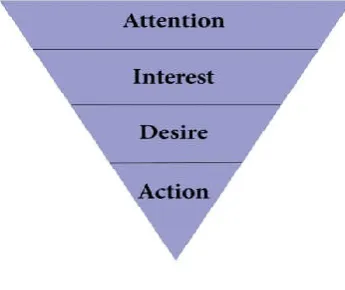
Figure 1. AIDA Model
AIDA is the acronym for Awareness Interest desire Action (Lombardo). This is an approach used in advertising to describe different phases of consumer association with an advertisement. The model was first developed by E.St. Elmo Lewis in 1898. AIDA is used in the field of marketing and advertising management. The model describes a common list of events that may occur when a consumer engages with an advertisement (see Figure 1).
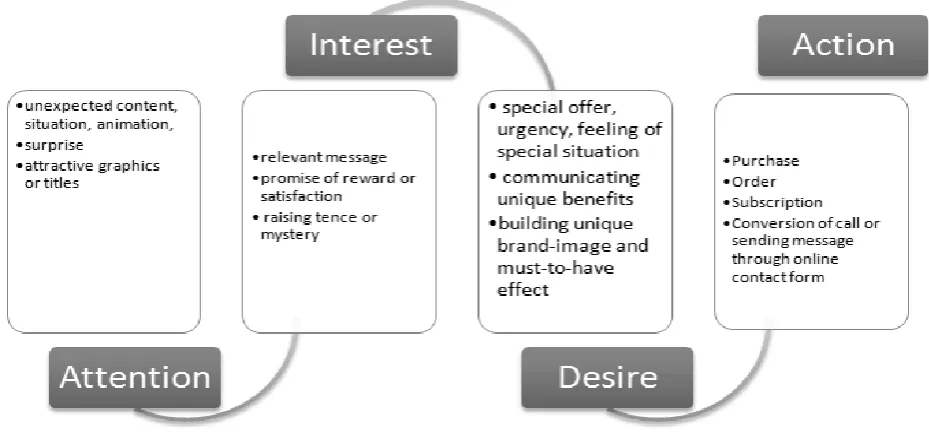
A - Attention (Awareness): It is the process of attracting the attention of the customer. In developing an advertising program, marketing managers should always start by identifying the targeted audience and its reasons to purchase a specific product or service.
I - Interest: This can be defined as the process of raising customer interest by focusing on and demonstrating advantages and benefits (instead of focusing on features, as in traditional advertising). It must use emotions to address the fact that this purchase is a good bargain, the right step, a sound decision, etc. In addition to that it is also essential to let the customer know the dark side if he/she doesn’t buy the product or service.
D - Desire: It is the way to convince customers that they want and desire the product or service and that it will satisfy their needs. There is huge difference between being interested in something and desiring it. A television ad must create a strong urge inside the consumers mind and generate a need or stimulate their latent need. This can happen only if the ad has used the correct combination of all 5 M’s (Mission, Message, Media, Money, Measurement) into the advertisement.
A - Action: It is the final phase that leads customers towards taking action i.e. purchasing and doing positive word of mouth. When a company promotes its brand image through advertisements, the level of persuasion must be ensured or it must make the consumers inquisitive enough to know more about the brand.
The applicability of AIDA model in marketing is to attract the attention from potential clients, arouse their interest and desire for final buying action. Researchers found that repetition in the advertisement hit the mind of the customers which leads to repeat purchase (Pope, 2009). Marketing strategy of this model generally is to increase the conversion rate (Potential client becomes a real buyer). This can be further explained as below-
Mutual Fund
Mutual funds, as already mentioned, are high involvement products. It is a popular financial product all over the world for wealth creation. While wealth creation was the first and foremost objective of mutual funds in its early phase, with the passage of time, number of other mutual fund schemes has been engineered to serve various other objectives. This is to cater the changing needs of investors based on their risk profile and return requirement. There are number of mutual fund schemes available in India today. And not to mention they are present in Patna too, thanks to increasing use of telecommunication. The companies offering these schemes are numerous, thus competing among to grab a better market share. According to MutualFundIndia.com, currently there are more than eleven thousand mutual fund schemes offered by forty companies in India.
Research Gap
Many of the earlier researchers have conducted various research works to measure the impact of TV advertising on consumer behavior (Raj, 2013) (Samar & Lodhi., 2015) or on consumer buying decision. Many of them (Jiangyu & Haibo, 2013) have measured the impact of advertising by using AIDA model. But none of the earlier research has been conducted to measure the effectiveness of TV advertisement on mutual fund buying decision based on AIDA model. This study is an attempt to find some empirical findings into the existing GAP as mentioned above.
Objectives of the Study
To study the impact of television advertising on buying
behavior of mutual fund investors in Patna.
To study the implication of AIDA model for TV
advertisement.
Hypotheses
The hypotheses formulated for this study are as follows-
H01: The TV ads are not effective/ very effective in creating
awareness among the mutual fund investors.
H02: The TV ads are not effective/ very effective in creating
interest among the mutual fund investors.
H03: The TV ads are not effective/ very effective in creating
desire among the mutual fund investors.
H04: The TV ads are not effective/ very effective in creating
action among the mutual fund investors.
H05: There is no statistical significant relationship between
awareness and interest of TV ads among the mutual fund investors.
H06: There is no statistical significant relationship between
interest and desire of TV ads among the mutual fund investors.
The diagrammatic explanation of the model
[image:3.595.70.535.103.325.2](Source: http://www.guerrillaonline.com/cs/Guerrilla-Marketing-Principles-54.htm)
Figure 2. Diagrammatic explanation of the model AIDA
Figure 3. Conceptual Model of the Study
[image:3.595.86.519.386.533.2]H07: There is no statistical significant relationship between
desire and action of TV ads among the mutual fund investors.
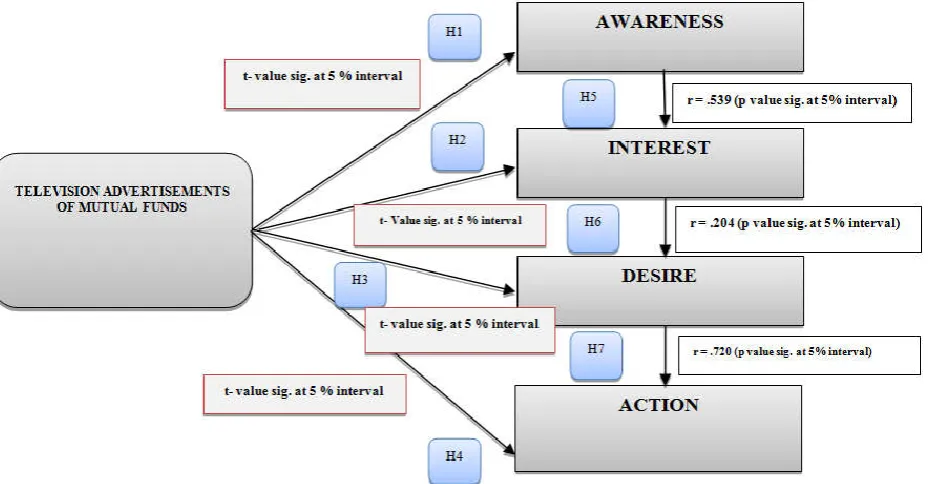
On the basis of above mentioned hypotheses, a conceptual model has been developed for this study. The model has been further tested with the help of detailed statistical analysis:
Limitations of the Research
The geographical area i.e. the city, Patna only.
The research is completely focused on mutual fund
products (schemes) only.
Data have been collected from limited number of
respondents (samples).
Research Methodology
This study is based on cross-sectional descriptive design which uses survey as a method of collecting data. A questionnaire based on five-point Likert’s scale has been developed as a tool for data collection. The choices of the variables incorporated in the questionnaire were based on AIDA model and the constructs of the model have been framed with the help of extensive literature review. Further the questionnaire has been modified with the consultation of experts from relevant subjects. The basic purpose of this research was to measure the effectiveness of TV advertisement on mutual fund purchase decision. So, the mutual fund investors present in Patna are the population for this research. The samples have been selected using cluster sampling method. Consumer base of six companies, contribute most to QAAUM, were chosen to collect the data in Patna. The sample size (Newman, 1998) decided for the study is 192. The city was divided into four parts (north, south, east, and west). To achieve the required sample size, initially 300 questionnaires were distributed. The wrongly filled questionnaires have been discarded and 192 perfectly filled questionnaires have been selected for the purpose. The mean comparison, t-test and Pearson correlation has been applied to analyze the data.
Data Analysis
Demography of the Sample
The sample of the study consisted of 143 male and 49 female respondents. Most of the respondents are middle aged and belongs to the age group of 30-50. They are mostly educated (Graduate-52.08%, Post Graduate- 45.83%) which also shows the authenticity of the responses.
Reliability of the Scale
The reliabilities of the scales have been measured by calculating the Cronbach’s alpha value. The calculated values are 0.791(awareness), 0.764 (interest), 0.744 (desire) and 0.65 (action).
RESULTS
H1, H2, H3 & H4
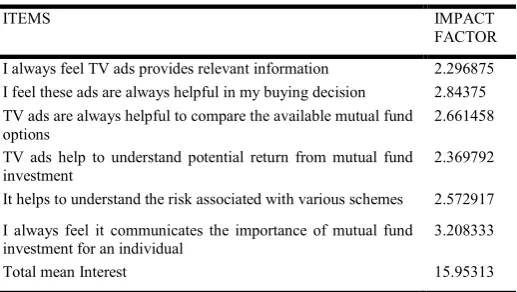
Impact factor for items of all the factors, i.e., awareness, interest, desire and action, have been calculated and shown in Table 1-4. The impact factor with value less than 3 denotes
[image:4.595.309.560.175.334.2]that the corresponding items have less influence on the respective factor; whereas value more than 3 denotes that the corresponding items have influence on the respective factor. A value equal to 3 means people are neutral on that particular item. The impact factor corresponding to total for a factor denotes its importance. A total value greater than 18 means the factor is affected considerably by TV ads; whereas value less than 18 means no such effect.
Table 1. Impact Factor- Awareness
ITEMS IMPACT
FACTOR
I came to know about mutual funds via TV ads 2.385417
I consider TV ads as good source of information for mutual funds
2.541667
I always like to watch the mutual fund ads 2.661458
I can easily remember the popular mutual fund brands seen in TV ads
3.161458
I can easily recognize the mutual fund brands seen in TV ads
3.244792
TV ads always helps me to update the latest mutual fund schemes
2.677083
Total mean Awareness 16.67188
[image:4.595.306.565.451.597.2]The results show that TV ads on mutual funds have less influence on awareness of viewers. The possible reasons might be either the inadequate amount of TV ads on mutual funds or people consider other source of information to be more reliable and important for awareness of mutual fund than TV ads. Nevertheless, TV ads definitely help the viewers to recall and recognize the mutual fund brands as and when required.
Table 2. Impact Factor- Interest
ITEMS IMPACT
FACTOR
I always feel TV ads provides relevant information 2.296875 I feel these ads are always helpful in my buying decision 2.84375 TV ads are always helpful to compare the available mutual fund
options
2.661458
TV ads help to understand potential return from mutual fund investment
2.369792
It helps to understand the risk associated with various schemes 2.572917
I always feel it communicates the importance of mutual fund investment for an individual
3.208333
Total mean Interest 15.95313
[image:4.595.310.560.667.801.2]As most of the values in the Table above are less than 3, it shows that TV ads are not much effective in generating interest among the viewers.
Table 3. Impact Factor- Desire
ITEMS IMPACT
FACTOR TV ads give me confidence that I can get above average
return from my investment
3.114583
I always feel mutual fund ads show the path of a wealthy life 3.494792 It is always helpful to identify and plan the future needs 2.463542
Mutual fund ads create an emotional attachment with the brand
3.651042
I feel that the ads are helpful in attaining my desire 1.90625
It is a great source of credibility for mutual fund schemes 2.552083
The TV ads have not been much effective in creation of desire among the viewer. Although for some items result are slightly on the positive side. The results could be attributed to TV ads which are effective in communicating potential benefits of mutual funds but unable to reveal the processes and risk associated properly. Moreover, this can also be caused due to lack of TV ads on mutual funds.
Table 4. Impact Factor- Action
ITEMS IMPACT
FACTOR
I believe that my mutual fund purchase are influenced by TV ads
2.3125
TV ads are always supportive to choose the best scheme 2.489583 Latest ads with innovative offers motivates me to stick with
the brand
2.921875
Latest ads with innovative offers helps me to purchase the scheme for repeated time
2.276042
I always share the information about the schemes with others 3.223958 I will refer the brand in future as well 2.895833
Total mean Action 16.11979
TV ads have not been successful in creating action among viewers. This is because mutual funds are high involvement and high risk financial products. The choices made can have a long term impact on the financial position of the individual. So, individuals do explore through some other sources of information before acting on it.
[image:5.595.40.291.166.311.2]Further t-test has been performed to test the significance of the hypotheses. The means of the factors are tested against two test values, i.e., 15 and 21, using one-tailed t-test. The two test values were so chosen, as any mean below 15 on the scale will denote ineffectiveness of TV ads; whereas mean above 21 will ratify the high effectiveness of TV ads on mutual fund buying behavior of consumer. The mean between 15 and 21 will speak for moderate effectiveness of TV ads. The result of the t-test is given below:
Table 5. t-test statistics
t-test results
Test Value=15 Test Value=21 Factors t-value p-value
(1-tailed)
t-value p-value (1-tailed) Awareness 4.088 .000 -10.582 .000
Interest 3.12 .001 -16.52 .000
Desire 6.218 .000 -10.878 .000
Action 3.935 .000 -17.168 .000
The one-tailed t-test performed at test value of 15 gives a significant p-value for all factors. This means that the null hypothesis that mutual funds TV ads are ineffective in creating awareness, interest, desire or action has been rejected. Whereas, the same test performed at test value of 21 suggests that mutual funds TV ads are not highly effective in generating awareness, interest, desire or action.
It shows that the effect of mutual fund TV ads on consumers lies in a moderate area, i.e. the ads are moderately affecting the awareness, interest, desire and action among the viewers.
H5, H6 & H7
The correlation between the factors of AIDA model has been calculated below:
Table 6. Correlation Statistics- Awareness & Interest
AwC InC
AwC Pearson Correlation 1 .539**
Sig. (2-tailed) .000
N 192 192
InC Pearson Correlation .539** 1
Sig. (2-tailed) .000
N 192 192
**. Correlation is significant at the 0.01 level (2-tailed).
Figure 4. Accepted Conceptual Model of the Study
[image:5.595.324.543.406.496.2] [image:5.595.70.535.524.766.2]Table 7. Correlation Statistics Interest & Desire
InC DeC
InC Pearson Correlation 1 .204**
Sig. (2-tailed) .005
N 192 192
DeC Pearson Correlation .204** 1
Sig. (2-tailed) .005
N 192 192
**. Correlation is significant at the 0.01 level (2-tailed).
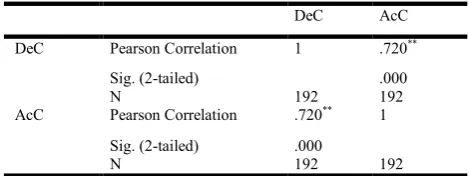
Table 8. Correlation Statistics Desire & Action
DeC AcC
DeC Pearson Correlation 1 .720**
Sig. (2-tailed) .000
N 192 192
AcC Pearson Correlation .720** 1
Sig. (2-tailed) .000
N 192 192
**. Correlation is significant at the 0.01 level (2-tailed).
The positive and significant correlations between the factors (awareness & interest; interest & desire; desire & action) support the applicability of AIDA model in case of TV ads for mutual funds. The low correlation between interest and desire demonstrates that these are not sufficiently associated in case of TV ads for mutual funds. The lack of effectiveness in advertising is the probable reason for it.
Conclusion
As the world of advertising becomes more and more
competitive, advertising becomes more and more
sophisticated. Yet the basic principle behind advertising remains same – that it must attract attention and persuade someone to take action. The study reveals that the basic principle of advertising remains applicable for mutual fund products as well. The findings show that TV advertisement has a significant effect on consumer’s mutual fund buying decisions. But the result of the mean comparison suggests TV advertisements of mutual fund products are not so effective to create awareness or interest or desire or action among the viewers. The result of Pearson correlation denotes that there is a statistically significant relationship among the variables awareness, interest, desire and action, i.e. awareness can be converted into interest, interest can be converted into desire and desire can be converted into action. The above analysis explains the effectiveness of advertising using the AIDA model of mutual fund companies. It shows AIDA model is applicable for the advertising of mutual fund products. But it
also shows the mutual fund companies involves in TV advertising are not so much successful with their ads to
generate awareness or interest or to create desire or to convert such desire into purchase of mutual fund products in Patna. The lack of effectiveness of TV advertisement suggests lack of creativity of such ads in terms of development and implementation of mutual fund advertisements. By considering the high risk & complex buying decisions involved in mutual fund products, possible reasons could be ineffective message development or lack of frequency in case of such TV ads. By considering the above it is suggestible for the mutual fund companies to become more creative with their advertising strategies. Mutual fund products are high risk involved products. By considering this fact, the messages of the advertisements must clarify the associated risks and the ways to tackle such risks. Moreover, it is also suggested for the companies to look after the effective frequency, duration and timing of advertising.
REFERENCES
Barry, T. E. and Howard, D. J. 1990. Are view and critique of
hierarchy of effects in advertising. International Journal of
advertising, 9(1), 121-135.
Jiangyu, L. and Haibo, Y. 2013. An Innovative Marketing Model Based on AIDA: - A Case from E-bank
Campus-marketing by China Construction Bank. 5, 47-51.
Katke, K. 2007. The Impact of Television Advertising on
Child Health & Family Spending. International Marketing
Conference on Marketing & Society.
Lewis, E. S. 1899, February. Side Talks about Advertising.
The Western Druggist, 21, 65-66.
Lohade, N. 2004, March 27. Mutual funds become brand consious. Mumbai, Maharastra, India.
Lombardo, J. (n.d.). Consumer Awareness of Promotion: The
AIDA Acronym. Retrieved from http://study.com/
academy/lesson/consumer-awareness-of-promotion-the-aida-acronym.html
Mohan, M. 2008. Advertising Management: Concepts and
Cases. New Delhi: TATA McGraw-Hill Publishing
Company Ltd.
Newman, 1998. Research Onion-Explanation of the Concept. Retrieved May 17, 2016, from http://www.ukessays.com/ essays/psychology/explanation-of-the-concept-of-research-onion-psychology-essay.php
Pope, D. 2009. Making Sense of Advertisements.
Raj, N. 2013. Impact of Advertising on Consumer Behaviour and Attitude with reference to Consumer Durables.
International Journal of Management Research and
Business Strategy, 2(2).
Samar, F. and Lodhi., S. 2015. Impact of Advertisement on Buying Behaviours of the consumers: Study of Cosmetic
Industry in Karachi City. International Journal of
Management Sciences and Business Research, 4(10).
[image:6.595.44.279.184.272.2]