Buffer AVL Alone Does Not Inactivate Ebola Virus in a
Representative Clinical Sample Type
Sophie J. Smither, Simon A. Weller, Amanda Phelps, Lin Eastaugh, Sarah Ngugi, Lyn M. O’Brien, Jackie Steward, Steve G. Lonsdale, Mark S. Lever
CBR Division, Defence Science and Technology Laboratory (Dstl), Porton Down, Salisbury, Wiltshire, United Kingdom
Rapid inactivation of Ebola virus (EBOV) is crucial for high-throughput testing of clinical samples in low-resource,
out-break scenarios. The EBOV inactivation efficacy of Buffer AVL (Qiagen) was tested against marmoset serum (EBOV
con-centration of 1
ⴛ
10
850% tissue culture infective dose per milliliter [TCID
50
· ml
ⴚ1]) and murine blood (EBOV
concentra-tion of 1
ⴛ
10
7TCID
50
· ml
ⴚ1) at 4:1 vol/vol buffer/sample ratios. Posttreatment cell culture and enzyme-linked
immunosorbent assay (ELISA) analysis indicated that treatment with Buffer AVL did not inactivate EBOV in 67% of
sam-ples, indicating that Buffer AVL, which is designed for RNA extraction and not virus inactivation, cannot be guaranteed to
inactivate EBOV in diagnostic samples. Murine blood samples treated with ethanol (4:1 [vol/vol] ethanol/sample) or heat
(60°C for 15 min) also showed no viral inactivation in 67% or 100% of samples, respectively. However, combined Buffer
AVL and ethanol or Buffer AVL and heat treatments showed total viral inactivation in 100% of samples tested. The Buffer
AVL plus ethanol and Buffer AVL plus heat treatments were also shown not to affect the extraction of PCR quality RNA
from EBOV-spiked murine blood samples.
A
n outbreak of Ebola virus disease (EVD) occurred in West
Africa starting in December 2013 and was declared a Public
Health Emergency of International Concern by the World Health
Organization (WHO) in August 2014 (
1
). In response to this
out-break, the international community has deployed an increasing
number of Ebola diagnostic laboratories into the main West
Afri-can countries affected (Guinea, Liberia, and Sierra Leone). Rapid
diagnosis of EVD in humans is critical in the management of this
disease in outbreak situations, as it allows prompt isolation and
the chance to provide the best supportive care to patients, which
helps reduce the overall infection rate and break the transmission
chain.
The preferred clinical sample for testing for Ebola virus
(EBOV), an enveloped negative-sense single-strand RNA virus, is
EDTA-blood, serum, or plasma with the primary diagnostic
tech-nology being real-time PCR (
2
). Other sample types, such as swabs
or urine, may also be received by a laboratory. EBOV is designated
in the United Kingdom by the Advisory Committee on Dangerous
Pathogens (ACDP) as a hazard group 4 pathogen that must be
handled under containment level (CL) 4 standards (biosafety level
4 [BSL4] in other countries). As such stringent laboratory
infra-structure and containment procedures are required to handle
vi-able EBOV material, only a few laboratories in Europe and
else-where are suitably equipped (
3
). Within the timelines and budgets
available, it has been impractical to create this laboratory
infra-structure in West Africa, and therefore diagnostic laboratories
have relied on methods that rapidly inactivate EBOV prior to
rou-tine processing and testing of samples by PCR.
Laboratory methods of EBOV inactivation include gamma
ir-radiation (
4
), nanoemulsion (
5
), photoinducible alkylating agents
(
6
), and UV radiation (
7
), but these methods are primarily used
for research purposes and may not be practicable in an outbreak
situation that is likely to involve a high number of samples but
reduced capability for handling and manipulation. In this context,
any inactivation method must also be compatible with the EBOV
PCR diagnostic approach.
The CDC recommends Triton X-100 and heat treatment for 1
h for diagnostic samples containing hemorrhagic fever viruses (
8
),
and this method has been adopted by many laboratories for
han-dling of samples that may contain EBOV (
9
). Heating (alone or
with acetic acid) for 1 h at 60°C has also been shown to reduce the
titer of EBOV (
10
). Other guidelines can be nonspecific, specifying
only the need for inactivation but not suggesting how (
11
) or
suggesting generic use of denaturing/lysis buffers and/or heat
(
12
). In the United Kingdom, the Advisory Committee on
Dan-gerous Pathogens guidelines state that samples from confirmed
cases may be processed in a containment level 2 laboratory using
routine autoanalyzers if a containment level 4 laboratory is not
available and provided specific procedures are followed (
13
).
Within these guidelines, which encompass the application of
mul-tiple clinical tests, there is no specific requirement to inactivate
EBOV (or other viral hemorrhagic fever agents) within a sample.
However, these guidelines are based on an expected low frequency
of positive samples and would not be applicable to an outbreak
environment where a high number of positive samples will be
routinely handled and autoanalyzers and appropriately trained
staff may not be available.
In this study, we evaluated the EBOV inactivation efficacy,
Received29 May 2015Returned for modification6 July 2015
Accepted14 July 2015
Accepted manuscript posted online15 July 2015
CitationSmither SJ, Weller SA, Phelps A, Eastaugh L, Ngugi S, O’Brien LM, Steward J, Lonsdale SG, Lever MS. 2015. Buffer AVL alone does not inactivate Ebola virus in a representative clinical sample type. J Clin Microbiol 53:3148 –3154.
doi:10.1128/JCM.01449-15.
Editor:A. M. Caliendo
Address correspondence to Sophie J. Smither, [email protected]. © Crown copyright 2015.
doi:10.1128/JCM.01449-15
on May 16, 2020 by guest
http://jcm.asm.org/
within whole blood and sera (the most common diagnostic
sam-ple types), of a common laboratory reagent, Buffer AVL (
14
).
Buffer AVL contains a chaotropic salt (guanidine isothiocyanate)
and has previously been reported to inactivate EBOV (
15
), and it
is the first reagent used in common RNA extraction techniques
(
14
). In this study, we extended the findings of previous research
to evaluate the EBOV inactivation efficacies of ethanol and heat in
whole blood. Additionally, we evaluated whether these
inactiva-tion methods allow the extracinactiva-tion and purificainactiva-tion of PCR-quality
RNA from the treated samples.
MATERIALS AND METHODS
Virus strains, cell culture, and reagents.All virus manipulation, inacti-vation, and subsequent testing were carried out under BSL/CL 4 condi-tions in previously described facilities (16). Inactivation studies were car-ried out with EBOV/H.sapiens-tc/COD/1995/13625 Kikwit, subsequently referred to as EBOV-Kikwit. Buffer AVL (Qiagen, United Kingdom) from the QIAamp viral RNA minikit (Qiagen, United Kingdom) and 96% mo-lecular grade ethanol (Sigma, United Kingdom) were used in inactivation studies. An initial study with Buffer AVL was performed on sera harvested from infected marmosets (produced at the Defence Science and Technol-ogy Laboratory [Dstl] during other studies [25]) at a titer of 1.5⫻10850%
tissue culture infectious dose per milliliter (TCID50· ml⫺1) EBOV-Kikwit.
Due to availability of samples and consistency, subsequent studies were performed with naive mouse blood (Charles River, United Kingdom) spiked with 1⫻106TCID
50EBOV-Kikwit. Ethical approval for the use of
human blood from volunteers or from infected individuals was not ob-tained within the time frame of these studies. Cell culture was carried out using confluent monolayers of Vero C1008 cells (European Collection of Cell Cultures [ECACC], United Kingdom; catalog no. 85020206) main-tained in Dulbecco’s minimal essential medium (DMEM; Sigma, United Kingdom) supplemented with 10% fetal calf serum, 1%L-glutamine, and 1% penicillin-streptomycin (Sigma, United Kingdom). Prior to test sam-ples being added to cell culture flasks, 10% DMEM was replaced with 2% DMEM.
Viral inactivation.The inactivation efficacy of Buffer AVL, ethanol, and heat were evaluated individually as was the combination of Buffer AVL and ethanol and Buffer AVL and heat. An initial study (Buffer AVL only) was performed on the serum from EBOV-Kikwit-infected marmo-sets and EBOV-Kitwit-spiked mouse blood. All subsequent studies were performed with EBOV-Kikwit-spiked mouse blood.
Buffer AVL and/or ethanol were mixed by vortexing with blood or serum samples for 10 min at a ratio of 4:1 (vol/vol) reagent/sample, re-taining the ratio of reagent to sample as defined in the viral RNA minikit instructions (14) and as tested in the previous Buffer AVL study (15). Typically, 560l Buffer AVL or ethanol was added to 140-l EBOV-Kikwit blood samples (14). For heat-treated samples, tubes were placed in a heat block (Grant, United Kingdom) set to 68°C for 20 min. Laboratory tests showed that this was the temperature setting required by this indi-vidual heat block to heat and maintain the 700-l sample to 60°C for 15 min, the temperature and time tested for inactivation purposes. Heat steps were carried out after addition of Buffer AVL or after addition of 560 l tissue culture medium to test the effect of heat alone. All inactivation treatments were performed in triplicate on at least two separate occasions. EBOV-Kikwit-spiked blood or EBOV-Kikwit-infected sera were sham in-activated with the addition of the appropriate volume of tissue culture media as controls. Additional controls included replication of all sample types using naive blood without virus in parallel with EBOV-Kikwit-con-taining samples.
After inactivation, samples and controls were pelleted by centrifuga-tion at 6,000⫻gfor 5 min in an MSE Micro Centaur microcentrifuge (sufficient for single or combination treatments with heat or Buffer AVL-treated samples) or 20,000 rpm (approximately 52,000⫻g) for 90 min in an Beckman Optima Ultracentrifuge SW28 rotor (required for samples treated with ethanol in order to form a pellet). The supernatant was
dis-carded and the pellet washed via resuspension in 1 ml tissue culture me-dium and further centrifugation as above. A total of 3 washes were per-formed by centrifugation and resuspension to remove any traces of the inactivant (Buffer AVL and/or ethanol) from the sample to avoid toxicity during cell culture. After three washes, the pellets were resuspended in 1 ml final volume tissue culture medium for testing in cell culture and a capture enzyme-linked immunosorbent assay (ELISA).
Cell culture and ELISA.Passage of EBOV in cell culture and capture ELISA (using cell culture supernatant) were used to test for inactivation of EBOV. Passage was used to allow very low levels of virus to amplify and reduce the chance of false negatives by titring after inactivation, and ELISAs were used to give an independent, quantifiable read-out. For pas-saging, the entire washed inactivated or control sample was added to a T12.5 flask (Corning, United Kingdom) of Vero C1008 cells (final vol-ume, 5 ml) and incubated at 37°C and 5% CO2. After 1 week (⫾1 day), the
cell monolayers were examined for signs of infection, and the entire su-pernatant was added to 5 ml of fresh medium in a T25 flask of Vero C1008 cells (final volume, 10 ml). After a further week (⫾1 day) of incubation (as above) the monolayers were examined again, and the entire supernatant was added to 10 ml of fresh medium in a T75 flask of Vero C1008 cells (final volume, 20 ml). After a final week (⫾1 day) of incubation (total time incubated, 18 to 24 days over 3 passages), the monolayers were observed independently by two individuals for signs of infection. A range of control flasks were passaged alongside the test flasks on each occasion; these in-cluded cells only and cells plus the inactivating material (Buffer AVL, ethanol), cells plus heated media or untreated infected blood. Stock EBOV-Kikwit, at a range of starting concentrations covering a 7 to 10 log10dilution series, were always run in parallel to inform the limit of
detection in monolayers and the starting concentration of virus from which amplification through passage can occur.
Capture ELISA was performed on the cell culture supernatants from the third and final passage with two different in-house EBOV anti-bodies. The capture antibody, Dstl186, was a protein G-purified (GE Healthcare, United Kingdom) monoclonal IgG1antibody generated from a mouse repeatedly immunized with irradiated sucrose gradient-purified Ebola virus H.sapiens-tc/COD/1976/Yambuku-Mayinga (EBOV-Mayinga) (USAMRIID) that reacted to a band consistent with VP40 in Western blotting. The detection antibody was a protein G-puri-fied (GE Healthcare, United Kingdom) polyclonal IgG preparation gen-erated by the repeated immunization of a rabbit with irradiated sucrose gradient-purified EBOV-Mayinga. This sandwich ELISA format was pre-viously shown to be unreactive to preparations of other ebolaviruses (S. Lonsdale, unpublished data). Immunoassay plates (Immulon 2HB, United Kingdom) were coated with 100l per well of 10g · ml⫺1of
Dstl186 in phosphate-buffered saline (PBS) at 4°C for 24 h. Wells were blocked for nonspecific binding using 300l of 2% (wt/vol) skimmed milk powder (Sigma, United Kingdom) in PBS (Gibco, United Kingdom) for 1 h at 37°C. Cell culture supernatants from the T75 flasks were added to the immunoassay plate and serially diluted 1:1 in 2% skimmed milk in PBS to give a final volume of 100l per well. Irradiated EBOV-Mayinga at 107PFU · ml⫺1was used as a positive control for the ELISA, and
super-natants from uninfected flasks and other control flasks were used as neg-ative controls to generate a background/threshold absorbance level. Im-munoassay plates were incubated for 60 to 90 min at 37°C and then washed 5 times with 100l PBS supplemented with 0.05% (vol/vol) Tween (Sigma, United Kingdom) (PBS-T). The detecting antibody was added at a concentration of 10g · ml⫺1in PBS-T to all wells in a volume
of 100l. Plates were incubated at 37°C for 60 to 90 min and washed as above. Secondary antibody (anti-rabbit-horseradish peroxidase [HRP] conjugate [GE Healthcare, United Kingdom]) was used at a 1:1,000 dilu-tion in 100l of PBS-T and added to all plates for 45 min at 37°C. After a final series of 5 washes as above, ABTS [2,2= -azinobis(3-ethylbenzthiazo-linesulfonic acid)] solution (Sigma) was added for 10 to 20 min, and the absorbance was read at 414 nm using the Bio-Rad iMark ELISA plate
on May 16, 2020 by guest
http://jcm.asm.org/
reader. Samples were considered positive if the absorbance readings were at least two times greater than the mean negative-control value.
PCR on simulated inactivated samples.Gamma irradiated EBOV-Mayinga, (concentration 107PFU · mL⫺1), was added to mouse blood to
give concentrations of 106and 104PFU · mL⫺1. Seventy-microliter
ali-quots of these concentrations were then subjected to the following four treatments (4 replicates per treatment): H2O only (4:1 vol/vol water/sam-ple), H2O plus heat (4:1 vol/vol water/sample, heated), Buffer AVL only (4:1 vol/vol AVL/sample), and Buffer AVL plus heat (4:1 vol/vol AVL/ sample, heated). Heated samples (in 2-ml microtubes) were placed in a heat block (Thermomixer comfort; Eppendorf International, United Kingdom) set to 68°C for 20 min. After treatment, RNA was extracted from the resulting suspensions using the QIAamp viral RNA minikit (14). Real-time PCR (2 replicates per RNA extract) was conducted using the Ebola Zaire-TM assay (17) on the ABI7500 PCR platform (Life Technol-ogies, USA). PCRs (25l volume) comprised forward and reverse primers (1M), probe (0.1M), 6.25l 4⫻TaqMan Fast Virus 1-step master mix (Life Technologies, USA), 5l RNA extract, and molecular biology grade H2O to volume. PCR thermal cycling conditions comprised 50°C for 15 min, 95°C for 5 min, and 45 cycles of 95°C for 15 s and 60°C for 30 secs. Positive results were recorded as a quantification cycle (Cq) value, the cycle during which fluorescence was first detected during the PCR.
RESULTS
The results of all inactivation evaluations are summarized in
Table
1
. Samples were subject to different inactivation methods, and
inactivation was determined by passage of samples in cell culture
to allow amplification of virus and capture ELISA for EBOV on
cell culture supernatants. Inactivation was defined as no signs of
infection after three passages in cell culture and negative ELISA
results for all replicates. Observation of infection in flasks and/or a
positive ELISA reading in any of the replicates indicated no
inac-tivation.
Buffer AVL alone did not consistently inactivate
EBOV-Kik-wit under conditions tested.
EBOV infection in Vero C1008 cell
monolayers was confirmed by ELISA of cell culture supernatants.
Cell monolayers from the initial study (Buffer AVL only;
EBOV-Kitwit-infected marmoset sera) indicated the presence of virus
growth through the observation of cytopathic effects (CPE) in
two-thirds of flasks. Typically, cells did not show signs of infection
(no CPE) until the second or third passage. All monolayers from
the third passage that appeared to be infected returned positive
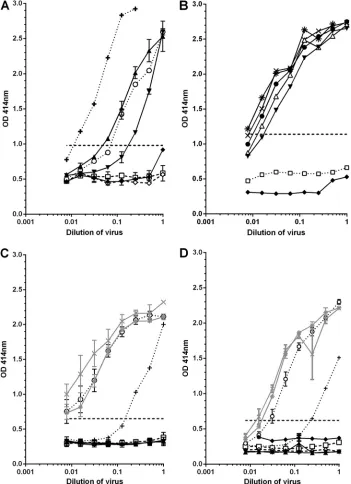
EBOV ELISA results (
Fig. 1A
). Serum from
EBOV-Kikwit-in-fected marmosets or EBOV-Kikwit-spiked mouse blood that was
sham inactivated with the addition of tissue culture media and
washed three times showed strong signs of infection (visible CPE)
within a week and gave positive ELISA results (
Table 1
;
Fig. 1A
).
The lowest starting amount of EBOV to show CPE in flasks
inoc-ulated with samples from a EBOV-Kikwit dilution series was 10
⫺1TCID
50EBOV; all dilutions to this value showed CPE (in the first
passage) and returned positive EBOV ELISA results (
Table 1
;
Fig.
1B
). Buffer AVL alone was toxic to cells resulting in complete
destruction of the cell layer within days of infection, indicating the
importance of washing the samples prior to infection.
Buffer AVL plus heat (but not heat alone) consistently
inac-tivated EBOV-Kikwit under conditions tested.
All monolayers
inoculated with samples treated with Buffer AVL plus heat showed
no signs of infection (no CPE) (
Table 1
), and all subsequent EBOV
ELISAs were negative (
Fig. 1C
). All flasks containing the heated
only samples (EBOV-Kikwit-spiked mouse blood) showed clear
signs of cell infection through visible CPE in the first passage and
also returned positive ELISA results (
Fig. 1C
). Sham-inactivated
and washed samples of EBOV-Kikwit-spiked blood showed signs
of infection (visible CPE) within a week and gave positive ELISA
results. All flasks inoculated with samples from an EBOV dilution
series gave results as above (
Fig. 1B
) and returned positive EBOV
ELISA results, and heated medium had no effect on the cells.
[image:3.585.42.545.86.295.2]Buffer AVL plus ethanol (but not ethanol alone) consistently
inactivated EBOV-Kikwit under conditions tested.
All
monolay-ers inoculated with Buffer AVL plus ethanol-treated samples
TABLE 1Summary of results from cell culture passage and EBOV capture ELISA on serum and blood samples treated with three different inactivation methods (and also experimental control and EBOV dilution series)
Treatment/control Sample type (EBOV-Kikwit amt/concn)
Observations of potential infection in Vero C1008 cells (no. of flasks with indicated result/total no. of flask)
EBOV ELISA result
EBOV inactivation result
Buffer AVL only Marmoset sera (108TCID 50· ml⫺
1) Infection in 3rd passage (2/3)a Positivea No
Buffer AVL only Murine blood (106TCID
50) Infection in 3rd passage (4/6)
a Positivea No
Heat only Murine blood (106TCID
50) Infection in 1st passage (6/6) Positive No
Buffer AVL⫹heat Murine blood (106TCID
50) No infection after 3rd passage (6/6) Negative Yes
Ethanol only Murine blood (106TCID
50) Infection after 1st/2nd passage (3/6)
a Positivea No
Buffer AVL⫹ethanol Murine blood (106TCID
50) No infection after 3rd passage (6/6) Negative Yes
Dilution series Cell culture medium (10⫺2TCID
50) No infection after 3rd passage (4/4) Negative N/A
b
Dilution series Cell culture medium (10⫺1TCID
50) Infection in 1st passage (4/4) Positive N/A
Dilution series Cell culture medium (100TCID
50) Infection in 1st passage (4/4) Positive N/A
Dilution series Cell culture medium (101TCID
50) Infection in 1st passage (4/4) Positive N/A
Dilution series Cell culture medium (102TCID
50) Infection in 1st passage (4/4) Positive N/A
Dilution series Cell culture medium (103TCID
50) Infection in 1st passage (4/4) Positive N/A
Dilution series Cell culture medium (104TCID
50) Infection in 1st passage (4/4) Positive N/A
Dilution series Cell culture medium (105TCID
50) Infection in 1st passage (4/4) Positive N/A
Dilution series Cell culture medium (106TCID
50) Infection in 1st passage (4/4) Positive N/A
Positive controls (sham inactivated) Murine blood (106TCID
50) Infection in 1st passage (12/12) Positive N/A
Negative/reagent controls Various (no EBOV) No infection in 3rd passage (12/12) Negative N/A a
Only the third passage cell culture supernatants were tested by ELISA. Where less than 100% flasks were infected/gave positive ELISA results, the remaining flasks showed no infection after the 3rd passage and were negative in ELISA.
b
N/A, not applicable.
Smither et al.
on May 16, 2020 by guest
http://jcm.asm.org/
FIG 1ELISAs to demonstrate inactivation efficacy of Buffer AVL, ethanol, or heat alone or in combination on Kikwit. Replicate samples of EBOV-Kikwit-infected marmoset serum or EBOV-Kikwit-spiked blood were treated as described below for individual panels. After inactivation, samples were then washed three times in tissue culture medium and added to flasks of Vero C1008 cells. After three passages in Vero C1008 cells, cell culture supernatants were tested in an ELISA for detection of EBOV via anti-EBOV antibodies. Samples were considered positive if they gave an optical density (OD) at 414 nm reading above the threshold (dashed black line). The threshold was determined as twice the average OD414-nm value of noninfected cells (dashed black line,䊐). Inactivation tests
also included positive controls of sham-inactivated samples of blood treated with medium only and then washed three times (dotted black line,Œ, shown in A, C, and D only). The ELISA-positive control was irradiated EBOV-Mayinga (dotted black line,⫹, shown in A, C, and D only). (A, C, and D) OD readings at 414 nm⫾standard error of the mean (SEM) from duplicate wells shown. (A) Efficacy of Buffer AVL alone. Replicate samples of EBOV-Kikwit-infected marmoset serum were mixed with Buffer AVL at a ratio of 1:4 (vol/vol), vortexed, and incubated for 10 min. Two of three Buffer AVL-treated samples were positive for EBOV (solid black lines,Œ,, or䉬). Buffer AVL inoculated straight on to cells gave no reaction (dashed black line,{). On subsequent independent repeats of the conditions above with spiked mouse blood instead of marmoset serum, 3 of 3 and 1 of 3 flasks and ELISAs were positive for EBOV. (B) Dilution range to show sensitivity. A dilution range of EBOV-Kikwit was used to inoculate monolayers to determine the sensitivity of cells for amplification of virus. After 3 passages, monolayers were observed for infection, and cell culture supernatants were tested by ELISA as described above. Starting concentrations of EBOV-Kikwit of⬎104
TCID50were all positive (not shown) and above the threshold as were starting concentrations of 1,000 (), 100 (o), 10 (), 1 (⫻), and 0.1 (10⫺1, *) TCID50
EBOV-Kikwit. A starting concentration of 0.01 (10⫺2) TCID
50() did not cause infection or give a positive ELISA result and showed similar results to uninfected
flasks. Results shown for a single test; similar results were obtained on repetition. (C) Efficacy of Buffer AVL plus heat. Replicate samples of EBOV-Kikwit-spiked mouse blood were heated at 60°C for 15 min. Other samples were mixed with Buffer AVL at a ratio of 1:4 (vol/vol), vortexed, incubated for 10 min, and then heated at 60°C. Samples that were heat inactivated only were positive for EBOV (gray lines,⫻, and *). Samples that were mixed with Buffer AVL and then heated showed no reaction (solid black line,Œ,, or䉬). Repeat studies gave similar results. (D) Efficacy of Buffer AVL plus ethanol. Replicate samples of EBOV-Kikwit-spiked mouse blood were mixed with ethanol at a ratio of 4:1 (vol/vol). Other samples were mixed with Buffer AVL at a ratio of 1:4 (vol/vol), vortexed, incubated for 10 min, and then an equal volume of ethanol was added. Samples that were treated with ethanol only were positive for EBOV (gray lines,⫻, and *). Samples that were mixed with Buffer AVL plus ethanol showed no reaction (solid black line,Œ,, or䉬). Repeat studies gave similar results.
on May 16, 2020 by guest
[image:4.585.117.468.35.519.2]showed no signs of infection (no CPE) (
Table 1
), and all
subse-quent EBOV ELISAs were negative (
Fig. 1D
). Results from
etha-nol-only treatments varied. Fifty percent of flasks showed no CPE
after 3 passages and returned negative ELISA results, but in half
the flasks, there were signs of infection (visible CPE) after the first
or second passage, and these flasks all returned positive ELISA
results (
Fig. 1D
). All flasks inoculated with samples from an EBOV
dilution series (lowest concentration 10
⫺1TCID
50
EBOV) showed
CPE (in the first passage) and returned positive EBOV ELISA
re-sults as above (
Fig. 1B
); sham-inactivated EBOV-Kikwit-spiked
and washed blood was positive, and ethanol alone was toxic to
cells (
Table 1
;
Fig. 1D
).
Positive PCR results were obtained after different
treat-ments.
PCR results are summarized in
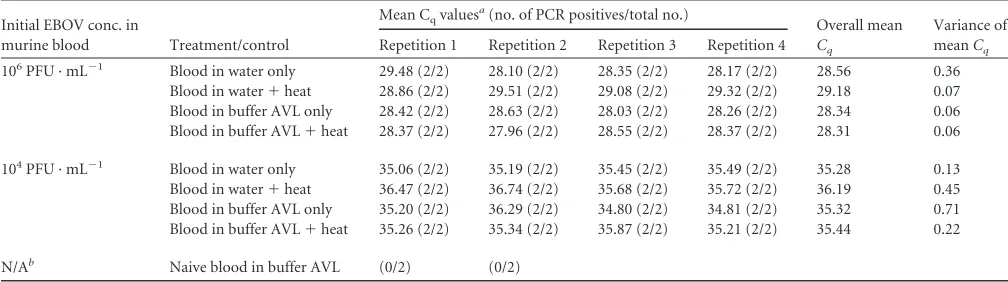
Table 2
. All EBOV
contain-ing samples produced positive PCR results. From the two EBOV
concentrations and four treatments, mean quantification cycle
(
C
q) results from the blood in water and heat treatment were
around 0.7 higher at both concentrations compared with those of
other treatments, which had equivalent mean
C
qresults in a range
of 0.2 units. Of note, heated blood in water suspensions formed an
inconsistent red-brown precipitate after heating whereas heated
blood and Buffer AVL suspensions formed a clear red-colored
solution. Statistical analysis identified significant differences
be-tween the blood in water plus heat treatment and other treatments
at the 99% confidence level for the 10
6PFU · mL
⫺1concentration
and identified significant differences between blood in water plus
heat treatment and the blood in water (only) and blood in Buffer
AVL (only) treatments at the 90% confidence level for the 10
4PFU ·
mL
⫺1concentration, though significant differences between some
other treatments were also observed at various confidence levels.
As all
C
qvalues generated were within 1.5
C
qunits in the two viral
concentrations, it is not clear whether these are practical
differ-ences even though the differdiffer-ences are statistically significant.
DISCUSSION
Robust inactivation of clinical samples potentially containing
EBOV is critical before manipulation (RNA extraction and PCR)
outside biological containment in outbreak environments. In this
study, we have shown that a combination of Buffer AVL and
eth-anol or Buffer AVL and heat can inactivate EBOV-Kikwit in whole
mouse blood samples, which we believe are likely to form a
worst-case sample type in terms of both inactivation and also being able
to extract PCR-quality RNA. This work extends earlier work (
15
)
but does not contradict it. The previous study tested filoviruses or
filovirus tissue samples and not the more representative, in terms
of a practical diagnostic sample type, whole blood. It is possible
that blood extends a protective effect to suspended virions against
inactivation methods, which was not tested by Blow et al. (
15
). It
may also be that the formulation of Buffer AVL has changed in the
period between the two studies. This buffer is a commercial
for-mulation designed principally for the purposes of RNA extraction
and not virus inactivation. The manufacturers are not required to
disclose changes in formulation, which is an important point to
consider when relying on this buffer for viral inactivation. It might
be advisable to periodically revalidate the performance of Buffer
AVL against EBOV to counteract this potential issue
Our methodology to test inactivation was different from those
in reference
15
and others (
4–7
) in that, after inactivation, all
samples were passaged through three cell culture stages to give
maximum chance for infectious virus to be amplified to detectable
levels, and we did not quantify virus by direct titration after
inac-tivation. Repeated passaging allows growth from very low titers of
virus, which otherwise may be undetectable in
in vitro
titration
assays but could still be infectious. This was the case with the
treatment in which Buffer AVL was used alone where there was an
initial apparent reduction in viral titer to levels below that which
would be detectable by TCID
50assay, but after cell culture passage,
viable virus was observed in some of the third-passage flasks. Our
methodology also included washing steps to remove reagents that
may be toxic to cells and could therefore have affected observation
and interpretation of infectivity postinactivation. However,
con-trols indicated that these washing steps did not eliminate virus
from the resulting cell culture stages and that the appearance of
cell culture infection was not due to residual reagent
contamina-tion.
In terms of viral inactivation, there are several caveats to
dis-close for the current study. First, this work was carried out with
EBOV-Kikwit and not the EBOV variant (EBOV-Makona) from
the current outbreak (
18
). This work was also carried out using
[image:5.585.40.544.87.228.2]spiked mouse blood or serum from infected marmosets and
hu-man blood or serum was not tested at any stage, and other EBOV
containing matrices such as urine, feces, or swabs were also not
TABLE 2Summary of Ebola Zaire-TM real-time PCR results when tested against RNA extracts derived from murine blood samples spiked with different concentrations of EBOV and treated with different inactivation methods
Initial EBOV conc. in
murine blood Treatment/control
Mean Cqvaluesa(no. of PCR positives/total no.) Overall mean
Cq
Variance of meanCq
Repetition 1 Repetition 2 Repetition 3 Repetition 4
106PFU · mL⫺1 Blood in water only 29.48 (2/2) 28.10 (2/2) 28.35 (2/2) 28.17 (2/2) 28.56 0.36
Blood in water⫹heat 28.86 (2/2) 29.51 (2/2) 29.08 (2/2) 29.32 (2/2) 29.18 0.07 Blood in buffer AVL only 28.42 (2/2) 28.63 (2/2) 28.03 (2/2) 28.26 (2/2) 28.34 0.06 Blood in buffer AVL⫹heat 28.37 (2/2) 27.96 (2/2) 28.55 (2/2) 28.37 (2/2) 28.31 0.06
104PFU · mL⫺1 Blood in water only 35.06 (2/2) 35.19 (2/2) 35.45 (2/2) 35.49 (2/2) 35.28 0.13
Blood in water⫹heat 36.47 (2/2) 36.74 (2/2) 35.68 (2/2) 35.72 (2/2) 36.19 0.45 Blood in buffer AVL only 35.20 (2/2) 36.29 (2/2) 34.80 (2/2) 34.81 (2/2) 35.32 0.71 Blood in buffer AVL⫹heat 35.26 (2/2) 35.34 (2/2) 35.87 (2/2) 35.21 (2/2) 35.44 0.22
N/Ab Naive blood in buffer AVL (0/2) (0/2)
aC
qvalue, PCR cycle number at which fluorescence was first detected in 45-cycle PCR. b
N/A, not applicable.
Smither et al.
on May 16, 2020 by guest
http://jcm.asm.org/
tested. It is also possible that within an outbreak situation there
will be inherent variation in the samples obtained from a human
population (i.e., presence/absence of different metabolites, drug
regimes, PCR inhibitors, etc.), which all may affect inactivation
and the resulting PCR analysis. In addition, the viral titers used in
this study did not exceed 10
8TCID
50· ml
⫺1EBOV-Kikwit, but it
is thought that samples encountered in the current outbreak may
considerably exceed this concentration value (
19
,
20
).
C
qvalues of
less than 15 were observed when testing samples during the recent
outbreak in West Africa (
19
,
20
; S. J. Smither, M. S. Lever, and S. A.
Weller, personal observations). In comparison, in our study, viral
concentrations of irradiated EBOV of 10
6PFU · mL
⫺1generated
mean
C
qvalues of around 28. Finally, on a practical note, heating
at 60°C for 15 min may mean setting a heat block or water bath to
a higher temperature (to be determined by individual labs for
different apparatus) to ensure the required volume of liquid
reaches 60°C. In our study, we heated tubes in heat blocks set to
68°C for 20 min in order to ensure each sample was subjected to
60°C of heat for 15 min.
The mechanism of action of each separate treatment is likely to
be viral capsid or envelope denaturation. Guanidine salts have
been shown to denature the MS2 RNA virus (bacteriophage) coat
protein (
21
), with ethanol and heat exhibiting a similar
mecha-nism of inactivation on the Hepatitis C virus virion (
22
). Our
experimental observations suggest that both Buffer AVL and
eth-anol do have some individual efficacy against EBOV and cause a
substantial reduction in titer when measured by the number of cell
culture passages required before infection was observed (2 or 3
passages) compared to the number of passages required before
signs of infection were observed in control and dilution series
samples (starting concentration of 0.1 TCID
50resulting in visible
CPE within 7 days of infection). Additionally, some replicates of
the single reagent treatments showed complete inactivation, but it
was not consistently achieved in all samples on repeated occasions.
Fifty percent of samples treated with ethanol only did indicate
total EBOV inactivation, and 33% of Buffer AVL-treated samples
showed EBOV inactivation. However, it was notable that in our
study to have high confidence in viral inactivation on repeat
oc-casions, additional treatment, Buffer AVL plus ethanol, or Buffer
AVL plus heat was required to guarantee total EBOV inactivation
100% of the time when the virus was suspended in whole mouse
blood. The mechanisms of this dual-action effect have not been
determined, nor whether whole blood confers a protective effect
on EBOV. In the case of Buffer AVL plus ethanol, a saturation
effect may simply be the cause, rather than the two chemicals
having differing action upon the viral envelope. It is possible that
increased volume of Buffer AVL (or ethanol) or increased time in
the reagent may have resulted in further or complete inactivation,
but these parameters were not tested, as we intuitively prefer the
robustness of two inactivation chemicals in combination (which
also introduces a degree of redundancy—i.e., in the event of an
unknown change in Buffer AVL formulation), and deviations
from this method could increase variability in inactivation efficacy
and also the time required to inactivate EBOV.
The evaluation of whether these inactivation methods would
affect the extraction PCR quality of RNA from samples indicated
that the Buffer AVL plus ethanol and Buffer AVL plus heat
treat-ments did not result in consistently elevated
C
qvalues (compared
against other treatments), with only the blood in water plus heat
treatment resulting in consistently and significantly elevated
C
qvalues. As stated, heated blood (in water) resulted in a sample with
a noticeable precipitate, and this may have caused the slight
ele-vation of
C
qvalues from this treatment, though the use of an RNA
extraction and purification kit and the use of the inhibitor tolerant
Fast Virus 1-step PCR reagent (
23
) may have masked a release of
PCR inhibitors by all treatments (though it would be expected that
the Buffer AVL plus ethanol treatment did not affect RNA
extrac-tion; this forms the first two steps of the manufacturers protocol
for the Viral RNA kit).
A previous PCR study using Chikungunya viruses exposed
vi-ral supernatants to 20-min treatments of 50, 60 70, 80, and 90°C
prior to a reverse transcriptase PCR (RT-PCR) method with no
noticeable elevated
C
qvalues (indicating temperature derived
RNA denaturation) until the 90°C treatment (
24
). Although these
treatments were applied to evaluate the effects of heat on RNA
release from enveloped virions and not viral inactivation, it would
seem that higher temperatures, greater than 60°C, could be
ap-plied for viral inactivation protocols if deemed necessary while
still allowing the extraction of PCR-quality RNA.
Practically, the inactivation methods described here are
suit-able for use in field laboratories that may not have the
infrastruc-ture, supporting personnel, footprint, or longevity of a standard
BSL/CL 4 research laboratory and are consistent with most of the
guidelines for handling samples (
8
,
11
,
12
.) The methods
de-scribed consist of readily available reagents and small heat blocks,
which require minimal maintenance or calibration. Additionally,
the dual treatment method is relatively quick, with inactivation
being achievable within 30 min, which helps with throughput of
samples. The heating time is reduced compared to previous
meth-ods (
8–10
). After inactivation, samples are then able to be
manip-ulated outside containment, which increases sample throughput.
During the recent outbreak, adaptions of both the Buffer AVL
plus ethanol and Buffer AVL plus heat inactivation methods were
used in an EBOV diagnostic laboratory in Sierra Leone (Smither,
Lever, and Weller, personal observations), with the only adaptions
being a decrease in sample volume (facilitated by high EBOV
ti-ters) allowing a higher ratio of buffer to sample. In this laboratory,
blood and serum samples were treated in a microbiological
isola-tor with Buffer AVL plus ethanol (11:1 vol/vol Buffer AVL plus
ethanol to sample) prior to removal to the bench and manual
RNA extraction with the Viral RNA minikit. Alternatively, swab
and serum samples were treated with Buffer AVL (8:1 vol/vol
Buf-fer AVL to sample) in the isolator and then immediately removed
to a benchtop heat block prior to automated RNA extraction on
the Qiagen EZ1 platform. Although the inactivation efficacy of
these methods against these samples was not evaluated, the prior
work (as described in this paper) provided confidence to allow
RNA extraction outside containment with no additional operative
protection other than good laboratory practice. Several thousand
samples were processed in this laboratory using these inactivation
methods.
Despite the caveats described above, we have demonstrated
that Buffer AVL alone should not be relied on to inactivate EBOV
in whole blood samples, and a second treatment should be
con-sidered to allow for safer handling of samples containing EBOV
outside CL 4/BSL4 containment.
ACKNOWLEDGMENTS
This work was funded by the United Kingdom Ministry of Defense (Pro-gramme Office). The funding body approved submission of the
on May 16, 2020 by guest
http://jcm.asm.org/
script for publication, but had no role in study design, data collection and analysis, or preparation of the manuscript.
We thank the Public Health Agency of Canada for provision of EBOV/ H.sapiens-tc/COD/1995/13625 Kikwit strain, and R. Schoepp, United States Army Medical Research Institute of Infectious Diseases, for provi-sion of the inactivated EBOV-Mayinga strain. The authors also thank V. Cox for statistical analysis and A. Gates, R. Lukaszewski, and S. Perkins for their support of this work.
Opinions, recommendations, and conclusions of the authors are not necessarily endorsed by the United Kingdom Ministry of Defense.
REFERENCES
1.World Health Organization.2014. Statement on the 1st meeting of the IHR Emergency Committee on the 2014 Ebola outbreak in West Africa. World Health Organization, Geneva, Switzerland. http://www.who.int /mediacentre/news/statements/2014/ebola-20140808/en/. Accessed 9 April 2015.
2.Towner JS, Rollin PE, Bausch DG, Sanchez A, Crary SM, Vincent M, Lee WF, Spiropoulou CF, Ksiazek TG, Lukwiya M, Kaducu F, Downing R, Nichol ST.2004. Rapid diagnosis of Ebola hemorrhagic fever by re-verse transcription-PCR in an outbreak setting and assessment of patient viral load as a predictor of outcome. J Virol78:4330 – 4341.http://dx.doi .org/10.1128/JVI.78.8.4330-4341.2004.
3.Reusken C, Niedrig M, Pas S, Anda P, Baize S, Charrel R, Di Caro A, Drosten C, Fernandez-Garcia MD, Franco L, Gunther S, Leparc-Goffart I, Martina B, Pannetier D, Papa A, Sanchez-Seco MP, Vapalahti O, Koopmans M.2015. Identification of essential outstanding questions for an adequate European laboratory response to Ebolavirus Zaire West Af-rica 2014. J Clin Virol62:124 –134.http://dx.doi.org/10.1016/j.jcv.2014 .11.007.
4.Elliott LH, McCormick JB, Johnson KM.1982. Inactivation of Lassa, Marburg, and Ebola viruses by gamma irradiation. J Clin Microbiol16:
704 –708.
5.Chepurnov AA, Bakulina LF, Dadaeva AA, Ustinova EN, Chepurnova TS, Baker JR, Jr.2003. Inactivation of Ebola virus with a surfactant nanoemulsion. Acta Trop87:315–320.http://dx.doi.org/10.1016/S0001 -706X(03)00120-7.
6.Warfield KL, Swenson DL, Olinger GG, Kalina WV, Viard M, Aitichou M, Chi X, Ibrahim S, Blumenthal R, Raviv Y, Bavari S, Aman MJ.2007. Ebola virus inactivation with preservation of antigenic and structural in-tegrity by a photoinducible alkylating agent. J Infect Dis196(Suppl):
S276 –S283.http://dx.doi.org/10.1086/520605.
7.Sagripanti JL, Lytle CD.2011. Sensitivity to ultraviolet radiation of Lassa, vaccinia, and Ebola viruses dried on surfaces. Arch Virol156:489 – 494. http://dx.doi.org/10.1007/s00705-010-0847-1.
8.Centers for Disease Control and Prevention.2005. Interim guidance for managing patients with suspected viral hemorrhagic fever in U.S. hospi-tals. Centers for Disease Control and Prevention, Atlanta, GA.http://www .cdc.gov/HAI/pdfs/bbp/VHFinterimGuidance05_19_05.pdf.
9.Lau R, Wang A, Chong-Kit A, Ralevski F, Boggild AK.2015. Evaluation of Ebola virus inactivation procedures forPlasmodium falciparummalaria diagnostics. J Clin Microbiol 53:1387–1390.http://dx.doi.org/10.1128 /JCM.00165-15.
10. Mitchell SW, McCormick JB. 1984. Physicochemical inactivation of Lassa, Ebola, and Marburg viruses and effect on clinical laboratory analy-ses. J Clin Microbiol20:486 – 489.
11. World Health Organization.2015. Interim guideline. laboratory diagno-sis of Ebola virus disease. World Health Organization, Geneva, Switzer-land.http://apps.who.int/iris/bitstream/10665/134009/1/WHO_EVD_ GUIDANCE_LAB_14.1_eng.pdf.
12. Pan American Health Organization and World Health Organization.
2015. General procedures for inactivation of potentially infectious sam-ples with Ebola virus and other highly pathogenic viral agents. Regional Office for the Americas of the World Health Organization, Washington DC. http://www.paho.org/hq/index.php?option⫽com_docman&task ⫽doc_view&Itemid⫽270&gid⫽27982&lang⫽en.
13. Advisory Committee on Dangerous Pathogens.2015. Management of haz-ard group 4 viral haemorrhagic fevers and similar human infectious diseases of high consequence. Department of Health and Health and Safety Executive, London, United Kingdom.https://www.gov.uk/government/uploads/system
/uploads/attachment_data/file/377143/VHF_guidance_document_updated _19112014.pdf.
14. Qiagen.2015. QIAamp Viral RNA mini handbook available. Qiagen, Venlo, Limburg.https://www.qiagen.com/gb/resources/resourcedetail?id ⫽c80685c0-4103-49ea-aa72-8989420e3018&lang⫽en. Accessed 9 April 2015.
15. Blow JA, Dohm DJ, Negley DL, Mores CN.2004. Virus inactivation by nucleic acid extraction reagents. J Virol Methods119:195–198.http://dx .doi.org/10.1016/j.jviromet.2004.03.015.
16. Smither SJ, Lever MS.2012. A review of filovirus work and facilities at the Defence Science and Technology Laboratory Porton Down. Viruses
4:1305–1317.http://dx.doi.org/10.3390/v4081305.
17. Trombley AR, Wachter L, Garrison J, Buckley-Beason VA, Jahrling J, Hensley LE, Schoepp RJ, Norwood DA, Goba A, Fair JN, Kulesh DA.
2010. Comprehensive panel of real-time TaqMan polymerase chain reac-tion assays for detecreac-tion and absolute quantificareac-tion of filoviruses, arena-viruses, and New World hantaviruses. Am J Trop Med Hyg82:954 –960. http://dx.doi.org/10.4269/ajtmh.2010.09-0636.
18. Kuhn JH, Andersen KG, Baize S, Bào Y, Bavari S, Berthet N, Blinkova O, Brister JR, Clawson AN, Fair J, Gabriel M, Garry RF, Gire SK, Goba A, Gonzalez JP, Günther S, Happi CT, Jahrling PB, Kapetshi J, Kob-inger G, Kugelman JR, Leroy EM, Maganga GD, Mbala PK, Moses LM, Muyembe-Tamfum JJ, N=Faly M, Nichol ST, Omilabu SA, Palacios G, Park DJ, Paweska JT, Radoshitzky SR, Rossi CA, Sabeti PC, Schieffelin JS, Schoepp RJ, Sealfon R, Swanepoel R, Towner JS, Wada J, Wauquier N, Yozwiak NL, Formenty P. 2014. Nomenclature- and database-compatible names for the two Ebola virus variants that emerged in Guinea and the Democratic Republic of the Congo in 2014. Viruses6:4760 – 4799. http://dx.doi.org/10.3390/v6114760.
19. Bah EI, Lamah MC, Fletcher T, Jacob ST, Brett-Major DM, Sall AA, Shindo N, Fischer WA, II, Lamontagne F, Saliou SM, Bausch DG, Moumié B, Jagatic T, Sprecher A, Lawler JV, Mayet T, Jacquerioz FA, Méndez Baggi MF, Vallenas C, Clement C, Mardel S, Faye O, Faye O, Soropogui B, Magassouba N, Koivogui L, Pinto R, Fowler RA.2015. Clinical presentation of patients with Ebola virus disease in Conakry, Guinea. N Engl J Med372:
40 – 47.http://dx.doi.org/10.1056/NEJMoa1411249.
20. Schieffelin JS, Shaffer JG, Goba A, Gbakie M, Gire SK, Colubri A, Sealfon RS, Kanneh L, Moigboi A, Momoh M, Fullah M, Moses LM, Brown BL, Andersen KG, Winnicki S, Schaffner SF, Park DJ, Yozwiak NL, Jiang PP, Kargbo D, Jalloh S, Fonnie M, Sinnah V, French I, Kovoma A, Kamara FK, Tucker V, Konuwa E, Sellu J, Mustapha I, Foday M, Yillah M, Kanneh F, Saffa S, Massally JL, Boisen ML, Branco LM, Vandi MA, Grant DS, Happi C, Gevao SM, Fletcher TE, Fowler RA, Bausch DG, Sabeti PC, Khan SH, Garry RF, KGHLassa Fever Program, Viral Hemorrhagic Fever Consortium, Clinical Response Team WHO.2014. Clinical illness and outcomes in patients with Ebola in Sierra Leone. N Engl J Med371:2092–2100.http://dx.doi.org/10.1056 /NEJMoa1411680.
21. Lima SM, Vaz AC, Souza TL, Peabody DS, Silva JL, Oliviera AC.2006. Dissecting the role of protein-protein and protein-nucleic acid interac-tions in MS2 bacteriophage stability. FEBS J273:1463–1475.http://dx.doi .org/10.1111/j.1742-4658.2006.05167.x.
22. Pfaender S, Brinkman J, Todt D, Riebesehl N, Steinmann J, Steinmann J, Piestchmann T, Steinmann E.2015. Mechanisms of methods for hep-atitis C virus inactivation. Appl Environ Microbiol81:1616 –1621.http: //dx.doi.org/10.1128/AEM.03580-14.
23. Minogue TD, Rachwal PA, Trombley-Hall A, Koehler JW, Weller SA.
2014. Cross-institute evaluations of inhibitor-resistant PCR reagents for direct testing of aerosol and blood samples containing biological warfare agent DNA. Appl Environ Microbiol80:1322–1329.http://dx.doi.org/10 .1128/AEM.03478-13.
24. Pastorino B, Bessaud M, Grandadam M, Murri S, Tolou HJ, Peyrefitte CN.2005. Development of a TaqMan RT-PCR assay without RNA extrac-tion step for the detecextrac-tion and quantificaextrac-tion of African Chikungunya viruses. J Virol Methods124:65–71.http://dx.doi.org/10.1016/j.jviromet .2004.11.002.
25. Smither SJ, Nelson M, Eastaugh L, Nunez A, Salguero FJ, Lever MS.23 July 2015. Experimental respiratory infection of marmosets (Callithrix jacchus) with Ebola virus Kikwit. J Infect Dis http://dx.doi.org/10.1093/infdis /jiv371.
Smither et al.