ORIGINAL RESEARCH ARTICLE
ANTIBACTERIAL EFFICACY OF CALCIUM HYDROXIDE AND CHLORHEXIDINE AGAINST
ENTEROCOCCUS FAECALIS–A SYSTEMATIC REVIEW
*1
Dr. Aishwarya C Kadam,
2Dr. Lotika M Beri and
3Dr. Sanjyot A Mulay
1
Post Graduate student, Department of Conservative Dentistry and Endodontics,
Dr. D. Y. Patil Dental College
and hospital, Dr. D. Y. Patil Vidyapeeth, Pimpri, Pune 411018
2
Professor, Department of conservative dentistry and Endodontics,
Dr. D. Y. Patil Dental College and
hospital, Dr. D. Y. Patil Vidyapeeth, Pimpri, Pune 411018
3
HOD and Professor, Department of conservative dentistry and Endodontics,
Dr. D. Y. Patil Dental College
and hospital, Dr. D. Y. Patil Vidyapeeth, Pimpri, Pune 411018
ARTICLE INFO ABSTRACT
Aim: To compare the antimicrobial efficacy of calcium hydroxide and chlorhexidine against E.faecalis.
Material and Method: MEDLINE, the Cochrane library, Google Scholar and major journals were searched for studies from 1st Jan 2006 to 31st July 2017 to identify appropriate articles. A comprehensive search was designed, and the articles were independently screened for eligibility by two reviewers. In vitro studies comparing antimicrobial efficacy of calcium hydroxide and chlorhexidine against E.faecalis were considered for review.
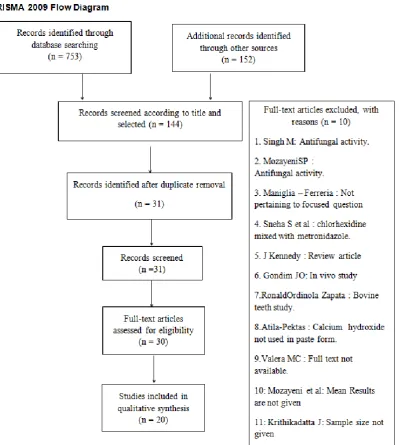
Results: Total of 905 articles were obtained using search strategies out of which 144 articles were selected after reading title and abstract. As a second step, full text publication were obtained. Studies in which calcium hydroxide and chlorhexidine were compared as an intracanal medicament against E.faecalis were selected for this review. Finally a total of 31 articles were included out of which 10 articles were excluded on basis of inclusion and exclusion criteria.
Conclusion
1. CHX showed a better antimicrobial efficacy than calcium hydroxide against E.faecalis. Though 2% chlorhexidine has been found to be more effective against E.faecalis more sophisticated methods such as confocal laser microscopy have shown that bacteria may still be viable but in non-cultivable state so the results are not reliable.
2. The vehicle used for calcium hydroxide would alter its antimicrobial efficacy and substantivity.
3. 2% Chlorhexidine gel has increased bactericidal action when compared to lower concentrations of chlorhexidine gel.
4. Antimicrobial efficacy of calcium hydroxide and chlorhexidine decreases with the time.
Copyright © 2018,Maria Jamily Tavares Leal Vidal. This is an open access article distributed under the Creative Commons Attribution License, which permits
unrestricted use, distribution, and reproduction in any medium, provided the original work is properly cited.
INTRODUCTION
Complete debridement and effective disinfection of the root canal space is an essential step for achieving long term success of nonsurgical endodontics. Elimination of microorganisms is important for management of pulpal disease (Bhardwaj, 2012).
Corresponding author: Dr. Aishwarya C Kadam
Post Graduate student, Department of Conservative Dentistry and Endodontics, Dr. D. Y. Patil Dental College and hospital, Dr. D. Y. Patil Vidyapeeth, Pimpri, Pune 411018
While treating teeth with a vital pulp, there is no need for intracanal medication as such. However, all root canal treatments cannot be completed in single visit so it is recommended to fill the root canal with an antimicrobial dressing between appoinments, to ensure sterility in the canal space until completion of treatment. If there is persistent pain and exudation, placing an intracanal medicament becomes a necessity (Ingle, 2008). The excellent biologic and antimicrobial properties of calcium hydroxide have made this
ISSN: 2230-9926
International Journal of Development Research
Vol. 08, Issue, 07, pp.21786-21790, July,2018
Article History:
Received 22nd April, 2018
Received in revised form 16th May, 2018
Accepted 08th June, 2018
Published online 30th July, 2018
Available online at http://www.journalijdr.com
Key Words:
1.Calcium Hydroxide 2. Chlorhexidine 3. Enterococcus faecalis
4. Intracanal Medicament : Intracanal dressing OR Root canal medicament OR Root canal dressing
5. Antimicrobial efficacy: Antibiofilm efficacy or Antibacterial efficacy
Citation: Maria Jamily Tavares Leal Vidal, Horst Naconecy de Souza, Hérika Maria Filgueira Costa, Lorena de Sousa Cunha, Bruno Frota Amora
Silva, 2018. “Epidemiological profile of pediatric patients hospitalized in a small hospital in the Brazilian Northeast”, international Journal of Development
Research, 8, (07), 21786-21790
medication the choice for the intracanal dressing of infected root canals. It is bactericidal and neutralizes the remaining tissue debris in the root canal system (Bhandari, 2014). The use of calcium hydroxide as an intracanal medicament is very well documented. However its efficacy in clinical practice is controversial (Hargreaves, 2014). Bystrom et al showed that 34 out of 35 canals were bacteria free after 4 weeks of medication period with calcium hydroxide. The study
conducted by Sjogren et al. (1991), also demonstrated that a 7
day dressing with Calcium hydroxide reduced all bacteria in
root canal. However Kvist el al. (2004), reported that residual
bacteria were detected in 29% of one visit teeth and 36% of two visit teeth treated with calcium hydroxide, with no statistically significant difference in both the groups. Nowdays interest has been developed in the effectiveness of CHX gel alone or its mixture with calcium hydroxide. Chlorhexidine (CHX) is a synthetic cationic bisguanide used in endodontics as an irrigant and intracanal dressing. It has an immediate antimicrobial effect, a wide spectrum of action, substantivity, and relatively less toxicity, but it cannot dissolve organic debris which might interfere with the sealing of the root filling (Carbajal Mejía, 2014). Ercan et al reported that 2% CHX gel was significantly more effective when compared with mixture of CHX gel and calcium hydroxide or calcium hydroxide alone
against E.faecalis. Kandaswamy Eswar evaluated the
antimicrobial efficacy using real-time polymerase chain reaction. This study also showed that chlorhexidine is more
effective against E.faecalis compared to calcium hydroxide.
However some studies states that altering the vehicle increases the antimicrobial effect of calcium hydroxide against
E.faecalis when compared with chlorhexidine (Vaghela,
2011). The quest for better intra canal antimicrobial protocols must be continued to ensure complete eradication of bacteria from canal prior to obturation. Results of the different studies are inconsistent, because various techniques have been used to asses antimicrobial efficacy such as zone of inhibition, colony forming units, optical densities and polymerase chain reaction technique. This systematic review can clarify conflicting research data and current state of information regarding specific issues about intracanal medicament. So here in this systematic review we are comparing antibacterial efficacy of
calcium hydroxide and chlorhexidine against E.faecalis when
used as an intracanal medicament.
MATERIAL AND METHODS
The methodology used in this systematic review includes
a literature search strategy,
selection criteria,
screening and data extraction.
The PRISMA 2009 flow chart was followed in this systematic review.
PICO
P: Human extracted teeth
I: Chlorhexidine C: Calcium hydroxide
O: Antimicrobial activity against e.feacalis
Literature Search Strategy
The search strategy covered electronic databases and the reference lists of such articles identified and published from
1st Jan 2006 to 31st July 2017. The electronic databases
searched were the following: PubMed (MEDLINE), the Cochrane library and Google Scholar, Google, Clinical trials registry and manual search using DPU college library resources. All cross reference lists of the selected studies were screened for additional papers that could meet the eligibility criteria of the study. The databases were searched up to and including July 2017 using the search strategy. The following combination of key words were used: Calcium Hydroxide AND Chlorhexidine AND Intracanal Medicament, Intracanal Medicament AND Enterococcus Faecalis, Calcium Hydroxide AND Chlorhexidine, Calcium Hydroxide AND Chlorhexidine AND Antimicrobial Efficacy, Calcium Hydroxide AND Chlorhexidine AND Intracanal Medicament OR Intracanal Dressing, Intracanal Medicament OR Root Canal Dressing AND Enterococcus Faecalis, Calcium hydroxide AND
chlorhexidine against enterococcus faecalis, Calcium
hydroxide AND Chlorhexidine AND Enterococcus faecalis AND Antimicrobial efficacy, Calcium hydroxide AND Chlorhexidine AND Root canal dressing against Enterococcus faecalis.
Inclusion Criteria
Articles in English language or those having summary in
English.
Studies published in 1st Jan 2006 to 31st July 2017.
In vitro studies done on human extracted teeth.
Studies comparing antimicrobial efficacy of calcium
hydroxide and chlorhexidine against E.faecalis
Exclusion Criteria
Review, Abstract, Letter to editorials studies are excluded
An in vivo studies are excluded.
Any studies done before 1st Jan 2006
Screening and Data Extraction
Initially, potential relevant publications involving calcium hydroxide and chlorhexidine as an intracanal medicament were retrieved independently by two reviewers. All articles were screened for eligibility criteria. Any disagreements were resolved by consensus after discussion with a third reviewer . The extraction of information from studies were conducted by the same reviewers.
RESULTS
DISCUSSION
The main objectives of endodontic therapy are to eliminate bacteria from the root canal and to prevent the regrowth of
residual micro-organisms. Antimicrobial agents are
recommended for intracanal antisepsis, to prevent the growth
of microorganisms between appointments (Vaghela, 2011). Despite the antimicrobial properties of the intracanal medicaments and irrigants, elimination of micro-organisms may not be uniform because of the varying vulnerabilities of the involved organisms (Neelakantan, 2007). Studies have shown the poor antimicrobial effect of calcium hydroxide on
Sr. No. Search strategy Number of
articles
Number of selected articles
After Duplicate Removal Search Strategy 1 Calcium Hydroxide AND Chlorhexidine AND Intracanal Medicament 52 12 8
Search Strategy 2 Intracanal Medicament AND Enterococcus Faecalis 56 11 10
Search Strategy 3 Calcium Hydroxide AND Chlorhexidine 233 28 18
Search Strategy 4 Calcium Hydroxide AND Chlorhexidine AND Antimicrobial Efficacy 57 15 9 Search Strategy 5 Calcium Hydroxide AND Chlorhexidine AND Intracanal Medicament
OR Intracanal Dressing
171 13 10
Search Strategy 6 Intracanal Medicament OR Root Canal Dressing AND Enterococcus Faecalis
78 10 7
Search Strategy 7 Calcium hydroxide AND chlorhexidine against enterococcus faecalis 66 10 7 Search Strategy 8 Calcium hydroxide AND Chlorhexidine AND Enterococcus faecalis
AND Antimicrobial efficacy
[image:3.595.56.545.53.207.2]35 12 8
TABLE 1 Search Strategy 9
Calcium hydroxide AND Chlorhexidine AND Root canal dressing against Enterococcus faecalis
5 1 3
[image:3.595.107.507.242.688.2]Total 753 112 80
Figure 1 is uploaded as excel sheet
Figure 2.
E.faecalis (Carbajal Mejía, 2014; Delgado, 2010; Kumar, 2013 and Pavaskar, 2014). However 2% CHX gel demonstrated
significant inhibition of E.faecalis compared with calcium
hydroxide (Bhardwaj, 2012; Bhandari, 2014; Carbajal Mejía, 2014; Neelakantan, 2007; Delgado, 2010; Eswar, 2013 Ballal, 2000; Jhamb, 2010). These differences may have been caused by differences in experimental methodology , concentration of chlorhexidine gel, vehicle used for calcium hydroxide, dressing period of medicament. PrasannaNeelakanthan et al states that the agar diffusion method has been widely used to test the antimicrobial activity of dental materials and medicaments. The advantage of this method is that it allows direct comparison of the materials against the organisms, which indicates that material has the potential to eliminate bacteria in the local micro environment of the root canal system. However, the disadvantage of this method is that the result not only depends on the toxicity of the material for the particular organism, but also is influenced by the ability of the material to diffuse across the medium. Chlorhexidine gel produced the largest inhibitory zones against all the microorganisms whereas Calcium hydroxide was seem to be
least effective against E.faecalis.
Francisco José de SOUZA-FILHO et al stated that the inhibition zones may be more related to material solubility and diffusibility in agar than to its actual efficacy against the microorganisms. Antimicrobial activity of calcium hydroxide is because of its high pH, which in turn precipitates this medicament on agar, preventing its diffusion. This may be the
explanation for poor performance of Ca(OH)2 using the agar
diffusion method. This was in accordance with studies conducted on agar plates by measuring zones of inhibition by V Ballal et al, SwathyJhamb et al, RajdeepPavskar et al and
Prasanna Neelkanthan et al. Chlorhexidine gluconate, a
cationic bis-biguanide, is a broad-spectrum antimicrobial agent and is an effective bactericidal and fungicidal agent and its action is related to the binding of the cationic molecule to the negatively charged bacterial cell walls, thereby altering the
cell’s osmotic equilibrium. A major advantage of
chlorhexidine is its substantivity, which allows prolonged residual antimicrobial effect. Another advantage is that it does not produce resistant microorganisms (Neelakantan, 2007). This might be the reason attributed to the largest inhibitory zones against all the microorganisms, even after 72 hours. However Francisco José de SOUZA-FILHO et al stated that it is not an effective intracanal barrier, needing to be changed frequently as it diffuses through the dentinal tubules, leaving an empty canal. Also the study done by SwathyJhamb et al states that Chlorhexidine had a better antibacterial activity in comparison to calcium hydroxide, but loses its property, when used for a long time.
According to study conducted by AR Prabhakar et al in
2013antibacterial activity of Ca(OH)2 can be attributed to
direct contact through high pH (12.5-12.8) and its ability to dissociate into hydroxyl ions causing bacterial cell death.
Ca(OH)2 showed decreased antibacterial activity over a period
of time which may be attributed to several factors. Firstly, the
buffering of the alkalinity of Ca(OH)2 by dentin and dentin
components.3,5,10 Secondly, low diffusibility of hydroxyl ions
in dentinal tubules.3,10 Thirdly, E. faecalis colonize within
dentinal tubules forming dense biofilms, such that bacteria located within the dentinal tubules can protect those located deeper inside the tubules thus evading the hydroxyl ions
(Prabhakar, 2013). The present investigation reviewed the
literature for the studies published comparing the efficacy of calcium hydroxide and chlorhexidine against E. faecalis. Most of the studies based on colony forming units showed that both
the medicaments have antibacterial efficacy against E.faecalis
but it was found that calcium hydroxide was less effective than
chlorhexidine. Chlorhexidine gel showed maximum
antimicrobial activity against E.faecalis (Bhardwaj, 2012;
Bhandari, 2014; Carbajal Mejía, 2014; Neelakantan, 2007; Kumar, 2013; Prabhakar, 2013; Eswar, 2013; Jhamb, 2010; Ercan, 2006 and Sharifian, 2008). According to results of the study conducted by SwathyJhamb et al in 2009, 2% CHX gel shows higher antimicrobial activity when compared to 0.12 CHX gel. The possible cause could be the high concentration of CHX (2%), lethal bactericidal mode of action and enhanced diffusion into dentinal tubules. Because CHX gel has low contact angle with dentin and thus penetrates the dentinal tubules effectively at faster rate (Bhardwaj, 2012; Prabhakar,
2013; Eswar, 2013).Moreover, SonamBhadari et al stated that
the presence of chlorhexidine adds substantivity to the formulation, due to its adsorption capacity and slow liberation of active molecules by dental tissues. Another advantage is that it does not produce resistant micro-organisms. Similar reason was explained by PrasannaNeelkanthanet and Jesion B Carbajal Mejia.
The study conducted by Jesion B Carbajal Mejia states that 2% CHX gel is effective against E.feacalis after 14 days of application. But Ronan J.R. Delgado used confocal laser microscopy to detect the viability of bacteria from which he detected nonculturable E. Faecalis after 14 days of treatment with CHX. However Jesion B Carbajal Mejia’s study only checked the colony forming units and did not check the viability of bacteria and hence the results. The antimicrobial action of all the three medicaments increased on the seventh day as compared to that on the second day, for both the organisms tested in the study. This was in accordance with the study conducted by Sonam Bhandari which showed that antimicrobial action of calcium hydroxide increased on third and fifth day. Also in the study conducted by Anuj Bhardwaj et al antimicrobial action of calcium hydroxide increased on 5th day compared to 1st day. But the results of the study by Carbajal Mezia indicated that antimicrobial action of calcium hydroxide decreased on 5th day compared to 1st and 3rd day. Similarly results obtained by AR Prabhakar et al showed that antimicrobial action of calcium hydroxide decreased on 3rd and 5th day compared to 24 hours.
From the study conducted by Dakshita Joy Vaghela et al it was concluded that: The type of vehicle used would alter the antimicrobial property of calcium hydroxide as an intracanal medicament. Addition of propylene glycol to calcium hydroxide as an intracanal medicament showed that calcium
hydroxide as an effective antibacterial agent against E.faecalis
whereas to use aqueous solutions of calcium hydroxide were
not as effective against E.faecalis. The vehicle may also alter
the substantivity of calcium hydroxide. The agar diffusion method detects a zone of inhibition around the wells containing the medicament. It is so far the most commonly used method. Most of the studies done by using agar diffusion
method to assess antimicrobial activity against E.faecalis have
fact that owing to high pH calcium hydroxide, the medicament may precipitate on the agar and thereby reduce its diffusion and hence the poor performance of calcium hydroxide may be explained. Most of the studies testing the antimicrobial action of calcium hydroxide and chlorhexidine using colony forming units have shown that both the
medicaments exerts the antimicrobial activity but
chlorhexidine demonstrated significant reduction of colony
forming units against E.faecalis (Bhardwaj, 2012; Bhandari,
2014; Delgado, 2010; Prabhakar, 2013 and Kandaswamy,
2010).KandaswamyEswar evaluated the antimicrobial efficacy
using real-time polymerase chain reactionand they found that
chlorhexidine is more effective against E.faecalis compared to
calcium hydroxide. The viable but non culturable states of E. faecalis under adverse environmental conditions, where the enterococcalcells lose their culturability but are viable which often result in PCR positive/culture negative cases. This was in accordance with the study conducted by Ronan Degaldo who used CLSM to detect viability of bacteria.
Conclusions
CHX showed a better antimicrobial efficacy than
calcium hydroxide against E.faecalis.Various methods
such as checking zone of inhibition, counting colony forming units or checking optical densities have been used to assess antimicrobial efficacy. Though 2% chlorhexidine found to be more effective against
E.faecalis more sophisticated methods such as confocal
laser microscopy have shown that bacteria may still be viable but in non-cultivable state so the results are not reliable.
The vehicle used for calcium hydroxide would alter its
antimicrobial efficacy and substantivity.
2% Chlorhexidine gel has increased bactericidal action
when compared to lower concentrations of
chlorhexidine gel.
Antimicrobial efficacy of calcium hydroxide and
chlorhexidine decreases with the time.
REFERENCES
Ballal, V., Kundabala, M., Acharya, S., Ballal, M. 200. Antimicrobial action of calcium hydroxide, chlorhexidine
and their combination on endodontic pathogens. Aust Dent
J. Jun;52(2):118-21.
Bhandari S, T S A, Patil CR. An in Vitro Evaluation of Antimicrobial Efficacy of 2% Chlorhexidine Gel, Propolis and Calcium Hydroxide Against Enterococcus faecalis in
Human Root Dentin. J ClinDiagn Res. 2014 Nov;
8(11):ZC60-3.
Bhardwaj A, Ballal S, Velmurugan N. Comparative evaluation of the antimicrobial activity of natural extracts of Morindacitrifolia, papain and aloe vera (all in gel formulation), 2% chlorhexidine gel and calcium hydroxide,
against Enterococcus faecalis: An in vitro study. J Conserv
Dent. 2012 Jul; 15(3):293-7.
Carbajal Mejía JB. Antimicrobial effects of calcium hydroxide, chlorhexidine, and propolis on Enterococcus
faecalis and Candida albicans. J InvestigClin Dent 2014
Aug;5(3):194-200.
De Souza-Filho FJ, Soares Ade J, Vianna ME, Zaia AA, Ferraz CC, Gomes BP. Antimicrobial effect and pH of chlorhexidine gel and calcium hydroxide alone and
associated with other materials. Braz Dent J.
2008;19(1):28-33.
Delgado RJ, Gasparoto TH, Sipert CR, Pinheiro CR, Moraes IG, Garcia RB,Bramante CM, Campanelli AP, Bernardineli N. Antimicrobial effects of calcium hydroxide and
chlorhexidine on Enterococcus faecalis. J Endod. 2010
Aug;36(8):1389-93.
Ercan E, Dalli M, Dülgergil CT. In vitro assessment of the effectiveness of chlorhexidine gel and calcium hydroxide paste with chlorhexidine against Enterococcus faecalis and
Candida albicans. Oral Surg Oral Med Oral Pathol Oral
RadiolEndod. 2006 Aug;102(2):e27-31.
Eswar K, Venkateshbabu N, Rajeswari K, Kandaswamy D. Dentinal tubule disinfection with 2% chlorhexidine, garlic extract, and calcium hydroxide against Enterococcus faecalis by using real-time polymerase chain reaction: In vitro study.
J Conserv Dent. 2013 May;16(3):194-8.
Hargreaves K, Cohen S, Berman L, Rostein I. Cohen’s
pathways of the pulp. 11th ed. St.Louis: Elsevier; 2016.
Ingle J, Bakland L, Baumgartner J, Ingle J. Ingle’s Endodontics 6. Hamilton, ON:BC Decker;2008.
Jhamb S, Nikhil V, Singh V. An in vitro study of antibacterial effect of calcium hydroxide and chlorhexidine on
Enterococcus faecalis. Indian J Dent Res. 2010
Oct-Dec;21(4):512-4.
Kandaswamy D, Venkateshbabu N, Gogulnath D, Kindo AJ. Dentinal tubule disinfection with 2% chlorhexidine gel, propolis, morindacitrifolia juice, 2% povidone iodine, and
calcium hydroxide. IntEndod J. 2010 May;43(5):419-23.
Kumar H. An in vitro evaluation of the antimicrobial efficacy of Curcuma longa, Tachyspermumammi, chlorhexidine gluconate, and calcium hydroxide on Enterococcus faecalis. J Conserv Dent. 2013 Mar;16(2):144-7.
Marickar RF, Geetha RV, Neelakantan P. Efficacy of contemporary and novelIntracanal medicaments against
enterococcus faecalis. J ClinPediatr Dent. 2014Fall;
39(1):47-50.
Neelakantan P, Sanjeev K, Subbarao CV. Duration-dependent susceptibility of endodontic pathogens to calcium hydroxide and chlorhexidene gel used as intracanal medicament: an in vitro evaluation. Oral Surg Oral Med Oral Pathol Oral RadiolEndod. 2007 Oct;104(4):e138-41. Epub 2007 Aug 6. Pavaskar R, Chalakkal P, Krishnan R, Sirikonda S, Vasepalli
M, Venkataramana P. Study comparing the effectiveness of chlorhexidine, calcium hydroxide and linezolid based
medicaments against enterococcus faecalis. J ClinDiagn
Res. 2014 Mar;8(3):240-2.
Prabhakar A, Taur S, Hadakar S, Sugandhan S. Comparison of Antibacterial Efficacy of Calcium Hydroxide Paste, 2% Chlorhexidine Gel and Turmeric Extract as an Intracanal Medicament and their Effect on Microhardness of Root
Dentin: An in vitro Study. Int J ClinPediatr Dent. 2013
Sep;6(3):171-7.
Sharifian, M.R., Shokouhinejad, N., Aligholi, M, Emaneini, M, Katebi, A, Assadian, H. In vitro comparison of the effectiveness of chlorhexidine and two calcium hydroxide
formulations on enterococcus faecalis. Iran Endod J. 2008
Summer;3(3):50-6.
Vaghela, D.J., Kandaswamy, D., Venkateshbabu, N., Jamini, N, Ganesh, A. Disinfection of dentinal tubules with two different formulations of calcium hydroxide as compared to 2% chlorhexidine: As intracanal medicaments against Enterococcus faecalis and Candida albicans: An in vitro
study. J Conserv Dent. 2011 Apr;14(2):182-6.