Full Length Research Article
RP-HPLC METHOD DEVELOPMENT AND VALIDATION FOR THE SIMULTANEOUS
DETERMINATION OF BROMHEXINE AND SULBACTAM IN PHARMACEUTICAL DOSAGE FORMS
*1
Venkata Raj Kumar Prava,
1Ganapati Seru,
2Siva Kumar Gubbala
and
1Arun Sathyadev Siddhanadham
1
A.U. College of Pharmaceutical Sciences, Andhra University, Visakhapatnam, Andhra Pradesh, India
2Quagen Pharma, Tnanam Village, Parawada, Visakhapatnam, Andhra Pradesh, India
ARTICLE INFO ABSTRACT
Bromhexineis a mucolytic agent used in the treatment of respiratory disorders associated with viscid or excessive mucus. In addition, Bromhexine has antioxidant properties. Bromhexine is intended to support the body's mechanisms for clearing mucus from the respiratory tract. The present study is to develop and validate a suitable RP-HPLC method for simultaneous estimation of Bromhexine and Sulbactam in pharmaceutical dosage forms in accordance with the ICH guidelines. Altima C18 (150 x 4.6 mm, 5m) column was selected as the stationary phase. Phosphate buffer (pH 4), acetonitrile were taken in the ratio 40:60%v/v and used as mobile phase at a flow rate of 1.0 ml/min. The retention times of Bromhexine and Sulbactam were found to be 2.1 min & 3.2 min, respectively. The study clearly shows that the developed method can be successfully employed for routine quality control of Bromhexine and Sulbactam in drug testing laboratories and pharmaceutical industries.
Copyright©2017, Venkata Raj Kumar Prava et al. This is an open access article distributed under the Creative Commons Attribution License, which permits
unrestricted use, distribution, and reproduction in any medium, provided the original work is properly cited.
INTRODUCTION
Bromhexine is a mucolytic agent used in the treatment of respiratory disorders associated with viscid or excessive mucus. In addition, Bromhexine has antioxidant properties. Bromhexine is intended to support the body's mechanisms for clearing mucus from the respiratory tract. It is secretolytic, increasing the production of serous mucus in the respiratory tract and makes the phlegm thinner and less viscous. This contributes to a secretomotoric effect by helping the cilia transport the phlegm out of the lungs. For this reason it is often added to cough syrups. Bromhexine is a synthetic derivative of the herbal active ingredient Vasicine. It has been shown to increase the proportion of serous bronchial secretion, making it more easily expectorated. It is indicated as "secretolytic therapy in bronchopulmonary diseases associated with abnormal mucus secretion and impaired mucus transport". Bromhexine is contained in various formulations, high and low strength syrups 8 mg/5 ml, 4 mg/5 ml, tablets and soluble tablets (both with 8 mg Bromohexine) and solution for oral use 10 mg/5 ml, adapted to the need of the patients. The posology varies with the age and weight, but there are products for all age groups from infant on.
*Corresponding author: Venkata Raj Kumar Prava,
A.U. College of Pharmaceutical Sciences, Andhra University, Visakhapatnam, Andhra Pradesh, India.
Bromhexine is well absorbed and tolerated. Sometimes it is replaced by its metabolite Ambroxol, as in Mucosolvan or Mucoangin.
Sulbactam
Sulbactam is a β-lactamase inhibitor. This drug is given in combination with β-lactam antibiotics to inhibit β-lactamase, an enzyme produced by bacteria that destroys the antibiotics. A combination product of the above two drugs is being marketed under the brand name of Astarest in India.Since there were no methods available for the simultaneous estimation of the above two drugs in the combination product when we started our work. We attempted the same and successfully developed and validated a RP-HPLC method for this purpose.The work done on this method is incorporated in this chapter. The analytical methods reported so far are either in single or in combination with other drugs are reviewed in the following literature survey.
Literature Survey
Susmitha et al. (2013) reported five spectrophotometric methods for the determination of Bromhexine hydrochloride, validated and applied for the assay of the drug in
ISSN: 2230-9926
International Journal of Development Research
Vol. 07, Issue, 01, pp.11020-11031, January,2017
International Journal of
DEVELOPMENT RESEARCH
Article History:
Received 22nd October, 2016
Received in revised form 04th November, 2016
Accepted 19th December, 2016 Published online 30th January, 2017 Key Words:
pharmaceuticals. Amit kumar et al. (2011)
estimation of Bromhexine (BH) in combination with Terbutaline. Sonawane et al. Reported a reverse phase high pressure liquid chromatographic (RP-HPLC) method for the simultaneous estimation of Amoxicillin trihydrate and Bromhexine hydrochloride from oily suspension. Madhura dhoka et al. (2010), reported a high performance liquid chromatographic method for the simultaneous determination of Amoxicillin trihydrate and Bromhexine hydrochloride in oral dosage forms. Rajan et al. (2013)
performance liquid chromatography method for the
[image:2.595.105.223.328.425.2]simultaneous determination of Amoxicillin trihydrate and Bromhexine hydrochloride from the combine formulation i.e. capsules.
Fig. 1. Chemical Structure of Bromhexine
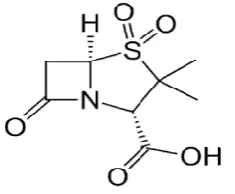
Fig. 2. Chemical Structure of Sulbactam
Satyanarayana et al. (2012) reported a reverse phase high
performance liquid chromatographic method for the
simultaneous estimation of Terbutaline and Bromhexine in bulk and pharmaceutical dosage forms. Senthilraja (2011) reported a reversed phase HPLC method for the
simultaneous quantification of Terbutaline sulphate,
Bromhexine hydrochloride and Guaifenesin in a cough syrup formulation. Madhukar et al. (2011), reported a reverse phase high performance liquid chromatographic method for the simultaneous estimation of Ampicillin sodium and Sulbactam sodium in injectable formulation. Dhandapani
reported a reverse phase liquid chromatographic method for simultaneous determination of Cefoperazone and
parenteral preparation. Palanikumar et al. (2010)
isocratic liquid chromatographic method with UV detection at 230 nm for the simultaneous determination of Ceftriaxone sodium and Sulbactam sodium in Cetriax s 1.5gm injection. Anusha et al. (2012), reported a method for determining the concentration of Amoxicillin and Sulbactam simultaneously in Amoxirum forte injection vial, based on high
liquid chromatography. Sanjay Mohan et al. (2004),
an isocratic liquid chromatographic method with UV detection at 220 nm is for the simultaneous determination of Ceftriaxone sodium and Sulbactam sodium in Sulbactomax. Masoom Raza
et al. (2009), reported a method to determine Ceftriaxone and Sulbactam simultaneously in spiked plasma and combined
formulations. Patel et al. (2012), Developed two UV
spectrophotometric methods which are validated for the simultaneous determination of Cefuroxime sodium (CEF) and Sulbactam sodium (SUL) in their combined dosage forms. Pai
11021 Venkata Raj Kumar Prava et al. Rp
determination of bromhexine and sulbactam
. (2011) reported the estimation of Bromhexine (BH) in combination with a reverse phase high HPLC) method for the simultaneous estimation of Amoxicillin trihydrate and Bromhexine hydrochloride from oily suspension. Madhura reported a high performance liquid chromatographic method for the simultaneous determination of Amoxicillin trihydrate and Bromhexine hydrochloride in reported a high
performance liquid chromatography method for the
imultaneous determination of Amoxicillin trihydrate and Bromhexine hydrochloride from the combine formulation i.e.
1. Chemical Structure of Bromhexine
Chemical Structure of Sulbactam
reported a reverse phase
high-performance liquid chromatographic method for the
simultaneous estimation of Terbutaline and Bromhexine in bulk and pharmaceutical dosage forms. Senthilraja et al.
reported a reversed phase HPLC method for the
simultaneous quantification of Terbutaline sulphate,
Bromhexine hydrochloride and Guaifenesin in a cough syrup reported a reverse phase atographic method for the simultaneous estimation of Ampicillin sodium and Sulbactam sodium in injectable formulation. Dhandapani et al. (2010), reported a reverse phase liquid chromatographic method for simultaneous determination of Cefoperazone and Sulbactam in . (2010)reported an isocratic liquid chromatographic method with UV detection at 230 nm for the simultaneous determination of Ceftriaxone s 1.5gm injection. reported a method for determining the concentration of Amoxicillin and Sulbactam simultaneously in Amoxirum forte injection vial, based on high-performance . (2004), reported id chromatographic method with UV detection at 220 nm is for the simultaneous determination of Ceftriaxone sodium and Sulbactam sodium in Sulbactomax. Masoom Raza reported a method to determine Ceftriaxone and asma and combined Developed two UV spectrophotometric methods which are validated for the simultaneous determination of Cefuroxime sodium (CEF) and Sulbactam sodium (SUL) in their combined dosage forms. Pai
et al. (2009), reported a reverse phase liquid chromatographic method for the simultaneous determination of Salbutamol sulphate and Bromhexine hydrochloride.
Aim and Objective
Various UV and HPLC me literature for the estimation individually and in-combinatio literature survey there is n
simultaneous estimation of Bromhexine and Sulbactam RP-HPLC in combined pharmaceutical
planned to develop and validate a
simultaneous estimation of Bromhexine and Sulbactam pharmaceutical dosage forms in accordance with the ICH guidelines.
The main aim and objective of the present study is
To develop a new reverse phase high performance liquid
chromatographic method for the simultaneous
determination of Bromhexine and Sulbactam pharmaceutical dosage form.
To validate the developed method for the following parameters
System suitability
Specificity
Linearity
Accuracy
Precision
Limit of Detection
Limit of Quantification
Robustness
Solution stability.
EXPERIMENTAL PROCEDURE
Instrumentation: Chromatog
Alliance Waters 2695 HPLC provided with high speed auto sampler, column oven, degasser and & 2996 PDA detector to provide a compact and with class Empower
Reagents and chemicals:
Bromhexine and Sulbactam w
from Spectrum pharma research solutions grade acetonitrile, HPLC gr
chemicals were obtained fro
Mumbai. HPLC grade water obtained from Milli
purification system was used throughout the study. Commercial formulations (Brand Name:
Bromhexine and Sulbactam purchased from the local pharmacy.
Preparation of buffer Solution:
of sodium dihyrogen ortho
volumetric flask, about 900ml of HPLC grade water was added, sonicated and degassed and finally made up the volume to 1000ml with water, and then pH was adjusted to 4 with dilute orthophosphoric acid solution.
Preparation of diluent solution:
diluent which is filtered through 0.22 micron filter.
Preparation of Standard St
solutions were prepared
Venkata Raj Kumar Prava et al. Rp-hplc method development and validation for the simultaneous determination of bromhexine and sulbactam in pharmaceutical dosage forms
reported a reverse phase liquid chromatographic method for the simultaneous determination of Salbutamol sulphate and Bromhexine hydrochloride.
ethods were reported in the n of Bromhexine and Sulbactam on with other drug. According to no method reported for the f Bromhexine and Sulbactam by pharmaceutical dosage forms. So we planned to develop and validate a RP-HPLC method for Bromhexine and Sulbactam in s in accordance with the ICH
The main aim and objective of the present study is
rse phase high performance liquid
chromatographic method for the simultaneous
Bromhexine and Sulbactam in pharmaceutical dosage form.
To validate the developed method for the following
Limit of Quantification
L PROCEDURE
ography was performed with Alliance Waters 2695 HPLC provided with high speed auto degasser and & 2996 PDA detector to provide a compact and with class Empower-2 software.
The reference samples of were provided as gift samples m Spectrum pharma research solutions, Hyderabad. HPLC rade methanol and all other om Merck chemical division, HPLC grade water obtained from Milli-Q water purification system was used throughout the study. (Brand Name: Astarest; Lable Claim: Bromhexine and Sulbactam - 4 mg &2 mg /5ml) were
l pharmacy.
Preparation of buffer Solution: Accurately weighed 1.41gm phosphate in a 1000ml of volumetric flask, about 900ml of HPLC grade water was added, sonicated and degassed and finally made up the volume to 1000ml with water, and then pH was adjusted to 4 with dilute orthophosphoric acid solution.
uent solution: Milli-Q water was used as diluent which is filtered through 0.22 micron filter.
tock Solution: Standard stock d by dissolving 10mg of
Bromhexine and 5mg of Sulbactam into a clean and dry 25ml volumetric flask, to that 15 ml of diluent was added, sonicated for 5 minutes and volume was made up to 25 ml with the diluent to get stock solution with a concentration of 0.4mg/ml for Bromhexine and 0.2mg/ml for Sulbactum respectively.
Preparation of Working Standard Solutions: Aliquots of 0.25, 0.5, 0.75, 1, 1.25 & 1.5 ml were pipetted out from stock solution and transferred into 10 ml volumetric flask and the volume was made up to 10 ml with diluent. This gives the solutions of 10, 20, 30, 40, 50 and 60µg/ml for Bromhexine and 5, 10, 15, 20, 25 and 30 µg/ml for Sulbactam respectively.
Sample preparation: 5 bottles of Astarest syrup was transferred into a clean & dried beaker and mixed well. From the above syrup, 5 ml was transferred into a 100ml volumetric flask, 70ml of diluent was added and sonicated for 30 min, further the volume was made up with diluent and filtered. This solution gave 40µg/ml of Bromhexine and 20µg/ml of Sulbactum respectively.
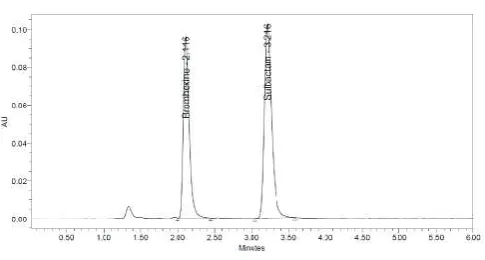
Chromatographic conditions: The chromatographic separation was carried out under the isocratic conditions. Chromatographic separation was achieved by injecting a volume of 10μl of standard into Altima (150x 4.6mm, 5m) column. The mobile phase of composition 400 ml of buffer (pH 4) and 600ml of acetonitrile were allowed to flow through the column at a flow rate of 1.0 ml/min for a period of 6min at 300C column temperature. Detection of the component was carried out at a wavelength of 260 nm. The retention time of the components were found to be 2.1 and 3.2 min for Bromhexine and Sulbactam respectively.
Method Validation
System Suitability Tests: Data from six injections of 10 µl of the working standard solutions of Bromhexine (40µg) and Sulbactam (20µg) were used for the evaluation of the system suitability parameters like tailing factor, the number of theoretical plates, retention time and resolution factor.
Specificity
The specificity of the method was performed by injecting blank solution, placebo solution and standard solutions of Bromohexine and Sulbactam separately.
Linearity: By t a k i n g appropriate aliquots of the standard Bromhexine and Sulbactam solutions with the mobile phase, six working solutions ranging between 10-60 μg/ml and 5-30 μg/ml were prepared. Each experiment linearity point was
performed in triplicate according to optimized
chromatographic conditions. The peak areas of the chromatograms were plotted against the concentration of Bromhexine and Sulbactam to obtain the calibration curve.
Accuracy: Previously analyzed samples of Bromhexine (40µg) and Sulbactam (20µg) to which known amounts of standard Bromhexine and Sulbactam corresponding to 50%, 100% and 150% of target concentration were added and analyzed in triplicate. The accuracy was expressed as the percentage of analyte recovered by the proposed method.
Precision: The repeatability and intermediate precision were determined by analyzing the six samples of Bromhexine (40µg) and Sulbactam (20µg).
Limit of detection and the Limit of quantification: Limit of detection (LOD) and limit of quantification (LOQ) of Bromohexine and Sulbactam were determined by calibration curve method. Solutions of both Bromohexine and Sulbactam were prepared in linearity range and injected in triplicate. Average peak area of three analyses was plotted against concentration. LOD and LOQ were calculated by using following equations.
LOD = (3.3 ×Syx)/b, LOQ= (10.0×Syx)/b.
Where Syx is residual variance due to regression; b is slope.
Robustness: The robustness of the method was performed by deliberately changing the chromatographic conditions. The parameters included slight variation in organic phase percentage in the mobile phase (54, 66%), flow rate (0.9, 1.1 ml/min) and column temperature (25, 35°C).
Stability: The sample solutions of Bromhexine (40µg) and Sulbactam (20µg) were injected at 0 hrs (comparison sample) and after 24 hrs (stability sample) by keeping at ambient room temperature. Stability was determined by determining %RSD for sample and standard solutions.
RESULTS AND DISCUSSION
Method Development
Initially reverse phase liquid chromatography separation was attempted using various ratios of methanol and water, acetonitrile and water as mobile phases, in which both the drugs did not responded properly, and the resolution was also poor. Further several systematic trials were performed to optimize the mobile phase and the organic content of mobile phase was also investigated to optimize the separation of both drugs. To improve the tailing factor, the pH of mobile phase becomes important factor. The organic content of mobile phase was investigated further to optimize the separation of both drugs. To improve the tailing factor, the pH of mobile phase becomes important factor. Thereafter, buffer: acetonitrile were taken in ratio of 40:60%v/v and with a flow rate of 1.0 ml/min was employed. Preliminary development trials were performed with octdecyl columns of different types, configurations and from different manufacturers.
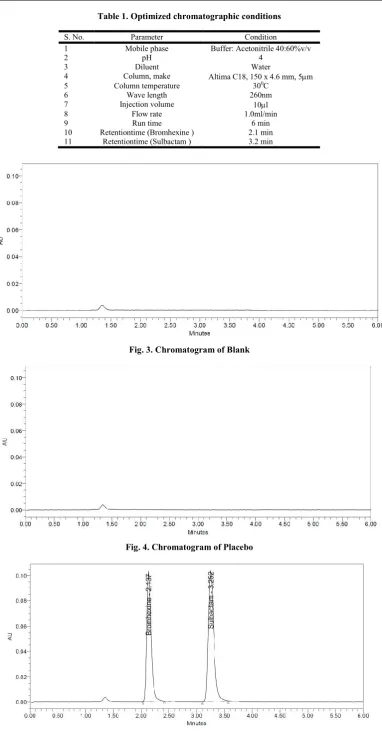
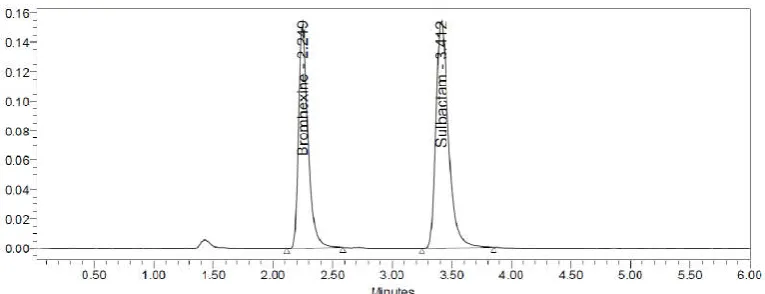
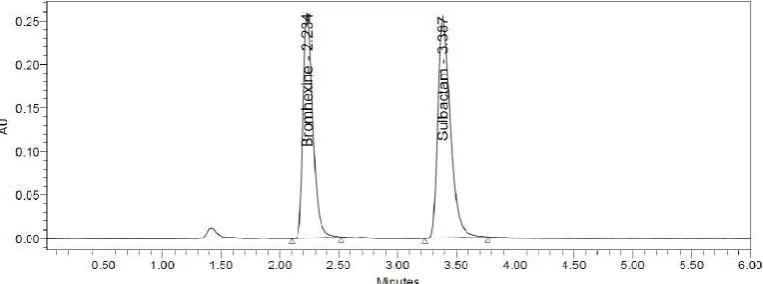
FinallyAltima column (4.6x150mm, 5μm) was selected as the stationary phase to improve resolution and the tailing of both peaks were reduced considerably and brought close to 1. To analyze both drugs detection were tried at various wavelengths from 205nm to 280nm. Both Bromhexine and Sulbactam showed maximum absorption at 260nm of wavelength and the same was selected as the detection wavelength for PDA detector. The retention times were found to about 2.1 min and 3.2 min for Bromhexine and Sulbactam respectively. The chromatograms obtained for blank injection, placebo injection and optimized method were shown in the Fig.3, 4 and 5 respectively and optimized chromatographic conditions were shown in Table 1.
Method Validation
Table 1. Optimized chromatographic conditions
S. No. Parameter Condition
1 Mobile phase Buffer: Acetonitrile 40:60%v/v
2 pH 4
3 Diluent Water
4 Column, make Altima C18, 150 x 4.6 mm, 5m
5 Column temperature 300C
6 Wave length 260nm
7 Injection volume 10l
8 Flow rate 1.0ml/min
9 Run time 6 min
10 Retentiontime (Bromhexine ) 2.1 min 11 Retentiontime (Sulbactam ) 3.2 min
[image:4.595.117.484.603.772.2]Fig. 3. Chromatogram of Blank
Fig. 4. Chromatogram of Placebo
Fig. 5. Chromatogram of Bromhexine and Sulbactam standards
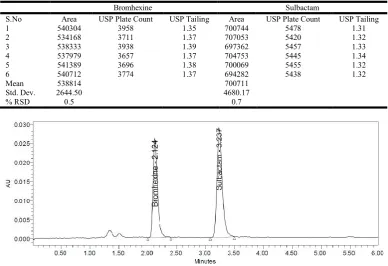
The total run time required for the method is only 6 minutes for eluting both Bromhexine and Sulbactam. The results obtained were shown in Table No.2. The number of theoretical plates was found to be > 2000, USP tailing was < 2 and USP resolution is above 2. The % RSD of areas for Bromhexine and Sulbactam were 0.5 and 0.7 respectively.
Specificity
[image:5.595.106.495.78.344.2]The specificity of the method was performed by injecting blank solution, placebo solution and standard solutions separately. The chromatogram of the drug was compared with blank and placebo chromatogram to verify the interference.
Table 2. System Suitability of Bromhexine and Sulbactam
Bromhexine Sulbactam
S.No Area USP Plate Count USP Tailing Area USP Plate Count USP Tailing
1 540304 3958 1.35 700744 5478 1.31
2 534168 3711 1.37 707053 5420 1.32
3 538333 3938 1.39 697362 5457 1.33
4 537979 3657 1.37 704753 5445 1.34
5 541389 3696 1.38 700069 5455 1.32
6 540712 3774 1.37 694282 5438 1.32
Mean 538814 700711
Std. Dev. 2644.50 4680.17
[image:5.595.102.496.86.470.2]% RSD 0.5 0.7
Fig. 6. Linearity 25% chromatogram of Bromhexine and Sulbactam
Fig. 7. Linearity 50% chromatogram of Bromhexine and Sulbactam
[image:5.595.105.495.536.682.2]No interfering peak was observed at the retention time of Bromhexine and Sulbactam. Hence, the method is specific for the determination of Bromhexine and Sulbactam.
Linearity
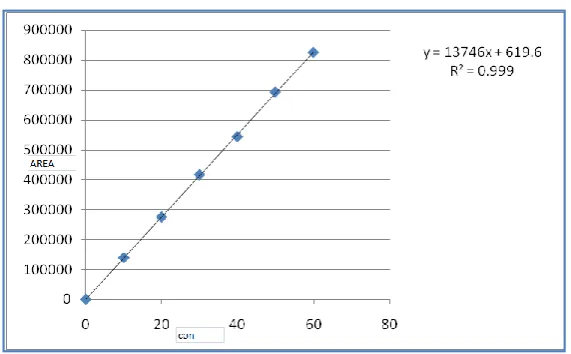
Bromhexine showed a linearity of response between 10-60 μg/ml and Sulbactam showed a linearity of response between 5-30 μg/ml. These were represented by a linear regression equation as follows: y (Bromhexine)= 13746x + 619.65 (r2=0.9999), y(Sulbactam)= 38096x + 2441 (r2=0.9997) and regression line was established by least squares method and correlation coefficient (r2) for Bromhexine and Sulbactam is found to be greater than 0.98. Hence, the curves established were linear. The results were shown in the Table 3 and Fig. 6-13.
Accuracy
To the pre analyzed sample solution, a definite concentration of standard drug (50%, 100% & 150 % level) was added and recovery was studied. The % mean recovery for Bromhexine and Sulbactam are 99.97% and 100.06%, respectively and these results are within acceptable limit of 98-102. The % RSD for Bromhexine and Sulbactam are 1.1 and 0.9 respectively and %RSD for Bromhexine and Sulbactam is within limit of ≤2. Hence, the proposed method is accurate and the results are summarized in Table-4 and Figure 14-16.
[image:6.595.98.505.54.212.2]Precision: The repeatability and Intermediate precision data were summarized in Table 5 and 6, respectively and were assessed by the use of standard solutions of Bromohexine and Sulbactam.
[image:6.595.111.494.420.567.2]Fig. 9. Linearity 100% chromatogram of Bromhexine and Sulbactam
Fig.10. Linearity 125% chromatogram of Bromhexine and Sulbactam
Fig.11. Linearity 150% chromatogram of Bromhexine and Sulbactam
Fig.12. Calibration Curve for Bromhexine
Table 3. Linearity data of Bromhexine and Sulbactam
Bromhexine Sulbactam
Conc. (µg/ml) Peak area Average(n=3) Conc. (µg/ml) Peak area Average(n=3)
10 139020 5 188298
20 275225 10 393333
30 416368 15 573983
40 543543 20 758611
50 691987 25 964101
[image:7.595.121.473.284.618.2]60 824893 30 1138861
Fig.13. Calibration Curve for Sulbactam
Repeatability: Six replicates injections in same concentration of Bromhexine and Sulbactam were analyzed in the same day for repeatability and the % RSD for Bromhexine and Sulbactam found to be 0.7 and 0.8 respectively and % RSD for Bromhexine and Sulbactam found to be within acceptable limit of ≤2.
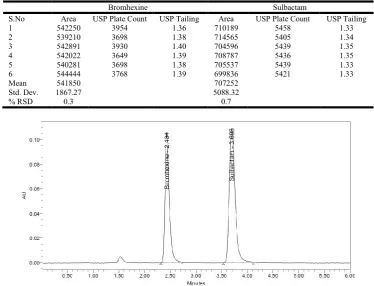
[image:8.595.106.510.54.211.2]Intermediate Precision: Six replicates injections in same concentration were analyzed on two different days with different analyst and column for verifying the variation in the precision and the % RSD for Bromhexine and Sulbactam is found to be 0.3 and 0.7 respectively and it is within acceptable limit of ≤2.
Fig. 15. Accuracy 100% chromatogram of Bromhexine and Sulbactam
[image:8.595.111.493.241.383.2]Fig.16. Accuracy 150% chromatogram of Bromhexine and Sulbactam
Table 4. Results of Recovery Experiments of Bromhexine and Sulbactam
Preanalysed amount (µg/ml) Spiked Amount (µg/ml) % Recovered Bromhexine Sulbactam Bromhexine Sulbactam Bromhexine Sulbactam
40 20 20 10 100.93 100.31
40 20 20 10 100.78 99.06
40 20 20 10 99.33 99.56
40 20 40 20 99.48 98.66
40 20 40 20 100.92 100.62
40 20 40 20 98.92 100.9
40 20 60 30 98.19 101.05
40 20 60 30 99.69 100.71
40 20 60 30 101.46 99.63
MEAN 99.97 100.06
SD 1.1 0.86
[image:8.595.145.460.438.573.2]%RSD 1.1 0.9
Table 5. Results of Repeatability of Bromhexine and Sulbactam
Bromhexine Sulbactam
S.No Area USP Plate Count USP Tailing Area USP Plate Count USP Tailing
1 542957 4023 1.35 706362 5418 1.34
2 536424 3780 1.37 703018 5265 1.34
3 539519 3707 1.39 706813 5520 1.31
4 541519 3739 1.37 706899 5597 1.33
5 544129 3678 1.36 693735 5631 1.32
6 534132 4056 1.39 696628 5616 1.32
Mean 539780 702243
Std. Dev. 3879.74 5727.90
% RSD 0.7 0.8
[image:8.595.111.495.605.712.2]Hence, the method is reproducible on different days with different analyst and column. This indicates that the method is precise.
[image:9.595.112.487.79.365.2]Robustness: To evaluate the robustness of the developed HPLC method, few chromatographic conditions were deliberately altered.
Table 6. Results of Intermediate precision of Bromhexine and Sulbactam
Bromhexine Sulbactam
S.No Area USP Plate Count USP Tailing Area USP Plate Count USP Tailing
1 542250 3954 1.36 710189 5458 1.33
2 539210 3698 1.38 714565 5405 1.34
3 542891 3930 1.40 704596 5439 1.35
4 542022 3649 1.39 708787 5436 1.35
5 540281 3698 1.38 705537 5439 1.33
6 544444 3768 1.39 699836 5421 1.33
Mean 541850 707252
Std. Dev. 1867.27 5088.32
[image:9.595.137.465.389.554.2]% RSD 0.3 0.7
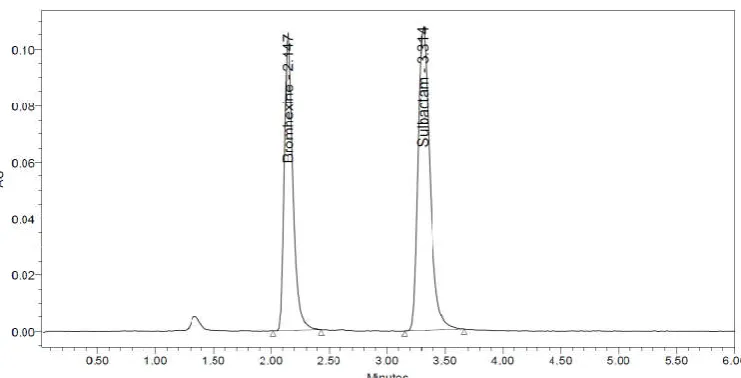
[image:9.595.138.465.578.743.2]Fig.17. Robustness (Flow minus: 0.9ml/min) chromatogram of Bromhexine and Sulbactam
Fig.18. Robustness (Flow Plus: 1.1ml/min) chromatogram of Bromhexine and Sulbactam
The robustness was established by changing the flow rate, column temperature and composition of the mobile phase within allowable limits from actual chromatographic conditions. It was observed that there were no marked change in mean Rt and RSD is within limit of ≤2. The tailing factor,
resolution factor and no. of theoretical plates were found to be acceptable limits for both Bromhexine and Sulbactam. Hence, the method is reliable with variations in the analytical conditions and the results are shown in Table No.8.7 and Figure No. 17-22.
Stability of sample solution: The sample solution injected after 24 hrs by keeping at ambient room temperature 300C did not show any appreciable change. The deviation in the assay is not more than 2 and the results are shown in Table-8.
[image:10.595.111.482.58.247.2]LOD and LOQ: LOD and LOQ for Bromhexine were 0.04 and 0.11 μg/ml, respectively and for Sulbactum were 0.09 and 0.27 μg/ml respectively.
[image:10.595.119.474.276.452.2]Fig. 20. Robustness (Mobile Phase Plus: 66%) chromatogram of Bromhexine and Sulbactam
Fig.21. Robustness (Temperature Minus: 25°C) chromatogram of Bromhexine and Sulbactam
Fig. 22. Robustness (Temperature Plus: 35°C) chromatogram of Bromhexine and Sulbactam
[image:10.595.117.476.480.657.2]Table 7(a). Robustness – Flow Minus (n=6)
S.No. Parameter Bromhexine Sulbactam
1. % RSD of area 0.5 0.3
2. Tailing Factor 1.36 1.34
3. Plate count 3987 5772
Table 7(b). Robustness- Flow Plus (n=6)
S.No. Parameter Bromhexine Sulbactam 1. % RSD of area 0.4 0.5 2. Tailing Factor 1.32 1.31 3. Plate count 3969 5398
Table-7(c). Robustness - Mobile Phase Minus (n=6)
S.No. Parameter Bromhexine Sulbactam 1. % RSD of area 0.5 1.0 2. Tailing Factor 1.36 1.34 3. Plate count 3972 5464
Robustness – Mobile Phase Plus (n=6)
S.No. Parameter Bromhexine Sulbactam 1. % RSD of area 0.7 0.6 2. Tailing Factor 1.38 1.32 3. Plate count 4058 5571
Table- 7(e). Robustness- Temperature Minus (n=6)
S.No. Parameter Bromhexine Sulbactam 1. % RSD of area 0.8 0.6 2. Tailing Factor 1.36 1.32 3. Plate count 4056 5597
Table-7(f). Robustness – Temperature Plus (n=6)
[image:11.595.310.553.51.181.2]S.No. Parameter Bromhexine Sulbactam 1. % RSD of area 0.9 0.4 2. Tailing Factor 1.35 1.33 3. Plate count 3961 5501
Table 8. Stability data of Bromhexine and Sulbactam
Drug %Assay at 0 hr* %Assay at 24hr* Deviation
Bromhexine 99.78 98.31 1.04
Sulbactam 99.82 99.11 0.50
*n=6 for each parameter
[image:11.595.309.559.223.276.2]The lowest values of LOD and LOQ as obtained by the proposed method indicate that the method is sensitive and the results are shown in Table-9.
Table 9. LOD and LOQ data of Bromhexine and Sulbactam
Bromhexine Sulbactam
S.no Slope Y-intercept S.no Slope Y-intercept
1 13850 504.6 1 38383 1264
2 13715 564.4 2 38224 3135
3 13673 789.9 3 37681 2922
AVG 13746 619.6 AVG 38096 2440
SD 150.46 SD 1024.29
LOD 0.04 LOD 0.09
LOQ 0.11 LOQ 0.27
Assay: Thepercentage assay of labeled claim of Bromhexine and Sulbactam present in the astarest syrup were 99.78±0.72 % and 99.80±0.82% respectively. RSD values for both Bromhexine and Sulbactam are within limit of ≤2 and the results were shown in Figure No. 23 and Table 10.
Fig.23. Assay chromatogram of Bromhexine and Sulbactam
Table 10. Assay of pharmaceutical dosage form
S. No. Drug Name Amount injected (μg/ml)
Amount found (μg/ml)
% Assay ± SD*
1 Bromhexine 40 39.91 99.78±0.72 2 Sulbactam 20 19.96 99.80±0.82 *n=6 for each parameter; Label Claim: 4mg Bromhexine+2mg of Salbactum/5 ml
Conclusion
A new simple, precise and accurate HPLC method was developed and validated for the simultaneous estimation of
Bromhexine and Sulbactamin pharmaceutical dosage form. In
this method, Altima C18 (150 x 4.6 mm, 5m) column was selected as the stationary phase. Phosphate buffer (pH 4), acetonitrile were taken in the ratio 40:60%v/v and used as mobile phase at a flow rate of 1.0 ml/min. The retention times of Bromhexine and Sulbactam were found to be 2.1 min & 3.2 min, respectively. This HPLC method for the determination of
Bromhexine and Sulbactam was validated as per the ICH
guidelines. In this method, the numbers of theoretical plates were above 2000, tailing factor is less than 2 and RSD of peak area is less than 2, this indicates that the optimized method met the system suitability parameters. The regression coefficient value (r2)
was 0.999 for Bromhexine and Sulbactamand the response was
linear.
The percentage mean recovery of Bromhexine and Sulbactam were found to be 99.97% and 100.06%, respectively and it showed that the proposed method is accurate. RSD values of repeatability and intermediate precision were ≤2 and the method is precise. The lowest values of LOD and LOQ as obtained by the proposed HPLC method indicate that the method is sensitive. The solution stability studies of method indicate that the Bromhexine and Sulbactam drugs were stable up to 24 hours. In robustness chromatographic conditions were changed as flow minus: 0.9 ml/min; flow plus: 1.1ml/min; temperature minus: 250C; temperature plus: 350C; mobile phase minus: organic phase 54%v/v; mobile phase plus: organic phase 66%v/v. These changes didn’t show any variation in results and it showed the reliability of the method. Hence, the developed method can be successfully employed for routine quality control of Bromhexine and Sulbactam in drug testing laboratories and pharmaceutical industries.
Acknowledgements
[image:11.595.44.279.505.536.2] [image:11.595.43.280.624.713.2]Andhra Pradesh, India for providing all possible facilities to carry out this research work.
REFERENCES
Amit Kumar, Sanju Nanda. 2011. Pharm methods, 2(4): 218.
Anusha, N., Uday Kamath. B. 2012. Int J Pharm Pharm Sci, 4(4): 330.
Dhandapani, B., Thirumoorthy, N. 2010. Rasheed, Shaik. Harun. Int J of ChemTech Research, 2(1): 752.
Madhukar Badgujar, Kiran Mangaonkar. 2011. Oriental j of chem., 27(4): 1659.
Madhura dhoka, Vandana Gawande, Pranav Joshi. 2010.
International journal of pharmacy and pharmaceutical sciences, 2(1): 129.
Masoom Raza Siddiqui, Abu Tariq, Manu Chaudhary.
American J of Applied Sci, 2009; 6(10): 1781.
Pai, P.N.S., Rao, G.K. Murthy, MS., Agarwal, A., Puranik. S.2009. Indian Journal of Pharmaceutical Sciences, 2009; 71(1): 53.
Palanikumar, B., Thenmozhi, A., Sridharan. D. 2010. Int J Pharmacy Pharm Sci., 2(3): 34.
Patel, F.M., Dave, J.B. and Patel. C.N. 2012. Indian Journal of Pharma Sci. Research, 3(9): 3513.
Rajan, V. Rele, Rajesh N. Mali. 2013. Der Pharma Chemica, 5(1): 273.
Sanjay Mohan Shrivastava, Raj kumar Singh. 2004. J. Pharm.
Biomed. Anal, 36: 565.
Satyanarayana, P.V.V., Murali, M., Venkateswara Rao. P. 2012. Int. J. ChemTech Res, 4(1): 240.
Senthilraja, M., Giriraj. 2011. Asian j pharm clin res., 4(2), 13.
Sonawane, L.V., Bari, S.B. Pharm Anal Acta 1:107.
10.4172/2153- 2435.1000107.
Susmitha, K., Thirumalachary, M., Venkateshwarlu. G.2013.
ISRN Analytical Chemistry, Volume, Article ID 861851, 7.