1444
ROTATION INVARIANT FACE RECOGNITION USING
JACOBI –FOURIER MOMENTS
1DR ALI MOHAMMED SAHAN, 2ALI SAMI AZEEZ, AND 3MOHAMMED FADHIL IBRAHIM 1[email protected]
2[email protected] 3[email protected]
IT Dept, Technical College of Management, Middle Technical University, Baghdad, Iraq
ABSTRACT
The face image comprises different global and local details related to the whole and different local areas of the face image, therefore extract global features from the local areas leads to provide distinct distinguishing of the face images. In this, work a face recognition approach based on Jacobi-Fourier moments has been presented. Jacobi-Fourier moments used to provide global and distinct features about local areas in the face image. These features are used to construct histogram bins. Extensive experiments are carried out using different standard face database such as ORL, JAFEE and UMIST which are contain large variability in facial expression, pose and illumination. The experimental analysis refers that the proposed approach outperforms the traditional method under pose, facial expression, and different variations as well as it rotation invariant.
Keywords: Rotation Invariant, Face Recognition, Jacobi-Fourier Moments, Global Features, Local Features.
1. INTRODUCTION
The human face image has different components occupied different positions. These positions comprise important details about the face image which are the local features. Furthermore, all these positions participate each to other to form global features about the whole face image. On the other hand, the face image affected by many variations such as poses, illumination, facial expression, and rotation. Therefore, face recognition can be considered as an important field in the biometric domain which has numerous applications in various fields [1,2] like electronic library, security in different building, control access, on line face image identification in surveillance video, criminal identification, and authentication in different organization and different economic and military field. The above-mentioned issues lead to increase the attention in scientific research of face recognition field. Therefore, many face recognition techniques have been proposed. These techniques consider different feature extraction methods which can classify into local, global, and mixed local and global features. The local feature extraction method captures local features about the face image these methods are robust against irrelevant information like hair and background.
However, they are affected by environmental conditions [3]. The global feature capturing methods provide global details about the whole image of the human face. However, these methods are affected by face facial expressions variation. The hybrid local and global methods decrypting both local and global features that leads to providing robust recognition of the face images. Most of the face recognition methods are suffer from geometric problems because their recognition accuracy affected by rotation, scaling, and shifting variations. The rotation invariant moments techniques provides solutions for these geometric problems, therefore, a lots of face recognition techniques have been presented [4-11].
1445 invariant hybrid global and local feature in face recognition system.
The rest of this paper is organized as follows: the related work is discussed in Section 2. An overview of JFMs presented in Section 3. Section 4 describes the proposed technique. Section 5 presented the used distance measure. Section 6 describes the utilized standard face databases. Section 7 presented the details of the experimental part. Section 8 discussed the conclusions existed in this work.
2. RELATED WORK
The JFMs can be considered as a strong feature descriptor due to its attractive characteristics like rotation invariance, good image reconstruction and representation capability and minimum redundancy. Therefore, many face recognition methods based on JFMs have been existed in literature. C. Camacho-Bello et.al.[12] Proposed a fast and accurate algorithm for JFMs computation. The proposed algorithm is utilized in image description and compared with other related methods. C. Toxqui-Quitl et. al. [13] presented a motion descriptor based on JFMs used to classify the objects from motion blurred images. N. V. S. Sree Rathna Lakshmi and C. Manoharan [14] utilized JFMs as a feature extraction descriptor for detecting micro-calcifications in mammograms. K. Sankar and K. Nirmala [15] also used JFMs as a feature extraction descriptor to classify mammogram images into abnormal and normal. Rahul Upneja and Chandan Singh [16] proposed a fast computation algorithm of JFMs. The proposed algorithm used in invariant image recognition. Francisco Solís et.al. [17] presented static sign recognition system for Mexican language base JFMs. They represent each sign image by 64 JFMs in order to reduce the computational dimensionality. The system achieves %95 recognition accuracy using the artificial neural network in the classification stage. Cesar Camacho-Bello et.al. [18] used JFMs for color image description. Guleng Amu [19] presented an algorithm to compute Pseudo JFMs in Cartesian coordinate instead of the polar coordinate in order to reduce the computation dimensionality. The evaluation of the presented algorithm under image reconstruction referred that the computation of JFMs in Cartesian coordinate gains advantages against of its computation in polar coordinate. The JFMs didn’t utilize yet in face recognition problem, therefore, contribution of the proposed technique is analyzing the performance of these
invariant moments as a rotation invariant hybrid global and local feature descriptor in face recognition system.
3. JACOBI-FOURIER MOMENTS
The image function under polar coordinates can be defined using JFMs of repetition m and order n as [16,20,21]
2
0 1 0 * ( , , , ) ) ,
(r V pq r rdrd f
Hnm nm (1)
where p and q represented the real parameters, n refer to nonnegative integer, while m refer to an integer and Vnm* (p,q,r,) is the complex conjugate of JFMs kernel function Vnm(p,q,r,)
) ( ) , , ( ) , , ,
(pqr R pqr w
Vnm n m (2)
The function is a polynomial of JFMs and can be defined as follows:
(3)
Where Jn(p,q,r)are represented the shifted
Jacobi polynomials and bn(p,q,r)are weight
function n k k k n k n k q k r p k n n p q n r q p J
0 !( 1)!( )!
! ) 1 ( ) 1 ( )! 1 ( )! 1 ( ! ) , ,
( (4)
r p qr q
n q p q n n p n p n q r q p
bn (1 ) 2
)! ( )! 1 ( 2 ! ) 2 ( )! 1 ( )! 1 ( ) , , ( 2 / 1
(5)
wm ejm
2 1 )
(
(6)
The simplest computation for Rn(p,q,r) are:
) , , ( ) , ( 2 ) 1 ( ) 2 ( ) , ,
(pqr p n rp qrq 1/2A pqP pqr Rn n n (7)
Where n k k k n k n k q k r p k n r q p P
0 !( 1)!( )! ! ) 1 ( ) 1 ( ) , ,
( (8)
1446 )! ( )! 1 ( )! 1 ( ! ) , ( 2 / 1 n q p n p n q n q p
An (9)
4. PROPOSED TECHNIQUE
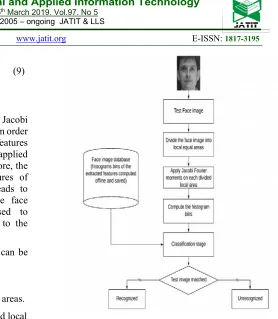
The proposed method utilized Jacobi moments as a feature extraction technique in order to provide distinct and rotation invariant features about the face image. These moments are applied on the local area of the face image; therefore, the resulting features represent global features of local areas in the face image which leads to provides an accurate description of the face image. The resulted features are used to construction histogram bins which feed to the classification stage.
The proposed face recognition technique can be described as follows:
1. Divide the face image into equal local areas. 2. Apply Jacobi moments on each divided local
area in order to extract global rotation invariant features.
3. Generate the histogram bins of the resulted features.
[image:3.612.261.539.40.359.2]4. Compute the distance between training and test images. For this purpose, we have used Cosine distance similarity measure. Figure 1 illustrates the proposed technique's block diagram.
Fig. 1. the block diagram of the proposed technique.
5. COSINE DISTANCE SIMILARITY MEASURE
The cosine distance similarity measure evaluates the similarity between two feature vectors in the angular direction [22]. It estimates the angle between feature vectors. The lower the angular separation refers to little similarity. The cosine distance similarity measure can be defined as: 2 1 0 2 1 0 1 0 ) ( ( ) ( ( )) ( ) ( ( D F T F D F T F d N i i N i i i N i i
(10)
where Fi(T),Fi(D)represent the features of test and database video frames, N is the total features number.
5.1 The Database Used In The Experimental Part
In the experimental part of this work we have used different types of face database we can explain to them as follows:
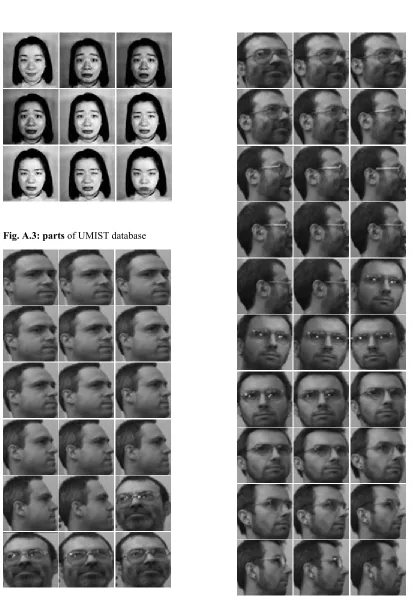
[image:3.612.83.549.55.437.2]1447 facial expressions like disgust, surprise, angry, fear, happy, and natural. [23] 6. UMIST: contains 564 frontals to profile
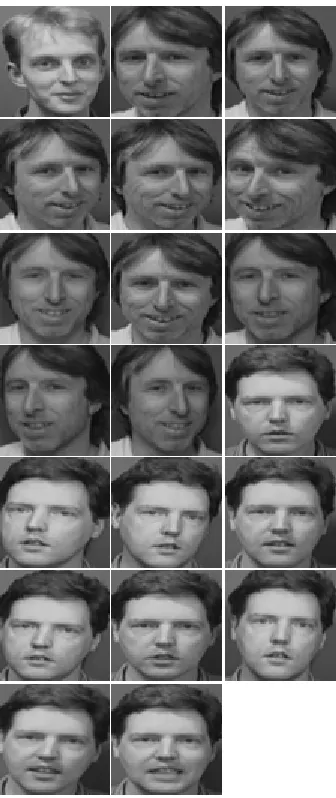
images distributed on 20 subjects. each subject has different pose view from profile to frontal with pose angles between -90 to 0 [23].
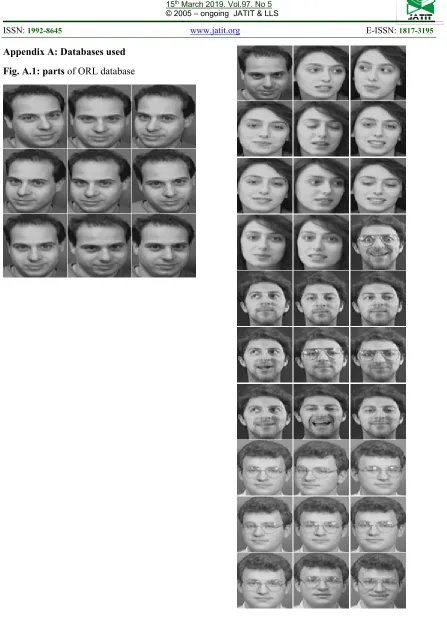
7. ORL: contains 40 subjects. Each subject includes 10 different variations like the pose, scales, illumination, facial expression, and a little bit of rotation. Therefore, it consists of 400 images [23]. Appendix A: shows parts of the used databases.
6. EXPERIMENTAL ANALYSIS
We carried out extensive experiments on the above-mentioned face databases in order to evaluate the accuracy of both traditional and proposed method under different face image variation such as pose, facial expression, and rotation variation as well as different variation in the same time. We reduce the dimensionality of the images of the used databases by cropped these images into 64 x 4 pixels. The Matlab has been used to prepare the database while all utilized algorithms have implemented using VC++ 6.0 and PC has 5.0-GHZ-CPU and 4GB-RAM.
6.1. Evaluate The Proposed Method Under Pose Variation.
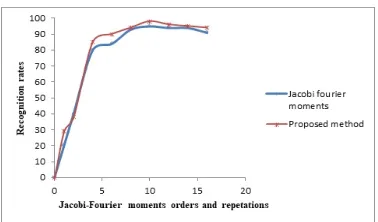
The robustness of the proposed approach against pose variation has been investigated. For this purpose, we conduct experiment over UMIST database. In this experiment we select 8 images with different angles of pose for the training and two profile images for testing. Figure.2. display the training and testing images. The results of this experiment are shown in Figure.3. indicated that the highest recognition rates gained using the traditional and proposed methods at the order and reputation 12 are %93 and %96.5 respectively. Which means that the proposed approach is better than the traditional use of Jacobi-Fourier moments under the condition of pose variation.
(a)
(b)
Fig.2. (a) Training image, (b) Testing image.
Fig.3. Recognition rates of proposed the approach over pose variation.
6.2. Evaluate The Proposed Method Under Facial Expression Variation.
1448
(a)
(b)
Fig. 4. (a) Testing images, (b) training images
Fig. 5. Recognition rates of the proposed approach over facial expression variation.
6.3. Evaluate The Proposed Method Under Different Variations
In order to assess the effect of different variations on the accuracy of the proposed method, we carried out excrements using ORL database which contains different variations.
These experiments are utilized five random images for the training and remain fiveimages for the test. Figure.6 shows part of the utilized face database setup, while Figure.7 presented the results of these experiments. The analysis of these experiments indicated that the recognition accuracy achieved using proposed technique is approximately %3 higher than the recognition rate achieved using the traditional method under different variations.
(a)
(b)
Fig. 6. (a) Testing images, (b) training images
Fig. 7. Recognition rates of the proposed approach over different variation
6.4. Evaluate The Proposed Method Under Rotation Variation
In this section accuracy of the proposed technique has been analyzed under rotation variation using ORL database, we conduct experiments on ORL database. In these experiments, the same database setup used in the experiment of evaluation of different variations is considered. The test images are rotated by 30˚, 90˚, and 180˚while the training images without rotation angle. Figure.8 presented part of the training and test face images. The results of these experiments which presented in table1 revere that the recognition rates after rotation are very close to those achieved before rotation, which means that the proposed method is rotation invariant.
[image:5.612.329.518.273.384.2] [image:5.612.90.291.359.476.2]1449
(a)
(b)
Fig. 8. (a) training face images, (b) test face images rotated at 30˚
Table 1. Evaluate the proposed technique against rotation variation on ORL database.
7. CONCLUSIONS
In this work, we presented a face recognition technique based on Jacobi-Fourier moments. In this technique, the Jacobi-Fourier moments used to extract rotation and global features from local areas in the face image, and then the histogram has been constructed based on these features. The experimental analysis of the experiments carried out on standard face databases under facial expression, pose, and different versions indicated that the proposed technique improves the accuracy of the recognition rates achieved using the traditional method which utilized Jacobi-Fourier moments for the whole face image. This leads to conclude that extracting global features from local face image areas leads to increase the discrimination of these features. Furthermore, experiments are implemented to assess the impact of rotation variation on the proposed technique revered that the proposed technique is rotation invariant.
REFERENCES:
[1] A. Tolba, A. El-Baz, and A. El-Harby, Face Recognition: a Literature Review, Int. J. Signal Process 2 (2005) 88–103.
[2] R. Chellappa, C. L.Wilson, and S. Sirohey, Human and Machine Recognition of Faces: A survey, Proceedings of the IEEE 83(5) (1995) 705-740.
[3] N. Farajzadeh, K. FaeZ, and G. Pan, Study on the Performance of Moments as Invari-ant Descriptors for Practical Face Recognition Systems, IET Comp. Vis. 4(4) (2010) 272-285.
[4] Chandan Singh and Ali Mohammed
Sahan, Face recognition using complex wavelet moments, Optics & Laser
Technology 47 (2013) 256–267.
[5] Chandan Singh, Ali Mohammed Sahan, and Rahul Upneja, Effective and fast face recognition system using hybrid features of orthogonal rotation invariant moments and wavelet transforms, Journal of Electronic Imaging 23(4), 043020 (Jul ∕ Aug 2014). [6] Rahul Upneja,, Miroslaw Pawlak, and Ali
Mohammed Sahan, An accurate approach for the computation of polar harmonic transforms, Optik 158 (2018) 1–11. [7] Emrah Basaran, Muhittin Gökmen, and
Mustafa E. Kamasak, An Efficient Multiscale Scheme Using Local Zernike Moments for Face Recognition, Appl. Sci.
2018, 8(5), 827.
[8] N. Farajzadeh, K. Faez, and G. Pan, Study on the performance of moments as invariant descriptors for practical face recognition systems, IET Computer Vision 2010;4(4):272–85.
[9] Foon N, Pang Y, Jin A, Ling D, an efficient method for human face recognition using wavelet transform and Zernike moments. In Proceedings of the international conference on computer graphics, imaging and visualization. Washington, USA; 2004. p. 65–9.
[10] Pang Y, Teoh A, Ngo D, A discriminant pseudo Zernike moments in face recognition, Journal of Research and Practice in Information Technology 2006; 38(2): 197–11.
[11] Hadddania J, Faez K, Ahmadi M, An efficient human face ecognition using pseudo Zernike moment invariants and radial basis function neural network, International Journal of Pattern Recogniti
on rate before rotation
Recognitio n rate after rotation at
30˚
Recognitio n rate after rotation at 90˚ Recognition rate after rotation at 180˚
1450 Recognition and Artificial Intelligence 2003;17(1):41–62.
[12] C. Camacho-Bello, C. Toxqui-Quitl, A. Padilla-Vivanco, and J. Báez-Rojas, High preci-sion and fast computation of Jacobi-Fourier moments for image description, J. Opt. Soc. Am., 31(1):124_134, 2014. [13] C. Toxqui-Quitl, A. Padilla-Vivanco, and
C. Santiago Tepantlán, Minimum image reso-lution for shape recognition using the generic Jacobi Fourier moments, In 22nd Con-gress of the International Commission for Optics: Light for the De-velopment of the World, volume 8011 of SPIE, page 80117W, 2011.
[14] N. V. S. Sree Rathna Lakshmi and C. Manoharan, An Automated System for Classifi-cation of Micro Calcification in Mammogram Based on Jacobi Moments. International Journal of Computer Theory and Engineering, Vol. 3, No. 3, June 2011. [15] K. Sankar and K. Nirmala, Orthogonal Features based Classification of Microcalcifica-tion in Mammogram using Jacobi Moments, Indian Journal of Science and Technolo-gy, Vol 8(15), DOI: 10.17485/ijst/2015/v8i12/73229, July 2015.
[16] Rahul Upneja and Chandan Singh, Fast Computation of Jacobi-Fourier Moments for Invariant Image Recognition, Pattern Recognition 48(2015), 1836–1843. [17] Francisco Solís, Carina Toxqui, and David
Martínez, Mexican Sign Language ecognition Using Jacobi-Fourier Moments, Engineering, 2015, 7, 700-705.
[18] César Camacho-Bello, Alfonso Padilla-Vivanco, Carina Toxqui-Quitl, and José Javier Báez-Rojas, Reconstruction of color biomedical images by means of quaternion generic Ja-cobi-Fourier moments in the framework of polar pixels, Journal of Medical Imaging 3(1), 014004 (Jan–Mar 2016).
[19] Guleng Amu, An Improved Algorithm for Pseduo-Jacobi-Fourier Moments, Optics and Photonics Journal, 2017, 7, 68-74. [20] Z. Ping, H. Ren, J. Zou, Y. Sheng, and W.
Bo, Generic orthogonal moments: Jacobi– Fouri-er moments for invariant image
description, Pattern Recognition 40(4) (2007) 1245–1254.
[21] T. V. Hoang, S. Tabbone, Errata and comments on “Generic orthogonal moments: Ja-cobi–Fourier moments for invariant image description”, Pattern Recognition 46 (2013) 3148–3155. [22] J. Ye, Cosine similarity measures for
intuitionistic fuzzy sets and their Applications, Mathematical and Computer Modelling, vol. 53, pp. 91-97, 2011. [23] Olivetti Research Laboratory (ORL),
1451
[image:8.612.87.534.48.680.2]1453
1455