Reading by six
1
Contents
Foreword by Her Majesty’s Chief Inspector
3Summary of findings and recommendations
4Introduction
5The schools and their approaches
7Choosing the schools 8
The schools’ approaches to teaching reading 8 A common approach to teaching reading 21
Conditions for success
23Leadership
24The headteacher 24
The subject leader 25
Leadership in the classroom 26
Principles for the reading curriculum
27Oral language 27
Phonic knowledge and skills 28
Broadening and extending the range of reading
and introducing writing 30
Reading and writing across the curriculum 31 If it’s not broken, don’t fix it: a case study 32
The quality and consistency of teaching
34Staff development 34
Precision in teaching 35
Assessment of children’s progress 36
Grouping by attainment 38
Individual learning support 39
How are trainees being taught to teach reading
using systematic phonics? 40
Coda
41Annex. Criteria for assuring high-quality
Last year’s Annual Report drew
attention to the need to ensure that
children have the literacy skills they
will need in life.
In recent years, there have been major strategic and significant local initiatives to promote and support approaches to raising standards in reading and writing. Yet weaknesses remain in teaching children to read and write, with the result that the standards achieved by many children at the end of the primary years fall stubbornly short of what are desirable and, the evidence suggests, achievable.1
The foundations for competent reading and writing are laid down from the age of three to seven. We know the importance of children developing their vocabulary, listening both to what others say and mean, and to the sounds of words. We know how to teach the recognition of letters and the association of sounds with letters and combinations of letters to decode and spell words. We know how to develop, encourage and improve reading and writing and how to overcome the challenges that some children experience, but the evidence suggests that we have not succeeded in doing these things consistently and persistently across all schools in the country.
This report draws from the practice of 12 outstanding schools in different parts of England to illuminate what works in teaching children to read. The schools represent a diverse range of communities but have striking features in common. They are passionate in their belief that every child can learn to read. Teaching children to read is at the heart of their curriculum. Rigorous, intensive and systematic phonics teaching underpins reading, spelling and writing. Teachers and teaching assistants are well trained and highly effective, and the schools are led and managed by able, committed headteachers and reading managers who assure quality and drive improvement.
The schools are not a rarified elite; there are many others that do an equally good job. The challenge is for all schools to emulate practices which are eminently transferable and which should be applied consistently and reliably everywhere. I hope you will be inspired by the examples here.
Christine Gilbert
Her Majesty’s Chief Inspector
4
n Too many children in England do not read or write well enough by the time they leave primary school. The proportion of 11-year-olds that reach the expected level (Level 4 of the National Curriculum) in English has stalled at around 80% and the national average point score for reading at the end of Key Stage 1 has remained between 15.6 and 15.7 for the last four years.
n The best primary schools in England teach virtually every child to read, regardless of the social and economic circumstances of their neighbourhoods, the ethnicity of their pupils, the language spoken at home and most special educational needs or disabilities.
n A sample of 12 of these schools finds that their success is based on a determination that every child will learn to read, together with a very rigorous and sequential approach to developing speaking and listening and teaching reading, writing and spelling through systematic phonics.2 This approach is applied with a high degree of
consistency and sustained.
n If some schools can do this, it should be a moral imperative for all primary schools. This study shows that primary – including infant – schools can achieve very high standards in reading if they focus on this objective, adopt a consistent approach and make every minute of every lesson count.
n The diligent, concentrated and systematic teaching of
phonics is central to the success of all the schools that achieve high reading standards in Key Stage 1. This requires high-quality and expert teaching that follows a carefully planned and tightly structured approach to teaching phonic knowledge and skills. Pupils are given opportunities to apply what they have learnt through reading – including time to read aloud to adults to practise their decoding skills – writing and comprehension of what they are reading.
n Schools with Nursery classes begin such teaching early on. The curriculum gives children rich opportunities to talk and listen in a wide range of contexts. This contributes to developing their familiarity with books and stories and their knowledge of the meanings of words. There is a strong focus on developing the children’s capacity to listen, concentrate and discriminate between sounds.
n The best phonics teaching is characterised by planned structure, fast pace, praise and reinforcement, perceptive responses, active participation by all children and evidence of progress. Effective teachers are highly trained to instil the principles of phonics, can identify the learning needs of young children, and recognise and overcome the barriers that impede learning.
n Well-structured resources are used appropriately, either individually or in combination, to support the teaching programme. Phonics teaching is monitored to ensure consistency and steps are taken if improvement is called for.
n The assessment of individual pupils’ progress, phonic knowledge and skills is sufficiently frequent and detailed to identify quickly the pupils who are failing, or in danger of failing, to keep up with their peers. Effective provision for them to catch up is put in place early and there are high expectations of what all pupils should achieve.
n Children should be involved in the assessment of their
progress and receive regular supportive feedback on their work. The quality of formative assessment and the interaction that stems from it make an important contribution to learning.
n All children should be reading at standards appropriate
to Level 1A/2C when they are six, that is, by the end of Year 1. Children at this stage who are still struggling to read should have individual support which is carefully attuned to overcoming barriers to their phonological development.
n In any school where the teaching of reading and writing falls below the ‘outstanding’ benchmark and pupils’ achievement lags behind that in the most effective schools, there should be a critical focus on the teaching of phonic knowledge and skills. Shortcomings in the rigour and fitness for purpose of schools’ programmes for phonics teaching should be redressed urgently, for example through using a high-quality synthetic phonics scheme. This should be accompanied by training for staff to use it, by rigorous monitoring of the implementation of the programme, especially the quality of the teaching, and by evaluation of the impact of the programme on pupils’ decoding and spelling skills.
Summary of findings and recommendations
1 Understanding the relationship between the sounds
of spoken language and the way those sounds can be represented by one or more letters of the alphabet is as fundamental to reading in English – as well as to writing and spelling – as understanding the notes on staves and practising scales are to playing music. To misquote Shakespeare, it appears that ‘some children are born readers, some achieve reading skills and others have reading thrust upon them’. Primary schools encounter and must provide for all three types. The best schools work on the principle that every child can learn to read.
2 There has been much ado about reading for many years,
fuelled, for example, by some employers who lament the level of basic skills of some of those entering the labour market and by secondary schools that admit poor readers. Actually, the concerns go back very much further, as do the efforts to redress them. The ‘initial teaching alphabet’, for example, was an attempt in the early 1960s to link sounds with specifically devised symbols. It was, indeed, an initial teaching alphabet and therefore doomed to fail since some of the symbols that had been devised in addition to 24 of the letters of the Roman alphabet existed only for the purpose of the scheme. The 18 additional characters had to be discarded or unlearnt as the child transferred to traditional orthography. The approach was also relatively expensive, since reading books were limited in range and written in the scheme’s own well-intentioned but impracticable code. However, lying behind the initial teaching alphabet was a brave attempt at regularising what appeared to many to be the irregularities of sound–symbol relationships (phonics) in English.
3 The introduction of the National Literacy Strategy in
1998 provided for a daily literacy hour for Key Stages 1 and 2, which, together with structured lessons, raised national performance several notches before it stalled by the mid-2000s. Following the Select Committee report Teaching childrento read in 2005,3 an independent review of early
reading in 2006, informed by evidence from Her Majesty’s Inspectors (HMI), reiterated the importance of developing early spoken language as the basis for a systematic grounding in phonics for later reading and spelling.4
4 The Communication, Language and Literacy
Development programme was set up in autumn 2006 to implement the recommendations of the independent review. Since 2006, schools have been urged to adopt a high-quality programme for the systematic teaching of phonics. Local authorities were funded to appoint consultants to train and support schools, and guidance was produced on teaching synthetic phonics in Reception and Key Stage 1 classes. Commercial publishers responded with new or updated schemes for teaching phonics. They also published decodable books – that is, early reading books specially designed so that children could practise reading using the phonic knowledge and skills they had already learnt.
5 The coalition government’s proposal to test the reading
of six-year-olds is a reminder to the education system in England, if one were needed, of the imperative of teaching young children to read. This report examines best practice in the teaching of initial reading. It focuses particularly on approaches to teaching phonics as an indispensable tool for children to make sense of written words, in reading and in spelling them for themselves.
6 The report finds that the best practice has
some strikingly common features as well as different manifestations. Keys to the success of all the schools in the sample include:
n clarity and constant purpose
n knowledge and understanding of the processes that help children learn to read
n a programme of rigorous systematic phonics work as the
prime approach to decoding print
n consistent teaching of the highest quality, together with effective assessment of children’s progress and help for those who encounter difficulty in reading
n effective leadership and management of the school and of literacy.
6
7 The schools in this survey have two things in common:
8
The schools and their approaches
Choosing the schools
8 The search for exemplary practice starts with
considering schools in which teaching is outstanding and outcomes for their pupils are very high. An examination of such schools reveals that, in terms of children learning to read, the best schools can succeed regardless of the socio-economic circumstances of the communities they serve. If the school is good enough, the great majority of children will learn to read (Figure 1).
The horizontal line represents the proportion of pupils reaching Level 2B+ nationally.
9 A sample of 12 schools was identified for this study.
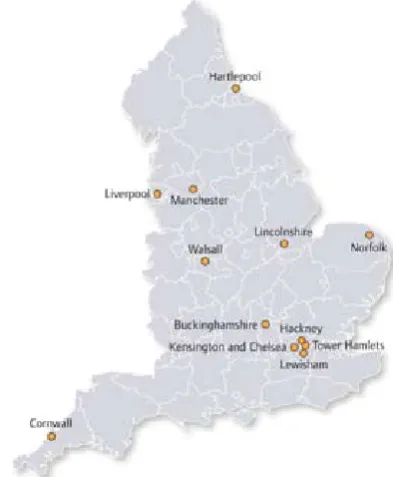
The schools were selected from Ofsted’s database on the basis of their inspection outcomes and standards in reading at Key Stage 1 and, where relevant, English at Key Stage 2. All the 12 schools were judged to be outstanding in their last inspection, not only in terms of their overall effectiveness but also in the quality of the teaching and learning, and the quality of leadership and management. The quality of teaching is a key determinant. All the 12 schools visited had above-average results in reading at Key Stage 1 and above-average English results at Key Stage 2. Their school populations represent a spectrum in terms of ethnicity and socio-economic backgrounds, and the schools are geographically widely distributed (Figure 2). The sample consists of four infant and nursery schools and eight full-range primary schools. Four are faith schools; the rest are non-denominational.
10 All the schools were visited by HMI during October
2010, relatively early in the school year. They observed over 100 phonics, reading and writing sessions in action. Although visiting within a short period of time restricted the range of work seen, it had the advantage of showing how different schools were teaching phonics to children at the same time of the year. The schools set the agenda for the visits; they were asked simply to show how they taught children to read.
The schools’ approaches to teaching reading
11 The following portraits provide a brief introduction to
the approach taken by each of the 12 schools to teaching initial reading. The illustrations of good practice have also been drawn from the 12 schools. The portraits are vignettes, written by HMI after visiting the schools to observe the teaching of reading and writing and meeting the headteacher, subject leader for literacy, reading manager and others. They also include data that reflect the context and performance of the school, using 2009 as the reference year.5 Many of the schools have higher results in
2010 but, as the full range of 2010 data were not available, the report uses data from 2009. Readers should bear in mind that one year’s results may not be typical.6
5 In the tables of school data, CVA denotes the Key Stage 1 to Key Stage 2
contextual value-added indicator for the school, averaged over the three years 2007, 2008 and 2009; FSM denotes the percentage of pupils eligible for a free school meal; EAL denotes the percentage of pupils who speak English as an additional language. The data are derived from the RAISEonline reports for 2009, produced by Ofsted and the Department for Education for every school,
0 20 40 60 80 100 10 30 50 70 90
[image:9.595.314.511.147.386.2]10 20 30 40 50 60 70
[image:9.595.57.283.297.452.2]Figure 1: Distribution of Key Stage 1 reading proficiency at Level 2B or above in the outstanding schools in this report
Figure 2: Location of schools in the sample
to which each school has access. RAISEonline – Reporting and Analysis for Improvement through School Self-Evaluation – provides interactive analysis of school and pupil performance data.
6 More details about each school can be found on Ofsted’s website:
www.ofsted.gov.uk. P er ce n ta ge o f Y ea
r 2 p
up ils a ch ie vi n g Le ve l 2 B + i n r ea di n g , 2 0 09
12 A higher than average proportion of children joining
Blue Coat are learning to speak English as an additional language but they rapidly gain fluency. When she came to the school in 2000, the headteacher, Janet Davies, saw a need for reading to be taught more effectively, especially in the younger classes.
13 The school tried out and then adopted the synthetic
phonics approach of Read Write Inc. with enthusiasm. Talking, listening, extending vocabulary and gaining familiarity with core books are key elements of the Nursery programme before the children embark on systematic phonics sessions. Children’s competence in language and early reading is assessed within a few weeks, after which they are taught phonics in groups based on attainment. The teachers and teaching
assistants maintain their consistent approach through frequent training and meetings, both within and outside school, and through constant monitoring by the headteacher and the reading manager, who is given time to visit classes when phonics lessons are in progress. Children’s individual needs and progress are readily identified.
Blue Coat Church of England Infant School
and Nursery,
Walsall
Percentage of Year 2 pupils reaching Level 2C and above for reading and writing in Key Stage 1 (KS1) at Blue Coat in 2009, compared with the national average
2009 data School
Outcomes in English
Roll Year 2 Age range FSM Deprivation EAL
293 70 3 to 7 21.6% 0.41 42%
National
238
17% 0.24 15.3%
L4 English at KS2 L5 English at KS2 KS1-2 CVA 3-year mean
N/A N/A N/A
0 20 40 60 80 100
Reading at KS1, 2009 Writing at KS1, 2009
10 30 50 70 90
L 2C 93
81
54
33
L 2B L 2A L 3 0
20 40 60 80 100
10 30 50 70 90
L 2C 85
61
40
18
L 2B L 2A L 3 84
72
49
81
60
32
12 25
10
7 In 2005, what was then known as the National College for School Leadershipwas asked to establish a group of outstanding headteachers who would not only demonstrate excellent leadership in their own schools but would also be able to support schools in challenging circumstances. For further information, see www. nationalcollege.org.uk/national-leaders-of-education.
14 The school mainly serves White British families. Its
headteacher, Cherry Edwards, is a National Leader of Education and she and her staff support a number of schools in Lincolnshire.7
15 From Reception onwards, children read and write
every day. The school introduced the Read Write Inc. scheme for reading and writing three years ago and it is now a lead school for the programme. Generally, Reception, Year 1 and Year 2 children follow the programme for four days each week, and on Fridays spend time on a piece of more extended writing. From October during their Reception year, children are set by attainment across the year group. This setting continues in Year 1 and Year 2. The school considers that children do not become fluent readers using one skill alone,
so children take part in guided reading at least three times a week, and more often if they need this. As well as texts from the Oxford Reading Tree scheme, which include phonically decodable books, ‘real’ books are available for the children to take home, banded by difficulty. A team of parent helpers assists with guided reading.
Bourne Abbey Church of England Primary School,
Lincolnshire
Percentage of Year 2 pupils reaching Level 2C and above for reading and writing in Key Stage 1 (KS1) at Bourne Abbey in 2009, compared with the national average
2009 data School
Outcomes in English
Roll Year 2 Age range FSM Deprivation EAL
628 65 3 to 11
3.7% 0.09 3.7%
National
238
17% 0.24 15.3%
L4 English at KS2 L5 English at KS2 KS1-2 CVA 3-year mean
88% 38% 100.6%
80% 29%
0 20 40 60 80 100
Reading at KS1, 2009 Writing at KS1, 2009
10 30 50 70 90
L 2C
86 85
69
35
L 2B L 2A L 3 0
20 40 60 80 100
10 30 50 70 90
L 2C
85 82
40
20
L 2B L 2A L 3 84
72
49
81
60
32
12 25
National School
16 Fairlawn has a multi-ethnic school population in
which 36 home languages are spoken. It welcomes this cosmopolitan mix. When the headteacher, Robin Bosher, arrived in 2002, he found a good school but judged that pupils could achieve much more.
17 The provision for children’s reading is meticulously
organised, from when children start in the Fairlawn nursery annex to their departure as highly literate 11-year-olds. The nursery staff encourage careful listening to sounds and words in a language-rich environment, with specific phonics work four times a week. Children get to know three core books well each half term, and a wide range of resources stimulate interest in reading and writing. Progress is carefully assessed and recorded and there are daily opportunities for reading, ready access to books, and support for parents, including for those whose circumstances make
them hard to reach. Systematic phonics teaching is based on Letters and Sounds. This is embedded in a 20-minute phonics session for the Reception and Key Stage 1 classes at 11am every morning. The sessions are rigorously structured and taught in a very engaging way, taking the children through a sequence of phases of phonic development. Their reading is consolidated by the books and activities used in the rest of the curriculum. Boxes of banded reading resources are available in every class and children are encouraged to choose books at an appropriate level. The unusually long lunch period includes half an hour that is used for individual and guided reading.
Fairlawn Primary School,
Lewisham
Percentage of Year 2 pupils reaching Level 2C and above for reading and writing in Key Stage 1 (KS1) at Fairlawn Primary in 2009, compared with the national average
2009 data School
Outcomes in English
Roll Year 2 Age range FSM Deprivation EAL 504 59 3 to 11
11.3% 0.24 21.3% National 238 17% 0.24 15.3%
L4 English at KS2 L5 English at KS2 KS1-2 CVA 3-year mean
95% 53% 101.1% 80% 29% 0 20 40 60 80 100
Reading at KS1, 2009 Writing at KS1, 2009
10 30 50 70 90 L 2C 92 75 63 51
L 2B L 2A L 3 0
20 40 60 80 100 10 30 50 70 90 L 2C 86 69 54 42
12
18 Kingsley, led by Alison Darby, serves a stable local
community. Many children at the school have parents and grandparents who also attended it.
19 The successful Kingsley system of reading is
long-established. The school’s approach to reading is meticulous, based on a main spine built on Letterland and Letters and Sounds, with some use of Jolly Phonics for individual children who are not achieving on the main spine. The phonics programme starts from the moment children arrive in the nursery. The school says that in the past it has had to counter criticism from some experts who baulked at the school’s enthusiasm for introducing early reading activities to young children, but that criticism faded as the proof of its approach became evident in the consistently excellent standards. Children attend the nursery part
time, the older children in the morning, the younger in the afternoon. Even at this age, the variation among children in readiness for early reading activities is stark. Some come to the Nursery clearly having had rich early literacy experiences of books, stories and rhymes, and they are able to carry out simple tasks; others arrive still wearing nappies and sucking dummies. Despite this wide and challenging range, the school’s nursery provision centres on language and literacy.
Kingsley Primary School,
Hartlepool
Percentage of Year 2 pupils reaching Level 2C and above for reading and writing in Key Stage 1 (KS1) at Kingsley Primary in 2009, compared with the national average
2009 data School
Outcomes in English
Roll Year 2 Age range FSM Deprivation EAL
487 59 3 to 11
21.8% 0.29
0%
National
238
17% 0.24 15.3%
L4 English at KS2 L5 English at KS2 KS1-2 CVA 3-year mean
92% 66% 101.2%
80% 29%
0 20 40 60 80 100
Reading at KS1, 2009 Writing at KS1, 2009
10 30 50 70 90
L 2C 92
86
61
31
L 2B L 2A L 3 0
20 40 60 80 100
10 30 50 70 90
L 2C 92
76
47
24
L 2B L 2A L 3 84
72
49
81
60
32
12 25
National School
20 The school serves a population which is described as
being divided between those who commute to Norwich and those who do not. There is some rural deprivation. The school has a 52-place nursery.
21 The headteacher, Clare Fletcher, wanted to get
the children to be much more active in learning and participating. The school invested in an integrated scheme, Read Write Inc., which ‘promoted participation as well as literacy’. Every teacher was trained to use the scheme and the staff show pupils how to extend their language. They place great emphasis on story time. The children enjoy listening to five high-quality books each term from Reception to Year 2 – 15 in the course of a year. Life in the nursery contains a lot of imaginative play, role play and some practice of phonics. Staff encourage children to speak in sentences. In Reception there is a daily 20-minute phonics session with each
class organised into two groups within the classroom. There is tight, individual pre- and post-lesson tutoring, with the children being challenged through the whole day. The school says that there is a large and positive effect on children’s self-esteem and confidence. Much of this is to do with the children’s participation and work as partners that the scheme encourages. All the groups are composed so as to meet particular needs, and children are moved around the groups. In Key Stage 1, teaching assistants often work with the middle groups and teachers with the higher- and lower-attaining groups. The reading manager is released from her own teaching during the time for teaching phonics so she can guide staff and observe the needs and progress of individual children. Their success is celebrated at every opportunity and parents are very involved and supportive.
North Walsham Infant School and Nursery,
Norfolk
Percentage of Year 2 pupils reaching Level 2C and above for reading and writing in Key Stage 1 (KS1) at North Walsham in 2009, compared with the national average
2009 data School
Outcomes in English
Roll Year 2 Age range FSM Deprivation EAL 228 43 3 to 11
18.2% 0.18 7.8% National 238 17% 0.24 15.3%
L4 English at KS2 L5 English at KS2 KS1-2 CVA 3-year mean
N/A N/A N/A 0 20 40 60 80 100
Reading at KS1, 2009 Writing at KS1, 2009
10 30 50 70 90 L 2C 95 88 74 44
L 2B L 2A L 3 0
20 40 60 80 100 10 30 50 70 90 L 2C 93 81 56 30
14
22 The headteacher, Amanda Phillips, joined Old Ford
Primary School in 2004 and now also heads Culloden Primary School. The school, in East London, provides for the immediate Bangladeshi community, together with White, Black African and Black Caribbean British children, and the children of Somali and European immigrant or refugee families.
23 There is a holistic approach to the teaching of
reading in Old Ford in which phonics – based on Read Write Inc. – guided reading, early attention to writing and constant language development all play their part. As a result, children’s reading progress is rapid and the majority of children reach Level 1A or 2C by the end of Year 1. The school is clear about wanting to develop confident readers who will experiment with words and take risks. Some children enter the nursery with
a background that has not helped them to develop independence and prepared them to come to school. Their speech is very limited. Priorities for the nursery are on language learning and practice; personal, social and emotional development, and instilling routines into the children’s lives. For the first half term, language skills are developed through songs, games, toys, stories and rhymes. In the second half term, the children who are deemed to be ready are introduced, as a group, to phonics and learn to distinguish between sounds. The general pattern of organisation through the school is reflected in a daily literacy hour, half an hour of guided reading in English and two hours of extended writing at some point in the week. The school also retains a commitment to Reading Recovery for a number of pupils each year in Year 1.
Old Ford Primary School,
Tower Hamlets
Percentage of Year 2 pupils reaching Level 2C and above for reading and writing in Key Stage 1 (KS1) at Old Ford in 2009, compared with the national average
2009 data School
Outcomes in English
Roll Year 2 Age range FSM Deprivation EAL 726 90 3 to 11
62.1% 0.72 71.4% National 238 17% 0.24 15.3%
L4 English at KS2 L5 English at KS2 KS1-2 CVA 3-year mean
91% 12% 101.1% 80% 29% 0 20 40 60 80 100
Reading at KS1, 2009 Writing at KS1, 2009
10 30 50 70 90 L 2C 92 77 49 17
L 2B L 2A L 3 0
20 40 60 80 100 10 30 50 70 90 L 2C 92 80 44 10
L 2B L 2A L 3 84 72 49 81 60 32 12 25 National School
24 Nearly half the children at St Clare’s are eligible for
free school meals, reflecting some of the social issues, including unemployment, facing the families living in the area; and almost half are of minority ethnic heritage. This includes a rising number of children who have newly arrived in the country.
25 The headteacher, Michael Hennessey, attributes
the strength of reading to the ‘huge commitment from staff’, especially from the teachers in Reception, Year 1, Year 2 and Year 3 who take daily guided reading groups in their lunchtimes. He also singles out the thorough and consistent approach to the teaching of phonic skills throughout the Early Years Foundation Stage and Key Stage 1. The school introduces phonics after Easter in the nursery, using Jolly Phonics to introduce a sound and letter each week. More intensive phonics starts
in Reception, with two new sounds a week, teaching the whole class and bringing in the Letters and Sounds programme. Once the children are familiar with the routines, they are also given the first set of words of a first-stage reader to take home to learn. Once they know them, they are given the books with the words. Progress through the sounds that children need to learn follows a standard list and is supported for each child by two reading schemes: New Way, a phonically based scheme, and the Oxford Reading Tree. This combination of phonics and reading schemes, including a phonically based spelling scheme, Spelling for Literacy, is continued through Key Stage 1.
St Clare’s Catholic Primary School,
Liverpool
Percentage of Year 2 pupils reaching Level 2C and above for reading and writing in Key Stage 1 (KS1) at St Clare’s in 2009, compared with the national average
2009 data School
Outcomes in English
Roll Year 2 Age range FSM Deprivation EAL
248 26 3 to 11
42.7% 0.53 9.4%
National
238
17% 0.24 15.3%
L4 English at KS2 L5 English at KS2 KS1-2 CVA 3-year mean
87% 27% 100.2%
80% 29%
0 20 40 60 80 100
Reading at KS1, 2009 Writing at KS1, 2009
10 30 50 70 90
L 2C
88 85
54
31
L 2B L 2A L 3 0
20 40 60 80 100
10 30 50 70 90
L 2C 85
73
37
12
L 2B L 2A L 3 84
72
49
81
60
32
12 25
16
26 Thirty per cent of the school’s pupils are of faiths
other than Catholic, predominantly Islam, and over half are of minority ethnic heritage. The school’s population reflects the ethnically diverse area it serves.
27 The headteacher, Sharon Sesnan, is in her fourth
year, but the long-service award belongs to the assistant headteacher and literacy coordinator, Kathryn Broadbent. She joined the school in 1974 and has worked very effectively with other staff, and with the considerable support of parents, to develop the school’s hugely successful reading system. Staff identify the secrets of success in teaching reading as: consistency; a straightforward system rigorously applied; new staff trained into the system quickly; meticulous monitoring; and engagement with parents. This school has always seen reading as a core priority. The staff have a very
clear idea of where pupils need to be on the reading scheme in order to be on track to achieve Level 2 at the age of seven and Level 4 at the age of 11. The strong teaching of phonics, based on Jolly Phonics and Letters and Sounds, and a tightly organised and managed reading scheme, are all they need to achieve this. A range of resources is used to support the programme, including the Oxford Reading Tree and Ginn 360 books.
St Richard’s RC Primary School,
Manchester
Percentage of Year 2 pupils reaching Level 2C and above for reading and writing in Key Stage 1 (KS1) at St Richard’s in 2009, compared with the national average
2009 data School
Outcomes in English
Roll Year 2 Age range FSM Deprivation EAL
367 40 3 to 11
33.2% 0.51 29.6%
National
238
17% 0.24 15.3%
L4 English at KS2 L5 English at KS2 KS1-2 CVA 3-year mean
83% 24% 100.9%
80% 29%
0 20 40 60 80 100
Reading at KS1, 2009 Writing at KS1, 2009
10 30 50 70 90
L 2C 98
93 85
57
L 2B L 2A L 3 0
20 40 60 80 100
10 30 50 70 90
L 2C 98
90
70
45
L 2B L 2A L 3 84
72
49
81
60
32
12 25
National School
28 A high proportion of the pupils are from
economically and socially deprived backgrounds. Most of them live in local authority housing and, currently, 65% of the pupils are learning to speak English as an additional language.
29 The school is focused on ensuring that, by the time
a pupil leaves the school, she or he can read. This, says the headteacher, David Sellens, is the so-called ‘bottom line’. Everything is done to that end. It starts with the specific teaching of letters and sounds, recognised in the school’s inspection in 2009 as having a positive effect on raising standards and preparing children well for when they move through the school. Jolly Phonics and Letters and Sounds are used as a basis, supported by a reading scheme, Rigby Star. The school is keen to
ensure not only that the pupils are able to read but also that they read because they like it. This means providing high-quality texts, both literature and non-fiction, and ensuring that children are introduced to these through cross-curricular projects, story-tellers, and the promotion of books and reading by teachers to children. Reading is given high status.
Thomas Jones Primary School,
Kensington and Chelsea
Percentage of Year 2 pupils reaching Level 2C and above for reading and writing in Key Stage 1 (KS1) at Thomas Jones in 2009, compared with the national average
2009 data School
Outcomes in English
Roll Year 2 Age range FSM Deprivation EAL
235 30 3 to 11
52.3% 0.51 65.6%
National
238
17% 0.24 15.3%
L4 English at KS2 L5 English at KS2 KS1-2 CVA 3-year mean
97% 80% 100.9%
80% 29%
0 20 40 60 80 100
Reading at KS1, 2009 Writing at KS1, 2009
10 30 50 70 90
L 2C
97
83
60
23
L 2B L 2A L 3 0
20 40 60 80 100
10 30 50 70 90
L 2C
97
67
43
7
L 2B L 2A L 3
84 72
49
81
60
32
12 25
18
30 The school serves the tourist town of Newquay.8
The vast majority of the pupils are White British; languages other than English include Polish and Filipino. The current headteacher, Lisa Mannall, took up her post in September 2007, inheriting the structured Read Write Inc. programme for reading and writing that her predecessor had recently adopted.
31 The keys to the school’s success were reiterated
constantly: absolute consistency across the school; high-quality training and staff development for everyone involved in teaching reading; very strong, logical progression from individual sounds to blending sounds to make words, then sentences, and then reading whole books; setting by attainment, with fluid movement across groups and, every eight weeks,
assessment of the progress of each child across the whole school to refine the groupings. In addition, the high-quality, consistent teaching has had a substantial impact on eliminating behavioural problems because the pupils are so engaged.
Trenance Infant School,
Cornwall
Percentage of Year 2 pupils reaching Level 2C and above for reading and writing in Key Stage 1 (KS1) at Trenance in 2009, compared with the national average
2009 data School
Outcomes in English
Roll Year 2 Age range FSM Deprivation EAL
331 119 4 to 7
10% 0.22 1.8%
National
238
17% 0.24 15.3%
L4 English at KS2 L5 English at KS2 KS1-2 CVA 3-year mean
N/A N/A N/A
0 20 40 60 80 100
Reading at KS1, 2009 Writing at KS1, 2009
10 30 50 70 90
L 2C
92 84
65
33
L 2B L 2A L 3 0
20 40 60 80 100
10 30 50 70 90
L 2C
91
68
39
20
L 2B L 2A L 3
84 72
49
81
60
32
12 25
National School
8 The school was designated as an academy on 1 November 2010 and is now
known as the Trenance Learning Academy.
32 Turnfurlong sits within a 1960s housing estate
in Aylesbury. The school population is socially and ethnically mixed. Jan Tyson has been the headteacher for just over 12 years. Her expertise is used beyond Turnfurlong as a mentor for new headteachers.
33 Speaking and listening is an integral part of the
school’s curriculum, used by all staff as a vehicle in each lesson to improve reading and writing. Children use their developing vocabulary in an appropriately timely manner; every child at this school reads and writes almost every day. The school believes that the more children read and write, the more quickly their reading and writing improve. Children take part in daily systematic phonics lessons, lasting around 20 minutes, when they have numerous opportunities to blend sounds together to read words and segment words into
their individual sounds to spell. The staff developed their own programme of phonics, incorporating elements of Read Write Inc., Letters and Sounds and Jolly Phonics, leading on to a reading scheme based on Heinemann. In the summer term of their Reception year and throughout Years 1 and 2, pupils are set by attainment for phonics work so as to enable work to be matched effectively to their needs. The success of the school’s approach is seen in its results at the end of Year 2. Attainment in reading and writing scores for the past five years has been significantly above national averages.
Turnfurlong Infant School,
Buckinghamshire
Percentage of Year 2 pupils reaching Level 2C and above for reading and writing in Key Stage 1 (KS1) at Turnfurlong in 2009, compared with the national average
2009 data School
Outcomes in English
Roll Year 2 Age range FSM Deprivation EAL
251 83 4 to 7
2.2% 0.15 16.7%
National
238
17% 0.24 15.3%
L4 English at KS2 L5 English at KS2 KS1-2 CVA 3-year mean
N/A N/A N/A
0 20 40 60 80 100
Reading at KS1, 2009 Writing at KS1, 2009
10 30 50 70 90
L 2C
95 90
83
66
L 2B L 2A L 3 0
20 40 60 80 100
10 30 50 70 90
L 2C
96 90
72
45
L 2B L 2A L 3
84 72
49
81
60
32
12 25
20
34 This multi-ethnic school has a mobile population of
pupils, almost two thirds of whom are learning to speak English as an additional language. There is much social and economic deprivation and a quarter of the pupils are refugees.
35 One of the assistant headteachers coordinates work
on reading and writing, providing weekly staff training sessions to sharpen the skills of teachers and teaching assistants. She also trains the staff of other schools, especially the other three members of the Best Start Federation, of which the headteacher of Woodberry Down, Greg Wallace, is the executive headteacher. Phonics teaching uses the Read Write Inc. programme and is systematic, fast-paced and intensive. Within the nursery, there is a very strong emphasis on speaking and listening to prepare children to enunciate sounds, blend
sounds together and segment words into their individual sounds. Developing children’s social skills, including speaking and listening, is essential as many of those at the school come from homes where there is much less structure than usual. Formal phonics teaching starts properly in the Reception year, where pupils from the two classes are organised in seven attainment groups on a ‘carousel’ basis. Pupils are taught in sets based on attainment across each year group.
Woodberry Down Primary School,
Hackney
Percentage of Year 2 pupils reaching Level 2C and above for reading and writing in Key Stage 1 (KS1) at Woodberry Down in 2009, compared with the national average
2009 data School
Outcomes in English
Roll Year 2 Age range FSM Deprivation EAL
395 42 3 to 11
56.6% 0.59 62.5%
National
238
17% 0.24 15.3%
L4 English at KS2 L5 English at KS2 KS1-2 CVA 3-year mean
87% 26% 100.4%
80% 29%
0 20 40 60 80 100
Reading at KS1, 2009 Writing at KS1, 2009
10 30 50 70 90
L 2C
90 79
40
14
L 2B L 2A L 3 0
20 40 60 80 100
10 30 50 70 90
L 2C
83
57
24
2
L 2B L 2A L 3
84 72
49
81
60
32
12 25
National School
A common approach to teaching reading
36 Many of the schools described in the earlier pages
reviewed their approaches to teaching reading in the last few years when phonics became a firm requirement of the curriculum and the principles of effective phonics programmes were articulated more clearly. As the headteacher of one school said: ‘Phonics teaching has always been central here but staff looked again at their practice.’ This meant focusing on having a systematic (or synthetic) approach to teaching phonics, the key features of which are to teach beginner readers:
n grapheme/phoneme (letter/sound) correspondences (the alphabetic principle) in a clearly defined incremental sequence
n to apply the highly important skill of blending
(synthesising) phonemes in order, all through a word, to read it
n to apply the skills of segmenting words into their constituent phonemes to spell
n that blending and segmenting are reversible processes.9 37 These elements were strongly present in the schools
featured in this report. Publishers also responded by making new or revised materials for the teaching of phonics and literacy available to schools. These schemes support the teaching of all the letter–sound relationships in a clearly defined sequence. They also provide a greater range of phonically decodable books.
38 Together the elements listed here form the basis of
high-quality phonic work which is a body of knowledge, skills and understanding that has to be learned. The 12 schools all have thorough, well-conceived and well-planned programmes for teaching phonics which give children the understanding of letter–sound correspondences (the alphabetic principle) and the skills for blending and segmenting which – together with building comprehension – are the foundations on which reading, spelling and writing are based. About half of the schools in the sample use a single, comprehensive, dedicated scheme for systematic phonics teaching. The rest draw upon two or more published resources to forge a coherent structured programme which, when conceived and implemented well, can also provide a highly effective, phonics-centred
One school that took a measured decision to change its approach to phonics teaching was Bourne Abbey.
39 Other schools in the group of 12 that have pursued a
similar path are Blue Coat, North Walsham and Trenance infant schools and Woodberry Down Primary School, while Old Ford Primary School has modified the approach in a way the school feels best meets the needs of its children (described earlier).
40 Fairlawn Primary School was another school that
reflected on its teaching of phonics and embarked on a fundamental shift three years ago – changing practice and creating policy, in that order – when it shifted its focus from teaching to learning, based on the principles of assessment for learning.10 The effect has been to achieve a higher
proportion of children gaining Level 4 at Key Stage 2 and greatly improve the proportion of children attaining Level
Big decisions at Bourne Abbey
Four years ago, having visited a school using Read Write Inc., one of the school’s deputy headteachers felt that the scheme offered a better way of teaching phonics than the scheme they had been using. Initially, RWI was piloted in Year 1. The three Year 1 class teachers were so impressed by the scheme that it was rolled out to Reception and Year 2 the following year. RWI is now well established. Within Year 2, children come to the end of the RWI scheme and move on to literacy sessions, although pupils’ understanding of more complex graphemic representations of particular phonemes are reinforced during a daily phonics input.
22
The schools and their approaches
continued
as an additional language make at least two sub-levels of progress within a year, for example from Level 1 to 2B. All the children on the special needs register achieved Level 4 in English in 2010, including those on school action plus.
41 A further group of schools in the 12 constructed their
early reading programme from more than one resource. These schools are every bit as committed to finding the best approach for their staff and children as those described earlier, using external consultancy only when they have identified a need to seek technical expertise, such as in pronouncing all the phonemes precisely. They include Kingsley, St Clare’s and St Richard’s, Thomas Jones and Turnfurlong primary schools. Their results speak for the success of their literacy programmes. In each case, the school’s approach to teaching phonics reflects its confidence in its own philosophy and practice.
The systematic phonics programme at each school is undeniably rigorous. Although they draw from more than one scheme, the programmes are themselves coherent and applied consistently.
42 Kingsley School has an eclectic programme that
has been developed over many years. Every child goes through the programme, including those on the autistic spectrum. The spine of its phonics programme draws on three sets of resources, two of which provide structure and progress, with a third used for individual children who are not achieving well enough on the main core. The school’s reading scheme draws from four products until pupils reach a certain level, then the school’s own colour-coded scheme is used – a mixture of reading scheme books, supplementary scheme sets, and fiction and non-fiction books for pupils up to Year 6. No child is left ‘a free reader’; every child is monitored. The programme works because it is based on a thorough grounding in phonics and is applied systematically, consistently and with absolute rigour. It makes best use of resources acquired over the years and there are layers of assessment, monitoring and personal support for children who need more help with their reading. It is complex – quirky perhaps – but it works.
43 Like Kingsley, St Clare’s has maintained a traditional
approach to the teaching of early reading. With the introduction of new national policies and strategies, the school did not discard the methods it had always used to teach children to read. It updated and adapted them to include modern resources, but still relied mainly on its traditional combination of teaching phonics and using reading schemes.
44 It is easy to discern a common thread in all these
well-thought-out approaches to teaching reading and writing based on the primacy of phonics. It is expressed in terms such as rigour, consistency, structure, monitoring, assessment, support and shared commitment. Good resources can be a great help, providing systematic structure, reducing the burden of planning, and offering pupils and teachers attractive and well-matched materials. But the resources do not replace high-quality instruction by teachers who really understand what they are doing in schools and who provide the pedagogical leadership that gives every child the best chance of becoming a proficient reader.
Synthetic phonics at Fairlawn
24
Conditions for success
Leadership
45 In all the schools visited, it quickly became apparent
that they shared a number of characteristics, both generally in terms of features that had made them outstanding, and specifically in relation to teaching children to read. The main factors that determined the successful teaching of reading in the schools included: n the quality of the overall leadership of the school and
the leadership and management of the literacy teaching programme
n the principles on which the reading curriculum was based
n the quality and consistency of teaching, especially discrete phonics teaching
n the assessment of children’s progress, especially early identification of difficulties and the resulting intervention.
46 The report discusses each of these in turn, illustrated,
where appropriate, by examples drawn from the 12 schools.
The headteacher
47 The first, most overt feature of headship in these
schools is the determination that children will learn to read. Teaching reading is the avowed core purpose of the schools. All the headteachers take a highly professional, committed and personal approach to making this happen. They:
n articulate the school’s vision and its ambitions for children’s reading
n invest in the best teachers and teaching assistants they can find and scrupulously train or retrain them to teach phonics
n appoint the most suitable person to lead and manage the day-to-day teaching of phonics, reading and writing
n exert instructional leadership through demonstration, monitoring and dialogue
n build cohesive teams with shared values and consistent practice
n take responsibility for the achievements of the school and account for them to governors and parents
n are obsessive about the quality of children’s learning as well as the extent to which teaching engages and enthuses them.
48 All the headteachers were highly visible as well
as being uncompromising about the things that were important for their pupils. They recognised the vital importance of a secure grounding in phonics and provided the staffing, resources and structural framework for this to take place. They placed a very strong emphasis on books, reading and writing, sticking to principles that the school owned. They gave their staff the confidence that they were doing things the right way, even if that did not necessarily accord with orthodoxies promoted through local and national initiatives and interventions. Their results tended to endorse their convictions.
49 The 12 schools were led in such a way as to weld
50 The headteachers and senior staff of these
outstanding schools expected teaching of the highest quality and were passionately involved in how well children were learning.
51 The headteachers readily acknowledged that much
of the success of their schools was the result, as one said, of the ‘huge commitment from staff’, adding ‘especially of the teachers in Reception, Year 1, Year 2 and Year 3 who take daily guided reading groups in lunchtimes!’ They all invested heavily in the training and continuing development of teachers and teaching assistants, particularly in relation to teaching phonics. For example:
n A newly qualified teacher at St Clare’s described the training she received at the school in her first year of teaching as ‘very, very thorough’ and very different from that which she had experienced during her initial teacher education.
n A senior leader at Turnfurlong said: ‘When you join the school, you see others teaching very regularly. This helped me enormously as a newly qualified teacher because I was not experienced in teaching phonics.’
52 Teamwork in these schools was important. At
Turnfurlong, time and again the staff underlined the importance of their year group teams in ensuring that they provided a consistently high-quality experience for their pupils. One commented: ‘We plan as a team and we are very critical. We see what works well and constantly look for new ways to change things for the better.’
The subject leader
53 The subject leader for literacy, often called the
literacy coordinator or, in some of the schools, the reading manager, had an important middle or senior leadership role in these 12 schools. The most capable subject leaders for literacy were steeped in the detail of their school’s reading and writing programme, knowledgeable about the strengths and development needs of all the staff who were involved in teaching phonics, and closely in touch with individual children’s progress in reading and writing.
54 Commonly, discrete, systematic phonics teaching
took place at set times of the day. The subject leaders were often released from their own classes at these times so that they could monitor the implementation of the phonics programme. This was an important function since the success of systematic phonics teaching relies on the
Through the eyes of staff at Thomas Jones
The staff are clear about the leadership approach of the headteacher, giving this picture of his example and influence across the whole school:
n ‘He has very, very high expectations.’
n ‘Very hands-on; pretty much all day, every day he teaches – it sends out a message to the staff; sends a message to the children, too.’
n ‘He knows all the children and their families, and has strong contact with parents, for example, by being at the school gate virtually every morning.’
n ‘He has expectations that we behave as well as teach professionally, including high expectations about standards of dress.’
n ‘He recruits people with minds of their own.’
n ‘He requires Year 6 to be scholars… like undergraduates; that’s what he calls them – “scholars” – and they all want to rise to it.’
26
Leadership
continued
challenge as well as the range of skills that expert teaching requires. When the job was done well, the subject leader tracked the progress of individual children from a slightly detached perspective and considered whether they needed to change attainment group in order to work at a level that was more appropriate to their needs.
55 In some of the schools visited, it appeared that
monitoring compliance with the chosen approach, invariably accomplished efficiently, obscured the fact that compliance does not always guarantee effectiveness. While most of the teaching observed during the visits was good or outstanding, the impact of individual teachers was occasionally reduced because they neglected small details. For instance, they held flashcards of graphemes too high for the children sitting at their feet to read them, or they failed to challenge a child when one of the partners in partner work was persistently and unhelpfully dominant. In both cases, the school’s normal monitoring should have identified these weaknesses and the teachers should have received feedback to correct them. Minor weaknesses, if allowed to continue, can impair children’s learning. This was not the case at Turnfurlong.
Leadership in the classroom
56 Systematic phonics teaching revealed the teacher
not just as an instructor but as a leader of learning. In programmes of systematic phonics, the sequence of teaching and learning is prescribed, but conducting the class or group along this tricky path – anticipating pitfalls, delegating responsibility, overcoming obstacles and celebrating success – requires both leadership and pedagogical skills. Many of the teachers whose work is represented in this report showed all these qualities and, in doing so, were models for their pupils and for their colleagues, as in Trenance.
The teachers in these schools also played a valuable role in mentoring new teachers, especially if the newcomer was teaching in the same year group.
Monitoring the quality of teaching at
Turnfurlong
The literacy coordinator undertakes focused observations of the teaching of phonics, reading and writing. She provides written feedback to a set format which is discussed at a meeting of the senior leadership team. In addition, she attends each year group’s team meeting and discusses with the team the areas of strength and those which require improvement. She has noted how much her colleagues value this feedback: ‘People in this school are up for constructive criticism.’ We are held to account.’
Opportunities for peer observation
at Trenance
Principles for the reading curriculum
57 The curriculum for reading and writing in all the
schools visited had at least four key components:
n developing children’s oral language: speaking, listening and enhancing their vocabulary
n establishing their phonic knowledge and skills and supporting them to apply these to reading and spelling
n broadening and extending the range of reading and writing, progressing from simple texts that the children could read by themselves to a wider range of books
n locating the curriculum for reading within the wider school curriculum, so that each aspect complemented and reinforced the other.
Oral language
58 The majority of the schools visited that had nursery
classes commented that, increasingly, children joined unprepared for learning and with poor listening and speaking skills. Lack of preparation extended to children arriving who had not been toilet-trained and children with dummies in their mouths. In these cases, the onus rested with parents or carers but staff still had to invest time in the early days or weeks in educating parents, reducing children’s dependency and improving their socialising skills.
59 The schools attributed weak listening skills not
only to poor conversation in the home but, very often, also to continuous background noise, such as constant television, the noise of siblings and raised voices, which are bound to dull sensitivity to the nuances of sounds. The schools responded with activities that developed listening skills: sounds first, letter-sounds later. Examples included teacher-led work where the teacher used an artefact (concealed from the children) to make a sound, and they had to guess which of a range of objects it was; paired work, where one child had to match the sounding instrument with that of another, sounded behind a screen. In the following example, the teacher used musical sounds to lead on to the sounds of spoken language.
60 The spoken language of some of the children
was limited to basic statements such as: ‘Me want...’. Vocabulary was often equally limited. These features required schools to place an early emphasis on speaking, listening, developing vocabulary and using sentences. Schools felt the need to generate the stimuli for improving vocabulary through every means possible, bringing the world to the children as well as taking the children out into the world. Many of them had been no further from home
Listening to sounds: Kingsley
28
61 A key feature of the effective Nursery classes facing
such challenges was to introduce highly structured days from the very beginning, both to get learning off to a good start and to compensate for the chaotic home lives that too many of the children were experiencing. Reading stories from big books that the children could see easily was important in engaging children in how books and stories worked.
62 Literacy work for younger children in this school
included, every day, a ‘big book’ story session, phonics, guided reading, writing and sessions focusing on high-frequency words. The school based its teaching of reading on five principles:
n systematic phonics to help children who are trying to read
n context and experiences, to broaden vocabulary and develop comprehension
n knowledge of high-frequency works
n knowledge of grammar and syntax
n ability and confidence to ‘have a go’ in decoding words.
63 The school argued ‘that phonics is one part in a bigger
picture and that reading is aided by association and high-frequency words’. It claimed that as a result its children could read more fluently. Its very best readers reached Level 2B by the end of Year 1, and most children in Year 2 reached Level 2B or Level 2A. The school defended the success of its practice by pointing to equal success in the second school that shared its headteacher. Phonics still has primacy in the school’s range of approaches and all the teachers had been trained through and used the synthetic phonics programme of Read Write Inc. This broad approach, however, is not recommended to any school whose reading results are not already well above average and where systematic phonics is not already
well embedded.
Phonic knowledge and skills
64 The rigorous way in which daily systematic phonics
work was conducted in the schools was impressive. In all cases, the teachers and teaching assistants knew exactly what they were doing and why. They understood the fundamental principles that lay behind the need for children to know letter–sound correspondences and to learn the skills of blending and segmenting to decode and spell words. They knew the sequence in which the letter–sound correspondences were to be taught, the way in which different resources should be used and how children were best grouped and managed. They observed and assessed children’s understanding and progress minutely. They used a range of strategies to ensure that all the children participated actively and that learning was enjoyable as well as productive. The phonics sessions observed were fast-paced. The staff were passionate about teaching children phonics and showing them how to use their knowledge and skills to read, spell and write.
Story for nursery children at Old Ford
Fifteen children are seated on the carpet in the nursery class when the teacher produces a big book entitled Mrs Wishy Washy. The children first work out which way up and which way round the book should be held, finding the front and the back. She also shows them how to care for the book and turn the pages. The children are asked what they see on the front cover and the back. As they look at the cover picture showing a woman with a large ‘scrubbing machine’, the children are asked what we do with it. ‘Vacuum,’ says one child, which the teacher picks up and discusses. Children follow the words and pictures well, joining in with the rhyming bits: ‘Wishy washy, wishy washy; double bubble plop!’ They discuss the plot and, as they become familiar with the words, they join in happily. The word ‘horrid’ is used (‘a horrid moment’) and the children discuss what this could mean and suggest alternatives.
65 Such were the knowledge, understanding and skills
shared between teachers and teaching assistants engaged in phonics that the two roles were largely interchangeable. The teachers were usually deployed in the more technically demanding situations, with the highest- and lowest-attaining pupils, for example. Adult-to-pupil ratios were usually very favourable for the daily phonics sessions, which were supported in some of the schools by teaching assistants drawn from other parts of the school. The example below illustrates the pace and variety of well-planned, intelligent and responsive teaching for 28
children. They had been in a Reception class for five weeks.
66 After this intensive 20 minutes, the children are
divided into groups for activities which still have a literacy focus. The teacher is blending sounds with one group, a teaching assistant is playing a sound-sorting activity with another, and another assistant is helping children to cut out pictures, discussing and reinforcing the sounds recently learnt and sticking the ‘sounds’ into books for children to take home and share. Others make the shape of the letter ‘h’ in modelling clay and printing, paint things beginning with the sound /h/, find or draw h-shaped things in sand, and so on.
The class is rehearsing sounds previously learnt, such as /s/, /t/, /i/, /p/, /a/ and /n/. Then the teacher brings out Donald the Donkey, a toy donkey wearing a sweatband. He’s puffed out, he’s been exercising, running and jumping. He’s puffing – ‘/h/h/h/h/h’. ‘He says he has a new sound for us today,’ the teacher says. Donald and the teacher show children how to blow hard on the palm of their hands and all of them say, ‘h/h/h/ h/h/h’. Daniel says, ‘I think the sound today is aitch.’ ‘Yes,’ says the teacher, ‘that’s right….the name of the sound is aitch – but the sound it makes is /h/.’
On a free-standing display board next to the teacher is a big book showing a page for ‘H’ and ‘h’ with pictures and words of objects and actions beginning with the sound /h/. The teacher tells children to get their ‘magic fingers’ ready. She uses a flashing pointer to direct their magic fingers and she writes the letter, forming the letter correctly, on the white display board where three lines, correctly spaced, even and straight (drawn with a board ruler) are all ready. As she writes the letter ‘h’ she says, ‘Down, up, over; down, up, over,’ describing the direction of the letter. The children repeat this and follow her directions with their fingers. She describes how the letters look: ‘Look! The letters sit carefully on the line. They are not sinking below or flying above.’
Learning a new sound and letter
–
what can be done in 20 minutes: St Clare’s
Then she introduces a sorting activity. She has a large bag of items, a hat and a bin. As she extracts items from the bag, the children name them. Items beginning with the sound /h/ go in the hat; the others go in the bin. She extracts a horse, a heart, a feather, a house and other objects.
Children speak out, saying whether the items should go in the hat or the bin. The teacher hears a boy saying that the horse goes in the bin. She draws him to the front and together they repeat the word: ‘horse’… ‘horse’… ‘horse’. ‘What sound can you hear at the beginning?’ He says /s/ persistently. ‘Well,’ says the teacher, ‘there is an /s/ – good boy – but listen! I think it is at the end…’ She stresses the /s/ sound at the end of ‘horssse’.
30
67 The example also shows how early phonics work
can incorporate the physical skills that are a necessary introduction to learning handwriting. Multi-sensory approaches to phonics can – and should – support children in recalling the shape of a letter and, if physical movement is involved, the direction in which to form a letter. Writing ‘in the air’, on the back of another child with a finger, on the hand or in sand are all useful gross motor activities and, if taught properly, they reinforce the way in which the letters should be formed. Teaching handwriting, however, is about helping children to develop and refine the physical movements they need to create letters and sequences of letters. Handwriting comprises a set of kinaesthetic rather than visual skills and, although there is a close relationship with teaching phonics, it requires separate teaching if children are to develop handwriting that is sufficiently fluent to support their writing and spelling and be aesthetically pleasing to a reader.
68 Mini whiteboards, seen during some of the visits,
were useful for giving children the chance to write down quickly the sounds they heard and to spell whole words by segmenting their sounds. The whiteboards were also very useful for the teacher’s assessment, since she or he could scan them efficiently to pick up errors. However, whiteboards are a poor medium for teaching handwriting. The pens used are frequently too big; this means that the children are not learning how to hold a pencil or pen correctly. Further, if children are sitting on the floor, they are not learning how to place the paper correctly in relation to their bodies and how to manage if they are left-handed.
Broadening and extending the range of
reading and introducing writing
69 Fundamental to the structure of reading and writing at
one of the schools was the notion that all children should read and write daily. As the subject leader put it, ‘How do you learn to write if you don’t write?’ The headteacher underlined the importance of supporting children’s writing. She said, ‘We model speaking in sentences so children understand what they are by the time they write them. We teach capital letters, spaces between words and full stops. We now never get children writing a string of words without these.’
70 In another school, the high quality of the teaching
of literature in Year 6 built on the foundations laid down earlier. The example that follows was a small part of a Year 6 lesson on Shakespeare’s Sonnet 18 (‘Shall I compare thee to a summer’s day?’), taught by the headteacher.
All children should read
and write daily.
Teaching handwriting at Trenance
One of the schools visited teaches handwriting three times a week, separately from