Clustering Comparable Corpora For Bilingual Lexicon Extraction
Bo Li, Eric Gaussier UJF-Grenoble 1 / CNRS, France
LIG UMR 5217
Akiko Aizawa
National Institute of Informatics Tokyo, Japan
Abstract
We study in this paper the problem of enhanc-ing the comparability of bilenhanc-ingual corpora in order to improve the quality of bilingual lexi-cons extracted from comparable corpora. We introduce a clustering-based approach for en-hancing corpus comparability which exploits the homogeneity feature of the corpus, and finally preserves most of the vocabulary of the original corpus. Our experiments illus-trate the well-foundedness of this method and show that the bilingual lexicons obtained from the homogeneous corpus are of better quality than the lexicons obtained with previous ap-proaches.
1 Introduction
Bilingual lexicons are an important resource in mul-tilingual natural language processing tasks such as statistical machine translation (Och and Ney, 2003) and cross-language information retrieval (Balles-teros and Croft, 1997). Because it is expensive to manually build bilingual lexicons adapted to dif-ferent domains, researchers have tried to automat-ically extract bilingual lexicons from various cor-pora. Compared with parallel corpora, it is much easier to build high-volume comparable corpora, i.e. corpora consisting of documents in different lan-guages covering overlapping information. Several studies have focused on the extraction of bilingual lexicons from comparable corpora (Fung and McK-eown, 1997; Fung and Yee, 1998; Rapp, 1999; D´ejean et al., 2002; Gaussier et al., 2004; Robitaille et al., 2006; Morin et al., 2007; Garera et al., 2009;
Yu and Tsujii, 2009; Shezaf and Rappoport, 2010). The basic assumption behind most studies on lex-icon extraction from comparable corpora is a dis-tributional hypothesis, stating that words which are translation of each other are likely to appear in simi-lar context across languages. On top of this hypoth-esis, researchers have investigated the use of better representations for word contexts, as well as the use of different methods for matching words across lan-guages. These approaches seem to have reached a plateau in terms of performance. More recently, and departing from such traditional approaches, we have proposed in (Li and Gaussier, 2010) an approach based on improving the comparability of the cor-pus under consideration, prior to extracting bilingual lexicons. This approach is interesting since there is no point in trying to extract lexicons from a corpus with a low degree of comparability, as the probabil-ity of finding translations of any given word is low in such cases. We follow here the same general idea and aim, in a first step, at improving the compara-bility of a given corpus while preserving most of its vocabulary. However, unlike the previous work, we show here that it is possible to guarantee a cer-tain degree ofhomogeneityfor the improved corpus, and that this homogeneity translates into a signifi-cant improvement of both the quality of the resulting corpora and the bilingual lexicons extracted.
2 Enhancing Comparable Corpora: A Clustering Approach
We first introduce in this section the comparability measure proposed in former work, prior to describ-ing the clusterdescrib-ing-based algorithm to improve the
quality of a given comparable corpus. For conve-nience, the following discussion will be made in the context of the English-French comparable corpus.
2.1 The Comparability Measure
In order to measure the degree of comparability of bilingual corpora, we make use of the measureM
developed in (Li and Gaussier, 2010): Given a com-parable corpusP consisting of an English part Pe
and a French partPf, the degree of comparability of
P is defined as the expectation of finding the trans-lation of any given source/target word in the tar-get/source corpus vocabulary. Let σ be a function indicating whether a translation from the translation setTwof the wordw is found in the vocabularyPv
of a corpusP, i.e.:
σ(w,P) =
1 iffTw∩ Pv 6=∅
0 else
and letDbe a bilingual dictionary withDv
edenoting
its English vocabulary andDv
fits French vocabulary.
The comparability measureM can be written as:
M(Pe,Pf) (1)
=
P
w∈Pe∩Dv
eσ(w,Pf) +
P
w∈Pf∩Dfvσ(w,Pe)
#w(Pe∩ Dev) + #w(Pf∩ Dvf)
where #w(P) denotes the number of different
words present in P. One can find from equa-tion 1 that M directly measures the proportion of source/target words translated in the target/source vocabulary ofP.
2.2 Clustering Documents for High Quality Comparable Corpora
If a corpus covers a limited set of topics, it is more likely to contain consistent information on the words used (Morin et al., 2007), leading to improved bilin-gual lexicons extracted with existing algorithms re-lying on the distributional hypothesis. The term ho-mogeneitydirectly refers to this fact, and we will say, in an informal manner, that a corpus is homogeneous if it covers a limited set of topics. The rationale for the algorithm we introduce here to enhance corpus comparability is precisely based on the concept of homogeneity. In order to find document sets which are similar with each other (i.e. homogeneous), it
is natural to resort to clustering techniques. Further-more, since we need homogeneous corpora for bilin-gual lexicon extraction, it will be convenient to rely on techniques which allows one to easily prune less relevant clusters. To perform all this, we use in this work a standard hierarchical agglomerative cluster-ing method.
2.2.1 Bilingual Clustering Algorithm
The overall process retained to build high quality, homogeneous comparable corpora relies on the fol-lowing steps:
1. Using the bilingual similarity measure defined in Section 2.2.2, cluster English and French documents so as to get bilingual dendrograms from the original corpusP by grouping docu-ments with related content;
2. Pick high quality sub-clusters by threshold-ing the obtained dendrograms accordthreshold-ing to the node depth, which retains nodes far from the roots of the clustering trees;
3. Combine all these sub-clusters to form a new comparable corpus PH, which thus contains
homogeneous, high-quality subparts;
4. Use again steps (1), (2) and (3) to enrich the remaining subpart ofP (denoted asPL,PL =
P \ PH) with external resources.
The first three steps aim at extracting the most com-parable and homogeneous subpart ofP. Once this has been done, one needs to resort to new corpora if one wants to build an homogeneous corpus with a high degree of comparability fromPL. To do so,
we simply perform, in step (4), the clustering and thresholding process defined in (1), (2) and (3) on two comparable corpora: The first one consists of the English part ofPLand the French part of an
ex-ternal corpus PT; The second one consists of the
French part ofPL and the English part ofPT. The
two high quality subparts obtained from these two new comparable corpora in step (4) are then com-bined with PH to constitute the final comparable
2.2.2 Similarity Measure
Let us assume that we have two document sets (i.e. clusters) C1 and C2. In the task of bilingual lexi-con extraction, two document sets are similar to each other and should be clustered if the combination of the two can complement the content of each single set, which relates to the notion of homogeneity. In other words, both the English partCe
1 ofC1 and the French partCf1 ofC1 should be comparable to their counterparts (respectively the same for the French partC2f of C2 and the English partC2e of C2). This leads to the following similarity measure forC1and C2:
sim(C1,C2) =β·M(C1e,C2f) + (1−β)·M(C2e,C1f)
where β(0 ≤ β ≤ 1) is a weight controlling the importance of the two subparts (Ce
1, C
f
2) and (C2e, C1f). Intuitively, the larger one, containing more in-formation, of the two comparable corpora (Ce
1, C
f
2) and (Ce
2, C
f
1) should dominate the overall similar-itysim(C1,C2). Since the content relatedness in the comparable corpus is basically reflected by the re-lations between all the possible bilingual document pairs, we use here the number of document pairs to represent the scale of the comparable corpus. The weight β can thus be defined as the proportion of possible document pairs in the current comparable corpus (Ce
1, C
f
2) to all the possible document pairs, which is:
β= #d(C
e
1)·#d(C2f)
#d(C1e)·#d(C2f) + #d(C2e)·#d(C1f)
where#d(C)stands for the number of documents in
C. However, this measure does not integrate the rel-ative length of the French and English parts, which actually impacts the performance of bilingual lexi-con extraction. If a 1-to-1 lexi-constraint is too strong (i.e. assuming that all clusters should contain the same number of English and French documents), having completely unbalanced corpora is also not desirable. We thus introduce a penalty function φ
aiming at penalizing unbalanced corpora:
φ(C) = 1
(1 +log(1 + |#d(Ce)−#d(Cf)|
min(#d(Ce)),#d(Cf))
)
(2)
The above penalty function leads us to a new simi-larity measuresimlwhich is the one finally used in
the above algorithm:
siml(C1,C2) =sim(C1,C2)·φ(C1∪ C2) (3)
3 Experiments and Results
The experiments we have designed in this paper aim at assessing (a) whether the clustering-based algo-rithm we have introduced yields corpora of higher quality in terms of comparability scores, and (b) whether the bilingual lexicons extracted from such corpora are of higher quality. Several corpora were used in our experiments: the TREC1 Associated Press corpus (AP, English) and the corpora used in the CLEF2 campaign including the Los Ange-les Times (LAT94, English), the Glasgow Herald (GH95, English),Le Monde(MON94, French),SDA French 94 (SDA94, French) and SDA French 95 (SDA95, French). In addition, two monolingual cor-poraWiki-EnandWiki-Frwere built by respectively retrieving all the articles below the categorySociety and Soci´et´e from the Wikipedia dump files3. The bilingual dictionary used in the experiments is con-structed from an online dictionary. It consists of 33k distinct English words and 28k distinct French words, constituting 76k translation pairs. In our ex-periments, we use the method described in this pa-per, as well as the one in (Li and Gaussier, 2010) which is the only alternative method to enhance cor-pus comparability.
3.1 Improving Corpus Quality
In this subsection, the clustering algorithm described in Section 2.2.1 is employed to improve the quality of the comparable corpus. The corporaGH95 and SDA95are used as the original corpusP0 (56k En-glish documents and 42k French documents). We consider two external corpora: P1
T (109k English
documents and 87k French documents) consisting of the corporaLAT94,MON94andSDA94; P2
T (368k
English documents and 378k French documents) consisting ofWiki-EnandWiki-Fr.
1
http://trec.nist.gov
2
http://www.clef-campaign.org
3The Wikipedia dump files can be downloaded at
P0 P10 P20 P1 P2 P1>P0 P2>P0 Precision 0.226 0.277 0.325 0.295 0.461 0.069, 30.5% 0.235, 104.0% Recall 0.103 0.122 0.145 0.133 0.212 0.030, 29.1% 0.109, 105.8%
Table 1: Performance of the bilingual lexicon extraction from different corpora (best results in bold)
After the clustering process, we obtain the result-ing corpora P1 (with the external corpus P1
T) and
P2 (withP2
T). As mentioned before, we also used
the method described in (Li and Gaussier, 2010) on the same data, producing resulting corpora P10 (with P1
T) and P2
0
(with P2
T) from P0. In terms
of lexical coverage, P1 (resp. P2) covers 97.9% (resp. 99.0%) of the vocabulary ofP0. Hence, most of the vocabulary of the original corpus has been preserved. The comparability score of P1 reaches 0.924 and that of P2
is 0.939. Both corpora are more comparable thanP0of which the comparabil-ity is 0.881. Furthermore, bothP1andP2are more comparable thanP10(comparability 0.912) andP20 (comparability 0.915), which shows homogeneity is crucial for comparability. The intrinsic evaluation shows the efficiency of our approach which can im-prove the quality of the given corpus while preserv-ing most of its vocabulary.
3.2 Bilingual Lexicon Extraction Experiments
To extract bilingual lexicons from comparable cor-pora, we directly use here the method proposed by Fung and Yee (1998) which has been referred to as the standard approach in more recent studies (D´ejean et al., 2002; Gaussier et al., 2004; Yu and Tsujii, 2009). In this approach, each wordw is rep-resented as a context vector consisting of the words co-occurring withwin a certain window in the cor-pus. The context vectors in different languages are then bridged with an existing bilingual dictionary. Finally, a similarity score is given to any word pair based on the cosine of their respective context vec-tors.
3.2.1 Experiment Settings
In order to measure the performance of the lexi-cons extracted, we follow the common practice by dividing the bilingual dictionary into 2 parts: 10% of the English words (3,338 words) together with their translations are randomly chosen and used as the evaluation set, the remaining words being used
to compute the similarity of context vectors. En-glish words not present inPeor with no translation
inPf are excluded from the evaluation set. For each
English word in the evaluation set, all the French words inPf are then ranked according to their
sim-ilarity with the English word. Precision and recall are then computed on the firstN translation candi-date lists. The precision amounts in this case to the proportion of lists containing the correct translation (in case of multiple translations, a list is deemed to contain the correct translation as soon as one of the possible translations is present). The recall is the proportion of correct translations found in the lists to all the translations in the corpus. This evaluation procedure has been used in previous studies and is now standard.
3.2.2 Results and Analysis
In a first series of experiments, bilingual lexicons were extracted from the corpora obtained by our ap-proach (P1 and P2), the corpora obtained by the approach described in (Li and Gaussier, 2010) (P10 andP20) and the original corpusP0, with the fixed
N value set to 20. Table 1 displays the results ob-tained. Each of the last two columns “P1 > P0” and “P2 > P0” contains the absolute and the rel-ative difference (in %) w.r.t. P0. As one can note, the best results (in bold) are obtained from the cor-poraP2built with the method we have described in this paper. The lexicons extracted from the enhanced corpora are of much higher quality than the ones ob-tained from the original corpus . For instance, the increase of the precision is 6.9% (30.5% relatively) in P1
and 23.5% (104.0% relatively) in P2 , com-pared withP0. The difference is more remarkable withP2, which is obtained from a large external cor-pusP2
T. Intuitively, one can expect to find, in larger
methodology.
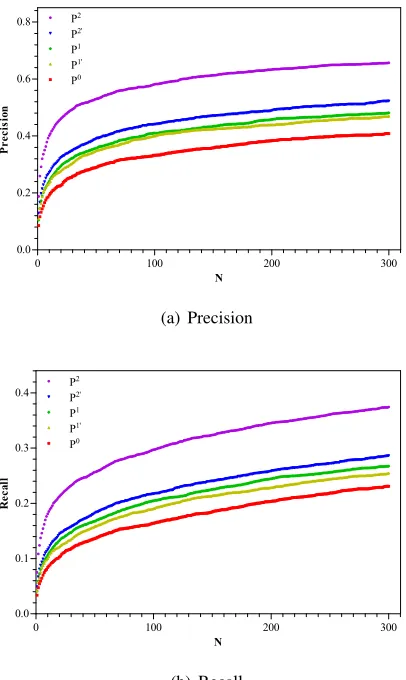
Intuitively, the value N plays an important role in the above experiments. In a second series of ex-periments, we letN vary from 1 to 300 and plot the results obtained with different evaluation measure in Figure 1. In Figure 1(a) (resp. Figure 1(b)), thex -axis corresponds to the values taken by N, and they -axis to the precision (resp. recall) scores for the lexi-cons extracted on each of the 5 corporaP0,P10,P20, P1 andP2. A clear fact from the figure is that both the precision and the recall scores increase accord-ing to the increase of theN values, which coincides with our intuition. As one can note, our method con-sistently outperforms the previous work and also the original corpus on all the values considered forN.
0 100 200 300
0.0 0.2 0.4 0.6 0.8
N
P
re
ci
si
on
P2
P2'
P1
P1'
P0
(a) Precision
0 100 200 300
0.0 0.1 0.2 0.3 0.4
N
Re
ca
ll
P2
P2'
P1
P1'
P0
[image:5.612.87.290.280.620.2](b) Recall
Figure 1: Performance of bilingual lexicon extraction from different corpora with variedN values from 1 to 300. The five lines from the top down in each subfigure are corresponding to the results forP2,P20,P1,P10and
P0respectively.
4 Discussion
As previous studies on bilingual lexicon extrac-tion from comparable corpora radically differ on resources used and technical choices, it is very difficult to compare them in a unified framework (Laroche and Langlais, 2010). We compare in this section our method with some ones in the same vein (i.e. enhancing bilingual corpora prior to extract-ing bilextract-ingual lexicons from them). Some works like (Munteanu et al., 2004) and (Munteanu and Marcu, 2006) propose methods to extract parallel fragments from comparable corpora. However, their approach only focuses on a very small part of the original cor-pus, whereas our work aims at preserving most of the vocabulary of the original corpus.
We have followed here the general approach in (Li and Gaussier, 2010) which consists in enhancing the quality of a comparable corpus prior to extract-ing information from it. However, despite this latter work, we have shown here a method which ensures homogeneity of the obtained corpus, and which fi-nally leads to comparable corpora of higher quality. In turn such corpora yield better bilingual lexicons extracted.
Acknowledgements
This work was supported by the French National Re-search Agency grant ANR-08-CORD-009.
References
Lisa Ballesteros and W. Bruce Croft. 1997. Phrasal translation and query expansion techniques for cross-language information retrieval. InProceedings of the 20th ACM SIGIR, pages 84–91, Philadelphia, Pennsyl-vania, USA.
Herv´e D´ejean, Eric Gaussier, and Fatia Sadat. 2002. An approach based on multilingual thesauri and model combination for bilingual lexicon extraction. In Pro-ceedings of the 19th International Conference on Computational Linguistics, pages 1–7, Taipei, Taiwan. Pascale Fung and Kathleen McKeown. 1997. Find-ing terminology translations from non-parallel cor-pora. InProceedings of the 5th Annual Workshop on Very Large Corpora, pages 192–202, Hong Kong. Pascale Fung and Lo Yuen Yee. 1998. An IR approach
con-ference on Computational linguistics, pages 414–420, Montreal, Quebec, Canada.
Nikesh Garera, Chris Callison-Burch, and David Yarowsky. 2009. Improving translation lexicon induc-tion from monolingual corpora via dependency con-texts and part-of-speech equivalences. InCoNLL 09: Proceedings of the Thirteenth Conference on Compu-tational Natural Language Learning, pages 129–137, Boulder, Colorado.
E. Gaussier, J.-M. Renders, I. Matveeva, C. Goutte, and H. D´ejean. 2004. A geometric view on bilingual lexicon extraction from comparable corpora. In Pro-ceedings of the 42nd Annual Meeting of the Associ-ation for ComputAssoci-ational Linguistics, pages 526–533, Barcelona, Spain.
Audrey Laroche and Philippe Langlais. 2010. Revisiting context-based projection methods for term-translation spotting in comparable corpora. In Proceedings of the 23rd International Conference on Computational Linguistics (Coling 2010), pages 617–625, Beijing, China, August.
Bo Li and Eric Gaussier. 2010. Improving corpus comparability for bilingual lexicon extraction from comparable corpora. InProceedings of the 23rd In-ternational Conference on Computational Linguistics, pages 644–652, Beijing, China.
Emmanuel Morin, B´eatrice Daille, Koichi Takeuchi, and Kyo Kageura. 2007. Bilingual terminology mining -using brain, not brawn comparable corpora. In Pro-ceedings of the 45th Annual Meeting of the Associ-ation for ComputAssoci-ational Linguistics, pages 664–671, Prague, Czech Republic.
Dragos Stefan Munteanu and Daniel Marcu. 2006. Ex-tracting parallel sub-sentential fragments from non-parallel corpora. InProceedings of the 21st Interna-tional Conference on ComputaInterna-tional Linguistics and the 44th annual meeting of the Association for Compu-tational Linguistics, pages 81–88, Sydney, Australia. Dragos Stefan Munteanu, Alexander Fraser, and Daniel
Marcu. 2004. Improved machine translation perfor-mance via parallel sentence extraction from compara-ble corpora. InProceedings of the HLT-NAACL 2004, pages 265–272, Boston, MA., USA.
Franz Josef Och and Hermann Ney. 2003. A system-atic comparison of various statistical alignment mod-els.Computational Linguistics, 29(1):19–51.
Reinhard Rapp. 1999. Automatic identification of word translations from unrelated English and German cor-pora. InProceedings of the 37th Annual Meeting of the Association for Computational Linguistics, pages 519–526, College Park, Maryland, USA.
Xavier Robitaille, Yasuhiro Sasaki, Masatsugu Tonoike, Satoshi Sato, and Takehito Utsuro. 2006. Compil-ing French-Japanese terminologies from the web. In
Proceedings of the 11st Conference of the European Chapter of the Association for Computational Linguis-tics, pages 225–232, Trento, Italy.
Daphna Shezaf and Ari Rappoport. 2010. Bilingual lex-icon generation using non-aligned signatures. In Pro-ceedings of the 48th Annual Meeting of the Associa-tion for ComputaAssocia-tional Linguistics, pages 98–107, Up-psala, Sweden.