i
Introduction to Software Testing
Extensively class tested, this text takes an innovative approach to soft-ware testing: it defines testing as the process of applying a few well-defined, general-purpose test criteria to a structure or model of the soft-ware. The structure of the text directly reflects the pedagogical approach and incorporates the latest innovations in testing, including modern types of software such as OO, Web applications, and embedded software. The book contains numerous examples throughout. An instructor’s solution manual, PowerPoint slides, sample syllabi, additional examples and up-dates, testing tools for students, and example software programs in Java are available on an extensive Web site at www.introsoftwaretesting.com. Paul Ammann, PhD, is an Associate Professor of software engineer-ing at George Mason University. He received an outstandengineer-ing teachengineer-ing award in 2007 from the Volgenau School of Information Technology and Engineering. Dr. Ammann earned an AB degree in computer science from Dartmouth College and MS and PhD degrees in computer science from the University of Virginia.
Jeff Offutt, PhD, is a Professor of software engineering at George Mason University. He is editor-in-chief of theJournal of Software Testing, Verification and Reliability; chair of the steering committee for the IEEE International Conference on Software Testing, Verification, and Valida-tion; and on the editorial boards for several journals. He recived the outstanding teacher award from the Volgenau School of Information Technology and Engineering in 2003. Dr. Offutt earned a BS degree in mathematics and data processing from Morehead State University and MS and PhD degrees in computer science from the Georgia Institute of Technology.
INTRODUCTION TO
SOFTWARE
TESTING
Paul Ammann
George Mason University
Jeff Offutt
George Mason University
The Edinburgh Building, Cambridge CB2 8RU, UK
First published in print format
ISBN-13 978-0-521-88038-1
ISBN-13 978-0-511-39330-3
© Paul Ammann and Jeff Offutt 2008
2008
Information on this title: www.cambridge.org/9780521880381
This publication is in copyright. Subject to statutory exception and to the provision of
relevant collective licensing agreements, no reproduction of any part may take place
without the written permission of Cambridge University Press.
Cambridge University Press has no responsibility for the persistence or accuracy of urls
for external or third-party internet websites referred to in this publication, and does not
guarantee that any content on such websites is, or will remain, accurate or appropriate.
Published in the United States of America by Cambridge University Press, New York
www.cambridge.org
eBook (EBL)
Contents
List of Figures pageix
List of Tables xiii
Preface xv
Part 1 Overview 1
1 Introduction 3
1.1 Activities of a Test Engineer 4
1.1.1 Testing Levels Based on Software Activity 5 1.1.2 Beizer’s Testing Levels Based on Test Process
Maturity 8
1.1.3 Automation of Test Activities 10
1.2 Software Testing Limitations and Terminology 11
1.3 Coverage Criteria for Testing 16
1.3.1 Infeasibility and Subsumption 20
1.3.2 Characteristics of a Good Coverage Criterion 20
1.4 Older Software Testing Terminology 21
1.5 Bibliographic Notes 22
Part 2 Coverage Criteria 25
2 Graph Coverage 27
2.1 Overview 27
2.2 Graph Coverage Criteria 32
2.2.1 Structural Coverage Criteria 33
2.2.2 Data Flow Criteria 44
2.2.3 Subsumption Relationships among Graph Coverage
Criteria 50
2.3 Graph Coverage for Source Code 52
vi Contents
2.3.1 Structural Graph Coverage for Source Code 52 2.3.2 Data Flow Graph Coverage for Source Code 54
2.4 Graph Coverage for Design Elements 65
2.4.1 Structural Graph Coverage for Design Elements 65 2.4.2 Data Flow Graph Coverage for Design Elements 67
2.5 Graph Coverage for Specifications 75
2.5.1 Testing Sequencing Constraints 75
2.5.2 Testing State Behavior of Software 77
2.6 Graph Coverage for Use Cases 87
2.6.1 Use Case Scenarios 90
2.7 Representing Graphs Algebraically 91
2.7.1 Reducing Graphs to Path Expressions 94
2.7.2 Applications of Path Expressions 96
2.7.3 Deriving Test Inputs 96
2.7.4 Counting Paths in a Flow Graph and Determining
Max Path Length 97
2.7.5 Minimum Number of Paths to Reach All Edges 98
2.7.6 Complementary Operations Analysis 98
2.8 Bibliographic Notes 100
3 Logic Coverage 104
3.1 Overview: Logic Predicates and Clauses 104
3.2 Logic Expression Coverage Criteria 106
3.2.1 Active Clause Coverage 107
3.2.2 Inactive Clause Coverage 111
3.2.3 Infeasibility and Subsumption 112
3.2.4 Making a Clause Determine a Predicate 113
3.2.5 Finding Satisfying Values 115
3.3 Structural Logic Coverage of Programs 120
3.3.1 Predicate Transformation Issues 127
3.4 Specification-Based Logic Coverage 131
3.5 Logic Coverage of Finite State Machines 134
3.6 Disjunctive Normal Form Criteria 138
3.7 Bibliographic Notes 147
4 Input Space Partitioning 150
4.1 Input Domain Modeling 152
4.1.1 Interface-Based Input Domain Modeling 153 4.1.2 Functionality-Based Input Domain Modeling 154
4.1.3 Identifying Characteristics 154
4.1.4 Choosing Blocks and Values 156
4.1.5 Using More than One Input Domain Model 158
4.1.6 Checking the Input Domain Model 158
4.2 Combination Strategies Criteria 160
4.3 Constraints among Partitions 165
Contents vii
5 Syntax-Based Testing 170
5.1 Syntax-Based Coverage Criteria 170
5.1.1 BNF Coverage Criteria 170
5.1.2 Mutation Testing 173
5.2 Program-Based Grammars 176
5.2.1 BNF Grammars for Languages 176
5.2.2 Program-Based Mutation 176
5.3 Integration and Object-Oriented Testing 191
5.3.1 BNF Integration Testing 192
5.3.2 Integration Mutation 192
5.4 Specification-Based Grammars 197
5.4.1 BNF Grammars 198
5.4.2 Specification-Based Mutation 198
5.5 Input Space Grammars 201
5.5.1 BNF Grammars 201
5.5.2 Mutation for Input Grammars 204
5.6 Bibliographic Notes 210
Part 3 Applying Criteria in Practice 213
6 Practical Considerations 215
6.1 Regression Testing 215
6.2 Integration and Testing 217
6.2.1 Stubs and Drivers 218
6.2.2 Class Integration Test Order 218
6.3 Test Process 219
6.3.1 Requirements Analysis and Specification 220
6.3.2 System and Software Design 221
6.3.3 Intermediate Design 222
6.3.4 Detailed Design 223
6.3.5 Implementation 223
6.3.6 Integration 224
6.3.7 System Deployment 224
6.3.8 Operation and Maintenance 224
6.3.9 Summary 225
6.4 Test Plans 225
6.5 Identifying Correct Outputs 230
6.5.1 Direct Verification of Outputs 230
6.5.2 Redundant Computations 231
6.5.3 Consistency Checks 231
6.5.4 Data Redundancy 232
6.6 Bibliographic Notes 233
7 Engineering Criteria for Technologies 235
7.1 Testing Object-Oriented Software 236
viii Contents
7.1.2 Types of Object-Oriented Faults 237
7.2 Testing Web Applications and Web Services 256 7.2.1 Testing Static Hyper Text Web Sites 257
7.2.2 Testing Dynamic Web Applications 257
7.2.3 Testing Web Services 260
7.3 Testing Graphical User Interfaces 260
7.3.1 Testing GUIs 261
7.4 Real-Time Software and Embedded Software 262
7.5 Bibliographic Notes 265
8 Building Testing Tools 268
8.1 Instrumentation for Graph and Logical
Expression Criteria 268
8.1.1 Node and Edge Coverage 268
8.1.2 Data Flow Coverage 271
8.1.3 Logic Coverage 272
8.2 Building Mutation Testing Tools 272
8.2.1 The Interpretation Approach 274
8.2.2 The Separate Compilation Approach 274
8.2.3 The Schema-Based Approach 275
8.2.4 Using Java Reflection 276
8.2.5 Implementing a Modern Mutation System 277
8.3 Bibliographic Notes 277
9 Challenges in Testing Software 280
9.1 Testing for Emergent Properties: Safety and Security 280 9.1.1 Classes of Test Cases for Emergent Properties 283
9.2 Software Testability 284
9.2.1 Testability for Common Technologies 285 9.3 Test Criteria and the Future of Software Testing 286 9.3.1 Going Forward with Testing Research 288
9.4 Bibliographic Notes 290
List of Criteria 293
Bibliography 295
List of Figures
1.1 Activities of test engineers page4
1.2 Software development activities and testing levels – the “V Model” 6 2.1 Graph (a) has a single initial node, graph (b) multiple initial nodes,
and graph (c) (rejected) with no initial nodes 28
2.2 Example of paths 29
2.3 A single entry single exit graph 30
2.4 Test case mappings to test paths 31
2.5 A set of test cases and corresponding test paths 32 2.6 A graph showing node coverage and edge coverage 34
2.7 Two graphs showing prime path coverage 37
2.8 Graph with a loop 37
2.9 Tours, sidetrips, and detours in graph coverage 38
2.10 An example for prime test paths 40
2.11 A graph showing variables, def sets and use sets 44
2.12 A graph showing an example of du-paths 46
2.13 Graph showing explicit def and use sets 47
2.14 Example of the differences among the three data flow coverage
criteria 49
2.15 Subsumption relations among graph coverage criteria 50
2.16 CFG fragment for the if-else structure 52
2.17 CFG fragment for the if structure without an else 53
2.18 CFG fragment for the while loop structure 53
2.19 CFG fragment for the for loop structure 54
2.20 CFG fragment for the case structure 54
2.21 TestPat for data flow example 56
2.22 A simple call graph 65
2.23 A simple inheritance hierarchy 66
2.24 An inheritance hierarchy with objects instantiated 67
2.25 An example of parameter coupling 68
2.26 Coupling du-pairs 69
2.27 Last-defs and first-uses 69
x List of Figures
2.28 Quadratic root program 71
2.29 Def-use pairs under intra-procedural and inter-procedural data flow 72
2.30 Def-use pairs in object-oriented software 72
2.31 Def-use pairs in web applications and other distributed software 73
2.32 Control flow graph using the File ADT 76
2.33 Elevator door open transition 79
2.34 Stutter – Part A 80
2.35 Stutter – Part B 81
2.36 A FSM representing Stutter, based on control flow graphs of the
methods 82
2.37 A FSM representing Stutter, based on the structure of the software 83 2.38 A FSM representing Stutter, based on modeling state variables 84 2.39 A FSM representing Stutter, based on the specifications 85
2.40 Class Queue for exercises. 86
2.41 ATM actor and use cases 88
2.42 Activity graph for ATM withdraw funds 90
2.43 Examples of path products 92
2.44 Null path that leads to additive identityφ 93
2.45 A or lambda 94
2.46 Example graph to show reduction to path expressions 94
2.47 After step 1 in path expression reduction 95
2.48 After step 2 in path expression reduction 95
2.49 After step 3 in path expression reduction 95
2.50 Removing arbitrary nodes 95
2.51 Eliminating noden2 95
2.52 Removing sequential edges 95
2.53 Removing self-loop edges 96
2.54 Final graph with one path expression 96
2.55 Graph example for computing maximum number of paths 97
2.56 Graph example for complementary path analysis 99
3.1 Subsumption relations among logic coverage criteria 113
3.2 TriTyp – Part A 121
3.3 TriTyp – Part B 122
3.4 Calendar method 132
3.5 FSM for a memory car seat – Lexus 2003 ES300 135
3.6 Fault detection relationships 143
4.1 Partitioning of input domainDinto three blocks 151 4.2 Subsumption relations among input space partitioning criteria 163
5.1 Method Min and six mutants 177
5.2 Mutation testing process 181
5.3 Partial truth table for (a∧b) 187
5.4 Finite state machine for SMV specification 199
5.5 Mutated finite state machine for SMV specification 200
5.6 Finite state machine for bank example 202
5.7 Finite state machine for bank example grammar 202
5.8 Simple XML message for books 204
List of Figures xi
7.1 Example class hierarchy in UML 238
7.2 Data flow anomalies with polymorphism 238
7.3 Calls to d() when object has various actual types 239
7.4 ITU: Descendant with no overriding methods 241
7.5 SDA, SDIH: State definition anomalies 243
7.6 IISD: Example of indirect inconsistent state definition 244 7.7 ACB1: Example of anomalous construction behavior 245
7.8 SVA: State visibility anomaly 247
7.9 Sample class hierarchy (a) and associated type families (b) 248 7.10 Control flow graph fragment (a) and associated definitions and
uses (b) 249
7.11 Def-use pairs in object-oriented software 250
7.12 Control flow schematic for prototypical coupling sequence 251
7.13 Sample class hierarchy anddef-usetable 252
7.14 Coupling sequence:oof typeA(a) bound to instance ofA(b),B(c)
orC(d) 253
8.2 Node coverage instrumentation 269
8.3 Edge coverage instrumentation 270
8.4 All uses coverage instrumentation 271
List of Tables
2.1 Defs and uses at each node in the CFG for TestPat page57 2.2 Defs and uses at each edge in the CFG for TestPat 57
2.3 Du-path sets for each variable in TestPat 58
2.4 Test paths to satisfy all du-paths coverage on TestPat 59
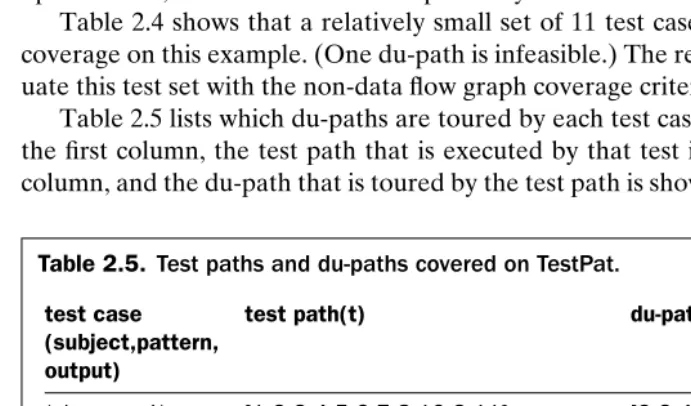
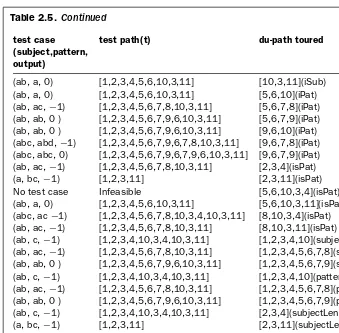
2.5 Test paths and du-paths covered on TestPat 59
3.1 Reachability for Triang predicates 123
3.2 Reachability for Triang predicates – reduced by solving for triOut 124
3.3 Predicate coverage for Triang 125
3.4 Clause coverage for Triang 126
3.5 Correlated active clause coverage for Triang 127
3.6 Correlated active clause coverage forcal()preconditions 133
3.7 Predicates from memory seat example 136
3.8 DNF fault classes 143
4.1 First partitioning of TriTyp’s inputs (interface-based) 156 4.2 Second partitioning of TriTyp’s inputs (interface-based) 157 4.3 Possible values for blocks in the second partitioning in Table 4.2 157 4.4 Geometric partitioning of TriTyp’s inputs (functionality-based) 158 4.5 Correct geometric partitioning of TriTyp’s inputs (functionality-based) 158 4.6 Possible values for blocks in geometric partitioning in Table 4.5 159
4.7 Examples of invalid block combinations 165
5.1 Java’s access levels 193
6.1 Testing objectives and activities during requirements analysis and
specification 221
6.2 Testing objectives and activities during system and software design 222 6.3 Testing objectives and activities during intermediate design 222 6.4 Testing objectives and activities during detailed design 223 6.5 Testing objectives and activities during implementation 223 6.6 Testing objectives and activities during integration 224 6.7 Testing objectives and activities during system deployment 224 6.8 Testing objectives and activities during operation and maintenance 225 7.1 Faults and anomalies due to inheritance and polymorphism 240
xiv List of Tables
7.2 ITU: Code example showing inconsistent type usage 242 7.3 IC: Incomplete construction of state variablefd 246
7.4 Summary of sample coupling paths 254
7.5 Binding triples for coupling sequence from class hierarchy in Figure
Preface
This book presents software testing as a practical engineering activity, essential to producing high-quality software. It is designed to be used as the primary textbook in either an undergraduate or graduate course on software testing, as a supplement to a general course on software engineering or data structures, and as a resource for software test engineers and developers. This book has a number of unique features:
It organizes the complex and confusing landscape of test coverage criteria with
a novel and extremely simple structure. At a technical level, software testing is based on satisfying coverage criteria. The book’s central observation is that there are few truly different coverage criteria, each of which fits easily into one of four categories: graphs, logical expressions, input space, and syntax structures. This not only simplifies testing, but it also allows a convenient and direct theoretical treatment of each category. This approach contrasts strongly with the traditional view of testing, which treats testing at each phase in the development process differently.
It is designed and written to be a textbook. The writing style is direct, it builds the
concepts from the ground up with a minimum of required background, and it in-cludes lots of examples, homework problems, and teaching materials. It provides a balance of theory and practical application, presenting testing as a collection of objective, quantitative activities that can be measured and repeated. The the-oretical concepts are presented when needed to support the practical activities that test engineers follow.
It assumes that testing is part of a mental discipline that helps all IT professionals
develop higher-quality software. Testing is not an anti-engineering activity, and it is not an inherently destructive process. Neither is it only for testing specialists or domain experts who know little about programming or math.
It is designed with modular, interconnecting pieces; thus it can be used in
multi-ple courses. Most of the book requires only basic discrete math and introductory programming, and the parts that need more background are clearly marked. By
xvi Preface
using the appropriate sections, this book can support several classes, as described later in the preface.
It assumes the reader is learning to be an engineer whose goal is to produce the
best possible software with the lowest possible cost. The concepts in this book are well grounded in theory, are practical, and most are currently in use.
WHY SHOULD THIS BOOK BE USED?
Not very long ago, software development companies could afford to employ pro-grammers who could not test and testers who could not program. For most of the industry, it was not necessary for either group to know the technical principles be-hind software testing or even software development. Software testing in industry historically has been a nontechnical activity. Industry viewed testing primarily from the managerial and process perspective and had limited expectations of practition-ers’ technical training.
As the software engineering profession matures, and as software becomes more pervasive in everyday life, there are increasingly stringent requirements for software reliability, maintainability, and security. Industry must respond to these changes by, among other things, improving the way software is tested. This requires increased technical expertise on the part of test engineers, as well as increased emphasis on testing by software developers. The good news is that the knowledge and technol-ogy are available and based on over 30 years of research and practice. This book puts that knowledge into a form that students, test engineers, test managers, and developers can access.
At the same time, it is relatively rare to find courses that teach testing in univer-sities. Only a few undergraduate courses exist, almost no masters degree programs in computer science or software engineering require a course in software testing, and only a few dozen have an elective course. Not only is testing not covered as an essential part of undergraduate computer science education, most computer science students either never gain any knowledge about testing, or see only a few lectures as part of a general course in software engineering.
The authors of this book have been teaching software testing to software en-gineering and computer science students for more than 15 years. Over that time we somewhat reluctantly came to the conclusion that no one was going to write the book we wanted to use. Rather, to get the book we wanted, we would have to write it.
Preface xvii
This book differs from other books on software testing in other important ways. Many books address managing the testing process. While this is important, it is equally important to give testers specific techniques grounded in basic theory. This book provides a balance of theory and practical application. This is important in-formation that software companies must have; however, this book focuses specif-ically on the technical nuts-and-bolts issues of designing and creating tests. Other testing books currently on the market focus on specific techniques or activities, such as system testing or unit testing. This book is intended to be comprehensive over the entire software development process and to cover as many techniques as possible.
As stated previously, the motivation for this book is to support courses in soft-ware testing. Our first target was our own softsoft-ware testing course in our Soft-ware Engineering MS program at George Mason University. This popular elective is taught to about 30 computer science and software engineering students every semester. We also teach PhD seminars in software testing, industry short courses on specialized aspects, and lectures on software testing in various undergraduate courses. Although few undergraduate courses on software testing exist, we believe that they should exist, and we expect they will in the near future. Most testing books are not designed for classroom use. We specifically wrote this book to support our classroom activities, and it is no accident that the syllabus for our testing course, available on the book’s Web site (www.introsoftwaretesting.com), closely follows the table of contents for this book.
This book includes numerous carefully worked examples to help students and teachers alike learn the sometimes complicated concepts. The instructor’s resources include high-quality powerpoint slides, presentation hints, solutions to exercises, and working software. Our philosophy is that we are doing more than writing a book; we are offering our course to the community. One of our goals was to write material that is scholarly and true to the published research literature, but that is also accessible to nonresearchers. Although the presentation in the book is quite a bit different from the research papers that the material is derived from, the essen-tial ideas are true to the literature. To make the text flow more smoothly, we have removed the references from the presentation. For those interested in the research genealogy, each chapter closes with a bibliographic notes section that summarizes where the concepts come from.
WHO SHOULD READ THIS BOOK?
xviii Preface
presented, the practical applications reveal what is useful and what is not, and the advanced reading and bibliographic notes provide pointers into the literature. Al-though the set of research students in software testing is a relatively small audi-ence, we believe it is a key audiaudi-ence, because a common, easily achievable baseline would reduce the effort required for research students to join the community of testing researchers.Researcherswho are already familiar with the field will find the criteria-approach to be novel and interesting. Some may disagree with the pedagog-ical approach, but we have found that the view that testing is an application of only a few criteria to a very few software structures to be very helpful to our research. We hope that testing research in the future will draw away from searches for more criteria to novel uses and evaluations of existing criteria.
Testersin the industry will find this book to be an invaluable collection of tech-niques that will help improve their testing, no matter what their current process is. The criteria presented here are intended to be used as a “toolbox” of tricks that can be used to find faults.Developerswho read this book will find numerous ways to improve their own software. Their self-testing activities can become more effi-cient and effective, and the discussions of software faults that test engineers search for will help developers avoid them. To paraphrase a famous parable, if you want to teach a person to be a better fisherman, explain how and where the fish swim. Finally,managers will find this book to be a useful explanation of how clever test engineers do their job, and of how test tools work. They will be able to make more effective decisions regarding hiring, promotions, and purchasing tools.
HOW CAN THIS BOOK BE USED?
A major advantage of the structure of this book is that it can be easily used for several different courses. Most of the book depends on material that is taught very early in college and some high schools: basic concepts from data structures and dis-crete math. The sections are organized so that the early material in each chapter is accessible to less advanced students, and material that requires more advanced knowledge is clearly marked.
Specifically, the book defines six separate sets of chapter sections that form streamsthrough the book:
1. A module within a CS II course
2. A sophomore-level course on software testing 3. A module in a general software engineering course 4. A senior-level course on software testing
5. A first-year MS level course on software testing
6. An advanced graduate research-oriented course on software testing 7. Industry practioner relevant sections
Preface xix
Stream 1: Module in a CS II course.
Stream 2: Sophomore-level course on software testing.
Stream 3: Module in a general software engineering course.
Stream 4: Senior-level course on software testing.
Stream 5: First-year MS course on software testing.
Stream 6: Advanced graduate research-oriented course on software testing.
Stream 7: Industry practitioner relevant sections
STREAMS
1 2 3 4 5 6 7
Part I: Overview
Chapter 1. Introduction 1.1 Activities of a Test Engineer
1.2 Software Testing Limitations and Terminology 1.3 Coverage Criteria for Testing
1.4 Older Software Testing Terminology 1.5 Bibliographic Notes
Part II: Coverage Criteria
Chapter 2. Graph Coverage2.1 Overview
2.2 Graph Coverage Criteria 2.3 Graph Coverage for Source Code 2.4 Graph Coverage for Design Elements 2.5 Graph Coverage for Specifications 2.6 Graph Coverage for Use Cases 2.7 Representing Graphs Algebraically 2.8 Bibliographic Notes
Chapter 3. Logic Coverage
3.1 Overview: Logic Predicates and Clauses 3.2 Logic Expression Coverage Criteria 3.3 Structural Logic Coverage of Programs 3.4 Specification-Based Logic Coverage 3.5 Logic Coverage of Finite State Machines 3.6 Disjunctive Normal Form Criteria 3.7 Bibliographic Notes
Chapter 4. Input Space Partitioning 4.1 Input Domain Modeling
4.2 Combination Strategies Criteria 4.3 Constraints among Partitions 4.4 Bibliographic Notes
Chapter 5. Syntax-Based Testing 5.1 Syntax-Based Coverage Criteria 5.2 Program-Based Grammars
xx Preface
Stream 1: Module in a CS II course.
Stream 2: Sophomore-level course on software testing.
Stream 3: Module in a general software engineering course.
Stream 4: Senior-level course on software testing.
Stream 5: First-year MS course on software testing.
Stream 6: Advanced graduate research-oriented course on software testing.
Stream 7: Industry practitioner relevant sections
STREAMS
1 2 3 4 5 6 7
Part III: Applying Criteria in Practice
Chapter 6. Practical Considerations 6.1 Regression Testing
6.2 Integration and Testing 6.3 Test Process
6.4 Test Plans
6.5 Identifying Correct Outputs 6.5 Bibliographic Notes
Chapter 7. Engineering Criteria for Technologies 7.1 Testing Object-Oriented Software
7.2 Testing Web Applications and Web Services 7.3 Testing Graphical User Interfaces
7.4 Real-Time Software and Embedded Software 7.5 Bibliographic Notes
Chapter 8. Building Testing Tools
8.1 Instrumentation for Graph and Logical Expression Criteria 8.2 Building Mutation Testing Tools
8.3 Bibliographic Notes
Chapter 9. Challenges in Testing Software 9.1 Testing for Emergent Properties: Safety and Security 9.2 Software Testability
9.3 Test Criteria and the Future of Software Testing 9.4 Bibliographic Notes
assignment. Our favorite is to ask the students to retrieve one of their previously graded programs and satisfy some simple test criterion like branch coverage. We offer points for every fault found, driving home two concepts: an “A” grade doesn’t mean the program always works, and finding faults is a good thing.
The sophomore-level course on software testing (stream 2) is designed to imme-diately follow a data structures course (CS II). The marked sections contain material that depends only on data structures and discrete math.
A module in a general software engineering course (stream 3) could augment the survey material typical in such courses. The sections marked provide basic literacy in software testing.
Preface xxi
software development than the sophomore stream. This includes sections in Chap-ter 2 on data flow testing, sections that involve integration testing of multiple mod-ules, and sections that rely on grammars or finite state machines. Most senior com-puter science students will have seen this material in their other courses. Most of the sections that appear in stream 4 but not stream 2 could be added to stream 2 with appropriate short introductions. It is important to note that a test engineer does not need to know all the theory of parsing to use data flow testing or all the theory on finite state machines to use statecharts for testing.
The graduate-level course on software testing (stream 5) adds some additional sections that rely on a broader context and that require more theoretical maturity. For example, these sections use knowledge of elementary formal methods, polymor-phism, and some of the UML diagrams. Some of the more advanced topics and the entire chapter on building testing tools are also intended for a graduate audience. This chapter could form the basis for a good project, for example, to implement a simple coverage analyzer.
An advanced graduate course in software testing with a research emphasis such as a PhD seminar (stream 6) includes issues that are still unproven and research in nature. The bibliographic notes are recommended only for these students as indica-tors for future in-depth reading.
Finally, sections that are reasonably widely used in industry, especially those that have commercial tool support, are marked for stream 7. These sections have a minimum of theory and omit criteria that are still of questionable usefulness.
Extensive supplementary materials, including sample syllabuses, PowerPoint slides, presentation hints, solutions to exercises, working software, and errata are available on the book’s companion Web site.
ACKNOWLEDGMENTS
xxii Preface
for providing unwavering support and enforcing the occasional deadline to move the project along, as well as Kerry Cahill from Cambridge University Press for very strong support on this project.
We also acknowledge George Mason University for supporting both of us on sabbaticals and for providing GTA support at crucial times. Our department Chair, Hassan Gomaa, has enthusiastically supported this effort.
Finally, of course none of this is possible without the support of our families. Thanks to Becky, Jian, Steffi, Matt, Joyce, and Andrew for keeping us grounded in reality and helping keep us happy for the past five years.
Just as all programs contain faults, all texts contain errors. Our text is no differ-ent. And, as responsibility for software faults rests with the developers, responsibil-ity for errors in this text rests with us, the authors. In particular, the bibliographic notes sections reflect our perspective of the testing field, a body of work we read-ily acknowledge as large and complex. We apologize in advance for omissions, and invite pointers to relevant citations.
PART 1
Overview
1
Introduction
The ideas and techniques of software testing have become essential knowledge for all software developers. A software developer can expect to use the concepts pre-sented in this book many times during his or her career. This chapter introduces the subject of software testing by describing the activities of a test engineer, defining a number of key terms, and then explaining the central notion of test coverage.
Software is a key ingredient in many of the devices and systems that pervade our society. Software defines the behavior of network routers, financial networks, telephone switching networks, the Web, and other infrastructure of modern life. Software is an essential component of embedded applications that control exotic applications such as airplanes, spaceships, and air traffic control systems, as well as mundane appliances such as watches, ovens, cars, DVD players, garage door open-ers, cell phones, and remote controllers. Modern households have over 50 proces-sors, and some new cars have over 100; all of them running software that optimistic consumers assume will never fail! Although many factors affect the engineering of reliable software, including, of course, careful design and sound process manage-ment, testing is the primary method that the industry uses to evaluate software un-der development. Fortunately, a few basic software testing concepts can be used to design tests for a large variety of software applications. A goal of this book is to present these concepts in such a way that the student or practicing engineer can easily apply them to any software testing situation.
This textbook differs from other software testing books in several respects. The most important difference is in how it views testing techniques. In his land-mark bookSoftware Testing Techniques, Beizer wrote that testing is simple – all a tester needs to do is “find a graph and cover it.” Thanks to Beizer’s insight, it became evident to us that the myriad testing techniques present in the literature have much more in common than is obvious at first glance. Testing techniques typ-ically are presented in the context of a particular software artifact (for example, a requirements document or code) or a particular phase of the lifecycle (for exam-ple, requirements analysis or implementation). Unfortunately, such a presentation obscures the underlying similarities between techniques. This book clarifies these similarities.
4 Overview
It turns out that graphs do not characterize all testing techniques well; other abstract models are necessary. Much to our surprise, we have found that a small number of abstract models suffice: graphs, logical expressions, input domain char-acterizations, and syntactic descriptions. The main contribution of this book is to simplify testing by classifying coverage criteria into these four categories, and this is why Part II of this book has exactly four chapters.
This book provides a balance of theory and practical application, thereby pre-senting testing as a collection of objective, quantitative activities that can be mea-sured and repeated. The theory is based on the published literature, and presented without excessive formalism. Most importantly, the theoretical concepts are pre-sented when needed to support the practical activities that test engineers follow. That is, this book is intended for software developers.
1.1
ACTIVITIES OF A TEST ENGINEER
In this book, atest engineeris an information technology (IT) professional who is in charge of one or more technical test activities, including designing test inputs, pro-ducing test case values, running test scripts, analyzing results, and reporting results to developers and managers. Although we cast the description in terms of test engi-neers, every engineer involved in software development should realize that he or she sometimes wears the hat of a test engineer. The reason is that each software artifact produced over the course of a product’s development has, or should have, an asso-ciated set of test cases, and the person best positioned to define these test cases is often the designer of the artifact. Atest manageris in charge of one or more test en-gineers. Test managers set test policies and processes, interact with other managers on the project, and otherwise help the engineers do their work.
Figure 1.1 shows some of the major activities of test engineers. A test engi-neer must design tests by creating test requirements. These requirements are then
Test Engineer
Test Designs
Executable Tests
Computer Evaluate
P Output
Test
Engineer Test
Engineer
design instantiate
execute
}
[image:28.612.57.345.430.631.2]Test Manager
Introduction 5
transformed into actual values and scripts that are ready for execution. These ex-ecutable tests are run against the software, denotedPin the figure, and the results are evaluated to determine if the tests reveal a fault in the software. These activities may be carried out by one person or by several, and the process is monitored by a test manager.
One of a test engineer’s most powerful tools is a formal coverage criterion. For-mal coverage criteria give test engineers ways to decide what test inputs to use dur-ing testdur-ing, makdur-ing it more likely that the tester will find problems in the program and providing greater assurance that the software is of high quality and reliability. Coverage criteria also provide stopping rules for the test engineers. The technical core of this book presents the coverage criteria that are available, describes how they are supported by tools (commercial and otherwise), explains how they can best be applied, and suggests how they can be integrated into the overall development process.
Software testing activities have long been categorized into levels, and two kinds of levels have traditionally been used. The most often used level categorization is based on traditional software process steps. Although most types of tests can only be run after some part of the software is implemented, tests can be designed and constructed during all software development steps. The most time-consuming parts of testing are actually the test design and construction, so test activities can and should be carried out throughout development. The second-level categorization is based on the attitude and thinking of the testers.
1.1.1
Testing Levels Based on Software Activity
Tests can be derived from requirements and specifications, design artifacts, or the source code. A different level of testing accompanies each distinct software devel-opment activity:
Acceptance Testing – assess software with respect to requirements.
System Testing – assess software with respect to architectural design.
Integration Testing – assess software with respect to subsystem design.
Module Testing – assess software with respect to detailed design.
Unit Testing – assess software with respect to implementation.
Figure 1.2 illustrates a typical scenario for testing levels and how they relate to software development activities by isolating each step. Information for each test level is typically derived from the associated development activity. Indeed, stan-dard advice is to design the tests concurrently with each development activity, even though the software will not be in an executable form until the implementation phase. The reason for this advice is that the mere process of explicitly articulat-ing tests can identify defects in design decisions that otherwise appear reasonable. Early identification of defects is by far the best means of reducing their ultimate cost. Note that this diagram isnotintended to imply a waterfall process. The syn-thesis and analysis activities generically apply to any development process.
6 Overview
Requirements Analysis
Architectural Design
Subsystem Design
Detailed Design
Implementation TestUnit Module
Test
System Test
Integration Test
Acceptance Test
Test
Design
Information
Figure 1.2. Software development activities and testing levels – the “V Model”.
whether the software does what the users want. Acceptance testing must involve users or other individuals who have strong domain knowledge.
The architectural design phase of software development chooses components and connectors that together realize a system whose specification is intended to meet the previously identified requirements.System testingis designed to determine whether the assembled system meets its specifications. It assumes that the pieces work individually, and asks if the system works as a whole. This level of testing usu-ally looks for design and specification problems. It is a very expensive place to find lower-level faults and is usually not done by the programmers, but by a separate testing team.
Thesubsystem designphase of software development specifies the structure and behavior of subsystems, each of which is intended to satisfy some function in the overall architecture. Often, the subsystems are adaptations of previously developed software. Integration testing is designed to assess whether the interfaces between modules (defined below) in a given subsystem have consistent assumptions and com-municate correctly. Integration testing must assume that modules work correctly. Some testing literature uses the terms integration testing and system testing inter-changeably; in this book, integration testing doesnotrefer to testing the integrated system or subsystem. Integration testing is usually the responsibility of members of the development team.
Introduction 7
Implementation is the phase of software development that actually produces code. Unit testingis designed to assess the units produced by the implementation phase and is the “lowest” level of testing. In some cases, such as when building general-purpose library modules, unit testing is done without knowledge of the en-capsulating software application. As with module testing, most software develop-ment organizations make unit testing the responsibility of the programmer. It is straightforward to package unit tests together with the corresponding code through the use of tools such asJUnitfor Java classes.
Not shown in Figure 1.2 is regression testing, a standard part of the mainte-nance phase of software development.Regression testingis testing that is done after changes are made to the software, and its purpose is to help ensure that the updated software still possesses the functionality it had before the updates.
Mistakes in requirements and high-level design wind up being implemented as faults in the program; thus testing can reveal them. Unfortunately, the software faults that come from requirements and design mistakes are visible only through testing months or years after the original mistake. The effects of the mistake tend to be dispersed throughout multiple software components; hence such faults are usually difficult to pin down and expensive to correct. On the positive side, even if tests cannot be executed, the very process of defining tests can identify a significant fraction of the mistakes in requirements and design. Hence, it is important for test planning to proceed concurrently with requirements analysis and design and not be put off until late in a project. Fortunately, through techniques such as use-case analysis, test planning is becoming better integrated with requirements analysis in standard software practice.
Although most of the literature emphasizes these levels in terms ofwhenthey are applied, a more important distinction is on thetypes of faultsthat we are looking for. The faults are based on the softwareartifactthat we are testing, and the software
artifactthat we derive the tests from. For example, unit and module tests are derived
to test units and modules, and we usually try to find faults that can be found when executing the units and modules individually.
One of the best examples of the differences between unit testing and system testing can be illustrated in the context of the infamous Pentium bug. In 1994, Intel introduced its Pentium microprocessor, and a few months later, Thomas Nicely, a mathematician at Lynchburg College in Virginia, found that the chip gave incorrect answers to certain floating-point division calculations.
8 Overview
The Pentium bug not only illustrates the difference in testing levels, but it is also one of the best arguments for paying more attention to unit testing. There are no shortcuts – all aspects of software need to be tested.
On the other hand, some faults can only be found at the system level. One dra-matic example was the launch failure of the first Ariane 5 rocket, which exploded 37 seconds after liftoff on June 4, 1996. The low-level cause was an unhandled floating-point conversion exception in an internal guidance system function. It turned out that the guidance system could never encounter the unhandled exception when used on the Ariane 4 rocket. In other words, the guidance system function is correct for Ariane 4. The developers of the Ariane 5 quite reasonably wanted to reuse the successful inertial guidance system from the Ariane 4, but no one reana-lyzed the software in light of the substantially different flight trajectory of Ariane 5. Furthermore, the system tests that would have found the problem were technically difficult to execute, and so were not performed. The result was spectacular – and expensive!
Another public failure was the Mars lander of September 1999, which crashed due to a misunderstanding in the units of measure used by two modules created by separate software groups. One module computed thruster data in English units and forwarded the data to a module that expected data in metric units. This is a very typical integration fault (but in this case enormously expensive, both in terms of money and prestige).
One final note is that object-oriented (OO) software changes the testing levels. OO software blurs the distinction between units and modules, so the OO software testing literature has developed a slight variation of these levels.Intramethod testing is when tests are constructed for individual methods.Intermethod testing is when pairs of methods within the same class are tested in concert. Intraclass testing is when tests are constructed for a single entire class, usually as sequences of calls to methods within the class. Finally,interclass testingis when more than one class is tested at the same time. The first three are variations of unit and module testing, whereas interclass testing is a type of integration testing.
1.1.2
Beizer’s Testing Levels Based on Test Process Maturity
Another categorization of levels is based on the test process maturity level of an organization. Each level is characterized by the goal of the test engineers. The fol-lowing material is adapted from Beizer [29].
Level 0 There’s no difference between testing and debugging.
Level 1 The purpose of testing is to show that the software works.
Level 2 The purpose of testing is to show that the software doesn’t work.
Level 3 The purpose of testing is not to prove anything specific, but to reduce the risk of using the software.
Level 4 Testing is a mental discipline that helps all IT professionals develop higher quality software.
Introduction 9
This model does not distinguish between a program’s incorrect behavior and a mis-take within the program, and does very little to help develop software that is reliable or safe.
InLevel 1testing, the purpose is to show correctness. While a significant step up
from the naive level 0, this has the unfortunate problem that in any but the most triv-ial of programs, correctness is virtually impossible to either achieve or demonstrate. Suppose we run a collection of tests and find no failures. What do we know? Should we assume that we have good software or just bad tests? Since the goal of correct-ness is impossible, test engineers usually have no strict goal, real stopping rule, or formal test technique. If a development manager asks how much testing remains to be done, the test manager has no way to answer the question. In fact, test managers are in a powerless position because they have no way to quantitatively express or evaluate their work.
InLevel 2testing, the purpose is to show failures. Although looking for failures
is certainly a valid goal, it is also a negative goal. Testers may enjoy finding the problem, but the developers never want to find problems – they want the software to work (level 1 thinking is natural for the developers). Thus, level 2 testing puts testers and developers into an adversarial relationship, which can be bad for team morale. Beyond that, when our primary goal is to look for failures, we are still left wondering what to do if no failures are found. Is our work done? Is our software very good, or is the testing weak? Having confidence in when testing is complete is an important goal for all testers.
The thinking that leads toLevel 3testing starts with the realization that testing can show the presence, but not the absence, of failures. This lets us accept the fact that whenever we use software, we incur some risk. The risk may be small and the consequences unimportant, or the risk may be great and the consequences catas-trophic, but risk is always there. This allows us to realize that the entire develop-ment team wants the same thing – to reduce the risk of using the software. In level 3 testing, both testers and developers work together to reduce risk.
Once the testers and developers are on the same “team,” an organization can progress to realLevel 4testing. Level 4 thinking defines testing asa mental disci-pline that increases quality. Various ways exist to increase quality, of which creating tests that cause the software to fail is only one. Adopting this mindset, test engi-neers can become the technical leaders of the project (as is common in many other engineering disciplines). They have the primary responsibility of measuring and im-proving software quality, and their expertise should help the developers. An analogy that Beizer used is that of a spell checker. We often think that the purpose of a spell checker is to find misspelled words, but in fact, the best purpose of a spell checker is to improve our ability to spell. Every time the spell checker finds an incorrectly spelled word, we have the opportunity to learn how to spell the word correctly. The spell checker is the “expert” on spelling quality. In the same way, level 4 testing means that the purpose of testing is to improve the ability of the developers to pro-duce high quality software. The testers should train your developers.
10 Overview
you the knowledge, skills, and tools to be able to work at level 3. The ultimate goal of this book is to provide a philosophical basis that will allow readers to become “change agents” in their organizations for level 4 thinking, and test engineers to becomesoftware quality experts.
1.1.3
Automation of Test Activities
Software testing is expensive and labor intensive. Software testing requires up to 50% of software development costs, and even more for safety-critical applications. One of the goals of software testing is to automate as much as possible, thereby signi-ficantly reducing its cost, minimizing human error, and making regression testing easier.
Software engineers sometimes distinguish revenue tasks, which contribute di-rectly to the solution of a problem, fromexcisetasks, which do not. For example, compiling a Java class is a classic excise task because, although necessary for the class to become executable, compilation contributes nothing to the particular behav-ior of that class. In contrast, determining which methods are appropriate to define a given data abstraction as a Java class is a revenue task. Excise tasks are candidates for automation; revenue tasks are not. Software testing probably has more excise tasks than any other aspect of software development. Maintaining test scripts, re-running tests, and comparing expected results with actual results are all common excise tasks that routinely consume large chunks of test engineer’s time. Automat-ing excise tasks serves the test engineer in many ways. First, eliminatAutomat-ing excise tasks eliminates drudgery, thereby making the test engineers job more satisfying. Second, automation frees up time to focus on the fun and challenging parts of testing, namely the revenue tasks. Third, automation can help eliminate errors of omission, such as failing to update all the relevant files with the new set of expected results. Fourth, automation eliminates some of the variance in test quality caused by differences in individual’s abilities.
Many testing tasks that defied automation in the past are now candidates for such treatment due to advances in technology. For example, generating test cases that satisfy given test requirements is typically a hard problem that requires intervention from the test engineer. However, there are tools, both research and commercial, that automate this task to varying degrees.
EXERCISES
Section 1.1.
1. What are some of the factors that would help a development organization move from Beizer’s testing level 2 (testing is to show errors) to testing level 4 (a mental discipline that increases quality)?
2. The following exercise is intended to encourage you to think of testing in a more rigorous way than you may be used to. The exercise also hints at the strong relationship between specification clarity, faults, and test cases.1
(a) Write a Java method with the signature public static Vector union (Vector a, Vector b)
Introduction 11
(b) Upon reflection, you may discover a variety of defects and ambiguities in the given assignment. In other words, ample opportunities for faults exist. Identify as many possible faults as you can. (Note:Vectoris a Java Collectionclass. If you are using another language, interpretVector as a list.)
(c) Create a set of test cases that you think would have a reasonable chance of revealing the faults you identified above. Document a rationale for each test in your test set. If possible, characterize all of your rationales in some concise summary. Run your tests against your implementation. (d) Rewrite the method signature to be precise enough to clarify the defects
and ambiguities identified earlier. You might wish to illustrate your spec-ification with examples drawn from your test cases.
1.2
SOFTWARE TESTING LIMITATIONS AND TERMINOLOGY
As said in the previous section, one of the most important limitations of software testing is that testing can show only the presence of failures, not their absence. This is a fundamental, theoretical limitation; generally speaking, the problem of finding all failures in a program is undecidable. Testers often call a successful (or effective) test one that finds an error. While this is an example of level 2 thinking, it is also a characterization that is often useful and that we will use later in this book.
The rest of this section presents a number of terms that are important in software testing and that will be used later in this book. Most of these are taken from stan-dards documents, and although the phrasing is ours, we try to be consistent with the standards. Useful standards for reading in more detail are the IEEE Standard Glos-sary of Software Engineering Terminology, DOD-STD-2167A and MIL-STD-498 from the US Department of Defense, and the British Computer Society’s Standard for Software Component Testing.
One of the most important distinctions to make is between validation and verifi-cation.
Definition 1.1 Validation: The process of evaluating software at the end of software development to ensure compliance with intended usage.
Definition 1.2 Verification: The process of determining whether the products of a given phase of the software development process fulfill the requirements established during the previous phase.
Verification is usually a more technical activity that uses knowledge about the individual software artifacts, requirements, and specifications. Validation usually depends on domain knowledge; that is, knowledge of the application for which the software is written. For example, validation of software for an airplane requires knowledge from aerospace engineers and pilots.
12 Overview
development. This can sometimes mean that validation is given more weight than verification.
Two terms that we have already used are fault and failure. Understanding this dis-tinction is the first step in moving from level 0 thinking to level 1 thinking. We adopt the definition of software fault, error, and failure from the dependability community.
Definition 1.3 Software Fault: A static defect in the software.
Definition 1.4 Software Error: An incorrect internal state that is the manifes-tation of some fault.
Definition 1.5 Software Failure: External, incorrect behavior with respect to the requirements or other description of the expected behavior.
Consider a medical doctor making a diagnosis for a patient. The patient enters the doctor’s office with a list offailures(that is,symptoms). The doctor then must discover thefault, or root cause of the symptom. To aid in the diagnosis, a doctor may order tests that look for anomalous internal conditions, such as high blood pressure, an irregular heartbeat, high levels of blood glucose, or high cholesterol. In our terminology, these anomalous internal conditions correspond toerrors.
While this analogy may help the student clarify his or her thinking about faults, errors, and failures, software testing and a doctor’s diagnosis differ in one crucial way. Specifically, faults in software aredesign mistakes. They do not appear spon-taneously, but rather exist as a result of some (unfortunate) decision by a human. Medical problems (as well as faults in computer system hardware), on the other hand, are often a result of physical degradation. This distinction is important be-cause it explains the limits on the extent to which any process can hope to control software faults. Specifically, since no foolproof way exists to catch arbitrary mis-takes made by humans, we cannot eliminate all faults from software. In colloquial terms, we can make software development foolproof, but we cannot, and should not attempt to, make it damn-foolproof.
For a more technical example of the definitions of fault, error, and failure, con-sider the following Java method:
public static int numZero (int[] x) {
// Effects: if x == null throw NullPointerException // else return the number of occurrences of 0 in x int count = 0;
for (int i = 1; i < x.length; i++) {
if (x[i] == 0) {
count++; }
}
Introduction 13
The fault in this program is that it starts looking for zeroes at index 1 instead of index 0, as is necessary for arrays in Java. For example,numZero ([2, 7, 0]) cor-rectly evaluates to 1, whilenumZero ([0, 7, 2])incorrectly evaluates to 0. In both of these cases the fault is executed. Although both of these cases result in an error, only the second case results in failure. To understand the error states, we need to identify the state for the program. The state fornumZeroconsists of values for the variablesx,count,i, and the program counter (denotedPC). For the first example given above, the state at theif statement on the very first iteration of the loop is (x=[2, 7, 0],count=0,i=1,PC=if). Notice that this state is in error precisely be-cause the value ofishould be zero on the first iteration. However, since the value of countis coincidentally correct, the error state does not propagate to the output, and hence the software does not fail. In other words, a state is in error simply if it is not the expected state, even if all of the values in the state, considered in isolation, are acceptable. More generally, if the required sequence of states iss0,s1,s2, . . ., and the actual sequence of states iss0,s2,s3, . . ., then states2 is in error in the second sequence.
In the second case the corresponding (error) state is (x=[0, 7, 2],count=0,i= 1,PC=if). In this case, the error propagates to the variablecountand is present in the return value of the method. Hence a failure results.
The definitions of fault and failure allow us to distinguish testing from debugg-ing.
Definition 1.6 Testing: Evaluating software by observing its execution. Definition 1.7 Test Failure: Execution that results in a failure.
Definition 1.8 Debugging: The process of finding a fault given a failure.
Of course the central issue is that for a given fault, not all inputs will “trigger” the fault into creating incorrect output (a failure). Also, it is often very difficult to re-late a failure to the associated fault. Analyzing these ideas leads to the fault/failure model, which states that three conditions must be present for a failure to be ob-served.
1. The location or locations in the program that contain the fault must be reached (Reachability).
2. After executing the location, the state of the program must be incorrect (Infection).
3. The infected state must propagate to cause some output of the program to be incorrect (Propagation).
This “RIP” model is very important for coverage criteria such as mutation (Chap-ter 5) and for automatic test data generation. It is important to note that the RIP model applies even in the case of faults of omission. In particular, when execution traverses the missing code, the program counter, which is part of the internal state, necessarily has the wrong value.
14 Overview
software artifacts. The piece of a test case that is referred to the most often is what we call the test case value.
Definition 1.9 Test Case Values: The input values necessary to complete some execution of the software under test.
Note that the definition of test case values is quite broad. In a traditional batch environment, the definition is extremely clear. In a Web application, a complete execution might be as small as the generation of part of a simple Web page, or it might be as complex as the completion of a set of commercial transactions. In a real-time system such as an avionics application, a complete execution might be a single frame, or it might be an entire flight.
Test case values are the inputs to the program that test engineers typically focus on during testing. They really define what sort of testing we will achieve. However, test case values are not enough. In addition to test case values, other inputs are often needed to run a test. These inputs may depend on the source of the tests, and may be commands, user inputs, or a software method to call with values for its parameters. In order to evaluate the results of a test, we must know what output a correct version of the program would produce for that test.
Definition 1.10 Expected Results: The result that will be produced when exe-cuting the test if and only if the program satisfies its intended behavior.
Two common practical problems associated with software testing are how to provide the right values to the software and observing details of the software’s be-havior. These two ideas are used to refine the definition of a test case.
Definition 1.11 Software Observability: How easy it is to observe the behav-ior of a program in terms of its outputs, effects on the environment, and other hardware and software components.
Definition 1.12 Software Controllability: How easy it is to provide a program with the needed inputs, in terms of values, operations, and behaviors.
These ideas are easily illustrated in the context of embedded software. Embed-ded software often does not produce output for human consumption, but affects the behavior of some piece of hardware. Thus, observability will be quite low. Likewise, software for which all inputs are values entered from a keyboard is easy to control. But an embedded program that gets its inputs from hardware sensors is more diffi-cult to control and some inputs may be diffidiffi-cult, dangerous or impossible to supply (for example, how does the automatic pilot behave when a train jumps off-track). Many observability and controllability problems can be addressed with simulation, by extra software built to “bypass” the hardware or software components that in-terfere with testing. Other applications that sometimes have low observability and controllability include component-based software, distributed software and Web applications.
Introduction 15
phone on to put it in the appropriate state and then we may need to press “talk” and “end” buttons to view the results of the test case values and terminate the test. These ideas are formalized as follows.
Definition 1.13 Prefix Values: Any inputs necessary to put the software into the appropriate state to receive the test case values.
Definition 1.14 Postfix Values: Any inputs that need to be sent to the soft-ware after the test case values are sent.
Postfix values can be subdivided into two types.
Definition 1.15 Verification Values: Values necessary to see the results of the test case values.
Definition 1.16 Exit Commands: Values needed to terminate the program or otherwise return it to a stable state.
A test case is the combination of all these components (test case values, expected results, prefix values, and postfix values). When it is clear from context, however, we will follow tradition and use the term “test case” in place of “test case values.”
Definition 1.17 Test Case: A test case is composed of the test case values, expected results, prefix values, and postfix values necessary for a complete execution and evaluation of the software under test.
We provide an explicit definition for a test set to emphasize that coverage is a property of a set of test cases, rather than a property of a single test case.
Definition 1.18 Test Set: A test set is simply a set of test cases.
Finally, wise test engineers automate as many test activities as possible. A cru-cial way to automate testing is to prepare the test inputs as executable tests for the software. This may be done as Unix shell scripts, input files, or through the use of a tool that can control the software or software component being tested. Ideally, the execution should be complete in the sense of running the software with the test case values, getting the results, comparing the results with the expected results, and preparing a clear report for the test engineer.
Definition 1.19 Executable Test Script: A test case that is prepared in a form to be executed automatically on the test software and produce a report.
The only time a test engineer would not want to automate is if the cost of au-tomation outweighs the benefits. For example, this may happen if we are sure the test will only be used once or if the automation requires knowledge or skills that the test engineer does not have.
EXERCISES
Section 1.2.
16 Overview
3. Below are four faulty programs. Each includes a test case that results in fail-ure. Answer the following questions about each program.
public int findLast (int[] x, int y) { public static int lastZero (int[] x) {
//Effects: If x==null throw NullPointerException //Effects: if x==null throw NullPointerException // else return the index of the last element // else return the index of the LAST 0 in x. // in x that equals y. // Return -1 if 0 does not occur in x // If no such element exists, return -1
for (int i=x.length-1; i > 0; i--) for (int i = 0; i < x.length; i++)
{ {
if (x[i] == y) if (x[i] == 0)
{ {
return i; return i;
} }
} }
return -1; return -1;
} }
// test: x=[2, 3, 5]; y = 2 // test: x=[0, 1, 0]
// Expected = 0 // Expected = 2
public int countPositive (int[] x) { public static int oddOrPos(int[] x) {
//Effects: If x==null throw NullPointerException //Effects: if x==null throw NullPointerException // else return the number of // else return the number of elements in x that // positive elements in x. // are either odd or positive (or both)
int count = 0; int count = 0;
for (int i=0; i < x.length; i++) for (int i = 0; i < x.length; i++)
{ {
if (x[i] >= 0) if (x[i]% 2 == 1 || x[i] > 0)
{ {
count++; count++;
} }
} }
return count; return count;
} }
// test: x=[-4, 2, 0, 2] // test: x=[-3, -2, 0, 1, 4]
// Expected = 2 // Expected = 3
(a) Identify the fault.
(b) If possible, identify a test case that doesnotexecute the fault.
(c) If possible, identify a test case that executes the fault, but doesnotresult in an error state.
(d) If possible identify a test case that results in an error, but nota failure. Hint: Don’t forget about the program counter.
(e) For the given test case, identify the first error state. Be sure to describe the complete state.
(f) Fix the fault and verify that the given test now produces the expected output.
1.3
COVERAGE CRITERIA FOR TESTING
Introduction 17
This is where formal coverage criteria come in. Since we cannot test with all in-puts, coverage criteria are used to decide which test inputs to use. The software test-ing community believes that effective use of coverage criteria makes it more likely that test engineers will find faults in a program and provides informal assurance that the software is of high quality and reliability. While this is, perhaps, more an article of faith than a scientifically supported proposition, it is, in our view, the best option currently available. From a practical perspective, coverage criteria provide useful rules for when to stop testing.
This book defines coverage criteria in terms of test requirements. The basic idea is that we want our set of test cases to have various properties, each of which is provided (or not) by an individual test case.2
Definition 1.20 Test Requirement: A test requirement is a specific element of a software artifact that a test case must satisfy or cover.
Test requirements usually come in sets, and we use the abbreviationTRto de-note a set of test requirements.
Test requirements can be described with respect to a variety of software artifacts, including the source code, design components, specification modeling elements, or even descriptions of the input space. Later in this book, test requirements will be generated from all of these.
Let’s begin with a non-software example. Suppose we are given the enviable task of testing bags of jelly beans. We need to come up with ways to sample from the bags. Suppose these jelly beans have the following six flavors and come in four colors: Lemon (colored Yellow), Pistachio (Green), Cantaloupe (Orange), Pear (White), Tangerine (also Orange), and Apricot (also Yellow). A simple approach to testing might be to test one jelly bean of each flavor. Then we have six test require-ments, one for each flavor. We satisfy the test requirement “Lemon” by selecting and, of course, tasting a Lemon jelly bean from a bag of jelly beans. The reader might wish to ponder how to decide, prior to the tasting step, if a given Yellow jelly bean is Lemon or Apricot. This dilemma illustrates a classic controllability issue.
As a more software-oriented example, if the goal is to cover all decisions in the program (branch coverage), then each decision leads to two test requirements, one for the decision to evaluate to false, and one for the decision to evaluate to true. If every method must be called at least once (call coverage), each method leads to one test requirement.
A coverage criterion is simply a recipe