https://www.scirp.org/journal/jbcpr ISSN Online: 2328-4897
ISSN Print: 2328-4889
DOI: 10.4236/jbcpr.2019.74008 Dec. 3, 2019 115 Journal of Building Construction and Planning Research
Construction of Green Community Index
System under the Background of Community
Construction
Jiayu Shang
Architecture and Urban Planning College, Southwest Minzu University, Chengdu, China
Abstract
Under the background of community construction, green community has become a concentrated embodiment of human pursuit of high-quality life. Green community plays an important role in saving energy, improving living environment and promoting sustainable development. By establishing the evaluation index system of green community, this paper attempts to make a more comprehensive evaluation from the aspects of resources, environment and management mode of green community, to effectively evaluate the de-velopment level of green community, to provide reference for government departments to manage and develop the development of decision-making green community, to provide guidance for planning and designing green community environment, and to provide direction for the construction of green sustainable development. At the same time, it is beneficial to the pro-motion and development of green environmental protection technology.
Keywords
Community Construction, Green Communities, Evaluation Index System
1. Introduction
With the development of the society, the community has become the basic envi-ronment of people’s survival and development. In the background of communi-ty construction, the green communicommuni-ty has become a reflection of human’s pur-suit of high-quality life. Green community plays an important role in saving energy, improving living environment and promoting sustainable development. By establishing the evaluation index system of green community, this paper tries to make a more comprehensive evaluation from the aspects of resources, envi-ronment and management mode of green community under the guidance of
How to cite this paper: Shang, J.Y. (2019) Construction of Green Community Index System under the Background of Commu-nity Construction. Journal of Building Con-struction and Planning Research, 7, 115-125. https://doi.org/10.4236/jbcpr.2019.74008
Received: October 23, 2019 Accepted: November 30, 2019 Published: December 3, 2019
Copyright © 2019 by author(s) and Scientific Research Publishing Inc. This work is licensed under the Creative Commons Attribution International License (CC BY 4.0).
DOI: 10.4236/jbcpr.2019.74008 116 Journal of Building Construction and Planning Research ecological theory, effectively evaluate the development level of green communi-ty, provide reference for government departments to manage and develop the development of decision-making green community, provide guidance for plan-ning and desigplan-ning green community environment, and provide direction for the construction of green sustainable development. At the same time, it is bene-ficial to the promotion and development of green environmental protection technology.
2. Analysis of Related Concepts
2.1. Community and Community Construction
The concept of the “community” originates from the English Community, which is translated into “community of life” by Japanese scholars, and the German scholar Ferdinand has defined the community in such a way that it is human, with common values and a close relationship with the community of social life, that is, the community is a group of people that form a community of life and are geographically clustered together [1].
Jiade Luo, a professor at Tsinghua University, believes that under the guid-ance of the government, the spontaneous support of non-governmental organi-zations and the help of NGO, the community solves the problems of economic development, social harmony and social welfare through self-organization, self-control and self-development, and constantly promotes the collective social capital of the community in this process [2]. In a word, community construction is to transform and innovate the current situation of the community, inherit and carry forward the characteristic culture of the community, so as to enhance the residents’ sense of community belonging, reproduce the community or cohe-sion, and realize the coordinated and sustainable development of the communi-ty.
2.2. Green Community
DOI: 10.4236/jbcpr.2019.74008 117 Journal of Building Construction and Planning Research protection and participation in environmental protection, which is of great sig-nificance to the building of social citizens in the new century. The purpose of this paper is to make the community development not only pay attention to the protection of people’s physical and mental health and environment, but also coordinate with the economic growth of the city and the green sustainable de-velopment of society.
3. Green Community and Community Construction
3.1. An Analysis of the Background of Community Construction
In China, community construction originated in Taiwan. Since 1950s, in order to solve the problems of unreasonable rural population structure, alienation of interpersonal relationship and low quality of life, the concept of community construction has been put forward in Taiwan in order to solve the ecological en-vironment caused by local economic growth. The construction of community always adheres to the principle of “bottom-up, community autonomy, resident participation and sustainable development”, and advocates residents to partici-pate in community construction and discussion in order to realize the coordi-nated development of community culture, life, environment and industry [4]. The connotation of community construction is very rich, and the design level is also very diversified. Community construction aims to stimulate people’s sense of social responsibility and participation through training and management of community residents, awaken the internal cohesion of community residents, sti-mulate residents’ sense of local cultural pride, and thus promote the socialization of residents. In mainland of China, the development of community construction is very slow. In the inland areas, most communities follow the top-down community concept and construction approach under the background of the national condi-tions with the characteristics of our country [5]. At present, the slogan of “community leading and government paying” called for by community con-struction is difficult to implement in domestic communities. Social workers can type very limited aspects in the community. How to make more community residents invest in the construction of collective affairs under the guidance of so-cial workers’ professional skills and promote the further development of com-munity green construction is the focus of the current research.
3.2. The Relationship between Green Community and Community Construction
3.2.1. The Construction of Green Community Is an Important Component of Community Construction
DOI: 10.4236/jbcpr.2019.74008 118 Journal of Building Construction and Planning Research culture, regime instability and so on, made Taiwan’s social reality increasingly prominent. The emergence of community construction is the product of com-munity development and change in Taiwan, and its emergence plays a certain role in promoting the transformation of local society and culture.
The function of community construction covers different aspects, including social, cultural, economic and political aspects, among which the realization of social function is the most important goal of community construction. The so-cial function of the community is embodied in the shaping of the people, that is, the building of the community residents, the protection of the people’s social right to participate, the promotion of the self-government of the residents, the active cultivation of the residents’ ability to participate in the public affairs, and finally the cohesion and the vitality of the community, Promote the overall de-velopment of the community. To sum up, we can summarize the definition of community construction as follows: community construction is to make full use of all the available resources inside and outside the community, extensively mo-bilize residents to participate, give full play to their own initiative, bring together the consensus and creativity of residents, and create a more perfect community political, economic and cultural environment.
However, the construction of the green community and the content and goal of the community construction are very consistent, and the construction of the green community is an important component of the community construction. The education of residents’ environmental awareness, the inheritance and pro-tection of local green culture, and the utilization of all local community re-sources are all consistent with the concept and goal of community building. The development and construction of green community will greatly promote the rea-lization of the goal of community construction. Green community construction pays attention to the protection of ecology and humanization and is committed to cultivating residents’ awareness of environmental protection and helping res-idents pay attention to their physical and mental health through rich and profes-sional means of intervention. In addition, green community construction advo-cates that the economic growth of the community is synchronized with the green sustainable development of the environment, and its principles, ideas and meas-ures complement each other in the construction of the community, so building a green community is one of the goals of community construction.
3.2.2. The Construction of Green Community Promotes the Process of Community Construction
com-DOI: 10.4236/jbcpr.2019.74008 119 Journal of Building Construction and Planning Research munity will promote the deepening and refinement of the community construc-tion in different ways, and the performance is summarized as follows:
First, in terms of social function. Residents are the main force to promote the development and growth of the community. In the process of construction and development, the green community pays attention to the cultivation of each res-ident’s awareness of environmental protection, social responsibility, community affairs and so on, which is beneficial to the promotion of community cohesion and the reproduction of community vitality and plays an important role in pro-moting the shaping and development of “human” resources in community con-struction.
Second, in terms of cultural functions. The key point of establishing green community lies in the protection of community culture, which has been well in-herited and carried forward in the process of its construction. At the same time, the community residents have improved the identity of community culture and deepened the understanding of community culture, which is very helpful to promote the development of community culture in community construction.
Third, in terms of economic function. The construction of green community emphasizes the propaganda, education and development of community green culture, emphasizes the construction and development of green culture indus-try, and encourages the community industry to inject the cultural concept of green environmental protection into the development. These measures are of far-reaching significance to the realization of revitalizing local cultural industry and realizing culture-driven economic development.
Fourth, in terms of political functions. The construction of the community and the construction of the green community as the people’s livelihood project belong to the government’s political engineering, both of which will promote the process of the people’s livelihood projects.
3.2.3. Community Construction Promotes the Development of Green Community
With the principle of bottom-up, localization and sustainable operation, the community construction focuses on the comprehensive transformation of local cultural landscape, cultural landform and quality of life. It advocates to improve the overall quality of community residents by shaping the community “human’’, and promote the new climate of economic development of local and surround-ing areas through the protection and industrial protection and industry. There-fore, community construction promotes the pace of green community construc-tion from different angles, and it gives solid backing to green community con-struction in terms of concept and strategy.
4. Construction of Evaluation Index System of Green
Community
4.1. Evaluation Index Selection
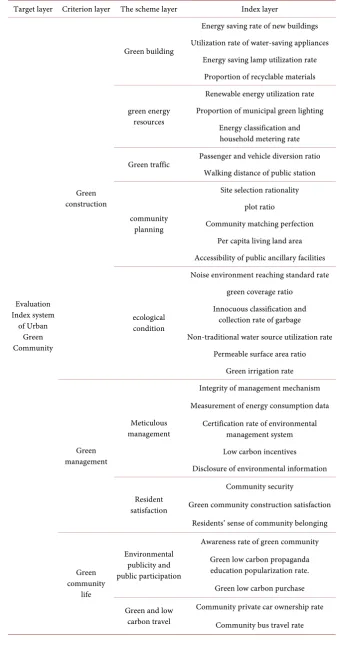
DOI: 10.4236/jbcpr.2019.74008 120 Journal of Building Construction and Planning Research system. In this paper, based on the specific application of DPSIR theory (that is, driving force-pressure-state-influence-corresponding) at the community level, combined with the construction content of green community, the evaluation in-dex system of green community is constructed from four levels (objectives, cri-teria, schemes, indicators), including 9 secondary indicators and 33 third-level indicators, as shown in Table 1.
The goal layer is that the whole green community pursues the goal, that is, the community reaches the green ecological standard in two aspects: software ability and hardware ability.
Criterion layer (primary index): the criterion layer can comprehensively and comprehensively describe the overall situation and future development trend of the evaluated green community. According to the content of green community construction, the main criterion layer is mainly divided into three levels: green construction, green management and green community life.
1) Green construction. The basic hardware construction of the community is the key part of green environmental protection, energy saving and emission re-duction, including construction, energy, transportation, planning, environment and so on, which provides the most basic living facilities and environment for residents.
2) Green management. The important software part of green community con-struction is community operation and management. Including operation man-agement, certification evaluation, reward and punishment mechanism, overall planning and other important aspects, to help the basic green living facilities play the greatest role.
3) Green community life. Including the community residents’ green concept popularization rate and education and travel mode. The universal education of green concept is the fundamental starting point in the construction of green community, and it is also the most neglected aspect. The travel mode of resi-dents is one of the most superficial criteria of green life.
The program level (secondary index): Is a further breakdown of the first-level indicator (guideline level) and the design of the various dimensions of the green community life. The green construction is divided into five aspects: green build-ing, green energy, green transportation, community planning and ecological en-vironment; the green management is divided into two aspects: management de-tail and residents’ satisfaction; green community life is divided into two sub-items of public participation and green travel.
1) Green building. Building is the most important carrier of community life, large scale, large volume, belongs to the key part of green construction. The progress of energy saving, water saving, and recyclable building materials can greatly improve the green living standard.
DOI: 10.4236/jbcpr.2019.74008 121 Journal of Building Construction and Planning Research
Table 1. Evaluation index system of urban green community.
Target layer Criterion layer The scheme layer Index layer
Evaluation Index system
of Urban Green Community
Green construction
Green building
Energy saving rate of new buildings Utilization rate of water-saving appliances
Energy saving lamp utilization rate Proportion of recyclable materials
green energy resources
Renewable energy utilization rate Proportion of municipal green lighting
Energy classification and household metering rate
Green traffic Passenger and vehicle diversion ratio Walking distance of public station
community planning
Site selection rationality plot ratio
Community matching perfection Per capita living land area Accessibility of public ancillary facilities
ecological condition
Noise environment reaching standard rate green coverage ratio
Innocuous classification and collection rate of garbage Non-traditional water source utilization rate
Permeable surface area ratio Green irrigation rate
Green management
Meticulous management
Integrity of management mechanism
Measurement of energy consumption data Certification rate of environmental
management system Low carbon incentives Disclosure of environmental information
Resident satisfaction
Community security
Green community construction satisfaction
Residents’ sense of community belonging
Green community
life
Environmental publicity and public participation
Awareness rate of green community
Green low carbon propaganda education popularization rate.
Green low carbon purchase
Green and low carbon travel
Community private car ownership rate
DOI: 10.4236/jbcpr.2019.74008 122 Journal of Building Construction and Planning Research management mainly lies in the statistical management and scheduling of classi-fied household and so on.
3) Green traffic. Green traffic is mainly public transport construction, rea-sonably improve the density of bus stations, reduce the difficulty of residents to travel, through convenient public transport travel to effectively promote the re-duction of private car use.
4) Community planning. Community planning is the key part of green con-struction. The rationality of planning directly affects the difficulty of later opera-tion and management of green community and the quality of green life. It mainly includes the rationality of site selection, the volume rate, the perfection of community matching, the per capita living land area, the accessibility rate of public supporting facilities and so on.
5) Ecological environment. Ecological environment index is the most sensory index for community residents. Ecological environment determines residents’ living experience and recognition of green community, including green space construction, green irrigation intensity range, garbage disposal, noise manage-ment and other aspects closely related to life.
6) Meticulous management. The management and operation mechanism of green community management is the soul of green community. Its management must start from the green concept, the green idea runs through all the time. It mainly includes the soundness of management mechanism, the measurement of energy consumption data, the certification rate of environmental management system, the low carbon incentive type, the openness of environmental informa-tion and so on. Covers management, operainforma-tion, evaluainforma-tion, reward and other indicators.
7) Sufficient population. The index of residents’ satisfaction emphasizes resi-dents’ feedback on the construction of green community. Green community life of the main poet, human feedback is the most important evaluation of the indi-cators. Mainly includes the residents to the community safety degree, the green-ing construction and so on aspect satisfaction.
8) Public participation. Public participation includes universal education of green concept within community residents and implementation of green com-munity construction by residents. As the main body of the comcom-munity, the par-ticipation of residents is one of the guarantees for the sustainable development of green community.
9) Green trip. The travel mode is a special evaluation index, which has an im-portant influence on the carbon displacement, tail gas emission, noise, traffic pressure and so on, so a secondary index is established separately. And mainly comprises the ownership rate of the private car and the travel rate of the bus.
DOI: 10.4236/jbcpr.2019.74008 123 Journal of Building Construction and Planning Research
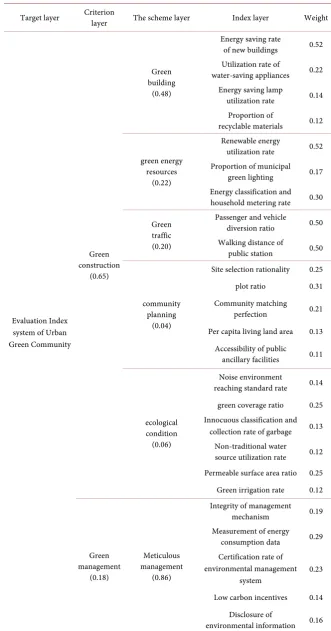
Table 2. Green community index, weight.
Target layer Criterion
layer The scheme layer Index layer Weight
Evaluation Index system of Urban Green Community Green construction (0.65) Green building (0.48)
Energy saving rate
of new buildings 0.52 Utilization rate of
water-saving appliances 0.22 Energy saving lamp
utilization rate 0.14 Proportion of
recyclable materials 0.12
green energy resources
(0.22)
Renewable energy
utilization rate 0.52 Proportion of municipal
green lighting 0.17 Energy classification and household metering rate 0.30
Green traffic (0.20)
Passenger and vehicle
diversion ratio 0.50 Walking distance of
public station 0.50
community planning
(0.04)
Site selection rationality 0.25 plot ratio 0.31 Community matching
perfection 0.21 Per capita living land area 0.13
Accessibility of public
ancillary facilities 0.11
ecological condition (0.06)
Noise environment
reaching standard rate 0.14 green coverage ratio 0.25 Innocuous classification and
collection rate of garbage 0.13 Non-traditional water
source utilization rate 0.12 Permeable surface area ratio 0.25 Green irrigation rate 0.12
Green management (0.18) Meticulous management (0.86)
Integrity of management mechanism 0.19 Measurement of energy
consumption data 0.29 Certification rate of
environmental management system
0.23
Low carbon incentives 0.14 Disclosure of
DOI: 10.4236/jbcpr.2019.74008 124 Journal of Building Construction and Planning Research
Continued
Resident satisfaction
(0.14)
Community security 0.39 Green community
construction satisfaction 0.39 Residents’ sense of
community belonging 0.27
Green community
life (0.18)
Environmental publicity and public participation
(0.76)
Awareness rate of
green community 0.45 Green low carbon
propaganda education popularization rate.
0.35
Green low carbon purchase 0.21 Green and low
carbon travel (0.24)
Community private
[image:10.595.209.539.86.271.2]car ownership rate 0.50 Community bus travel rate 0.50
Table 3. Green Community Evaluation Registration Classification form.
Grade Green community
One-level Two-level Three-level Four-level Non-green community Status Perfect Better Good Pass line Fail Fraction 100 - 90 90 - 80 80 - 70 70 - 60 Under 60
4.2. Evaluation Method and Determination of Index Weight
Green community is a complex system composed of many components, green construction is its foundation, green operation management mode is its guaran-tee, green low-carbon lifestyle makes its core, including many sub-modules, such as physical material, management technology application and ecological culture shaping, which not only have independence, but also related to each other, which makes the evaluation of green community have the characteristics of in unity, hierarchical difference and fuzziness. Analytic hierarchy process (AHP) can help us to separate different levels of systems, analyze the problems of each level separately and compare with each other, reduce the uncertainty and fuzzi-ness of the analysis results, and accurately quantify the statistical analysis of the memory of the indicators. The specific weight calculation results are shown in
Table 2.
4.3. Evaluation and Classification Determination
[image:10.595.209.540.307.368.2]DOI: 10.4236/jbcpr.2019.74008 125 Journal of Building Construction and Planning Research
5. Conclusion
With the vigorous development of green community, in-depth theoretical re-search is particularly important. According to the concept of green community, this paper puts forward an index system in line with the sustainable develop-ment of green community under the background of community construction. According to the established evaluation index system of green community, the optimal allocation of factor resources of green community can be realized, and the positive factors can be mobilized comprehensively and systematically, to provide scientific basis for the development of green community.
Conflicts of Interest
The author declares no conflicts of interest regarding the publication of this paper.
References
[1] Gao, X.F., Kong, Y., et al. (2009) From Learning Community to Learning Commu-nity: An Analysis of “Learning Community” in the Field of Educational
Technolo-gy. Journal of Taizhou College, 12, 57-60.
[2] Luo, J.D. and Shuai, M. (2013) The True Meaning of Social Management Innova-tion and the Practice of Community ConstrucInnova-tion: An Interview with Professor Luo Jiade, Ph.D. Supervisor of Tsinghua University. Social Scientist, 24, 1-4.
[3] Gu, X.D. and Xia, B. (2014) Construction of Green Community Evaluation Index System. Science and Technology Management Research, 34, 35.
[4] Junnan. (2015) Green Community Makes Green Life. Environmental Economy, 12, 33-36.
[5] Shi, Q. and Xu, L.Y. (2007) Analysis of Green Building Evaluation System. Journal