organic papers
o1250
Ma and Li C6H12NO2+Cl doi:10.1107/S1600536806007252 Acta Cryst.(2006). E62, o1250–o1251 Acta Crystallographica Section E
Structure Reports
Online
ISSN 1600-5368
Isonipecotate chloride
Zhi-Cheng Ma and Xin-Hua Li*
School of Chemistry and Materials Science, Wenzhou Normal College, Zhejiang, Wenzhou 325027, People’s Republic of China
Correspondence e-mail: [email protected]
Key indicators
Single-crystal X-ray study
T= 298 K
Mean(C–C) = 0.005 A˚
Rfactor = 0.046
wRfactor = 0.123
Data-to-parameter ratio = 15.5
For details of how these key indicators were automatically derived from the article, see http://journals.iucr.org/e.
Received 3 January 2006 Accepted 28 February 2006
#2006 International Union of Crystallography
All rights reserved
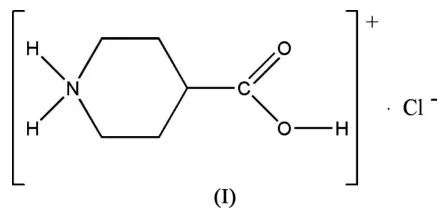
The structure of the title compound, C6H12NO2 +
Cl, consists of an isonipecotate cation and a Cl anion linked by intermolecular O—H Cl and N—H Cl interactions into a three-dimensional network structure.
Comment
In the synthesis of crystal structures by design, the assembly of molecular units in predefined arrangements is a key goal (Desiraju, 1995, 1997; Braga et al., 1998). Directional inter-molecular interactions are the primary tools in achieving this goal (Zaworotko, 1997; Braga & Grepioni, 2000).
The title compound, (I), consists of a isonipecotate cation and a Clanion (Fig. 1). The bond lengths and angles (Table 1) are within normal ranges (Allenet al., 1987). The ring (N1/ C1–C5) is not planar, having a total puckering amplitudeQT= 0.571 (2) A˚ (Cremer & Pople, 1975) and a distorted chair form [’ = 157.9 (3) and = 177.9 (3)]. It has a pseudo-mirror
plane passing through atoms N1 and C3, as can be deduced from the torsion angles (Table 1).
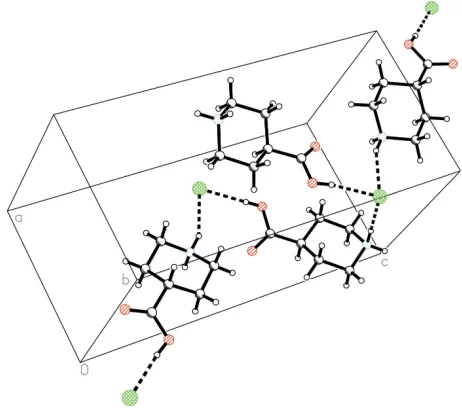
[image:1.610.220.443.317.424.2] [image:1.610.209.458.601.713.2]In the crystal structure of (I), there are multiple inter-molecular interactions, such as O—H Cl and N—H Cl (Table 2, Fig. 2), generating a three-dimensional network structure (Fig. 2).
Figure 1
Experimental
The title compound was synthesized by the hydrothermal method from a mixture of isonipecotic acid (0.04 g, 0.3 mmol), 2,20-bipyridine
(0.05 g, 0.3 mmol), copper(II) chloride dihydrate (0.05 g, 0.3 mmol) and water (8.0 ml) in a Teflon-lined stainless steel reactor (15.0 ml). The solution was heated at 423 K for 4 d. After reaction, the vessel was slowly cooled to room temperature to give colourless crystals of (I) (yield 0.012 g, 30%; m.p. 521–522 K).
Crystal data
C6H12NO2+Cl
Mr= 165.62
Orthorhombic,P212121
a= 7.0405 (7) A˚
b= 7.4902 (7) A˚
c= 15.2806 (15) A˚
V= 805.82 (14) A˚3
Z= 4
Dx= 1.365 Mg m
3
MoKradiation Cell parameters from 352
reflections
= 2.7–25.1 = 0.42 mm1
T= 298 (2) K Block, colourless 0.360.310.18 mm
Data collection
Bruker SMART CCD area-detector diffractometer
!scans
Absorption correction: numerical (SADABS; Sheldrick, 1996)
Tmin= 0.86,Tmax= 0.93
3980 measured reflections
1426 independent reflections 1394 reflections withI> 2(I)
Rint= 0.016 max= 25.1
h=6!8
k=8!8
l=18!18
Refinement
Refinement onF2
R[F2> 2(F2)] = 0.046
wR(F2) = 0.123
S= 1.20 1426 reflections 92 parameters
H-atom parameters constrained
w= 1/[2(F
o2) + (0.0636P)2
+ 0.4526P]
whereP= (Fo2+ 2Fc2)/3
(/)max< 0.001
max= 0.76 e A˚3 min=0.22 e A˚3
Absolute structure: Flack (1983), with 568 Friedel pairs Flack parameter: 0.40 (13)
Table 1
Selected geometric parameters (A˚ ,).
O1—C6 1.293 (4)
N1—C5 1.486 (5)
C2—C1 1.511 (5)
C3—C6 1.511 (4)
O2—C6 1.202 (4)
C5—N1—C1 111.8 (3)
C1—C2—C3 110.9 (3)
N1—C1—C2 110.6 (3)
C6—C3—C4 110.5 (3)
C6—C3—C2 113.8 (3)
C4—C3—C2 110.9 (3)
O2—C6—O1 120.8 (3)
O2—C6—C3 122.7 (3)
O1—C6—C3 116.0 (3)
C5—N1—C1—C2 58.6 (4)
C3—C2—C1—N1 55.4 (4)
C1—C2—C3—C4 53.9 (4)
C1—N1—C5—C4 58.7 (4) C2—C3—C4—C5 54.8 (4)
N1—C5—C4—C3 56.8 (4)
Table 2
Hydrogen-bond geometry (A˚ ,).
D—H A D—H H A D A D—H A
N1—H1B Cl1i
0.90 2.26 3.157 (3) 178
N1—H1A Cl1ii
0.90 2.34 3.184 (3) 156
O1—H1 Cl1 0.82 2.20 3.016 (3) 172
Symmetry codes: (i)xþ1;yþ1;zþ3; (ii)xþ3;yþ1;z1.
H atoms were positioned geometrically, with O—H = 0.82 A˚ , N— H = 0.90 A˚ , and C—H = 0.97 and 0.98 A˚ for methylene and methine H, respectively, and constrained to ride on their parent atoms, with
Uiso(H) =xUeq(C,N,O), wherex= 1.5 for hydroxyl H andx= 1.2 for all other H. The value of the Flack parameter suggests inversion twinning.
Data collection:SMART(Bruker, 2002); cell refinement:SAINT
(Bruker, 2002); data reduction:SAINT; program(s) used to solve structure:SHELXS97(Sheldrick, 1997); program(s) used to refine structure: SHELXL97 (Sheldrick, 1997); molecular graphics:
ORTEPIII (Johnson & Burnett, 1996); software used to prepare material for publication:SHELXTL(Bruker, 2002).
The authors acknowledge financial support by the Zhejiang Provincial Natural Science Foundation of China (grant No. Y404294), and the ‘151’ Distinguished Person Foundation of Zhejiang Province.
References
Allen, F. H., Kennard, O., Watson, D. G., Brammer, L., Orpen, A. G. & Taylor, R. (1987).J. Chem. Soc. Perkin Trans. 2, pp. S1–19.
Braga, D. & Grepioni, F. (2000).Acc. Chem. Res.33, 601–608.
Braga, D., Grepioni, F. & Desiraju, G. R. (1998).Chem. Rev.98, 1375–1405. Bruker (2002).SMART,SAINTandSHELXTL. Bruker AXS Inc., Madison,
Wisconsin, USA.
Cremer, D. & Pople, J. A. (1975).J. Am. Chem. Soc.97, 1354–1358. Desiraju, G. R. (1995).Angew. Chem. Int. Ed. Engl.34, 2311–2327. Desiraju, G. R. (1997).J. Chem. Soc. Chem. Commun.pp. 1475–1482. Flack, H. D. (1983).Acta Cryst.A39, 876–881.
Johnson, C. K. & Burnett, M. N. (1996).ORTEPIII. Report ORNL-6895. Oak Ridge National Laboratory, Tennessee, USA.
Sheldrick, G. M. (1996).SADABS. University of Go¨ttingen, Germany. Sheldrick, G. M. (1997). SHELXS97 and SHELXL97. University of
Go¨ttingen, Germany.
[image:2.610.324.555.74.278.2]Zaworotko, M. J. (1997).Nature (London),386, 220–221.
Figure 2
supporting information
sup-1 Acta Cryst. (2006). E62, o1250–o1251
supporting information
Acta Cryst. (2006). E62, o1250–o1251 [https://doi.org/10.1107/S1600536806007252]
Isonipecotate chloride
Zhi-Cheng Ma and Xin-Hua Li
Isonipecotate chloride
Crystal data
C6H12NO2+·Cl−
Mr = 165.62
Orthorhombic, P212121 Hall symbol: P 2ac 2ab
a = 7.0405 (7) Å
b = 7.4902 (7) Å
c = 15.2806 (15) Å
V = 805.82 (14) Å3
Z = 4
F(000) = 352
Dx = 1.365 Mg m−3
Mo Kα radiation, λ = 0.71073 Å Cell parameters from 352 reflections
θ = 2.7–25.1°
µ = 0.42 mm−1
T = 298 K Block, colourless 0.36 × 0.31 × 0.18 mm
Data collection
Bruker SMART CCD area-detector diffractometer
Radiation source: fine-focus sealed tube Graphite monochromator
ω scans
Absorption correction: numerical (SADABS; Sheldrick, 1996)
Tmin = 0.86, Tmax = 0.93
3980 measured reflections 1426 independent reflections 1394 reflections with I > 2σ(I)
Rint = 0.016
θmax = 25.1°, θmin = 2.7°
h = −6→8
k = −8→8
l = −18→18
Refinement
Refinement on F2 Least-squares matrix: full
R[F2 > 2σ(F2)] = 0.046
wR(F2) = 0.123
S = 1.20 1426 reflections 92 parameters 0 restraints
Primary atom site location: structure-invariant direct methods
Secondary atom site location: difference Fourier map
Hydrogen site location: inferred from neighbouring sites
H-atom parameters constrained
w = 1/[σ2(F
o2) + (0.0636P)2 + 0.4526P] where P = (Fo2 + 2Fc2)/3
(Δ/σ)max < 0.001 Δρmax = 0.76 e Å−3 Δρmin = −0.22 e Å−3
Absolute structure: Flack (1983), with 568 Friedel pairs
Absolute structure parameter: 0.40 (13)
Special details
Refinement. Refinement of F2 against ALL reflections. The weighted R-factor wR and goodness of fit S are based on F2, conventional R-factors R are based on F, with F set to zero for negative F2. The threshold expression of F2 > σ(F2) is used only for calculating R-factors(gt) etc. and is not relevant to the choice of reflections for refinement. R-factors based on F2 are statistically about twice as large as those based on F, and R- factors based on ALL data will be even larger.
Fractional atomic coordinates and isotropic or equivalent isotropic displacement parameters (Å2)
x y z Uiso*/Ueq
Cl1 0.19967 (11) 0.45733 (11) 0.92845 (5) 0.0365 (2) O1 0.4268 (4) 0.4291 (6) 0.76164 (17) 0.0674 (10) H1 0.3722 0.4460 0.8083 0.101* N1 0.9303 (4) 0.5567 (4) 0.54806 (18) 0.0394 (7) H1A 1.0082 0.5493 0.5015 0.047* H1B 0.8922 0.6710 0.5530 0.047* C2 0.6281 (5) 0.4490 (6) 0.6107 (2) 0.0403 (8) H2A 0.5235 0.3668 0.6017 0.048* H2B 0.5760 0.5685 0.6155 0.048* C1 0.7613 (5) 0.4404 (5) 0.5333 (2) 0.0434 (8) H1C 0.8024 0.3181 0.5245 0.052* H1D 0.6950 0.4790 0.4810 0.052* C3 0.7313 (4) 0.4012 (4) 0.69518 (19) 0.0333 (7) H3 0.7748 0.2775 0.6894 0.040* C5 1.0363 (5) 0.5047 (6) 0.6282 (2) 0.0479 (10) H5A 1.1442 0.5835 0.6362 0.057* H5B 1.0836 0.3837 0.6220 0.057* C4 0.9062 (5) 0.5162 (6) 0.7071 (2) 0.0442 (9) H4A 0.9745 0.4776 0.7589 0.053* H4B 0.8679 0.6393 0.7159 0.053* O2 0.6659 (4) 0.3805 (7) 0.84800 (16) 0.0873 (13) C6 0.6068 (5) 0.4097 (5) 0.7756 (2) 0.0405 (9)
Atomic displacement parameters (Å2)
U11 U22 U33 U12 U13 U23
supporting information
sup-3 Acta Cryst. (2006). E62, o1250–o1251
Geometric parameters (Å, º)
O1—C6 1.293 (4) C1—H1D 0.9700 O1—H1 0.8200 C3—C6 1.511 (4) N1—C5 1.486 (5) C3—C4 1.514 (5) N1—C1 1.492 (5) C3—H3 0.9800 N1—H1A 0.9000 C5—C4 1.517 (5) N1—H1B 0.9000 C5—H5A 0.9700 C2—C1 1.511 (5) C5—H5B 0.9700 C2—C3 1.524 (4) C4—H4A 0.9700 C2—H2A 0.9700 C4—H4B 0.9700 C2—H2B 0.9700 O2—C6 1.202 (4) C1—H1C 0.9700
C6—O1—H1 109.5 C6—C3—C2 113.8 (3) C5—N1—C1 111.8 (3) C4—C3—C2 110.9 (3) C5—N1—H1A 109.3 C6—C3—H3 107.1 C1—N1—H1A 109.3 C4—C3—H3 107.1 C5—N1—H1B 109.3 C2—C3—H3 107.1 C1—N1—H1B 109.3 N1—C5—C4 109.7 (3) H1A—N1—H1B 107.9 N1—C5—H5A 109.7 C1—C2—C3 110.9 (3) C4—C5—H5A 109.7 C1—C2—H2A 109.5 N1—C5—H5B 109.7 C3—C2—H2A 109.5 C4—C5—H5B 109.7 C1—C2—H2B 109.5 H5A—C5—H5B 108.2 C3—C2—H2B 109.5 C3—C4—C5 111.3 (3) H2A—C2—H2B 108.0 C3—C4—H4A 109.4 N1—C1—C2 110.6 (3) C5—C4—H4A 109.4 N1—C1—H1C 109.5 C3—C4—H4B 109.4 C2—C1—H1C 109.5 C5—C4—H4B 109.4 N1—C1—H1D 109.5 H4A—C4—H4B 108.0 C2—C1—H1D 109.5 O2—C6—O1 120.8 (3) H1C—C1—H1D 108.1 O2—C6—C3 122.7 (3) C6—C3—C4 110.5 (3) O1—C6—C3 116.0 (3)
C5—N1—C1—C2 58.6 (4) C2—C3—C4—C5 −54.8 (4) C3—C2—C1—N1 −55.4 (4) N1—C5—C4—C3 56.8 (4) C1—C2—C3—C6 179.2 (3) C4—C3—C6—O2 −52.7 (5) C1—C2—C3—C4 53.9 (4) C2—C3—C6—O2 −178.1 (4) C1—N1—C5—C4 −58.7 (4) C4—C3—C6—O1 135.4 (4) C6—C3—C4—C5 178.1 (3) C2—C3—C6—O1 9.9 (5)
Hydrogen-bond geometry (Å, º)
D—H···A D—H H···A D···A D—H···A
N1—H1A···Cl1ii 0.90 2.34 3.184 (3) 156 O1—H1···Cl1 0.82 2.20 3.016 (3) 172