What Can Syntax-based MT Learn from Phrase-based MT?
Steve DeNeefe and Kevin Knight Information Sciences Institute The Viterbi School of Engineering
University of Southern California 4676 Admiralty Way, Suite 1001
Marina del Rey, CA 90292
{sdeneefe,knight}@isi.edu
Wei Wang and Daniel Marcu Language Weaver, Inc. 4640 Admiralty Way, Suite 1210
Marina del Rey, CA 90292
{wwang,dmarcu}@languageweaver.com
Abstract
We compare and contrast the strengths and weaknesses of a syntax-based machine translation model with a phrase-based ma-chine translation model on several levels. We briefly describe each model, highlight-ing points where they differ. We include a quantitative comparison of the phrase pairs that each model has to work with, as well as the reasons why some phrase pairs are not learned by the syntax-based model. We then evaluate proposed improvements to the syntax-based extraction techniques in light of phrase pairs captured. We also compare the translation accuracy for all variations.
1 Introduction
String models are popular in statistical machine translation. Approaches include word substitution systems (Brown et al., 1993), phrase substitution systems (Koehn et al., 2003; Och and Ney, 2004), and synchronous context-free grammar systems (Wu and Wong, 1998; Chiang, 2005), all of which train on string pairs and seek to establish connections be-tween source and target strings. By contrast, ex-plicit syntax approaches seek to directly model the relations learned from parsed data, including models between source trees and target trees (Gildea, 2003; Eisner, 2003; Melamed, 2004; Cowan et al., 2006), source trees and target strings (Quirk et al., 2005; Huang et al., 2006), or source strings and target trees (Yamada and Knight, 2001; Galley et al., 2004).
It is unclear which of these important pursuits will best explain human translation data, as each has
ad-vantages and disadad-vantages. A strength of phrase models is that they can acquire all phrase pairs con-sistent with computed word alignments, snap those phrases together easily by concatenation, and re-order them under several cost models. An advan-tage of syntax-based models is that outputs tend to be syntactically well-formed, with re-ordering influ-enced by syntactic context and function words intro-duced to serve specific syntactic purposes.
A great number of MT models have been re-cently proposed, and other papers have gone over the expressive advantages of syntax-based approaches. But it is rare to see an in-depth, quantitative study of strengths and weaknesses of particular models with respect to each other. This is important for a scientific understanding of how these models work in practice. Our main novel contribution is a com-parison of phrase-based and syntax-based extraction methods and phrase pair coverage. We also add to the literature a new method of improving that cover-age. Additionally, we do a careful study of several syntax-based extraction techniques, testing whether (and how much) they affect phrase pair coverage, and whether (and how much) they affect end-to-end MT accuracy. The MT accuracy tests are needed because we want to see the individual effects of par-ticular techniques under the same testing conditions. For this comparison, we choose a previously estab-lished statistical phrase-based model (Och and Ney, 2004) and a previously established statistical string-to-tree model (Galley et al., 2004). These two mod-els are chosen because they are the basis of two of the most successful systems in the NIST 2006 MT
evaluation1.
2 Phrase-based Extraction
The Alignment Template system (ATS) described by Och and Ney (2004) is representative of statistical phrase-based models. The basic unit of translation is the phrase pair, which consists of a sequence of words in the source language, a sequence of words in the target language, and a vector of feature val-ues which describe this pair’s likelihood. Decod-ing produces a strDecod-ing in the target language, in or-der, from beginning to end. During decoding, fea-tures from each phrase pair are combined with other features (e.g., re-ordering, language models) using a log-linear model to compute the score of the entire translation.
The ATS phrase extraction algorithm learns these phrase pairs from an aligned, parallel corpus. This corpus is conceptually a list of tuples of
<source sentence, target sentence, bi-directional word alignments> which serve as training exam-ples, one of which is shown in Figure 1.
Figure 1: a phrase-based training example
For each training example, the algorithm identi-fies and extracts all pairs of<source sequence, tar-get sequence> that are consistent with the align-ments. It does this by first enumerating all source-side word sequences up to a length limitL, and for each source sequence, it identifies all target words aligned to those source words. For example, in Fig-ure 1, for the source phrase , the target
words it aligns to are felt, obliged, and do. These words, and all those between them, are the proposed target phrase. If no words in the proposed target phrase align to words outside of the source phrase, then this phrase pair is extracted.
The extraction algorithm can also look to the left and right of the proposed target phrase for neighbor-ing unaligned words and extracts phrases. For ex-ample, for the phrase pair ↔felt obliged,
1
http://www.nist.gov/speech/tests/mt/ mt06eval official results.html
the word to is a neighboring unaligned word. It constructs new target phrases by adding on con-secutive unaligned words in both directions, and extracts those in new pairs, too (e.g., ↔
[image:2.612.337.514.249.398.2]felt obliged to). For efficiency reasons, imple-mentations often skip this step.
Figure 2 shows the complete set of phrase pairs up to length 4 that are extracted from the Figure 1 training example. Notice that no extracted phrase pair contains the character···. Because of the
align-ments, the smallest legal phrase pair, ···
↔i felt obliged to do my, is beyond the size
limit of 4, so it is not extracted in this example.
↔ felt
↔ felt obliged
↔ felt obliged to do ↔ obliged
↔ obliged to do
↔ do
PPP ↔ part
PPPÅÅÅ ↔ part
PPPÅÅÅ. ↔ part . Å
Å
Å. ↔ .
[image:2.612.113.256.376.413.2]. ↔ .
Figure 2: phrases up to length 4 extracted from the example in Figure 1
Phrase pairs are extracted over the entire train-ing corpus. Due to differing alignments, some phrase pairs that cannot be learned from one exam-ple may be learned from another. These pairs are then counted, once for each time they are seen in a training example, and these counts are used as the basis for maximum likelihood probability features, such asp(f|e)andp(e|f).
3 Syntax-based Extraction
and variables in the source language, a syntax tree in the target language having words or variables at the leaves, and again a vector of feature values which describe this pair’s likelihood. Translation rules can:
• look like phrase pairs with syntax decoration:
NPB(NNP(prime) NNP(minister) NNP(keizo) NNP(obuchi))
↔BBBÁÁÁÈÈÈ®®®DDD###
• carry extra contextual constraints:
VP(VBD(said)
x0:SBAR-C) ↔
x0
(according to this rule, can translate to said only if some Chinese sequence to the right ofis translated into anSBAR-C)
• be non-constituent phrases:
VP(VBD(said) SBAR-C(IN(that)
x0:S-C))
↔x0
VP(VBD(pointed) PRT(RP(out))
x0:SBAR-C)
↔ñññx0
• contain non-contiguous phrases, effectively “phrases with holes”:
PP(IN(on)
NP-C(NPB(DT(the)
x0:NNP))
NN(issue))))
↔óóóx0¯¯¯ÞÞÞ
PP(IN(on)
NP-C(NPB(DT(the) NN(issue))
x0:PP))
↔óóóx0¯¯¯ÞÞÞ
• be purely structural (no words):
S(x0:NP-C x1:VP)↔x0x1 • re-order their children:
NP-C(NPB(DT(the)
x0:NN)
PP(IN(of)
x1:NP-C))
↔x1{{{x0
Decoding with this model produces a tree in the target language, bottom-up, by parsing the foreign string using a CYK parser and a binarized rule set
(Zhang et al., 2006). During decoding, features from each translation rule are combined with a language model using a log-linear model to compute the score of the entire translation.
[image:3.612.351.499.205.388.2]The GHKM extractor learns translation rules from an aligned parallel corpus where the target side has been parsed. This corpus is conceptually a list of tu-ples of<source sentence, target tree, bi-directional word alignments> which serve as training exam-ples, one of which is shown in Figure 3.
Figure 3: a syntax-based training example
For each training example, the GHKM extrac-tor computes the set of minimally-sized translation rules that can explain the training example while re-maining consistent with the alignments. This is, in effect, a non-overlapping tiling of translation rules over the tree-string pair. If there are no unaligned words in the source sentence, this is a unique set. This set, ordered into a tree of rule applications, is called the derivation tree of the training example. Unlike the ATS model, there are no inherent size limits, just the constraint that the rules be as small as possible for the example.
Ignoring the unaligned ÅÅÅ for the moment, there
be-comes a part of this rule naturally. If the alignments were not as constraining (e.g., ifmywas unaligned), then instead of this one big rule many smaller rules would be extracted, such as structural rules (e.g., VP(x0:VBD x1:VP-C)↔x0x1) and function word in-sertion rules (e.g.,VP(TO(to) x0:VP-C)↔x0).
1. VBD(felt)↔
2. VBN(obliged)↔
3. VB(do)↔
4. NN(part)↔PPP
5. PERIOD(.)↔.
6. S(NP-C(NPB(PRP(I))) VP(x0:VBD
VP-C(x1:VBN
SG-C(VP(TO(to)
VP-C(x2:VB
NP-C(NPB(PRP$(my)
x3:NN)))))))
x4:PERIOD)↔···x0x1x2x3x4
7. TOP(x0:S)↔x0
Figure 4: rules extracted from training example
We ignored unaligned source words in the exam-ple above. Galley et al. (2004) attach the unaligned source word to the highest possible location, in our example, theS. Thus it is extracted along with our large rule 6, changing the target language sequence to “···x0 x1 x2 x3 ÅÅÅx4”. This treatment still
re-sults in a unique derivation tree no matter how many unaligned words are present.
In Galley et al. (2006), instead of a unique deriva-tion tree, the extractor computes several derivaderiva-tion trees, each with the unaligned word added to a dif-ferent rule such that the data is still explained. For example, for the tree-string pair in Figure 3, ÅÅÅ
could be added not only to rule 6, but alternatively to rule 4 or 5, to make the new rules:
NN(part)↔PPPÅÅÅ
PERIOD(.)↔ÅÅÅ.
This results in three different derivations, one with theÅÅÅ character in rule 4 (with rules 5 and 6
as originally shown), another with theÅÅÅcharacter
in rule 5 (with rules 4 and 6 as originally shown), and lastly one with theÅÅÅcharacter in rule 6 (with
rules 4 and 5 as originally shown) as in the origi-nal paper (Galley et al., 2004). In total, ten different rules are extracted from this training example.
As with ATS, translation rules are extracted and counted over the entire training corpus, a count of
one for each time they appear in a training example. These counts are used to estimate several features, including maximum likelihood probability features for p(etree, fwords|ehead), p(ewords|fwords), and
p(fwords|ewords).
4 Differences in Phrasal Coverage
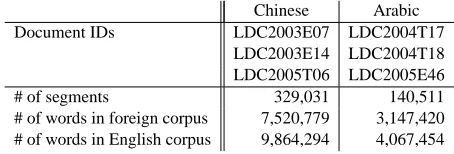
Both the ATS model and the GHKM model extract linguistic knowledge from parallel corpora, but each has fundamentally different constraints and assump-tions. To compare the models empirically, we ex-tracted phrase pairs (for the ATS model) and transla-tion rules (for the GHKM model) from parallel train-ing corpora described in Table 1. The ATS model was limited to phrases of length 10 on the source side, and length 20 on the target side. A super-set of the parallel data was word aligned by GIZA union (Och and Ney, 2003) and EMD (Fraser and Marcu, 2006). The English side of training data was parsed using an implementation of Collins’ model 2 (Collins, 2003).
Chinese Arabic Document IDs LDC2003E07 LDC2004T17
[image:4.612.313.540.359.436.2]LDC2003E14 LDC2004T18 LDC2005T06 LDC2005E46 # of segments 329,031 140,511 # of words in foreign corpus 7,520,779 3,147,420 # of words in English corpus 9,864,294 4,067,454
Table 1: parallel corpora used to train both models
Table 2 shows the total number of GHKM rules extracted, and a breakdown of the different kinds of rules. Non-lexical rules are those whose source side is composed entirely of variables — there are no source words in them. Because of this, they potentially apply to any sentence. Lexical rules (their counterpart) far outnumber non-lexical rules. Of the lexical rules, a rule is considered a phrasal
rule if its source side and the yield of its target
side contain exactly one contiguous phrase each, op-tionally with one or more variables on either side of the phrase. Non-phrasal rules include structural rules, re-ordering rules, and non-contiguous phrases. These rules are not easy to directly compare to any phrase pairs from the ATS model, so we do not focus on them here.
Statistic Chinese Arabic total translation rules 2,487,110 662,037 non-lexical rules 110,066 15,812 lexical rules 2,377,044 646,225 phrasal rules 1,069,233 406,020 distinct GHKM-derived phrase pairs 919,234 352,783 distinct corpus-specific
[image:5.612.78.298.59.150.2]GHKM-derived phrase pairs 203,809 75,807
Table 2: a breakdown of how many rules the GHKM extraction algorithm produces, and how many phrase pairs can be derived from them
syntactic context and look at the phrases contained in the rules. The second to last line of Table 2 shows the number of phrase pairs that can be derived from the above phrasal rules. The number of GHKM-derived phrase pairs is lower than the number of phrasal rules because some rules represent the same phrasal translation, but with different syntactic con-texts. The last line of Table 2 shows the subset of phrase pairs that contain source phrases found in our development corpus.
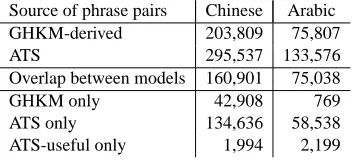
Table 3 compares these corpus-specific GHKM-derived phrase pairs with the corpus-specific ATS phrase pairs. Note that the number of phrase pairs derived from the GHKM rules is less than the num-ber of phrase pairs extracted by ATS. Moreover, only slightly over half of the phrase pairs extracted by the ATS model are common to both models. The lim-its and constraints of each model are responsible for this difference in contiguous phrases learned.
Source of phrase pairs Chinese Arabic GHKM-derived 203,809 75,807 ATS 295,537 133,576 Overlap between models 160,901 75,038 GHKM only 42,908 769 ATS only 134,636 58,538 ATS-useful only 1,994 2,199
Table 3: comparison of corpus-specific phrase pairs from each model
GHKM learns some contiguous phrase pairs that the phrase-based extractor does not. Only a small portion of these are due to the fact that the GHKM model has no inherent size limit, while the phrase based system has limits. More numerous are cases where unaligned English words are not added to an ATS phrase pair while GHKM adopts them at a
[image:5.612.329.518.166.295.2]syn-tactically motivated location, or where a larger rule contains mostly syntactic structure but happens to have some unaligned words in it. For example, con-sider Figure 5. Becausebasic andwill are un-aligned, ATS will learn no phrase pairs that translate to these words alone, though they will be learned as a part of larger phrases.
Figure 5: Situation where GHKM is able to learn rules that translate intobasicandwill, but ATS is not
GHKM, however, will learn several phrasal rules that translate tobasic, based on the syntactic con-text
NPB(x0:DT JJ(basic)
x1:NN)
↔x0x1
NPB(x0:DT
JJ(basic)
x1:NN)
↔x0äääýýýx1
NPB(x0:DT JJ(basic)
x1:NN)
↔x0äääýýýx1
and one phrasal rule that translates intowill
VP(MD(will)
x0:RB
x1:VP-C)
↔x0ÄÄÄx1
The quality of such phrases may vary. For example, the first translation of(literally: “one” or “a”) to basicabove is a phrase pair of poor quality, while the other two forbasicand one for willare ar-guably reasonable.
However, Table 3 shows that ATS was able to learn many more phrase pairs that GHKM was not. Even more significant is the subset of these missing phrase pairs that the ATS decoder used in its best2
2
[image:5.612.98.275.491.571.2]translation of the corpus. According to the phrase-based system these are the most “useful” phrase pairs and GHKM could not learn them. Since this is a clear deficiency, we will focus on analyzing these phrase pairs (which we call ATS-useful) and the rea-sons they were not learned.
Table 4 shows a breakdown, categorizing each of these missing ATS-useful phrase pairs and the rea-sons they were not able to be learned. The most common reason is straightforward: by extracting only the minimally-sized rules, GHKM is unable to learn many larger phrases that ATS learns. If GHKM can make a word-level analysis, it will do that, at the expense of a phrase-level analysis. Galley et al. (2006) propose one solution to this problem and Marcu et al. (2006) propose another, both of which we explore in Sections 5.1 and 5.2.
[image:6.612.75.297.303.369.2]Category of missing ATS-useful phrase pairs Chinese Arabic Not minimal 1,320 1,366 Extra target words in GHKM rules 220 27 Extra source words in GHKM rules 446 799 Other (e.g. parse failures) 8 7 Total missing useful phrase pairs 1,994 2,199
Table 4: reasons that ATS-useful phrase pairs could not be extracted by GHKM as phrasal rules
The second reason is that the GHKM model is sometimes forced by its syntactic constraints to in-clude extra words. Sometimes this is only target lan-guage words, and this is often useful — the rules are learning to insert these words in their proper context. But most of the time, source language words are also forced to be part of the rule, and this is harmful — it makes the rules less general. This latter case is often due to poorly aligned target language words (such as the···in our Section 3 rule extraction example), or
unaligned words under large, flat constituents. Another factor here: some of the phrase pairs are learned by both systems, but GHKM is more specific about the context of use. This can be both a strength and a weakness. It is a strength when the syntactic context helps the phrase to be used in a syntactically correct way, as in
VP(VBD(said)
x0:SBAR-C)
↔x0
where the syntax rule requires a constituent of type SBAR-C. Conversely its weakness is seen when the
context is too constrained. For example, ATS can easily learn the phrase
®®®↔prime minister
and is then free to use it in many contexts. But GHKM learns 45 different rules, each that translate this phrase pair in a unique context. Figure 6 shows a sampling. Notice that though many variations are present, the decoder is unable to use any of these rules to produce certain noun phrases, such as “cur-rent Japanese Prime Minister Shinzo Abe”, because no rule has the proper number of English modifiers.
NPB(NNP(prime) NNP(minister) x0:NNP)↔x0®®®
NPB(x0:NNP NNP(prime) NNP(minister) x1:NNP)↔x0®®®x1
NPB(x0:JJ NNP(prime) NNP(minister) x1:NNP)↔x0®®®x1
NPB(NNP(prime) NNP(minister) x0:NNP)↔®®®x0
NPB(NNP(prime) NNP(minister))↔®®®
NPB(NNP(prime) NNP(minister) x0:NNPx1:NNP)↔x0x1®®®
NPB(x0:DT x1:JJ JJ(prime) NN(minister))↔x0x1®®®
NPB(x0:NNP NNP(prime) NNP(minister) x1:NNP)↔x0®®®x1
NPB(x0:NNP NNP(prime) NNP(minister) x1:NNP)↔x0®®®x1
Figure 6: a sampling of the 45 rules that translate
®®®toprime minister
5 Coverage Improvements
Each of the models presented so far has advantages and disadvantages. In this section, we consider ideas that make up for deficiencies in the GHKM model, drawing our inspiration from the strong points of the ATS model. We then measure the effects of each idea empirically, showing both what is gained and the potential limits of each modification.
5.1 Composed Rules
Galley et al. (2006) proposed the idea of composed rules. This removes the minimality constraint re-quired earlier: any two or more rules in a parent-child relationship in the derivation tree can be com-bined to form a larger, composed rule. This change is similar in spirit to the move from word-based to phrase-based MT models, or parsing with a DOP model (Bod et al., 2003) rather than a plain PCFG.
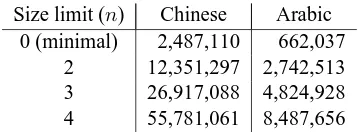
constituent labels in a rule’s target tree. For exam-ple, rules 1-5 shown in Section 3 have a size of 0, and rule 6 has a size of 10. Composed rules are ex-tracted in addition to minimal rules, which means that a larger nlimit always results in a superset of the rules extracted when a smallern value is used. Whennis set to 0, then only minimal rules are ex-tracted. Table 5 shows the growth in the number of rules extracted for several size limits.
Size limit (n) Chinese Arabic 0 (minimal) 2,487,110 662,037
2 12,351,297 2,742,513
3 26,917,088 4,824,928
[image:7.612.97.276.190.256.2]4 55,781,061 8,487,656
Table 5: increasing the size limit of composed rules significantly increases the number of rules extracted
In our previous analysis, the main reason that GHKM did not learn translations for ATS-useful phrase pairs was due to its minimal-only approach. Table 6 shows the effect that composed rule extrac-tion has on the total number of ATS-useful phrases missing. Note that as the allowed size of composed rule increases, we are able to extract an greater per-centage of the missing ATS-useful phrase pairs.
Size limit (n) Chinese Arabic
0 (minimal) 1,994 2,199
2 1,478 1,528
3 1,096 1,210
[image:7.612.320.539.219.273.2]4 900 1,041
Table 6: number of ATS-useful phrases still missing when using GHKM composed rule extraction
Unfortunately, a comparison of Tables 5 and 6 in-dicates that the number of ATS-useful phrase pairs gained is growing at a much slower rate than the total number of rules. From a practical standpoint, more rules means more processing work and longer de-coding times, so there are diminishing returns from continuing to explore larger size limits.
5.2 SPMT Model 1 Rules
An alternative for extracting larger rules called SPMT model 1 is presented by Marcu et al. (2006). Though originally presented as a separate model, the method of rule extraction itself builds upon the
minimal GHKM method just as composed rules do. For each training example, the method considers all source language phrases up to lengthL. For each of these phrases, it extracts the smallest possible syn-tax rule that does not violate the alignments. Ta-ble 7 shows that this method is aTa-ble to extract rules that cover useful phrases, and can be combined with size 4 composed rules to an even better effect. Since there is some overlap in these methods, when com-bining the two methods we eliminate any redundant rules.
Method Chinese Arabic
composed alone (size 4) 900 1,041 SPMT model 1 alone 676 854 composed + SPMT model 1 663 835
Table 7: ATS-useful phrases still missing after dif-ferent non-minimal methods are applied
Note that having more phrasal rules is not the only advantage of composed rules. Here, combining both composed and SPMT model 1 rules, our gain in use-ful phrases is not very large, but we do gain addi-tional, larger syntax rules. As discussed in (Galley et al., 2006), composed rules also allow the learning of more context, such as
ADJP(ADVP(RB(far) CC(and) RB(away)
x0:JJ)
↔ÏÏÏÏÏÏx0
This rule is not learned by SPMT model 1 because it is not the smallest rule that can explain the phrase pair, but it is still valuable for its syntactic context.
5.3 Restructuring Trees
[image:7.612.117.257.423.485.2]Category of ATS-useful phrase pairs Chinese Arabic
Too large 12 9
Extra target words in GHKM rules 218 27
Extra source words in GHKM rules 424 792
Other (e.g. parse failures) 9 7
[image:8.612.74.298.60.134.2]Total missing useful phrase pairs 663 835
Table 8: reasons that ATS-useful phrase pairs are still not extracted as phrasal rules, with composed and SPMT model 1 rules in place
are binarized one direction, while the children to the right are binarized the other direction. The top node retains its original label (e.g. NPB), while the new partial constituents are labeled with a bar (e.g. NPB). Figure 7 shows an example.
[image:8.612.315.540.138.194.2]Figure 7: head-out binarization in the target lan-guage: S, NPB, and VP are binarized according to the head word
Table 9 shows the effect of binarization on phrasal coverage, using both composed and SPMT rules. By eliminating some of the syntactic constraints we al-low more freedom, which alal-lows increased phrasal coverage, but generates more rules.
Category of missing ATS-useful phrase pairs Chinese Arabic
Too large 16 12
Extra target words in GHKM rules 123 12 Extra source words in GHKM rules 307 591 Other (e.g. parse failures) 12 7 Total missing useful phrase pairs 458 622
Table 9: reasons that ATS-useful phrase pairs still could not be extracted as phrasal rules after bina-rization
6 Evaluation of Translations
To evaluate translation quality of each of these mod-els and methods, we ran the ATS decoder using its extracted phrase pairs and the syntax-based decoder using all the rule sets mentioned above. Table 10 de-scribes the development and test datasets used, along
with four references for measuring BLEU. Tun-ing was done usTun-ing Maximum BLEU hill-climbTun-ing (Och, 2003). Features used for the ATS system were the standard set. For the syntax-based translation system, we used a similar set of features.
# of lines Dataset Chinese Arabic Development set NIST 2002 MT eval 925 696
(sentences<47 tokens)
Test set NIST 2003 MT eval 919 663
[image:8.612.71.302.274.353.2]Table 10: development and test corpora
Table 11 shows the case-insensitive NIST BLEU4 scores for both our development and test decod-ings. The BLEU scores indicate, first of all, that the syntax-based system is much stronger in trans-lating Chinese than Arabic, in comparison to the phrase-based system. Also, the ideas presented here for improving phrasal coverage generally improve the syntax-based translation quality. In addition, composed rules are shown to be helpful as com-pared to the minimal runs. This is true even when SPMT model 1 is added, which indicates that the size 4 composed rules bring more than just improved phrasal coverage.
Chinese Arabic
Experiment Dev Test Dev Test
[image:8.612.314.541.414.514.2]Baseline ATS 34.94 32.83 50.46 50.52 Baseline GHKM (minimal only) 38.02 37.67 49.34 49.99 GHKM composed size 2 40.24 39.75 50.76 50.94 GHKM composed size 3 40.95 40.44 51.56 51.48 GHKM composed size 4 41.36 40.69 51.60 51.71 GHKM minimal + SPMT model 1 39.78 39.16 50.17 51.27 GHKM composed + SPMT model 1 42.04 41.07 51.73 51.53 With binarization 42.17 41.26 52.50 51.79
Table 11: evaluation results (reported in case-insensitive NIST BLEU4)
7 Conclusions
[image:8.612.72.297.492.556.2]the phrasal coverage and translation accuracy of the syntax-based model.
However, there is still room for improvement in both models. For syntax models, there are still holes in phrasal coverage, and other areas are needing progress, such as decoding efficiency. For phrase-based models, incorporating syntactic knowledge and constraints may lead to improvements as well.
8 Acknowledgments
The authors wish to acknowledge our colleagues at ISI, especially David Chiang, for constructive criti-cism on an early draft of this document, and several reviewers for their detailed comments which helped us make the paper stronger. We are also grateful to Jens-S¨onke V¨ockler for his assistance in setting up an experimental pipeline, without which this work would have been much more tedious and difficult. This research was supported under DARPA Contract No. HR0011-06-C-0022.
References
Rens Bod, Remko Scha, and Khalil Sima’an, editors. 2003.
Data-Oriented Parsing. CSLI Publications, University of
Chicago Press.
Peter F. Brown, Stephen A. Della Pietra, Vincent J. Della Pietra, and Robert L. Mercer. 1993. The mathematics of statistical machine translation: Parameter estimation. Computational
Linguistics, 19.
David Chiang. 2005. A hierarchical phrase-based model for statistical machine translation. In Proc. ACL 2005.
Michael Collins. 2003. Head-driven statistical models for nat-ural language parsing. Computational Linguistics, 29(4).
Brooke Cowan, Ivona Ku˘cerov´a, and Michael Collins. 2006. A discriminative model for tree-to-tree translation. In Proc.
EMNLP 2006.
Jason Eisner. 2003. Learning non-isomorphic tree mappings for machine translation. In Proc. ACL 2003.
Alexander Fraser and Daniel Marcu. 2006. Semi-supervised training for statistical word alignment. In Proc. ACL 2006.
Michel Galley, Mark Hopkins, Kevin Knight, and Daniel Marcu. 2004. What’s in a translation rule? In Proc.
HLT-NAACL 2004.
Michel Galley, Jonathan Graehl, Kevin Knight, Daniel Marcu, Steve DeNeefe, Wei Wang, and Ignacio Thayer. 2006. Scal-able inference and training of context-rich syntactic transla-tion models. In Proc. ACL 2006.
Daniel Gildea. 2003. Loosely tree-based alignment for ma-chine translation. In Proc. ACL 2003, companion volume.
Liang Huang, Kevin Knight, and Aravind Joshi. 2006. Sta-tistical syntax-directed translation with extended domain of locality. In Proc. AMTA 2006.
Philipp Koehn, Franz Josef Och, and Daniel Marcu. 2003. Sta-tistical phrase-based translation. In Proc. HLT-NAACL 2003.
Daniel Marcu, Wei Wang, Abdessamad Echihabi, and Kevin Knight. 2006. SPMT: Statistical machine translation with syntactified target language phrases. In Proc. EMNLP 2006.
I. Dan Melamed. 2004. Statistical machine translation by pars-ing. In Proc. ACL 2004.
Franz Josef Och and Hermann Ney. 2003. A systematic com-parison of various statistical alignment models.
Computa-tional Linguistics, 29(1).
Franz Josef Och and Hermann Ney. 2004. The alignment tem-plate approach to statistical machine translation.
Computa-tional Linguistics, 30.
Franz Josef Och. 2003. Minimum error rate training in statisti-cal machine translation. In Proc. ACL 2003.
Chris Quirk, Arul Menezes, and Colin Cherry. 2005. De-pendency treelet translation: Syntactically informed phrasal SMT. In Proc. ACL 2005.
Wei Wang, Kevin Knight, and Daniel Marcu. 2007. Binarizing syntax trees to improve syntax-based machine translation ac-curacy. In Proc. EMNLP and CoNLL 2007.
Dekai Wu and Hongsing Wong. 1998. Machine translation with a stochastic grammatical channel. In Proc. ACL 1998.
Kenji Yamada and Kevin Knight. 2001. A syntax-based statis-tical translation model. In Proc. ACL 2001.
Hao Zhang, Liang Huang, Daniel Gildea, and Kevin Knight. 2006. Synchronous binarization for machine translation. In