
A thesis presented for the degree of Doctor of Philosophy
in the University of Canterbury, Christchurch, New Zealand
by
M.J. Qurµiingham
71::!ES!S :'.rt--c• i
·u
To my Wife
I would like to thank:
Professor B.G. Wybourne for his supervision, interest and guidance, and many fruitful discussions;
My fellow research students, in particular Dr P.H. Butler, for many interesting and helpful discussions;
Professor B.R. Judd and Dr L. Armstrong Jr for an advance copy of their manuscript on quasiparticles;
Dr J.P. Elliott for vital discussions on the above work;
Dr L. Armstrong Jr for an advance copy of his manuscript on 0(2,1) and the hydrogen atom;
The referees of some of my papers for pertinent and con structive remarks;
Mrs M.A. Sewell for her long suffering in typing this thesis.
ABSTRACT
This thesis is concerned with the representation theory of continuous groups both compact and non-compact and its application to atomic spectroscopy. In Chapter I some atomic wavefunctions for equivalent electrons in the group scheme
su
2x
(u
2£+1 � R2£+1 � R3) are constructed in terms of electron fermion creation and annihilationoperators. The concept of semiconjugacy is defined and shown to reduce the number of states that must be explicit ly calculated. The states of the d shell are calculated and tabulated. In Chapter II it is shown how to extract n body cfp's associated with arbitrary auxiliary quantum
numbers from the n-body generalisation of Redmond's formula. The method is applied to give explicit formulae for the squares of one body cfp's of the atomic d-shell.
The hydrogen atom is factorised according to the scheme
0(4,2) � 0(2,1)
x0(3)
in Chapter V and the radial group0(2,1)
studied. It is shown that r D n , where Dakn+q
is a dilatation operator, is proportional to a tensor
operator in this scheme, allowing a group theoretical study of the radial matrix element rk, including an explanation of the Pasternack and Sternheimer selection rule. The
technique is extended in Chapter VI to solve a differential equation directly related to the generalised Kepler
equation of Infeld and Hull in an
0(2,1)
x0(3)
group scheme. This equation contains as special cases theTABLE OF CONTENTS
INTRODUCTION
SECTION I - THEORY
CHAPTER I: SECOND QUANTIZED ATOMIC WAVEFUNCTIONS WITH DEFINITE UNITARY AND ROTATIONAL SYMMETRY 1. Introduction
2. Group Generators
3.
Rotational Symmetry 4. Some Generalities5.
Semi conjugacy 6. The d-Shell7.
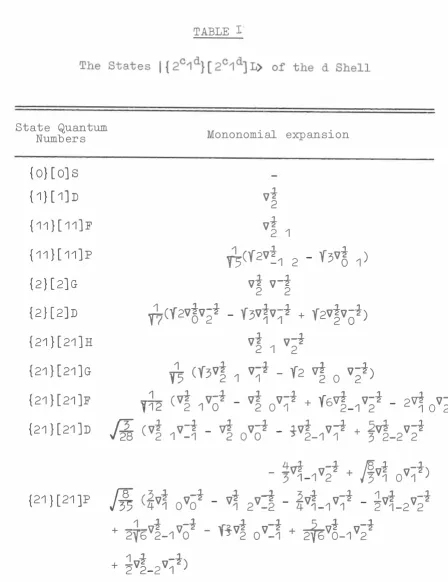
ConclusionsPage 4 6 9 16 26 31 35 TABLE I: The States l{2c1d}[2c1d)L> of the d Shell 36
CHAPTER II: A REFINEMENT OF REDMOND'S FORMULA APPLIED TO d-SHELL COEFFICIENTS OF FRACTIONAL PARENTAGE 1. Introduction
2. The Expansion of the Redmond State
3
.
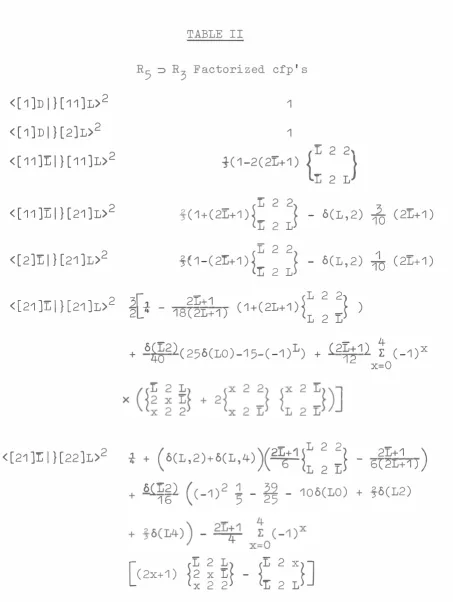
d-Shell One Body cfp'sTABLE II: R5 � R3 Factorized cfp's 4. Two Body cfp's
5.
ConclusionsCHAPTER III: QUASIPARTICLE FORMALISM AND ATOMIC SHELL THEORY. I. EQUIVALENT ELECTRONS
1. Introduction
2. The Basic Group Structure
3
.
The Basic Spin Representations4. Quasiparticle and Determinantal States
5
.
Calculation of Matrix Elements6. Conclusions
CHAPTER IV: QUASIPARTICLE FORMALISM AND ATOMIC SHELL THEORY. II. MIXED CONFIGURATIONS
1. Introduction
2. The Group Structure
3.
The Weyl Selfcommuting Operators 4. Representations5.
Branching Rules6. Duplicated R
3
Representati�ns7
.
Operators and Matrix Elements 8. Conclusions54
58 60 64
71
77
79
8084 88 94
CHAPTER V: RADIAL MATRIX ELEMENTS OF THE RADIAL-ANGULAR FACTORIZED HYDROGEN ATOM 1. Introduction
2. The Group Scheme
3
.
The Tensorial Properties of rk 4. The Wigner -Eckart Theorem5
.
The Racah Algebra 6. ConclusionsCHAPTER VI: AN 0(2, 1) x 0(3) SOLUTION TO A GENERALIZED QUANTUM MECHANICAL KEPLER PROBLEM
1. Introduction
2. Group Structure of the Generalised Kepler Equation
3
.
Tensor Operators and the Racah Algebra 4. Matrix Elements5
.
ConclusionsCHAPTER VII: GENERAL CONCLUSIONS
APPENDIX I: SOME BINOMIAL IDENTITIES
INTR ODUCTION
This thesis is concerned with the representation theory of continuous groups and its application to atomic spectros copy. The use of compact groups to label n particle states and to simplify the computation of matrix elements was
pioneered by R acah1• To successfully use this technique one requires an extensive knowledge of Kronecker products, branching rules, and coupling or Cleb-s.ch-Gordan coefficients of the groups one is using . .An extensive literature has been built up over the years relating to these topics.
Access to this literature can be gained through the follow ing review papers:
2 "Group Theory and S pectroscopy" by G. R acah ,
"Group Theory in Atomic S pectroscopy" by B.R . Judd3,
11R ecent Progress Toward a Theory of Tensor Operators in the Unitary Groups" by J.D. Louck4, and from the texts of B.R . Judd5,6 "Operator Techniques in Atomic Spectroscopy11 and "S econd Quantization and Atomic S pectroscopy11 and B.G. Wybourne7 11S ymmetry Pri.nciples and Atomic S pectroscopy11•
Very recently non-compact groups have been applied to
t . 8-10 ( )
a omic spectroscopy , in particular the O 4,2 model of
the hydrogen atom due to Barut and Kleinert8• S o recent
of non-compact groups to the many electron problem is the direction in which atomic spectroscopy is heading.
2
My thesis is divided into two sections: Section I, Theory, Section II, Application. Section I is concerned with some aspects of the mechanics of compact representat ion theory, in particular fractional parentage coefficients (cfp's) - special cases of coupling coefficients. In
detail in Chapter I I show how to construct fermion wave functions for equivalent l electrons with definite unitary (U(2l+1)) and rotational (R(2l+1)) symmetry11• Special
cases containing also R(3) symmetry are constructed. I define the concept of semiconjugacy and show that it reduces the number of states that must be explicitly cal
culated. For d electrons all possible R(3) states are con structed. Chapter II contains a refinement to Redmond's method for calculating cfp's that enables me to give closed (if somewhat complei) formulas for the square of all cfp's
for d electrons.
Section II is concerned with the application of con tinuous groups, both compact and non-compac� to atomic spectroscopy. Chapter III extends a new method of classif
ying electron wave functions initially developed by
angular momentum (L) quantum numbers up to l = 3, and for l
>
4 is much more successful than the usual classification schemes) and that it allows general operator-matrixelement evaluation without the use of cfp's. Its disadvan tage is that spin and particle number quantum numbers are lost. This so called quasiparticle formalism is extended to inequivalent electrons14 in Chapter IV.
In Chapter V the non-compact group 0(2,1) is used to
examine the radial eigenfunctions of the hydrogen atom. Armstrong9 has used this group but his approach does not
fit into an embracing group scheme like the 0(4, 2) model of the hydrogen atom due to Barut and Kleinert8 that I use in this thesis. The use of 0(2, 1) enables one to find a selection rule on radial matrix elements discovered by
S ECTION I THEORY
C HA P T E R I
'l"HE LIBRAftY IA'-!IVERSITY OF CANTI;fllUIY
CHRISTCHURCH, N;lz.
SECOND QUANTIZED ATOMIC WAVEFUNCTIONS WITH
DEFINITE UNITARY AND ROTATIONAL SYMMETRY11
1. Introduction
It has been known for some time5-18 th1 at the bases for the irreducible representations of the classical groups
can be constructed in terms of sums of products of boson creation and annihilation operators acting on a suitably defined vacuum. The group Un has been extensivelystudied using the canonical chain Un� Un_1 � ••• �
u
1 as the
solution to the state labelling problem17,18• su 3 has also been investigated by this technique using the scheme
su 3 � R 317,19_
Moshinsky2O has shown that the same analysis
can be repeated using fermion operators. Using this method J. Flores et a1.21 analysed the group
u
6 in the schemeu
6 � R6 � R5 � R 3 for all representations ofu
6 of the form {4a3b2c1d}, i.e. for nucleons, while in this chapter, I identify the fermion creation operator as a single
l and spin of½, and using the scheme widely used by atomic spectroscopists for a configuration of equivalent electrons1 ,
5
viz. su2 x (u2,+ 1 � R2,+ 1 � R
3)
construct some of the basisstates for the representations {2a1 b} , S = ib (S is the
total spin quantum number) of the group su2 x u2,+ 1 in
terms of sums of products of single electron wavefunctions.
The method used to construct these states is essential ly one of projection with the Casimir operator at the R2,+ 1
level , coupled with the demand at the R
3
level that L+ and S+ on the state be zero (Section 3). Hence, unless otherwise stated, every state in this Chapter has ML = L and Ms = S = ib. Lower states can of course be derived by
stepping down with L and S . This differs from the tech
nique of Flores et al . which demands the raising operators
of R 2l+1 on the state be zero and then obtains the R
3
stateby the use of a lowering operator. This method exploits
the inherent greater simplicity of the atomic wavefunctions
over nuclear wavefunctions , so that an explicit closed formula can be given for the states l {2a1b}[2c1d]1M> where
� is the maximum value of L in the branching rule for the
[2c1d) represent
ation of R 2l+ 1 upon being restricted to R 3.
Closed formulae can also be given for some R
6
In Section 5 the concept of semiconjugacy is defined,
which, together with some group theory, allows any state to be written down once the state l{ 2c1d}[ 2c1d]L> is known. In Section 6 the preceding theory is illustrated by calcul ating and tabulating the wavefunctions for the multiplicity free case of the d shell.
2. Group Generators
Judd5 has shown that the generators of the group
u
2,+1are
=
while the generators of the group R 2,+1 are
L (-1)J-a(1-(-1)k)[ k]f ( l k ') vCk)
k, q -a q b q
If we substitute for vC�) using the formula6
these become
Wab = E
= X ab - (-1)a+b X -b-a (I-1)
where the a's are single electron creation or annihilation operators, with subscripts identifying respectively spin and orbital angular momentum projections. These operators are just proportional to Moshinsky's2° Cb a and Ab a
respect-ively, in fact Xab = C� and A�= fWab·
If I invert the expression for the
u
21,+1 generators Iget
= E (-1)1,-a(k]1 � ( I, k J,
) xab
a, b -a q b
by noting that15
�[3/i,(i,+1)(21,+1) ]-t
I have that the R3 generators, i.e. the components of the vector�' are given by
L =
=
J, 1 J,
[1,(1,+1)(2i,+11°L(-1)J,-b (
)x
b-qb -b q b-q b
E tq X
b b q b-q
where t% = (-1)J,-b[J,(i,+1)(2i,+1)]t ( i, 1
J,)
-b q b-qNote that t% = t�-b·
The generators for the group su2, namely s±1 and s0 are given by�= [2l +1/2]i�(1o) so for instance s+1 in second quantized form becomes
If we now define
= a!a •. at a
2 1
in
a somewhat specialized form of Moshinsky1s17,20 V, then it
follows immediately from definitions that
xab
v
i�
--
�
8
(I
-
3)
ands v
iv-
i+1 � •• µ._n_ v1 •• "'m
=
3
.
The condition on the form of the state is found in
this section in order that it transform according to defin
ite
u
2,+1, R21+1 and R3
symmetry. Clearlyv¼
i l-1 . . l-a-b+1 l l-1 . . l-a+1v-t
is the greatest weight state of {2a1b}, S = lb for
SU2 X U2l+1 since Xµv = 0, µ > V and S+1 = 0 while
x ..
ll = k where k = 2, 1 or O if l-a+1<
i<
l,l-a-b +1
<
i<
l-a or i<
l-a-b respectively, whiles
0 = fb By application of the step dovm operators ofu
2,+1, namely Xµv' µ < v, it can be seen that a state of arbitrary weight of the representation {2a1b} ofu
2,+1 (but of maximumweight in
su
2) takes the form of a linear combination of states like�v-f
.
To apply the additionalµ1 • • µa+ b v 1 • • v a
constraint that this state IT > transforms according to the
representation [2c1d] of R
2,+1 we demand that
(I
-5
)
where G is the Casimir operator of R2,+1 having the eigen
which, following Moshinsky20, we write as (from equation (I-1))
10
i.e. G =
2r - 2P
(I-6)where
f
= E (-1 )a+bxabX-a-b' and
r
is the Casimir operatora,b
for
u
2,+1• The eigenvalues ofr
acting on a state thattransforms according to {2a1b} can be found by operating
r
on the greatest weight state of {2a1b} givingrvi
l t-1 •. £-a-b+1v-i
l £-1 . . J-a+1= [(2£+2-a-b)(a+b) + (2l+4-a)a]ivi � £-1
v-i
• . £-a-b+1 £ l-1 • • £-a+1
(I-
7
)
while the eigenvalues of G for the representation [2c1d] of R2,+1 are found by substitution in the formula2 L w-(w.+1+2l-2i) given by Judd5 for the representation i=1 l l
IT> = [(a+b)(2l+2-a-b) + a(2l+4-a) - 2c(2l+2-c)
-d (2l+1-2c-d) ]IT>
= PIT> (I-8)
We examine first then the action of on a general mononomial state S =
v½
v-f
We write fasµ1 . . µa+b V1··Va
+ I:
b b/t-a
a�OX-a-aXaa + a�OXa-aX-aa + a:b(-1) a+b
x_b-aXba + XOOXOO a/j:b
and look at each term in turn.
1. X-a-axaa + Xaax-a-a· Effective only if both ±a present in S. Gives an eigenvalue of 2NaN-a where N±a is the number of ±a's present in S.
2. Xa-ax-aa + X-aaxa-a· Effective if S contains a
or -�, or both if they are present in opposite spin spaces.
. f f 2 ! ! 2
Gives an eigenvalue (Na-N-a) + (Na-N-a) where the
12
the ±a' s. Gives also a term of the form (i.e. other
orbital angular momentum projection quentum numbers m,, may also be present in the state, distributed in an arbitrary manner),
2vi
.. -a.. . .a. .v-i
if s is of the formvi
. .a. . .v-i
.-a . .3. E (-1 )a+b(X
_b-a¾a+X_ba¾-a). Effective only if
b b;i±a
S contains both ±a. However, if they are both present in
the same spin space we have
=
o
.
So a term of the form
v
i. . a. . . . -a . .v-
i becomesv-
i.
4. E X_b bo¾o· Effective only if S is of the form b/0
vi
v-i
. • 0. • • . 0 •.• S becomes 2 E (b -1)bvi.. b ..
b/0
-i
'v •• -b •• •
5
.
x
00x
00• Effective if S contains zeros giving an2 eigenvalue of N0 •
Hence
(I-9)
from 1, 2 and
5,
plus terms in which each external a, -apair, (i.e. a and -a in different spin spaces) is replaced by a sum through an external b, -b pair, for all b ;i a, this
term being derived from 2, 3 and 4. This term will be
written as
&(Pll>0)2
r r
(-1)a+bvfv-i
each b/a • • b • • • • -b • •pair
(I-10)
where pll is the number of external pairs in S and o(PT1>0)
signifies that this term exists only if there is at least
one external pair. The first term (I-9) can be further
simplified for, using the notation that PT(P1) is the
number of internal pairs in the spin up (down) space, while
14
(I-11a) and
(I-11b)
and similarly for spin down. Since
t
1+i
1 equals the total
number of electrons, equals 2a+b, we have by (I-11) that
In all then ((I-10) and (I-12) )
fs = (2a+b+2P11)s + &(Pt1>0) 2 I: I: (-1)a+bv-½
v-i
each b/a • .b •• • .-b. • pair
(I-13) Returning now to the R2,+1 condition (I-8) and writing
IT>
asIT>
= I: a8s
s
where S is of the mononomial form as used above and a8 are unknown coefficients to be determined, we have immediately that
P «s = ( 2 + b + 2P J 1 ) a8 +
o
(P8 t! >O ) 2 I: I: ( -1 ) a+ b a;each b �
v-i
pair b/a · .b • • •. -b •
counting is being taken over the state S. If we now form
the matrix array A of coefficients of a
8 for all S, which will have 2a+b +2P11 as diagonal elements and ±2 as
non-diagonal elements (remembering that
1 _1 .1
v
2v-
2 andv
2•. a .. b.. • .-a .. -b.. • .b .. a •.
terms like
-i
V . .-b .. -a .. are equal
so their ±2 coefficient will appear in the same column)
then the R2,+1 condition (I-14) becomes: - if the eigen
values of matrix A are equal to p then the corresponding
eigenstate transforms according to {2a1b}[2c1d] of u2,+1
and R2,+1• We note that several distinct values of p may
satisfy this condition.
Moreover we see that if S has n external pairs then
each term in the above equation (I-14) has n external pairs;
thus A breaks up into block diagonal form, each block
associated with a different number of (external) pairs. The
problem thus reduces to finding the eigenvalues and eigen
states for each block separately.
Finally the R3 and s u2 greatest weight condition is imposed by demanding that L+i= � t% Xq b-q (I-2) and s+1 on the state be zero, giving a set of simultaneous equations, which in the general case will have a set of solutions
corresponding to the multiplicity of L in the branching rule of [2c1d] upon restriction to R
state forbidden by the corresponding branching rule, one
will get a vanishing result.
16
The R2 condition that the state has a definite�
(equal to L in our case) is simply fulfilled by demanding
that each mononomial of type S in the state has the sum of
its ml quantum numbers equal to�
-4. Some Generalities
The eigenvalues and eigenvectors for matrix A have
been found for the zero and one pair case, together with
one important solution for the n pair case. Before deriving these, we will first examine the
u
2,+1 - R21+1 branchingrules. These can be divided into two classes5,23,24 ' namely
{2a1 b} a [2a-x1 b]
1 . a+b
<
l,-
� (I-15a)x=O
Min(a,a+b-j-1)
2. a+b > l, {2a1 b}
-
t [2a-x12 +1-2a-b+2x]x=O
(I-15b)
In all the above cases it is assumed that
2a+b
<
2l+1. States with 2a+b > 2l+1 can be found byutilizing the particle-hole equivalence1,5. p thus takes
the relation between a and b, and c and d being different
in each case. Upon substitution into the formula for p
(I-8) we get in each case
1. p = 4xt +2x(x +2) +2(1-2x)a+(1-2x)b.
2. As for 1. (but not trivially so).
We consider now the function
(I-16)
which has
= µ1 +µ2+ 0 • µ
(-1) m
m = a-c' where c' and d' are the values of c and d before Murnaghan1s24 modification rules have been applied, that is, c' = a-x and d' = b. � 'µ2, •• J.lm. are summed through all permissible values, their ordering being simply to avoid a redundancy of states as mentioned in Section 3. If we substitute these values for a in matrix A (I-14), we get
µ1-t •. +µ (2a+b+2m) (-1) m
m µ . + V . µ1 + • • + µ . 1 + V . + µ. 1 + • • + µ
+ 2 I: I: (-1) 1 1
. (-1) 1- 1 1+ m
i=1 v./µ.l l
18
= (I-17)
By inspection of the values "i can take in the
expression
vi
v-f
we find thatq1 . . qc'+d'µ1 . . µm r1··rc' -µ1 . . -µm
l: 1 v./µ. l l
2.t+1-a-b-c'.
Hence (I-17) becomes 4ml+4m+2(1-m)a + (1-2m)b-2mc'. As we vary c' through case 1 and 2 (I-15) above we find quite remarkably that this expression equals the corresponding expression for p with m in place of x. Thus the R
2i+1
condition (I-14) is satisfied, establishing that Fm (I-16) transforms according to {2a1b}[2a-m1b] or
{2a1b}[2a-m12i+1-2a-b+2m] according to the rel
ative sizes of a, b and m. Clearly Fm reduces to just one term if
m = O, so all non -paired mononomials transform according to {2a1b}[2a1b] or {2a1b}[2a121+1-2a-b]. We can find a second eigenstate of the submatrix of A associated with
m = 1 by letting x = O. This gives as a solution the
= 0 (I-18)
In brief then, the submatrix associated with m = O, gives as its complete set of solutions mononomials trans forming according to the pair of
u
2l+1 and R2£+1 represent ations associated with x = O, which we shall shorten to -transforming as x=
0. The nxn matrix associated with m=
1 gives a one dimensional solution F1, transforming as x = 1, and an n-1 dimensional solution (I-18) transforming asx = O. Clearly A is symmetric, hence all possible one pair solutions have been exhausted. For a general number of pairs I have been able to find only a one dimensional solution Fm (I-16), transforming as x = m.
The state l{2a1b}[2c1d)�> where� is the maximum L in the R2J+1 - R3 branching rule for [2c1d) can now be written down as
(I-19)
where m = a-c' as before and N is a normalisation constant.
This is so since the state satisfies the
u
2J+1 and R21+1=
=
( .t-c +E 1 t 1 X ) '1.. J. a=c +d-£-1 a a a-1 m
N
t
(µ1> •• >µ. 1-1>µ. !1 1 'µ. 1 1+ >µ. 1 µ •• >µ m
+ E
µ1>· .>µ.
1>µ. 'µ. -1>µ. 1>· .>µ
1- 1 1 1+ m
N :E E
i µ1>-. >
µi-1>µi' µi -1>µi+1>-. >ll:m t1
-µ.+1
l
= 0 as required.
form
since we note to each mono�omial of the
v-i
. --�=-k •. with -k<l-c' -d' +1 that is non-vanishing under S+� there exists a termv�.µ-=-k •• V��-µ-=k .. which together cancel under s+1•
J J
The raising operators Wab' b < a, of R21,+1 when applied to
J
m
give of course a null result.It follows from (I-19) that
J, 1,-c'
2 I: i + I: i
i=i,-c'+1 i=l-c'-d'+1 = (21,+1-c')c' + l(2J+1-2c'-d') d'
Since each term inJm has a coefficient of modulus one, the normalisation can be derived simply by counting the number of mononomials inJm. Hence
M l,L,j N = I: I:
µ1 =1 J-1;2=1
where M is the maximum number of different values that l,L,j (or�) can take, i.e. M = 21,+2-a-b-c'. Now
�-1 I: 1 =
�=1
= �-1
So N = m'" 1 m-1 •
rr
(M+r)r=O = m. (M-1) •�M+m-1(�
22
t
v4
x V1, .t-1 •. .t-c'-d'+1 µ1µ2 .. µ , £ .t-1 .. l-c'+1-µ1-µ2 • • -µ , a-c a-c (I-20) To give a general formula for arb itrary L is a very much more difficult task. [ O]S and [ 1]£ are special cases of:f'm; additionally formulas for [2]L and [11]L have b een derived. Writing l {11}[11]L> as N
r
�a V!-a a andapplying the L+1 condition, we get a set of simultaneous equations, namely
1
� t
tL-.t+1 V L-1,/,
1 f3
t
tL-.t+2 V L-£+1 £-1 1
t.t-1
J:lvt
+ .t-2 L-.t+21
f3vt
+ t, L-.t+1 l-1
1 f3
t
+ t.t-1
V L-.t+2 .t-2 1
f3vt
tL-.l+2 .t-1 L-.t+1
= 0
which has the solution
= 0 (a)
= 0 (b )
(I-21) = 0 (b)
13a y=II
a+1 (I -22)
which is understood to be ( -1)a = (-1)/, if a = I,. Since the equations aa, bb etc. are equal the summation is restricted to f(L+1) < a < t, i.e.
l{11 }[11]L> = N /, t 13a v21 L a a
a=f(L+1)
-No solution exists if L is even as required by the branch ing rule. We get a similar solution for l{2}[2]L>
namely
I
{2 } [2]L> = N I, l: 13 a=L-J awith the same 13 a as for [11](22), the summation in this case being unrestricted. Note that
S +1
I
{2 }[2]L> N E ( 13 a L-vt
+ Avt )
a a �L-a a L-a a
L
so since 13a = (-1) PL-a' this expression vanishes for L even, as required by the branching rule.
To find N we
E 132 =
a
a
must evaluate the expression
1 2
E � cL-y+1 )
y=a+1 t 1
with the appropriate limits for each case. We have that
(-1)\_: 1
t1 1
1
t1
(-1 )b( ' b
-b 1 so (I-23) becomes
I, (.t +L-y+1j (.l-L+y)
I: II
y=a+1 (l+y)( -y+1)
a
a-1)
b�1)
=
=
[ t'
+aHl-a+1 �]= .l+b .l-b+1
t'
+a� !
t
.l +L-a� ! I:a Z-a � l-L+a �
(2.l-L� !L! I: ( /+a ) (2] � a - +a .t L (.l+L-aL-a )
24
(2.t-L
�!L! (2l+L+ 1
)
=
Ct)
(2J , • (I-24)2.l-L
as a consequence of one of the many variants of the
binomial addition formula. The-½ occurs only in the res
tricted summation case of (11]. (I-24) implies that
N
=I
{11 }[11]L> ==and
I
{2 }[2]L> ==[2
1
2 L+1)�(2l- L)�1(-'1)a
(L!)2(2l+1+ L)!
a= i( L+1)
[(2 L+1)!(2l- L)!1 t
(
-
'1
)a
( Il)2(2l +1+ L)� a= L- t
(I-25a)
(I-25b)
To find the expansion of a tbree or more particle
state of general Land greatest weight in
su
2, in lieu of ageneral formula, we must demand that
== (I-2)
and s+1 on the state be zero, giving a set of simultaneous
equations, which in the general case will have a set of solutions corresponding to the multiplicity of Lin the
branching rule of [2c1d] upon restric
26
5
-
Semi conjugacyIn this section it is shown that once the states
J{2c1d}[2c1d)L> have been calculated explicitly, all other
general states may b e written down. We start by noting that the b ranching rules given in Section 4 imply that a general state falls into two classes, namely
and
We consider now the product state
l{2c1d}[2c1d)L >l{2x}[O)S>. Since the only unitary represen
tation of the form {2a1b} contained in the direct product
{2c1d} x {2x} is {2c+x1d}, the product st
ate is proportion al to l{2c+x1d}[2c1d)L >, the first of two classes of a
general state. Similarly l {2c12'+1-2c-d}[2c1d)L >l{2x}[o)s >
is proportional to l{2c+x12'+1-2c-d}[2c1d)L >, i.e. the
second class. Since l{2x}[O)S> is known (equals.1,
Section 4) and l{2c1d}[2c1d)L > is assumed known, we now have
the first class of a general state. To find the second
class we have only to find how to form
For this, the operation of semiconjugacy is introduced
and represented by
/l.
Associated with a given setA
of m,e� U� == {.e , .t-1, . . . 1, 0, -1, . . -.t+1, -.t} and--'/)1 == <p the null set, for example if l = 2 and A= {2, 1} then£ = {0, -1,-2}.
Semiconjugacy is now defined by its action on a mononomial, namely
where
½
V I Iµ1. • µ2J+1-m
(I-26)
where {µ
1
..
µ2.e+1
-m} is the negative of the complementaryset to {µ1 • • µm}. For instance if
,,f
= {2,1} and l = 2,X
= {0, -1, -2} and the negative of this set is {210}. Thephase given in the definition (I-26) of/<., (namely +1) holds
only if µ1 . • IJ.m and µ
1
..
µ2
,+1-m are ordered after thefashion µ1 > µ2 > • • > µm and µ
1
> µ2
> • . > µ2
1+1-m. Theoperation is equivalent to replacing spin up electrons only, with their corresponding holes, hence its name.
It remains to show that has the desired property
that�
I
{2c1d}[2c1d]L> = 1{2c12'+1-2c-d}[2c1d]L>, allowing the right hand state to be written down simply by placing a bar over thev
i of each mononomial in the expansion ofthe left hand state, assumed known. We see firstly that each mononomial
W
v-i
. since if q1+q2+ • • +qa+b = Qq1··qa+b r1··ra
= •• +
+ • •
where the first term does not exist if µi_1 = µi+1 while
L +1 •.. µi µi -k •.
#
= • • + Ct 1 v2 1 ) + t 1 _
v
2 1µi +1 •. µi +1 µi -k.. µi -k+ •. µi� -k+1 + ••
28
Hence the simultaneous equations derived by I<,- trans
forming the L+1 simultaneous equations for the state l{2c1d}[2c1d]> are again a set of simultaneous equations
satisfying the L+1 condition.
We consider now the action of on the n-1 dimension
L (-1) qi
vt
X=-q. l q-q. l
v-t
r q. l +cvt
q O r 0v-t)
(-1)x
vf v-t
q x r-x
The zero term is bracketed, since if ri or qi equals zero it does not exist, so
=
+ L x/0
/-q. l
1
(-1)x
MX V"Z. q-x (I-27)
where the first summation is through qi, such that there
exists a qj = -qi in q, while Mg is the phase required to
order
v
i q-�.
.
So if g belongs to position k inv
f countingfrom the left, Mg = (-1)k-a-b_ q is taken as the negative
of the complementary set to q, i.e •
=
vz.
.1 qwhile .!. means "without", i.e. {2,1,0 } .!. 0 = {21}. The three summations of equation (I-27) above taken together are thus an instruction to take each q. from l
q
and place it30
i of -g in q. To do so we reason that since the number of blanks in the sequence l l-1 ... g for the set of quantum numbers q + g is both equal to l-g-k+1 and the position of -g in q counting from the right, then the position of -g equals the difference of t:telength of
q
and the right posit ion of g plus one, i.e.i = (2l+1)-a-b) - (l-g-k+1) + 1 = l+g+k+1-a-b
Finally then
v-t
r g.l (I-28)
This, however, is just proportional to the general
type of equation we get if we demand that the states
�
q1· ·qa+b r1v-½
•. ra satisfy the s+1 condition (c.f. (I-4)).Conversely, we find that any s+1 equation for the
v
½v-½
states transform under to a single pairq1· ·qa+b r1· ·ra
R2• 1 .+ condition (I-24) for¢"
v-t
Since can q1· ·qa+b r1· ·raclearly be applied in the reverse sense (i.e. from
V
to V) giving the same result we have that the total set ofequationsrequired to solve for the state l{2c1d}[2c1d)L> is identical apart from a barred
v
i to the total set ofequations for 1{2c1d}[2c1d)L>. Since
vi
v-
iq1··qa+b r1· ·ra
has 2l-1-a-b terms in the spin up space and Ms and ML are
(I-29)
Now since a general state is proportional to the product of {2c1d}[2c1d]L> or 1 {2c1d}[2c1d]L> with
l {2x}[O]S > it is clear that the proportionality constant is dependent only on the values of c and d and is thus equal to the normalisation of fx divided by the normalisation of
j {2x}[O)S >, i.e. is equal to
[�2l+1-2c-d-x) !(21+1j !J 2l+1-2c-d)�(2l+1 -x �
i
6. The d-Shell
It has been shown how to reduce the problem of con structing atomic wavefunctions in the
u
21+1 � R2,+1 � R3 to finding only the states 1{2c1d}[2c1d)L> . Unfortunately, it has not been pos sible to find a closed algebraic expression for these terms in general (with the exception of a fewspecial cases given in Section 4) so they must be found by solving the set of simultaneous equations given by the L+1 and s+1 conditions, and applying additionally the single paired condition (I-18) given in Section 3. Even this may not be enough; since in Section 3 only one solution,
32
value (I-8) of the state in question . .Any attempt to solve for this state with only zero and one pair , will give a vanishing result. In practise this serves as a guide to finding which states are of this type.
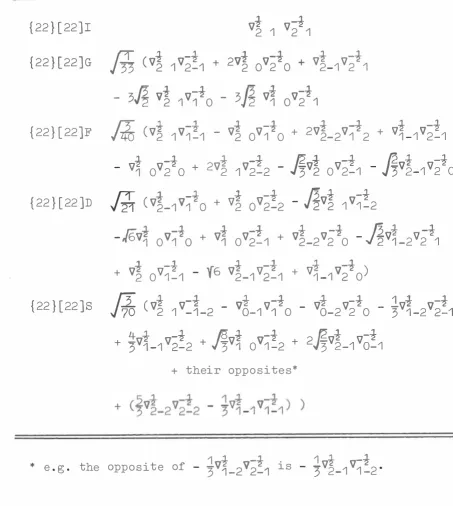
In the d shell the only term of this type is
I {
22} [ 22] S> • The double paired submatrix for this case has eigenvalues 1 0 , 5 (four times ) and 2 (five times ). The eigenvalue of 10 being the same as the p value forI {
22} [ 0] S> corresponds to the doubly paired solution tothis state , namelyf2• The eigenvalue of 2 equals the p
value for l {22} [22] S> and gives an eigenstate spanning a five dimensional space , described by the following
equations
+ a
vi v-i
1 -2 2-1
+
a
vi v-i
1-2 2 1V,z r;--z 'i/
v--z
V'?:V-i
'i/,zv-i
a. 1 1
- a t
1 + a _:i_ - a _1_2-1 1 -2 -1 1 -1 0-2 2 0 -1 -2 2 1
= 0
0
= 0
This taken with the L+ 1 and s+ 1 equations gives the
expansion of
I
{22 } [22) S > as tabulated in Table I. There is no single paired condition for this state, for if it hasone pair it has two.
As an example the equations for the state l {21}[21) D> are displayed. R2,+1 equation
0: V2 1
t t
V:1 - a; V� 1L+ 1 equations
1
t1 a;
t
v-i
+v2
t1
2
t1
2
0 0
a
v2
11
v-i
+
0 1
a
i
+V 1-1
v-f
2-t
+ ai
-i
- at -t
= 0o
Vo
V2-1V1 V2 -2V2t1 0
(X j_
v-t
=0
v2
2 1 -1t1 a:
vi v-t
+ t1a:
t
v-t
= 00 1
2-1 1 v2 0 0
t1 1 0
a
vi v-i
+ t2c\1t v-i
=-1
34
s+1 equation
= 0
t1
Since 1 =
A_
the normalised solution to these equations2 is
One point to note; for the l�2}(22]L> states the s+1 condition becomes
= 0
i.e.
which allows us, with the exception of L = 0 (it has other
s+1 equations as well) , to nearly half the number of unknowns.
The states of the form l{2c1d}(2c1d]L> are foun d
7
.
ConclusionsIn this Chapter the atomic states l{2a1 b}[2c1d]L> for
maximum ML and Ms and for 2a+b
<
2l+1 have been constructedin the scheme
u
2,�1 � R2,+1 � R3• Clearly states with2a+b > 2l+1 can be derived by using particle hole equival
ence1,5; in terms of my notation, one would simply place a bar over both
vi
andv-i
to derive the hole state equivalentto a given particle state. The form of the states I use
V
i
v-i
imply a phase convention, for the state 3 2 1 _2_1 could equally well be written as
v!
2 1v:i_
2 (any other permutation of m, indices is clearly equivalent to one of these two
states). In general then one cannot expect the phase of any cfp' s derived using this basis to agree with that of
Racah1, or Nielson and Koster25 unless one deliberately defined the phase of the states to do so. However, one is
guaranteed a self-consistent set of phases that is all that
is required practically. Defining semiconjugacy makes it
necessary to calculate only the states {2c1 d}[2c1d]L>; for
these states however, no general closed algebraic expression could be found, in fact in view of the immense combinatorial
complexity of this problem, it seems doubtful that such an
State Quantum Numbers
{ O} [O] S
{
1} [
1] D
{
11 } [
1 1]F
{
11 } [
11]P
{2} [2]G
{ 2 } [ 2] D
{2
1} [21]
H{21 } [21]G
{2
1} [21]F
{21 } [21
] D{21 } [21 JP
TABLE I
Mononomial expansion
vi 2
v
!
1r5Cf2
v!
12
-
f3
v!
1)
vi v2 2-
i'f?c12
v!
v2
i-
f3
vi
v1
i +f2
v!
v0
i)
vi 2 1 2 v-
iV5
(f3
v!
1 v1
i- f2 1 o
v2
i)
36
1�2
c
v! 1
vo
i-
v! o
v1
i +f
61
-
1
v2
i-
2� o
v2·
�
c
v! 1
v=�
-
1
o
vo
i-
t
v!_1
v1
i +�1-2
v2
i- ;vt
_
1
v2
i +'3
v� o
v1
i)
/f;
c¾
vi o
vo
i-
v� 2
vj
-
¾
v�
-
1
v1
i-
;
v�-2
v2
i1
i -i
,rz
i -i
---2_i -i
+
2y6
V2-1
VO - ,
3v2 O
v-1
+2f6
V0-1
v2
[image:44.553.53.502.62.645.2]Table I ( contd)
{
22} [
22]1
vj
1 v2
i1{
22} [
22]G
/:;:,
c
vj
1v2
!
1 + 2vj
0v2
i0 + v!_
1v2
i1- 3�
vj
1v1
io -
3A_
vi o
v2
i1{
22} [
22]F � c
v!
1 v1!
1-
vj
0v1
i0 + 2vj_2
v1
i2 + v1_1
v2!
1-
v1 o
v2
io
+ 2v!
1v2!
2-
,'3
vj
o
v2!
1-
,A
vi
_1
v2
io
{
22} [
22]n
lf1
c
vj_
1v1i
0 +vj
0v2!
2-
};
v!
1 v1!
2-
'6v1 o
v1
io
+ v1 o
v2!
1 + v!_2
v2
io
-
.,A
v�_
2v2
i1+ v
! ov1!
1-
V
6 v!_
1v2!
1 +v
i
_
1v2
io
)
{
22} [
22]s
Ho
C
v!
1 v:�_
2 - v!_
1 v1
i O - v!_
2 v2
i O -;
v�_
2 v2!
1+
5
v�
_
1v2!
2 +A
vt o
v1!
2 + 2'3
v!_
1voi
1 + their opposites*1
i -i
1vi v-
i [image:45.553.52.506.108.614.2]1 .
C H A P T E R I I
A REFINEMENT OF REDMOND'S FORMULA APPLIED TO d-SHELL COEFFICIE�TS OF FRACTIONAL PARENTAGE
Introduction
38
in 1954 Redmond26 derived bis formula giving an
iterat-ive relation for one body coefficients of fractional parent age (cfp's) for equivalent fermions. Simplified rederivat ions have been given by many authors2
7-
29 and the original formula has been generalized to cover n-body cfp'sconnecting states of general permutational symmetry2
7
,
29
.
However, the use of Redmond's (generalized) formula as a practical technique for calculating cfp's is cumbersome, except under very special circumstances29
,
30
,
for several reasons : The Redmond states are non-orthogonal andessentially un-normalized, in that extra steps are required to evaluate normalization constants. Moreover, as has been shown by Nutter and Nielson31, elaborate projection proced ures must be followed in order to derive from Redmond cfp's,
cfp's oonnected states whose auxiliary quantum numbers are fixed from other considerations (in particular whose
by showing how to expand the Redmond cfp in terms of cfp's of states with arbitrary auxiliary quantum numbers (Section 2).
The method is then applied to derive formulae as
opposed to simply numerical values for the squares of atomic d shell one body cfp's (Section 3
)
with the auxiliaryquantum numbers given by the representations of the group R5. Numerical values for these cfp's have long been
known22,25,27, but attempts to give formulae have met with only limited success, due to the complexity of the R
5
generator matrix elements in the basis specified by the non-canonical R5 �
R3 group chain32.
In Section 4 a shortdiscussion on two body cfp's is given. Numerical values
for these have been given by Jucys et a133.
2. The Expansion of the Redmond State
In this section the generalization of Redmond's
formula for n-body cfp's of antisymmetric states is derived by the method of Horie28• The resulting Redmond cfp is then expanded in terms of cfp's of arbitrarily defined orthonormal states.
Rorie defines an antisymmetrizer
40
where the summation is through all n� permutations P of the symmetric group Sn and (-1 )P is the parity of the permutat ion. ,,4 Cn) acts on an arbitrary n particle state l aJM>
(here a is an auxiliary quantum number, J is the angular momentum of the state and M its z projection) and anti symmetrizes it. Thus
l (a) JM> = N _.(n) J aJM>
CIJ-where NaJ is a normalization constant and the brackets around a mean that the state is antisymmetrized.
If the wavefunction l a:'J' , o:" J" ; JM> is defined as
l
a:'J' o:"J" · JM>'
'
L l o:'J'M'> l a:" J"M" > <J'M'J"M" IJM>M M
'
' n-m mwhere the subscript to l o:JM > specifies the number of particles associated with that state, then
(II-1 )
:::: N( a1 J 1 'a:
2J 2; J)
.4
(n)I
«1 J 1 'o:2J 2; JM>(II -2)
However, by the definition of cfp's we have
l (o:)JM> = l a:' J' , a" J" ; JM><a' J ' , a"J" l }(cx:)J> (II-3)
a' J' , a" J"
so assuming that the states l cx:' J'M'> n-m and l a"J"M" > arem orthonormal it follows that
From
(II-2)
and(II-4)
therefore<a:'J' a:"J" l}(a: J a ·J ) · J>' 1 1' 2 2 '
<a: ' J' ,a:"J" ; JMI .4Cn)
I
a:1J 1 'a:2J 2; JM>
(II
-
5)
Rorie now expands Jn) in terms of antisymmetrizers for n1 and n2 particles (n1+n2 = n) to obtain the general ized Redmond' s formula, viz.
< a: , J, a:11 J" . JM
I
in) I a: J a: J . JM>' ' .ct 1 1' 2 2 '
p(n2-m+p)
= I: (-1) (m) (n-m
)1(
n )I: < (a:' ) J' { I a:' Jr ' a:' J, > p n1-P n1 1 1 2 2X <(a:")J"{ la:"J" a;" J"> <J' J' (J' ) J"J" (J") 1 1' 2 2 1 2 1 2 ' ·JIJ1 1 1 2 2 2 ' 'J"(J ) J' J" (J ) · J>
(II-6)
42
1 �
No:J = <a:JM 1 _A (n) I cxJM>
(II-7)
so N(o:1J1,o:2J2; J) is found b y deriving the matrix element <«1J1, «2J2; JMI A(n) la:1J1,cx2J2; JM> from
(
I
I-6)
.
To expand the Redmond cfp's in terms of the cfp's of the arb itrarily defined orthonormal states l(cx) JM> one
looks more closely at the action of lo:1J1,o:2J2;JM>. We have
sincej (n) is hermitian
b y
(II-4)
on the state
<a:' J'M ' a:"J"M" · JM I ; (n) l' ' � o: 1 1 1 ' 2 z·-2' J M a J_M · JM>
This then taken with
(II-6)
gives an iterative relation b etween cfp's of the states l(a) JM>.x < ( a " ) J" { l a" J " a:" J" > <J ' J ' (J ' ) J " J" (J" ) · J \ J ' J " (J ) J ' J" (J ) · J> 1 1' 2 2 1 2 1 2 ' 1 1 1 2 2 2 '
(II-9)
Innes29 has noted the special case of one body cfp's of
equivalent electron states classified by the seniority
scheme5.
3
.
d-Shell One Body cfp ' sIn this section, formula (II-9) is applied to atomic states of the d shell, specified (completely) according to
1 the representations of the groups
(u
5 � R5 � R3) xsu
2 , i.e. the state will be written as ldn(2a1b)LS> where n isthe particle number, (2a1b) is an R
5 representation greatest weight label, and S and L are the spin (SU
2) and orb ital (R3) quantum numbers respectively (n and S taken together specify the
u
5 representation, so this issuppressed).
t < dn-1a1L1s1 + d l }dnaLS><dn-1a1L' S' + d l }dnaLS> a
2 2
44
(II-10)
where t = s1 + S' + L1 + L' , [x] = 2x +1 and � is the set of quantum numbers aLS.
To evaluate one-body cfp' s we note firstly that for
( I I -1 1 )
before modification rules are applied23,24, provided that
the exponents on the right hand side are non-negative
(otherwise the term vanishes). This formula can be easily
derived using Littlewood' s methods7,23• In electron . [ a-1 b]
states states characterized by 32 1 never occur.
However, if S is the spin associated with the parent state
[2a1b], the
n the daughter state can have spin either S +i
or S-i, which in turn (through the
u
5 � R5 bPanching rules)and [2a 1 1b+1] (S+i) or [2a+1 1b ] or [2a1b ] (S-½). Hence if in (II-10) we put a
1
= a' ,
s
1 = S', L1 = L' theleft hand side becomes
<dn-1[2a1b]L
1S1 +d l }dn[2a1b+1) LS1 +i >2
+ <dn-1[
2a1b]L1S1 +dl }dn[2a-1 1b+1 ]LS1 +t >2 or
(II-12a)
<dn-1[2a1b) L
1S1 +d l }a?[2a+11b-1) LS1-i >2
+ <dn-1[
2a1b]L1S1+d l }dn[2a1b-1) LS1-i >2 (II-12b)
In building up the cfp's the second terms of (II-12)
can be given in terms of cfp's already known through Racah
factorization and reciprocity1 •
e.g.
=
<dn-1[2a1b]S
1 l }dn[2a1 b-1 )S1 -i >2<[2a1b]L1 1 }[2a1b-1 ]L>2
[ L )D([2a1b-1 ])
1 <dn-1[2a1b)s l }dn[2a1 b-1 ]s -½ >2
[ L]D([2a1b) ) 1 1
X <[2a1b-1 ]Ll }[2a1 b]L1 >2
[ L1 ]D([2a1 b-1 ])
[ L]D([2a1 b])
<dn-1[2a1b ]S
1 l }dn[2a1b-1)s1 -i >2 <dn-2[2a1b-1 )S
1 - i l }dn[2a1b]S1 >2
where D(W) is the dimension of the representation W, and
for [w1w2) of R5 is given by�
46
= ( II-14)
Terms like <dn-1[2a1b
)s1 l }dn[2a1b-1
)s1-t> appearing in
( II-13) can be derived from Racah1s1 factorized cfp's given
in the seniority scheme. In detail (and before modification
rules have been applied to [2a1b))
<ln-1[2a1b-1]S-1 l }l
�
n[2a1b]S>2 = (4l+4-n-2n(2l+2-2a-
2a-2s�&2a)(2S+1) +4S+2)S4l+4-n-2a-2S 2a S+1 2n 2l+2-2a-2S 2S+1
( II-15)
<ln-1[2a1b+1]s+1 l }ln[2a1b]S>2 = (n-2a-2S)(4l+4-2a-4S)(S+1)
� (2n(2l+2-2a-2S)(2S+1)
As an example the cfp <d2[2)1t ! }d3[21)2L> is calcul ated. ( II-10) gives
= � + f<d [1] D l}d [2 2 2) L> (2L+1) 1 2 {O
i i}
1--L 2 2}and all one to two particle cfp's are one. This gives the remarkably simple result
=
i - iC 2t+1 ) S_
L
2 2i - o(L,2) 2L+1
(L 2 L5 60
The
u
5 �
R5
dependence can now be factorized off by use of (II-15) and in this manner Table II, giving the R5 � R3 factorized cfp'� can be built up. This table, taken with (II-15), reciprocity, and particle-hole. 1 1
equiva ence viz.
(-1)z
{(4J(����[��[l�L' ]}
i x <J4J+1-n� l }J4l+2-n�, >< [ 1)D I } [ 11)L>
2< [1) D I } [
2)L>
2< [11)L I } [11)L>
2TABLE II
R5 � R3 Factorized cfp's
1
1
L
2 2
}
-t(1-
2(
2L+1) {
I: 2 L
48
< [11)'.E I } [21)L>
2t
(1
+
(
2L+
1
) 5
I; 2 2_
l
-
o(L ,2)
16
(
2L+1)
(L 2
LS
< [
2)L I } [
21 )L>
2t{1
-
(
2I:+1) 5
L
2 22
-
o(L ,
2)
�
(
2L+1)
(I;
2LS
2
31
2'.E 1 5 L 2 21< E
21J'.E l } E
21JL>
a
¾
-
18c2�+1> c1+c
2L+1) ,
L 2 r;S
)
+ 6£L
2)(
2
5
6
(L0)
-
15-(
-
1)
L)
+ (
2L+1)
i
(
-
1)
xO
12 x=O
2
(
)(
2L 15
L2
2c
2L+1
)
< [
21)I: 1 } [2
2)L>
¾ + 6(L ,
2)+ 6(
L,
4) -i-,
L 2
y;
S - 6(2L+1)
+
&(��) (
(
-
1)
2�
-
�
-
106(
LO) + t6(L2)
[image:56.553.51.505.61.664.2]Table II (contd)
< [ 22]LI } [ 22]L>2
+ 26 52 6
Ll
5
6 2 4l5
6 2Ll)
{2 L t5 t 5 2
t5
+ 234t�
�
�5
+ 6(L, 2) ( o(tO)i - 6(L2)-z& - o(t4)�+ 2L50 +1((-1 )L -
22)
5 + o(L4)(1 6 - §..2. 55 34l
2 4Ll
2 4 65
_ 9
{4 2 2}) - 4
+ 2L+1r
(-1 )x8 4 2 L --g-x=O
((2x+1 ) St �
�
l
_
5L 2 xl ) _ 2L:1 �5
�
2xi
(x 2 25 {L 2
t5
x=O {L 2L5
2t 1 4 4! L ry 2 2
t]
+
-i}-
r r
(-1 ) +y(2x+1 ) ( 2y+1 )1 � 2 L yx=O y= LL 2 2 x
- (-1 )x+y( 2x+1 ) {� � �} ]
y 2 2
[image:57.553.63.502.93.641.2]50
4. Two Body cfp's
For simplicity, the discussion of two body cfp's will
be illustrated by the two to four particle cfp only. The
analogue to (II-10) is thus
2 2 L '
i i
S'- 4([L' ] [L" ] [L ] [L ] [S ' ] [S " ] [s ] [s ] )i5 2 2 L"i
Si
i
s1 1l]
1 2 1 2 lL L
LS
Cs
S SS
Hence, for example
1 2 1 2
(II-16)
However, the Kronecker products [2a1b]x[11] or
[2a1b]x[2] unlike the one body case, introduce more than
one "new" term, so by using (II-16) alone, all the two body cfp's cannot be built up. Thus one has the particul
arly simple result
with , however, two unknown cfp's on the left hand side. We might hope to overcome this difficulty by building up one of the cfp's from one body cfp' s using the well
known formula
(II-18)
where x = S.+ S+ L+ L.
To use (II-18), however, requires the knowledge of non-arbitrary relative phases between one-body cfp' s,
which the above derivations have not given. Other forms of
(II-8) , say
( [
L' ] [L1 ] [S ' ] [s1 ])i
X5
L L1 2 t 5
sS1 i (
l
2 L I L 1 1s
(i
s
Is
11s
L" 2 2 S"
![Table II (contd) < [ 22] I } [ 22]L>](https://thumb-us.123doks.com/thumbv2/123dok_us/9936258.495535/57.553.63.502.93.641/table-ii-contd-l.webp)
