1
Task integration in the DSP task
Zainab Sayed, S0161713
Department of Cognitive Psychology and Ergonomics
Faculty of Behavioural, Management and Social sciences
University of Twente, The Netherlands
1st supervisor: Prof. Dr. Ing. Willem Verwey
2nd supervisor: Dr. Rob van der Lubbe
2
Abstract
In the present study we wanted to examine whether there will be a race between the motor processor and the cognitive processor from the Dual Processor Model (DPM). By adding a secondary tone counting task to the primary Discrete Sequence Production (DSP) task and using other hand configuration. Our main prediction was that reaction times will be slower when participants counted the target tones while executing the sequences with other hand configuration. Twenty four students from the University of Twente and Saxion Hogescholen participated in an experiment with a practice and a test phase. In the practice phase
participants executed the sequences with two hands and on the third key position a tone was presented. In the test phase the participants used in two of the four sub blocks two hands and in the rest of the sub blocks they used the left hand. The tones were presented on the third and the fifth key position in the test phase. Twelve of the 24 participants were the control group where they ignored the presented tones in both the practice and the test phase. Only the reaction times data was analyzed, with (within subject) repeated measures ANOVA. Results
3
1.
Introduction
Driving a car or playing an instrument are a few activities in daily life that require motor skills. There are two experimental paradigms to understand how these motor skills are
acquired and controlled (Doyon, Penhune & Ungerleider, 2003). The present study uses tasks based on the motor sequence learning paradigm to understand the acquisition of motor skills.
Motor sequence learning means acquiring the skill to produce a sequence of
movements as accurately and rapidly without any effort (Abrahamse, Ruitenberg, De Kleine & Verwey, 2013). Most of our everyday life activities require motor skills that use sequential structure, therefore it has been an important topic in research in the last decades. This research lead to the development of many sequence acquisition tasks (Abrahamse et al., 2013).
One of the tasks that are used to investigate sequence learning is the Discrete Sequence Production (DSP) task. In the DSP task participants have to place four to eight fingers on the designated keys of the computer keyboard. On the computer screen are
displayed the same number of small square placeholders, each placeholder corresponds to one of the keys on the computer keyboard in a spatially compatible way. When a placeholder lights up, the participant has to press rapidly the compatible key on the computer keyboard. After reacting to the stimulus, the next stimulus is displayed on the computer screen. A sequence in the DSP tasks has two fixed series of 3-7 stimuli. There are two phases in the DSP task, the practice phase and the test phase. In the practice phase, participants practice each sequence 500-1000 times. By practicing, participants develop motor chunks, which are responses that can be selected and executed as if they are one response (Abrahamse et al., 2013). In the test phase participants execute unfamiliar sequences, that serve as the control condition.
One of the cognitive models that account for the capacity to acquire sequential skill, is the Dual Processor Model (DPM). DPM includes two processors, the cognitive processor and the motor processor. The sequence execution has three modes, the reaction mode, associative mode and the chunking mode (Verwey & Abrahamse, 2012). When practicing a keying task, participants use each stimulus, specific to the key, to react, this is the reaction mode. An associative mode involves when the responses are primed by previous response, but still need stimulus processing. In the chunking mode participants only use the first key-specific
stimulus, the so called motor chunk, to response to the discrete sequence. After practising, a mental representation of the sequences or parts of longer sequences can develop, this
4
the motor buffer. The motor processor can use these chunks as a single stimulus, after being triggered by the cognitive processor to read the codes for each movement and execute the series of movements relatively autonomous (Abrahamse et al., 2013). studies showed that longer sequences are executed as more than one successive segment (Abrahamse et al., 2013). The process of these rapid successive segmentation is called concatenation, where different chunks within a sequence are executed as smoothly as possible. When a sequence contains more than one chunk, only the first key-specific stimulus of each chunk needs preparation. The point where the first key-specific stimulus of the next chunk within a sequence is initiated, is called the concatenation point. At the concatenation point, the reaction times can be slower, due to preparation for the motor chunk. When the circumstances are right, the motor processor and the cognitive processor will race each other. In the race the motor processor will trigger a response from the motor buffer and the cognitive processor select each key-specific response (Verwey, 2001). The cognitive processor may also use explicit sequence knowledge or spatial/verbal coding in the race with the motor processor. During the execution of the DSP task participants can obtain explicit knowledge about the sequences. The explicit knowledge about the structure of the sequences can be verbal knowledge as well as spatial knowledge (Abrahamse et al., 2013). Spatial knowledge means the knowledge about the spatial position of the different elements of the sequence. Verbal knowledge refers to being able to verbally reproduce the different elements of the sequences.
5
both a secondary task and an alternation is added to the primary DSP task. This allowed us to hypothesize that using other hand configuration there will be a shift from the chunking mode (motor) and counting target tones there will be a shift from the associative mode
(verbal/spatial).
Based on earlier studies our first prediction is that counting target tones in the
secondary task will slow the reaction times on the keying sequences. Our second prediction is that using other hand configuration in the test phase of the primary DSP task, the reaction times on the keying sequences will be slower. In the present study the alteration is using one hand in two of the sub blocks in the test phase, instead of using the two-handed configuration of the practice phase. Our third prediction is that reaction times on the keying sequences will be slower when participants count target tones while executing the keying sequences with other hand configuration. To find any effects of the secondary task and the alteration on the performance of the keying sequences, an experiment with a practice and a test phase was set up.
2.
Methods
Participants
Twenty four students from the University of Twente and Saxion Hogescholen participated in the experiment. The participants were between the age of 17 and 32. Eligibility requirements for the participants were that they were not older than 35 years, they were not smokers, they had no motor and visual impairments and they were not allowed to consume alcohol in the 24 hours prior to the experiment. Participants from the University og Twente had to assign for the experiment via SONA-Systems of the university of Twente and obtained 3 credit points per participant. Participants from the Saxion Hogescholen had to assign by email. There was also a lottery where participants could win 50 Euro’s.
Materials
6
Tasks
DSP task
The DSP task consisted of two phases. The practice phase consisted of 6 blocks, with 120 7-key sequences per block, with four minutes break between each block. An additional task was added to the DSP task: counting low tones. During the whole experiment, participants heard high and low tones through a headphone. Twelve participants, the experimental group, were instructed to count the low tones during the DSP task execution and twelve participants, the control group, were instructed to ignore the tones, but had keep the headphone on.
Participants had to place their left middle finger on the C key of the keyboard, the left index finger on the V key and their right index finger on the B key and their right middle finger on the N key. On the computer screen four square placeholders would appear, each time a square would lit up, the participant had to press the corresponding (compatible) key on the keyboard. At the same time they would hear high and low tones and had to count the low ones. In the practice phase the tones were presented in the third position. If a participant pressed the wrong key, on the screen would appear they had pressed the wrong key.
The test phase consisted of 1 block with four sub blocks, each with 48 sequences. In two blocks participants had to use both hands, just as in the practice phase and in two blocks participants had to use only their left hand. The tones were presented in two blocks on the third position, in one block they were using both hands and in one block they were using just the left hand. The tones were also presented on the fifth position in the other two blocks where participants had to use both hands in a block and the left hand in the other block. Keys in the sequences were counterbalanced for the fingers used in the task.
Awareness Test
After completing the DSP task, participants were asked to fill in the Awareness Test on the computer. The researcher hid all keys on the keyboard, except for the Space key. Participants were asked to click with the left mouse button the horizontally presented square placeholders in the order of the sequences that were presented in the DSP task. They were also instructed to click the right order on the square placeholders with the letters C, V, B, N, but this time these placeholders were presented across the computer screen. After the part where they had to answer the right order, participants had to answer a few questions about how they
7
Paper questionnaire
After filling in the Awareness Test, participants filled in a paper questionnaire consisting of three pages. The paper questionnaire was used to examine the explicit sequential knowledge of participants. Each page had to be filled in, before going on with the next page, Participants were not allowed to go back to a previous page.
Procedure
8
Data analyses
For the results a repeated measures ANOVA was conducted for both the data from the
practice and the test phase. This means that the control group consisting of twelve participants was left out as well as the data collected from the Awareness Test and the paper and pencil questionnaire of all the 24 participants.
3.
Results
Practice phase
To examine the reaction times in the practice phase, a 6 (Block: 1-6) x 2 (Tone High/Low) x 7 (Key) repeated measures ANOVA was conducted on the data. The analysis showed
significant main effect for Block F(5, 55) = 82.91, p < .000. The reaction time decreased with each consecutive block. Participants executed the sequences faster with practice. Practicing the sequences allowed the participants to develop motor chunks.
The analysis also showed significant main effect for Key F(6, 66) = 15.67, p < .000. The reaction time decreases from first to second key the most, then increase up to key four and then decreases again. The interactions Block x Key and Block x Tone x Key were also significant. For Block x Key interaction F(30, 330) = 3.41, p < .000, the reaction time decreases with each consecutive key, but decreases more for higher keys. For Block x Tone x Key interaction F(30, 330) = 2.41, p = .000, the reaction time decreases for each consecutive key within each block and between each block, while this development is more pronounced for the high tone than for low tone. There was no significant main effect found for Tone.
9
Test phase
For the test phase a 2 (TonePosition 3 or 5) x 2 (Hand: 1 or 2 hands) x 2 (High vs Low tone) x 7 (Key) repeated measures ANOVA was conducted on the data. The analysis showed
significant main effect for Hand , F(1, 11) = 16.26, p = .002. The reaction time is lower for two-handed than for one-two-handed trials. This main effect supports the prediction that using other hand configuration, than the one used in practice phase, slows the reaction times. Also for Key there was a significant main effect F(6, 66) = 7.18, p = .000. The reaction time decreases from first to third key, then increases from third to fifth key and then decreases to the last key. The interaction Hand x Key was determined to be a statistically significant predictor of reaction time, F(6, 66) = 4.69, p = .005. The analysis shows that the reaction time decreases from first to third key, then increase up to key five and then decreases again to key six. Then the one-handed trials increase in reaction time, while the two-handed trials decrease in reaction time. There were no main effects found for TonePosition F(1, 11) = 2.42, p = .148 and for Tone F(1, 11) = 0.85, p = .375.
10
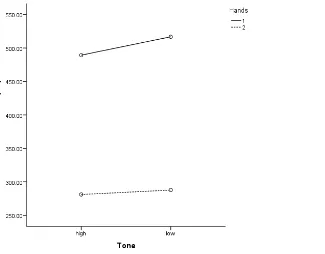
Figure 1. Reaction Time (ms) over the Hand and Tone interaction for the three keys after tone presentation on position 3 and position 5 in the test phase of the DSP Task.
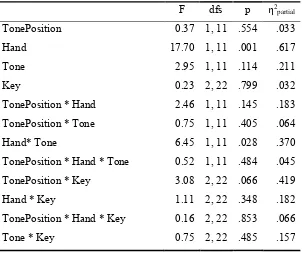
There were no main effects found for TonePosition F(1, 11) = 0.37, p = .554, for Tone F(1, 11) = 2.95, p = .114 and for Key F(2, 22) = 0.23, p = .799.
11
4.
Discussion
To answer the question whether there will be a race between the cognitive processor and the motor processor, we tested our hypothesis by testing three predictions. The results support the hypothesis that using other hand configuration there will be a shift from the chunking mode (motor) to the reaction mode and counting target tones there will be a shift from the associative mode (verbal/spatial).
The results from the practice phase show that participants develop motor chunks after
practice. The reaction times decreased with each block. The main effect for block
confirms the notion from the DPM that with practice there should be a shift from reaction mode to chunking mode. There was no significant main effect found for Tone, yet there was a significant interaction Block x Tone x Key. The reaction times decreased for each key within and between each block, but the reaction time increased for key four and then decreased for key five, six and seven. After tone presentation on key three, the cognitive processor was needed more for the counting task and therefor it is possible that the reaction time on key four was slowed because the motor processor did not race with the cognitive processor.
The results from the test phase support two out of three of our predictions. Our second prediction that using other hand configuration, than the one used in the practice phase, will slow the reaction times. The reaction times for the practiced two-handed
configuration was lower than for the one-handed configuration. Through practice effector specific knowledge develops, this means that with practice effector-dependent
components will develop. This makes the reaction times slower, when in the test phase the specific knowledge has to transfer to other effector (De Kleine & Verwey, 2009; Park & Shea, 2003; Verwey, 2004). Taking the lack of specific knowledge about the other effector in account, the execution of the sequences got more dependent on the cognitive processor, this can explain the slow reaction times for Hand.
12
minimal) in the reaction time with two-handed configuration. Even though there was no significant main effect found for Tone, the significant Hand x Tone interaction shows that when participants used other hand configuration, while counting target tones, the reaction
times slowed. The difference in reaction time for two-handed and one-handed
configuration is more than 200 ms for Hand as a main effect over all the keys. After tone presentation, at both tone positions, this difference is larger than the previous difference. The larger difference supports our third prediction even more. That both adding a
secondary task and using other hand configuration will slow the reaction times a lot more, than with just a secondary task or with just an alteration (using other hand configuration).
The overall described results from the test phase do not support our first prediction that counting target tones in the secondary task, will slow the reaction times on the keying sequences. There was no significant main effect found for Tone, both in the overall test phase results as well as in the results from the three keys after tone presentation. An explanation for the lack of significant effects might be that during the practice phase participants learned knowledge about the tones and tone position. The learned knowledge would then not need much effort from the cognitive processor. This gives the cognitive processor more room to race with the motor processor where the motor processor wins the race. Race between the cognitive processor and motor processor can make the motor processor respond faster than when the motor processor is not in race (Abrahamse et al., 2013).
Nevertheless the results support our hypothesis because even when there is no
significant main effect found for tone, the interaction Hand x Tone is significant after tone presentation.
13
also provide an insight in the explicit sequence knowledge of the participants or the lack of it.
References
Abrahamse, E. L., Ruitenberg, M. F. L., De Kleine, E., & Verwey, W. B. (2013). Control of automated behavior: insights from the discrete sequence production task. Frontiers In Human Neuroscience, 7. http://dx.doi.org/10.3389/fnhum.2013.00082
De Kleine, E., & Verwey, W. B. (2009). Representations underlying skill in the discrete sequence production task: Effect of hand used and hand position. Psychological Research, 73(5), 685-694.
DOI 10.1007/s00426-008-0174-2
Doyon, J., Penhune, V., Ungerleider, L. G. (2003). Distinct contribution of the cortico-striatal and cortico-cerebellar systems to motor skill learning. Neuropsychologia 41 (3), 252–262. https://doi.org/10.1016/S0028-3932(02)00158-6
Park, J.-H., & Shea, C. H. (2003). Effect of practice on effector independence. Journal of Motor Behavior, 35(1), 33-40.
https://doi.org/10.1080/00222890309602119
Verwey, W. B., Abrahamse, E. L., (2012). Distinct modes of executing movement sequences: Reacting, associating and chunking. Acta Psychologica, 140 (3), 274-282.
14 Verwey W. B. (2001). Concatenating familiar movement sequences: the versatile cognitive processor. Acta Psychologica, 106 (1-2), 69–95.
https://doi.org/10.1016/S0001-6918(00)00027-5
Verwey W. B., Wright D. L. (2004). Effector-independent and effector-dependent learning in the discrete sequence production task. Psychological Research, 68, 64–70.
DOI 10.1007/s00426-003-0144-7
Verwey W. B., Abrahamse E. L., De Kleine E. (2010). Cognitive processing in new and practiced discrete keying sequences. Front. Psychol. 1:32.
https://doi.org/10.3389/fpsyg.2010.00032
Verwey, W. B. (2015). Contributions from associative and explicit sequence knowledge to the execution of discrete keying sequences. Acta Politica, 122-130.
15
Appendices
18
[image:18.595.76.381.145.420.2]Main and interaction effects on reaction times in the test phase.
Table 1.
Repeated Measures ANOVA to explain reaction time by TonePosition, Hand, Tone, Key and their interactions.
F df1, df2 p η2 partial
TonePosition 2.42 1, 11 .148 .181
Hand 16.26 1, 11 .002 .596
Tone 0.85 1, 11 .375 .072
Key 7.18 1, 11 .001 .395
Position * Hand 0.28 1, 11 .608 .025
TonePosition * Tone 0.43 1, 11 .527 .037
Hand * Tone 2.89 1, 11 .117 .208
TonePosition * Hand * Tone 0.66 1, 11 .433 .057
TonePosition * Key 2.07 1, 11 .144 .158
Hand * Key 4.69 1, 11 .007 .299
TonePosition * Hand * Key 1.09 1, 11 .371 .090
Tone * Key 2.22 1, 11 .097 .168
TonePosition * Tone * Key 1.43 1, 11 .252 .115
Hand * Tone * Key 1.27 1, 11 .301 .104
TonePositie * Hand * Tone * Key 0.14 1, 11 .904 .013
Table 2.
Repeated Measures ANOVA to explain reaction time on the keys T3, T4, T5 and on the keys T5, T6, T7 by tone TonePosition, Hand, Tone, Key and their interactions.
F dfs p η2
partial
TonePosition 0.37 1, 11 .554 .033
Hand 17.70 1, 11 .001 .617
Tone 2.95 1, 11 .114 .211
Key 0.23 2, 22 .799 .032
TonePosition * Hand 2.46 1, 11 .145 .183
TonePosition * Tone 0.75 1, 11 .405 .064
Hand* Tone 6.45 1, 11 .028 .370
TonePosition * Hand * Tone 0.52 1, 11 .484 .045
TonePosition * Key 3.08 2, 22 .066 .419
Hand * Key 1.11 2, 22 .348 .182
TonePosition * Hand * Key 0.16 2, 22 .853 .066
[image:18.595.74.376.509.762.2]19
TonePosition * Tone * Key 0.53 2, 22 .597 .078
Hand * Tone * Key 0.29 2, 22 .750 .072
[image:19.595.75.371.232.540.2]TonePosition * Hand * Tone * Key 0.71 2, 22 .504 .410
Table 3.
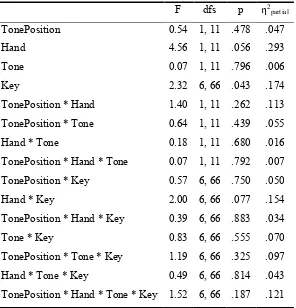
Repeated Measures ANOVA on arcsine transformed error data to explain error proportion by TonePosition, Hand, Tone, Key and their interactions.
F dfs p η2
partial
TonePosition 0.54 1, 11 .478 .047
Hand 4.56 1, 11 .056 .293
Tone 0.07 1, 11 .796 .006
Key 2.32 6, 66 .043 .174
TonePosition * Hand 1.40 1, 11 .262 .113
TonePosition * Tone 0.64 1, 11 .439 .055
Hand * Tone 0.18 1, 11 .680 .016
TonePosition * Hand * Tone 0.07 1, 11 .792 .007
TonePosition * Key 0.57 6, 66 .750 .050
Hand * Key 2.00 6, 66 .077 .154
TonePosition * Hand * Key 0.39 6, 66 .883 .034
Tone * Key 0.83 6, 66 .555 .070
TonePosition * Tone * Key 1.19 6, 66 .325 .097
Hand * Tone * Key 0.49 6, 66 .814 .043