University of Warwick institutional repository: http://go.warwick.ac.uk/wrap A Thesis Submitted for the Degree of PhD at the University of Warwick
http://go.warwick.ac.uk/wrap/4451
This thesis is made available online and is protected by original copyright. Please scroll down to view the document itself.
, Joining-up' : a study of partnership in
post-16 learning
Jaswinder Kaur Dhillon
A thesis submitted in partial fulfilment of the requirements for the degree of
Doctor of Philosophy in Continuing Education
University of Warwick, Centre for Lifelong Learning
Contents
List of figures and tables
Abbreviations
Acknowledgments
Abstract
Introduction
Chapter 1 - The shifting landscape of post-16 learning 1.1 Delineating the field of post-16 learning
Education, training, learning and skills Globalisation, risk and learning
Contested meanings of lifelong learning
1.2 New Labour, the Third Way and post-16 learning
The policy rhetoric: imperatives for participation in learning The imperative for economic competitiveness
The imperative for social inclusion The imperative for active citizenship
1.3 Partnership as a strategy for widening participation
Partnership working between further and higher education Collaboration, partnership and New Labour
Post-16 learning partnerships
1.4 The emergence of Midlands Urban Partnership (MUP)
Chapter 2 - Defining and conceptualising partnership and partnership working
2.1 Partnership: a new way of working? Partnership as a concept and a practice Roots of partnership approaches
2.2 Defining partnership
Characteristics of partnership
Weak and strong forms of partnership
Power relations and personalities in partnerships
2.3 The basis of relationships in inter-organisational partnerships Contracts or trust
Networks and networking
Co-ordination, collaboration and co-operation
Chapter 3 - Social capital as a conceptual framework for
understanding partnership working 77
3.1 The significance of social capital in policy and research 77 3.2 Origins and development of the concept of social capital 79
Different forms of capital 81
Power relations and predominant theories of social capital 82 Social capital as a resource for achieving mutual goals 84 Social capital as networks, trust and norms of reciprocity 87 Recent policy and research interest in social capital 90
3.3 Dimensions of social capital 93
Vertical and horizontal networks 94
Types of linkages in social networks 95
Measures and indicators of social capital 102 3.4 Using social capital to theorise partnership working in MUP 107
Weaknesses in conceptualisations of social capital 108
Chapter 4 - The methodology and fieldwork used to
construct an understanding of partnership processes 112 4.1 Contextualisation of research approach 112
Research paradigm 114
The researcher and the researched 119
The transition from observer to participant observer 120
4.2 Designing the study 123
Case study of MUP 125
Crafting the methodology 126
Reliability, validity and triangulation 128
4.3 Access, ethics and reciprocity 129
4.4 Fieldwork 132
Observations of partnership working 132
Documentary evidence of partnership working 135
Interviews with MUP Board members 137
4.5 Data analysis and interpretation 139
Chapter 5 - The lifecourse of Midlands Urban Partnership 143
5.1 The Black Country 143
5.2 Members ofMUP 146
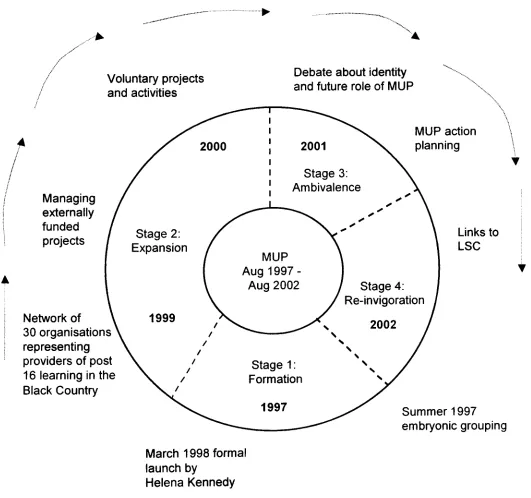
5.3 The four stages in the lifecourse of MUP 150
Stage 1: formation and early development 152
Stage 2: expansion 156
Stage 3: ambivalence 162
Stage 4: re-invigoration 168
Chapter 6 - Peaks and troughs of collaborative activity: an
analysis of partnership working 176
6.1 A peak and a trough in the lifecourse ofMUP 177 6.2 Expansion: a peak in the lifecourse of MUP 180
The policy context and its contribution to expansion in MUP 183 Power differentials between institutions and individuals 191 Relative contributions of representatives of different organisations 195
6.3 Ambivalence: a trough in the lifecourse ofMUP 212
The policy context and its contribution to ambivalence in MUP 213 Power differentials between institutions and individuals 218 Relative contributions of representatives of different organisations 222
Chapter 7 - Participants' perspectives of partnership 230 7.1 ' Joining-up' to work in partnership 231
Networking 232
The time and effort needed to sustain joining-up' 235
7.2 The role of trust in sustaining partnership 237
Levels and layers of trust 239
Building trust through partnership working 241
7.3 Developing shared goals in a partnership 243
Shared goals and gendered perspectives of partnership 243 Norms of reciprocity, respect and equality 249
Shared values 252
Chapter 8 - Discussion: the role of social capital in sustaining
partnership 256
8.1 Distinctive characteristics of MUP 257
Questioning the data and revealing the role of social capital 259
8.2 Networks and partnership working 262
8.3 Trust and partnership 268
8.4 Norms, values and shared goals 272 8.5 Power and inequality in partnership 274 8.6 Characteristics of weak and strong forms of partnership 278
Chapter 9 - Conclusion: the potential of partnership and the
practicalities of partnership working 286
9.1 Review of the research questions 286
9.2 Limitations of the study 294
9.3 Costs and benefits of partnership working 295 9.4 Factors that contribute to effective and sustained partnership 297
9.5 Concluding remarks 299
References 301
List of figures and tables
Figure 1: Primary and secondary 'stars' in networks 97
Figure 2: Sources of social capital 110
Figure 3: The four stages in the lifecourse of MUP 151
Figure 4: Layers of collaboration in MUP 172
Figure 5: Networks in MUP showing primary and 174
secondary clusters and links
Figure 6: Organisational structures in MUP 159
Figure 7: Peaks and troughs in the lifecourse of MUP 178
Figure 8: Collaborative activities and links in MUP 182
Figure 9: Operation of formal and informal networks 196
amongst members of MUP
Figure 10: Dormant individuals (nodes) in networks in MUP 223
Table 1: Partnership working between further and higher education 35
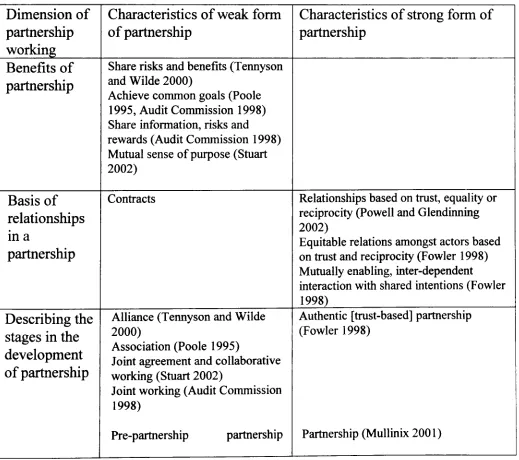
Table 2: Characteristics of weak and strong forms of partnership 58
Table 3: The basis of relationships in a partnership 75
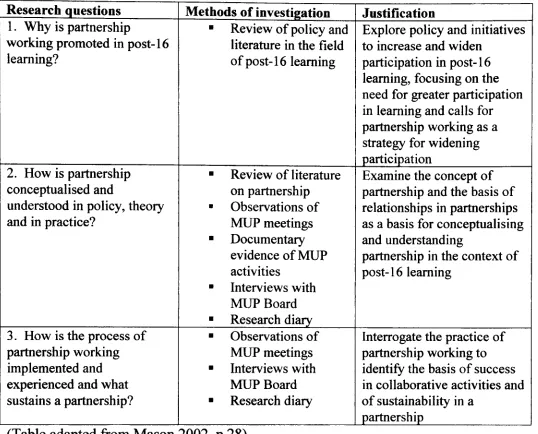
Table 4: Research framework 124
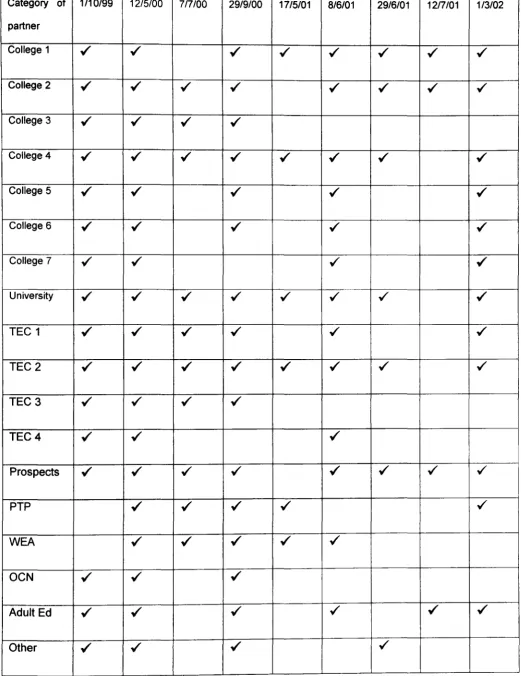
Table 5: Log of attendance at MUP meetings 148
by organisations from 1999-2002
Table 6: Continuum of characteristic features 280
List of abbreviations
ALI
DfEE
DfES
ESRC
EU
FE
FEFC
HEFCE
LSC
Ofsted
SRB
TEC
Ufi
UK
Adult Learning Inspectorate
Department for Education and Employment
Department for Education and Skills (replaced DfEE in 2001)
Economic and Social Research Council
European Union
Further Education
Further Education Funding Council
Higher Education Funding Council for England
Learning and Skills Council
Office for Standards in Education
Single Regeneration Budget
Training and Enterprise Council
University for Industry
Acknowledgements
Many people have provided support and encouragement in helping me to complete this study. Friends, colleagues and family have all been a source of academic and social support and I have made many new friends and contacts as a result of undertaking the research and sharing the findings with the academic community at conferences and in research seminars. I am particularly indebted to the members of Midlands Urban Partnership who agreed to be observed and interviewed by an outsider and gave so freely of their time despite having such busy schedules.
I would like to thank my supervisors, John Field and Barbara Merrill for their patience and constructive feedback, which challenged but did not constrain my thinking. John Field continued to show an interest in my work even though he moved to Stirling University during the course of the research and sent me pertinent references at most opportune moments in the research process. Staff and students from the former department of Continuing Education at the University of Warwick assisted me in conceptualising and theorising my empirical work and made the learning experience both interesting and enjoyable for which I am most grateful.
My special thanks go to my two good friends, Ann-Marie Bathmaker and Nest Thomas, without whose unstinting support this thesis would truly have not been possible. Our regular discussions in Selly Oak in Birmingham kept me on track and made me persevere during the troughs in the process of making sense of the data and getting to the story in the thesis.
Declaration
Abstract
This thesis examines the concept and practice of partnership in the context of post-16 learning. The study explores the process of partnership working through a qualitative case study of a sub-regional partnership that aims to widen participation in post-16 learning through its collaborative activities. The investigation seeks to learn about the basis of partnership and to identify characteristics that contribute to continued and effective partnership working. Drawing on understandings of partnership in policy, theory and in practice, I develop a more detailed conceptualisation of partnership than is currently available in the field of post-16 learning.
The history, development and work of the case study partnership were investigated through a combination of methods including observations of partnership meetings, documentary evidence of partnership working and semi-structured interviews with participants in the case study. The interviews with senior managers of institutions and organisations that provide education, training and guidance for post-16 learners in the Black Country, a sub-region of the Midlands in England, focused on the reasons for participation in a partnership and the aspects of partnership working that contribute to sustainability in partnerships.
Introduction
This introduction provides a brief history of the development of the research and my personal and professional reasons for focusing on partnership working in post-16 learning. This is followed by an overview of the structure of the thesis.
I begin with my personal motivations, interests and values as I recognIse the importance of the self in research, which Coffey characterises as the 'silent space' (Coffey 1999) in research methodology as not all researchers acknowledge the ways in which the person of the researcher shapes a study. My primary reason for re-engaging in formal study at this stage in my lifecourse was a need for personal learning. I wanted to participate in learning for its own sake or as one of the senior managers I interviewed as part of this study put it 'learning for the sheer joy of it'. As a learner, I felt a need for intellectual challenge and as a professional, the need to re-fresh my thinking by undertaking an in-depth investigation that would bring me into contact with new ideas and concepts and other professionals in post-16 education.
opportunities available to them were not equal to those accessible to other students. In my own and my family's schooling I had experienced the effects of cultural stereotyping and low teacher expectations on educational aspirations. As a reflexive teacher and researcher working in higher education in the 1990s I was interested in exploring the global spread in notions of learning throughout life and the more specific strategy of partnership as a means of widening participation in learning.
The following section provides a brief history of the development of the research to give the reader an insight into how the concepts of lifelong learning, widening participation and partnership shaped the course of the study.
Development of the research
I was intrigued by the notion of lifelong learning and more specifically in the related policy emphasis on widening and not just increasing participation in learning. Widening participation is identified in policy as a means of promoting social inclusion and I was interested in finding out if this policy was actually making any difference to the opportunities open to learners living and working in disadvantaged areas. It was this interest that led me to the work of Midlands Urban Partnership, (MUP), as its purpose is to widen participation in post-16 learning in the Black Country, a sub-region that suffers from economic, social and educational disadvantage. Subsequently, during the fieldwork as I explored the concept of partnership and observed the process of partnership working in MUP, in particular at the micro-level of the relationships and interactions amongst the people in the partnership, my emphasis shifted slightly to focus on the basis of sustainability in a partnership.
Getting to the heart of partnership: the research journey
The research was carried out during a period of intense policy and academic interest in the contested concept of lifelong learning, which in practice in England was largely defined as post-16 learning, and the collaborative discourse of partnership (Powell and Glendinning 2002). During the process of research, there were two aspects of the study that led to the slight shift of focus to concentrate more sharply on partnership than on widening participation in learning though this remains the context for interpreting the findings.
analysing and interpreting empirical data and generated searching questions ill
relation to MUP given the context in which it worked as a partnership. The fieldwork data revealed that MUP was a relatively successful example of continued partnership working in a field where partnerships proliferated and disappeared in response to policy imperatives, often linked to financial incentives to work in partnership. However, unlike other partnerships, such as learning partnerships (DfEE 1999b, Ramsden et al 2004), MUP was a voluntary partnership that did not
receive funding to operate as a partnership from any external funding body. Furthermore, the individuals and organisations in MUP were simultaneously involved in many other partnerships and networks in the region, some of which were much more successful in attracting substantial funding from government departments and funding agencies than MUP. Despite this, they continued to see a need for MUP and sustained it through 'thick and thin' for over five years and at the end of the fieldwork for this study, MUP was continuing to function as a partnership. It thus became an interesting research site for exploring the basis of partnership working and the purposes it served for the people involved.
partnership working and what sustains a partnership? This question emerged from the inductive process of probing the essence of partnership by examining the lifecourse of MUP and analysing the relationships amongst the people that became involved in its formation, expansion and continued presence in the sub-region.
The empirical data
The methods used to gather and analyse empirical data are discussed in Chapter 4 but a brief note is provided here to assist the reader in placing this study of partnership in the context of the development of the research. The main methods for researching the work of the partnership were observation of meetings of the full partnership board and the smaller executive group, in-depth interviews with members of the partnership board, and analysis of documentary evidence of partnership working. This documentary evidence included minutes of formal board meetings, agendas, action plans, letters, discussion papers and newsletters produced by members of the partnership.
shift in the focus of the study from lifelong learning to partnership working but has been published elsewhere (Dhillon 2004).
During my research journey I have had the opportunity to share my findings with researchers in national and international conferences and have learnt from their questioning of my interpretation of the data. I have also published my emerging findings (Dhillon 2001 b; 2005), and this has helped me to theorise partnership.
Research questions
The thesis focuses on the overarching research question of what sustains partnership and partnership working in the field of post-16 learning through a case study of MUP. The study explores and analyses the concept of partnership and the process of partnership working by addressing the following sub-questions:
1.1 Why is partnership working promoted in post-16 learning?
1.2 How is partnership conceptualised and understood in policy, theory and in practice?
1.3 How is the process of partnership working implemented and experienced and what sustains a partnership?
The structure of the thesis
history of the development of the research. It explains the reasons for the slight shift
in the focus of the study and summaries the content of each of the chapters in the
thesis.
Chapter One places the study of partnership and partnership working in the policy
context of post-16 learning. It discusses policies and initiatives that have led to a
blurring of the boundaries between further, higher and adult education and traces the
development of collaborative working arrangements which aim to widen
participation in post-16 education and training.
Chapter Two examines the concept of partnership drawing on literature from
different disciplines and policy fields. It analyses the reasons for the prominence of
partnership as a concept and a practice and discusses characteristics of weak and
strong forms of partnership, including power differentials amongst organisations,
agencies and individuals. The chapter considers the role of contracts, trust and
networks in partnership working and explores the boundaries between collaboration,
co-operation and partnership.
Chapter Three discusses social capital which emerged as a key concept for
understanding partnership working in this study. It traces the origins and
applications of the concept by seminal and contemporary researchers and defines the
dimensions of social capital that are applicable to understanding partnership. The
final part of the chapter explains how I have drawn on network analysis and social
Chapter Four explains the methodology and fieldwork used to research partnership
working. It positions the study in research terms and discusses the considerations
that affected the process of data collection, analysis and interpretation.
Chapters Five, Six and Seven present the fieldwork data. Chapter Five presents the
history of the development and progress of the case study partnership through the
framework of the four stages in its lifecourse. Chapter Six compares partnership
working during two contrasting stages in its lifecourse, a peak, a period of expansion,
and a trough, a period of decline. Chapter Seven presents participants' perspectives
of partnership in which senior managers of post-16 education and training
organisations reflect on the factors that contribute to effective and sustained
partnership.
Chapter Eight relates the fmdings from the fieldwork data to policy and theoretical
literature on partnership. It discusses the role of social capital in sustaining
partnership and presents a continuum of characteristic features of weak to strong
forms of partnership, which were found in the case study and in the literature.
The final chapter reflects on the maIn research questions and discusses the
limitations of the study. It also looks to future practice in partnership working by
focusing on what we can learn about the basis of sustained partnership from this
Chapter 1
The shifting landscape of post-16 learning
This chapter places the study of partnership in the policy context of post-16 learning and outlines recent policies and initiatives that have promoted partnership working as a strategy for widening participation in post-compulsory education and training. It defines the field of post-16 learning for the purposes of this study and explores the more expansive discourse of 'learning', which has to some extent displaced the concepts of education and training in policies for the post-16 sector.
The chapter considers two dominant themes in academic and policy debate that have led to changes in the sector. Firstly, policies that posit participation in learning as the panacea for economic, social, civic and democratic problems. Secondly, the call for greater collaboration and partnership working amongst providers of education, training and other stakeholders as a strategy for widening participation in learning. It thus locates partnership as a specific strategy for widening participation and introduces the emergence of the case study partnership in this policy context. I start by discussing post-16 learning and then consider partnership working because partnership in this thesis needs to be understood in this context.
wider changes brought about by globalisation. The debate amongst 'an extraordinary range of organisations and nations' (Field and Leicester 2000b, p.xvi) led to the development of policies and strategies to increase and widen participation in formal learning as this was perceived by policymakers as the solution to economic and social disadvantage and the key to economic prosperity and social well-being. 'Learning' emerged as a key theme and the need for learning throughout life was reinforced in policy and in practice through initiatives and incentives (Hodgson and Spours 2000) to encourage, sometimes compel, participation in formal, often vocational, learning.
Policies and initiatives developed by governments, supranational and international organisations to bring about greater participation in post-16 learning emphasise two key elements that are particularly pertinent to the context of this study. Firstly, the importance of widening, not just increasing, participation in learning and secondly, the call for greater collaboration and co-operation amongst stakeholders and providers of education and training through partnerships. Partnership working amongst different government departments, various tiers of government and between institutions and agencies is promoted as a more effective and efficient way of improving access to learning and of developing the quality and standards of prOVIsIon.
widen participation in post-16 learning through 'joined-up' working amongst providers of education, training and related services in one sub-region in England.
1.1. Delineating the field of post-16 learning
The field of post-16 learning is not easy to delineate as traditional fields of policy and practice have become displaced by more open, less bounded concepts and changing boundaries (Green and Lucas 1999, Gallacher and Thompson 1999, Field and Leicester 2000a). The more bounded fields of further, higher, adult, community and continuing education as fields of study and practice have become encompassed by the 'more diverse moorland of lifelong learning' (Edwards 1997, p.67). At the same time policies and incentives to encourage and improve collaborative working arrangements amongst providers of education and training (Stuart 2002) have led to boundary crossing as more higher education is delivered in further education colleges (Hyland and Merrill 2003, Jary and Jones 2003) and some universities have established centres of lifelong learning (www.warwick.ac.uk. http://crll.ac.uk). Discussions around the 14-19 curriculum (Tomlinson 2004) also reflect changing boundaries and thinking in new ways about traditional sectors of education. Both the discourses of lifelong learning and the emphasis in policy and practice on boundary crossing have led to transformations and shifts in post-compulsory education and training and redefinitions of the field.
the learners and captures the dispositions of the people who participated in the research as they saw partnership working as a form of learning, both for themselves as individuals and for the organisations they represented in the partnership. I use post-16 learning to refer to all education and training provision for post-16 learners, other than higher education at degree level or above. This interpretation of post-16 learning is close to how lifelong learning is officially defined in England as according to TeacherNet, the government's resource to support the education profession: 'for most practical purposes, the term [lifelong learning] is taken by the Government (and its partners: local government, the further and higher education sectors) to mean all post-16 learning' (TeacherNet 2003, p.l).
Education, training, learning and skills
This dominant discourse assumes that it is possible for organisations and individuals to continually improve; an assumption that is not unchallenged (Avis 2003).
The ideas and expectations associated with learning are rooted in ideas of reflexive modernity (Beck 1992, Giddens 1998, Alheit 1999) and are evident in educational research as well as in policy and practice. Researchers are expected to engage in reflexive analysis (Griffiths 2000) to learn from the process of research as well as to make a contribution to a body of knowledge. The emphasis is not just on the content of the work but also on the individuals' ability to transfer learning to other situations, a skill which is valued in learners and workers as rapid technological change means that knowledge quickly becomes out-dated. The importance of skills is reflected in the concept of employability and has led 'schools, colleges and universities to sprinkle their provision with such offerings as 'enterprise education', 'life skills' , and 'key skills' (Unwin 2003, p.8).
globalisation, such as shifts in the economy and labour markets, and other aspects of living in a world of increasing risk and uncertainty.
Globalisation, risk and learning
Globalisation and the information revolution are leading to major transformations in the economy and society (Beck 1992, Giddens 1998, Castells 1998) bringing changes in patterns of employment in Western capitalist countries and increased risks for individuals, communities and nations. In globalised capitalism, multinational companies are able to move resources easily around the world and shift manufacturing production, and more recently service industries, to poorer countries and regions to take advantage of lower labour costs. It is claimed that this is necessary in order to remain competitive in the global economy but this aspect of globalisation increases the risks of unemployment for those working in these industries and the potential for economic decline and related social problems for those living in areas with high levels of manufacturing industry and lower levels of skill. Though the inevitability of the forces of globalisation are contested (for example by Castells 2000, Elliott 2003) the consequences of marginalisation for those affected by labour market shifts are accepted by policymakers and their critics as these communities and neighbourhoods are at greater risk of social exclusion (Geddes 1998, SED 2004).
disasters, can cross national boundaries and hence pose further risks to global society. Giddens (1998) suggests that national governments need to work with non-governmental organisations and transnational pressure groups to maintain political stability and cope with changes brought about by globalisation, technological and ecological developments. In response to these changes governments and organisations have posited lifelong learning as a means of coping with these pressures and increased risks. As knowledge rather than physical resources becomes the key to prosperity and well-being in global capitalism, knowledge workers, that is those with the skill to manipulate existing and new knowledge in their work, become an increasingly valuable commodity in the labour market whilst those with few vocational skills or no marketable skills risk become de-valued and in danger of isolation and exclusion.
Contested meanings of lifelong learning
The eruption of interest in the concept of lifelong learning in the 1990s is well documented in the policy and academic literature (CEC 1995, Delors 1996, Fryer 1997, DfEE 1998, G8 1999, Watson and Taylor 1998, Field and Schuller 1999, Field 2000a, Hodgson 2000a, Edwards et a12002, Tett 2002, Longworth 2003, Hyland and Merrill 2003). However, in this now substantial body of literature on the topic, there is sometimes a failure to differentiate between lifelong learning as a policy approach and lifelong learning as a concept. Griffin points out that 'the shifting emphasis away from education to learning in the lifelong context does signify some kind of a substantive development away from a conceptual to a policy-orientated approach' (Griffin 1999, p.122). Policymakers tend to focus on the need for lifelong learning, and hence its policy implications, whilst academics focus also on its purpose, and hence its conceptual meaning. The academic literature includes a critical perspective, which challenges policy interpretations of lifelong learning.
Critics point out that the magic bullet of lifelong learning (Coffield 1999b) cannot by itself address the structural inequalities in poor neighbourhoods that lead to economic and social deprivation. Initiatives such as government funded training schemes for the unemployed (for example New Deal) may not lead to jobs in areas 'where there are no jobs to be had' (Thompson 2000). New Deal, a training scheme primarily designed to equip unemployed 18-24 year-olds (DfEE 1997) with the skills needed for employment, was implemented under the banner of lifelong learning during the period of this study and members of MUP were contracted to implement it in the Black Country. However, in practice such training did not always lead to employment opportunities for the individuals involved. The reasons for lack of success in obtaining employment were attributable to deeper structural factors in patterns of employment in the local labour market rather than the quality of the training or the skills of the individual.
The issues raised by such debates about lifelong learning are pertinent to the context of this study as the institutions, organisations, agencies, managers and practitioners that became involved in MUP worked in partnership to create opportunities for learning for a range of reasons. They came together to increase and widen participation in formal learning but were also alert to the social and personal purposes of learning. Competing notions of lifelong learning challenged their understandings of the purposes of post-16 learning reflecting older debates about lifelong and recurrent education (Field 2001, Edwards et al 2002) and of routes to
dominate contemporary policy texts. The members of MUP had to work within the boundaries of government policy and were not in a position to address structural inequalities but were able to pool their resources to address social as well as economic purposes for learning in the area in which they worked, as shown by the research data presented in Chapters 5, 6 and 7.
The context of this study includes the policies of the Labour government and the motivations of the individuals and organisations that participated in MUP both of which shaped the meaning and nature of partnership. Motivations for engaging in partnership are discussed in Chapter 2. The next section of this chapter considers New Labour's policies, which like other policymakers (EUROPA 2004, OECD 1996) offer three broad reasons for participation in post-16 learning. These are, firstly and predominantly, that participation in learning is necessary to sustain economic growth and prosperity, secondly, that it is needed to promote social inclusion and social cohesion in society, and thirdly, to encourage active participation in democratic forms of government. New Labour discourse uses the terms economic competitiveness, social inclusion and active citizenship in its policies and these provide the policy and historical context for the study.
1.2 New Labour, the Third Way and post-16 learning
following its election in 1997 New Labour announced 'its intention to move from a contract culture to a partnership culture' (Balloch and Taylor 2001, p.3).
The first theme focuses on why there is a need for participation in post-16 learning whilst the second provides the means for achieving this in terms of a strategy. Both reflect third way thinking and values (Giddens 1998; 2000, Clarke and Glendinning 2002) which contend that new ways of thinking and working are needed to meet the challenges of globalised capitalism and increasing individualisation in society. They also show the impatience of a government determined to be seen to be taking action to address the challenges faced by the nation. The focus on partnership is discussed in Chapter 2. The remainder of this chapter considers the importance given by New Labour to lifelong learning, which as the definition given on page 12 shows is for all practical purposes, defmed in policy as post-16 learning.
The speed with which lifelong learning policy was developed in the UK following New Labour's election to power is comparable to other countries such as Germany, Finland, Norway and Ireland (Field 2000b) and reflects the global interest in the concept. In 1997 the government appointed the first Minister of Lifelong Learning and commissioned wide-ranging reports on further (Kennedy 1997), higher (Dearing 1997) and continuing education (Fryer 1997). In 1998, separate Green Papers set out proposals for England (DfEE 1998), Scotland (Scottish Office 1998) and Wales (Welsh Office 1998) followed by a White Paper (DfEE 1999a) for restructuring
The policy rhetoric: imperatives for participation in learning
New Labour's policy rhetoric provides three imperatives for greater participation in learning, which is taken to refer to formal accredited forms of learning. Despite evidence of the significance of informal learning (Coffield 2000a, Field and Spence 2000) policy has tended to ignore this aspect of learning. In New Labour's policy the imperatives are firstly, the need to achieve and maintain economic competitiveness in a global market, secondly, to promote social inclusion in society and thirdly, to engage individuals in more active citizenship.
The imperative for economic competitiveness
In its key policy document The Learning Age (1998) the government set out its
vision of developing a new culture of learning and although the subtitle 'a renaissance for a new Britain' might appear to allude to the cultural benefits of learning the dominant idea in the text is that lifelong learning is needed for economic competitiveness. In the foreword to this Green Paper, David Blunkett, then Secretary of State for Education and Employment writes:
Learning is the key to prosperity - for each of us as individuals, as well as for the nation as a whole. Investment in human capital will be the foundation of success in the knowledge-based global economy of the twenty-first century. (DfEE 1998, p.7)
This idea is reinforced by the Prime Minister, Tony Blair, who is quoted as saying 'Education is the best economic policy we have' (DfEE 1998, p.9) and further amplified in other policy papers by Blunkett:
The early part of the 21 st century will be characterised by the transformation
success and failure and between competitiveness and decline. (Blunkett 1999 quoted in Hodgson 2000c, p.12)
For New Labour, lifelong learning is a central strategy for ensuring the future
economic prosperity of the UK and updating of skills a key priority for 'enabling
people, and businesses, to succeed' (DillE 1999a, p.3) in the information and
communications age of the twenty-ftrst century. The centrality of skills in
government thinking is reflected in policy texts and in actions such as the renaming
of the Department for Education and Employment (DillE) as the Department for
Education and Skills (DillS), in 2001, and replacing Training and Enterprise
Councils (TECS) with the Learning and Skills Council (LSC) as part of a major shift
in planning and funding post-16 education and training in England (DillE 1999a).
These changes took place during the course of the present study and some of the
organisations and individuals in MUP experienced the transition from being TECs to
becoming a local LSC as shown in Chapter 6.
In its White Paper Learning to Succeed (DillE 1999a), which sets out the new
framework for post-16 provision, the proposal to create 'a single body to oversee
national strategies for post-16 learning' is described as 'a fundamental change' for
which there is 'widespread support' (DillE 1999a, p.3). Notions of change and
widespread support for its policies permeate the rhetoric of New Labour's discourse
but the realities of accountability and the drive to raise educational standards and
workforce skills are equally evident in policy texts and in the structures put in place
to implement and monitor policies. Thus, although Learning to Succeed sets out
strategies for realising the vision of The Learning Age in the post-16 sector the
potential through learning. F or example, in the opening paragraph of the White Paper, the statement 'it [lifelong learning] can and must nurture a love for learning' is followed in the second paragraph by 'we must develop a new approach to skills' and place 'the emphasis on quality to lever up standards' (DfEE 1999a, p.3). The shift in language from 'learning' to 'skills' reveals the real focus of New Labour's agenda for post-16 learning and the structures put in place to make this happen demonstrate its determination to make providers more accountable for the money that the government spends on education and training.
These themes are present in all spheres of education from schools to higher education
and reflect the emphasis on measurement and performance of both individual and
organisational achievement in delivering improvements and providing 'value for
money'.
In the post-16 sector, National Learning Targets, previously known as National
Education and Training Targets, embody the government's emphasis on measuring
learning although in policy rhetoric they are presented as evidence of 'our
commitment to widen and increase participation in learning and raise the attainment
levels of people entering education and training' (DfEE 1999a, p.14). In practice,
however, the focus is very much on increasing skills levels amongst the workforce to
meet economic needs. I observed this emphasis on the ground during the fieldwork
for this study. In several meetings of MUP, the LSC representative presented the
skills strategy for the Black Country which included targets for increasing the
proportion of people receiving job-related training, increasing the proportion of
people achieving higher level vocational qualifications and improving literacy and
numeracy skills of adults, in order to meet the needs of the local economy and labour
markets (MUP document 2001a). These targets derived from national objectives and
local needs reflect another aspect of New Labour's policy: that of drawing local,
regional and national needs together to bring greater coherence and responsiveness to
planning and delivering post-16 learning by encouraging greater collaboration
between different tiers of government and agencies and organisations working in the
Hodgson (2000c) suggests that the infrastructure for planning, orgamslng and funding lifelong learning creates 'an interesting balance or tension between national, regional and local tiers of government' (p.l3). However, Giddens (1998) argues that the third way is not only possible but also necessary in politics in order to find a way of tackling social, political and economic issues in a changing world. It is claimed that polarities between left and right and between public and private sector are no longer appropriate and a mixture of competition and collaboration is needed. Leadbetter argues that 'the most knowledge-intensive sectors of the economy, software and bio-technology, thrive on a mix of competition and collaboration' (Leadbetter 1998 quoted in Hyland and Merrill 2003, p.29). This example highlights the strength of economic arguments in New Labour thinking and policy although the third way is not exclusively focused on economic competitiveness and the skills agenda. This is reflected in policy rhetoric, which does acknowledge broader aims of post-16 learning:
As well as securing our economic future, learning has a wider contribution.
It helps make ours a civilised society, develops the spiritual side of our lives and promotes active citizenship. Learning enables people to play a full part in their community. It strengthens the family, the neighbourhood and consequently the nation. (DillE 1998, p.7)
The imperative for social inclusion
The second strand in New Labour's policy is that learning has a central role in promoting social inclusion (DillE 1998; 1999a, Gallacher and Crossan 2000, Hyland and Merrill 2001, VSS 2004). In The Learning Age it is stated that 'learning is
lifelong learning is seen as 'central not only to competitiveness and employability but also to social inclusion, active citizenship and personal development' (EUROPA 2004, p.1). Lifelong learning is a core strategy in the European Union's ten-year mission to become a dynamic knowledge-based economy with better jobs and greater social cohesion. The OECD also includes social inclusion in its aims of lifelong learning (OECD 1996).
Social inclusion is thus an important element in national and international lifelong policies though secondary to economic reasons for participation in post-16 learning. Even when framed in the context of social inclusion it is presented as a way of gaining employability skills and seen as a route to employment and consequently to being 'included' in society. Furthermore, it is often conceived as a means of tackling social exclusion as participation in learning forms part of economic and social regeneration strategies targeting deprived regions, disadvantaged groups and disengaged individuals (Geddes 1997, Hibbett et al 2001, LGA 2004). Clegg and
The formation of strategic units to co-ordinate action to deal with deep-rooted problems, such as social exclusion, is another feature of New Labour's policy. In
1997 the Prime Minister set up a Social Exclusion Unit (SEU) as 'part of the Government's strategic approach to tackling social exclusion including all Whitehall departments and many external partners' (SEU 2004, p.1). In 2002 the SEU became part of the cross-cutting Office of the Deputy Prime Minister working across departments to deliver an overarching strategy to achieve social justice and quality of life for everyone (ibid).
rather than addressing the structural inequalities that lie at the root of social and
economic problems in poor neighbourhoods.
Though social inclusion can be interpreted as being the opposite of social exclusion,
there are differences between the meanings of the two terms, in particular when
related to third way values which underpin New Labour thinking. Social inclusion is
linked to notions of social justice and equity as equality is identified as a core value
of the third way in addition to 'protection of the vulnerable, freedom as autonomy,
no rights without responsibilities and no authority without democracy' (Giddens
(1998, p.66). Giddens, a key proponent of the third way argues that:
the idea of equality or social justice is basic to the outlook of the left .... Those on the left not only pursue social justice, but believe that government has a key role in furthering that aim.' (Giddens 1998, pAl)
One of the ways in which New Labour sets out to further that aim is by widening
participation in learning through strategies to improve access and lift barriers to
participation for those who have not traditionally participated (DfEE 1998) in formal,
accredited post-16 learning. Other forms of learning, such as informal, non-formal
and experiential learning that are not formally accredited, do not feature in the policy
discourse reflecting the credentialist emphasis in government policy.
Participation in learning is posited as the key not only to economic prosperity but
also to social unity by policymakers and influential figures that have chaired
committees to advise the government on reform of different sectors of post -16
learning. For example, Helena Kennedy, Chair of the committee set up to report on
cohesion. Equity dictates that all should have the opportunity to succeed' (Kennedy 1997, p.15). Notions of equity and social justice highlighted by influential figures, such as Giddens and Kennedy, appeal to researchers and practitioners who share a concern for issues of inequality and disadvantage, such as the participants in MUP.
Another aspect of the increasing individualisation of society is the emphasis placed on the learner for learning accompanied by the idea that learning is not bound to any particular time, institution or place. Infonnation and Communications Technology (lCT) is regarded as having the potential to revolutionise learning (Dearing 1997, Ufi 1999) by making it possible to deliver learning in more flexible ways, in particular through different fonns of e-Iearning. In post-16 learning the development of opportunities to 'learn anywhere, at any time and at any pace' (Learndirect 2004, p.1) is co-ordinated by the Ufi, a public-private partnership which aims to enable people 'to fit learning into their lives' and put them into a 'better position to get jobs, improve their career prospects and boost business competitiveness' (Ufi 2004). This government-sponsored initiative delivers learning through Learndirect 'a network of online learning and infonnation services' (Learndirect 2004) where learners can access learning through the Internet or in the extensive network (now over 2000) of learning centres located across the country.
(Biesta 2004). This rather naive portrayal of the process of learning as easy, fun and something for everyone is appealing but ignores the complexities of knowledge construction as an educational process which can be challenging, uncomfortable and difficult as well as transformational for the individual. There is also evidence that forms of on-line learning though intended to widen participation in learning are reinforcing the gap between the knowledge rich and the knowledge poor, the educational 'haves' and the educational 'have-nots' (Gallacher et al 2000, Fryer 1997) through the digital divide (Sargant 2000, Osbourne 2003) and hence contributing to exclusion.
The imperative for active citizenship
sharpen divisions amongst communities, risking further marginalisation of groups and individuals and hence increasing social exclusion. For a national government that promotes social inclusion and believes in 'No authority without democracy' as fundamental third way values this clearly poses significant challenges.
In trying to reconstruct democracy on the basis of no rights without responsibilities the government is trying to engage its citizens in a process of political, social and civic renewal, partly through education and participation in learning. Education to encourage active participation in democratic processes includes the introduction of citizenship as a subject in the national curriculum for schools and citizenship as a theme in 14-19 qualifications (Hyland and Merrill 2003) in post-16 learning. Other developments include resources, websites and funded projects (TeacherNet Citizenship 2004, DfES 2004a) to enable 'young adults to exercise social responsibility ... and [support them] in developing their roles as learners, workers, consumers, and members of families and communities' (DfES 2004b, p.l).
young people ... to become more active citizens' (Institute for Citizenship 2004, p.l). Such partnerships place particular emphasis on empowering members of the community themselves to take a key role in regenerating their neighbourhood and developing a sense of community. Promotion of partnership as a means for developing a sense of community involves recognising the importance of social connections amongst individuals, groups and communities and draws on communitarian values and the concept of social capital, which is discussed in Chapter 3. Whilst the government's concern for empowering citizens to engage in the civic and political life of their neighbourhoods and communities, as well as in wider processes of democratic participation can be seen as commendable, a more critical reading suggests that it is way of maintaining social control and of shifting the responsibility for regeneration on to communities and individual citizens (Thompson 2000).
New Labour's policies and its reforms to the structures for planning and delivering post-16 learning show the significance placed upon partnership working as a means for increasing and widening participation in formal education and training. However, though the vigour with which New Labour has promoted both learning and partnership is exceptional, issues about participation in learning and collaborative working between providers of education and training have a longer history. These are considered in the following section.
1.3 Partnership as a strategy for widening participation
education colleges and universities have existed from the 1980s (Bird 1996). Such arrangements have been a means for opening up opportunities for individuals and groups who may not aspire to further and higher education or as routes for adults without traditional entry qualifications for higher education, for example 'Access' courses (Jary and Jones 2003). The greater emphasis by New Labour on widening participation reflects third way values, such as equity and social justice (Kennedy 1997, Giddens 1998) and the policy thrust sees lifelong learning as 'a policy instrument for promoting greater social justice, equity and inclusion' (Hodgson 2000b, p.52).
Strategies to widen participation in learning focus on getting individuals from lower socio-economic groups, in particular social classes III, IV and V, and certain minority ethnic groups, to participate in education and training as they are currently under-represented in post-16 learning (CIHE 1997, Woodrow et al 1998, Thomas
2002, Archer et al 2003) and non-participation is linked to economic and social
Partnership working between further and higher education
Paczuska (1999) dates links and partnerships between further (FE) and higher education (HE) to the 1960s though the main growth was in the 1980s and 1990s. The increase is linked to a 'growing emphasis on widening access to further and higher education [which] emerged in the second half of the 1980s' (Gallacher and Thompson 1999, p.14) as the government became interested in attracting more students to return to education to improve their qualifications and skills. During the 1980s 'Access' courses developed to provide special routes and a second chance for those that had missed out on the opportunity to enter HE (Jary and Jones 2003). The provision of Access courses was located in FE colleges with progression routes linked to HE institutions and according to Stuart (2002) it was mainly women, who had been denied education earlier in their lives, that participated in such programmes.
Table 1: Partnership working between further and higher education
Types of further educationlhigher education partnerships (Paczuska 1999, p.99)
Rawlinson (1997) Bird (1996) HEQC (1993)
Associate college arrangements Franchising Articulation
Preferred partnerships Associate college arrangements Joint provision
Validation and accreditation Validation arrangements
Access courses Franchising
Subcontracting
The table shows the three main approaches to describing relationships between FE and HE and the overlap between the categorisations. Rawlinson (1997) distinguishes two main types of collaboration: associate college and preferred partnerships. Bird (1996) offers four categories of activity: franchising, associate college arrangements, validation and accreditation arrangements and Access courses. The HEQC (Higher Education Quality Council) differentiates five categories: articulation, joint provision, validation, franchising and subcontracting. All the categories attempt to capture a closer working relationship between an HE institution and FE colleges, which are often located in the same geographical region.
[image:45.685.77.609.112.320.2]universities provide a different kind of HE expenence for standard age and background students (Taylor et al 2002, Taylor 2001). Jary and Jones (2003, p.l) maintain that recent HE policy 'has a Janus-face' as the government endeavours to create fair access and social justice in a much expanded system whilst at the same time setting out to maintain a minority of institutions as 'world class universities'. The university that is a key partner in MUP is a post-1992 university with a strong mission for widening participation and a history of working collaboratively with FE colleges through Access courses, franchising and accreditation and validation activities.
Franchising is the most common form of collaborative activity and though precise forms of the arrangement vary between institutions, it generally refers to a whole course, or stage of a course which is designed by an HE institution and delivered in an FE college (Opacic 1996). The HE institution remains the more powerful partner as it retains responsibility for quality assurance though more recent developments describe such relationships as partnerships (Brownlow 1994) implying that the relationship between the HE institution and the FE partners is more equal.
initial teacher education programmes tends to use the tenn partnership without defining it (Griffiths and Owen 1995). Consequently, in Chapter 2, I draw on the use of partnership in other disciplines and contexts to conceptualise partnership and consider aspects of partnership working.
The literature on FEIHE partnerships reflects the changing boundaries between FE and HE and the re-Iabelling of such collaborative links as partnerships, which was given fresh impetus by the election of the Labour government.
Collaboration, partnership and New Labour
For New Labour and third way politics collaboration, co-operation and partnership is a necessary strategy for developing coherent polices and for delivering post-16 learning. The 'new framework for post-16 learning' set out in the White Paper
Learning to Succeed aims to 'create a framework based on partnership and
co-operation between individuals, businesses and communities, as well as institutions' (DfEE 1999a, p.4). In this framework, national networks, such as the Learning and Skills Council, (LSC 2005), are given a strategic role in identifying needs, addressing gaps in provision and avoiding duplication of services to bring greater coherence to local, regional and national planning and provision ofpost-16 learning.
'widen participation in learning, increase attainment, improve standards and raise skills' (DtEE 1999b, p.1). They also have 'a key role in taking forward the Government's social inclusion and regeneration agendas' (ibid).
Post-l 6 learning partnerships
Learning partnerships and the shifting terminology used to describe them illustrate the pace of change in policy development and implementation and the government's determination to improve existing practice in the field. These non-statutory, voluntary groupings of local learning providers were known as strategic lifelong learning partnerships before New Labour turned its attention to reforming post-16 learning. In 1999, they were re-Iabelled lifelong learning partnerships, just prior to the conception of the LSC, and brought together in a national network covering all the regions in England:
to promote a new culture of provider collaboration across the sectors (schools, FE, work-based learning and adult and community learning) and to rationalise the plethora of existing local partnership arrangements covering post-16 learning. (Rodger et al2001, p.1)
accountability. The linguistic shifts in the discourse and the changes to frameworks and structures for delivering post-16 learning reveal the government's detennination to search for a language and a mechanism to address issues such as social inclusion, regeneration and widening participation and to improve current arrangements through a pooling of ideas, expertise and resources, together with the rhetoric of partnership.
New Labour's approach is indicative of wider debate about new forms of governance (Field 2000c, Rhodes 2000, Stoker 2000). A central argument in this debate is that the role of government is to steer rather than row policy development and implementation in public sector services. Rhodes (1996, p.655) uses the image of rowing and steering to argue that there is a need for 'less government' (or less rowing) but 'more governance' (or more steering) where government is associated with central control and hierarchical systems and governance with collaboration and looser networked structures, as in partnerships. The shift towards new forms of governance, in particular networked governance is discussed in Chapter 2, as part of defining partnership.
In New Labour's policy rhetoric the language of partnership is used to encourage stakeholders to work together to fmd solutions to educational and social problems whilst at the same time central government retains power and control through mechanisms, such as funding and inspection regimes, and shifts responsibility for delivering improvements away from the centre onto other actors, such as the LSC, learning partnerships and providers of education and training.
It is this shifting landscape that provides the context for the present study.
The emergence of Midlands Urban Partnership
collaboration in post-16 learning and can be understood in the context of policy imperatives and initiatives in post-16 learning and third way approaches to policy development and implementation.
In other respects though, MUP is unlike other partnerships. It was instigated by a group of individuals though it is an inter-organisational partnership. Throughout its existence it has not been funded to operate as a partnership by any external funding body, unlike other partnerships in the post-16 sector. It started as, and remains, a voluntary partnership of organisations and individuals and is an example of sustained and successful partnership working in a field scattered with examples of ineffective partnerships. It thus provides an interesting empirical case study to learn about the basis of sustained partnership with the potential to make a contribution to knowledge and understanding of the concept of partnership through an in-depth analysis of the process of partnership working in the context of widening participation in post-16 learning.
Chapter 2
Defining and conceptualising partnership and partnership
working
This chapter examines the central concept in this study by drawing on a range of literature from different policy fields, including post-16 learning. It considers the meaning of partnership and partnership working by discussing definitions, theorisations and empirical studies of partnerships in different contexts. I draw on the use of the concept in other disciplines and contexts as the literature on partnership in post-16 learning is limited, largely, to descriptions of collaborative working arrangements between educational institutions, as the previous chapter has shown. The post-16 partnership literature does not interrogate the meaning of partnership or the basis of relationships amongst organisations, agencies and individuals that work in partnership. I thus tum to a wider literature to analyse characteristics of partnership and partnership working which include power relations, trust and networks. The chapter begins by discussing the history of the development of partnership and then considers the basis of relationships in inter-organisational partnerships.
In the literature, partnership is described as a buzz-word (Harriss 2000), a transdisciplinary concept (Mullinix 2001) and a global practice and this chapter analyses how the concept is used and understood in policy, theory and in practice. Powell and Glendinning (2002, p.2) characterise partnership as 'the indefinable in
the focus of this chapter is: why is partnership being promoted and how is it being
defined and conceptualised?
2.1 Partnership: a new way of working?
Partnership is promoted as a 'new' way of delivering improvements in services and
of achieving maximum impact in alleviating poverty and disadvantage (Clegg and
McNulty 2002, Tett 2003). At the level of policy the concept 'seems to have
permeated the fabric of policy making' (Trevillion 1999, p.2) and at the level of
practice, organisations and individuals are busy 'doing partnership'. In different
fields, including education, health, housing, social and community development and
international development, the language of partnership pervades policy and practice.
Governments, agencies, organisations and individuals, which I will refer to as actors
in this thesis, engage in a range of working arrangements which fall under the
partnership label in national, (Geddes 1997, Hyland and Merrill 2001, Blaxter et al
2003) supranational (Geddes 1998, CEC 2001, OECD 2000) and international arenas
(F owler 1998, Ansari and Phillips 2001, Preston 2002). In this chapter I use the UK,
the ED and the OECD as examples to illustrate the prominence of partnership at
national, supranational and international levels.
The dominant theme in the literature on partnership is the imperative for government
departments, non-government agencies, public and private sector organisations and
individuals to work together to tackle international, national, regional and local
Issues. Policymakers urge actors to transcend traditional sector boundaries and
conventional organisational structures to work in new ways to achieve goals and
way forward In addressing economIC and social inequalities, particularly in communities suffering from economic decline and social and educational disadvantage in both rich and poor countries.
In the UK, partnership has been embraced by New Labour (Jones and Bird 2000, Painter and Clarence 2001, Tett 2005) and is pivotal in the modernisation agenda for public sector services (Balloch and Taylor 2001, Glendinning et aI2002), including education as Chapter 1 has shown. It is also explicitly placed at the centre of regeneration strategies: 'partnership and collaboration are essential to achieving the government's goals for economic prosperity and social cohesion through regeneration, capacity building and community development' (DfEE 1 999b, p.l.).
As well as national governments, member states of wider political, economic and social groupings such as the European Union (EU), sign-up to the notion of partnership. The Commission for the European Communities declares, 'as well as promoting partnership at all levels, national, regional and local, Governments should lead by example by ensuring effective coordination and coherence in policy between ministries' (CEC 2001, p.ll). Strategies to actively promote partnership working include websites and databases dedicated to finding partners for projects in different member states (www.partnerbase.eupro.se, http://leonardo.cec.eu.intipsd) in addition to initiatives such as ESF (European Social Fund) project funding.