Staphylococcus aureus isolates from bovine mastitis in eight countries: genotypes, detection of 1
genes encoding different toxins and other virulence genes 2
Valentina Monisteroa, Hans Ulrich Graberb, Claudia Polleraa, Paola Cremonesic*, Bianca
3
Castiglionic, Enriqueta Bottinid, Alejandro Ceballos-Marqueze, Laura Lasso-Rojase, Volker
4
Kroemkerf, Nicole Wentef, Inge-Marie Petzerg, Carlos Santistebanh, Jeff Runyanh, Marcos Veiga
5
Santosi, Bruna Gomes Alvesi, Renata Piccininia, Valerio Bronzoa, Mohamed Salah Abbassil,
6
Meriam Ben Saidl and Paolo Moroni a,h
7
8
a Università degli Studi di Milano, Dipartimento di Medicina Veterinaria, via Celoria 10, 20133
9
Milan, Italy
10
b Agroscope, Research Division, Food Microbial Systems, Schwarzenburgstrasse 161, 3003 Bern,
11
Switzerland
12
c Istituto di Biologia e Biotecnologia Agraria, (IBBA-CNR), via Einstein, 26900 Lodi, Italy
13
d Becaria CONICET, Facultad de Ciencias Veterinarias, Universidad Nacional del Centro de la
14
Provincia de Buenos Aires (FCV, UNCPBA), Laboratorio de Microbiologia Clinica y
15
Experimental, Departamento de Sanidad Animal y Medicina Preventiva SAMP/ CIVETAM
16
e Universidad de Caldas, Laboratorio de Calidad de Leche y Epidemiología Veterinaria (Grupo
17
CLEV). Calle 65 # 26 – 10, Manizales, Caldas, Colombia
18
f University of Applied Sciences and Arts, Bioprocess Engineering – Faculty II, Microbiology
19
Heisterbergallee 12, 30453 Hannover
20
g Faculty of Veterinary Science, University of Pretoria, South Africa, M35, Pretoria, 0110, South
21
Africa
22
h Cornell University, Animal Health Diagnostic Center, Quality Milk Production Services, 240
23
Farrier Road, Ithaca NY 14850 USA
24
i
School of Veterinary Medicine and Animal Sciences, Department of Animal Nutrition and
25
Production/Faculdade de Medicina Veterinária e Zootecnia, Departamento de Nutrição e Produção
26
Animal, Rua Duque de Caxias Norte, 225, Pirassununga-SP, 13635900, Brazil
27
l
University of Tunis El Manar, Tunisian Institute of Veterinary Research, Tunis, Tunisia
28 29
*corresponding author, Paola Cremonesi: [email protected]
30
31
Authors:
32
Valentina Monistero [email protected]
33
Hans Ulrich Graber [email protected]
34
Claudia Pollera [email protected]
35
Paola Cremonesi [email protected]
36
Bianca Castiglioni [email protected]
37
Enriqueta Bottini [email protected]
38
Alejandro Ceballos-Marquez [email protected]
39
Laura Lasso-Rojas [email protected]
40
Volker Kroemker [email protected]
41
Nicole Wente [email protected]
42
Inge-Marie Petzer [email protected]
43
Carlos Santisteban [email protected]
44
Jeff Runyan [email protected]
45
Marcos Veiga Santos [email protected]
46
Bruna Gomes Alves [email protected]
47
Renata Piccinini [email protected]
48
Valerio Bronzo [email protected]
49
Mohamed Salah Abbassi [email protected]
Meriam Ben Said [email protected]
51
Paolo Moroni [email protected]
52
53
Abstract 54
Staphylococcus aureus (S. aureus) is recognized worldwide as one of the major agents of dairy cow
55
intra-mammary infections. This microorganism can express a wide spectrum of pathogenic factors
56
used to attach, colonize, invade and infect the host. The present study evaluated 120 isolates from
57
eight different countries that were genotyped by RS-PCR and investigated for 26 different virulence
58
factors to increase the knowledge on the circulating genetic lineages among the cow population
59
with mastitis. New genotypes were observed for South African strains while for all the other
60
countries new variants of existing genotypes were detected. For each country, a specific genotypic
61
pattern was found. Among the virulence factors, fmtB, cna, clfA and leucocidins genes were the
62
most frequent. The sea and sei genes were present in seven out of eight countries; seh showed high
63
frequency in South American countries (Brazil, Colombia, Argentina), while sel was harboured
64
especially in one Mediterranean country (Tunisia). The etb, seb and see genes were not detected in
65
any of the isolates, while only two isolates were MRSA (Germany and Italy) confirming the low
66
diffusion of methicillin resistance microorganism among bovine mastitis isolates. This work
67
demonstrated the wide variety of S. aureus genotypes found in dairy cattle worldwide. This
68
condition suggests that considering the region of interest might help to formulate strategies for
69
reducing the infection spreading.
70
71
Keywords: mastitis; dairy cow; S. aureus; genotypes, virulence genes
72
73
Introduction 74
Staphylococcus aureus continues to be one of the most prevalent pathogens causing intramammary
75
infections (IMI) in dairy cows. It’s a worldwide pathogen recognized as a cause of subclinical
infections, resulting in increased somatic cell count (SCC), but may also cause clinical mastitis.
77
Staphylococcal mastitis is a major problem in dairy industry, affecting animal health and causing
78
economic losses of up to € 300 per cow per year, due to the reduced milk quality and production
[1-79
2]. The main reservoir of S. aureus seems to be the infected quarter, and transmission usually
80
occurs from cow to cow during milking.
81
Successful infection depends on virulence factors produced by S. aureus. A wide spectrum of
82
secreted and cell surface-associated virulence factors can be expressed to promote adhesion to the
83
host extracellular matrix components, damage host cells, and fight the immune system [3]. At least
84
25 different toxins (such as enterotoxins SEA to SEQ, toxic shock syndrome toxin-1 TSST-1,
85
exfoliative toxins Eta, Etb), 15 microbial surface components recognizing adhesive matrix
86
molecules, which are important for adhesion to tissues (such as clumping factor A clfA, intercellular
87
adhesion genes icaA and icaD), 20 immune evasion molecules (such as protein A, coagulase,
88
haemolysins and leucocidins, factors associated with suppressing innate immunity) and several
89
other S. aureus virulence factors are known. Some virulence factors are expressed by genes that are
90
located on mobile genetic elements called pathogenicity islands (i.e., TSST and some enterotoxins)
91
or lysogenic bacteriophages (i.e., Panton-Valentine Leucocidin, PVL) and others such as the
92
staphylococcal complement inhibitor, scn, the chemotaxis inhibitory protein, chp, and
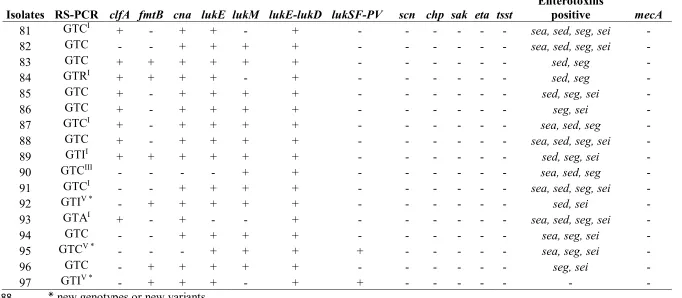
93
staphylokinase, sak, are integrated in the bacterial chromosome [4]. Furthermore, S. aureus can also
94
acquire the staphylococcal cassette chromosome SCCmec, giving rise to methicillin-resistant S.
95
aureus (MRSA) [5]. In fact, the expression of the mecA or mecC gene in S. aureus confers
96
resistance to most of β-lactams, drugs which are frequently used for treatment of mastitis [6].
97
The determination of the origin of the S. aureus isolates involved in the aetiology of bovine mastitis
98
is highly relevant from the epidemiological point of view. In such a context, the precise
99
characterization of this pathogen provides monitoring of the bacterial strains dissemination among
100
animal populations.
Over the past two decades, a wide range of phenotyping and genotyping methods have been used or
102
developed for S. aureus including, but not limited to, ribotyping, RAPD-typing, PFGE, MLST,
spa-103
typing, RS-PCR, coagulase gene RFLP, MLVA, micro-arrays and whole genome comparisons
[7-8-104
9-10-11]. Many molecular epidemiological studies have been based on the use of selected targets in
105
the genome, giving rise to banding patterns based on restriction- or primer binding sites, or to allelic
106
profiles for housekeeping or virulence genes [12]. Such studies continue to be useful diagnostic
107
tools when the aim is to understand pathogen sources and transmission mechanisms. Moreover,
108
among the genotyping methods, the RS-PCR showed to be accurate, rapid and inexpensive with a
109
discriminatory power like the other more-recognized genotyping methods [13].
110
The aim of this study was to genotype by RS-PCR and compare the molecular-epidemiologic
111
profiles of a large world collection of S. aureus isolates to deepen the knowledge on the circulating
112
genetic lineages among the cow population with mastitis.
113
114
Results 115
In this study, a total of 120 isolates collected from eight different countries were genotyped by
RS-116
PCR and analyzed for 26 virulence factors related to S. aureus pathogenicity, such as genes related
117
to host adhesion and invasion (clfA, cna, fmtB), genes that have the potential to interfere with host
118
defense mechanisms (tsst, scn, chp, sak, enterotoxins from sea to sel and leukotoxins), and the gene
119
encoding the acquisition of methicillin resistance (mecA).
120
121
RS-PCR Genotyping
122
New genotypes comprising GTAR, GTBZ, and GTCA were observed for South African strains
123
(Table 1). For all the other countries, at maximum new variants of existing genotypes were
124
detected. They included GTIV, GTIVI (Argentina), GTAQI, GTBNI, GTBNII, GTBYI (Brazil),
125
GTAOI, GTAOII (Colombia), GTRXIII (Italy), GTCV and GTIV (New York State). For each country,
126
a specific genotypic pattern was found. Major genotypes with their variants were combined into
genotypic clusters (CL) [14]. For Argentina (Table 1) it mainly consisted of CLI (56 % of GTI
128
variants) and CLR (25% of GTR variants), whereas for Brazil CLBN (20% of GTBN plus variants)
129
and CLBY (40% of GTBY plus a variants) were most prominent. The Colombian strains were
130
mainly positive for GTAO and its variants (CLAO, 60%). In the case of Germany and Italy, the
131
most prevalent genotypes were GTCI, GTR plus variants, and GTB, combined into CLC (30%),
132
CLR (64.7%) and CLB (29.4%), respectively. Finally, the main genotypes observed for the South
133
African and Tunisian strains were GTR and its variants (CLR, 45%), whereas the American strains
134
were mainly positive for GTC and variants of it (CLC, 70.6%). In conclusion, cluster C was
135
observed mostly in Germany and New York State, while CLR was widely disseminated in seven
136
countries; especially it was frequently detected in Argentina, Germany, Italy, South Africa and
137
Tunisia but less in Colombia and New York State.
138
All the existing genotypes including their variants such as GTC and GTCI had been previously
139
isolated from bovine intramammary infection or bovine milk. Exceptions were GTBH (sandwich
140
with Mozzarella) and GTAO (human nasal carriage).
141
142
Virulence genes
143
All the 120 isolates analyzed in this study were positive for coagulase (coa) and thermonuclease
144
(nuc) genes, but negative for a gene involved in host cell invasion, the exfoliative toxin (etb), and
145
for SEB and SEE enterotoxins. The distribution of the virulence genes for each country is described
146
in detail below.
147
148
Argentina
149
As reported in Table 2, all the Argentinian isolates were positive for a leucocidin (lukE-lukD) and
150
for an enterotoxin (sei), but negative for the gene encoding exfoliative toxin (eta), for mecA, sel and
151
sej. All strains were also negative for two mobile genetic element genes (chp, scn), while 5 carried
152
sak.
Out of 16 isolates, 15 (93.7%) had the genes encoding for lukE and clfA, 14 (87.5%) for a cell
wall-154
associated protein (fmtB), 13 (81.2%) harboured the genes encoding for collagen-binding protein
155
(cna), lukM and Panton-Valentine leucocidin lukSF-PV, whereas 5 (37.5%) were positive for sak
156
and/or for tsst, respectively.
157
All the 16 isolates were enterotoxigenic, harbouring at least one of the genes coding for A, C, D, G
158
and H enterotoxins genes. Three isolates from 3 different farms were positive for 5 different
159
enterotoxins (combination of sea, sec, seg, seh and sei or sea, sed, seg, seh and sei or sea, sed, seg,
160
seh and sei) while 8 isolates from 8 different farms were positive for 4 enterotoxins (combination of
161
sed, seg, seh and sei or sea, seg, seh). Four isolates, collected in 4 different farms, were positive for
162
3 enterotoxins genes (combination of sea, seg and sei or seg, seh and sei) and 1 isolates for 2
163
different enterotoxins genes (seh, sei).
164
165
Brazil
166
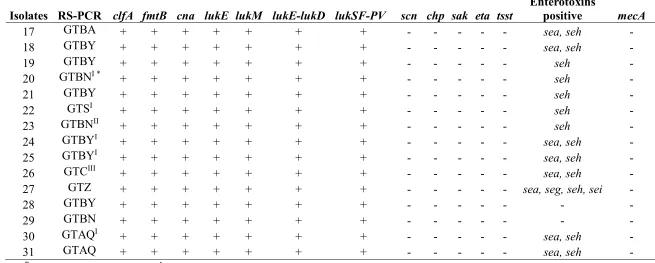
Isolates collected from Brazil were all positive for fmtB, cna, clfA and for the genes encoding
167
leucocidins (lukE, lukE-lukD, lukM, lukSF-PV) (Table 3). All the Brazilian isolates were negative
168
for genes carried on mobile genetic elements and usually present in isolates involved in human
169
infections, such as chp, scn, and sak. Moreover, they were negative for tsst, eta, mecA, and sec, sed,
170
sel, sej. Out of 15 isolates, 5 (33.3%) were positive for seh, 8 (53.3%) for both sea and seh, while a
171
single isolate (6.6%) harboured other 2 enterotoxin genes (seg, sei).
172
173
Colombia
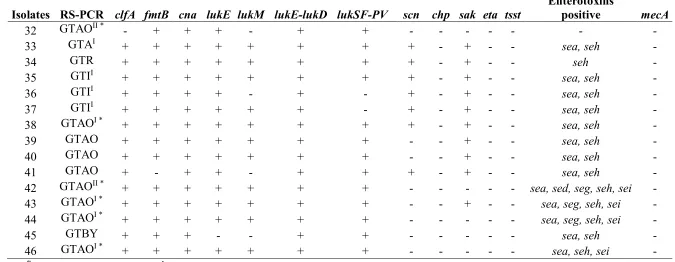
174
As shown in Table 4, all the Colombian isolates were positive for lukE-lukD and cna, but negative
175
for chp, tsst, eta, mecA and sec, sel, sej. Out of 15 isolates, 14 (93.4%) were positive for clfA and
176
fmtB genes, 13 (86.7%) for lukSF-PV, 10 (66.7%) for sak and lukM, and 7 (46.7%) for scn.
177
Fourteen (93.3%) isolates were enterotoxigenic harbouring at least one of the genes sea, sed, seg,
178
sei or seh.
The most frequently detected genes were seh (93.3%) and sea (86.6%), followed by sei (26.6%) and
180
seg (20%). One isolate harboured all the 5 enterotoxin genes (sea, sed, seg, seh and sei); 2 other
181
isolates coming from 2 different farms harboured 4 enterotoxin genes (sea, seg, seh and sei) and 1
182
isolate 3 enterotoxin genes (sea, seh and sei). Finally, 9 isolates, from 6 different farms, had the
183
combination of genes encoding for SEA and SEH.
184
185
Germany
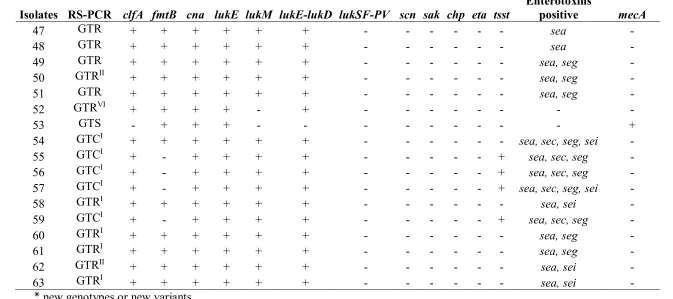
186
All the German isolates were positive for lukE and cna, but negative for the mobile genetic element
187
genes (chp, scn, sak), for eta, lukSF-PV and for enterotoxin genes sed, seh, sel, sej (Table 5). Out of
188
17 isolates, one (6%) harboured the mecA gene, 4 (23.5%) the tsst, 13 (76.5%) the fmtB, 15 (88.2%)
189
the lukM and 16 (94.1%) both clfA and lukE-lukD genes.
190
Fifteen isolates out of 17 (88.2%), collected from 15 different farms, were enterotoxigenic,
191
harbouring at least one of the genes coding for A, C, G and I enterotoxins. The most frequently
192
detected genes were sea (88.2%) and seg (58.8%), followed by sei and sec (29.4%). Two isolates
193
harboured all the 4 enterotoxin genes (sea, sec, seg, and sei); 3 and 8 other isolates harboured 3
194
(sea, sec, and seg) or 2 genes (combination of sea and seg, or sea and sei), respectively.
195
196
Italy
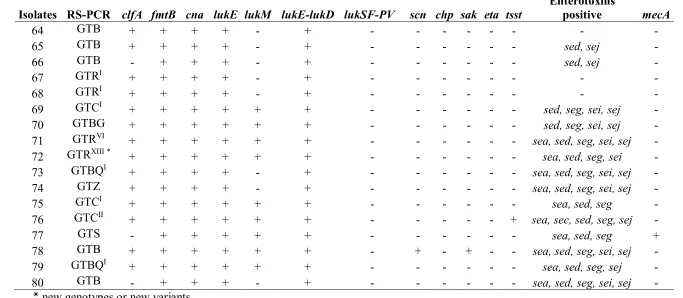
197
All the Italian isolates were positive for lukE, lukE-lukD, cna and fmtB, but negative for chp, eta,
198
lukSF-PV and seh, sel enterotoxin genes (Table 6). Out of 17 isolates, 14 (82.3%) were positive for
199
clfA and 9 (53%) had the gene encoding lukM. One isolate (6%) was positive for both scn and sak
200
genes, and other two different isolates were positive for tsst (6%) and mecA (6%), respectively.
201
Fourteen isolates out of 17 (82.3%) were enterotoxigenic, harbouring at least 1 of the genes coding
202
for A, C, D, G, I and J enterotoxins. The most frequently detected genes were sed (82.3%) and seg
203
(70.5%), followed by sej (64.7%), sea (58.8%) and sei (47%). Six isolates harboured 5 enterotoxin
204
genes (combination of sea, sed, seg, sei and sej, or sea, sed, seg, sec and sej); 4 other isolates
harboured 4 enterotoxin genes (combination of sea, sei, sed and seg, or sei, sed, seg and sej or sea,
206
sed, sej and seg). Moreover, 2 isolates harboured 3 different enterotoxins (sea, sed and seg) and 2
207
isolates, from the same farm, a combination of sed and sej.
208
209
NewYork State
210
As reported in Table 7, all the New York State isolates were positive for lukE-lukD, but negative for
211
chp, scn, sak, tsst, eta, mecA and sec, sel, seh, sej. Out of 17 isolates, 15 (88.2%) were positive for
212
cna and lukE, while 13 (76.4%) and 9 (53%) were positive for lukM and clfA genes, respectively. In
213
addition, 6 isolates (35.2%) and 2 (12%) had the fmtB and lukSF-PV genes, respectively. Only one
214
isolate was not enterotoxigenic; the remaining 16 isolates (95%) harboured at least one of the genes
215
encoding SEA, SED, SEG, SEI enterotoxins. Five isolates, collected from 5 different farms, had all
216
the enterotoxin genes (sea, sed, seg, sei); 6 isolates, from 6 different farms, harboured 3 genes
217
(combination of sea, sed and seg or sea, seg and sei or sed, seg and sei). Five isolates, from 4
218
different farms, had 2 enterotoxin genes (combination of sed and seg or seg and sei or sed and sei).
219
220
South Africa
221
As reported in Table 8, all the South African isolates were positive for sak, cna, lukE-lukD, lukE
222
genes. All the isolates were negative for chp, mecA, tsst and for sec, sed, seg, sej and sel. In
223
addition, 10 (90.9%) out of 11 isolates were positive for fmtB, 7 (63.7%) for clfA, 3 (27.3%) for
224
lukSF-PV, 2 (18.2%) for lukM and 1 (9%) for eta genes, respectively. Ten isolates, recovered in 9
225
different farms, were enterotoxigenic and positive for both sea and seh genes; out of them, 3
226
isolates from 2 different farms, harboured also the sei gene.
227
228
Tunisia
229
The Tunisian isolates were all positive for fmtB, cna and clfA genes, but negative for eta, mecA,
230
lukSF-PV and sea, sed, seg, sei, sej (Table 9). Out of 12 isolates, 11 (91.6%) harboured leucocidin
genes (lukM, lukE, lukE-lukD). Six isolates (50%) were positive for at least one gene of the immune
232
evasion cluster with the combination of chp, scn and sak for 2 isolates, scn and sak or chp and scn,
233
respectively, while the remaining 2 isolates harboured only the chp gene. Moreover, 4 isolates from
234
4 different farms, were enterotoxigenic harbouring sec and sel (2 isolates) or seh genes (2 isolates).
235
236
Discussion 237
Pathogenic factors of S. aureus enable this bacterium to attach, colonize, invade and infect the host
238
tissue. In this study, S. aureus isolates, collected from eight different countries, were investigated
239
using RS-PCR genotyping and PCR analysis for the carriage of different virulence factors to
240
examine the epidemiology of this microorganism.
241
The samples were obtained from collections of the collaborators, allowing a first overview about
242
the presence of the various staphylococcal subtypes among countries. Three new genotypes were
243
observed for South Africa whereas new variants were found in Argentina, Brazil, Colombia, Italy
244
and New York State. As previously described [14], GTB was observed only in Europe (Italy) while
245
CLR and CLC clusters were observed throughout America, Europe and Africa; particularly CLR
246
was detected in each country involved, except for Brazil.
247
And more, as previously described [15], S. aureus isolates harbouring genes coding for clumping
248
factor (clfA), a cell wall-associated protein (fmtB), and collagen-binding protein (cna) have a greater
249
capability to adhere to extracellular matrix proteins, essential for colonization and the establishment
250
of infections. Our results indicated that, except for the American isolates with a lower presence of
251
fmtB and clfA genes, in the other seven countries these genes were widely present in the circulating
252
isolates particularly in Brazilian and Tunisian ones.
253
And more, according to previous studies [11-13-15], except for Brazil, Germany and USA, the
254
remaining countries showed isolates encoding at least 2 virulence factors out of staphylococcal
255
complement inhibitor (scn), chemotaxis inhibitory protein of S. aureus (chp) and staphylokinase
256
(sak). These virulence factors show activity prevalently against the human innate immune system
but their presence among isolates recovered in herds with high prevalence of S. aureus mastitis
258
suggests their involvement also in bovine mammary gland immune response [16], and should be
259
further studied, especially in Colombia and Tunisia where this gene cluster is quite common [17]. In
260
a previous study [18], human strains were grouped in 7 immune evasion cluster (IEC) types,
261
depending on the presence of 2 out of the 3 genes, in association or not with sea or sep. Unlike
262
Colombian, Italian, South African strains and Tunisian isolates, the Argentinian ones carried only
263
one gene, sak, showing a clear distance from human strains. Among the isolates from the other
264
countries, uniquely the Tunisian strains testing positive for a IEC, did not harbor sea.
265
Superantigens, especially enterotoxins, have been suggested to play a role in the development of
266
mastitis, for instance by creating an attractive environment for colonization [19] since they are more
267
often identified in S. aureus isolated from cows with mastitis than in isolates from healthy cows or
268
from the environment [20]. As a result, enterotoxins support the pathogenesis of S. aureus
269
compromising mammary gland immune response and susceptibility to antibiotics resulting in the
270
onset of many diseases [21]. In this study, sea and sei were the main enterotoxins genes present in
271
all countries except for Tunisia (prevalence between 50 and 90 %). While seh gene had a frequency
272
higher than 90% in Argentinian, Brazilian, Colombian and South African isolates, sej and sel genes
273
were carried only by Italian and Tunisian isolates, respectively. Among the 120 isolates analyzed,
274
only 17 (14%) were not enterotoxigenic (1 from Argentina, 1 from Colombia, 2 isolates from
275
Germany, 3 from Italy, 1 from New York State, 1 from South Africa, and 8 from Tunisia). The
276
remaining 103 isolates (86%) harboured a combination of at least 2 up to 5 enterotoxins with the
277
linkages between sea, sed, seg and seh confirming their predominance in cows, as previously
278
described [22-23-24-25]. The absence of the enterotoxin genes seb and see in our isolates was in
279
accordance with previous results [15-23-26-27].
280
Here, among all the isolates we did not find the presence of etb exfoliative gene and only one
281
isolate from South Africa was positive for eta gene. These results agree with previous studies
282
conducted in different countries [28-29-30], showing that S. aureus isolates from animals with
mastitis were rarely positive for exfoliative toxins. On the contrary, in Europe, Kot and coworkers
284
reported a 14.5% of S. aureus harbouring the eta gene from bovine mastitis [31]. In our study, the
285
presence of tsst gene was more relevant, being carried by 37% of Argentinian, 23% of German,
286
16% of Tunisian and 6% of Italian isolates. All these isolates were also positive at least for a
287
combination of sec and sel, or sec, seg, and sei or sec, seg and sej or sec, seg and sel genes located
288
on the same bovine staphylococcal pathogenicity island (SaPIbov), confirming a positive
289
correlation between sec, sei or sej and tsst, as previously reported [32].
290
Panton-Valentine leucocidin, encoded by 2 co-transcribed genes located on a prophage, causes
291
leukocyte destruction and tissue necrosis [33]. The presence of PVL-encoding genes in S. aureus is
292
reported to be associated with increased disease severity [34]. In the present study, the presence of
293
PVL gene was lower than 20% in South Africa and New York State, higher than 80% in Argentina,
294
Colombia and Brazil, while in Germany, Italy and Tunisia none of the S. aureus isolates carried the
295
gene. For European countries, previously published results were in accordance with this study
[35-296
36]. Additionally, genes encoding the bicomponent leucotoxin lukE-lukD were observed in all
297
isolates, and, except for South Africa with only 2 isolates, most of the other isolates harboured
298
lukM, a gene encoding one operon like the one of PVL. The high rates of lukE-lukD and lukM found
299
in this study agree with other reports [35-37]. Additionally, only 2 isolates, one from Germany and
300
one from Italy were positive for mecA, confirming the low diffusion of MRSA among bovine
301
mastitis isolates [38-39]; interestingly, they are both GTS, in accordance with previous results [13].
302
303
Materials and methods 304
Sample collection and bacteriological analysis
305
A total of 120 S. aureus isolates from eight countries Argentina, Brazil, Colombia, Germany, Italy,
306
New York State, South Africa, Tunisia, (Figure 1), were selected for this study (Table 10). Isolates
307
of S. aureus were taken from the authors’ bacterial culture collections (BC) and they included
isolates previously collected (between 2012 and 2017) from clinical mastitis quarters (Q) or
309
composite samples (C), or high somatic cell count samples (H). The isolates were stored at -20°C
310
until they were transported to the Italian laboratory (University of Milan) where storage was
311
continued at −20°C until further use. During transport to the laboratory, they were kept frozen using
312
styrofoam boxes and dry ice (for long distances) or wet ice (for short distances).
313
After samples thawing, 10 l were streaked on blood agar plate. The plates were then incubated
314
aerobically at 37°C and examined after 24 h. The colonies were provisionally identified based on
315
morphology and hemolysis patterns and confirmed by coagulase test.
316
Figure 1. American, African and European countries contributing isolates of S. aureus to the
317
present study. Bacterial isolates were obtained from milk samples (clinical mastitis quarters,
318
composite samples, and high somatic cell count samples) taken in the indicated country (●)
319
(www.d-maps.com).
321
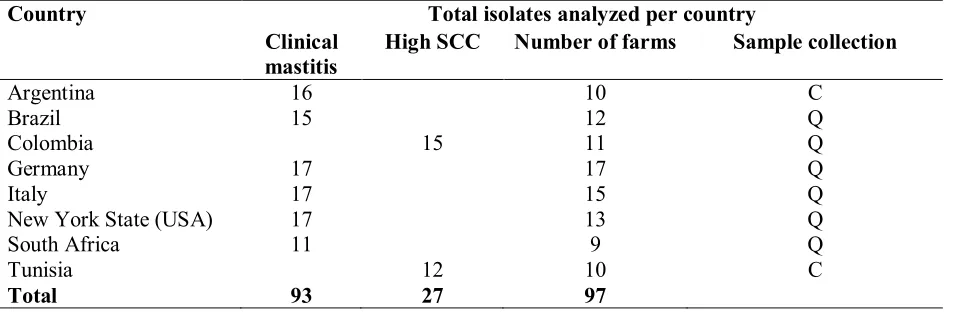
Table 10. World survey on S. aureus cow isolates: participating countries, total isolates analyzed
322
per country, number of isolated from clinical mastitis or high somatic cell count (SCC) samples,
323
and type of sample collection (C = composite milk sample; Q = quarter milk sample).
324
325
Country Total isolates analyzed per country
Clinical mastitis
High SCC Number of farms Sample collection
Argentina 16 10 C
Brazil 15 12 Q
Colombia 15 11 Q
Germany 17 17 Q
Italy 17 15 Q
New York State (USA) 17 13 Q
South Africa 11 9 Q
Tunisia 12 10 C
DNA extraction
326
DNA was extracted from isolates using the protocol previously described by Cremonesi and
co-327
workers [40]. The amount and quality of DNA were measured using a NanoDrop ND-1000
328
spectrophotometer (Nano-Drop Technologies, Wilmington, DE, USA), and DNA was stored at
329
−20°C until use.
330
331
Genotyping
332
All the 120 nuc positive isolates (= S. aureus) were then genotyped by RS-PCR and a miniaturized
333
electrophoresis system (Agilent Technologies, Santa Clara, USA) as previously described [23; 41]
334
where a detailed working protocol is given. The method is based on amplification of the 16S–23S
335
rRNA intergenic spacer region. Each reaction contained (total volume 25 l) 1x HotStarTaq Master
336
Mix (Qiagen), 800 nM of each primer (G1 and L1 primer) [23] and 7 l of DNA (originally
337
extracted DNA diluted 1:100 in water). The PCR profile was: 95 °C for 15 min, followed by 27
338
cycles comprising 94 °C for 1 min, followed by a 2 min ramp and annealing at 55 °C for 7 min.
339
After a further 2 min ramp, extension was done at 72 °C for 2 min. PCR was terminated by
340
incubating at 72 °C for 10 min followed by cooling down to 4 °C. One l of each of the PCR
341
products was then used for the miniaturized electrophoresis (Agilent) performed as described by the
342
manufacturer of the system. New genotypes were named and extended according to Fournier and
343
co-workers [23] leading to the genotypes GTA to GTZ, followed by the genotypes GTAA to
344
GTAZ, GTBA to GTBZ, and GTCA. An electrophoretic pattern differing in one band from the one
345
of a known genotype was considered as a genotypic variant. It was indicated with roman numerals
346
superscripted after the name of the genotype (e.g. GTRI, GTRII). To identify the genotypes and their
347
variants of the present strains, a freely available, in-house computer program was applied [42].
348
349
Molecular isolates characterization
The DNA was amplified to investigate the presence of 26 factors that can contribute in different
351
ways to S. aureus pathogenicity and therefore influence the management of the disease. In this
352
study genes encoding enterotoxins (from sea to sel), leucocidins (lukE, lukS–lukF/PV, lukE-lukD,
353
lukM), the acquisition of methicillin resistance (mecA) and genes related to host invasion (clfA,
354
fmtB, cna, eta, etb) or to factors that have the potential to interfere with host defense mechanisms
355
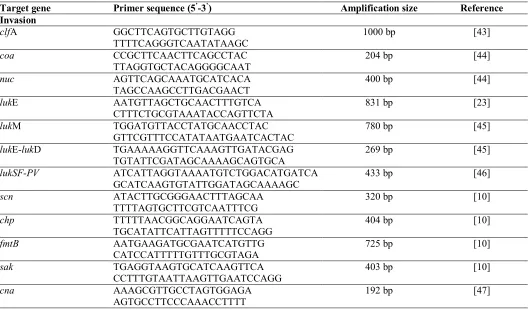
(tsst, scn, chp, sak) were analyzed using primers and protocols described in literature and listed in
356
Table 11. The amplified PCR fragments were visualized on 2% agarose gel electrophoresis
357
(GellyPhor, Euroclone, Milan, Italy), stained with ethidium bromide (0.05 mg/ml; Sigma Aldrich,
358
Milan, Italy), and visualized by UV transilluminator (BioView Ltd, Nes Ziona, Israel). A 100 bp
359
DNA ladder (Finnzymes, Espoo, Finland) was included in each gel.
360
361
Table 11. Primer used in this study for S. aureus isolates characterization.
362
363
Target gene Primer sequence (5’-3’) Amplification size Reference Invasion
clfA GGCTTCAGTGCTTGTAGG 1000 bp [43]
TTTTCAGGGTCAATATAAGC
coa CCGCTTCAACTTCAGCCTAC 204 bp [44]
TTAGGTGCTACAGGGGCAAT
nuc AGTTCAGCAAATGCATCACA 400 bp [44]
TAGCCAAGCCTTGACGAACT
lukE AATGTTAGCTGCAACTTTGTCA 831 bp [23]
CTTTCTGCGTAAATACCAGTTCTA
lukM TGGATGTTACCTATGCAACCTAC 780 bp [45]
GTTCGTTTCCATATAATGAATCACTAC
lukE-lukD TGAAAAAGGTTCAAAGTTGATACGAG 269 bp [45] TGTATTCGATAGCAAAAGCAGTGCA
lukSF-PV ATCATTAGGTAAAATGTCTGGACATGATCA 433 bp [46]
GCATCAAGTGTATTGGATAGCAAAAGC
scn ATACTTGCGGGAACTTTAGCAA 320 bp [10]
TTTTAGTGCTTCGTCAATTTCG
chp TTTTTAACGGCAGGAATCAGTA 404 bp [10]
TGCATATTCATTAGTTTTTCCAGG
fmtB AATGAAGATGCGAATCATGTTG 725 bp [10]
CATCCATTTTTGTTTGCGTAGA
sak TGAGGTAAGTGCATCAAGTTCA 403 bp [10]
CCTTTGTAATTAAGTTGAATCCAGG
cna AAAGCGTTGCCTAGTGGAGA 192 bp [47]
AGTGCCTTCCCAAACCTTTT
tsst ATGGCAGCATCAGCTTGATA 300 bp [43] TTTCCAATAACCACCCGTTT
eta CTAGTGCATTTGTTATTCAA 120 bp [43]
TGCATTGACACCATAGTACT
etb ACGGCTATATACATTCAATT 200 bp [43]
TCCATCGATAATATACCTAA
sea TAAGGAGGTGGTGCCTATGG 180 bp [44]
CATCGAAACCAGCCAAAGTT
seb TCGCATCAAACTGACAAACG 478 bp [45]
GCAGGTACTCTATAAGTGCC
sec ACCAGACCCTATGCCAGATG 371 bp [44]
TCCCATTATCAAAGTGGTTTCC
sed TCAATTCAAAAGAAATGGCTCA 339 bp [44]
TTTTTCCGCGCTGTATTTTT
see TACCAATTAACTTGTGGATAGAC 170 bp [48]
CTCTTTGCACCTTACCGC
seg CCACCTGTTGAAGGAAGAGG 432 bp [44]
TGCAGAACCATCAAACTCGT
seh TCACATCATATGCGAAAGCAG 463 bp [44]
TCGGACAATATTTTTCTGATCTTT
sei CTCAAGGTGATATTGGTGTAGG 529 bp [44]
CAGGCAGTCCATCTCCTGTA
sej GGTTTTCAATGTTCTGGTGGT 306 bp [44]
AACCAACGGTTCTTTTGAGG
sel CACCAGAATCACACCGCTTA 240 bp [44]
CTGTTTGATGCTTGCCATTG Antibiotic resistance
mecA GTAGAAATGACTGAACGTCCGATAA 310 bp [46]
CCAATTCCACATTGTTTCGGTCTAA
364
Conclusions 365
Knowledge about the epidemiology of S. aureus genotypes in dairy species and herds might help to
366
formulate strategies for reducing the infection spreading and for focused treatments. In our work we
367
found that CLR and CLC clusters and some virulence factors related to host invasion, such as fmtB,
368
cna, clfA or immune defense impairment such as leukocidin genes, were the most frequent ones.
369
Further, fmtB gene has been shown to be related to the resistance of S. aureus to -lactam
370
antibiotics [10]. Therefore, due to the prevalence of these genes worldwide, it might be useful
371
screening them in S. aureus isolates to help predicting clinical outcomes and specially to identify
372
harmful strains. Meanwhile, our work demonstrated also that each country had a specific genotypic
373
pattern and in some countries the isolates harboured some virulence factors, such as PVL-encoding
374
genes, with high prevalence, recommending a close surveillance of S. aureus isolates in the animals
375
of these countries to avoid the wide spreading of these genes. Finally, it is notable that most of the
isolates worldwide were negative for mecA, confirming the evidence of the low diffusion of MRSA
377
among bovine mastitis isolates, as previously described [38-39].
378
In conclusion, this study confirms the wide variety of S. aureus genotypes found in dairy cattle
379
worldwide and that genetic differences are related to geographical origin of the isolates, suggesting
380
that considering the region of interest might help to formulate strategies directed to reduce the
381
infection spreading and to set up control measures according to pathogen and host features.
382
383
Author Contributions
384
Valentina Monistero performed and analyzed the data; Hans Graber analyzed the RS-PCR
385
genotypes; Claudia Pollera contributed to obtain samples and isolated from Italy; Paola Cremonesi
386
performed and designed experiments, analyzed the data and wrote the manuscript; Bianca
387
Castiglioni designed experiments and wrote the manuscript; Enriqueta Bottini contributed to obtain
388
samples and isolated from Argentina; Alejandro Ceballos-Marquez contributed to obtain samples
389
and isolated from Colombia; Laura Lasso-Rojas contributed to obtain samples and isolated from
390
Colombia; Volker Kroemker contributed to obtain samples and isolated from Germany; Nicole
391
Wente contributed to obtain samples and isolated from Germany; Inge-Marie Petzer contributed to
392
obtain samples and isolated from South Africa; Carlos Santisteban contributed to obtain samples
393
and isolated from New York State; Jeff Runyan contributed to obtain samples and isolated from
394
New York State; Marcos Veiga Santos contributed to obtain samples and isolated from Brazil;
395
Bruna Gomes Alves contributed to obtain samples and isolated from Brazil; Renata Piccinini
396
contributed to obtain samples and isolated from Italy; Valerio Bronzo contributed to all logistic and
397
project organization; Mohamed Salah Abbassi contributed to obtain samples and isolated from
398
Tunisia; Meriam Ben Saidcontributed to obtain samples and isolated from Tunisia; Paolo Moroni
399
designed experiments, analyzed the data and wrote the manuscript.
400
401
Conflicts of Interest
The authors declare that they have not conflict of interest.
403
404
References 405
1. Deb, R.; Kumar, A.; Chakraborty, S.; Verma, A.K.; Tiwari, R.; Dhama, K.; Singh, U.; Kumar,
406
S. Trends in diagnosis and control of bovine mastitis: a review. Pak J Biol Sci. 2013, 1,16 (23), 407
1653-1661. 408
2. Gomes, F.; Henriques, M. Control of Bovine Mastitis: Old and Recent Therapeutic Approaches.
409
Curr Microbiol. 2016, 72(4), 377-382. 410
3. Foster, TJ. Immune evasion by staphylococci. Nat Rev Microbiol. 2005, 3(12), 948-58.
411
4. van Wamel, WJ.; Rooijakkers, SH.; Ruyken, M.; van Kessel, KP.; van Strijp, JA. The innate
412
immune modulators staphylococcal complement inhibitor and chemotaxis inhibitory protein of 413
Staphylococcus aureus are located on beta-hemolysin-converting bacteriophages. J Bacteriol.
414
2006, 188(4), 1310-1315. 415
5. Pantosti, A. Methicillin-Resistant Staphylococcus aureus associated with animals and its
416
relevance to human health. Front Microbiol. 2012, 9, 3:127. 417
6. Sawant, A.A.; Sordillo, LM.; Jayarao, B.M. A survey on antibiotic usage in dairy herds in
418
Pennsylvania. J Dairy Sci. 2005, 88(8), 2991-2999. 419
7. Fitzgerald, J.R.; Meaney, W.J.; Hartigan, P.J; Smyth, C.J.; Kapur, V. Fine-structure molecular
420
epidemiological analysis of Staphylococcus aureus recovered from cows. Epidemiol Infect.
421
1997, 119(2), 261-269. 422
8. Sommerhäuser, J.; Kloppert, B.; Wolter, W.; Zschöck, M.; Sobiraj, A.; Failing, K. The
423
epidemiology of Staphylococcus aureus infections from subclinical mastitis in dairy cows
424
during a control programme. Vet Microbiol. 2003, 8,96(1), 91-102. 425
9. Herron-Olson, L.; Fitzgerald, J.R.; Musser, J.M.; Kapur, V. Molecular correlates of host
426
10.Sung, J.M.; Lloyd, D.H.; Lindsay, J.A. Staphylococcus aureus host specificity: comparative 428
genomics of human versus animal isolates by multi-strain microarray. Microbiol. 2008, 154,
429
1949-1959. 430
11.Ikawaty, R.; Brouwer, E.C.; Jansen, M.D.; van Duijkeren, E.; Mevius, D.; Verhoef, J.; Fluit,
431
A.C. Characterization of Dutch Staphylococcus aureus from bovine mastitis using a Multiple
432
Locus Variable Number Tandem Repeat Analysis. Vet Microbiol. 2009, 12,136(3-4), 277-284. 433
12. Zadoks, RN.; Middleton, JR.; McDougall, S.; Katholm, J.; Schukken, YH. Molecular
434
epidemiology of mastitis pathogens of dairy cattle and comparative relevance to humans. J
435
Mammary Gland Biol Neoplasia. 2011, 16(4), 357-372. 436
13. Cremonesi, P.; Pozzi, F.; Raschetti, M.; Bignoli, G.; Capra, E.; Graber, H.U.; Vezzoli, F.;
437
Piccinini, R.; Bertasi, B.; Biffani, S.; Castiglioni, B.; Luini M. Genomic characteristics of 438
Staphylococcus aureus strains associated with high within-herd prevalence of intramammary 439
infections in dairy cows. J Dairy Sci. 2015, 98(10), 6828-6838. 440
14.Cosandey, A.; Boss, R.; Luini, M.; Artursson, K.; Bardiau, M.; Breitenwieser, F.; Hehenberger,
441
E.; Lam, T.; Mansfeld, M.; Michel, A.; Mösslacher, G.; Naskova, J.; Nelson, S.; Podpečan, O.;
442
Raemy, A.; Ryan, E.; Salat, O.; Zangerl, P.; Steiner, A.; Graber, HU. Staphylococcus aureus
443
genotype B and other genotypes isolated from cow milk in European countries. J Dairy Sci.
444
2016, 99(1), 529-540.
445
15.Cremonesi, P.; Zottola, T.; Locatelli, C.; Pollera, C.; Castiglioni, B.; Scaccabarozzi, L.; Moroni
446
P. Identification of virulence factors in 16S-23S rRNA intergenic spacer genotyped 447
Staphylococcus aureus isolated from water buffaloes and small ruminants. J Dairy Sci. 2013,
448
96(12), 7666-7674. 449
16.Magro, G.; Biffani, S.; Minozzi, G.; Ehricht, R.; Monecke, S.; Luini, V.; Piccinini, R. Virulence
450
genes of S. aureus from dairy cow mastitis and contagiousness risk. Toxins 2017, 9, 195.
451
17.Ben Said, M.; Abbassi, M.S.; Bianchini, V.; Sghaier, S.; Cremonesi, P.; Romanò, A.; Gualdi,
452
V.; Hassen, A.; Luini, M.V. Genetic characterization and antimicrobial resistance of
Staphylococcus aureus isolated from bovine milk in Tunisia. Lett Appl Microbiol. 2016, 63(6),
454
473-481.
455
18.van Wamel, WJ.; Rooijakkers, SH.; Ruyken, M.; van Kessel, KP.; van Strijp, JA. The innate
456
immune modulators staphylococcal complement inhibitor and chemotaxis inhibitory protein of
457
Staphylococcus aureus are located on beta-hemolysin-converting bacteriophages. J Bacteriol.
458
2006, 188(4), 1310-1315.
459
19.Piccinini, R.; Borromeo, V.; Zecconi, A. Relationship between Staphylococcus aureus gene
460
pattern and dairy herd mastitis. Vet Microbiol. 2010, 145, 100–105.
461
20.Piechota, M.; Kot, B.; Zdunek, E.; Mitrus, J.; Wicha, J.; Wolska, M.K.; Sachanowicz, K.
462
Distribution of classical enterotoxin genes in staphylococci from milk of cows with- and
463
without mastitis and the cowshed environment. Pol J Vet Sci. 2014, 17, 407–411.
464
21.El-Sayed, A.; Alber, J.; Lammler, C.; Jager, S.; Woter, W.; Vázquez, H. Comparative study on
465
genotypic properties of Staphylococcus aureus isolated from clinical and subclinical mastitis in
466
Mexico. Vet Mex. 2006, 37(2), 165–179.
467
22.Haveri, M.; Roslöf, A.; Rantala, L.; Pyörälä, S. Virulence genes of bovine Staphylococcus
468
aureus from persistent and nonpersistent intramammary infections with different clinical
469
characteristics. J Appl Microbiol. 2007, 103(4), 993-1000. 470
23.Fournier, C.; Kuhnert, P.; Frey, J.; Miserez, R.; Kirchhofer, M.; Kaufmann, T.; Steiner, A.;
471
Graber, H.U. Bovine Staphylococcus aureus: Association of virulence genes, genotypes and
472
clinical outcome. Res Vet Sci. 2008, 85, 439–448. 473
24.Artursson, K.; Söderlund, R.; Liu, L.; Monecke, S.; Schelin, J. Genotyping of Staphylococcus
474
aureus in bovine mastitis and correlation to phenotypic characteristics. Vet Microbiol. 2016,
475
25,193, 156-161.
476
25.Sharma, V.; Sharma, S.; Dahiya, D.K.; Khan, A.; Mathur, M.; Sharma, A. Coagulase gene
477
polymorphism, enterotoxigenecity, biofilm production, and antibiotic resistance in
Staphylococcus aureus isolated from bovine raw milk in North West India. Ann Clin Microbiol
479
Antimicrob. 2017, 20,16(65),1-14.
480
26.Bystroń, J.; Bania, J.; Lis, E.; Molenda, J.; Bednarski, M. Characterisation of Staphylococcus
481
aureus strains isolated from cows’ milk. Bulletin of the Veterinary Institute in Pulawy. 2009, 53,
482
59–63.
483
27.Ote, I.; Taminiau, B.; Duprez, J.N.; Dizier, I.; Mainil, J.G. Genotypic characterization by
484
polymerase chain reaction of Staphylococcus aureus isolates associated with bovine mastitis.
485
Vet Microbiol. 2011, 153, 285– 292.
486
28.Darwish, S.F.; Asfour, H.A. Investigation of biofilm forming ability in Staphylococci causing
487
bovine mastitis using phenotypic and genotypic assays. Sci World J. 2013, 2013, 1–9.
488
29.Silveira-Filho, V.M.; Luz, I.S.; Campos, A.P.; Silva, W.M.; Barros, M.P.; Medeiros, E.S.;
489
Freitas, M.F.; Mota, R.A.; Sena, M.J.; Leal-Balbino, T.C. Antibiotic resistance and molecular
490
analysis of Staphylococcus aureus isolated from cow’s milk and dairy products in northeast
491
Brazil. J Food Protection. 2014, 77, 583–591.
492
30.Akindolire, M.A.; Babalola, O.O.; Ateba, C.N. Detection of Antibiotic Resistant
493
Staphylococcus aureus from Milk: A Public Health Implication. Int J Environ Res Public
494
Health. 2015, 25,12(9), 10254-10275.
495
31.Kot, B.; Szweda, P.; Frankowska-Maciejewska, A.; Piechota, M.; Wolska, K. Virulence gene
496
profiles in Staphylococcus aureus isolated from cows with subclinical mastitis in eastern Poland
497
J Dairy Res. 2016,83(2), 228-235.
498
32.Zschöck, M.; Kloppert, B.; Wolter, W.; Hamann, H.P.; Lammler, C.H. Pattern of enterotoxin
499
genes seg, seh, sei and sej positive Staphylococcus aureus isolated from bovine mastitis. Vet
500
Microbiol. 2005, 108, 243–249. 501
33.Bhatta, D.R.; Cavaco, L.M.; Nath, C.; Kumar, K.; Gaur, A.; Gokhale, S.; Bhatta D.R.
502
Association of Panton Valentine leukocidin (PVL) genes with methicillin-resistant
Staphylococcus aureus (MRSA) in Western Nepal: A matter of concern for community
504
infections (a hospital based prospective study). BMC Infec Dis. 2016, 16, 199.
505
34.Shariati, L.; Validi, M.; Hasheminia, A.M.; Ghasemikhah, R.; Kianpour, F.; Karimi, A.; Nafisi,
506
M.R.; Tabatabaiefar M.A. Staphylococcus aureus isolates carrying Panton-Valentine leucocidin
507
genes: Their frequency, antimicrobial patterns, and association with infectious disease in
508
Shahrekord city, Southwest Iran. Jundishapur J Microbiol. 2016, 9, e28291.
509
35.Fueyo, J. M.; Mendoza, M.C.; Rodicio, M.R.; Muñiz, J.; Alvarez, M.A.; Martín, M.C.
510
Cytotoxin and pyrogenic toxin superantigen gene profiles of Staphylococcus aureus associated
511
with subclinical mastitis in dairy cows and relationships with macrorestriction genomic profiles.
512
J Clin Microbiol. 2005, 43, 1278–1284.
513
36.Parisi, A.; Caruso, M.; Normanno, G.; Latorre, L.; Sottili, R.; Miccolupo, A.; Fraccalvieri, R.;
514
Santagada G. Prevalence, antimicrobial susceptibility and molecular typing of
methicillin-515
resistant Staphylococcus aureus (MRSA) in bulk tank milk from southern Italy. Food
516
Microbiol. 2016, 58, 36–42.
517
37.Schlotter, K.; Ehricht, R.; Hotzel, H.; Monecke, S.; Pfeffer, M.; Donat, K. Leukocidin genes
518
lukF-P83 and lukM are associated with Staphylococcus aureus clonal complexes 151, 479 and
519
133 isolated from bovine udder infections in Thuringia, Germany. Vet Res. 2012, 43, 42.
520
38.Luini M.; Cremonesi P.; Magro G.; Bianchini V.; Minozzi G.; Castiglioni B.; Piccinini R.
521
Methicillin-resistant Staphylococcus aureus (MRSA) is associated with low within-herd
522
prevalence of intra-mammary infections in dairy cows: genotyping of isolates. Vet Microbiol.
523
2015, 178(3-4), 270-274.
524
39.Hendriksen, R. S.; Mevius, D.J.; Schroeter, A.; Teale, C.; Meunier, D.; Butaye, P.; Franco, A.;
525
Utinane, A.; Amado, A.; Moreno, M.; Greko, C.; Stärk, K.; Berghold, C.; Myllyniemi, A.L.;
526
Wasyl, D.; Sunde, M.; Aarestrup, F.M. Prevalence of antimicrobial resistance among bacterial
527
pathogens isolated from cattle in different European countries: 2002–2004. Acta Vet Scand.
528
2008, 50, 28.
40.Cremonesi, P.; Castiglioni, B.; Malferrari, G.; Biunno, I.; Vimercati, C.; Moroni, P.; Morandi,
530
S.; Luzzana, M. Technical Note: Improved method for rapid DNA extraction of mastitis
531
pathogens directly from milk. J Dairy Sci. 2006, 89, 163–169.
532
41.Graber HU. Genotyping of Staphylococcus aureus by Ribosomal Spacer PCR (RS-PCR). J Vis
533
Exp. 2016, (117). doi: 10.3791/54623.
534
42.Syring, C., Boss, R., Reist, M., Bodmer, M., Hummerjohann, J., Gehrig, P., Graber, HU. Bovine
535
mastitis: the diagnostic properties of a PCR-based assay to monitor the Staphylococcus aureus
536
genotype B status of a herd, using bulk tank milk. J Dairy Sci. 2012, 95(7), 3674-3682.
537
43.Akineden, O.; Annemuller, C.; Hassan, A.A.; Lammler, C.; Wolter, W.; Zschock, M. Toxin 538
genes and other characteristics of Staphylococcus aureus isolates from milk of cows with
539
mastitis. Clin Diag Lab Immunol. 2001, 8, 959–964. 540
44.Cremonesi, P.; Luzzana, M.; Brasca, M.; Morandi, S.; Lodi, R.; Vimercati, C.; Agnellini, D.;
541
Caramenti, G.; Moroni, P.; Castiglioni, B. Development of a multiplex PCR assay for the 542
identification of Staphylococcus aureus enterotoxigenic strains isolated from milk and dairy
543
products. Mol Cell Probes. 2005, 19(5), 299-305. 544
45.Jarraud, S.; Mougel, C.; Thioulouse, J.; Lina, G.; Meugnier, H.; Forey, F.; Nesme, X.; Etienne,
545
J.; Vandenesch, F. Relationships between Staphylococcus aureus genetic background, virulence 546
factors, agr groups (alleles), and human disease. Infect Immun. 2001, 70, 631–641. 547
46.McClure, J.A.; Conly, J. M.; Lau, V.; Elsayed, S.; Louie, T.; Hutchins, W.; Zhang, K. Novel
548
multiplex PCR assay for detection of the staphylococcal virulence marker Panton-Valentine 549
leukocidin genes and simultaneous discrimination of methicillin-susceptible from -resistant 550
staphylococci. J Clin Microbiol. 2006, 44, 1141–1144. 551
47.Zecconi, A.; Cesaris, L.; Liandris, E.; Dapra, V.; Piccinini; R. Role of several Staphylococcus
552
aureus virulence factors on the inflammatory response in bovine mammary gland. Microb
553
Pathog. 2006, 40, 177–183.
48.Monday, S.R.; Bohach, G.A. Use of multiplex PCR to detect classical and newly described 555
pyrogenic toxin genes in staphylococcal isolates. J Clin Microbiol. 1999, 37, 3411–3414.
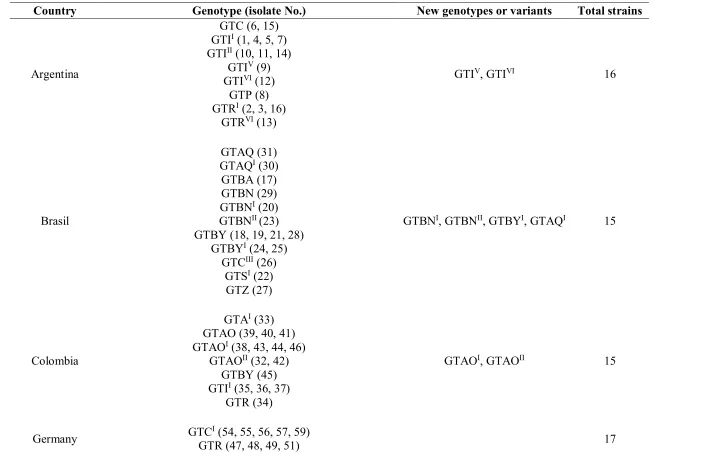
Table 1. Distribution of genotypes in the eight countries.
557
Country Genotype (isolate No.) New genotypes or variants Total strains
Argentina
GTC (6, 15) GTII (1, 4, 5, 7) GTIII (10, 11, 14)
GTIV (9) GTIVI (12)
GTP (8) GTRI (2, 3, 16)
GTRVI (13)
GTIV, GTIVI 16
Brasil
GTAQ (31) GTAQI (30) GTBA (17) GTBN (29) GTBNI (20) GTBNII (23) GTBY (18, 19, 21, 28)
GTBYI (24, 25) GTCIII (26)
GTSI (22) GTZ (27)
GTBNI, GTBNII, GTBYI, GTAQI 15
Colombia
GTAI (33) GTAO (39, 40, 41) GTAOI (38, 43, 44, 46)
GTAOII (32, 42) GTBY (45) GTII (35, 36, 37)
GTR (34)
GTAOI, GTAOII 15
Germany GTC
I (54, 55, 56, 57, 59)
GTRI (58, 60, 61, 63) GTRII (50, 62)
GTRVI (52) GTS (53)
Italy
GTB (64, 65, 66, 78, 80) GTBG (70) GTBQI (73, 79)
GTCI (69, 75) GTCII (76) GTRI (67, 68)
GTRXIII (72) GTRVI (71)
GTS (77) GTZ (74)
GTRXIII 17
New York State
GTAI (93)
GTC (82, 83, 85, 86, 88, 94, 96) GTCI (81, 87, 91)
GTCIII (90) GTCV (95) GTII (89) GTIV (97) GTRI (84)
GTCV, GTIV 17
South Africa
GTAR (101) GTBH (98) GTBZ (99, 100, 105)
GTCA (103) GTR (102, 104, 107, 108)
GTRVI (106)
GTAR, GTBZ, GTCA 11
Tunisia GTAJ (111)
GTCA (113, 114) GTCB (119)
GTRI (109)
GTRVI (112, 115, 116, 117, 118, 120)
558
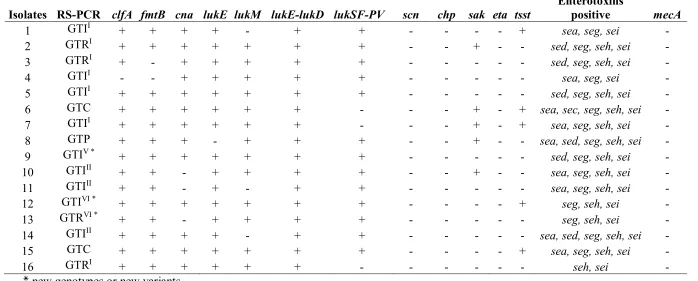
Table 2. Molecular characteristics of strains isolated in Argentina.
560
Isolates RS-PCR clfA fmtB cna lukE lukM lukE-lukD lukSF-PV scn chp sak eta tsst
Enterotoxins
positive mecA
1 GTII + + + + - + + - - - - + sea, seg, sei -
2 GTRI + + + + + + + - - + - - sed, seg, seh, sei -
3 GTRI + - + + + + + - - - sed, seg, seh, sei -
4 GTII - - + + + + + - - - sea, seg, sei -
5 GTII + + + + + + + - - - sed, seg, seh, sei -
6 GTC + + + + + + - - - + - + sea, sec, seg, seh, sei -
7 GTII + + + + + + - - - + - + sea, seg, seh, sei -
8 GTP + + + - + + + - - + - - sea, sed, seg, seh, sei -
9 GTIV * + + + + + + + - - - sed, seg, seh, sei -
10 GTIII + + - + + + + - - + - - sea, seg, seh, sei -
11 GTIII + + - + - + + - - - sea, seg, seh, sei -
12 GTIVI * + + + + + + + - - - - + seg, seh, sei -
13 GTRVI * + + - + + + + - - - seg, seh, sei -
14 GTIII + + + + - + + - - - sea, sed, seg, seh, sei -
15 GTC + + + + + + + - - - - + sea, seg, seh, sei -
16 GTRI + + + + + + - - - seh, sei -
new genotypes or new variants.
561
562
Table 3. Molecular characteristics of strains isolated in Brazil.
564
Isolates RS-PCR clfA fmtB cna lukE lukM lukE-lukD lukSF-PV scn chp sak eta tsst
Enterotoxins
positive mecA
17 GTBA + + + + + + + - - - sea, seh -
18 GTBY + + + + + + + - - - sea, seh -
19 GTBY + + + + + + + - - - seh -
20 GTBNI * + + + + + + + - - - seh -
21 GTBY + + + + + + + - - - seh -
22 GTSI + + + + + + + - - - seh -
23 GTBNII + + + + + + + - - - seh -
24 GTBYI + + + + + + + - - - sea, seh -
25 GTBYI + + + + + + + - - - sea, seh -
26 GTCIII + + + + + + + - - - sea, seh -
27 GTZ + + + + + + + - - - sea, seg, seh, sei -
28 GTBY + + + + + + + - - - -
29 GTBN + + + + + + + - - - -
30 GTAQI + + + + + + + - - - sea, seh -
31 GTAQ + + + + + + + - - - sea, seh -
new genotypes or new variants.
565
566
567
568
569
Table 4. Molecular characteristics of strains isolated in Colombia.
571
Isolates RS-PCR clfA fmtB cna lukE lukM lukE-lukD lukSF-PV scn chp sak eta tsst
Enterotoxins
positive mecA
32 GTAOII * - + + + - + + - - - -
33 GTAI + + + + + + + + - + - - sea, seh -
34 GTR + + + + + + + + - + - - seh -
35 GTII + + + + + + + + - + - - sea, seh -
36 GTII + + + + - + - + - + - - sea, seh -
37 GTII + + + + + + - + - + - - sea, seh -
38 GTAOI * + + + + + + + + - + - - sea, seh -
39 GTAO + + + + + + + - - + - - sea, seh -
40 GTAO + + + + + + + - - + - - sea, seh -
41 GTAO + - + + - + + + - + - - sea, seh -
42 GTAOII * + + + + + + + - - - sea, sed, seg, seh, sei -
43 GTAOI * + + + + + + + - - + - - sea, seg, seh, sei -
44 GTAOI * + + + + + + + - - - sea, seg, seh, sei -
45 GTBY + + + - - + + - - - sea, seh -
46 GTAOI * + + + + + + + - - - sea, seh, sei -
new genotypes or new variants.
572
573
574
575
Table 5. Molecular characteristics of strains isolated in Germany.
577
Isolates RS-PCR clfA fmtB cna lukE lukM lukE-lukD lukSF-PV scn sak chp eta tsst
Enterotoxins
positive mecA
47 GTR + + + + + + - - - sea -
48 GTR + + + + + + - - - sea -
49 GTR + + + + + + - - - sea, seg -
50 GTRII + + + + + + - - - sea, seg -
51 GTR + + + + + + - - - sea, seg -
52 GTRVI + + + + - + - - - -
53 GTS - + + + - - - +
54 GTCI + + + + + + - - - sea, sec, seg, sei -
55 GTCI + - + + + + - - - + sea, sec, seg -
56 GTCI + - + + + + - - - + sea, sec, seg -
57 GTCI + - + + + + - - - + sea, sec, seg, sei -
58 GTRI + + + + + + - - - sea, sei -
59 GTCI + - + + + + - - - + sea, sec, seg -
60 GTRI + + + + + + - - - sea, seg -
61 GTRI + + + + + + - - - sea, seg -
62 GTRII + + + + + + - - - sea, sei -
63 GTRI + + + + + + - - - sea, sei -
new genotypes or new variants.
578
579
Table 6. Molecular characteristics of strains isolated in Italy.
581
Isolates RS-PCR clfA fmtB cna lukE lukM lukE-lukD lukSF-PV scn chp sak eta tsst
Enterotoxins
positive mecA
64 GTB + + + + - + - - - -
65 GTB + + + + - + - - - sed, sej -
66 GTB - + + + - + - - - sed, sej -
67 GTRI + + + + - + - - - -
68 GTRI + + + + - + - - - -
69 GTCI + + + + + + - - - sed, seg, sei, sej -
70 GTBG + + + + + + - - - sed, seg, sei, sej -
71 GTRVI + + + + + + - - - sea, sed, seg, sei, sej -
72 GTRXIII * + + + + + + - - - sea, sed, seg, sei -
73 GTBQI + + + + - + - - - sea, sed, seg, sei, sej -
74 GTZ + + + + - + - - - sea, sed, seg, sei, sej -
75 GTCI + + + + + + - - - sea, sed, seg -
76 GTCII + + + + + + - - - + sea, sec, sed, seg, sej -
77 GTS - + + + + + - - - sea, sed, seg +
78 GTB + + + + + + - + - + - - sea, sed, seg, sei, sej -
79 GTBQI + + + + + + - - - sea, sed, seg, sej -
80 GTB - + + + - + - - - sea, sed, seg, sei, sej -
new genotypes or new variants.
582
583
584
585
Table 7. Molecular characteristics of strains isolated in New York State.
587
Isolates RS-PCR clfA fmtB cna lukE lukM lukE-lukD lukSF-PV scn chp sak eta tsst
Enterotoxins
positive mecA
81 GTCI + - + + - + - - - sea, sed, seg, sei -
82 GTC - - + + + + - - - sea, sed, seg, sei -
83 GTC + + + + + + - - - sed, seg -
84 GTRI + + + + - + - - - sed, seg -
85 GTC + - + + + + - - - sed, seg, sei -
86 GTC + - + + + + - - - seg, sei -
87 GTCI + - + + + + - - - sea, sed, seg -
88 GTC + - + + + + - - - sea, sed, seg, sei -
89 GTII + + + + + + - - - sed, seg, sei -
90 GTCIII - - - - + + - - - sea, sed, seg -
91 GTCI - - + + + + - - - sea, sed, seg, sei -
92 GTIV * - + + + + + - - - sed, sei -
93 GTAI + - + - - + - - - sea, sed, seg, sei -
94 GTC - - + + + + - - - sea, seg, sei -
95 GTCV * - - - + + + + - - - sea, seg, sei -
96 GTC - + + + + + - - - seg, sei -
97 GTIV * - + + + - + + - - - -
new genotypes or new variants.
588
589
590
Table 8. Molecular characteristics of strains isolated in South Africa.
592
Isolates RS-PCR clfA fmtB cna lukE lukM lukE-lukD lukSF-PV scn chp sak eta tsst
Enterotoxins
positive mecA
98 GTBH + + + + - + + - - + - - sea, seh -
99 GTBZ * - + + + - + - - - + - - sea, seh, sei -
100 GTBZ * - + + + - + - - - + - - sea, seh, sei -
101 GTAR * - + + + - + - - - + - - sea, seh, sei -
102 GTR + + + + + + - - - + - - sea, seh -
103 GTCA * + + + + - + - + - + + - sea, seh -
104 GTR + + + + - + - - - + - - sea, seh -
105 GTBZ * - - + + - + - - - + - - sea, seh -
106 GTRVI + + + + + + - - - + - - sea, seh -
107 GTR + + + + - + + - - + - - sea, seh -
108 GTR + + + + - + + - - + - - - -
new genotypes or new variants.
593
594
595
596
Table 9. Molecular characteristics of strains isolated in Tunisia.
598
Isolates RS-PCR clfA fmtB cna lukE lukM lukE-lukD lukSF-PV scn chp sak eta tsst
Enterotoxins
positive mecA
109 GTRI + + + - - + - - - -
110 GTBWII + + + + + + - - - + sec, sel -
111 GTAJ + + + + + + - - - + sec, sel -
112 GTRVI + + + + + + - + + + - - - -
113 GTCA + + + + + + - - + - - - seh -
114 GTCA + + + + + + - + - + - - seh -
115 GTRVI + + + + + + - - - -
116 GTRVI + + + + + + - - + - - - - -
117 GTRVI + + + + + + - - - -
118 GTRVI + + + + + + - - - -
119 GTCB + + + + + + - + + - - - - -
120 GTRVI + + + + + - - + + + - - - -
599
600
601