Two Round Multiparty Computation
via Multi-Key FHE
Pratyay Mukherjee∗ Daniel Wichs†
February 27, 2016
Abstract
We construct a general multiparty computation (MPC) protocol with only two rounds of interaction in the common random string model, which is known to be optimal. In the honest-but-curious setting we only rely on the learning with errors (LWE) assumption, and in the fully malicious setting we additionally assume the existence of non-interactive zero knowledge arguments (NIZKs). Previously, Asharov et al. (EUROCRYPT ’12) showed how to achieve three rounds based on LWE and NIZKs, while Garg et al. (TCC ’14) showed how to achieve the optimal two rounds based on indistinguishability obfuscation, but it was unknown if two rounds were possible under standard assumptions without obfuscation.
Our approach relies on multi-key fully homomorphic encryption (MFHE), introduced by Lopez-Alt et al. (STOC ’12), which enables homomorphic computation over data encrypted under different keys. We present a construction of MFHE based on LWE that significantly simplifies a recent scheme of Clear and McGoldrick (CRYPTO ’15). We then extend this construction to allow for a one-round distributed decryption of a multi-key ciphertext. Our entire MPC protocol consists of the following two rounds:
1. Each party individually encrypts its input under its own key and broadcasts the ciphertext. All parties can then homomorphically compute a multi-key encryption of the output.
2. Each party broadcasts a partial decryption of the output using its secret key. The partial decryptions can be combined to recover the output in plaintext.
∗
University of California, Berkeley. E-mail: [email protected]. Research supported in part from DARPA Safeware Award W911NF15C0210, AFOSR Award FA9550-15-1-0274 and NSF CRII Award 1464397. The views expressed are those of the author and do not reflect the official policy or position of the Department of Defense, the National Science Foundation, or the U.S. Government. Part of the work was done when this author was a PhD Fellow at Aarhus University supported by ERC starting grant 279447, the CTIC and CFEM research center (under the Sino-Danish grant no. 61061130540)
†
Contents
1 Introduction 2
2 Overview of Our Techniques 3
2.1 MPC via Threshold (Multi-Key) FHE . . . 3
2.2 Constructing Threshold Multi-Key FHE . . . 4
2.3 Road-Map Through the Paper . . . 7
3 Preliminaries 8 4 Defining Threshold Multi-Key FHE 8 4.1 Multi-Key FHE (MFHE) . . . 8
4.2 Threshold Decryption for MFHE . . . 10
5 Constructing Threshold Multi-Key FHE from LWE 11 5.1 GSW Fully Homomorphic Encryption . . . 11
5.1.1 Homomorphic Linear Combinations and Pseudo Encryption . . . 12
5.2 A Masking Scheme for GSW . . . 13
5.3 Construction of Multi-Key FHE . . . 15
5.3.1 Correctness and Security of MFHE Construction . . . 17
5.4 Threshold Decryption for Multi-key FHE . . . 18
5.4.1 Correctness and Simulation Security . . . 18
5.5 Bootstrapping . . . 19
6 Secure MPC via Threshold MFHE 19 6.1 Protocol Secure against Exactly N−1 Corruptions . . . 20
6.2 An Extended Protocol for Arbitrary Many Corruptions . . . 23
6.3 Extensions and Applications . . . 26
7 Conclusions 27 8 Acknowledgments 27 A Definitions of MPC 30 A.1 The Universal Composability Framework (UC) . . . 30
1
Introduction
Multiparty Computation. Secure multiparty computation (MPC) allows multiple parties to evaluate an arbitrary function over their inputs privately, without revealing anything about their inputs to each other beyond the function’s output. This problem was initially studied by Yao [Yao82, Yao86], in the case of two honest-but-curious parties (who follow the protocol honestly but hope to learn information from its execution) and later by Goldreich, Micali and Wigderson [GMW87] in the case of an arbitrary number offully malicious parties (who can deviate arbitrarily from the specified protocol execution). By now, MPC is a fundamental part of cryptography and a subject of intense study.
One of the main challenges is to optimize the efficiency of MPC protocols. In this work, our main focus will be on constructing MPC protocols with the optimal round complexity. 1
Round Complexity of MPC. We refer the reader to [AJLA+12] for a comprehensive overview of prior work on round complexity of MPC. In the honest-but-curious setting, it was known how to achieve a constant number of rounds assuming the existence of oblivious transfer [BMR90, IK00, Lin01, KOS03, AIK05]. However, the concrete constants were not explicitly stated and they seem to require at least 4 rounds. These protocols can also be compiled into secure constructions in the fully malicious setting with only a constant number of additional rounds by using coin-flipping and concurrent zero-knowledge proofs [Lin01, KOS03, Goy11, LP11]. In the plain model and the fully malicious setting, there is a known lower bounds of 5 rounds for two party computation2, albeit in non-simultaneous message model where no broadcast channel is available [KO04]. A recent work [GMPP15] shows a similar lower bound of 4 rounds assuming broadcast channel. However, in the honest-but-curious setting or even in the fully malicious setting with a common random string (CRS) the above lower bound does not hold and there is only a simple lower bound of 2 rounds [HLP11]. In this work, we will assume the CRS model.
Recently, a result of Asharov et al. [AJLA+12] showed how to achieve a 3 round MPC protocol in the CRS model, by relying on techniques from fully homomorphic encryption (FHE). Their construction achieves semi-honest security under thelearning with errors (LWE) assumption, and fully malicious security (in the universal composability (UC) framework) by further assuming the existence of non-interactive zero knowledge arguments (NIZKs). The construction also yields a 2 round protocol in the public-key infrastructure (PKI) model, but it was left as an open problem to achieve 2 rounds in the CRS model.
Even more recently, the results of Garg et al. [GGHR14, GP15] achieve a 2 round MPC protocol in the CRS model by relying onindistinguishability obfuscation (iO) and statistically sound NIZKs. On a high level, the main idea of that work is to have each party obfuscates its “next-message” function, after an initial round where the parties commit to their input. Making this work under the iO assumption is non-trivial and requires much care. However, this approach appears to crucially rely on obfuscation and does not easily lend itself to instantiations under simpler assumptions.
1We assume a broadcast communication channel and in each round of a protocol all parties broadcast a message
to all other parties. Each honest party must broadcast their roundimessage right away prior to receiving the round imessages of other parties. On the other hand, we assume a “rushing” adversary that can wait to collect the round imessages of all honest parties prior to selecting the roundimessages of the corrupted parties.
2They consider a model where broadcast channel is not present, in that only one party sends a message to another
The main open question left by these works is whether 2 round MPC is achievable under more “standard” cryptographic assumptions, without relying on obfuscation.
Our Result. In this work, we construct a 2 round MPC protocol in the CRS model. We achieve honest-but-curious security under only the LWE assumption, and fully malicious security (in the UC framework) by additionally assuming the existence of NIZKs. As our main technical result, which may be of independent interest, we show how to construct a multi-key fully homomorphic encryption scheme with a one-round threshold decryption protocol.
2
Overview of Our Techniques
We now give an overview of our techniques by first describing how to construct MPC from multi-key FHE with threshold decryption, and then how to construct the latter from LWE.
2.1 MPC via Threshold (Multi-Key) FHE
MPC via Threshold FHE. We begin with the approach of Asharov et al. [AJLA+12] (variants of which were used in many preceding works [FH96, JJ00, CDN01, DN03, BD10, BDOZ11, MSS11]) for constructing MPC based on fully homomorphic encryption (FHE). At a high level, this approach is based on the following simple template:
1. The parties first run a secure distributed protocol for the “threshold key-generation” of an FHE scheme to agree on a common public key pk and a secret sharing of the corresponding secret keysk so that each party holds one share, and all shares are needed to recoversk.
2. Each party i then broadcasts an encryption of its input xi under the common public key pk. Note that no individual party or incomplete set of parties can decrypt this ciphertext and so the privacy of the input is maintained. At the end of this round, each party can homomorphically compute the desired function f on the received ciphertexts and derive a common output ciphertext which encrypts y=f(x1, . . . , xN).
3. The parties run a secure distributed protocol for “threshold decryption” using their shares of the secret keysk to decrypt the output ciphertext and recover the output y in plaintext.3
Secure protocols for threshold key-generation and decryption can be implemented generically for any FHE scheme by using general MPC techniques, but this would require many rounds. Instead [AJLA+12] show that specific FHE schemes by Brakerski, Gentry and Vaikuntanathan [BV11, BGV12] based on the LWE assumption have a “key homomorphic” property which can be leveraged to get distributed key-generation and decryption protocols consisting of one round each. Therefore, when instantiated with these schemes, the above template results in a 3 round MPC protocol.4
3
Throughout this work, we use the term “threshold” to denote distributed schemes whereall parties are needed to perform an operation and security is maintained from any incomplete subset of parties.
4
MPC via Threshold Multi-Key FHE. One could hope to shave off an additional round from the above template by usingmulti-key fully homomorphic encryption (MFHE), recently introduced by Lopez-Alt, Tromer and Vaikuntanathan [LTV12]. An MFHE schemes allows parties to indepen-dently encrypt their data under different individually chosen keys, while still allowing homomorphic computations over such ciphertexts. The output of such homomorphic computation is a “multi-key ciphertext” which cannot be decrypted by any single party individually (as this would violate semantic security of the other parties) but can be decrypted by the parties jointly using the com-bination of all their secret keys. The work of [LTV12] constructed such an MFHE scheme based on (a variant of) the NTRU assumption.
Using MFHE, we naturally get the following simplified template for MPC:
1. Each party individually chooses its own MFHE key pair (pki, ski), encrypts its input xi
underpki, and broadcasts the resulting ciphertext. At the end of this round, each party can homomorphically compute the desired function f on the received ciphertexts and derive a common multi-key ciphertext which encrypts the output y=f(x1, . . . , xN).
2. The parties run a secure distributed protocol for “threshold decryption” using their secret keysski to decrypt the multi-key ciphertext and recover the output y in plaintext.
As before, a distributed threshold decryption can be implemented generically using general MPC techniques, but this would require many rounds. Unfortunately, the MFHE scheme of [LTV12] does not appear to admit any simpler threshold decryption protocol and therefore it is not known how to use this scheme to get a 2 round MPC.
A recent work of Clear and McGoldrick [CM15] gives an alternate construction of MFHE based on the LWE assumption, by cleverly adapting an FHE scheme of Gentry, Sahai and Waters [GSW13]. We first present a significantly simplified construction of MFHE from LWE and give a stand-alone presentation of this scheme. We then show that this scheme admits a simple 1-round threshold decryption protocol. This threshold decryption protocol only satisfies a weak notion of security which doesn’t allow us to directly plug it into the above template for MPC. However, we show that we can make this approach work with only minor additional modifications.
As in [AJLA+12], we show that our basic scheme (based on LWE) achieves security in semi-malicious setting, which is a strengthening of the honest-but-curious setting, where parties follow the protocol specification but can choose their random coins adversarially. By using NIZKs, we can then compile such a scheme into one which is secure in the fully malicious setting (and even universally composable) without additional rounds.
2.2 Constructing Threshold Multi-Key FHE
We now give a high-level description of the MFHE construction and the threshold decryption protocol. We begin by describing a recent FHE construction by Gentry, Sahai and Waters (GSW) [GSW13] using the notation and exposition of [AP14]. Then describe how to convert it into a MFHE scheme. Finally, we discuss how to perform threshold decryption.
Public Short Preimage Matrix. Before we describe the GSW encryption, we state a useful fact from [MP12] which we heavily rely on in the construction.
Lemma 2.1 ([MP12]). For any m ≥ ndlogqe there exists a fixed efficiently computable matrix
the following. On input a matrixM∈Zn×m0
q for anym0, the functionG−1(M)outputs a bit-matrix G−1(M)∈ {0,1}m×m0 such that GG−1(M) =M.
We can think of G as a special matrix with a “public trapdoor” that allows us to solve the short integer solution (SIS) problem. For those familiar with GSW encryption, multiplication by
G is the BitDecomp−1 operation and the function G−1(·) is called BitDecomp, but we can ignore the low-level detail of how this is implemented. Note that G−1(·) is not itself a matrix but rather an efficiently computable function.
Gentry-Sahai-Waters (GSW) FHE. Firstly, choose a random public matrix B ∈ Z(n−1)×mq
wherem =O(nlogq). We can think of this as a common public parameter used by all parties. A public/secret key pair is chosen by selecting a random vector s ∈ Zn−1q and setting b = sB+e
whereeis some short “error vector”. We set the secret key to t= (−s,1)∈Zn
q and the public key
to the matrix
A:=
B b
∈Zn×mq
which ensures that tA=e≈0(throughout the introduction, we use ≈to hide “short” values). A valid GSW ciphertext of a bitµ∈ {0,1}with respect to a secret keytis a matrixC∈Zn×m
q
such that tC ≈ µtG. To encrypt a bit µ using the public key A we set C = AR+µG where
R∈ {0,1}m×m is chosen as a random bit-matrix. This ensures that the result is a valid encryption of µunder the secret key tsincetC=tAR+µtG≈µtG.
Given two valid GSW ciphertexts C1,C2 encrypting the bitsµ1, µ2 with respect to a secret key t we can perform homomorphic addition by setting C+ = C1+C2 and multiplication by setting C×=C1G−1(C2). It is a simple exercise to check thattC+≈(µ1+µ2)tGandtC×≈(µ1µ2)tG.
This allows us to homomorphically evaluate any circuit, subject to the error not getting “too large”. Finally, to decrypt a ciphertext Cwe setw:= (0, . . . ,0,dq/2e) and compute v=tCG−1(wT). If C is a valid encryption of µ under t then v ≈µdq/2e. We recover µ by checking whether v is closer to 0 or toq/2.
Multi-Key variant of GSW. We now describe how to convert the above GSW FHE into a multi-key FHE. For simplicity, let’s assume that we only have N = 2 parties, but everything extends naturally to any polynomial number of parties N. We assume that the matrix B of the GSW encryption scheme is a common public parameter which is used by all parties.
The two parties choose independent GSW secret keys t1 = (−s1,1),t2= (−s2,1) and compute
the corresponding public key components b1 = s1B+e1 and b2 = s2B+e2 using the common
(and random) B. We let
A1 :=
B b1
, A2:=
B b2
be the two GSW public keys for parties 1 and 2 respectively.
In particular, we define a “combined secret key” bt= (t1,t2)∈Z2nq as the concatenation of the two individual secret keys. Our goal will be to take a ciphertext C∈Zn×m
q which encrypts a bit µ with respect to the secret key of a single party (along with some helper information specified later) and expand it into multi-key ciphertext Cb ∈ Z2n×2mq which encrypts µ with respect to the combined secret key bt. In particular, a multi-key encryption of a bit µ satisfies btCb ≈ µbtGb whereGb =
G 0 0 G
∈Z2n×2mq is an expanded public matrix with a corresponding short preimage
functionGb−1(·). Once we do this, we can expand all ciphertexts under individual keys into multi-key ciphertexts under the keybtand then perform homomorphic operations on the multi-key ciphertexts just like in basic GSW scheme (just with larger parametersn0= 2n, m0 = 2m). Therefore, the only challenge is how to perform the above “ciphertext expansion step”.
Ciphertext Expansion. To perform ciphertext expansion, we use a new primitive called “mask-ing scheme” introduced by Clear and McGoldrick in [CM15]. LetCbe a GSW encryption of some bitµ. A masking scheme allows party 1 to create some additional helper informationU about the ciphertext C at encryption time and release the tuple (U,C) while keeping the semantic security of the message intact. This information is completely independent of party 2 whose identity is unknown at encryption time. Later, if we are given the public key A2 for party 2, we can use the
information U to create a matrix X such that t1X+t2C ≈ µt2G where t2 is the secret key of
party 2. This allows us to perform ciphertext expansion by creating the expanded ciphertext:
b
C=
C X 0 C
so that,
btCb = [t1C, t1X+t2C ] ≈ [µt1G, µt2G ] =µbtGb.
We can similarly expand the individually created ciphertexts of party 2 and then perform GSW style homomorphic operations on the expanded ciphertexts.5 Therefore, the only thing left to do is to construct such a “masking scheme” which we briefly describe below.
A Masking Scheme for GSW. The masking scheme consists of party 1 creating tuple (U,C) whereCis a GSW encryption of the message µunder its own public keypk1=A1 so that
C:=A1R+µG=
BR b1R
+µG
for some random matrixR∈ {0,1}m×m. The additional helper informationU consists ofm2 GSW encryptions of each of the scalars{R[a, b]}a∈[m],b∈[m] under the public keypk1. It is easy to show
that the pair (U,C) computationally hides µby relying on semantic security of the GSW scheme. Later, assume we are given the public key A2 :=
B b2
for party 2, corresponding to a secret
key t2 = (−s2,1). Then
t2C=−s2BR+b1R+µt2G≈(b1−b2)R+µt2G
5
sinceb2 ≈s2B. The value t2Ccorresponds to decrypting the GSW ciphertext Cwith the
“incor-rect” secret keyt2 and it yields the correct valueµt2Gexcept that it is “masked” by the additional
term (b1−b2)R.
Our goal is to come up with a matrix X for which t1X ≈ (b2 −b1)R and therefore adding t1X+t2C≈µt2Gas desired. One can do this by homomorphically combining them2 ciphertexts
contained in U, which encrypt each of the scalars R[a, b] of the matrix R under t1, to get a
“pseudo ciphertext” X which acts like an encryption of the vector (b2−b1)R in the sense that t1X≈(b2−b1)R. This is not a standard homomorphic operation yielding a standard ciphertext
– for example, the output is a vector rather than a scalar – but the idea for how to do this is very similar to the way we do standard GSW homomorphic operations. We skip the details of this step in the introduction, and refer the reader to Section 5.1.1 for details.
Threshold Decryption of Multi-Key GSW. A multi-key GSW ciphertext encrypting a bit
µwith respect to the expanded secret keybt= (t1, . . . ,tN) corresponding toN parties, is a matrix
b
C∈ZnN×mN
q such thatbtCb ≈µbtGb.
If we were given all of the secret keys bt = (t1, . . . ,tN) simultaneously, we could decrypt this
ciphertext using the GSW decryption procedure, scaled up to the larger dimension: let wb = (0, . . . ,0,dq/2e)∈ZnN
q and computev=btCbGb−1(wbT)≈µdq/2e.
However, our goal is to design a distributed decryption protocol, where the parties collabora-tively decrypt µ without revealing their secret keys to each other. We do this as follows. Let’s think of Cb as consisting of N matrices Cb(i) ∈ Zn×mNq stacked on top of each other. Then each party iuses its secret keyti to output a “partial decryption”pi=tiCb(i)Gb−1(wbT) +ei whereei is some “medium-sized smudging error”. This error is needed to smudge out any information about the error contained in the ciphertextCb, which might contain sensitive information beyond just the plaintext bit. These partial decryptions can be combined to compute P
ipi ≈ v ≈ µdq/2e and
therefore recover the plaintext bitµ.
The above process satisfies the following security notion: given the ciphertextCb, the bitµthat it encrypts, and the secret keys {ti : i 6= j} of all-but-one of the parties, we can simulate the
partial decryption pj of party j without knowing its secret key tj. Intuitively, this property says
that the partial decryption pj cannot reveal too much information about tj.
The above security property of partial decryption is tricky to use since it allows us to simulate the partial decryption of only one party at a time. Nevertheless, we show that this security property of threshold decryption is sufficient in the context of implementing MPC.
2.3 Road-Map Through the Paper
3
Preliminaries
Throughout, we let λdenote the security parameter and negl(λ) denote a negligible function. We represent elements in Zq as integers in the range (−q/2, q/2]. Let x = (x1, . . . , xn) ∈ Zn be a
vector. We use the notation x[i] to denote the ith component scalar. Similarly for a matrix
M∈Zn×m we useM[i, j] to denote the scalar element located in thei-th row and thej-th column.
In general, vectors are represented as single row matrices. The infinity norm (often called simply norm) of a vector x is defined as kxk∞ = maxi(|x[i]|). The norm of matrices is defined similarly.
An n-dimensional all-zero vector is usually denoted by 0n and similarly 0n×m denotes an all-zero matrix.
For two distributions X, Y, over a finite domain Ω, thestatistical distance betweenX and Y is defined by ∆(X, Y) def= 12P
ω∈Ω|X(ω)−Y(ω)|. If X, Y are distribution ensembles parameterized
by the security parameter, we write X stat≈ Y if the quantity ∆(X, Y) is negligible. Similarly, we write X comp≈ Y if they are computationally indistinguishable. We write ω ← X to denote thatω
is sampled at random according to distribution X. We write ω ← Ω to denote that it is sampled uniformly at random from the set Ω. For a distribution ensemble χ=χ(λ) over the integers, and integers boundsB =B(λ), we say thatχ isB-bounded if Prx←χ(λ)[|x| ≤B(λ)] = 1.
We rely on the following lemma, which says that adding large noise “smudges out” any small values (see e.g.,[AJW11] for proof).
Lemma 3.1 (Smudging Lemma). Let B1 = B1(λ), and B2 = B2(λ) be positive integers and let
e1 ∈ [−B1, B1] be a fixed integer. Let e2 ← [−B2, B2] be chosen uniformly at random. Then the
distribution ofe2 is statistically indistinguishablefrom that of e2+e1 as long as B1/B2 =negl(λ).
Learning With Errors. The decisional learning with errors (LWE) problem, introduced by Regev [Reg05], is defined as follows.
Definition 3.2 (LWE [Reg05]). Let λ be the security parameter, n = n(λ), q = q(λ) be integers and let χ=χ(λ),be distributions over Z. The LWEn,q,χ assumption says that for any polynomial m=m(λ) we have
(A,sA+e)comp≈ (A,z) where A←Zn×mq , s←Znq, e←χm andz←Zmq .
The works of [Reg05, Pei09] show that the LWE problem is as hard as approximating the shortest vector problem in lattices (for appropriate parameters). The version of the LWE assumption that we need here is that for any polynomial p = p(λ) there is a polynomial n = n(λ), a modulus
q = q(λ) of singly-exponential size, and a distribution χ = χ(λ) such that χ is Bχ-bounded and
q ≥ 2pBχ such that LWEn,q,χ holds. This is as hard as approximating the shortest vector with
sub-exponential approximation factors.
4
Defining Threshold Multi-Key FHE
4.1 Multi-Key FHE (MFHE)
differences in the properties achieved by the schemes of [LTV12] and [CM15]. On the positive side, in the scheme of [CM15] the number of parties N need not be known ahead of time during key generation or encryption. On the negative side, the scheme of [CM15] requires some common public parameters that are available to the parties during key generation.
Below we call any ciphertext which is associated with multiple keys an “expanded” ciphertext. Also, the ciphertexts that are generated by the encryption procedure (and thus corresponds to a single key) are called “fresh” ciphertexts, and the expanded ciphertexts that are output by the homomorphic evaluations are called “evaluated” ciphertexts.
Definition 4.1. (Multi-key (Leveled) FHE)A multi-key (leveled) FHE is a tuple of algorithms MFHE= (Setup,Keygen,Encrypt,Expand,Eval,Decrypt) described as follows:
• params←Setup(1λ,1d): Setup takes as input the security parameter λ and the circuit depth d and outputs the system parameters params. We assume that all the other algorithms take paramsas an input implicitly.
• (sk, pk)←Keygen(params): Output secret keysk and public key pk.
• c←Encrypt(pk, µ): On inputpk and some message µoutput a ciphertext c.
• bc←Expand((pk1, . . . , pkN), i, c): Given a sequence of N public-keys and a fresh ciphertext c
under the i-th key pki, it outputs an “expanded” ciphertext bc.
• bc := Eval(params,C,(bc1, . . . ,bc`)): Given a (description of ) boolean circuit C of depth ≤ d along with ` expanded ciphertexts(bc1, . . . ,bc`), outputs an evaluated ciphertextbc.
• µ := Decrypt(params,(sk1, . . . , skN), c): On input some ciphertext bc and a sequence of N secret keys output a message µ.
We require the following properties:
Semantic security of encryption: For any polynomial d = d(λ) and any two messages µ0, µ1
the following distributions are computationally indistinguishable:
(params, pk,Encrypt(pk, µ0)) comp
≈ (params, pk,Encrypt(pk, µ1))
where params←Setup(1λ,1d),(sk, pk)←Keygen(params).
Correctness and compactness: Let params ← Setup(1λ,1d). Consider any sequences of N
correctly generated key pairs {(pki, ski) ← Keygen(params)}i∈[N] and any `-tuple of
mes-sages (µ1, . . . , µ`). For any sequence of indices (I1, . . . , I`) where each Ii ∈ [N] let {ci ←
Encrypt(pkIi, µi)}i∈[`] be encryptions of the messages µi under the Ii-th public key and let
b
ci ← Expand((pk1, . . . , pkN), Ii, ci)}i∈[`] be the corresponding expanded ciphertexts. Let C be
any (boolean) circuit of depth ≤dand let bc:=Eval(C,(bc1, . . . ,bc`) be the evaluated ciphertext. Then the following holds:
Correctness of Expansion: ∀ i ∈[`], Decrypt((sk1, . . . , skN),bci) =µi. Correctness of Evaluation: Decrypt((sk1, . . . , skN),bc) =C(µ1, . . . , µ`).
Public-Coin Parameter Generation. By default, we will consider schemes where theSetup al-gorithm is “public-coin” meaning that its randomness is included in its output. For such alal-gorithms, we can deriveparamsfrom a common random string.
4.2 Threshold Decryption for MFHE
We now define a multi-key FHE which supports a one-round threshold distributed decryption protocol. Such a protocol consists of two components: (1) given an expanded ciphertext (possibly evaluated) bc each party can compute a partial decryption using its secret key ski, (2) there is a
way to combine the partial decryptions computed by each party to recover the plaintext.
Definition 4.2. A Threshold multi-key FHE scheme (TMFHE)is a multi-key FHE scheme with two additional algorithms MFHE.PartDec,MFHE.FinDec described as follows:
• pi ← MFHE.PartDec(bc,(pk1, . . . , pkN), i, ski): On input an expanded ciphertext under a
se-quence of N keys and the i-th secret key output a partial decryption pi.
• µ←MFHE.FinDec(p1, . . . , pN): On inputN partial decryption output the plaintext µ.
Along with the properties of multi-key FHE we require the scheme to satisfy the following properties.
Correctness and Simulation: Let params ← Setup(1λ,1d). Consider any sequences of N cor-rectly generated key pairs {(pki, ski) ← Keygen(params)}i∈[N] and any `-tuple of messages
(µ1, . . . , µ`). For any sequence of indices(I1, . . . , I`)where eachIi ∈[N]let{ci←Encrypt(pkIi, µi)}i∈[`] be encryptions of the messagesµiunder theIi-th public key and letbci ←Expand((pk1, . . . , pkN), Ii, ci)}i∈[`] be the corresponding expanded ciphertexts. LetC be any (boolean) circuit of depth ≤dand let
b
c:=Eval(C,(bc1, . . . ,bc`) be the evaluated ciphertext.
Correctness of Decryption: The following holds with probability 1:
MFHE.FinDec(bc,(p1, . . . , pN)) =C(µ1, . . . , µ`)
where {pi←MFHE.PartDec(c,b (pk1, . . . , pkN), i, ski)}i∈[N] are the partial decryptions. Simulatability of partial decryption: There exists a PPT simulator Sthr which, on
input and index i∈[N] and all but the i-th keys{skj}j∈[N]\{i} the evaluated ciphertext
b
c and the output message µ := C(µ1, . . . , µ`) produces a simulated partial decryption p0i ← Sthr(µ,
b
c, i,{skj}j∈[N]\{i}) such that
pi stat≈ p0i
where pi ← MFHE.PartDec(bc,(pk1, . . . , pkN), i, ski). Note that the randomness is only over the random coins of the simulator and the MFHE.PartDec procedure and all other values are assumed to be fixed (and known).
The simulatability of partial decryptions property says that we can simulate the partial de-cryption pi produced by a single party i given the plaintext value µ and the secret keys of all other parties. Ideally, we would have a stronger definition that allows us to simulate the partial decryptions {pi}i∈S of any subset of the partiesS given the secret keys of all other parties (rather
5
Constructing Threshold Multi-Key FHE from LWE
We now show how to construct threshold multi-key FHE from LWE. The construction proceeds in four parts. First, we present the GSW encryption scheme along with a non-standard but useful homomorphic property that it satisfies. Secondly, we define the notion of a masking scheme for GSW and show how to construct it. Thirdly, we use GSW and the masking scheme to construct multi-key FHE. Finally, we show to perform threshold decryption for this scheme.
5.1 GSW Fully Homomorphic Encryption
We now describe the GSW fully homomorphic encryption scheme.
• params ← GSW.SetUp(1λ,1d): Choose a lattice dimension parameters n = n(λ, d) and Bχ
-bounded error distribution χ =χ(λ, d) and a modulus q of size q =Bχ2ω(dλlogλ) such that LWEn−1,q,χ,Bχ holds.
6 Choose m = nlog(q) +ω(logλ). Finally choose a random matrix B ∈Zn−1×m
q . Output params:= (q, n, m, χ, Bχ,B). We stress that all the other algorithms
implicitly getparamsas input even if we usually do not write this explicitly.
• GSW.Keygen(params) : We separately describe two sub-algorithms to generate secret-key and pubic-key respectively:
– GSW.SKGen(params): Samples←$ Zn−1
q . Outputsk =t= (−s,1)∈Znq. – GSW.PKGen(params, sk): Sample e ← χm. Set b := sB+e ∈ Zm
q . Output pk = A
where, A∈Zn×mq is defined as A:=
B b
• GSW.Encrypt(pk, µ): Choose a short random matrix as the randomness R ← {$ 0,1}m×m. Then output the encryption of messageµ∈ {0,1} asC∈Zn×mq where,
C:=AR+µG
• GSW.Decrypt(sk,C): Lett:=sk. Define a vector w∈Znq as follows:
w= [0, . . . ,0,dq/2e]
Then computev=tCG−1(wT)∈
Zmq . Finally outputµ0 =
j
v q/2
m
as the decrypted message.
• On input two ciphertextsC1,C2∈Zn×mq we can define homomorphic addition, multiplication:
– GSW.Add(C1,C2): OutputC1+C2 ∈Zn×mq .
– GSW.Mult(C1,C2): Output the matrix productC1G−1(C2)∈Zn×mq .
This also allows us to compute a homomorphic NAND gate by outputtingG−C1G−1(C2).
We sketch the proof of the following theorem for completeness.
Theorem 5.1 ([GSW13]). The scheme described above is a secure FHE under the LWEn−1,q,χ,Bχ assumption.
6
Security. The proof of semantic security consists of two steps. First, we can use the LWE assumption to replace the public key pk=A with a uniformly random matrix in Zn×mq . Then we
can use the leftover hash lemma to replace the ciphertextC:=AR+µGwith a uniformly random valueC0. We refer the reader to [GSW13] for details.
Correctness. To analyze correctness, it is helpful to define the following notion of a “noisy ciphertext”.
Definition 5.2. (β-noisy ciphertext) A β-noisy ciphertext of some message µ under secret-key
sk=t∈Znq is a matrix C∈Zn×mq such that: tC=µtG+e for some ewith kek∞≤β.
Encryption: Consider a fresh ciphertext C = AR +µG which is generated by encrypting some message µ with some public key A with corresponding secret key t. First recall that
tA = e such that kek∞ ≤ Bχ. Therefore tC = e0 +µtG where e0 = eR which implies
ke0k∞≤mBχ. Hence Cis mBχ-noisy encryption of µunder t. Let us call this value initial
noise orβinit=mBχ.
Evaluation: LetC1 andC2 be two ciphertexts which areβ1 and β2 noisy encryption ofµ1, µ2 ∈
{0,1} under the key t respectively, so that: tC1 =e1+µ1tG and tC2 = e2 +µ2tG with
ke1k∞≤β1,ke2k∞≤β2.
• Addition: Then their addition will result in a ciphertext C(+) = C
1 +C2 such that, tC(+)=e0+ (µ1+µ2)tGwheree0 =e1+e2. Clearly this isβ1+β2-noisy.
• Multiplication: On the other hand the multiplication would produce a ciphertextC(×)=
C1G−1(C2) such that tC(×) = e00 +µ1µ2G where e00 = eG−1(C2) +µ1e2. Clearly
ke00k∞≤(mβ1+β2) and the ciphertextC(×) is (mβ1+β2)-noisy. The same calculation
holds for NAND gates.
Decryption: LetCbe a β-noisy encryption ofµso that: tC=e+µtG wherekek∞=β. Then v=tCG−1(wT) =e0+µ(q/2) such thate0 =he, G−1(wT)i. Clearly,ke0k∞≤mβ. Now one
can observe that decryption works correctly as long as ke0k∞ < q/4. Therefore correctness
holds as long asβ < q/(4m). We call this value βmax :=q/(4m).
Consider evaluating a (boolean) circuit of depthd consisting of NAND gates. It takes input fresh ciphertexts (βinit-noisy) and each level multiplies the noise by a factor of at most (m+1). Therefore,
the final output is βf inal-noisy ciphertexts whereβf inal = (m+ 1)dβinit. To ensure correctness of decryption we need βf inal ≤βmax meaning Bχ4m2(m+ 1)d< q which is satisfied by our choice of
parameters. This concludes the proof.
5.1.1 Homomorphic Linear Combinations and Pseudo Encryption
We now define an additional homomorphic operation. This operation takes as input GSW cipher-textsCi,j encrypting the individual entriesM[i, j] of some matrixM∈Zm×mq under a secret keyt.
It also takes a plaintext vectorv∈Zmq which specifies the homomorphic function to be computed.
The operations outputs a “pseudo ciphertext” Clc which we can think of as a pseudo encryption
of the vector vM, meaning that tClc ≈ vM. Note that the “pseudo ciphertext” Clc cannot be
Property 5.3. (Linear combination) Let M∈ {0,1}m×m be a matrix and for i∈[m], j ∈ [m] let Ci,j ∈Zn×mq be a β-noisy GSW encryption of M[i, j]under a secret key t∈Znq. Let v∈Zmq be
some vector (not necessarily short). Then there is a polynomial-time deterministic algorithm
Clc =GSW.LComb((C1,1, . . . ,Cm,m),v)
which outputs Clc ∈Zn×mq such thattClc =vM+e where kek∞≤m3β.
Implementation. The algorithmGSW.LComb((C1,1, . . . ,Cm,m),v) is implemented as follows:
1. For eachi∈[m], j ∈[m] define a matrixZi,j ∈Zn×mq as follows:
Zi,j[a, b] :=
v[i] when a=n andb=j
0 otherwise
In other wordsZi,j will have 0 everywhere except then-th (final) row andj-th column where
it has the valuev[i].
2. Now output Clc ∈Zn×mq where: Clc = m,m
X
i=1,j=1
Ci,jG−1(Zi,j)
Correctness. Correctness follows because,
tClc =t
X
i,j
Ci,jG−1(Zi,j)
=X
i,j
(M[i, j]tG+ei,j)G−1(Zi,j)
=X
i,j
(M[i, j]tZi,j+e0i,j)
=tX i,j
M[i, j]Zi,j+
X
i,j e0i,j
= (−s,1)
0n−1
vM
+e00=vM+e00
where ei,j is the noise contained in Ci,j which is of magnitude kei,jk∞ ≤β, e0i,j = ei,jG−1(Zi,j)
has magnitudekei,jk∞≤mβ, and finally e00=
X
i,j
e0i,j has magnitudeke00k∞≤m3β.
5.2 A Masking Scheme for GSW
We now define and show how to construct a “masking scheme” for GSW, which serves as the main component of the multi-key FHE scheme. Intuitively, a masking scheme allows us to take a GSW public key pk =A (having a corresponding secret key t) and a bit µ and output a pair of values (U,C) such thatCis a GSW encryption ofµwithpk andU is an auxiliary value such that (1) the pair (U,C) computationally hide µ (just like C alone) and (2) later, given another GSW public key pk=A0 (having a corresponding secret key t0) we can compute a matrix X such that
Property 5.4. (GSW Masking Scheme) There exists a pair of algorithms (UniEnc,Extend):
• UniEnc(µ, pk): On input a message µ∈ {0,1} and a GSW public key pk it generates a pair (U,C) where C∈Zn×mq and U ∈ {0,1}
∗
.
• Extend(U, pk, pk0): On input U and GSW public keyspk, pk0 it outputs X∈Zn×mq .
for which the following properties holds:
Semantic Security: For any polynomial d=d(λ) security of GSW encryption implies that:
(params, pk,UniEnc(0, pk))comp≈ (params, pk,UniEnc(1, pk))
where params←GSW.SetUp(1λ,1d), (sk, pk)←GSW.Keygen(params).
Correctness: Let params ← GSW.SetUp(1λ,1d) and let (sk = t, pk),(sk0 = t0, pk0) be two independent key pairs generated withGSW.Keygen(params). For any µ∈ {0,1} let (U,C)←
UniEnc(µ, pk) and X←Extend(U, pk, pk0). Then
µ:=GSW.Decrypt(sk,C) and tX+t0C=µt0G+e
where kek∞≤βmask for βmask := (m4+m)Bχ.
Instantiation. We now show how to implement such masking scheme.
• UniEnc(pk, µ): On input a message µand a public keypk the algorithm outputsU, which is a m2-tuple of matrices in Zn×mq , and C∈Zn×mq as follows.
1. Let A = pk. Set C ← GSW.Encrypt(pk, µ) ∈ Zn×mq so that C = AR+µG where R∈ {0,1}m×m is the encryption randomness.
2. Encrypt each element of the random matrixR(chosen in Step 1) to getm2 ciphertexts:
V(a,b)←GSW.Encrypt(pk,R[a, b]). Set U := V(1,1), . . . ,V(m,m)
∈ Zn×m q
(m2) .
• Extend(U, pk, pk0): On input a U ∈ Zn×m q
(m2)
and public keys pk, pk0 the algorithm com-putes X∈Zn×mq as follows:
1. Parsepk=A=
B b
,pk0 =A0=
B b0
and,U = {V(a,b)}a,b∈[m]
.
2. SetX=GSW.LComb (V(1,1), . . . ,V(m,m)),b0−b.
Semantic Security. The view of the attacker is the following distribution:
params,A,C,U = V(11), . . . ,V(m,m)
generated via params← GSW.SetUp(1λ,1d), (sk, pk = A) ← GSW.Keygen(params) and (C,U) ←
• Firstly, we modify each of the ciphertextsV(a,b) so that instead of being GSW encryptions of
R[a, b], we just choose them as GSW encryptions of 0. This just relies on semantic security of GSW encryption.
• Secondly, we also chooseCas a GSW encryption of 0. This also just follows from the semantic security of GSW encryption, since after the first step no information about the randomness
Ris given out.
Finally, this distribution is completely independent of the bit µ which concludes the proof of semantic security.
Correctness. Let ((sk=t, pk=A),(sk0 =t0, pk0 =A0)) be two correctly generated GSW key-pairs. Now recall that, sk = t = (−s,1) ∈ Znq, and sk0 = t0 = (−s0,1)∈ Znq; pk = A =
B b
∈
Zn×mq ,pk0=A0 =
B b0
∈Zn×mq whereb=sB+e,b0 =s0B+e0 withkek∞,ke0k∞≤βχ.
Furthermore, for any message µ let (U,C)←UniEnc(pk, µ) and X←Extend(U, pk, pk0) where
U = V(1,1), . . . ,V(nm)
. Then it is easy to see that µ:= GSW.Decrypt(sk,C) which implies that
C=AR+µG=
B b
R+µGfor someR∈ {0,1}m×m and hence
t0C = (−s0,1)
B b
R+µt0G
= −s0BR+bR+µt0G
= −(b0−e0)R+bR+µt0G
= (b−b0)R+µt0G+eC
whereeC =e0R has norm keCk∞=mBχ.
On the other hand, by the correctness of linear combinations, we have:
tX= (b0−b)R+eX
wherekeXk∞=m4Bχ.
Combining these equations, we get tX+t0C = µt0G+e∗ where ke∗k∞ ≤ (m4 +m)Bχ as
claimed.
5.3 Construction of Multi-Key FHE
First recall the fixed matrixG∈Zn×mq that played an important role for the earlier construction
and analysis. In this section we define an “expanded matrix” GbN ∈ZnN×mNq as:
b
GN =
G · · · 0
0 G · · · ... ..
. · · · G 0 0 · · · G
We note that there exists a corresponding efficiently computable functionGb−1N (·) such that for any
m0 ∈ N any matrix M ∈ ZnN×m
0
q , Gb−1N (M0) ∈ {0,1}mN×mN is “short ” and GbNGb−1N (M) = M. Such Gb−1N (·) can be computed using G−1(·) in the natural way.
Construction. Now we describe our multi-key FHE construction.
• MFHE.SetUp(1λ,1d): Run the set-up algorithm of GSW to generate the parameters:
params:= (q, n, m, χ, Bχ,B)←GSW.SetUp(1λ,1d).
• MFHE.Keygen(params): Run the key-generation algorithm of GSW to generate:
sk:=t←GSW.SKGen(params) pk:=A←GSW.PKGen(params, sk)
• MFHE.Encrypt(pk, µ): Execute the following steps:
– Just use the masking scheme: (U,C)←UniEnc(µ, pk).
– Output the pairc:= (U,C) as the ciphertext for µ.
• MFHE.Expand((pk1, . . . , pkN), i, c): On receiving a sequence of public-keys (pk1, . . . , pkN) and
a fresh ciphertext c = (U,C) under the public key pki run the Extend algorithm for all pkj
wherei6=j.
– Forj∈ {pk1, . . . , pkN} \ {i}, computeXj ←Extend(U, pki, pkj).
– Then define a matrix Cb ∈ZnN×mNq as a concatenation of N2 sub-matrices where each sub-matrixCa,b∈Zn×mq fora, b∈[N] is defined as:
Ca,b:=
C when a=b
Xj when a=i6=j and b=j
0n×m otherwise
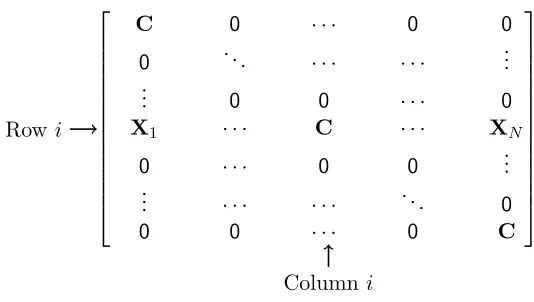
For reader’s convenience we provide a pictorial representation ofCb in Fig. 1: Finally outputbc:=Cb as the expanded ciphertext.
• MFHE.Eval(params,C,(bc1, . . . ,bc`)) On input`expanded ciphertexts simply use the GSW ho-momorphic evaluation algorithms namely GSW.Add and GSW.Mult, albeit with expanded dimensions n0 = nN and m0 = mN and the expanded GbN,Gb−1N (in place of n, m and
G,G−1).
• MFHE.Decrypt(params,(sk1, . . . , skN), c): On input a ciphertext c = Cb and the sequence of secret keys (sk1, . . . , skN) parse each ti := ski and then construct the joint secret key by
horizontally appending all the secret-keys in sequencebt =
b
t1 bt2 · · · btN
∈ZnN
q . Then run
Rowi
Columni
C 0 · · · 0 0
0 . .. · · · ... ..
. 0 0 · · · 0
X1 · · · C · · · XN
0 · · · 0 0 ... ..
. · · · . .. 0
0 0 · · · 0 C
Figure 1: Structure of the expanded ciphertextCb
5.3.1 Correctness and Security of MFHE Construction
Theorem 5.5. The scheme described above is a secure MFHE under theLWEn−1,q,χ,Bχ assumption (with the same parameters as we defined for GSW encryption).
Semantic security. The semantic security of the above multi-key FHE follows directly from that of the GSW masking scheme.
Correctness of Expansion. Consider a sequences of N correctly generated key pairs ((sk1 = t1, pk1), . . . ,(skN = tN, pkN)) such that {(pki, ski)← MFHE.Keygen(params)}i∈[N]. Now suppose
for any messageµ and any i∈[N] we have a ciphertext c←MFHE.Encrypt(pki, µ) under thei-th
key and the corresponding expanded ciphertext Cb ←MFHE.Expand((pk1, . . . , pkN), i, c) as shown in Fig. 1. Letbt= [t1, . . . ,tN]. Then
btCb = [tiX1+t1C, . . . ,tiC, . . . ,tiXN +tNC] = [µt1G+e1, . . . , µtiG+ei, . . . , µtNG+eN]
= µbtGb + [e1, . . . ,eN]
wherekeik∞≤mBχby the correctness of GSW encryption and forj6=i,kejk∞≤(m4+m)Bχ by
the correctness of the GSW masking scheme. Therefore,btCb =µbtGb+ewherekek∞≤(m4+m)Bχ.
Let’s call this value βinit0 = (m4 +m)B
χ = 2O(logλ)Bχ. The correctness of GSW encryption is
guaranteed as long as βinit0 ≤q/(4m0) which holds with the choice ofq we defined.
Correctness of Evaluation. LetCb1, . . . ,Cb`be expanded ciphertexts corresponding to bitµ1, . . . , µ` so that, by the above correctness property,btCbi=µibtGb+ei wherekeik∞≤β0init. IfCb is the output of a homomorphic evaluation of a circuit C of depth d over the above ciphertexts such that µ =
C(µ1, . . . , µ`) then by the correctness of GSW homomorphic evaluation with scaled up parameters
n0 =nN, m0 =mN we havebtCb =µbtGb +ewherekek∞≤βinit0 (m0+ 1)d= (m4+m)Bχ(mN+ 1)d.
Let’s call this value βf inal0 = Bχ(m4 +m)(mN + 1)d = 2O(dlogλ)Bχ. The correctness of GSW
5.4 Threshold Decryption for Multi-key FHE
We now show how to implement threshold decryption for the MFHE construction outlined in the previous section.
MFHE.PartDec(bc,(pk1, . . . , pkN), i, ski): On input an expanded ciphertextbc=Cb ∈Z
nN×mN
q under
a sequence of keys (pk1, . . . , pkN) and the i-th secret keyski =ti∈Znq do the following:
• ParseCb as consisting of N sub-matrices Cb(i)∈Zn×mNq such that
b C= b C(1) .. . b
C(N)
.
• Define wb ∈ZnNq aswb = [0, . . . ,0,dq/2e].
• Then compute γi =tiCb(i)Gb−1(wbT) ∈Zq and outputpi =γi+esmi ∈Zq where esmi
$
←
[−Bdecsmdg,−Bsmdgdec ] is some random “smudging noise” whereBdecsmdg= 2dλlogλBχ.
MFHE.FinDec(p1, . . . , pN): Givenp1, . . . , pN, compute the sump:=PN
i=1pi. Outputµ:=
l p q/2 k .
5.4.1 Correctness and Simulation Security
Theorem 5.6. The above threshold decryption procedures for MFHE satisfy correctness and (sta-tistical) simulation security.
Correctness. Here the entire scheme is same as MFHE except the decryption. So if Cb is an evaluated ciphertext encrypting a bit µ and the secret keys are bt = [bt1, . . . ,btN] then, by the analysis used for non-threshold correctness, we have
btCb = X
i∈[N]
tiCb(i)=µbtGb +e
wherekek∞≤β0f inal= (m4+m)Bχ(mN+1)d. Therefore if the partial decryptionspiare computed
as specified we have:
X
i∈[N]
pi = X
i∈[N]
γi+ X
i∈[N]
esmi = X
i∈[N]
tiCb(i)Gb−1(wbT) +esm
= (µbtGb +e)Gb−1(wbT) +esm = µdq/2e+e0+esm
where esm =P
i∈[N]esmi has norm|esm| ≤N Bsmdgdec = 2O(dλlogλ)Bχ and e 0 =e
b
G−1(wb
T) has norm
Simulatability: The simulator Sthr(µ,
b
C, i,{tj}j∈[N]\{i}), on input the secrets keys {tj}j6=i the
evaluated ciphertextCb ∈ZnN×mNq and the output valueµ=C(µ1, . . . , µ`) encrypted inCb outputs thesimulated partial decryption:
p0i =µdq/2e+esmi −X
i6=j
γj (1)
foresmi ←$ [−Bdecsmdg, Bsmdgdec ] whereγj =tjCb(j)Gb−1(wbT).
To see the indistinguishability note that, by the same calculation as used to argue correctness, we know thatP
j∈[N]γj =µdq/2e+e
0 where|e0| ≤β0
f inalmN = 2O(dlogλ)Bχ. Therefore ifpi=γi+esmi
is the real partial decryption then
pi =µdq/2e+e0+esmi −X
i6=j γj
The difference between the real value pi and the simulated value p0i is the noise e0 of norm |e0|= 2O(dlogλ)Bχ. But by the smudging lemma 3.1, the distributions ofesmi andesmi +e
0 are statistically
close sinceesmi ←$ [−Bsmdgdec ,−Bdecsmdg] where Bsmdgdec = 2dλlogλBχ so thatBsmdgdec /|e0| ≥2λ. Therefore the simulated partial decryption and the real one are statistically indistinguishable.
5.5 Bootstrapping
Note that the above MFHE scheme is leveled i.e., it depends on the multiplicative depth of the circuit to be computed. However, this dependency can be avoided easily by boot-strapping and assuming circular security. We briefly describe the straightforward procedure and omit the details. During key generation, each party i chooses a key pair (ski, pki) and uses the MFHE scheme to encrypt the secret keyski underpki bit-by-bit.7 It appends these encryptions to the public key.
Later, given a sequence of public keys {pk1, . . . , pkN} anyone can create an expanded multi-key encryption of eachski using the MFHE expansion procedure. This allows us to use Gentry’s boot-strapping technique [Gen09] to to “refresh” a highly noisy multi-key ciphertext by homomorphically computing the MFHE decryption procedure. Therefore, to compute a circuit of arbitrary depth, we only need to set the parameters of the MFHE scheme so as to be evaluate circuits of somefixed depthd+ 1 wheredis the depth of the MFHE decryption procedure.
Note that, by circular security it is assured that an encryption of a secret key under itself is semantically secure which implies that the semantic security of the above modified MFHE scheme remains intact.
6
Secure MPC via Threshold MFHE
Basic Template. We now present a protocol for general MPC, using any threshold multi-key fully homomorphic scheme. The protocol is based on the template discussed in the introduction which we recall below:
7We ignore the algebraic structure of the secret key here and assume each element in
Zq can be represented as a
1. Each party individually chooses its own MFHE key pair (pki, ski), encrypts its input xi
underpki, and broadcasts the resulting ciphertext. At the end of this round, each party can
homomorphically compute the desired function f on the received ciphertexts and derive a common multi-key ciphertext which encrypts the output y=f(x1, . . . , xN).
2. The parties run a distributed protocol for “threshold decryption” using their secret keys ski
to decrypt the multi-key ciphertext and recover the output y in plaintext. In particular each party first generates partial decryptions pi from the common (evaluated) ciphertext bc and then broadcasts them. Finally each party, on receiving all those partial decryptions can compute the final decryptiony.
Our goal is to prove the security of this protocol (as least in the honest-but-curious setting, as a start). The natural attempt to construct a MPC simulatorS would be to first use the simulator of threshold decryption, Sthr to replace the correct partial decryptions pi with simulated ones p0 i
and then use semantic security of the encryption to replace each ciphertext (broadcast in the first round) by encryptions of 0.
The Problem. Unfortunately, we notice that the simulatability of the threshold decryption does not suffice when there is more than one honest party. Essentially, our definition of simulation security for threshold decryption only allows us to simulate the partial decryption of a single party at a time while knowing the secret keys of all other parties. We cannot, however, simultaneously simulate the partial decryptions of (even) two honest parties without knowing either of their secret keys.
Solution. Essentially we solve the above problem by two steps. We first show that the “basic” protocol as described above is already secure when there is exactly one honest party. Then, later in Sec. 6.2 we extend the basic protocol to another protocol which can handle any arbitrary number of corruption. The extended protocol additionally requires only pseudorandom functions (PRFs) and thus no new assumptions are used. Combining, we get a protocol which securely realizes any functionality against any arbitrary number of corruptions. Below we provide the basic protocol from anyMFHEscheme and prove security against exactlyN−1 corruptions. Later in Sec. 6.2 we present the extension in detail.
Semi-Malicious Security. Following [AJLA+12], we will actually prove that the above proto-col satisfies something called “semi-malicious” security which is stronger than honest-but-curious. Intuitively, it means that adversarial parties need to follow the protocol specification, but can use arbitrary values for their random coins. In fact, the adversary only needs to decide on the input and the random coins to use for each party in each round at the time that the party sends the first message. See Appendix A for a formal definition. We will then rely on a theorem of [AJLA+12] showing that one can compile any such protocol which is secure in the semi-malicious setting into one that is secure in the fully malicious setting, without adding any rounds, by using non-interactive zero-knowledge proofs (NIZKs).
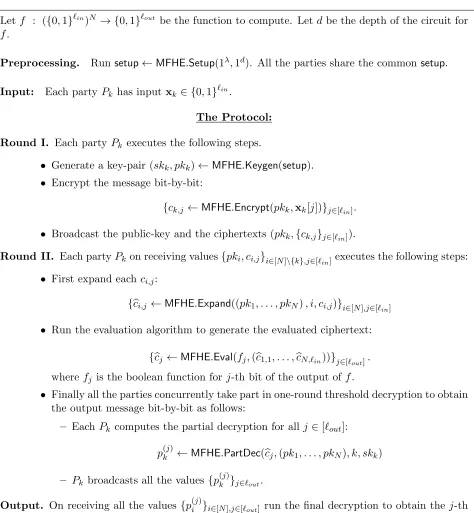
Letf : ({0,1}`in)N → {0,1}`out be the function to compute. Let dbe the depth of the circuit for
f.
Preprocessing. Run setup←MFHE.Setup(1λ,1d). All the parties share the common setup.
Input: Each partyPk has input xk∈ {0,1}`in.
The Protocol:
Round I. Each party Pk executes the following steps.
• Generate a key-pair (skk, pkk)←MFHE.Keygen(setup).
• Encrypt the message bit-by-bit:
{ck,j←MFHE.Encrypt(pkk,xk[j])}j∈[`in].
• Broadcast the public-key and the ciphertexts (pkk,{ck,j}j∈[`in]).
Round II. Each partyPkon receiving values{pki, ci,j}i∈[N]\{k},j∈[`
in]executes the following steps:
• First expand each ci,j:
{bci,j ←MFHE.Expand((pk1, . . . , pkN), i, ci,j)}i∈[N],j∈[`in]
• Run the evaluation algorithm to generate the evaluated ciphertext:
{bcj ←MFHE.Eval(fj,(bc1,1, . . . ,bcN,`in))}j∈[`out].
where fj is the boolean function forj-th bit of the output of f.
• Finally all the parties concurrently take part in one-round threshold decryption to obtain the output message bit-by-bit as follows:
– Each Pk computes the partial decryption for all j ∈[`out]:
p(j)k ←MFHE.PartDec(bcj,(pk1, . . . , pkN), k, skk)
– Pk broadcasts all the values{p(j)k }j∈`out.
Output. On receiving all the values {p(j)i }i∈[N],j∈[`out] run the final decryption to obtain the j-th output bit: {yj ←MFHE.FinDec(p(j)1 , . . . , pN(j))}j∈[`out]. Outputy=y1. . . y`out.
The protocol, given in Figure 2, realizes general multiparty computation for any polynomial-time deterministic functions f which produces a common output for all parties. It does so with respect to a static semi-malicious attackers corrupting exactly N −1 parties (see Appendix A). Formally we prove the following theorem.
Theorem 6.1. Letf be a poly-time computable deterministic function withN inputs and 1output. Let the schemeMFHE= (Setup,Keygen,Encrypt,Expand,Eval,PartDec,FinDec) be a multi-key FHE scheme with threshold decryption. Then the protocolπf described in Fig. 2 UC-realizes the function f against any static semi-malicious adversary corrupting exactlyN −1 parties.
Proof: The correctness of the protocol follows in a straightforward way from the correctness of the underlying threshold MFHEscheme.
To prove security basically we need to construct an efficient (PPT) simulatorSfor any adversary corrupting exactly N −1 parties. Let A be a static semi-malicious adversary andPh be the only honest party. The simulator simulates the protocol execution on behalf of the honest party Ph as
follows.
The Simulator. In round-I, the simulator encrypts 0s instead of the real input bits of the honest partyPh. After round-I it gets the inputs and the secret keys of theN−1 corrupt parties from the “witness tape”. It gives these inputs to the ideal functionality and receives the output bits yj for
each j ∈[`out]. At this point it can also compute the evaluated ciphertexts bcj. Then it computes the simulated partial decryptions for the honest party pe(j)h ← Sthr(y
j,bcj, h,{ski}i∈[N]\{h}) and broadcast those in round-II instead of correctly computed partial decryptions p(j)h generated via
MFHE.PartDec(· · ·).
Hybrid Games. We now define a series of hybrid games that will be used to prove the indistin-guishability of the real and ideal worlds:
IDEALF,S,Z comp
≈ REALπ,A,Z (2)
The output of each game is always just the output of the environment.
The game REALπ,A,Z: This is exactly an execution of the protocolπ in the real world with
envi-ronmentZ and semi-malicious adversaryA.
The game HYB1π,A,Z: In this game, we modify the real world experiment as follows. Assume (as
a mental experiment) thatPh is given the all the secret keys{ski}i∈[N]\{h} (as written on the
“witness tape” of the adversary) after round I. In the second round, instead of broadcasting a correctly generated partial decryptions p(j)h generated viaMFHE.PartDec(· · ·), it broadcasts simulated ones {pe(j)h ← Sthr(yj,
b
cj, h1,{ski}i6=h)}j∈[`out].
The game IDEALF,S,Z: This is similar to the gameHYB1π,A,Z except instead of encrypting its real
input,Ph now broadcasts encryption of 0s in the first round.
Claim 6.2. REALπ,A,Z stat
Proof: Notice that, the only change between those experiments are that, the partial decryption of party Ph is generated through simulator Sthr instead of correctly using MFHE.PartDec. By
simulatability of threshold decryption the partial decryptions are statistically indistinguishable hence so are the experiments.
Claim 6.3. HYB1π,A,Z comp
≈ IDEALF,S,Z
Proof: The only change between those experiments are in generating encryptions of partyPh. By semantic security of the underlying MFHE the encryptions are computationally indistinguishable. Hence the experiments are also computationally indistinguishable. Note that here it is possible to use the semantic security as the partial decryptions of Ph in both the experiments are simulated and hence independent of the secret key skh.
This concludes the proof of the theorem.
6.2 An Extended Protocol for Arbitrary Many Corruptions
In this section we construct an “extended” MPC protocolbπf which securely computes any function f against any semi-malicious adversary that can corrupt any t∈[N] parties. We do so by relying on the “basic” MPC protocolπf from the previous section, which is secure against a semi-malicious
adversary that corrupts exactly N −1 parties. To compute a function f, our extedned protocol simply runs the basic protocolπ
b
f on an extended functionfbdefined as follows.
Definition 6.4. (Extended function) For any polynomial `in, `out, N ∈ N let f : {{0,1}`in}N →
{0,1}`out be a poly-time computable function and PRF :{0,1}λ×[N]→ {0,1}`in be a PRF. Then we define an extended functionfb:{{0,1}`in× {1,2,3} × {0,1}λ}N → {0,1}`out which takes as input ((x1,mode1,z1), . . . ,(xN,modeN,zN))and does the following:
• If ∀ i∈[N], modei = 1 then outputf(x1, . . . ,xN).
• If ∃ unique i∈[N]such that modei = 2 then let K:=zi. For all j∈[N]:
– If modej = 3 then set x0j :=PRF(K, j)⊕xj. – Else set x0j :=xj.
Output f(x01, . . . ,x0N).
• Otherwise output 0`out.
Roughly speaking, the extended function does the same thing as the original function if all the inputs havemodei = 1. However, if there is one special party withmodei = 2 then the function uses
a PRF keyK=zi provided by that party to “decrypt” the inputs of all the parties withmodej = 3.
We define an “extended protocol” bπf in Figure 3. It essentially just runs the original basic
protocolπ b
f with an extended function fband appropriately extended inputs.
We now prove that that the extended protocol bπf is secure against any arbitrary number of
semi-malicious corruptions.
Theorem 6.5. Letf be a function withN inputs and 1 output. LetPRF:{0,1}λ×[N]→ {0,1}`out be a PRF. Then, under the LWE assumption, the protocol bπf shown in Figure 3 UC-realizes f
Letf :{{0,1}`in}N →`
out be the function we wish to compute and let andPRF:{0,1}λ×[N]→
{0,1}`in be a PRF. Let b
f : {{0,1}`in × {1,2,3} × {0,1}λ}N → {0,1}`out be the corresponding extended function (Definition 6.4). Let π
b
f be the protocol from Figure 2 applied to the extended
functionfb. The extended protocol b
πf is defined as follows:
Setup: The setup is the same as the that of the protocolπfb.
Input: Each partyPk has inputxk∈ {0,1}`in. Additionally each party sets modek:= 1,zk:=0,
and defines its extended input as xbk:= (xk,modek,zk)∈ {0,1} c `in where
c
`in =`in+λ+ 2.a
Protocol: The parties run the protocol π b
f using the extended inputs {bxk}k∈[N]. They output whateverπ
b
f outputs.
aHere any0denotes a string of 0s of appropriate size. We abuse notation for simplification.
Figure 3: bπf: Extended protocol secure against any any number of semi-malicious corruptions.
Proof: Correctness is clear from the definition of extended function. In particular note that each extended input has the flagmodekset to 1 which means the extended function computes the correct
output f(x1, . . . ,xN).
Let A be a static semi-malicious adversary against πfb , and let I be the set of corrupt parties with |I| = t. We can assume 0 < t ≤ N −1 as otherwise security is trivial to show. Let (h1, h2, . . . , hN−t)∈[N]\I be some arbitrary ordering of the honest parties{Phi}i∈[N−t].
The Simulator S. The simulatorS executes the protocol with the adversaryAacting on behalf oh the honest parties as specified, except that:
• In round-I: For party Ph1 the simulator uses the input xbh1 = 0
c
`in and for all other honest
partiesPhi,i >1 it uses the inputxbhi = (x
0
hi,modehi = 3,zhi = 0
`in) wherex0
hi ← {0,1}
`in is
chosen uniformly at random. It follows round I of the protocolπfbhonestly with these inputs.
• After round-I it gets the inputs and the secret keys of thetcorrupt parties from the “witness tape”. It gives the inputs to the ideal functionality and received the outputy= (y1, . . . , y`out).
• In round-II: The simulator homomorphically computes the evaluated ciphertexts bcj forj ∈
`out, encrypting the output. For honest parties Phi, i > 1 it gives the correctly generated partial decrpytions p(j)h
i ← MFHE.PartDec(bcj,(pk1, . . . , pkN), hi, skhi) using the secret key
skhi chosen for that party in round I. For the honest partyPh1 it computes simulated partial
decryptionspe(j)h
1 ← S
thr(y
j,bcj, h1,{ski}i∈[N]\{h1}) using the secret keysski of the other honest
and corrupted parties.
Below we argue that the simulated view is computationally indistinguishable from the view of the adversary in the real world:
IDEALF,S,Ze comp
Hybrid Games. We move from the real execution to the ideal execution through a series of hybrid games as defined below. The output of each game is always just the output of the environment.
The game REALπ,A,Zb : This is exactly an execution of the protocol πfb in the real world with
environment Z and semi-malicious adversary A. Recall that, here each honest party Pk
follows protocol π b
f with inputs (xk,1,0).
The game HYB1,1: In this game, we modify the real world experiment as follows. After round I,
let{ski}i∈[N]be the secret keys chosen by the honest parties and written on the “witness tape”
of the corrupt parties. Lety = (y1, . . . , y`out) be the output of the ideal functionalityf when given the actual inputs of the honest parties and the inputs written on the “witness tape” of the corrupt parties. In the second round of the protocol, instead of party Ph1 broadcasting
correctly generated partial decryptions p(j)h
1 generated viaMFHE.PartDec(· · ·), it broadcasts
simulated partial decryptions {pe(j)h ← Sthr(yj,
b
cj, h1,{ski}i6=h1)}j∈[`out].
The game HYB1,2: In this same as HYB1,1 except that, in round I, instead of Ph1 using the value
(xh1,modeh1 = 1,zh1 =0) as its input forπfb, it now chooses a random PRF keyK ← {0,1} λ
and uses the value (xh1,modeh1 = 2,zh1 =K) as its input.
The game HYB1,3: In this same as HYB1,2 except that, in round II, the party Ph1 goes back to
broadcasting the correctly generated partial decryptionsp(j)h
1 generated viaMFHE.PartDec(· · ·).
The games {HYBi,1}i=2,...,N−t: Each game HYBi,1 is same as the game HYBi−1,3 except that,
in round II of the protocol, instead of party Phi broadcasting correctly generated partial decryptions p(j)h
i generated via MFHE.PartDec(· · ·), it broadcasts simulated ones {pe
(j) hi ←
Sthr(yj,
b
cj, hi,{skk}k6=hi)}j∈[`out], whereskk and y are defined the same way as inHYB
1,1.
The games {HYBi,2}
i=2,...,N−t: Each game HYBi,2 is same as the game HYBi,1 except that, in
round I of the protocol, instead of Phi using the value (xhi,1,0) as its input for πfb, it now
uses the input (xhi ⊕PRF(K, hi),3,0), where K is the same PRF key that was defined in HybridHYB1,2.
The games {HYBi,3}
i=2,...,N−t: Each game HYBi,3 is same as the game HYBi,2 except that, in
round II of the protocol, the party Phi goes back to broadcasting the correctly generated partial decryptions p(j)h
i generated viaMFHE.PartDec(· · ·).
The game HYBN−t+1,1. This is the same as HYBN−t,3 except that, in round II of the protocol,
instead of party Ph1 broadcasting correctly generated partial decryptions p
(j)
h1 generated via
MFHE.PartDec(· · ·), it broadcasts simulated ones {pe(j)h
i ← S
thr(y
j,bcj, hi,{skk}k6=hi)}j∈[`out], whereskk andy are defined the same way as in HYB1,1.
The game HYBN−t+1,2. This is the same asHYBN−t+1,1 except that, in round I of the protocol,
instead ofPh1 using the value (xh1,2, K) as its input toπfb, it now uses the value 0 c `in.
The game IDEALF,S,Ze : This is the ideal-world execution with simulator S and environment Z.
It is the same as HYBN−t+1,2 except that, instead of the honest parties Phi,i >1 using the values (xhi⊕PRF(K, hi),3,0) as their inputs toπfbthey use the inputs (x
0
hi,3,0) wherex
0 h is
For notational convenience let us rename the real gameREALbπ,A,Z asHYB
0,3. Let us also define
hN−t+1 =h1.
Claim 6.6. For all i∈[N −t+ 1]: HYBi−1,3 stat≈ HYBi,1.
Proof: Notice that, the only change between these hybrids is in whether a single party Phi computes its partial decryptions honestly via p(j)h
i ← MFHE.PartDec(bcj,(pk1, . . . , pkN), hi, skhi) or whether it gives simulated onespe(j)h
i ← S
thr(yj,
b
cj, hi,{skk}k6=hi). Each of the evaluated ciphertexts
b
cj is an encryption of yj by correctness and the way we chose the inputs of all honest parties.
Therefore the above indistinguishability holds by the simulatability of partial decryption of the MFHE scheme.
Claim 6.7. For all i∈[N −t+ 1]: HYBi,1 comp
≈ HYBi,2.
Proof: Notice that, the only change between these hybrids is in the value encrypted by the party
Phi in round I. However, the secret key skhi of that party is not used anywhere in either of these hybrids. Therefore the hybrids are indistinguishable by the semantic security of the MFHE scheme.
Claim 6.8. For all i∈[N −t]: HYBi,2 stat≈ HYBi,3.
Proof: Notice that, the only change between these hybrids is in whether a single party Phi computes its partial decryptions honestly via p(j)h
i ← MFHE.PartDec(bcj,(pk1, . . . , pkN), hi, skhi) or whether it gives simulated onespe(j)h
i ← S
thr(y
j,bcj, hi,{skk}k6=hi). Each of the evaluated ciphertexts b
cj is an encryption of yj by correctness and the way we chose the inputs of all honest parties. Therefore the above indistinguishability holds by the simulatability of partial decryption of the MFHE scheme.
Claim 6.9. HYBN−t+1,2 comp
≈ IDEALF,S,Ze
Proof: The only difference between these hybrids is whether the inputs of the honest parties Phi
i∈[2, . . . , N−t] are of the form (xhi ⊕PRF(K, hi),3,0
`in) or (x0
hi,3,0
`in) where x0
hi ← {0,1}
`in.
This is indistinguishable by PRF security. Note that the keyK is not used anywhere else in either of these hybrids other than the PRF evaluationsPRF(K, hi).
Combining the above claims, we get IDEALF,S,Ze comp
≈ REAL
b
π,A,Z which concludes the proof of
Theorem 6.5.
6.3 Extensions and Applications