Image Denoising Using KD-Tree and Nearest Neighbour Based
Kernel Regression Model
P
1
P
Khushkismat Khera, P
2
P
Ms Aman Saini
P
1
P
M.Tech Scholar, ECE, CEC Landran , Mohali , Punjab
P
2
P
Asst. Professor, ECE, CEC Landran , Mohali , Punjab
Abstract: Image restoration is an important branch of image processing, dealing with the reconstruction of images by removing noise and blur from degraded images and making them suitable for human perception. Any image acquired by a device is susceptible of being degraded by the environment of acquisition and transmission. Therefore, a fundamental problem in the image processing is the improvement of their quality through the reduction of the noise that they can contain being often known as "cleaning of images". The goal of the restoration approach is to improve the given image so that it is suitable for further processing. Removal of noises from the images is a critical issue in the field of digital image processing. So, we propose a new model of image content restoration based on the KD-tree model of neural networking by using the nearest neighbour modelling of the image frame data under observation using patch order processing using kernel filtering with frame cross reference sing for dependent estimation of pattern to be restored and determine the intensity of the filter to be used. We have discussed the system results in the end based on Gaussian noise reduction with 10 % noise level values, the filter shows considerable improvisation while maintain the structure quality analyzed by PSNR assessment.
Keywords: Kernel, KD tree, Denoising, Gaussian, PSNR, MSE
1. INTRODUCTION
Video change is of soaring significance in a few applications like therapeutic administrations, image processing, composition examination, police examination, and logical representation.
Digital Video drawbacks are regularly grown as chances: given a data quality video feature furthermore effects the output quality video for particular applications. This work tries to support the standard of video.
Video feature has turned into an essential object of everyday life. It is no doubt understood that video change as a subject in portable workstation vision has gotten a considerable
measure of consideration. The point is to support the visual look of the video, or to create a "superior" redesign delineation for future programmed video procedure, similar to examination, identification, division, and acknowledgment [1-5]. Also, it helps investigations foundation information that is fundamental to know object conduct while not obliging extravagant human visual examination [6].
Noise evacuation and video improvement assumes a critical part in a few applications – like police examination – including videos taken underneath poor low weight conditions: they set a dreadfully troublesome drawback as an after effect of poor element being alien with high foundation level. Though procedure of extremely dull video is foreseen to gain from the reception of the flexibility out of their calculations, their particular adjustment to the instance of low element of other videos stays generally untouched.
Applying any image change control on these parts of the video gives undesirable impacts, similar to impediment, and expanding chrome noise that the video inventor implies.
different debasements of the first image or video, such operations may need to consider these errors like sensor commotion and deblurring.
Local kernel regression utilizing say polynomial demonstrating is lately developed as an adaptable and viable system for rebuilding assignments, for example, image denoising and super-resolution [7]. Case in point, a Steering Kernel Regression (SKR) calculation for image super-Resolution (SR) has been proposed. Neighbourhood polynomial relapse or demonstration has likewise been connected to image denoising in [8]. Both LPR and SKR investigate the nearby smoothness of the image/video and speak to the image/video by regional standards as a polynomial. By evaluating the coefficients of such neighbourhood polynomials, one may introduce image mainly utilizing these nearby representation and evacuate high recurrence commotion. To further endeavour the structural data in normal images which may come about because of repeated structures in the same image, Non-Local Kernel Regression (NLKR) calculation [9] has been proposed as of late. It is likewise in light of the nearby polynomial.
Comparative patches exists in the objective image for denoising errands. Later, this thought is summed up to handle multi-outline super-determination assignments. As of late, this self-similitude property is completely investigated by Glasner et. al in [10] for tending to single image super-determination issues. Gabriel Peyr' et. al proposed a non-neighbourhood regularization strategy for general reverse issues [11].
Another kind of routine misusing the self-similitude in normal images are being lately developed. The self-comparability property implies that larger amount designs (e.g., texton and pixon) will rehash themselves in the image
(perhaps in different scales). This additionally shows the DOF in one image is not exactly the DOF offered by the pixel-level representation. A delegate work is the well known Non-Local Means (NL-Means) [8], which exploits the redundancy of one of the latest patterns in image handling is to seek after the low-dimensional models for image representation and control. Cases incorporate the local structure based routines, scanty representation strategies, complex techniques and so on. The achievement of such models is ensured by the low Degree of Freedom (DOF) of the neighbourhood structures in normal images.
Numerous ordinary image handling calculations are taking into account the presumption of local structural regularity, implying that there are important structures in the spatial space of regular images. Illustrations are structure tensor based methods and respective exclusion. These strategies use the nearby auxiliary examples to regularize the image handling methodology and are in view of the assumption that images are by regional standards smooth with the exception at the edge.
2. LITERATURE SURVEY
Tschumperle, D [12] Local structural
regression unequivocally utilize the spatial bit for regularization.Howeverdisregard the excess of comparable neighbourhood designs helpful for hearty estimation.
Elad, M., Aharon, M [13]Meager
representation for denoising and super-determination do local regression utilizing bases gained from a preparation database. They perform estimation on every individual local patch and neglect the patch occurrence.
exclude the spatial structure entirely as a regularization.
Glasner, D., Bagon, S., Irani, M [15]
completely investigates the self-similitude property for single image super-determination, however no spatial basic regularization is connected. To compress, our model is the first work to exclusively bring together the match and nearby local continuation into a solitary model, permitting more strong estimation.
Chatterjee, P., Milanfar, P [16] The high request speculation of non-local means in utilizes the reckoning of non-local closeness to locate the nearby piece for relapse, which really abuses the theory of the non-nearby model.
Takeda, H., Milanfar, P., Protter, M., Elad, M. [17] The 3D kernel regression relapse strategy abuses the neighbourhood spatial-transient structure by expanding their 2D spatial kernel regression, additionally disposes of the non-nearby self-closeness.
Mairal, J., Bach, F., Ponce, J., Sapiro, G., Zisserman, representation model is later summed up for image denoising by doing synchronous inadequate coding over comparable patches found in distinctive areas of the image. Then again, the non-nearby excess is utilized as a part of a hard task grouping path instead of easier an way.
Proposed Method
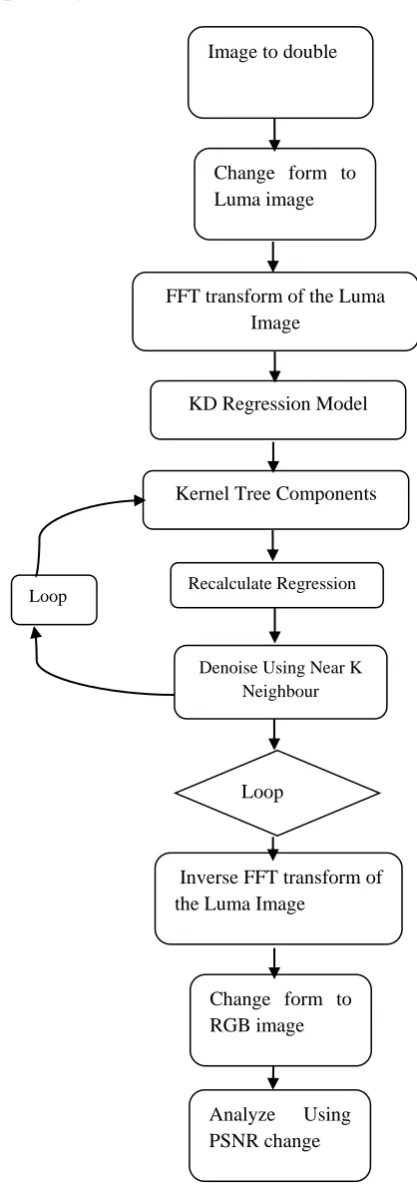
Select a Image file and import it in Matlab. Apply the noise filters on the image/video data separate the RGB layers. Convert the frame images into double format of 64-bit. Then apply ranking on the image data for global rank processing using KD-tree. Now use the rank values in the LR-KD-tree system to divide the kernel filtering order into rank based intensities for restoration of the image frames. Convert Image in to 8-bit visual format. Calculate the
efficiency of the restoration system using SNR, MSE, Standard deviation, entropy for original, distorted and restored image data.
Proposed system Model:
Figure 1: Proposed system Flow Diagram Change form to Luma image
FFT transform of the Luma Image
KD Regression Model
Kernel Tree Components
Recalculate Regression
Denoise Using Near K Neighbour
Change form to RGB image
Inverse FFT transform of the Luma Image
Analyze Using PSNR change
Loop Image to double
KD-Tree
KD-tree is a generalization of a binary search tree that stores points in k-dimensional space. It stores a collection of points in the Cartesian plane in three-dimensional space and it is also used to store biometric data. It can hold data of any dimension, but all of the data stored in a tree must have the same dimensions. KD-tree splits the point set alternately by x-coordinate and y-x-coordinate. This split is then reduced using pixel based regression based on weighting
Results
Figure 2 shows Input image (left), noisy Image (middle) and Denoised Image (Right) for multiple Images
Table 1Shows the proposed KD-Regression Denoising Results
Image Noisy
PSNR (in dB)
Denoised PSNR (in dB)
Bowl 28 32.34
Building 20 25.66
Casino 21 27.43
Girl 20 33.3
Grapes 20 26.22
Kernel Regression
Kernel is filter design made to adapt according to the mean variance, the kernel filter updates itself and form new filtering value, this feature enable the edge preservation in denoising system model.
Conclusion
In the proposed system the applicability of image denoising using KDtreelearing is shown and according to result analysis, it can be concluded that th system is practically applicable and can be enhanced to work with video data in an adaptive form for stable noise reduction in noisy videos
REFERENCES
[1] S. S. Agaian, S. Blair and K. A. Panetta, Transform coefficient histogram-based image enhancement algorithms using contrast entropy, IEEE Trans. Image Processing, vol. 16, no. 3, pp. 741-758, 2007.
[2] YunBoRao, W. Lin and L. T. Chen, Image-based fusion for image/video enhancement of nighttime surveillance, Optical Engineering Letters, vol. 49, no. 2, pp. 120501-1- 120501-3, 2010.
[3] Ilie, R. Raskar and J. Yu, Gradient domain context enhancement for fixed cameras, International Journal of Pattern Recognition and Artificial Intelligence, vol. 19, no. 4, pp. 533-549, 2005.
[4] H. Hu, Image/video enhancement: content classification and model selection, Ph. D. Thesis, Technique Universities Eindhoven, Eindhoven, Netherlands, 2010.
[5] P.Y Liu, K.B Jia, Research and Optimization of Low-Complexity Motion Estimation Method Based on Visual Perception, Journal of Information Hiding and Multimedia Signal Processing, vol. 2, no.3, pp. 217-226, 2011.
[6] T. Wan , T. George, T. Panagiotis,C. Nishan and A. Alin, Context enhancement through image fusion: a multi-resolution approach based on convolution of Cauchy distributions, Proc. of the IEEE InternationalConference on Acoustics, Speech and Signal Processing , pp. 1309-1312, 2008.
[7] Z. G. Zhang and S. C. Chan, “On Kernel Selection of Multivariate Local Polynomial Modelling and Its Application to Image Smoothing and Reconstruction,” J. Signal Process. Syst., Vol. 64, No. 3, pp. 361-374, 2011.
[8] S. C. Chan and Z. Zhang, “Local
Polynomial Modeling and Variable
Bandwidth Selection for Time-Varying Linear Systems,” IEEE Trans.Instrum. Meas., Vol. 60, No. 3, pp. 1102-1117, Mar. 2011.
[9] Glasner, D., Bagon, S., Irani, M.: Super-resolution from a single image. In: ICCV. (2009)
[10] H. Zhang, J. Yang, Y. Zhang and T. S.
Huang, “Non-Local Kernel Regression for
Image and Image/video Restoration,” The 11th European Conference on Computer Vision (ECCV), 2010.
[11] Peyre, G., Bougleux, S., Cohen, L.: Non-local regularization of inverse problems. In: ECCV. (2008)
[12] Tschumperle, D.PDE’s Based Regularization of Multivalued Images and Appli-cations. PhD thesis (2002)
[13] Elad, M., Aharon, M.: Image denoising via learned dictionaries and sparse repre-sentation. In: CVPR. (2006) 17–22
[14] Chang, H., Yeung, D.Y., Xiong, Y.: Super-resolution through neighbor embedding. In: CVPR. (2004)
[15] Glasner, D., Bagon, S., Irani, M.: Super-resolution from a single image. In: ICCV. (2009)
[16] Chatterjee, P., Milanfar, P.: A generalization of non-local means via kernel regres-sion. In: SPIE Conf. on Computational Imaging. (2008)
[17] Takeda, H., Milanfar, P., Protter, M., Elad, M.: Super-resolution without explicit subpixel motion estimation. IEEE TIP (2009)