
Practical Fully Secure Unrestricted Inner
Product Functional Encryption modulo
p
Guilhem Castagnos1, Fabien Laguillaumie2, and Ida Tucker2 1
Universit´e de Bordeaux, INRIA, CNRS, IMB UMR 5251, F-33405 Talence, France.
2 Univ Lyon, CNRS, Universit´e Claude Bernard Lyon 1, ENS de Lyon, INRIA, LIP UMR 5668, F-69007, LYON Cedex 07, France.
Abstract. Functional encryption is a modern public-key cryptographic primitive allowing an encryptor to finely control the information revealed to recipients from a given ciphertext. Abdalla, Bourse, De Caro, and Pointcheval (PKC 2015) were the first to consider functional encryption restricted to the class of linear functions, i.e. inner products. Though their schemes are only secure in the selective model, Agrawal, Libert, and Stehl´e (CRYPTO 16) soon provided adaptively secure schemes for the same functionality. These constructions, which rely on standard assump-tions such as the Decision Diffie-Hellman (DDH), the Learning-with-Errors (LWE), and Paillier’s Decision Composite Residuosity (DCR) problems, do however suffer of various practical drawbacks. Namely, the DCR based scheme only computes inner products modulo an RSA integer which is oversized for many practical applications, while the computa-tion of inner products modulo a primepeither requires, for their (DDH) based scheme, that the inner product be contained in a sufficiently small interval for decryption to be efficient, or, as in the LWE based scheme, suffers of poor efficiency due to impractical parameters.
In this paper, we provide adaptively secure functional encryption schemes for the inner product functionality which are both efficient and allow for the evaluation of unbounded inner products modulo a primep. Our con-structions rely on new natural cryptographic assumptions in a cyclic group containing a subgroup where the discrete logarithm (DL) problem is easy which extend Castagnos and Laguillaumie’s assumption (RSA 2015) of a DDH group with an easy DL subgroup. Instantiating our generic construction using class groups of imaginary quadratic fields gives rise to the most efficient functional encryption for inner products modulo an arbitrary large primep. One of our schemes outperforms the DCR variant of Agrawal et al.’s protocols in terms of size of keys and cipher-texts by factors varying between 2 and 20 for a 112-bit security.
Keywords :Inner Product Functional Encryption, Adaptive Security, Diffie-Hellman Assumptions.
1
Introduction
either recover the entire message with the appropriate secret key, or learns noth-ing about the encrypted message. In many real life applications however, the encryptor may wish for a more subtle encryption primitive, allowing him to disclose distinct and restricted information on the encrypted data according to the receivers privileges. For instance, consider a cloud-based email service where users may want the cloud to perform spam filtering on their encrypted emails but learn nothing more about the contents of these emails. Here the user only wants the cloud to learn one bit indicating whether or not the message is spam, but nothing more.
Functional encryption (FE) [BSW11,O’N10] emerged from a series of refine-ments of PKE, starting with identity based encryption [Sha84], which was later extended to fuzzy identity-based encryption by Sahai and Waters [SW05]. This work also introduced attribute-based encryption, where a message is encrypted for all users that have a certain set of attributes. FE encompasses all three of these primitives, and goes further still, as it allows not only to devise policies regulating which users can decrypt, but also provides control over which piece or function of the data each user can recover. Specifically, FE allows for a receiver to recover a function f(y) of the encrypted message y, without learning any-thing else abouty. The primitive requires a trusted authority, which possesses a master secret keymsk, to deliver secret keysskfi – associated to specific
func-tionalities fi – to the appropriate recipients. The encryptor computes a single
ciphertext associated to the plaintextc=Encrypt(y), from which any user, given a decryption keyskfi, can recoverfi(y) =Decrypt(ski, c).
There exist two main security definitions for FE, indistinguishability-based and a stronger simulation-based security. The former – which is the model we adopt throughout this paper – requires that no efficient adversary, having chosen plaintext messages y0 and y1, can guess, given the encryption of one of these, which is the underlying message with probability significantly greater than 1/2. The adversary can query a key derivation oracle for functionalitiesf, with the re-striction thatf(y0) =f(y1), otherwise one could trivially tell apart both cipher-texts. Though constructions for general FE have been put forth, these schemes are far from practical, and only allow for the adversary to request an a priori bounded number of secret keys [GKP+13b,SS10], or rely on non-standard and ill-understood cryptographic assumptions such as indistinguishability obfuscation or multilinear maps [ABSV15,BGJS16,GKP+13a,GVW12,Wat15,GGHZ16].
The problem thus arose of building efficient FE schemes for restricted classes of functions; such constructions could be of great use for many practical appli-cations, while developing our understanding of FE.
motivate FE for the computation of linear functions modulo a primepby demon-strating that such a scheme can be turned into a bounded collusion FE scheme for all circuits3. And as a final example, Agrawal, Bhattacherjee, Phan, Stehl´e and Yamada provide a generic transformation from FE for linear functions to trace-and-revoke systems in [ABP+17]. Naturally as they are performing linear algebra, their transformation requires the modulus to be prime and preferably quite large (of the order of 128 or 256 bits).
The primitive can succinctly be defined as follows: plaintexts are vectorsy∈ R`, whereRis a given ring. Function specific secret keyssk
x are derived from
vectorsx∈ R`and allow to recoverhy,xi ∈ Rbut reveal no further information
about y. It is worth noting that due to the linearity of inner products, if the adversary requests decryption keys derived from independent vectorsxi fori∈
{1, . . . , `}, it can recover y by resolving a simple system of linear equations resulting fromhy,xiifori∈ {1, . . . , `}.
This specific line of research was initiated by Abdalla, Bourse, De Caro and Pointcheval in 2015 [ABDP15]. They provided the first IPFE schemes which rely on standard assumptions such as learning with errors (LWE) and decision Diffie Hellman (DDH). However their schemes are only secure in theselective set-ting, i.e. the adversary must commit to challenge messages before having access to the schemes’ public parameters. Though of great theoretical interest, such schemes are not sufficiently secure for practical applications, indeed selective se-curity is often considered a first step towards proving fulladaptive security. The first fully secure schemes were put forth by Agrawal, Libert and Stehl´e [ALS16] under the LWE, DDH and Paillier’s Decision Composite Residuosity (DCR, cf. [Pai99]) assumptions. Abdalla et al.in [ABCP16] also put forth a generic con-struction achieving adaptive security and provide instantiations from the DDH,
DCR and LWE assumptions. However, their instantiation from Elgamal gives the same construction as theDDHbased scheme of [ALS16], and their obtained schemes fromLWE are restricted to the computation of inner products over the integers Z, and are less efficient than those of [ALS16]. Finally Benhamouda et al.[BBL17,Bou17] provided generic constructions from hash proof systems to both chosen plaintext and chosen ciphertext secure IPFE schemes. The resulting schemes are again restricted to the computation of inner products over the inte-gersZand the sizes of secret keys are larger than those of [ALS16] (see details at the end of the introduction).
These brilliant developments do however still suffer of practical drawbacks. Namely the computation of inner products modulo a primepare restricted, in that they require that the inner product hy,xi be small for decryption to be efficient (as is the case for the schemes of [ABDP15], [ABCP16], and the DDH
be exponentially large in the dimension of encrypted vectors while the size of ciphertexts is cubic in this dimension.
Our Contributions. In this paper we put forth IPFE schemes which resolve the aforementioned issue. Our constructions allow for inner products over the inte-gers and modulo a prime integerp, and rely on novel cryptographic assumptions defined in Subsection 3.1. These are variants of the [CL15] assumption, which supposes the existence of aDDHgroup with an easyDLsubgroup: a cyclic group G =hgiwhere the DDH assumption holds together with a subgroup F =hfi ofGwhere the discrete logarithm problem is easy. For ease of notation we will hereafter simply refer to this assumption as theDDHassumption.
The first assumption we introduce relies on a hard subgroup membership (HSM) problem (according to Gjøsteen’s terminology [Gjø05]), in order to some-what generalise Paillier’s DCR assumption, which follows on a long line of as-sumptions of distinguishing powers in Z/NZ. Known attacks for these require computing the groups’ order which reduces to factoringN. In the [CL15] frame-work, the group Gis cyclic of order pswhere s is unknown and gcd(p, s) = 1. We denoteGp=hg
pithe subgroup ofp−th powers inG. In this setting one has
G=F×Gp. The assumption is that it is hard to distinguish the elements ofGp
in G.
We then define theDDH-fassumption, which isweaker than both theDDH
assumption of [CL15], and the aforementionedHSMassumption. DenotingDa distribution statistically close to the uniform distribution modulo ps, this as-sumption states that it is hard to distinguish distributions{(gx, gy, gxy), x, y←
-D}(i.e. Diffie-Hellman triplets inG) and{(gx, gy, gxyfu), x, y←-D, u←-Z/pZ}.
We prove that this assumption is actuallyequivalent to the semantic security of the genericCLhomomorphic encryption scheme of [CL15], an Elgamal variant inGwhere the messages are encoded in the exponent in the subgroupF. In fact, theDDH-fassumption is better suited to mask an element ofF, thus providing clearer proofs.
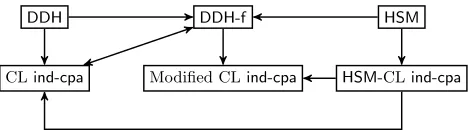
These new assumptions allow us to construct generic, linearly homomorphic encryption schemes overZ/pZwhich are semantically secure under chosen plain-text attacks (ind-cpa), which we callHSM-CL and Modified CL (cf.Section 3.2). The reductions between their semantic security and the underlying assumptions are given in Fig. 1, whereA→B indicates that assumptionB holds if assump-tionAholds, i.e.A is a stronger assumption thanB.
DDH DDH-f HSM
Modified CLind-cpa
CLind-cpa HSM-CLind-cpa
We then use the homomorphic properties of the above schemes to construct generic IPFE schemes over the integers and over Z/pZ, both from the weaker
DDH-f assumption in Section 4, and from the HSM assumption in Section 5, somewhat generalising the scheme based on DCR of [ALS16]. Since the inner product is encoded in the exponent in the subgroup F, it can efficiently be recovered, whatever its size. We thereby present the first IPFE schemes which are both efficient and recoverhy,xi modpwhatever its size.
Our security proofs for theHSMbased schemes follow a similar logic to those of [ALS16], analysing the entropy loss that occurs via queried keys, and demon-strating that there is enough residual entropy left for the challenge ciphertext to appear uniform to the adversary. However, significant difficulties occur for the schemes arising from the weakerDDH-f assumption. As in the DDHbased scheme of [ALS16], we use a variant of Elgamal`a la Cramer-Shoup. But unlike previous uses of this approach, the order of our group is unknownand may have small factors, so with constant probability an element may not be a generator. This calls for various subtleties: any element of the group can not be masked, however, ifpis large enough, elements of the subgroupF of order pcan be.
Moreover, in order to handle private key queries, instead of computing the global distribution of the keys given this information, we carefully simplify the description of the adversary’s view, since merely restricting the adversary’s view modulopcould potentially result in a loss of information.
We note that for our schemes overZ/pZ, vectorsxifrom which keys are
de-rived are inZ/pZ, whereas decryption keys are computed inZ, so a lift of thexi
inZmust be done. Since lifting does not preserve linear dependencies, it is essen-tial (as in [ALS16]) the key generation algorithm be stateful to lift vectors while maintaining linear dependencies. Without this restriction an adversary could learn a combination of the master key components which is singular modulop but invertible over Z, thus revealing the whole master key.
To instantiate our generic constructions we use class groups of imaginary quadratic fields. Although the devastating attack from [CL09] eliminates a whole family of protocols built from such groups, this attack applies to schemes whose security is based on factoring a discriminant while here this factorisation is pub-lic. Moreover [CL15] showed that designing with care discrete logarithm based cryptosystems within such groups is still possible and allows for efficient and versatile protocols (Encryption switching protocols for instance, cf. [CIL17]). The problem of computing a discrete logarithm in class groups of imaginary quadratic fields has been extensively studied since the 80’s, and the complexity of best known subexponential algorithms is4 O(L
1/2) (cf. [BJS10]) as opposed to O(L1/3) (cf. [Adl94]) for the discrete logarithm problem in finite field or factoring. In particular this implies that our keys can be chosen shorter and corroborates the above claim that the assumptions on which we rely are indeed weak.
4
In terms of efficiency, we show in Section 6 that for a security parameter of λ= 112 we outperform Paillier’s variant of [ALS16] on all possible sizes by factors varying between 2 and 20.
Relation to Hash Proof Systems. Hash proof systems (HPS) were introduced in [CS02] as a generalisation of the techniques used in [CS98]. Consider a set of wordsX, an NP languageL ⊂ X such thatL={x∈ X |w: (x, w)∈R} where
Ris the relation defining the language, Lis the language of true statements in X, and for (x, w)∈R,wis a witness forx∈ L. A HPS defines a key generation algorithmKeyGenwhich outputs a secret hashing keyhkand a public projection keyhpsuch thathkdefines a hash function Hhk:X 7→Π, andhpallows for the
(public) evaluation of the hash function on wordsx∈ L, i.e.Hhp(x, w) =Hhk(x)
for (x, w)∈R. Thesmoothness property requires that for anyx /∈ L, the value Hhk(x) be uniformly distributed knowinghp.
TheDDH and DCR assumptions can be used to instantiate smooth HPS’s where the languages L ⊂ X define hard subset membership problems. Such HPS’s, endowed with homomorphic properties over the key space, underly the IPFE schemes of [ALS16]. In fact Benhamouda, Bourse, and Lipmaa in [BBL17], and Bourse, in his thesis [Bou17], present a generic construction from a key homomorphic HPS (with a few other required properties) to an IPFE scheme in
Zwhich is secure under chosen plaintext attacks. They instantiate it fromDDH
and fromDCRbut leave outLWEdue to the complexity of the resulting scheme, as simpler constructions can be attained without using HPSs.
We note that though our constructions resemble the above – one can deduce new subset membership problems from the assumptions in Subsection 3.1 and associated HPS’s – our proof techniques are very different to those of [Bou17]: so as to achieve adaptive security, their game challenger mustguess the difference between challenge ciphertexts prior to generating the public/private key pair. If the hash key is not sampled uniformly at random from the key space (as in our constructions), then in order to maintain a level of security equivalent to that of the HPS the size of the secret keys increases substantially. Indeed, to encrypt vectors of dimension`whose coordinates are bounded byY, their proof techniques cause an additional `log(Y)-bit term to appear in each coordinate of the secret key, whereas in our constructions over Z, the bit length of the coordinates is independent of `. As a consequence, this approach leads to less efficient schemes.
2
Background
Notations. We denote sets by uppercase letters, vectors by bold lowercase letters, and the inner product of vectorsxandyis denotedhx,yi. For a distributionD, we writed←-D to refer tod being sampled fromD. We overload the notation as b←- B to say that bis sampled uniformally at random in the set B. For an integerx, we denote its size by|x|, and by [x] the set of integers{1, . . . , x}. For anyc∈R`, realσ >0, and`-dimensional latticeΛ,D
Λ,σ,cwill denote the usual
discrete Gaussian distribution overΛ.
Definition of Inner Product Functional Encryption. This is a special case of func-tional encryption, as first formalised by Boneh, Sahai and Waters in [BSW11]. To start with, we provide the definition of afunctionality.
Definition 1 (Functionality).A functionalityF defined over(K,Y)is a func-tionF :K × Y →Σ∪ {⊥}, whereK is a key space,Y is a message space andΣ is an output space, which does not contain the special symbol ⊥.
In this article, we consider the inner product functionality, which means that decrypting the encryption of a vector y with a key associated to a vector x
will reveal onlyhx,yi. More precisely, we consider the function F : (Z/pZ)`×
(Z/pZ)`→Z/pZ∪ {⊥} such thatF(x,y) =hx,yi. The syntax of a functional
encryption scheme is described below.
Definition 2 (Functional encryption scheme). Let λbe a positive integer. A functional encryption scheme for a functionality F over (K,Y) is a tuple (Setup,KeyDer,Encrypt,Decrypt)of algorithms with the following specifications:
– Setupon input a security parameter1λ, outputs a master key pair(mpk, msk); – KeyDer on input the master secret key msk and a keyK ∈ K, outputs a key
skK;
– Encrypt on input the master public keympk and a messageY ∈ Y, outputs a ciphertextC;
– Decrypttakes as input the master public keympk, a keyskK and a ciphertext
C and outputs v∈Σ∪ {⊥}.
For correctness, we require that for all(mpk, msk)←Setup(1λ), all keysK∈ K
and all messages Y ∈ Y, if skK ←KeyDer(msk, K)andC←Encrypt(mpk, Y),
with overwhelming probability it holds that, if v ← Decrypt(mpk, skK, C) then
v=F(K, Y)wheneverF(K, Y)6=⊥.
Security. We define below the security notion for functional encryption, which states that given the ciphertext of a messageY, the only information obtained from the secret key skK is the evaluation of the function f(K, Y). More
pre-cisely, no adversary can distinguish an encryption of Y0 from an encryption of Y1 even with the knowledge of secret keys skK chosen adaptatively but
and can perform a series of secret key requests before choosingY0 and Y1. We consider an indistinguishability-based definition instead of the simulation-based security definition of Boneh, Sahai and Waters from [BSW11]. This adaptive in-distinguishability notion is easier to handle, and it is also the strongest adaptive notion of security that can be achieved for numerous interesting functionalities. In particular, it has been demonstrated in [BSW11,AGVW13,BO13] that the strong simulation-based definition cannot be met in the standard model, while O’Neill showed in [O’N10] that indistinguishability-based security is equivalent to non-adaptive simulation-based security for a class of functions that includes the inner product. Moreover, De Caroet al.[DIJ+13] describe a method to trans-form an FE achieving an indistinguishability-based security notion into an FE attaining a certain simulation-based security.
Definition 3 (Indistinguishability-based security). A functional encryp-tion scheme FE = (Setup,KeyDer,Encrypt,Decrypt) provides semantic security under chosen-plaintext attacks (ind-fe-cpa) if no PPT adversary A has non-negligible advantage AdvA(λ) as defined below, under the constraints that A’s secret-key queries before and after its choice of challenge messages Y0 and Y1 satisfy F(K, Y0) =F(K, Y1)for all K in the set of key queries. The advantage is defined as follows:
AdvA(λ) =
Pr
β=β0:mpk, msk←Setup(1λ), Y
0, Y1← AKeyDer(msk,·)(mpk), β←− {$ 0,1}, C?←Encrypt(mpk, Y
β), β0← AKeyDer(msk,·)(C?)−
1 2
.
Backgound on Lattices. We here recall some definitions and basic results about Gaussian distributions. These are useful for our security proofs, in which we need to evaluate the distribution of an inner product when one of the two vectors follow a Gaussian distribution. We also recall an important result from [GPV08] which explains the conditions for a Gaussian distribution over a lattice which is reduced modulo a sublattice to be close to a uniform distribution, which is also a crucial point of our proofs.
Definition 4 (Gaussian Function).For anyσ >0define the Gaussian func-tion onR` centred atcwith parameter σ:
∀x∈R`, ρσ,c(x) = exp(−π||x−c||2/σ2).
If σ= 1 (resp.c=0), then the subscriptσ(resp. c) is omitted.
Definition 5 (Discrete Gaussians). For any c ∈ R`, real σ > 0, and ` -dimensional lattice Λ, define the discrete Gaussian distribution over Λas:
∀x∈Λ, DΛ,σ,c(x) =ρσ,c(x)/ρσ,c(Λ),
Lemma 1. Let x∈ R`\ {0}, c ∈R`, σ ∈ R with σ >0 and σ0 = σ/||x|| 2, c0= hhx,xc,xii. A random variableK is distributed according to DZ,σ0,c0 if and only
if V :=Kxis distributed according toDxZ,σ,c.
In dimension 1, Lemma 1 implies that ifx∈R, thenV =Kxis distributed according to DxZ,σ,c if and only if K is distributed according to DZ,σ/|x|,c/x.
The following lemma allows to evaluate the distribution of the inner product resulting from a constant vectorx, and a vector with coordinates sampled from a Gaussian distribution over the latticex·Z.
Lemma 2. Let x ∈ R` with x 6= 0, c ∈ R`, σ ∈ R with σ > 0. Let V be a
random variable distributed according to Dx·Z,σ,c. Then the random variable S
defined as S=hx, Viis distributed according toD||x||2
2·Z,σ·||x||2,hc,xi.
Proofs of Lemmas 1 and 2 are provided in Aux. Material I.
Lemma 3 ([GPV08]).LetΛ00⊂Λ0⊂R`be two lattices with the same dimen-sion. Let∈(0,1/2). Then for anyc∈R`and anyσ≥η
(Λ00), the distribution DΛ0,σ,c modΛ
0
0 is within statistical distance 2 from the uniform distribution overΛ0/Λ00. The value η(Λ00) is the smoothing parameterof the lattice Λ00, as defined in [MR04].
3
Variants of
CL
: assumptions and
ind
-
cpa
schemes
In [CL15], Castagnos and Laguillaumie introduced the framework of a DDH
group with an easy DL subgroup: a cyclic groupG where theDDH assumption holds together with a subgroupF ofGwhere the discrete logarithm problem is easy. Within this framework, they designed a linearly homomorphic variant of Elgamal, described in Aux. Material II, and denotedCLthroughout the rest of this paper. Moreover, they gave an instantiation using class groups of quadratic fields which allows the computation of linear operations modulo a primep.
Their protocol is similar to the one of Bressonet. al.[BCP03] whoseind-cpa
security relies on the DDH assumption in (Z/N2Z)×, where N = pq, using the arithmetic ideas of Paillier’s encryption [Pai99]. Another encryption scheme based on Elgamal over (Z/N2Z)× was proposed by Camenisch and Shoup in [CS03]. Itsind-cpasecurity relies on the Decision Composite Residuosity assump-tion (DCR), which consists in distinguishing theN−th powers in (Z/N2Z)×.
In the following subsection, we recall the framework of [CL15] and then gen-eralise theDCR assumption to fit this framework of aDDH group with an easy
DLsubgroupwith a hard subgroup membership problem (following [Gjø05]’s ter-minology). We also introduce a newDDH-like assumption which is weaker than
DDH in G. Then, in Subsection 3.2, we give generic encryption schemes whose
3.1 Algorithmic assumptions
To start with, we explicitly define the generatorGenGroupused in the framework of a DDH group with an easy DL subgroup introduced in [CL15], with a few modifications as discussed below.
Definition 6 (Generator for a DDH group with an easy DLsubgroup).
Let GenGroupbe a pair of algorithms(Gen,Solve). TheGenalgorithm is a group generator which takes as inputs two parameters λ and µ and outputs a tuple (p,s, g, f, g˜ p, G, F, Gp). The set(G,·)is a cyclic group of orderpswheresis an
integer, pis a µ-bit prime, andgcd(p, s) = 1. The algorithmGen only outputs an upper bound s˜of s. The set Gp={xp, x∈G} is the subgroup of order s of
G, and F is the subgroup of order pof G, so that G=F×Gp. The algorithm
Gen outputs f, gp andg =f·gp which are respective generators of F, Gp and
G. Moreover, theDLproblem is easy inF, which means that theSolvealgorithm is a deterministic polynomial time algorithm that solves the discrete logarithm problem inF:
Pr
x=x?: (p,˜s, g, f, g
p, G, F, Gp)←Gen(1λ,1µ), x←-Zp, X=fx,
x?←Solve(p,s, g, f, g˜ p, G, F, Gp, X)= 1.
Remark 1. In practice the size of s is chosen so that computing discrete loga-rithms inGp takes timeO(2λ).
We note that this definition differs slightly from the original definition of [CL15]. First, we impose F to be of prime orderpas our agenda is to use the instantiation with class groups of quadratic fields in order to haveZ/pZas the message space. This means that the generic constructions do not encompass the schemes built from Paillier where the message space isZ/NZ, withN =pq. If it is possible to useN =pq as the order ofF, the proofs have to rely on factoring assumptions to take care of the non-zero non-invertible elements of Z/NZ. As a consequence, this restriction simplifies the proofs, since an element ofZ/pZis invertible if and only if it is non-zero.
Another modification is outputing the elementgpthat generatesGpto define
theHSMassumption below, and to setg=f·gp. In practice, the instantiation
of [CL15] with class groups of quadratic fields already computes such an element gp and thus defines the generatorgofG. Note that this explicit definition ofgis
only needed for the proof of Theorem 4 for the relation between theHSMand the
DDH assumptions (cf.Def. 7, 8 and 9 of Aux. Material II respectively). A last modification is thatGen only outputs an upper bound ˜sofsand notn. This is more accurate than the original definition asnis not used in the applications and actually, the instantiation does not computenas it is a class number that requires sub-exponential time (with complexityO(L1/2)) to be computed. This implies
that in the following assumptions, exponents are sampled from distributions statistically close to uniform distributions. We discuss this in Remark 2.
as-sumption: in Def. 6, one hasG=F×Gp. The assumption is that it is hard to
distinguish the elements ofGp in G.
Definition 7 (HSMassumption).LetGenGroup= (Gen,Solve)be a generator for DDH groups with an easy DL subgroup. Using the notations introduced in Def 6, the HSM assumption requires that the HSM problem is hard in G even with access to the Solve algorithm. LetD (resp.Dp) be a distribution over the
integers such that the distribution {gx, x ←- D} (resp. {gx
p, x ←- Dp}) is at
distance less than 2−λ from the uniform distribution in G(resp. in Gp). LetA
be an adversary for the HSMproblem, its advantage is defined as:
AdvHSMA (λ, µ) =
2·Pr
b=b? : (p,˜s, g, f, gp, G, F, Gp)←Gen(1λ,1µ),
x←-D, x0←-Dp, b←-{0,1}, Z0=gx, Z1=gx
0 p ,
b?← A(p,s, g, f, g˜ p, G, F, Gp, Zb,Solve(.))−1
TheHSMproblem is said to be hard inGif for all probabilistic polynomial time attacker A,AdvHSMA (λ, µ)is negligible.
Remark 2. In contrast to the traditional formulation of DDH or DCR, we can not sample uniformly elements in Gp or G either by a direct construction or
using the generators and sampling uniformly exponents modulo the group order as the orders (resp.ps) of Gp (resp. ofG) is unknown. As a result we use the upper bound ˜s of s in order to instantiate the distributions Dp and D of the
above definitions. Choosing distributions D andDp with induced distributions
statistically close to the uniform distributions in G and Gp allows for more flexibility in our upcoming proofs, which is of interest, since, as proved in Aux. Material III, theDDHandHSMassumptions do not depend on the choice of the distribution.
In practice, we will instantiateDp andDthanks to the following lemma, whose
proof is in Aux. Material III. We use folded gaussians as they provide better efficiency than folded uniforms, and allow us to apply Lemma 3 in our security proofs.
Lemma 4. The distributionsDp andDcan be implemented from the output of Gen as follows:
1. One can chooseD to be the uniform distribution on{0, . . . ,2λ−2·s˜·p}. 2. Alternatively, choosingD=DZ,σ withσ= ˜s·p·
√
λallows for more efficient constructions as the sampled elements will tend to be smaller.
3. Likewise, one can chooseDp=DZ,σ0 withσ0 = ˜s·
√ λ 4. One can also, less efficiently, defineDp=D.
5. Conversely, one can also define D from Dp and the uniform distribution
modulop: the distribution {gx
p·fa, x←-Dp, a←-Zp}is statistically close to
Finally, we introduce a new assumption calledDDH-f that we prove to be weaker than DDH. The security of our first IPFE relies on this assumption. Roughly speaking, it means that it is hard to distinguish the distributions
{(gx, gy, gxy), x, y←-D}and{(gx, gy, gxyfu), x, y←-D, u←-Z/pZ}. In other words, as g = f ·gp, we have on the left, a Diffie-Hellman triplet in
G, and on the right, a triplet whose components in Gp form a Diffie-Hellman
triplet, and whose components in F form a random triplet: (fx, fy, fxy+u) (as
noted in the previous remark, Dinduces distributions statistically close to the uniform inGp andF).
We will see in the next subsection that the security of the CL encryption scheme is actually equivalent to this assumption and that this assumption is weaker than the DDH assumption and the HSMassumption (see Theorem 4). As a side effect, using this assumption will simplify the forthcoming proofs as it is tightly related to theind-cpasecurity of the underlying encryption scheme.
We note that DDH-f can be seen as an instance of the Extended-DDH (EDDH) problem as defined by Hemenway and Ostrovsky in [HO12]. They demonstrate thatQRandDCRimply two different instantiations ofEDDH, our implication fromHSM toDDH-f somewhat generalises their proof sinceDDH-f
is a more generic assumption than either of the hardness assumptions obtained from their reductions.
Definition 8 (DDH-f assumption). Let GenGroup = (Gen,Solve)be a gener-ator for DDH groups with an easyDL subgroup. Using the notations of Def 6, the DDH-f assumption requires that the DDH-f problem is hard inG even with access to theSolvealgorithm. LetDbe a distribution over the integers such that the distribution{gx, x←-D} is at distance less than 2−λ from the uniform
dis-tribution in G. Let Abe an adversary for the DDH-f problem, its advantage is defined as:
AdvDDHA -f(λ, µ) =
2·Prb=b?: (p,s, g, f, g˜ p, G, F, Gp)←Gen(1λ,1µ),
x, y←-D, u←-Z/pZ, X =gx, Y =gy, b←-{0,1}, Z0=gxy, Z1=gxyfu, b?← A(p,s, g, f, g˜ p, G, F, Gp, X, Y, Zb,Solve(.))
−1
.
The DDH-f problem is said to be hard in G if for all probabilistic polynomial time attacker A,AdvDDHA -f(λ, µ)is negligible.
3.2 Some variants of the CL generic encryption scheme
Def. 6. Its description is provided in Fig. 1 of Aux. Material II. They prove that this scheme isind-cpaunder the DDH assumption as defined in Def. 9 of Aux. Material II. We demonstrate below that we can be more precise and prove that the security of this scheme is equivalent to theDDH-f assumption of Def. 8: the key idea is to perform a one-time pad inF, instead of in the whole groupG.
Theorem 1. The CL encryption scheme is semantically secure under chosen plaintext attacks (ind-cpa) if and only if the DDH-f assumption holds.
Proof (sketch). Suppose that the DDH-f assumption holds. Let us consider the
ind-cpa game, with a public key, h = gx, x ←- D, and a challenge ciphertext
(c1, c2) = (gr, fmβhr) with r ←- D and β ←- {0,1}, m0, m1 ∈ Z/pZ. We can replace (h, c1, hr) = (gx, gr, gxr) by (gx, gr, gxrfu) = (gx, gr, hrfu) with u ←
-Z/pZ. As a result c2 =hrfu+mβ. For the adversary, the value of r modulo n is fixed by c1 =gr as g is a generator, so the value of hr is fixed. As a result fromc2 an unbounded adversary can inferu+mβ ∈Z/pZbut asuis uniformly
distributed inZ/pZ, he will have no information onβ.
Conversely, we construct an ind-cpa adversary from a distinguisher for the
DDH-f problem. Choosem0∈Zpandm1:=m0+uwithu←-Z/pZ. From the public key and the challenge ciphertext, construct the triplet
(h, c1, c2/fm0) = (gx, gr, gxrfmβ−m0).
This gives a DH triplet if and only β = 0 and the exponent of f is uniformly distributed inZ/pZif and onlyβ = 1. As a result, one can use the output of a distinguisher for theDDH-f problem to win theind-cpagame. ut
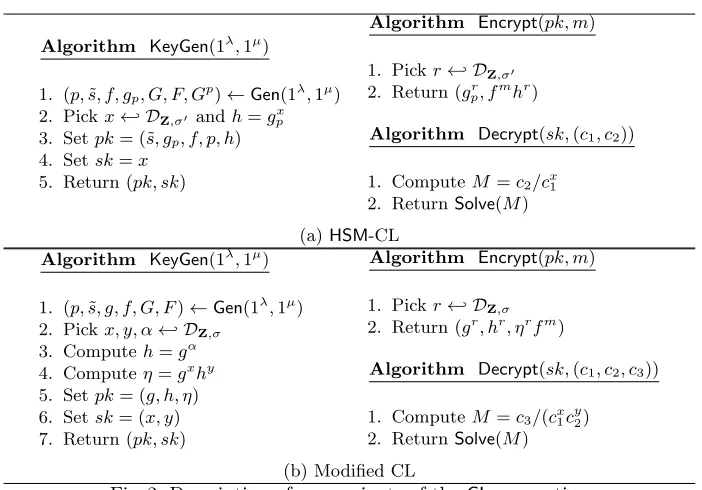
A linearly homomorphic encryption scheme from HSM. As noted in the introduction of this section, the CL scheme was inspired by the scheme of [BCP03]. We here present a slight modification to this scheme so that it relies on theHSMassumption of Def. 7 in order to somewhat generalise the approach of the Camenisch and Shoup scheme of [CS03]. This ind-cpascheme will be the basis of the functional encryption scheme for inner product of Section 5.
Setting the parameters. We use the output (p,˜s, g, f, gp, G, F, Gp) of the Gen-Group generator of Def. 6. We ignore the generator g (which is useless here). Following Lemma 4, Item 3, we requireσ0 >˜s√λto ensure that{gr
p, r←-DZ,σ0}
is at distance less than 2−λ from the uniform distribution inGp. The plaintext
space is Z/pZ, where pis a µ bit prime, with µ ≥λ. The scheme is depicted in Fig. 2a and the standard proof of the following theorem is provided in Aux. Material IV for completeness.
Algorithm KeyGen(1λ,1µ)
1. (p,s, f, g˜ p, G, F, Gp)←Gen(1λ,1µ)
2. Pickx←-DZ,σ0 andh=gpx
3. Setpk= (˜s, gp, f, p, h)
4. Setsk=x
5. Return (pk, sk)
Algorithm Encrypt(pk, m)
1. Pickr←-DZ,σ0
2. Return (gr p, fmhr)
Algorithm Decrypt(sk,(c1, c2))
1. ComputeM =c2/cx1 2. ReturnSolve(M)
(a)HSM-CL Algorithm KeyGen(1λ,1µ)
1. (p,s, g, f, G, F˜ )←Gen(1λ,1µ) 2. Pickx, y, α←-DZ,σ
3. Computeh=gα
4. Computeη=gxhy
5. Setpk= (g, h, η) 6. Setsk= (x, y) 7. Return (pk, sk)
Algorithm Encrypt(pk, m)
1. Pickr←-DZ,σ
2. Return (gr, hr, ηrfm)
Algorithm Decrypt(sk,(c1, c2, c3))
1. ComputeM =c3/(cx1cy2) 2. ReturnSolve(M)
(b) Modified CL
Fig. 2: Description of our variants of theCLencryption
Enhanced variant of the CL encryption scheme. We here put forth an enhanced version of the CL homomorphic encryption scheme. We modify the originalCLscheme by adding a key`a la Cramer-Shoup (cf.[CS98]). The security of this scheme also relies on theDDH-f assumption. Thisind-cpascheme will be the basis of the functional encryption scheme for inner product of Section 4.
This modification to theCLencryption scheme incurs some challenges: let us consider the vanilla Elgamal scheme defined over a cyclic group of prime order q, generated by an element g. The modification leading to the Cramer-Shoup encryption scheme uses a second generator hand creates a keyη=gxhy where
x, y←-Z/qZ. Thenηr, with r←-Z/qZis used to mask the plaintext message.
In the proof under theDDHassumption, one replaces the DH triplet (h, gr, hr)
built from the public key and the ciphertext by a random triplet and proves that the mask ηr is then uniformly distributed and acts as a one-time pad for
the plaintext, even with the knowledge of η. However, the triplet (h, gr, hr) is
indeed a DH triplet, because if his a generator, h=gα with α∈(Z/qZ)∗. As a result, α is almost uniformly distributed inZ/qZ (an elementα←-Z/qZis such thatα6= 0 with overwhelming probability ifqis large). The same happens when considering a composite group orderN0 whereN0 is an RSA integer as in [Luc02], for instance, under the factoring assumption.
In our case, we use theGenGroup generator of Def. 6, i.e. a cyclic groupG of composite order n= psgenerated byg, where s is unknown and may have some small factors. As a result, a random element h = gα, with α ←- D
may not be a generator with constant probability. Consequently, the padding ηr where r ←- D
Z,σ and η = gxhy, with x, y ←- DZ,σ may not be uniformly
distributed inGknowingη. However, we can still adapt the proof: we only need ηr to act as a one-time pad in the subgroup F =hfiofGof order p, since our
plaintext message m∈Z/pZis encoded asfm∈F. Supposing thatpis a µ-bit
prime, withµ≥λis sufficient to prove this. As the exponents are taken close to uniform modulon andn=p·swith gcd(p, s) = 1, they behave independently and close to uniform modulopand modulos. As we are interested only in what happens modulop, we can ignore the behavior modulosand getind-cpasecurity under the DDH-f assumption. Note that the use of this assumption instead of the strongerDDHassumption greatly simplifies the proof.
Setting the parameters. We use the output (p,s, g, f, g˜ p, G, F, Gp) of the
gener-ator GenGroup of Def. 6. As in the original CL scheme (cf. Aux. Material II), we ignore the group Gp and its generator (which are useless here). Following
Lemma 4, Item 2, we require σ > ps˜√λ to ensure that {gr, r ←- D
Z,σ} is at
distance less than 2−λ from the uniform distribution in G. The plaintext space isZ/pZ, wherepis aµbit prime, withµ≥λ. The scheme is depicted in Fig. 2b.
Theorem 3. The scheme described in Fig. 2b is semantically secure under cho-sen plaintext attacks (ind-cpa) under theDDH-f assumption.
The proof is provided in Aux. Material V for completeness.
3.3 Relations between the assumptions
One can establish direct reductions from the underlying problems of the DDH,
DDH-fandHSMassumptions. However it is somewhat easier to use intermediate results on theind-cpasecurity of the schemes defined in the previous subsection to demonstrate these reductions.
We proved in Theorem 1 that the original CL cryptosystem is ind-cpa if and only if the DDH-f assumption holds. In [CL15], it was proven that this scheme is ind-cpa under the DDH assumption. As a result, DDH-f is a weaker assumption than DDH. Furthermore, it is easy to see that if the HSM scheme of Fig. 2a isind-cpathen the originalCLcryptosystem isind-cpa: from a public keyh=gxp,x←-DZ,σ0 and a ciphertextc = (c1, c2) = (gpr, fm·hr), r←-DZ,σ0
for the HSM scheme, one can chose a, b ←- Z/pZ and construct h0 = h·fa, and the ciphertext c0 = (c01, c02) = (c1 ·fb, c2 ·fab). According to Lemma 4, Item 5,h0andc01are statistically indistinguishable from the uniform distribution in G. Furthermore, h0 = gx
pfa = gα where α is defined modulo n from the
Chinese remainder theorem, such that α ≡ x (mod s) and α ≡ a (modp). Likewise, c01 = gr
pfb = gβ for some β defined equivalently. Finally, one has
c02/fm =gxr
p fab =gpαβ modsfαβ modp = gαβ. As a result, (h0, c01, c02/fm) is a DH triplet in G, so h0, c0 are a public key and a ciphertext for m for the CL
assumption holds, from Theorem 2, theHSMscheme isind-cpa, so theCLscheme is alsoind-cpaand theDDH-fassumption holds.
We can sum up these results with the following theorem (see also Fig. 1).
Theorem 4. The DDH assumption implies the DDH-f assumption. Further-more, theHSMassumption implies the DDH-f assumption.
4
Inner product FE relying on the
DDH
-
f
assumption
In this section, we build an IPFE scheme from theDDH-fassumption (cf.Def. 8). As proven in Theorem 4, this assumption is weaker than both the DDH and the HSMassumptions and yields simple proofs as it is suited to deal with the encoding of the message into a subgroup of prime orderp. We use the formalism of a cyclic group with an easy DL subgroup. Our approach is based on the enhanced variant of the CLscheme, described in Fig. 2b. The resulting scheme over Z/pZcan be viewed as an adaptation of the DDH scheme of [ALS16] to this setting, thereby removing the restriction on the size of the inner product.
The proof technique somewhat differs from the general approach of [ALS16]. We start from the ind-cpa proof of the enhanced variant of CL and then deal with the information provided by the key queries. Instead of computing the global distribution of the keys given this information, in order to make the proof go through, we have to carefully simplify the description of the adversary’s view. A technical point is that even if we are only interested in what happens modulo p, as the plaintexts are defined in (Z/pZ)`, we cannot restrict the adversary’s
view modulop: this could potentially result in a loss of information, as the key queries are defined inZ.
We first present an FE scheme for inner products overZ (Section 4.1) and then consider a scheme for inner products overZ/pZ(Section 4.2).
4.1 DDH-f-based FE for inner product over Z
Setting the parameters. As in theind-cpascheme of Fig. 2b, we use the output (p,s, g, f, g˜ p, G, F, Gp) of theGenGroupgenerator of Def. 6. We ignore the group
Gp and its generator g
p (which are useless here). We require that pis a µ-bit
prime, withµ≥λ.
From Lemma 4, Item 2, choosingσ > s˜·p·√λ suffices to ensure that the distribution{gx, x← D
Z,σ} is at distance less than 2−λ from the uniform
dis-tribution in G, however for security we must take a larger σ > ˜s·p3/2·√2λ (cf.proof of Theorem 5). TheEncryptalgorithm operates on plaintext messages
y∈Z`and the key derivation algorithm derives keys from vectorsx∈Z`. Norm
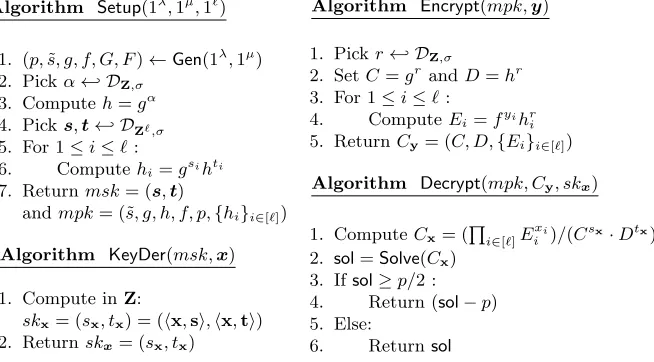
Construction. Fig. 3 depicts the functional encryption scheme for inner products in Zwhich is secure under theDDH-f assumption (cf.Def. 8).
Algorithm Setup(1λ,1µ,1`)
1. (p,s, g, f, G, F˜ )←Gen(1λ,1µ) 2. Pickα←-DZ,σ
3. Computeh=gα
4. Picks,t←-DZ`,σ
5. For 1≤i≤`:
6. Computehi=gsihti
7. Returnmsk= (s,t)
andmpk= (˜s, g, h, f, p,{hi}i∈[`])
Algorithm KeyDer(msk,x)
1. Compute inZ:
skx= (sx, tx) = (hx,si,hx,ti)
2. Returnskx= (sx, tx)
Algorithm Encrypt(mpk,y)
1. Pickr←-DZ,σ
2. SetC=grandD=hr
3. For 1≤i≤`:
4. ComputeEi=fyihri
5. ReturnCy= (C, D,{Ei}i∈[`])
Algorithm Decrypt(mpk, Cy, skx)
1. ComputeCx= (Qi∈[`]E
xi
i )/(C
sx·Dtx)
2. sol=Solve(Cx)
3. Ifsol≥p/2 : 4. Return (sol−p) 5. Else:
6. Returnsol
Fig. 3: FE scheme for inner product overZunder theDDH-f assumption.
Correctness. We have
Y
i∈[`] Exi
i /(C
sx·Dtx) = Y i∈[`]
(fyi(gsi·hti)r)xi/((gr)hx,si·(hr)hx,ti)
= (fP`i=1yixi)(grP`i=1sixi)(hrP`i=1tixi)/(grhx,si·hrhx,ti)
=fhx,yi.
Applying the Solvealgorithm to Cx yieldshx,yi modp, which, thanks to the
norm bounds, is either hx,yiorhx,yi+p. Since the absolute value ofhx,yiis lower thanp/2, ifsol< p/2 thenhx,yi=solinZ, otherwisehx,yi= (sol−p).
Theorem 5. Under the DDH-f assumption, the functional encryption scheme for inner products over Zof Fig. 3 provides full security (ind-fe-cpa).
Proof. The proof proceeds as a sequence of games, starting in Game 0 with the realind-fe-cpagame and ending in a game where the ciphertext statistically hides the random bit β chosen by the challenger from the adversary’s point of view. The beginning of the proof is similar to the proof of Theorem 3 onind-cpa
Game 1
1. mpk, msk←Setup(1λ,1µ,1`) 2. y0,y1← A
KeyDer(msk,·) (mpk) 3. Pickβ←-{0,1}
4. Pickr←-DZ,σ
5. ComputeC=gr, D=hr
6. For 1≤i≤`:
7. ComputeEi=fyβ,iCsiDti
8. Cy= (C, D,{Ei}i∈[`])
9. β0← AKeyDer(msk,·) (Cy)
10. Return (β=β0)
Game 2
1. mpk, msk←Setup(1λ,1µ,1`) 2. y0,y1← A
KeyDer(msk,·) (mpk) 3. Pickβ←-{0,1}
4. Pickr←-DZ,σandu←-Z/pZ
5. ComputeC=gr, D=hrfu
6. For 1≤i≤`:
7. ComputeEi=fyβ,iCsiDti
8. Cy= (C, D,{Ei}i∈[`])
9. β0← AKeyDer(msk,·) (Cy)
10. Return (β=β0)
ciphertext has exactly the same distribution therefore: Pr[S0] = Pr[S1].
Game 1 ⇒ Game 2:In Game 1, the tuple (h=gα, C =gr, D=hr =gαr),
whereα, r←-DZ,σ, is a DH triplet since choosingσ > p3/2·˜s·
√
2λ > p·s˜·√λ ensures that the induced distribution is at distance less than 2−λof the uniform
distribution in G. In Game 2, the challenger samples a random u ←- Z/pZ
and computes D = hrfu. Both games are indistinguishable under the DDH-f
assumption:
|Pr[S2]−Pr[S1]|=AdvDDHB -f(λ, µ). Now in Game 2 the challenge ciphertext is:
(C=gr, D=hrfu, {Ei=fyβ,i·Csi·Dti =fyβ,i+utihri}i∈[`]).
Lemma 5. In Game 2 the ciphertext (C, D, E1, . . . , E`) ∈ G`+2 statistically
hidesβ such that|P r[S2]−1/2| ≤2−λ.
Intuition. Following the proof methodology of [ALS16], we first delimit the information that is leaked in the challenge ciphertext by only considering the dimension in which both potential challenge ciphertexts differ. Indeed, denoting
zβ=yβ+u·t modp, then projectingzβonto the subspace generated byy0−y1 encapsulates all the information revealed by the challenge ciphertext.
Next, we consider the distribution of the projection of the secret key component
ton the subspace generated by y0−y1, conditionally on the adversary’s view (i.e. on the information leaked by private key queries and the public key). This amounts to a distribution over a one dimensional lattice Λ0. We then reduce this distribution modulo a sub-latticeΛ00 such that Λ0/Λ00 'Z/nZ, and using Lemma 3 we demonstrate that for an appropriate choice of the standard devia-tionσ(which definesDZ`,σ, from whichtis sampled), the projection ofton the
Proof (Lemma 5). The ciphertext componentC=gr information theoretically
reveals r modn. Furthermore, ∀i ∈ [`], Ei information theoretically reveals
yβ,i+uti modpas the value ofhri is fixed fromCand the public key. Therefore
the challenge ciphertext information theoretically revealszβ=yβ+u·t modp.
Throughout the rest of this proof we demonstrate that yβ is statistically
hidden modp, thanks to the distribution of tconditioned onA’s view.
We denotexi A’sith query to the key derivation oracle. It must hold that,
for alli,hxi,y0i=hxi,y1i. Let d6= 0 be the gcd of the coefficients ofy1−y0 and define
y= (y1, . . . , y`) = 1/d·(y1−y0)∈Z`.
It holds thathxi,yi= 0 over Zfor alli. Therefore if we consider the lattice y⊥={x∈Z`:hx,yi= 0},
all the queries xi must belong to that lattice. W.l.o.g., we assume the n0 first coordinates ofyare zero (for some n0), and all remaining entries are non-zero. Further, the rows of the following matrix form a basis ofy⊥:
Xtop=
In0
−yn0+2 yn0+1
−yn0+3 yn0+2
. .. . .. −y` y`−1
∈Z(`−1)×`.
We define the matrix:
X=
Xtop yT
∈Z`×`. (1)
We claim that Xis invertible modp. The proof – detailed in Aux. Material VI – follows the same reasoning as [ALS16, Proof of Theorem 2].
Now sinceX is invertible overZ/pZand does not depend onβ ∈ {0,1}, it suffices to show thatX·zβ∈(Z/pZ)`is statistically independent ofβ. Moreover
by construction Xtop·y0 =Xtop·y1 (over the integers), soXtop·zβ is clearly
independent ofβ and we only need to worry about the last row ofX·zβ modp,
i.e. the information aboutβ leaked by the challenge ciphertext is contained in: hy,zβi=hy,yβi+u· hy,ti modp. (2)
We hereafter prove that, fromA’s perspective,hy,tifollows a distribution statis-tically close to the uniform distribution modp, thus proving thatβis statistically hidden: sinceuis sampled uniformly at random fromZ/pZ,u6= 0 modpwith all but negligible probability as pis aµ-bit prime, with µ≥λ. To this end, we analyse the information that the adversary gains ontmodn. From this, we will prove that the distribution ofhy,tiis close to uniform modn, and thus, modp. As in the proof of Theorem 3, the adversary learnsz =s+αtmodn from the public key as∀i∈[`], hi=gsihti. Knowingz, the joint distribution of (s,t)
modnis:
As a result, knowingz does not give more information ont modntoA. One may assume that through its secret key queries, the information learned byAis completely determined byXtop·sandXtop·t∈Z(`−1), as all the queried
vectorsxi can be obtained as linear combinations of the rows ofXtop.
The value ofXtop·sdoes not giveAmore information ontmodnthan what
he obtains fromXtop·t. Indeed the remainder of the Euclidean division ofXtop·s
by ncan be deduced from z and Xtop·t; while the quotient is independent of t modnand Xtop·t, ass andt are sampled independently andz only brings
a relation modulo n. It is thus sufficient to analyse the distribution oftmodn knowingXtop·t.
Lett0 ∈Z` be an arbitrary vector such that Xtop·t0 =Xtop·t. Knowing
Xtop·t, the distribution oftist0+DΛ,σ,−t0 whereΛ={t∈Z `:X
top·t=0}.
This lattice has dimension 1 and contains y·Z. In fact, as gcd(y1, . . . , y`) = 1,
one has y·Z =Λ (there exitsy0 ∈ Z` such that Λ = y0·Z and y =αy0 so αmust divide gcd(y1, . . . , y`) = 1). Therefore, applying Lemma 2, we see that
conditioned onXtop·t, hy,tiis distributed according to
hy,t0i+D||y||2
2Z,||y||2σ,−ht0,yi.
Now consider the distribution obtained by reducingD||y||2
2Z,||y||2σ,−ht0,yiover
Λ0=||y||22·Zmodulo the sublatticeΛ00=n·||y||22·Z. In order to apply Lemma 3 we need||y||2·σ > η(Λ00), which – applying a bound on the smoothing parameter from [MR07] for= 2−λ−1– is guaranteed by choosing
||y||2·σ > λ1(Λ00)· √
λ.
Moreover sinceλ1(Λ00) =n· ||y||2
2, we require ||y||2·σ > p·˜s· ||y||22·
√ λ,
thus
σ > p·˜s· ||y||2· √
λ.
Now from the norm bounds on y0 and y1 it holds that ||y||2 < √
2p, so choosing
σ > p3/2·s˜·√2λ
suffices to ensure that from A0s view, hy,ti modulo n is within distance 2−λ
from the uniform distribution overΛ0/Λ00'Z/nZ. As a result,hy,timodulop is also close to the uniform distribution over Z/pZ.
We have therefore demonstrated that with overwhelming probability the term hy,yβiin eq. (2) is statistically hidden modulopand|P r[S2]−1/2| ≤2−λ.
4.2 DDH-f-based FE for inner product over Z/pZ
As in theLWEand Paillier-based IPFE modulopput forth in [ALS16], the main problem encountered here is that private key queries are performed over the integers. An adversary may therefore query keys for vectors that are linearly dependant over (Z/pZ)`but independent overZ`. To solve this issue we require
as in [ALS16] that the authority distributing private keys keeps track of all previously revealed private keys.
Setting the parameters.As in the previous construction, we use the output (p,s, f, g˜ p, G, F, Gp) of the GenGroupgenerator of Def. 6, withpa µ bit prime,
and withµ≥λ. We sample the coordinates of the secret key fromDZ`,σ.
Choos-ingσ >˜s·p`·√λ·(√`)`−1suffices for security to hold (cf.proof of Theorem 6), and ensures the distribution {gx, x← D
Z,σ} is at distance less than 2−λ from
the uniform distribution in G (cf. Lemma 4, Item 2). The Encrypt algorithm encrypts plaintextsy ∈(Z/pZ)` and the key derivation algorithm derives keys from vectorsx∈(Z/pZ)`.
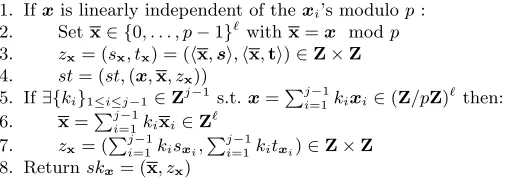
Construction. Algorithms Setup and Encrypt proceed exactly as in the con-struction for inner products overZunderDDH-f(cf.Fig. 3). AlgorithmsKeyDer
andDecrypt, which differ from those of the previous construction, are defined in Fig. 4. Again, correctness follows from the linearity of the inner product.
Algorithm KeyDer(msk,x, st)
Answering thejthkey requestskxwherex∈(Z/pZ)`. At any time the internal state
st contains at most`tuples (xi,xi, zxi) where (xi, zxi) are previously queried secret
keys and thexi’s are corresponding vectors.
1. Ifxis linearly independent of thexi’s modulop:
2. Setx∈ {0, . . . , p−1}`
withx=x modp
3. zx= (sx, tx) = (hx,si,hx,ti)∈Z×Z
4. st= (st,(x,x, zx))
5. If∃{ki}1≤i≤j−1∈Zj−1 s.t.x=Pj
−1
i=1kixi∈(Z/pZ)`then:
6. x=Pj−1
i=1kixi∈Z`
7. zx= (Pj
−1
i=1kisxi,
Pj−1
i=1kitxi)∈Z×Z
8. Returnskx= (x, zx)
Algorithm Decrypt(mpk, Cy, skx)
1. Parse (x= (x1, . . . , x`); zx= (sx, tx)) =skx 2. ComputeCx= (Qi∈[`]E
xi
i )/(C
sx·Dtx)
3. ReturnSolve(Cx)
Fig. 4: Stateful FE scheme for inner products overZ/pZfromDDH-f.
Proof. The proof proceeds similarly to that of Theorem 5, only we must define the matrix Xtop differently, as we can no longer guarantee that it is invertible
modulop. So we here follow the same steps as in the previous proof up until the definition of Game 2. The only difference being that the adversaryAqueries the stateful key derivation algorithm. We denote Gamei0 the variant of Gameiin which the key derivation algorithm is stateful. From the proof of Theorem 5, it holds that |Pr[S02]−Pr[S00]|=AdvDDHB -f(λ, µ).
As in the original Game 2, here in Game 20 the challenge ciphertext infor-mation theoretically revealszβ=yβ+u·t modp
We define y = (y1, . . . , y`) = y1 −y0 ∈ (Z/pZ)`; and, assuming A has performed j private key queries, for 1 ≤ i ≤ j, we denote xi ∈ (Z/pZ)` the
vectors for which keys have been derived.
We want to demonstrate that fromA’s view, the bitβis statistically hidden in Game 20. However we cannot use the same matrix Xtop as in the proof of
Theorem 5; indeed, if we defineX as in eq. (1) we cannot guarantee thatX is invertible modulop, since det(XXT) could be a multiple ofp. Therefore, so as
to ensure that the queried vectorsxi do not in some way depend onβ, we prove
via induction that after thejfirst private key queries (wherej∈ {0, . . . , `−1}), A’s view remains statistically independent ofβ, thus proving that the challenge ciphertext in Game 20 statistically hidesβ such that|P r[S20]−1/2| ≤2−λ. The induction proceeds on the value ofj.
Recall that Game 2 and Game 20 are identical but for the key derivation algo-rithm. Therefore if the adversary can make no calls to its key derivation oracle, the indistinguishability of ciphertexts in Game 20follows immediately from that in Game 2, demonstrated in the proof of Theorem 5, thus the induction hy-pothesis holds for j = 0. Now consider j ∈ {0, . . . , `−1}. From the induction hypothesis one may assume that at this point the statest ={(xi,xi, zxi)}i∈[j]
is independent ofβ. Indeed ifA’s view afterj−1 requests is independent ofβ then thejth request performed byAmust be so.
W.l.o.g. one may assume that the key requestsxiperformed by the adversary
are linearly independent. This implies that the xi’s are linearly independent
modulopand generate a subspace of
y⊥p ={x∈(Z/pZ)`:hx,yi= 0 modp}.
The set {xi}i∈[j] can be extended to a basis {xi}1≤i≤`−1 of y⊥p. We define
Xtop ∈Z(`−1)×` to be the matrix whose rows are the vectors xi fori∈[`−1].
Letx0 ∈(Z/pZ)` be a vector chosen deterministically, x0 ∈/ y⊥p, such that the adversaryAcan also easily compute x0. We definex
botto be the canonical lift
ofx0 overZ, andXas:
X=
Xtop
xT
bot
∈Z`×`.
The matrixXis invertible modulop, statistically independent ofβby induction and by construction, and computable byA, thus we need only prove thatX·zβ
only consider
hxbot,zβi=hxbot,yβi+u· hxbot,ti modp.
We hereafter prove that, fromA’s perspective,hxbot,tifollows a distribution
statistically close to the uniform distribution modulo p, thus proving that β is statistically hidden: sinceuis sampled uniformly at random from Z/pZ, u6= 0 modpwith all but negligible probability aspis aµbit prime, withµ≥λ. To this end, we analyse the information gained byAon tmodn. From this, we prove thattmodpfollows a distribution statistically close to the uniform distribution overy·Z/pZ, thus proving thathxbot,tifollows a distribution statistically close
to uniform modulop.
As in the proof of Theorem 3, the adversary learnsz :=s+αt modulo n from the public key as∀i∈[`], hi=gsihti. Knowingz, the joint distribution of
(s,t) modulonis (z−αt modn,t modn) wheret←-DZ`,σ.
As a result, knowingzdoes not giveAmore information ontmodn. Then, as in the proof of Theorem 5, private key queries give the adversary the knowledge ofXtop·sandXtop·tinZ`−1. The value ofXtop·sdoes not give the adversary
more information on tmodulon than what he obtains fromXtop·t. It is thus
sufficient to analyse the distribution oftmodulonknowingXtop·t.
We define Λ = {x ∈ Z`|X
top·x = 0 ∈ Z`}. This one dimensional lattice
can equivalently be defined as Λ = y0·Z where y0 = γ·y modp for some γ∈(Z/pZ)∗. One should note that all the coefficients ofy0 are co-prime (since
y0/gcd(y10, . . . , y`0)∈Λ).
Lett0 ∈Z` be an arbitrary vector such that Xtop·t0 =Xtop·t. Knowing
Xtop ·t, the distribution of t is t0+DΛ,σ,−t0. Now consider the distribution
obtained by reducing the distribution DΛ,σ,−t0 over Λ modulo the sublattice
Λ0 := n·Λ. We first bound ||y0||2 so as to bound λ1(Λ0). We can then apply Lemma 3 by imposing a lower bound forσ.
SinceΛ=y0·Z, it holds that||y0||2= det(Λ). We defineΛtop as the lattice
generated by the rows ofXtop, then applying results from [Mar03] and [Ngu91],
one obtains that
||y0||2= det(Λ)≤det(Λtop).
We now apply Hadamard’s bound, which tells us that, since the coordinates of eachxi are smaller than pand since we assumed all requestedxi’s are linearly
independent,
det(Λtop)≤
`−1
Y
i=1
||xi||2≤( √
`p)`−1.
Therefore||y0|| 2≤(
√
`p)`−1, this implies λ1(Λ0)≤n·(
√
`p)`−1<˜s·p`·( √
`)`−1. From [MR07] we know that the smoothing parameter verifies
η(Λ0)≤
r
ln(2(1 + 1/)) π ·λ1(Λ
Thus for= 2−λ−1, we haveη
(Λ0)≤˜s·p`·
√
λ·(√`)`−1. Therefore setting
σ >s˜·p`·√λ·(√`)`−1
and applying Lemma 3 ensures that the distribution DΛ,σ,−t0 modΛ
0, and therefore that of t mod n is within distance 2−λ from the uniform
distribu-tion over Λ/Λ0 ' y0·Z/nZ. This entails that t mod pis within distance 2−λ
from the uniform distribution overy0·Z/pZ'y·Z/pZsincey0=γ·y modp for someγ∈(Z/pZ)∗.
Since by constructionhxbot,yi 6= 0 modp, we get thathxbot,timodulopis
statistically close to the uniform distribution overZ/pZ. Moreover, with over-whelming probability u6= 0 modp, so u· hxbot,tistatistically hides hxbot,yβi
which implies thathxbot,zβidoes not carry significant information aboutβ, thus
concluding the proof. ut
5
Inner product FE relying on the
HSM
assumption
We here build IPFE schemes from theHSMassumption and theind-cpascheme described in Fig. 2a, using the formalism of a cyclic group with an easy DL
subgroup. Our approach is inspired by, and somewhat generalises, the approach of [ALS16] with Paillier’sDCRassumption (an RSA integerN plays the role of pin this scheme so one should invoke the factoring assumption in our proof in order to encompass this construction). We first present an FE scheme for inner products overZand then consider a scheme for inner products overZ/pZ.
5.1 HSM-based FE for inner product over Z
Setting the parameters. As in the ind-cpascheme of Fig. 2a, we use the output (p,s, g, f, g˜ p, G, F, Gp) of theGenGroupgenerator of Def. 6. We ignore the
gener-atorg(which is useless here). We require thatpis aµbit prime, withµ≥λ. The message space and decryption key space isZ`. As in Subsection 4.1 norm bounds
X, Y <(p/2`)1/2are chosen to ensure decryption correctness. Key vectorsxand message vectorsy are assumed to have an infinite norm bounded byX and Y respectively. The decryption algorithm uses a centered modulus to recoverhx,yi overZ. To guarantee the scheme’s security we sample the coordinates of the se-cret key s= (s1, . . . , s`)T ←-DZ`,σ with discrete Gaussian entries of standard
deviation σ >√2λ·p3/2·s˜. Settingσ0 >s˜√λensures that{gr
p, r←-DZ`,σ0} is
at distance less than 2−λ from the uniform distribution inGp.
Construction. Fig. 5 depicts our functional encryption for inner products over
Algorithm Setup(1λ,1µ,1`, X, Y)
1. (p,s, f, g˜ p, G, F, Gp)←Gen(1λ,1µ)
2. s= (s1, . . . , s`)T ←-DZ`,σ
3. For 1≤i≤`: 4. Computehi=gpsi
5. Returnmpk= (˜s, gp, f, p,{hi}i∈[`]),
msk=s.
Algorithm KeyDer(msk,x) x= (x1, . . . , x`)T ∈Z`,
1. Computeskx=hs,xioverZ. 2. Returnskx
Algorithm Encrypt(mpk,y) y= (y1, . . . , y`)T∈Z`,
1. Pickr←-DZ,σ0
2. ComputeC0=grp
3. For 1≤i≤`:
4. ComputeCi=fyi·hri
5. ReturnCy= (C0, C1, . . . , C`)
Algorithm Decrypt(mpk, Cy, skx)
1. ComputeCx= Qi∈[`]C
xi
i
·C−skx
0
2. sol←Solve(Cx)
3. Ifsol≥p/2 : 4. Return (sol−p) 5. Else returnsol
Fig. 5: FE scheme for inner product overZfrom theHSMassumption.
Theorem 7. Under theHSMassumption, the functional encryption scheme for inner products overZdepicted in Fig. 5 provides full security (ind-fe-cpa).
Proof. The proof proceeds as a sequence of games, starting with the real ind-fe-cpa game (Game 0) and ending in a game where the ciphertext statistically hides the random bit β chosen by the challenger from the adversary’s point of view. The beginning of the proof is similar to the proof of Theorem 2 onind-cpa
security. Then we take into account the fact that the adversaryAhas access to a key derivation oracle. For each Gamei, we denoteSi the event β=β0.
Game 1
1. mpk, msk←Setup(1λ,1µ,1`, X, Y)
2. Parse (s1, . . . , s`)T =msk
3. Parse (˜s, gp, f, p,{hi}i∈[`]) =mpk 4. y0,y1← A
KeyDer(msk,·) (mpk) 5. Pickβ←-{0,1}
6. Pickr←-DZ,σ0
7. ComputeC0=grp∈Gp
8. For 1≤i≤`:
9. ComputeCi=fyβ,i·C0si 10. Cy= (C0, C1, . . . , C`)
11. β0← AKeyDer(msk,·) (Cy)
12. Return (β=β0)
Game 2
1. mpk, msk←Setup(1λ,1µ,1`, X, Y) 2. Parse (s1, . . . , s`)T =msk
3. Parse (˜s, gp, f, p,{hi}i∈[`]) =mpk
4. y0,y1← AKeyDer(msk,·) (mpk) 5. Pickβ←-{0,1}
6. Pickr←-DZ,σ0 anda←-Z/pZ
7. ComputeC0=fa·grp∈G
8. For 1≤i≤`:
9. ComputeCi=fyβ,i·C0si 10. Cy= (C0, C1, . . . , C`)
11. β0← AKeyDer(msk,·)(C
y)
12. Return (β=β0)
Game 0 ⇒ Game 1: In Game 1 the challenger uses the secret key s = (s1, . . . , s`) to compute ciphertext elementsCi=fyβ,i·(gpr)si=fyβ,i·C
si
change does not impact the distribution of the obtained ciphertext, therefore the adversary’s success probability in both games is identical:P r[S0] =P r[S1].
Game 1 ⇒ Game 2: In Game 1, the distribution of C0 is at distance less than 2−λ of the uniform distribution in the subgroupGp. Thus under theHSM
assumption, we can, in Game 2, substituteC0bygpr·fa∈G, withr←-Dp, a← -Z/pZ, which, as stated in Lemma 4, Item 5, is indeed at distance less than 2−λ
of the uniform distribution inG. Therefore,|P r[S2]−P r[S1]| ≤AdvHSMB (λ, µ). Now in Game 2 we have, fora←-Z/pZandr←-DZ,σ0:
(
C0=fa·grp
Ci=fyβ,i+a·si·hri
. (3)
Lemma 6. In Game2 the ciphertextCy= (C0, C1, . . . , C`)∈G`+1 statistically
hidesβ such that|P r[S2]−1/2| ≤2−λ.
Proof. Let us begin with an overview of the proof. As in proof of Lemma 5, we first delimit the information that is leaked in the challenge ciphertext by considering the dimension in which both potential challenge ciphertexts differ. Indeed, we denotezβ =yβ+as modp, then projecting zβ onto the subspace
generated byy0−y1encapsulates all the information revealed by the challenge ciphertext.
Next, we consider the distribution of the projection of the secret key s on the subspace generated by y0−y1, conditionally on the adversary’s view (i.e. from the information leaked by private key queries and the public key). This amounts to a distribution over a one dimensional latticeΛ0. We then reduce this distri-bution modulo a sub-lattice Λ00 such thatΛ0/Λ00 'Z/pZ, and using Lemma 3 one gets that choosingσ >√2λ·˜s·p3/2 suffices to ensure that the distribution of the projection of s on the subspace generated byy0−y1 is within distance 2−λ from the uniform distribution overZ/pZ, and thus yβ (and thereforeβ) is
statistically hidden inzβ.
We now provide the full proof that in Game 2 the ciphertext Cy =
(C0, C1, . . . , C`)∈G`+1 statistically hidesβ such that |P r[S2]−1/2| ≤2−λ. The proof follows the approach of [ALS16, Theorem 5]. Let us first consider the information leaked to A via private key queries. We denote xi ∈ Z` the
vectors corresponding to secret key queries made by A. As A is a legitimate adversary, we havehxi,y0i=hxi,y1ioverZfor each secret key queryxi.
Thus if we let d 6= 0 be the gcd of the coefficients of y1−y0 and define
y= (y1, . . . , y`) = 1/d·(y1−y0)∈Z`, it holds that all queried vectorsxi must
belong to
y⊥={x∈Z`:hx,yi= 0}.
We construct matricesXtop∈Z(`−1)×`andX∈Z`×`exactly as in the proof
of Theorem 5, such that the rows of Xtop form a basis of y⊥, X is invertible
modulop, and:
X=
Xtop
yT
One may assume that through its secret key queries, the information learned by the adversary is completely determined by Xtop·s∈Z(`−1), as all the queried
vectorsxi can be obtained as linear combinations of the rows ofXtop.
Now let us consider the information leaked from the challenge ciphertext in Game 2. We recall that it is of the form:
(
C0=fa·gpr
Ci=fyβ,i+a·si·hri
fora←-Z/pZandr←-DZ,σ0.
We denote:
zβ= (yβ,1+a·s1, . . . , yβ,`+a·s`)∈(Z/pZ)`
=yβ+a·s modp.
As in proofs of Theorems 5 and 6, information theoretically, the adversary can glean:
yT·zβ modp=hy,yβi+a· hy,si modp. (4)
From the public key and from private key queries, the information gained by the adversary amounts at most to:
– a subset of the coordinates ofXtop·s∈Z`−1 (from private key queries).
– the knowledge thathi =gspi for 1 ≤i ≤` which information-theoretically
revealssi modulos(from the public key).
Lets0denote an arbitrary vector satisfying the same equations as the secret key
sfrom the view of the adversary, i.e.:
Xtop·s0=Xtop·s∈Z`−1 ∧ ∀i∈[`], hi=gpsi=g s0,i
p ∈G p.
Denotingt= (t1, . . . , t`) =s−s0 we can rewrite the above as:
Xtop·t=0∈Z`−1 ∧ ∀i∈[`], ti= 0 mods.
We define Λ = {t ∈ Z`|X
top·t = 0,t = 0 mods} ⊂ Z`. Since the protocol
sampless←-DZ`,σ, from the adversary’s viewsis of the forms0+T whereT is a random variable with values in Λ. The random variableT follows the same probability distribution ass−s0but taken overΛ, i.e.:
∀t∈Λ, Pr[T =t] =DZ`,σ,−s0(t)/DZ`,σ,−s0(Λ)
= ρσ,−s0(t)
ρσ,−s0(Z `)×
ρσ,−s0(Z `)
ρσ,−s0(Λ)
=DΛ,σ,−s0(t).
Therefore, from the adversary’s point of view, the distribution ofs∈Z`is:

![Table 1: Comparing our IPFE from HSM and the DCR scheme of [ALS16]](https://thumb-us.123doks.com/thumbv2/123dok_us/7976109.1322639/34.612.137.468.257.345/table-comparing-ipfe-hsm-dcr-scheme-als.webp)
![Table 2: Timings: our IPFE from HSM and vs. [ALS16]’s IPFE from DCR](https://thumb-us.123doks.com/thumbv2/123dok_us/7976109.1322639/35.612.154.462.363.433/table-timings-ipfe-hsm-vs-als-ipfe-dcr.webp)
