R E S E A R C H
Open Access
Power-efficient distributed resource
allocation under goodput QoS constraints
for heterogeneous networks
Riccardo Andreotti
1,2*, Paolo Del Fiorentino
1, Filippo Giannetti
1and Vincenzo Lottici
1Abstract
This work proposes a distributed resource allocation (RA) algorithm for packet bit-interleaved coded OFDM transmissions in the uplink of heterogeneous networks (HetNets), characterized by small cells deployed over a macrocell area and sharing the same band. Every user allocates its transmission resources, i.e., bits per active subcarrier, coding rate, and power per subcarrier, to minimize the power consumption while both guaranteeing a target quality of service (QoS) and accounting for the interference inflicted by other users transmitting over the same band. The QoS consists of the number of information bits delivered in error-free packets per unit of time, or goodput (GP), estimated at the transmitter by resorting to an efficient effective SNR mapping technique. First, the RA problem is solved in the point-to-point case, thus deriving an approximate yet accurate closed-form expression for the power allocation (PA). Then, the interference-limited HetNet case is examined, where the RA problem is described as a non-cooperative game, providing a solution in terms of generalized Nash equilibrium. Thanks to the closed-form of the PA, the solution analysis is based on the best response concept. Hence, sufficient conditions for existence and uniqueness of the solution are analytically derived, along with a distributed algorithm capable of reaching the game equilibrium.
Keywords: Power-efficiency, Game theory, Goodput
1 Introduction
Future wireless networks are required to offer extremely enhanced capabilities including very high achievable data rates, very low latency, ultra-high reliability, and the pos-sibility to handle very high density of devices [1]. On the other hand, since this trend dramatically contributes to the pollution related to energy consumption [2], energy-efficient wireless communications emerged as a viable design concept to reduce the CO2 emission in the next years [3]. In addition, to manage the envisioned huge demand of traffic, a very promising solution is offered by the concept of heterogeneous network (HetNet), where small-cell (SC) networks, characterized by cost, low-power, and low-coverage base stations (BSs), i.e., small BSs (SBSs), are massively deployed over the macrocell (MC) areas. Their adoption allows offloading the traffic of the
*Correspondence: [email protected]
1Department of Information Engineering, University of Pisa, Via G. Caruso 16,
I-56122 Pisa, Italy
2Wireless Systems Engineering and Research (WISER) S.r.l., Via Fiume 23,
I-57123 Livorno, Italy
macro network, thus increasing the offered data rate and spectrum re-usage and providing, at the same time, a more power-efficient architecture thanks to their reduced coverage [4]. Since in HetNets SCs share the same fre-quency bands of the MC [5], one of the main technical effort to be made is the management of the interference, either between SC and MC users (cross-tier interference) or between users in different SCs (co-tier interference). Hence, the random deployment of SCs together with the heterogeneity of these networks naturally calls for decen-tralized resource allocation (RA) strategies [6], where every user, independently from the other ones, maximizes its performance taking into account interference experi-enced on its transmission band. Indeed, distributed RA strategies only require the knowledge of local channel state information (CSI), exchanged between each user and its associated BS, thereby avoiding the waste of energy associated with centralized algorithms based instead on a huge information exchange between the users and/or the network administrator [6, 7].
1.1 Related works
Most of the works on RA in HetNets focus on the improvement of the energy efficiency (EE) as in [8], where the authors study the RA problem optimizing the EE over the downlink of an orthogonal frequency division mul-tiplexing (OFDM) cognitive radio (CR) HetNet. A joint subcarrier allocation (SA) and power allocation (PA) solu-tion is provided to guarantee quality of service (QoS) requirements for both secondary and primary users in the cognitive HetNet. Moreover, the authors propose a low-complexity RA algorithm in presence of imperfect CSI. In [9], authors address a joint EE RA and interference alignment problem for downlink input multiple-output (MIMO) transmissions in HetNets. The EE maxi-mization problem is solved in order to provide time-slot allocation, PA, and beamforming. Unlike [8, 9], paper [10] analyzes RA techniques with different levels of CSI for uplink orthogonal frequency-division multiple access (OFDMA) transmissions in HetNets with one macrocell and cognitive small cells. Here, the purpose of the RA is to maximize the weighted sum of instantaneous rates of all the users, providing a joint PA and SA. Article [11] dis-cusses possible future developments for HetNet in fifth-generation (5G) communications, where massive MIMO and mmWave technologies may be included, emphasizing that RA solutions will once again be one of the most criti-cal issues. Besides, in this work a distributed RA problem over interference channels is tackled.
The most suited framework to study this kind of prob-lem is identified in the theory of non-cooperative games [12], as outlined in [13, 14] about the uplink power control (PC) problem for flat and frequency-selective channels, respectively. Since then, the literature on this topic has increased more and more. Worth to be cited are [15, 16], where the energy-efficient PC problem for wireless data and code division multiple access (CDMA) networks is addressed, respectively, [17, 18], wherein the NCG frame-work is exploited to tackle the distributed PA problem for EE maximization in OFDM channels and MIMO HetNets, respectively, whereas in [19] the issue of dynamic RA is investigated in the context of multi-user cognitive net-works, by exploiting a NCG for signal waveform design combined with sparsity constraints. In [20–22], the equi-librium analysis of the NCG describing the rate maxi-mization problem in multicarrier and MIMO channels is discussed. A minimum PA game over OFDM chan-nels with rate constraints is proposed in [23], whereas the PA problem based on the EE maximization under rate constraints is studied for HetNets in [6]. A final interesting work is presented in [24], where the authors investigate the RA problem for device-to-device (D2D) uplink communications in MIMO cellular networks. The RA is evaluated by means of a non-cooperative game that provides a joint optimization of channel allocation,
power control, and precoding of the D2D users, by max-imizing the sum-rate of the cellular uplink network. The distributed RA solution in [24] is exploited in [25] for D2D communications in MIMO HetNets.
A common feature to all the above works is that they rely on the assumption of infinite-length Gaussian codebooks and thus employ the channel capacity as figure of merit. However, when dealing with real systems characterized by practical and finite-sized modulation and coding schemes and automatic repeat request (ARQ) mechanisms, such information theoretical performance metric may offer an unreliable picture of the actual link performance [26]. In this cases, a suitable performance measure is the number of information bits delivered in error-free packets per unit of time, namedgoodput(GP) for short [26, 27]. To our best knowledge, GP-based distributed RA strategies have been addressed so far in few works only, as in [28, 29]. In [28], a PC strategy for CDMA ad hoc networks is proposed, aiming at maximizing the GP to power ratio under trans-mission rate and power constraints, whereas in [29], a network utility maximization problem with GP flow vari-ables under queues stability constraints is proposed for flat fading mobile ad-hoc networks.
1.2 Contributions
This work proposes a novel distributed RA strategy for an energy-aware communication in the uplink of OFDM-based HetNets. Assuming a packet-oriented bit-interleaved coded (BIC) OFDM transmission with practical modulation and coding formats and ARQ mech-anisms, power consumption of all users is minimized, pro-vided they meet a given QoS in terms of a target GP value. In order to allocate the transmission resources according to the available CSI, namely, bit loading (BL) vector, i.e., bits per active subcarrier, coding rate, and PA vector, the transmitter requires an estimate of GP, called expected goodput (EGP). The analytical formulation of such perfor-mance metric under frequency-selective fading channel scenarios is efficiently obtained resorting to the link performance prediction (LPP) method known as effective signal-to-noise ratio mapping (ESM) [30] and, specifically, exploiting the ESM technique proposed in [31]. Thus, the distributed RA strategy allows every user to minimize its power consumption, meeting at the same time its QoS constraint expressed in terms of target EGP, by selfishly allocating its transmission resources. Hence, in view of all the above features (especially, the EGP evaluation for BIC-OFDM systems over frequency-selective fading channels), our work brings the following competitive contributions.
closed-form one, which is reminiscent of the water-filling solution for Gaussian signaling, is derived for the PA.
2) The RA problem is then extended to the the interference-limited HetNet scenario. The PA problem is solved in distributed manner as a function of the BL vector and the coding rate, by modeling it as a NCG, where players, strategy, and the utility function correspond to users, PA vector, and power consumption, respectively. Due to the QoS
constraints imposed on the GP level, the set of strategies of each user depends on the strategies of the other users. This is the basic reason why the solution is the generalized Nash equilibrium (GNE) [32]. To be more specific, the GNE is described by a set of fixed-point equations based on the best response (BR) strategy of each player, wherein the BR (depending on the target EGP level) is obtained by capitalizing on the water-filling-like solution to the PA. Sufficient conditions for the feasibility of the problem, as well as for the existence and uniqueness of the GNE, are analytically derived. Additionally, some insights on the relationship between the GNE and the pareto optimal (PO) solution are provided. 3) A distributed RA algorithm, that allows the network
to reach the equilibrium, is proposed. To support our findings, the algorithm performance is corroborated by physical layer simulations of the HetNet over realistic wireless scenarios.
Notations. Matrices are in upper case bold while col-umn vectors are in lower case bold; [·]Tis the transpose of
a matrix or a vector;xdenotes the nearest greater inte-ger thanx;×denotes the Cartesian product; calligraphic mathematical symbols, e.g.,A, represent sets;|A|denotes the cardinality of the setA;A(i)is theith element of the setA;y=[x]bameansy=xifa< x < b,x= a(x =b) ifx ≤a(x ≥ b);y=[x]+meansy = x(y= 0)ifx > 0
(x ≤ 0); the square root of a vector xis intended as the vector including the square root entries ofx;abdenotes the element-wise multiplication betweenaandb; anda⊥b meansa·b=0; inequalities between vectors are evaluated element-wise.
2 HetNet model
In this section, the HetNet scenario is first introduced and then the BIC-OFDM uplink channel with multiple access interference (MAI) is described.
2.1 HetNet scenario description
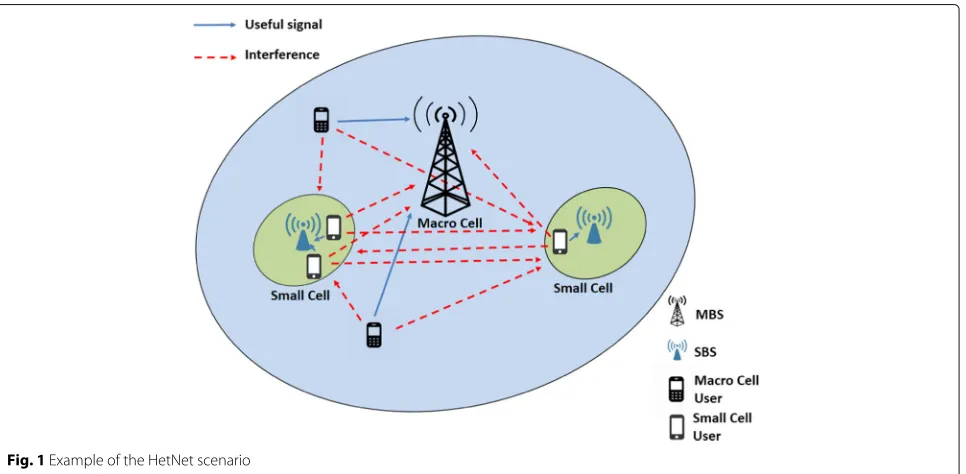
The HetNet scenario is depicted in Fig. 1 and is com-posed of Q+ 1 BSs, whose indexes belong to the set Q{0,· · ·,Q}. In particular, there is one macro base sta-tion (MBS), with indexq= 0, andQSBSs, with indexes q = 1,· · ·,Q, all of them sharing the same band B. Within the network, there existK users belonging to the setK {1,· · ·,K}, each of them transmitting to one of the BSs, so that, ifKqdenotes the set of users served by
BS q, thenK = K1∪ · · · ∪ KQ, with Kq ∩Kr = ∅if q=r. The transmission signaling between every user and the corresponding BS is based on the OFDM format, i.e., the available bandwidthBis subdivided intoNorthogonal subcarriers. Further, users within the same cell, either MC or SC, transmits over orthogonal frequencies according
to the OFDMA scheme [3]. Though, since SCs and MC share the same band, the same subcarrier can be used at the same time by users served by either different SBSs or the MBS, leading to inter-cell interference (ICI). For the sake of notation, let us define the mappingφ : K → Q to univocally associate each userk∈Kto the relevant BS q ∈ Q, so thatφ(k), with φ(k) = q, identifies the link between userkand its BSq.
2.2 BIC-OFDM system description
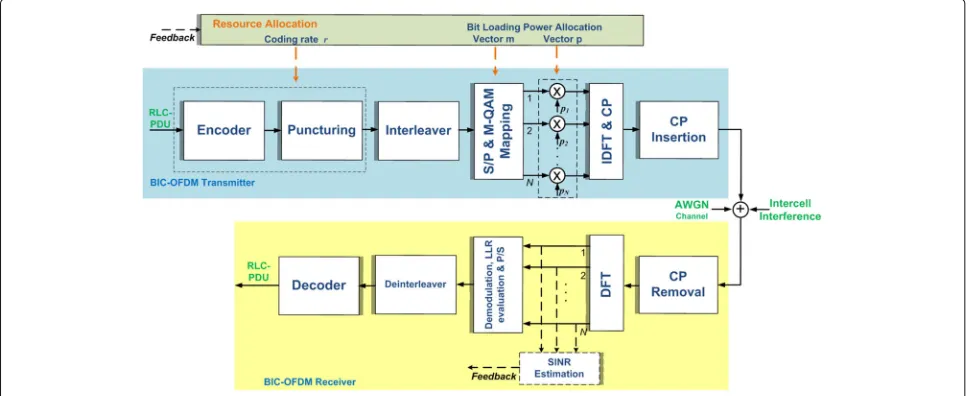
The block diagram of the uplink between userk∈Kand its BSφ(k) ∈ Q is depicted in Fig. 2. At the transmit-ter side, packets coming from the upper layers (usually IP packets) are processed as follows. First, each of them is one-to-one mapped to a radio link control sub-layer pro-tocol data unit (RLC-PDU), composed ofUk(i)bits (con-taining the header, payload, and cyclic redundancy check). Then, the RLC-PDU is encoded producing a codeword of Uk(s) Uk(i)/rk coded binary symbols (CBS), where rk∈Dris the coding rate andDrthe set of feasible coding
rates. After bit-interleaving, the CBSs are Gray-mapped into Sk complex-valued symbols, which are transmitted
through a frame of Lk Sk/Nkconsecutive OFDM
blocks, whereNk |Nk|, beingNk ⊆ N {1,. . .,N}.
The generic OFDM block,∀k ∈ K, consists of the vector xk[xk,1,· · ·,xk,N]T, wherexk,nis a 2mk,n-QAM
unitary-energy symbol, being mk,n ∈ Dm {2,· · ·,mmax} the number of bits allocated on thenth subcarrier, ifn∈Nk,
andxk,n =0 ifn ∈/ Nk. In the following, we will assume,
for the sake of simplicity, uniform bit loading (BL), that is, mk,n=mk∈Dm,∀n∈Nk. The vectorxkis element-wise
multiplied by the square root of the power allocation (PA) vectorpk [pk,1,· · ·,pk,N]T, where pk,n > 0 if n ∈ Nk
andpk,n=0 ifn∈/Nk, such that the available power limit Pkis satisfied according to
n∈Nk
pk,n≤Pk, ∀k∈K. (1)
Subsequently, IFFT operation is performed, cyclic prefix (CP) is inserted and after the digital-to-analog conversion, the OFDM signals of all theK users active in both the MC and the SCs are each transmitted in uplink over (dif-ferent) frequency-selective block-fading channels, which are assumed stationary for the whole packet transmission duration.
Focusing on thekth user’s signal at theφ(k)th BS,k∈K, at the FFT output, the received sample on subcarrier n∈Nkis
zk,n=√pk,nhk,φ(k),nxk,n+Ik,n+wk,n, (2)
where hj,s,n denotes the channel coefficient between
userjand BSsover subcarriern,wk,n∈N
0,σw2
k,n
is the zero-mean complex-valued Gaussian random variable modeling the ambient noise, and
Ik,n K
j=1 j=k
pj,nhj,φ(k),nxj,n (3)
represents the ICI, which is described as additive colored Gaussian noise with zero mean and variance
σ2
Ik,n
K
j=1 j=k
pj,n|hj,φ(k),n|2, ∀n∈Nk. (4)
As for (3), we note that since users within the same cell q ∈ Qtransmit according to the OFDMA scheme, then
for a given subcarriern ∈ N,pk,n > 0 at most for one
userk ∈ K such that φ(k) = q, whereaspi,n = 0 for
all the other users i ∈ K such that φ(i) = q. Finally, the signal-to-interference-plus-noise ratio (SINR) vector evaluated forkth user link results ask =pkγk, where
γk[γk,1,· · ·,γk,N]T, with
γk,n=
⎧ ⎨ ⎩
|hk,φ(k),n|2 σ2
Ik,n+σ 2 wk,n
∀n∈Nk
0 ∀n∈/Nk
. (5)
3 Performance metrics background and problem formulation
In this section, a brief description of the adopted LPP metric is first given, then the optimization problem (OP) for minimum power consumption under EGP constraint satisfaction is introduced.
3.1 LPP background
As discussed in Section 1, practical modulation and cod-ing schemes are employed; therefore, the GP metric is more suitable in giving a reliable picture of the actual link performance. Here, in order to apply the RA algorithm at the transmitter, the key issue is to get a prediction of the GP, i.e., the EGP, which in turn depends on the estimate of the link packet error rate (PER) [28, 31].
In a frequency-selective scenario as that considered in our paper, however, the expression of the PER may be hard to derive in closed-form. An efficient solution to pursue is given by the ESM techniques [30], which rely on one-to-one mappingkinto the scalarγk, the so-called effective
SNR (ESNR). Considering that a given subcarrier of every userk∈Kcan be loaded withm∈Dmbits, or
switched-off, i.e.,m = 0, let us denote withDmthe set collecting the|Dm| ·2N possible bit allocation vectors. Hence, for a
given transmission mode (TM)ϕk {rk,mk} ∈Dr×Dm, the ESNRγkis such that
PERϕk(k)=rk(γk), (6)
where PERϕk andrk denote the PER of the coded BIC-OFDM system over frequency-selective channel
employ-ing TM ϕk and that of the equivalent coded BPSK
system over AWGN channel experiencing the ESNRγk, respectively. Worth of being observed,rk, according to [33, 34], is an analytic, monotonically decreasing, and convex function in the region of interest.
Among the ESM techniques proposed in the literature, theκESM method, based on the cumulant moment gener-ating function of the log-likelihood metrics at the input of the soft decoder, is here exploited, since it offers a compet-itive accuracy-versus-complexity trade-off [31]. Herein, the ESNRγkis evaluated as
γk(ϕk,pk,p−k)−log
⎛ ⎜ ⎝N1
kmk
n∈Nk √
2mk/2
μ=1
αk,μe
−pk,nγk,n(p−k,n) ψk,μ
⎞ ⎟ ⎠,
(7)
wherep−k [pT1,· · ·,pTk−1,pTk+1,· · ·,pTK]T andp−k,n
[p1,n,· · ·,pk−1,n,pk+1,n,· · ·,pK,n]Tcollect all the PA
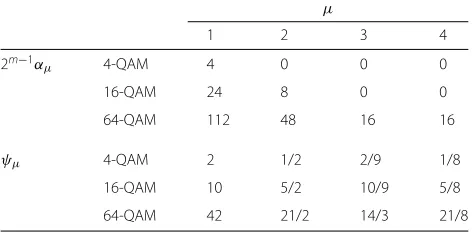
vec-tors and per-subcarrier PA coefficients except those asso-ciated to user k, respectively, and αk,μ and ψk,μ are constant values related to the modulation size adopted by the kth user. Their values are evaluated in [31] and reported in Table 1. It can be noted that the channel gain (5) has been explicitly expressed as a function ofp−k,n.
3.2 Problem formulation
Exploiting theκESM LPP method recalled in Section 3.1, the EGP metric, defined as the number of information bits delivered in error-free packets per unit of time, is expressed in (bit/OFDM block) as [31]
ζk(ϕk,pk,p−k)ζ˘krkNkmk
1−rk(γk(ϕk,pk,p−k))
, (8)
withζ˘k Uk(p)/Uk(i), beingUk(p) the number of payload
bits. Let us assume a given QoS per user in terms of a tar-get EGP valueζ¯k. The aim is to consume the lowest power
as possible, while meeting such EGP QoS constraints. Besides, due to the mutual interference, the EGP of a given user is affected by the transmission power employed by the other users. Thus, assuming the lack of a central coordinating unit, the goal of the users is to reach, in a distributed way, the optimal PAp∗k [p∗k,1,· · ·,p∗k,N]Tand the optimal TMϕ∗k,∀k ∈ K, which satisfy the QoS con-straints spending the minimum transmission power. This problem, tagged as power-efficient under guaranteed EGP OP, or PEGE for short, can thus be formalized as
∀k∈K: min
ϕk,pk
uk(pk) N
n=1
pk,n
s.t. ζk(ϕk,pk,p−k)≥ ¯ζk pk,n≥0, ∀n∈Nk,
ϕk ∈Dr×Dm
. (9)
Table 1Values ofκESM coefficients for 4-, 16-, and 64-QAM
μ
1 2 3 4
2m−1αμ 4-QAM 4 0 0 0
16-QAM 24 8 0 0
64-QAM 112 48 16 16
ψμ 4-QAM 2 1/2 2/9 1/8
16-QAM 10 5/2 10/9 5/8
A few remarks about (9) are now in order.
1) The OP (9), when applied to a P2P BIC-OFDM link, has not yet been taken into consideration, and so, it lacks analysis. Therefore, the above issue is first addressed in Section 4, where we derive a closed-form solution for the PA, being it useful for the subsequent case of multiple users addressed in Section 5.
2) In view of the QoS contraints, there exists a
competition among the multiple active users allowed to transmit over the same band. Thus, the problem falls in the NCG framework, which is efficiently employed to study the strategic inter-user interactions [35]. Hence, the OP (9) can be
formulated as a NCG, whose conditions of existence and uniqueness of the solution are analytically derived in Section 5, together with a distributed implementation of the RA algorithm.
3) The total power constraint (1) for each user is skipped in the OP (9), since its presence makes the game analysis impractical. Hence, we assume that the optimal PA, satisfying the QoS constraint, satisfies (1) as well. Nevertheless, when introducing the distributed RA algorithm in Section 5.3, such a power constraint will be restored, giving additional comments and insights on it.
4 PEGE OP in point-to-point links
Let us focus on the P2P communication link , that is |Q| =1 and|K| = 1 (for this reason in the reminder of this section, the indexkwill be neglected in the quantities of interest). Specifically, Section 4.1 formulates the strat-egy to select the optimal TM and PA vector solving OP (9), whereas Section 4.2 solves the PA problem in closed-form.
4.1 Problem formulation
As for the solution of OP (9), it can be pointed out that (i) even if uniform BL is chosen for each user, the choice of the active subcarriers entails again a BL procedure, since the nth component of the BL m is mn = m if
subcarrier nis active, mn = 0 otherwise, as described
in Section 3.1; (ii) the BL and PA problems cannot be jointly solved, in that the problem is NP-hard. Given the QoS constraint and the SINR vectorγ, however, the OP can be efficiently yet suboptimally tackled relying on the following strategy: first, the optimal PA vector p∗[p∗1,· · ·,p∗N]Tis derived as a function of the generic TM ϕ, i.e., p∗ ≡ p∗(ϕ), and, then, the pair TM and PA that minimizes the power consumption while satis-fying the QoS constraint is selected as solution to the OP.
PA in PEGE OP for a fixed TM. Assuming a given TM ϕ, the optimal PAp∗(ϕ)solving OP (9) is obtained as
p∗(ϕ)=argmin
p {
u(p)}
s.t.
N
n=1 √
2m/2 μ=1 αμ(ϕ)
e−pn γn
ψμ(ϕ) ≤κ(ϕ)
pn≥0
, (10)
where the first constraint in (10) corresponds to the QoS constraint of (9) expressed as a function of the PA, with, in view of (7) and (8),
κ(ϕ)Nme−γ∗(ϕ) (11)
and
γ∗(ϕ)−11− ¯ζ /(ζ˘rNm), (12)
being constant values, both depending only on ϕ. From Eqs. (11)–(12), it is seen that, given the BL vector and the coding rate, the QoS constraintζ¯ can be equivalently expressed as a function of the target ESNRγ∗(ϕ).
Nevertheless OP (10), having a linear objective function and convex constraints, be a convex OP, due to the pres-ence of the QoS constraint it does not present a closed-form solution. Therefore, solving (10) can be approached via conventional numerical methods [36], though at the price of a high computational load. Afterward, we pro-pose an alternative approximate yet efficient method to get a closed-form solution of OP (10). Hence, the numer-ical computationally heavy solution will be only used as benchmark to test the accuracy of the proposed approxi-mated closed-form solution.
TM selection in PEGE OP.Given the SINRγand assum-ing uniform PA across the subcarriers1, first the BL pro-cedure originally proposed in [37] is applied, with the set of feasible number of bits per subcarrier being{0,m}. As a result, we get |Dm| ·N possible BL vectors {m(n,m)}, n = 1,· · ·,N, withm ∈ Dm. As a matter of fact,m(n,m)
denotes thebestbit allocation vector withnactive subcar-riers andmbits per active subcarrier. Let us denote with Dm⊂Dmthe set collecting such vectors. Then, if the PA p∗(ϕ)are available for the TMsϕ ∈Dr×Dm, the OP (9) is solved by searching the best TMϕ∗that both minimizes the power consumption and satisfies the QoS constraint. Formally,
ϕ∗=argmin
ϕ {u(p
∗(ϕ))}
s.t. ζ(ϕ,p∗(ϕ))≥ ¯ζ, ϕ∈Dr×Dm.
(13)
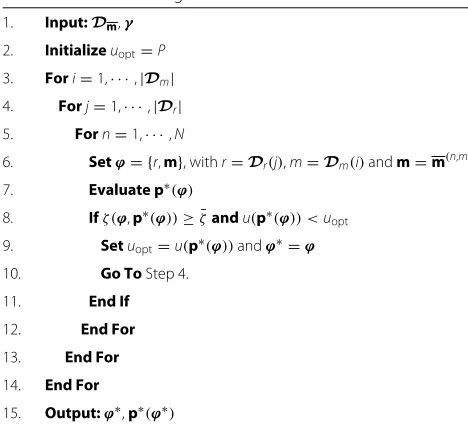
The OP (13) can thus be solved by means of the pseudo-code outlined in Table 2. The key points of the proposed procedure are as follows. (i) For everym ∈ Dm, the set
Table 2TM selection algorithm
1. Input:Dm,γ 2. Initializeuopt=P 3. Fori=1,· · ·,|Dm| 4. Forj=1,· · ·,|Dr| 5. Forn=1,· · ·,N
6. Setϕ= {r,m}, withr=Dr(j),m=Dm(i)andm=m(n,m) 7. Evaluate p∗(ϕ)
8. Ifζ(ϕ,p∗(ϕ))≥ ¯ζandu(p∗(ϕ)) <uopt 9. Setuopt=u(p∗(ϕ))andϕ∗=ϕ 10. Go ToStep 4.
11. End If
12. End For
13. End For
14. End For
15. Output:ϕ∗,p∗(ϕ∗)
an exhaustive search over the possible TMs. The latter stands for the worst case condition, in that, for a given pair{r,m}, the search is halted as soon as a feasible TM is found (step 10 of Table 2), because any other TM with the same pair{r,m}would require a larger amount of transmitted power. Indeed, for a given m, m(n+1,m) would have the same active subcarriers asm(n,m)plus an additional active subcarrier chosen among the remaining
N − n ones. As a consequence, the power
consump-tion of the former case would be greater than that of the latter one. (iii) In order to maintain an affordable complexity of the overall algorithm, a closed-form expres-sion of the PA can be derived, as illustrated in the next section.
4.2 Closed-form solution for the PA problem
Let us now point out that the summation overμin the QoS constraint prevents to easily obtain a closed-form solution to the PA problem. Thus, the idea we pursue is to approximate the QoS expression in (10) by introduc-ing a scalarβsuch that a possible closed-form PA solution matches the optimal one earned by solving (10) via a numerical (computationally heavy) method.
Proposition 1Approximating the left-hand side of the QoS constraint in(10)withβNn=1e−pnρn, withρnδ/γn, β∈R+andρ∈R+, the OP(10)turns into
min p u(p)
s.t. β
N
n=1
e−pnρn ≤κ
pn≥0.
(14)
So doing, the nth component of the solution p to(14) can be written in closed-form as the water-filling-like solution[20]
pn=ρn
log−logρn
β
+
, ∀n∈N, (15)
whereis such thatpsatisfies the QoS constraint in(14) with equality and represents the “water-level.”
Proof The proof is given in Appendix A.
Concerning the values ofβandδ, by looking at the val-ues assumed by the coefficients αμ and ψμ for a given modulation order (Table 1), it follows that the left-hand side of the QoS constraint in (10) can be lower and upper bounded as
β(l)
N
n=1
e−pnδ(γl)n ≤
N
n=1 √
2m/2
μ=1 αμe−
pnγn ψμ ≤β(u)
N
n=1 e−pnδ(uγn),
(16)
whereδ(l)ψ
1,β(l)α1,δ(u)ψ1andβ(u) √
2m/2 μ=1 αμ
.
The strict equality holds form =2, since in this case the sum overμreduces exactly to only one term.
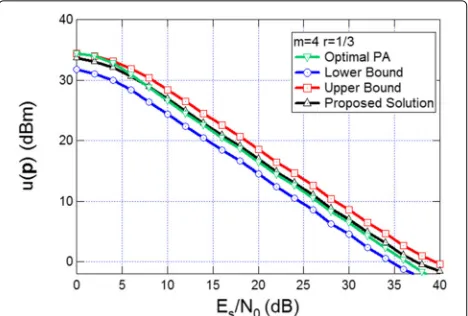
Denoting withp(l) andp(u) the optimal solutions (15) when the pair{β,δ} is set in Eqs. (14)–(15) to{β(l),δ(l)} and{β(u),δ(u)}, respectively, the drawback is that the solu-tion associated to the lower bound (LB) tends to under-estimate the QoS constraint and, thus, to allocate less power compared to the optimal solution. On the other hand, the solution associated to the upper bound (UB) overestimates the QoS constraint and, thus, the perfor-mance in term of EGP are always satisfied, although at the price of spending more power than the strictly required one. Hence, the idea is to find the optimal pair{β(o),δ(o)} that minimizes the mean square error (MSE) between the exact expression of the QoS constraint in (10) and the pro-posed expression of the QoS constraint in (14), for every modulation order.
Fig. 3Performance comparison of the proposed PA algorithms for (r,m)=(1/3, 4)
methods, while exploiting an efficient closed-form expres-sion. The optimal values of {β(o),δ(o)} that, for every modulation order, minimize the MSE betweem the opti-mal and the proposed expression of the QoS constraint have been computed forEs/N0 ∈[−6, 30] dB and can be found in Table 4. In the case of multiple users access, such an approximation will be utilized for evaluating the QoS constraint in OP (9).
5 PEGE OP over multi-access interference links
We assume now that there not exist any centralized unit, and so, users coordinate among themselves in a distributed manner in order to reach a stable RA configu-ration. The goal is to design a distributed algorithm so that each user minimizes its power consumption, while satisfy-ing its QoS constraint and accountsatisfy-ing for the interference caused by the other users exploiting the same frequencies.
Fig. 4Performance comparison of the proposed PA algorithms for (r,m)=(2/5, 6)
5.1 Game formulation
In order to derive a distributed algorithm solving OP (9), let us consider for the time being a given TM ϕk per user. Then, resorting to the QoS constraint approximation adopted in (14), the PEGE OP (9) can be reformulated as
∀k∈K:
min pk
uk(pk)
s.t. βk n∈Nk
e− pk,n
ρk,n(p−k,n) ≤κk,
pk,n≥0,
(17)
whereκkis evaluated∀k∈Kvia (11)-(12),
ρk,n(p−k,n) γ δk k,n(p−k,n)
, (18)
andβkandδkassume values reported in Table 4. OP (17) can be solved by modeling it as a NCG [35]. Such a frame-work offers a powerful analytical tool that describes how rational entities interact and make appropriate choices so that they can find their own maximum utility.
Accordingly, we introduce the game G {K,P,U}, described as follows:
1) KK1× · · · ×KQis the overall set of users, i.e.,
players.
2) P P1× · · · ×PKis the set strategies, where the
strategy of userk is its feasible PA set, defined as
Pk
pk,n|gk(pk,p−k) ≤0, pk,n
≥0, ∀n∈Nk}, ∀k∈K,
(19)
withgk(pk,p−k)
n∈Nkβke − pk,n
ρk,n(p−k,n) −κ
k.
3) U {u1,· · ·,uK}is the set collecting the utility
functions defined in (9).
By looking at the elements identifyingG, it worth point-ing out that the QoS constraints introduce an interde-pendency among the strategies of the players, i.e.,Pk =
Pk(pk,p−k). In other words, the set of strategies of the
generic playerkdepends on the other players’ strategies. The solution of game (17) is thus investigated in terms of GNE, which corresponds to the case where no player can decrease his objective function by changing unilater-ally its strategy to any other feasible one [32]. Equivalently, a GNE of the game is reached when every user, given the strategy profile of the others, does not get any power decrease by unilaterally changing its own strategy, still keeping the QoS constraint satisfied. Formally, the vec-torp∗ [p∗1T,· · ·,p∗KT]T∈ P, which represents now the optimum power allocation for all the users, is a GNE [35] for gameGif
uk
p∗k≤uk
Table 3BIC-OFDM link setup
Parameter Value/description
Payload lengthN(pp) 1024 bits
RLC-PDU lengthN(i) 1056 bits
N. of active subcarriersN 1320
FFT size 2048
RF bandwidth/subcarrier spacing 20 MHz/15.152 kHz
Coding scheme Parallel concatenated convolutional coding (PCCC) turbo codesDr=13,25,12,47
Modulation 4-,16-,64-QAM
Available powerP 33 dBm
Channel model 6-tap power profile of ITU-Pedestrian B
In order to study the game equilibrium, let us point out the following remark.
Remark 1For a given strategyp−kof the other players, the solution of (17)corresponds to the solution found for the P2P link(15). Thus, in this case the solution is unique and given, capitalizing on the approximate yet accurate closed-form one, by
p∗k=BRp−k
, ∀k∈K, (21)
where the nth component of the best response (BR) operator is defined as
BRp−k
nρk,n(p−k,n)
log∗k −logρk,n(p−k,n)
βk
+
,
∀n∈Nk, ∀k∈K, (22)
and∗k is such that the optimal PAp∗k satisfies the QoS constraints with equality.
Thus, according to the definition of GNE and in view of Remark 1, the GNE of the game must satisfy the following condition.
Proposition 2If problem (17) is feasible, i.e., if there exist a PA vectorp(f)≥0such that QoS constraints are met with equality, then there exists at least one PAp∗which is a GNE equilibrium of the game. Moreover, the GNE has to satisfy the so-called best response solution for each user, by solving the fixed-point system of equations
p∗k=BRp∗−k, ∀k∈K, (23)
with the operatorBRdefined as in(22).
Table 4Optimal values of{β(o),δ(o)}for every modulation order
4-QAM 16-QAM 64-QAM
β(o) 2 3.716 8.244
δ(o) 2 5.407 25.9134
We remark here that the fixed-point system of Eq. (23) may lead to more than one solution, or the solution of game (17) may not exist, since there may not exist ap∗that satisfies all the QoS constraints of all the users at the same time. Thus, before going into details of how to solve (17), in the next section we focus on the feasibility conditions of OP (17), as well as on the existence and uniqueness of the GNE of the game describing OP (17).
5.2 GNE analysis
In order to derive sufficient conditions for the feasibility of OP (17) and the existence of at least a solution for the associated game, given the vector of required EGP val-ues, or equivalently, the corresponding vector of optimal ESNRγ∗ [γ1∗,· · ·,γK∗]T, withγ∗
k defined in (12), let us
introduce the following definitions:
tn(γ∗)
˜
γ1∗σ1,2n,· · ·,γ˜K∗σK2,n
T
, (24)
and
Zn(γ∗) ⎡ ⎢ ⎢ ⎢ ⎢ ⎢ ⎢ ⎢ ⎣
h¯1,φ(1),n
2 − ˜γ∗
1h2,φ(1),n2 · · · − ˜γ1∗hK,φ(1),n2
− ˜γ∗
2h1,φ(2),n2 h¯2,φ(2),n
2
· · · − ˜γ∗
2hK,φ(2),n2 .
.
. ... . .. ...
− ˜γ∗
Kh1,φ(K),n2 − ˜γK∗h2,φ(K),n2 · · · h¯K,φ(K),n
2
⎤ ⎥ ⎥ ⎥ ⎥ ⎥ ⎥ ⎥ ⎦ ,
(25)
whereh¯k,φ(k),nhk,φ(k),n/δkandγ˜k∗γk∗+logβk, being
δkandβkconstant values defined in Table 4.
Proposition 3Given γ∗, a sufficient condition for the feasibility of (17) is that Zn(γ∗), defined in (25), is a P-matrix.
Proof See Appendix B.
Proposition 4Given γ∗ and assuming that problem (17)is feasible, then there exists at least a bounded GNE for game(17). Furthermore, any GNEp∗, which can be equiv-alently expressed as p∗ [q∗1T,· · ·,q∗NT]T, with q∗n
!
p∗1,n,· · ·,p∗K,n
"T
,1≤n≤N, is such that
q∗n≤ ¯qn=
Zn(γ∗)
−1·
tn(γ∗), ∀n, (26)
whereq¯n[p¯1,n,· · ·,p¯K,n]T.
Proof See Appendix C.
In order to better understand the physical meaning of the existence condition, let us first express the channel coefficient as a function of the path loss (PL) between the relevant transmitter and receiver pair, i.e., |˜hj,φ(k),n|2 |hj,φ(k),n|2Lj,φ(k), where Lj,φ(k) is the path loss between
between user j and BS φ(k) and h˜j,φ(k),n ∈ CN(0, 1). Since a sufficient condition for the matrices {Zn} to be P-matrices is that they satisfy the diagonal dominance condition [38], then the following corollary holds.
Corollary 1Sufficient conditions for the matrices {Zn} to be P-matrices, and hence for the solution set of game(17) to be non-empty, are
K
j=1 j=k
|˜hj,φ(k),n|2 |˜hk,φ(k),n|2
Lk,φ(k) Lj,φ(k) <
δk ˜
γ∗
k
∀n∈Nk, ∀k∈K, (27)
which can be derived by exploiting the definition of diago-nal dominance of a matrix.
Thus, the above condition states that as long as the ratio between the interfering channel and the direct one, i.e, the direct channel between the transmitter and the receiver, is lower than a certain threshold, or, in other words, the interference is small enough, then a solution for game (17) exists. The threshold depends on the EGP constraints, expressed in terms of optimal ESNR, along with the mod-ulation order adopted, via the coefficientsδkandβk (the
latter contained inγ˜k∗). Thus, the more distant the com-peting transmitters, the lower the interference and, thus, the higher the probability of having a non-empty solution set [21, 23]. Further, it is worth noting that the condition formulated in (27) is in agreement with that derived in [23] with Gaussian signaling. In this latter case, indeed,
δk = 1 andβk = 1 as well, thus implyingγ˜k∗ = γk∗, and
γ∗
k =eR
∗
k −1, whereR∗
kis the desired rate.
Finally, we focus on the sufficient conditions for the uniqueness of the GNE. This analysis, however, is made difficult by the presence of the QoS constraints, that introduces an interdependency among the strategy sets
of the users. Thus, partly inspired by [23], the deriva-tion of the uniqueness condideriva-tions is carried out as follows: first, a change of variable is done in order to obtain an equivalent formulation of the problem as a varia-tional inequality (VI) problem; then, the conditions of uniqueness of the solution for the original problem are derived.
Proposition 5Given γ∗ and under the assumption that the problem is feasible, a sufficient condition for the uniqueness of the GNE for game (17) is that the matrix V(γ∗), defined in(66), is a P-matrix.
Proof See Appendix D.
As expected, also the uniqueness condition depends on the target ESNRγ∗and on the ratio among the direct and interference channels, which appears on the off-diagonal elements ofV(γ∗)through the parameterχj(,maxk )defined in (64). Thus, although condition of Proposition 5 is less easy to check than the one corresponding to the existence of the GNE, from (66) it can be inferred that whenever the ratio between each direct and interference channel is small, matrixV(γ∗)is likely to satisfy the diagonal dom-inance property and thus to be aP-matrix, ensuring the uniqueness of the GNE.
5.3 Distributed algorithm
Since we are dealing with a decentralized implementa-tion, where no signaling among different BSs is allowed, our aim is to derive a totally distributed algorithm. In fact, this allows every user to independently optimize its own PA, as well as TM, according to the perceived SINR, which entails the interference caused by the other users. Recalling Proposition 1, a natural scheme is a distributed and iterative algorithm based on the BR. In particular, at each iteration j, considering the generic userk ∈ K and the PAp(−j−k1)chosen by the other users at the previ-ous iteration, the PA vectorp(kj)is evaluated, as function of the selected TM ϕk, according to (22),∀k ∈ K. This means that, to perform the update, the only information required by every userk is the SINR vector γk
p(−j−k1)
in (5). This is measured at the serving BS and sent with a modest feedback rate requirement on the return chan-nel. Then indeed, since every user is able to evaluate, at every iteration j, the best PA p(kj)(ϕk) as a function of the TM ϕk and SINR, the selection of the best pair {ϕ(j)
k ,p
(j)
k
ϕ(j)
k
Table 5Distributed RA algorithm
1. Input: p(k0),ϕk(0)∀k∈K. 2. Initialize:j=0,p.
3. Do
4. Fork=1,· · ·,K 5. EvaluateD(mk,j)
6. Evaluate p(kj+1)andϕ(kj+1)applying Algorithm in Table 2 with InputDm(k,j)andγk(p(−j)k)and evaluating the PA vector according to (22)
7. End For
8. Setj←j+1;
9. Until||p(j)−p(j−1)|| ≤porj=Nit 10. Output:ϕ∗k=ϕ(kj),p∗k=p(kj),∀k∈K.
the maximum number of iterations,p(k0) andϕ(k0)are an initial feasible PA vector and TM, respectively, andD(mk,j) denotes the set of best BL vectors for userkat iteration j, evaluated according to the perceived interference γk(p(
j)
−k),∀k∈K.
Remark 2The proposed best response-based algorithm converges under the same conditions for which the GNE is unique (stated in Proposition5), which in turn requires the condition stated in Proposition3 in order to have a non-empty solution set. In fact the condition of convergence can be demonstrated with the same approach used to derive the uniqueness condition, simply replacing the two solutions of the GNE with two PA vectors produced by the algorithm at two consecutive iterations.
Remark 3In the formulation of game(17), we did not consider the total power constraint per user(1). Even if this constraint is intrinsically present in wireless devices, since their power cannot grow infinitely, it makes the equilib-rium analysis more involved. Then, we did not take into account this constraint in the theoretical analysis, leaving it for future research. Anyway, the following observations can be done. First, algorithm in Table 5(as well as that for the P2P case) can easily account for constraint (1)as follows: for all k ∈ K, in the optimal PA expression(22), based on the water-filling like operator, the “water-level” must now be computed as k = min
#
log∗k, log˜∗k$, where˜∗kis the “water-level” that, put into the water-filling expression, returns the PA vectorp˜k that maximizes the EGPζk(pk)meeting with equality the total PA constraint
(1) [31]. Poorly speaking, for a given strategyp−k, the best response for user k is the PA vector that meets with equal-ity the QoS constraint if the required total PA is not greater than the maximum one, otherwise, all the power is allo-cated returning the highest possible value of EGP. Finally, as shown in the simulation results, practical values of the
PA never reach the maximum power limit, validating the theoretical results on the equilibrium analysis done.
5.4 Relationship between GNE and PO solution
In this section, we give some insights on the relation between the GNE and the PO solution, which represents the achievable performance upper bound. Specifically, the PO solution consists in solving a multi-objective OP, where the objective function is the sum of the utility func-tions of every user, i.e., uPO(p) =
K
k=1uk(pk), with ppT1,· · ·,pTKT, and where the set of constraints is the same than that in (17). Let us refer to this problem as PO-OP. Besides being a non-convex OP, whose solution may be very hard to find, the PO-OP requires that every user, or a centralized entity, knows, among the others, every channel coefficienthj,s,nbetween any user and base station
in the network. Obviously, this is unlikely to be feasible in the considered HetNet. However, in order to shed light on the relationship between the PO solution and the GNE, corresponding to the PA solution (23) based on the best response, we consider here a two-user two-subcarrier case (K = 2,N = 2), where user 1 is in cell 1 and user 2 is in cell 2, i.e.,φ(1) = 1 andφ(2) = 2. The simulation setup is as follows:h1,1,1 =1.821,h1,1,2=0.329,h1,2,1= 0.104,
h1,2,2 = 0.221, h2,2,1 = 0.821,h2,2,2 = 2.629, h2,1,1 = 0.319,h2,1,2 =0.097,σwk,1/Pk =0.01,∀n∈ Nk,∀k∈ K,
(mk,rk)=(2, 1/3), and∀k∈K. The PO solution is found
solving the PO-OP with the Matlab Global Optimization Toolbox. Finally, we consider the target EGP of user 2 to be
¯
ζ2=0.2 (b/s/Hz), whereas we letζ¯1vary in the set [ 0.2, 1] (b/s/Hz). Whenζ¯1= ¯ζ2, only one GNE solution exists and is close to the PO one. Indeed, the ratioς(GNE-PO)between the total power obtained with the GNE and PO solution, respectively, is about 0.77. Whenζ¯1 = 1 (b/s/Hz), more power needs to be allocated by user 1, yielding a higher co-channel interference. In this case indeed 2 GNE solutions arise andς(GNE-PO)drops down to about 0.56 in the worst case. From these observations, we can conclude that, as could be expected, the GNE is more efficient, i.e., closer to the PO, when the interference in the network is lower, whereas the more severe the interference, the less efficient the GNE solution. Nevertheless, we remark that the latter allows for a distributed solution suitable for the scenario under investigation.
6 Simulation results
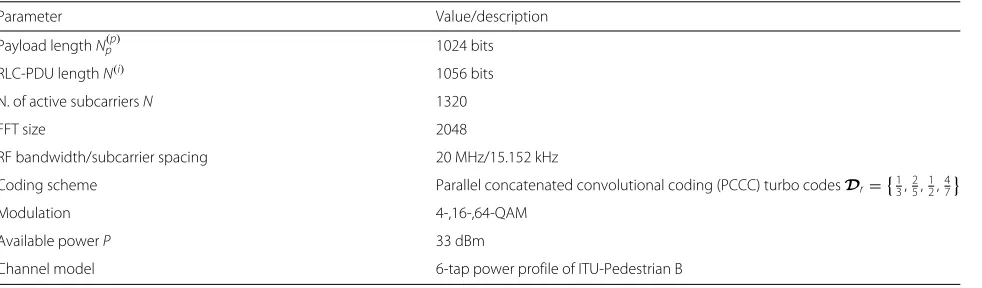
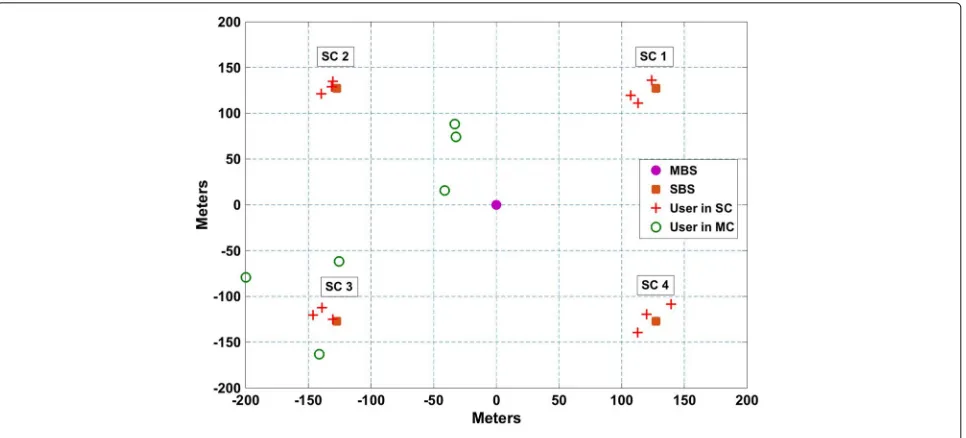
In this section, the effectiveness of the proposed dis-tributed RA algorithm is tested. The HetNet scenario taken into consideration for the simulations is composed of one MC andQ=4 SCs, withK0 =6 users connected to the MBS (coverage area of radiusRMBS = 200 m) and
Kq = 3,q = 1,· · ·,Qusers connected (coverage area of
Fig. 5HetNet simulated scenario
transmission system is summarized in Table 3. Finally, the path loss models for the SC and MC are those proposed in [39].
The target EGP QoS levelζ¯is compared in Fig. 6 against the actual GP (AGP) obtained by applying the proposed distributed RA algorithm, for six users randomly chosen within MC, SC 1, SC 2, and SC 3. The AGP for the generic kth user is defined as
AGPk
1 Na
Na
=1
Uk(p)ϑ() Tk() (
bit/s/Hz), (28)
whereϑ()equals 1 if theth packet is correctly decoded and 0 when it is discarded, Tk() is the transmission
interval of the th packet,Na is the number of trasmit-ted packets, set to 1000, each experiencing independent
Fig. 6Comparison between the minimum EGP QoS level and the relevant AGP for a few users selected in MC and SCs
channel realizations and with the position of users ran-domly placed within their cells. In view of the effective-ness of the GP prediction based on the κESM model recalled in Section 3.1, it is apparent that the AGP performance meets for all the considered users, taken as example, the minimum target EGP. It can be noted that the same result holds for all the other users as well.
Figure 7 shows the total transmitted power and the EGP per user as a function of the number of the itera-tions of the distributed RA algorithm, obtained for a given channel realization and network geometry. As can be seen, the distributed RA algorithm guarantees fast conver-gence to the equilibrium point for all users of the HetNet, thus exhibiting a considerable robustness against the ICI effects.
Furthermore, in order to shed light about the con-venience of employing as more SCs as possible in the
coverage area of the MC, Fig. 8 compares the average total transmitted power spent in the HetNet versus the distance from the selected users and their BS, i.e., user 1 in the SC 1 and user 1 in the MC. Two scenarios are addressed: together with the MC, we consider the pres-ence of Q = 1 SC orQ = 4 SCs, being in both cases, for a fair comparison, the total number of active users in the HetNet equal to 18. Particularly, forQ = 1,K1 = 3 users are served within the SC 1, and the 15 remaining ones belong to the MC. Conversely, forQ = 4, accord-ing to the scenario of Fig. 5, three users are connected to each SBS, and only six to the MBS. For each distance, the total power is averaged over 100 independent transmit-ted packets and network geometry different realizations, whereas the minimum target EGP is set toζ¯=2 bit/s/Hz. As for Fig. 8, empty and solid square marks are used for the case ofQ = 1 SC, whereas the curves with empty and solid circle marks refer to the case of Q = 4 SCs. As expected from the working of the distributed RA algo-rithm, the total power spent in the HetNet grows with increasing the distance, due to the fact that the minimum target EGP has to be guaranteed while allocating the min-imum power to each user. Further, when the number of SCs is increased moving fromQ=1 toQ= 4, the inter-ference gets higher, though slightly enough, since the SCs are not packed together. But, more users are located closer to their BS, with the result that each one will require less power, and consequently, the total power spent within the HetNet will be lower as well. Therefore, the larger number of sparse SCs, the less power is required to meet the QoS constraints in spite of higher ICI, thus corroborating the advantages of the SC concept.
Finally, let us assess the scalability of the proposed dis-tributed RA solution when many more BSs and users are present within the MC. To this end, Fig. 9 shows the new considered scenario called dense HetNet, which
Fig. 8Average total transmitted power of the HetNet vs. user distance from MBS or SBS
Fig. 9Dense HetNet simulated scenario
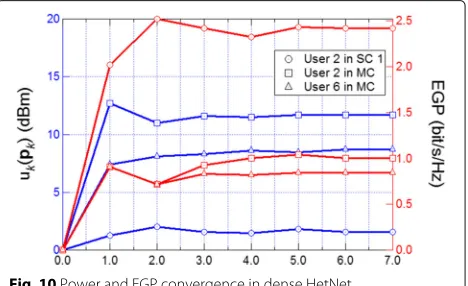
is composed by a MC with eight users and eight SCs with six users for each of them, thus notably increasing the number of users and SCs compared to the scenario considered so far. On the basis of the new dense Het-Net scenario, Fig. 10 depicts the convergence of power and EGP for the same users in the same geometric posi-tion of Fig. 7. Comparing results in Fig. 7 with those in Fig. 10, we point out that the algorithm is scalable since the fast convergence to the equilibrium point is still guaranteed.
7 Conclusions
This paper tackled the distributed RA problem, in the uplink of HetNets, aimed at minimizing the power con-sumption of each user under the satisfaction of a min-imum GP constraint per user. The problem, tagged as PEGE OP, was faced by suitably decoupling the BL and coding rate allocation problem from the PA problem. First, the PEGE OP in P2P links was investigated and solved, obtaining in particular an approximate yet accu-rate closed-form expression of the PA, in a water-filling-like form, which depends on the QoS constraint. Then,
we moved to the interference channel case, where the PA OP was described as a NCG. The relevant solu-tion concept was identified in the GNE, due to QoS constraint that couples the strategies (i.e., the set of fea-sible PA vectors) of the players (i.e., the users in the HetNet transmitting over the same frequencies). Capi-talizing on the closed-form expression for the PA, the analysis of the GNE was carried out through the BR con-cept, providing sufficient conditions for the existence and uniqueness of the solution. Finally, a distributed RA algo-rithm, which converges to the equilibrium of the game, was derived and its performance tested through extensive numerical simulations, certifying its good convergence properties, the reduction of power consumption in the HetNet, and the close match between EGP and AGP. Further line of research on this topic will be the anal-ysis of the impact of the total power constraint on the equilibrium.
Endnote
1The BL solution found applying the algorithm in [37]
clearly depends on the initial PA taken over the subcar-riers. Assuming an uniform PA, however, allows to have initially all the subcarriers being active, thus, to perform BL over all the subcarriers. This approach is suboptimal yet simple and efficient, as shown by the result obtained in [31].
Appendix A: Proof of Proposition 1
Since both the objective function and the constraints are convex, (14) is a convex OP. Introducing the multipliers, ν [ν1,· · ·,νN]T andλ [λ1,· · ·,λN]T, the associated
Lagrangian is
L(p,,ν)=
N
n=1
pn+
% β
N
n=1
e−pnρn −κ &
− N
n=1 νnpn
(29)
and, applying the KKT conditions, we have necessary and sufficient condition for optimality, i.e.,
1−∗ρβ ne
−p∗n ρn −ν∗
n=0, ∀n∈N,
ν∗
np∗n=0, ∀n∈N, ∗
'
βN
n=1e− p∗n ρn −κ
(
=0, p∗n≥0, ∀n∈N, νn∗≥0, ∀n∈N, ∗≥0,
(30)
wherep∗and{∗,ν∗}denote the optimal primal and dual variables, respectively. After some algebra, from (30) it
easily follows thatp∗n = ρn
!
log∗−logρn βn
"+
, where∗ is such that the QoS constraint in (14) holds with equality.
Appendix B: Proof of Proposition 3
Sufficient conditions for the feasibility of (17), i.e., there is a non-empty solution set, are derived considering that the QoS constraint must hold true ∀k ∈ K. This constraint can be equivalently rewritten as
n∈Nk '
βke
− pk,n
ρk,n(p−k,n) − κk
Nk
(
≤0 (31)
so that a more stringent condition, recalling that κk = mkNke−γ
∗ k, is
βke
− pk,n
ρk,n(p−k,n) ≤e−γk∗, ∀k,n. (32)
Exploiting the definition ofρk,nin (18) and definingγ˜k∗
γ∗
k +logβk > 0 (beingβk > 1), after some algebra (32)
becomes
pk,n|¯hk,φ(k),n|2− ˜γk∗ K
j=1 j=k
pj,n|hj,φ(k),n|2≥ ˜γk∗σk2,n, ∀k,n.
(33)
The above expression can be recast into a matrix form as
Zn(γ∗)·qn≥tn(γ∗)≥0, ∀n, (34)
that is,
qn≥
Zn(γ∗)
−1
·tn(γ∗)≥0, ∀n, (35)
whereZnandtnare defined in (25) and (24), respectively,
andqn[p1,n,· · ·,pK,n]T.
Looking at the expression ofZnin (25), it is aZ-matrix,
since all its off-diagonal entries are negative. Then, ifZn
is also aP-matrix, its inverse is nonnegative [40] and thus, sincetn≥0, condition (35) is satisfied, i.e., the problem is
feasible since there exist at least one solution.
Appendix C: Proof of Proposition 4
According to the Nash existence theorem [41], given a game in strategic form with K players, each character-ized by an action spacePk and an utility functionuk, if, ∀k ∈ K, (i) Pk is non-empty, convex and compact, (ii) uk :P →Ris continuous withP P1× · · · ×PK, and
(iii)∀p−k ∈P\Pk,ukis concave onPk, then a Nash
equi-librium exists. Conditions (ii) and (iii) and the convexity and compactness of each Pk easily follow by looking at
their analytical expression. A sufficient condition for the non-emptiness of the setsPk,∀k∈K, is given by the
fea-sibility condition stated in Proposition 3. This proves the first part of Proposition 4.
Under the feasibility condition, i.e., if Zn is a P-matrix,
Appendix D: Proof of Proposition 5
The KKT conditions of OP (17) are
1−kρk,n(βpk−k,n)e
Eliminating the Lagrange multiplier {νk,n} relevant to
the nonnegativity constraint of the power coefficients and making some substitutions (36) can be equivalently rewritten as the following mixed nonlinear complemen-tary problem (MNCP):
Let us now introduce the variable
zk,nf(pk,n)=1−e
Eq. (37) can be rewritten as
0≤zk,n⊥ 1+kρ βk
and after some algebra and taking the logarithm of the second inequality on the first line of (39), we get
0≤zk,n⊥logρk,n( Then, it follows that Eq. (40) is the KKT condition of the variational inequality (VI) problem VI(U,J) [7], with U )k∈KUk, Uk {zk ∈ RN :
Before proceeding further, let us introduce some defi-nitions and inequalities that will be instrumental for the subsequent analysis:
Summing (42) and (43), and after some simple algebra, we get
log
Substituting the above into (47), we get
where the first inequality comes from the upper bound on sk,n ≤ 1 (which in turn can be inferred by recalling the
bound in (48) and e−p(ki,)n/ρ (i)
k,n ≤ 1, ∀i,k,n), whereas the latter inequality comes from the triangle inequality. Thus, (49) implies exploiting the mean value theorem for the exponential function, we get relation (44), (50) becomes
e− ¯γk(max)
We now introduce the following definition
ξk,n(p(k2,n)−p
Accordingly, by noting that, due to the triangle inequality,
and that, by the mean value theorem of the logarithmic function,
we can bound (52) as follows
≤γ¯(max) in (45), and defining
χj,k,n τ¯j,n
inequality (60) can be further rearranged as
e− ¯γk(max)
expression (63) can be rewritten in matrix form as
Vb≤0, (65) matrix, it must have a nonnegative inverse, implyingb= 0. Ifb = 0, then the equilibrium is unique. This proves Proposition 4.
Acknowledgements
This work has been partially supported by the PRA 2016 research project 5GIOTTO funded by the University of Pisa.
Competing interests
The authors declare that they have no competing interests.
Received: 1 April 2016 Accepted: 23 November 2016
References
1. Ericsson, 5G Radio Access - Capabilities and technologies. Ericsson White Paper, 1–10 (2016). https://www.ericsson.com/res/docs/whitepapers/ wp-5g.pdf
2. The Climate Group and Global e-Sustainability Initiative (GeSI), 2008. SMART 2020: enabling the low carbon economy in the information age. http://gesi.org/article/43. Accessed 2008
3. X Sun, S Wang, Resource allocation scheme for energy saving in heterogeneous networks. Wirel. Commun. IEEE Trans.14(8), 4407–4416 (2015)
4. J Hoydis, M Kobayashi, M Debbah, Green small-cell networks. Veh. Technol. Mag. IEEE.6(1), 37–43 (2011)
5. N Saquib, E Hossain, LB Le, DI Kim, Interference management in OFDMA femtocell networks: issues and approaches. Wirel. Commun. IEEE.19(3), 86–95 (2012)
6. G Bacci, EV Belmega, P Mertikopoulos, L Sanguinetti, Energy-aware competitive power allocation for heterogeneous networks under QoS constraints. IEEE Trans. Wirel. Commun.14(9), 4728–4742 (2015) 7. G Scutari, D Palomar, F Facchinei, J-S Pang, Convex optimization, game
theory, and variational inequality theory. IEEE Signal Process. Mag.27(3), 35–49 (2010)
8. J Chen, Y Zhou, Y Kuo, Energy-efficiency resource allocation for cognitive heterogeneous networks with imperfect channel state information. IET Commun.10(11), 1312–1319 (2016)
9. J Ding, L Jiang, C He, Joint energy-efficient resource allocation and interference alignment for hetnets. IET Commun.10(9), 1104–1110 (2016) 10. N Mokari, F Alavi, S Parsaeefard, T Le-Ngoc, Limited-feedback resource
allocation in heterogeneous cellular networks. IEEE Trans. Veh. Technol. 65(4), 2509–2521 (2016)
11. TE Bogale, LB Le, Massive mimo and mmwave for 5g wireless hetnet: potential benefits and challenges. IEEE Veh. Technol. Mag.11(1), 64–75 (2016)
12. D Fudenberg, J Tirole,Game Theory. (MIT Press, Cambridge, 1991) 13. H Ji, C-Y Huang, Non-cooperative uplink power control in cellular radio
systems. Wirel. Netw.4(3), 233–240 (1998)
14. W Yu, G Ginis, JM Cioffi, Distributed multiuser power control for digital subscriber lines. IEEE J. Sel. Areas Commun.20(5), 1105–1115 (2002) 15. CU Saraydar, NB Mandayam, DJ Goodman, Efficient power control via
pricing in wireless data networks. Trans. Commun. IEEE.50(2), 291–303 (2002)
16. F Meshkati, SC Poor, HV Schwartz, NB Mandayam, An energy-efficient approach to power control and receiver design in wireless data networks. Trans. Commun. IEEE.53(11), 1885–1894 (2005)