R E S E A R C H
Open Access
Probability-based pilot allocation for
MIMO relay Distributed compressed sensing
channel estimation
Abbas Akbarpour-Kasgari
*and Mehrdad Ardebilipour
Abstract
Multiple-Input Multiple-Output (MIMO) relay communication systems are used as an efficient system in spectral efficiency and power allocation view point. In these systems, some of the facilities need channel state information (CSI). Besides, new estimation methods based on compressed sensing (CS) are well known for their spectral efficiency and accuracy. In this paper, we have used a Distributed CS-based channel estimation method to improve the accuracy and spectral efficiency of channel estimation for MIMO-Orthogonal Frequency Division Multiplexing relay network. Specifically, using Least Squares (LS) estimation increases the accuracy of well-known Compressive Sampling Matching Pursuit (CoSaMP) algorithm and proposes Block-verified CoSaMP (B-vCoSaMP). To improve the accuracy of estimation, we are encountered with a combinatorial optimization which is dealt with probability-based approaches in this paper. More particularly, three probability-based optimization methods have been proposed to optimize the mutual
coherence of measurement matrix called Sequential Cross-Entropy (SCE), Extended Estimating of Distribution Algorithm (EEDA), and Parallel Cross-Entropy (PCE). All these methods are based on sampling from a Probability Density Function (PDF) which is updated in each iteration using elite samples of the population. The simulation results represent the accuracy and speed of the proposed methods, and the comparison is expressed as well.
Keywords: Block-verified compressive sampling matching pursuit, Cross-entropy, Distributed compressed sensing, MIMO-OFDM relay channel estimation, Pilot allocation
1 Introduction
Multiple-Input Multiple-Output (MIMO) relay commu-nication systems make it possible to increase the data rate and coverage area of communication. Different character-istics of MIMO-Orthogonal Frequency Division Multi-plexing (OFDM) relaying make it an essential technology to conflict with fading and long-distance impairments
[1, 2]. There are some features which need channel
state information (CSI) to be available such as coherent demodulation, beamforming, relay selection, and so on [3,4]. Increasing demand for high data rate communica-tion could be accomplished by increasing the bandwidth efficiency of channel estimation methods which could be met by using compressed sensing (CS)-based procedures. Since there is a small number of significant scatterers
*Correspondence:[email protected]
Department of Electrical and Computer Engineering, K.N. Toosi University of Technology, Shari’ati Street, Tehran, Iran
in the wireless environments, and the delay spread is normally large, the wireless channel could be modeled by sparse signal especially when operating in wide bandwidth. Consequently, CS-based channel estimation approaches could be used to increase the bandwidth efficiency and accuracy of channel estimation. Further to sparsity, MIMO communication systems benefit from the joint support of all the channel ensembles, since there are common scatterers in the environment between antennas of a transmit-receive pair [5]. Consequently, the support vector of the different channel groups is distributed iden-tically. Thus, all the channels of MIMO communication between a transceiver pair are jointly sparse and could be represented in a block-sparse form [6]. By taking into account the block sparsity of MIMO channels, we could use the Distributed CS (DCS)-based channel estimation approaches instead of CS-based channel estimation meth-ods. DCS-Simultaneous Orthogonal Matching Pursuit
(SOMP) was one of the first DCS-based approaches which have been used in Single-Input Single-Output
(SISO)-OFDM channel estimation [7]. Subsequently,
in [8], DCS-SOMP was used to estimate the jointly
sparse channel vectors in MIMO transmission. Recently, massive MIMO CSI matrices were estimated using the joint-Orthogonal Matching Pursuit (OMP) algorithm
which has been proposed in [9] using the DCS-based
approaches.
In DCS-based channel estimation methods for MIMO-OFDM systems, the measurement matrix can be con-structed using random pilot patterns. However, it can be optimized to boost the estimation accuracy using Restricted Isometry Property (RIP). Since there is no known polynomial time approach to optimize RIP, alter-natively, the mutual coherence is minimized which is more practical [10]. It is shown that the mutual coher-ence is related to the position of pilots. As a consequcoher-ence, one may minimize the mutual coherence by exhaus-tively searching the best positions for pilots which are intractable from the computational point of view. Hence, utilizing computational programs to generate suboptimal pilot patterns are entirely favorable. To this end, some of the papers in the literature perform evolutionary algo-rithms to create pilot patterns. Specifically, in [11], two different methods are developed for optimizing pilot allo-cation in CS-based channel estimation including Genetic Algorithm (GA) and minimizing the largest element in mutual coherence set. Moreover, the pilot allocation for DCS-based channel estimation is proposed in [12] using GA-based suboptimal approach. Additionally, Estimating the Distribution Algorithm (EDA) is used as a promising approach to optimize the pilot positions in SISO-OFDM
systems [13]. For MIMO-OFDM systems, in [12], the
authors try to optimize the pilot allocation using GA-based approach which was the extension of [14]. Other papers including [15–17] focus on the SISO-OFDM sys-tems and try to generate pilot sequences to increase the compressed channel estimation accuracy.
In this paper, we have developed a DCS-based approach called Block-verified Compressive Sampling Matching Pursuit (B-vCoSaMP). Specifically, we have used the joint sparsity behavior of MIMO channels to produce a block sparse measurement matrix. Fortunately, using a permu-tation matrix, we have generated the measurement matrix and received pilot subcarriers. Using the measurement matrix and received pilot vectors, we have developed a distributed form of Compressive Sampling Matching Pursuit (CoSaMP) algorithm. To utilize CoSaMP success-fully, we have verified it by using Least Squares (LS) estimation on the positions of the channel vectors which are suggested by Block-CoSaMP (B-CoSaMP) algorithm. Hence, B-CoSaMP is completed by an LS estimation phase, and B-vCoSaMP is generated. In fact, by taking into
account the sparsity order of the channel, CoSaMP is one of the most successful algorithms to estimate the support. By applying block behavior into the recovery algorithm, B-CoSaMP is changed to the more accurate algorithm for estimating the support, as well. Support estimation deter-mines the non-zero paths of channel estimation vector. Furthermore, to increase the accuracy we used LS esti-mating, as well. Further to estimation algorithm, the pilot allocation approaches are also proposed.
The contributions of the paper can be summarized as:
• The compressed channel estimation using proposed
B-vCoSaMP algorithm which uses block
representation of the channel vectors to increase the accuracy of support estimation and excess LS estimation stage in the positions determined by estimated support to enhance the channel coefficients accuracy.
• The pilot allocation is optimized using proposed SCE-based sequence determination algorithm and extended to MIMO pilot allocation.
• In order to increase the speed of convergence of SCE-based pilot allocation, a special case is used called EEDA-based pilot allocation.
• To increase the accuracy together with the speed of convergence for pilot allocation, PCE-based pilot allocation algorithm is proposed in which multiple PDFs are used to generate the pilot sequences.
The remainder of the paper is as follows. The sys-tem model is represented in Section2. Section3 covers channel estimation approach using B-vCoSaMP, and pilot allocation scheme for SISO and MIMO systems and pro-posed pilot allocation methods are described in Sections4 and 5, respectively. Numerical results are expressed in
Section 6. Eventually, concluding remarks are
demon-strated in Section7.
Notations: Matrices and vectors are denoted by upper-case and lowerupper-case boldfaced letters, respectively.|.|and (.)∗ denote the complex modulus and the conjugate of a complex number. For a given matrixA,ATandAHdenote its transpose and conjugate transpose, respectively, and Ai,jdenotes the(i,j)th element ofA. For a given vectorx with its element denoted byxl,x2 =
√
xHxrepresents the Euclidean norm,x1 = l|xl|is thel1-norm, and
diag(x)denotes a diagonal matrix withxon its main diag-onal. For two vectorsxandy,<x,y>denotes their inner product. For a given set,n()is the number of elements in.Cm×nstands for the set of all complex-valuedm×n
matrices, and∅denotes the null set.
2 System model
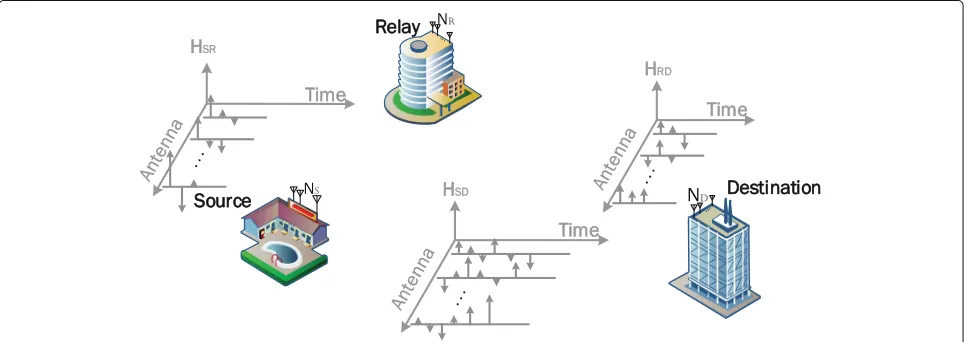
Consider an Amplify-and-Forward (AF) one-way relay network consisting of MIMO terminals (Fig.1). The net-work consists of a source node (S), a relay node (R), and a destination node (D), i.e., totally there are three MIMO nodes in a one-way AF network. Besides, source, relay, and destination terminals are equipped byNS,NR, andND
transceiver antennas, respectively. The channel between
mth antenna of S and qth antenna of Ris denoted by
fmq =[fmq(0),fmq(1),. . .,fmq(L − 1)]T and betweenqth
antenna of Randn-antenna of D is denoted bygqn =
[gqn(0),gqn(1),. . .,gqn(L − 1)]T form = 1, 2,. . .,NS,
q = 1, 2,. . .,NR andn = 1, 2,. . .,ND. All the channel ensembles are independent static linear selective chan-nels. Taking into account the distance between transmit-ting and receiving antenna and the conveying distance of light which is extremely small, the channel delay profile is independent of transmit-receive antenna pairs. Conse-quently, the antenna spacing can be modeled by a phase rotation into the delay profile. Hence, all the channel pairs in network share common delay profile where there are Lscatterers. Among these Lscatterers, there are K
significant scatterers where the channel coefficients are non-zero. TheseK significant scatterers are assumed to beCN(0,σ2)since each path contains multiple zero mean independent identically distributed (i.i.d.) subpaths.
Without loss of generality, we consider OFDM trans-mission in MIMO terminals. Consider OFDM system
with N subcarriers where Np of them are selected as
pilot subcarriers. Besides, to omit the interference of other
antenna’s pilots on each other, we consider to utilize the orthogonal pilot allocation, i.e., not only Np subcarriers are allocated to pilot subcarriers, but also pilot
subcar-riers assigned to other NS − 1 transmit antennas are
reserved to be zero [19]. Thus, the number of data sub-carriers on each of the transmit antenna is equal to
N − NSNp, assumingxm ∈ CN×1 as the OFDM
sym-bol before Cyclic Prefix (CP) adding to be transmitted on the mth transmit antenna of S. In the first time slot of the Time-Division-Duplexing (TDD), the received signal rqforq=1, 2,. . .,NRis formulated as
whereXmis the diagonal matrix withxmas its main diag-onal,FLmis the partial Discrete Fourier Transform (DFT) matrix withNprows corresponding to theNppilot sub-carriers ofmth transmit antenna and firstL columns of
N × N DFT matrix, andvqis the zero mean Additive
White Gaussian Noise (AWGN) vector with varianceσv2
in theqth antenna of relayR. In the second time slot, relay Ramplifies and retransmits the received signal to the des-tination nodeD. As a consequence, the received pilots in thenth antenna of destinationDcould be formulated as
yn= betweenSandDpassing byRandβis the relay power fac-tor which is selected asβ =Kσ2PPR
S+σv2 which is selected to keep the long-term observation relay power asPRand F2mL−1is the partial DFT matrix withNprows correspond-ing to theNp pilot subcarriers ofmth transmit antenna and first 2L−1 columns ofN×NDFT matrix. Moreover,
zn is the zero mean AWGN noise vector with variance
σ2
z. Collecting all the received pilots corresponding to all the antennas asy=yT1,y2T,. . .,yTNDT, we can represent Eq. (2) using matrix representation as
y=h+z (3)
where is the overall measurement matrix defined as
Eq. (2), h ∈ CNSND(2L−1)×1 is the overall channel vec-tor defined ash = hT11,. . .,hT1ND,hT21,. . .,hTNSNDT, and z∈CNDNp×1is the overall zero-mean noise vector.
In order to represent the channel vectors in Eq. (3) in a block sparse form, we used a permutation matrix called Wwithwjas its columns wherewjis aNSND(2L−1)×1
zero vector except on the jth position which is equal
to one. .2Since the different paths of different channels should be positioned beside each other, we define per-mutation matrixW = {wj}withj = s(2L − 1) + lfor
s=0, 1,. . .,NSND−1 andl=1, 2,. . ., 2L−1 wheresis increased first and afters = NSND−1 thenlis increased one unit andsbegins again from the first value. Besides,
WWT = I. As an example, for the case of NS = 2,
ND=2, andL=2, permutation matrix is defined asW=
wT1,wT4,wT7,wT10,wT2,wT5,wT8,wT11,wT3,w6T,wT9,wT12T.
Consequently, using permutation matrix we can
reformulate the received pilot as follows;
y = WWTh+z
= e+z (5)
where=Wande=WTh.
3 Distributed compressed sensing channel estimation
CS-based approaches try to estimate channels individu-ally while DCS-based channel estimation tries to estimate jointly sparse channels altogether. There are different channels in MIMO systems between the various transmit-ting and receiving antennas. Since all the transmit anten-nas gathered near each other and receive antenanten-nas as well, the significant scatterers which are encountered by the transmitted signals are the same. As a consequence, the sparsity pattern of different transmit-receive pairs would be the same while the channel coefficient would be com-pletely different. Thus, utilizing DCS would be very useful. As a result, we have used the CoSaMP method and define it in a distributed manner to estimate MIMO channels.
3.1 B-vCoSaMP algorithm
In this subsection, we represent the B-vCoSaMP. Appar-ently, the CoSaMP algorithm utilizes the channel sparsity. Here, we used B-CoSaMP algorithm to estimate the joint support of the channel responses. Finally, after calcu-lating the support of the channels, the channel impulse responses are estimated using LS-based estimation. The algorithm is represented in Algorithm 1.
Algorithm 1B-vCoSaMP-based channel estimation Input: the measurement matrix, the received pilotse and sparsity orderK
Output: the estimation of channel impulse responses
ˆ
hmnform=1, 2,. . .,NSandn=1, 2,. . .,ND Step 0:eˆ=0,v=eandt=0
Iteration:
Step 1: Proxy of the signal is formed byα=Hv Step 2: Reform the proxy to exploit the block sparsity
λ(l)=
Q
i=1
α((l−1)Q+i)
Step 3: The 2Klargest components are exploited =
supp{λ2K}
Step 4: Merging supports of the pervious iteration and the present oneTˆ =∪supp{at−1}
Step 5: Define the indexes corresponding toTˆ in other antennas byT =[1 :Q]+(Tˆ −1)Q
Step 6: Solve the LS problem to obtain coefficients
min
b y−Tb 2 2
Step 7: Reform the LS based coefficients to exploit block sparsitybˆ(l)=Qi=1|b((l−1)Q+i)|
Step 8: Prune to obtain the next approximationat= ˆbK
Step 9: Update the samples byv=y−Tbt
Step 10: If stop criteria not met gotoStep 1, otherwise continue with the last results
Step 11: Solve the LS problem
min
Obviously, exchanging the formation of the vectors between DCS and CS are repeated in Algorithm 1. Conse-quently, we try to explain it here. As explained before,e= [e1,e2,. . .,eQ(2L−1)]T is the DCS-formed channel model where Q = NSND. Actually, ei for i = 1, 2,. . .,Q are related to the first path of different channel pairs andi= Q+1,Q+2,. . ., 2Qare related to the second path of dif-ferent channel pairs. Consequently, we can represent it by
eifori=(l−1)Q+[ 1 :Q] andl=[ 1 : 2L−1] to clarify the DCS-formed representation. Hence, in Algorithm 1, to sum up all the paths in one vector, we should sum every Q-element of DCS-formed vector and consider it as the corresponding paths. This reformation is repre-sented inStep 2of Algorithm 1. Actually, inStep 2, we try to accumulate the calculated measurements coherently in order to organize the proxy. Moreover, to represent the DCS form into CS form, we should extend the DCS form
selections by using(Tˆ −1)Q+[1 :Q], whereTˆis selected path from DCS form representation.
We consider the B-CoSaMP algorithm to represent the support of the vectors. Actually, support estimation deter-mines the non-zero paths of channel estimation vector. To improve the accuracy of support estimation, block representation helps CoSaMP algorithm. Consequently, using B-CoSaMP we determine the significant paths of all the channel pairs in the network. Besides, at the end of the algorithm, we decide to calculate channel coefficients by LS equation to improve the accuracy of the estima-tion. LS equation is solved based on the support of the algorithm which is extracted from B-CoSaMP. In other words, B-CoSaMP represented that LS estimation should be solved only on the significant paths which are deter-mined. Hence, we combine LS channel estimation and B-CoSaMP together and generate the B-vCoSaMP. We should consider that in the LS part of the channel estima-tion, the LS equation is only solved forK indices of the measurement matrix which are estimated by B-CoSaMP. In fact, we used two interactive tools called block repre-sentation and LS estimation to increase the accuracy of estimation. Block representation enhances the precision of support estimation, and LS estimation improves the accuracy of coefficient estimation. Accordingly, two main features of channel estimation are increased attractively by exploiting the block representation and LS estimation. Consequently, in simulation results, the performance is developed expectedly.
3.2 Complexity analysis
Here, we discuss the complex multiplications which are loaded in each of the states in Algorithm 1 to repre-sent the complexity of the algorithm. Firstly, in Step 1 of Algorithm 1, the number of complex multiplications to proceed the proxy is NDNp. Furthermore, in Step 6
NDNp complex multiplications are performed. Besides,
NSND(2L− 1)complex numbers are multiplied inStep 9 and finally inStep 11number of complex multiplications isNDNp. Hence, the overall complexity of the proposed algorithm is of order 3NDNp + NSND(2L − 1).
4 Pilot allocation for compressed channel estimation
of channel estimation could be guaranteed using optimal pilot allocation based on RIP optimization. As stated, since there is no polynomial time approach to evaluating RIP, instead, mutual coherence is used which is com-putationally tractable. Hence, we introduce the mutual coherence at first and then minimize it using proposed population-based algorithms.
Here, we consider the SISO-OFDM system for simplic-ity and then extend the results to MIMO case. The mutual coherence of measurement matrix is the orthogonality between the columns of it and can be defined as
μ{} =max i=j
φH i φj
φiφj (6)
where is the measurement matrix and φi is the ith
column of it. According to the previous section, the mea-surement matrix is = XmF2mL−1. Consequently, by considering equal energy pilot symbols and unit energy partial Fourier transform matrixF2mL−1, we can define the mutual coherence using
where λi and λj are pilot subcarriers among N
avail-able subcarriers. In other words, mutual coherence can be expressed as the maximum off-diagonal entry of Gram matrixG{} =Hifis orthonormal [20]. Obviously, to minimize the mutual coherence, we have to choose pilot subcarriers which minimize Eq. (7). Moreover, in this equation, the pilot positionsλi andλj are selectable and could be considered as the design criteria. Besides, this problem is combinatorial and should be optimized using iterative search methods. Here we use probability-based methods to minimize Eq. (7). In the following section, the proposed algorithms are explained. To estimate channel using DCS-based approach, we should extend the mutual coherence to MIMO case.
4.1 Extension to MIMO
In order to design optimal pilot sequences for differ-ent transmit antennas in MIMO-OFDM relay networks, we should define the mutual coherence for measurement
matrix in Eq. (5). Since is a column-wise
permu-tation of , at first, we should consider the impact of permutation of columns on the mutual coherence.
Theorem 1. Assuming as an orthonormal
measure-ment matrix and its columns asφifor i = 1, 2,. . .,n. We
define¯ as a column-wise permutation of. Then, it can be demonstrated that
μ{} =μ{ ¯} (8)
We consider= [φ1,φ2,φ3,. . .,φn] and without loss of generality consider¯ as the substitution of the second and third columns of; consequently, it can be expressed as¯ =[φ1,φ3,φ2,. . .,φn]. According to the definition of it can be represented that
G{ ¯} = which indicates the equality of both mutual coher-ence. Therefore, the permutation of measurement matrix columns will not effect the mutual coherence value.
Considering Theorem1, one can deduce that instead of calculatingμ{}, it is enough to calculateμ{}sinceis the column-wise permutation of. According to Eq. (2),
we can representas
=
late the mutual coherence of , we should consider its
Therefore, the mutual coherence of measurement matrix in DCS-based channel estimation for MIMO-OFDM system consists of mutual coherence of different SISO-OFDM systems two by two. Consequently, we can consider the mutual coherence using measurement matrix or calculating the following:
μ{} = max 1≤i,j≤NSμ{i
,j} (14)
whereμ{i,i} = μ{i}andμ{i,j}is the largest off-diagonal absolute value ofHi j. Hence, in order to cal-culate the mutual coherence of the MIMO-OFDM mutual coherence, it is sufficient to calculate all the available SISO-OFDM pairs and consider the largest value as the mutual coherence.
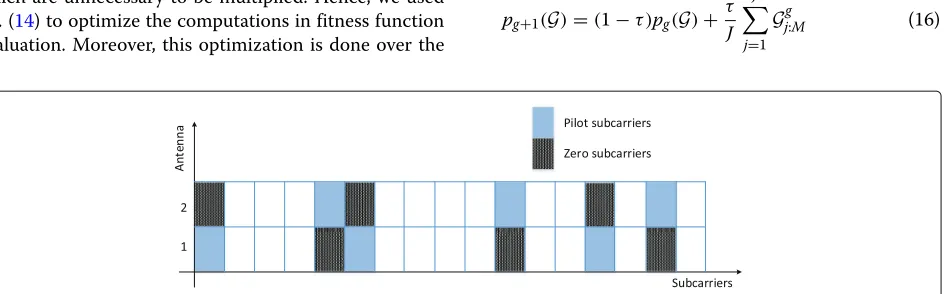
Another important consideration is the orthogonality of the pilot sequences for each of the transmit anten-nas. In fact, to omit the interference of the different pilot sequences, we generate orthogonal pilot sequences and then transmit zero subcarriers in the other antennas’ pilot subcarriers. Consequently, in creating different pilot sequences, we should consider orthogonality of the pilot sequences. The pilot allocation for aN = 16 subcarrier MIMO-OFDM system utilizing orthogonal pilot place-ment andNS = 2 transmit antennas depicted in Fig.2. In the following, we would consider algorithms to design pilot sequences.
5 Proposed pilot allocation algorithms
In this section, we will propose three algorithms based on the population and probability, to optimize the com-binatorial problem in Eq. (6). As mentioned, these algo-rithms work based on the probability function and try to sample the PDF using different populations and do this until convergence of the PDF to the steady state. Here, maxi,j;i=jl2=L0−2e−j2π(λm−λn)l/N is the fitness function which should be optimized. In order to decrease the com-putational complexity in fitness function we used Eq. (14). Evidently, there are lots of zero elements in matrix which are unnecessary to be multiplied. Hence, we used Eq. (14) to optimize the computations in fitness function evaluation. Moreover, this optimization is done over the
search spaceSwhich is composed ofNN p
candidate. Since the exhaustive search over search spaceS is intractable, we consider probability-based approaches to optimize it using initial generationG0 where I different individuals are found in each generation.
5.1 Sequential Cross-Entropy-based pilot allocation
approach
As discussed, this method is a probability-based approach which constructs each generation towards better objective function. In fact, SCE samples from a PDF and learns the new population fromJbest individuals in the current gen-eration. Since sampling from PDF is used as the primary approach in producing different generations, the SCE will be more robust than other population-based algorithms which work by mutation and crossover in trapping into
a local minimum. Here, we need a PDF calledP to
gen-erate individuals by sampling it. At first, we consider the fitness function, generation, and individuals as before. In
this approach, to construct each generation the PDF P
is used. This PDF represents the probability of selection of each element of the individual. Construction of this PDF is based on J elite individuals with best objective function and the PDF of the previous iteration. Mathemat-ically, we assume each generation individuals by a vector of probability
pg(G)=pg(G1),pg(G2),. . .,pg(GN) T
(15)
wherepg(Gi)refers to the probability of obtaining a value of 1 in theith element of G. At each generation, using the probability vector, pg(G), I individuals are obtained. In order to do random sampling by the PDF of pg(G), we first generate the Cumulative Density Function (CDF)
(P), and then, using a random number between 0 and 1
and the inverse of CDFP, the sample is randomly gen-erated. Each of these I individuals are evaluated and J
best of them (J ≤ I) are selected. We denote them by
J:I. These selected individuals are used to update the probability vector by
pg+1(G)=(1−τ)pg(G)+τ
where τ ∈ (0, 1] is a parameter of algorithm. Since the probability behavior of populations is evident, possibility of getting stuck in a local minimum is lower. The stage-by-stage algorithm is represented in Algorithm 2. The stop criteria is based on the PDF, and when the probability function contains zero and 1/NSNp, it means that the best possible value for pilot allocation is obtained.
Algorithm 2Sequential Cross-Entropy-based pilot
allo-cation
1: Initialize the populationG0usingIrandom individual
2: whilestop criteria not metdo
3: Sort the individuals in Gg in ascending order
according to fitness function
4: SelectJof the individuals inGgwith the best objec-tive value and establish subsetGjg:Iforj=1, 2,. . .,J
5: Construct PDFpg(G)usingGjg:Iand Eq. (16) 6: Generate the CDFPgusing thepg(G) 7: fori=1toIdo
8: Generate NSNp random numbers in interval
[ 0, 1]
9: Using the inverse of CDF (P−g1), sample the prob-ability function and generate the new individual without repeat and generate the new generation
Gg+1
10: end for
11: end while
5.2 Special case of SCE (τ=1)—extension of [18]
Considering PDF update criteria in Eq. (16), if we assume
τ = 1, the update process will not be affected by the
previous generation, i.e.,
As a result, the memory of PDF will be omitted. Wang et. al. in [18] proposed this approach called as the EDA for the SISO-OFDM system. Here, we extend the EDA-based algorithm for generating NS different orthogonal
sequences for the MIMO-OFDM system. In [18], it is
noted that matching the sequences with the best sequence in every stage is mandatory, but in the following theorem, it is proved that matching to the sequence is not manda-tory at all, since matching the sequences is obtained using circular shifting of the unmatched sequences. This phe-nomenon is considered in the following Theorem.
Theorem 2. Assuming as an orthonormal
measure-ment matrix and defining¯ as a row-wise permutation of
. Then, it can be demonstrated that
μ{} =μ{ ¯} (18)
Here, we consider = [φ1;φ2;φ3;. . .;φn] whereφiis 1×Lcomplex vector. On the other hand, we assume¯ = [φ1;φ3;φ2;. . .;φn], then mutual coherence for both of the measurement matrices can be calculated as the maxi-mum off-diagonal entry ofni=1φHi φi. Consequently, the mutual coherence for both of the matrices are the same and row-wise permutation does not change the mutual coherence.
Specifically, in the EDA-based algorithm which is rep-resented in [18], after circular shiftingJ best sequences, the PDF of the current stage is calculated by counting the number of used subcarriers inJselected placements. Obviously, the counting process is independent of the cir-cular shifting. Another drawback of the algorithm can be considered as trapping in the local minima, since the cur-rent PDF is considered without taking into account pre-vious ones. Apparently, the PDF is stuck in local minima more rapidly, and thus, the algorithm would be termi-nated. Although the speed of convergence is more than SCE algorithm, the accuracy is less since local minima trapping has occurred more rapidly. This algorithm is considered in Algorithm 3.
Algorithm 3Extended EDA-based pilot allocation
1: Initialize the populationG0usingIrandom individual
2: whilestop criteria not metdo
3: Sort the individuals in Gg in ascending order
according to fitness function
4: SelectJof the individuals inGgwith the best objec-tive value and establish subsetGjg:Iforj=1, 2,. . .,J
5: Construct PDFpg(G)usingGjg:Iand Eq. (17) 6: Generate the CDFPgusing thepg(G) 7: fori=1toIdo
8: Generate NSNp random numbers in interval
[ 0, 1]
9: Using the inverse of CDF (P−g1), sample the prob-ability function and generate the new individual without repeat and generate the new generation
Gg+1
10: end for
11: end while
5.3 Parallel Cross-Entropy-based pilot allocation
algorithm
algorithm, we have proposed PCE-based pilot allocation
plan. PCE considersα number of points in search space
Sand tries to converge the PDF of these points to steady
state, simultaneously. Hence, since α points are
con-sidered simultaneously, trapping in one local minimum is lowered than before. Moreover, working on a differ-ent number of PDFs at the same time accelerates the convergence of the proposed method. This algorithm is represented in Algorithm 4.
As demonstrated in Algorithm 4, the difference of the PCE and SCE is considered in pipelining the update PDF and generations. In other words, in each iteration of the algorithm, generation update is performed onαpipelined branches. Moreover, theseαpipelined branches are uti-lized to updateα different PDFs. As a consequence, the
random sampling is done over α different PDFs, where
α different generations are constructed. This approach uses more computational calculations in each iteration which can be handled by parallel-processing supporting hardware. In the other hand, we obtain two significant advantages including conservative behavior in impacting by local minima trapping and lower number of iterations in convergence. Thus, utilizing PCE-based pilot alloca-tion will confirm two critical aspects of pilot allocaalloca-tion algorithms.
Algorithm 4 Parallel Cross-Entropy-based pilot
alloca-tion
1: Initialize the populationG1:0αusingIrandom individ-ual
2: whilestop criteria not metdo 3: forlo=1toαdo
4: Sort the individuals inGlog in ascending order 5: Select J of the individuals in Glog with the best
objective value and establish subsetGlog,j:Iforj=
1, 2,. . .,J
6: Construct PDFplog(G)usingGlog,j:Iand Eq. (16)
7: Generate the CDFPlog using theplog(G) 8: fori=1toIdo
9: Generate NSNp random numbers in interval
[ 0, 1]
10: Using the inverse of CDF, sample the
proba-bility function and generate the new individual without repeat and generate the new genera-tionGglo+1
11: end for
12: end for
13: end while
6 Numerical results
In this section, the numerical results are collected to rep-resent the performance of the proposed SCE-, EEDA-, and
PCE-based pilot allocation algorithms. In all the
simula-tions, the number of OFDM subcarriers isN = 512, and
16-ary quadrature amplitude modulation (16-QAM) with Gray coding is utilized. AmongN available subcarriers, there areNpsubcarriers as pilot subcarriers. Various val-ues are assigned toNp in different simulations. Without loss of generality, in MIMO scenarios the number of trans-mitting and receiving antennas for all the nodes are 2, i.e.,NS = NR = ND = 2. Sparse Rayleigh fading chan-nels in the networks are modeled using Finite Impulse
Response (FIR) filters with L taps where K number of
taps are non-zero and are i.i.d. using zero mean and unit variance complex Gaussian distribution. Furthermore, all the results are averaged over 1000 independent channel ensembles.
6.1 Comparison of the proposed algorithms
In this part, we compare the performance of the
pro-posed algorithms in view of decreasing μ. To evaluate
the performance, we considerNp = 25 pilot subcarriers for each antenna which distributed orthogonally using
SCE, EEDA, and PCE approaches andL = 25 channel
taps withK = 3 significant non-zero. As a comparison
standard, we consider the optimized pilot allocation in [11] where GA was utilized to generate orthogonal pilot sequences. The comparison is evaluated using
the minimal mutual coherence μ and distribution of
μ. Distribution of μ is illustrated in Fig.3. Specifically,
in EEDA-based approach (Fig. 3b), the convergence
is acquired in 52nd iteration, where it is acquired for
PCE-based approach (Fig. 3a) and SCE-based approach
(Fig.3c) in 123rd and 186th, respectively. Expectedly, the distribution ofμin each iteration is getting closer in all the three methods. It is caused by the convergence of probability function which is sampled in each iteration.
As can be seen, the value of minimum μ in the last
a
b
c
Fig. 3μdistribution for different proposed algorithms.aSCE algorithm,bEEDA algorithm, andcPCE algorithm
Table 1Sample pilot sequences and their mutual coherence which have been achieved by different proposed approaches and comparison to the method in [11]
Alg. SCE EEDA PCE GA
μ 0.2360 0.2439 0.2227 0.2557
Ns 1 2 1 2 1 2 1 2
6 9 31 36 29 31 18 55
14 22 42 44 47 49 20 61
33 37 52 71 57 63 36 99
Pilot 40 44 80 87 64 71 44 132
seq. 51 54 92 142 72 110 66 148
56 59 149 150 115 116 86 160
62 66 155 186 121 124 116 179
95 99 187 194 198 200 124 196
103 105 195 203 207 208 135 203
112 135 205 210 217 218 145 222
151 152 215 217 227 228 166 230
158 212 223 225 236 237 177 238
219 242 230 233 247 248 185 256
243 249 237 241 255 257 197 263
252 257 244 251 278 280 237 277
276 318 263 291 287 289 252 295
324 325 292 299 298 308 306 307
344 349 311 329 317 318 323 331
354 355 330 335 326 346 348 352
372 373 349 409 348 355 357 381
413 420 414 418 357 362 385 419
430 431 423 426 363 412 421 428
436 483 429 437 414 434 446 434
487 493 445 469 439 466 484 447
502 512 498 500 470 483 490 483
better than GA-based approach. In the following section, we will consider the performance of the proposed pilot sequences utilizing the Normalized Mean Square Error (NMSE) and Bit Error Rate (BER) performance metrics.
6.2 Evaluating MSE and BER performance
Here, we consider the applicability of the proposed algo-rithm and the obtained pilot sequences utilizing two main characteristics of channel estimator called NMSE and
BER. The channel is characterized byL = 25 taps where
K = 3 of them are significant non-zero taps. NMSE is
calculated using
NMSE= 1
NMC NMC
i=1
hi− ˆhi22 hi22
wherehis the complete channel vector andhˆis its estima-tion. Moreover,NMCis the Monte Carlo iteration which is 1000. BER is evaluated using Monte Carlo simulation usingNMCindividual simulation.
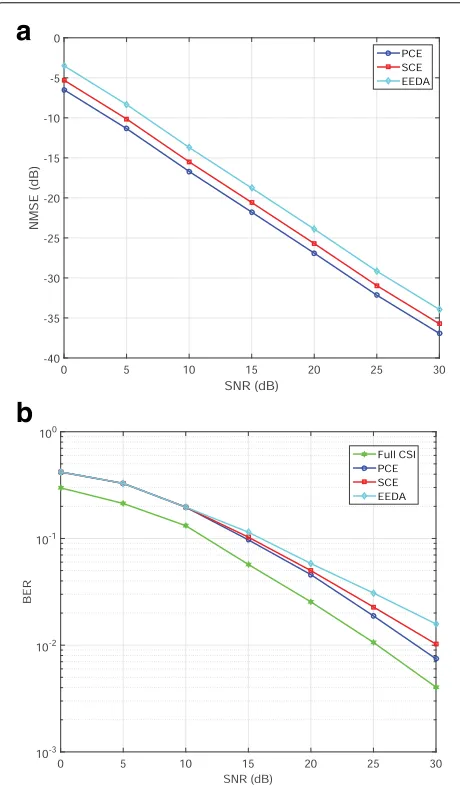
In Fig. 4 these two performance metrics are
com-pared. Apparently, decreasing the mutual coherence will cause a better NMSE metric and BER performance. As illustrated in Fig. 4a, the MSE of PCE enjoys from the mutual coherence approximately 1 and 2.5 dB rather than SCE- and EEDA-based approaches, respectively. Moreover, from BER point of view, the BER gain caused by mutual coherence supremacy is approximately 3 and
6 dB forBER = 2 × 10⁻² to SCE and EEDA-based
approaches, respectively. The BER for the case of Full
CSI is represented as a comparison metric. Evidently,
by utilizingNp = 25 optimized pilots on each antenna,
a
b
Fig. 4Performance comparison for different pilot allocation algorithms. aNMSE performance metric andbBER performance metric
the performance is almost 3 dB away from the optimal performance which could be compensated using other facilities. Actually, using optimized pilots will lead to 90% spectral efficiency which is one of the most critical characteristics of the system.
In order to compare the results with previous approaches in the literature, we have done the simulations usingGA-based pilot allocation approach together with
PCE-based approach. Hence, these two methods could be compared from spectral efficiency point of view utilizing
NMSE and BER performance metrics (Fig. 5). For the
simulations, the number of Np = 30 is selected. The
performance comparison represents the superiority of the proposed method from NMSE and BER performance
a
b
metric overview. Apparently, in NMSE and BER the PCE-based approach outperforms the GA-PCE-based algorithm
almost 4 dB, quantitatively. Furthermore, comparing
Figs. 4 and 5, the performance of GA-based algorithm
forNp = 30 is identical to the SCE-based approach for
Np = 25 pilot numbers. Hence, utilizing the proposed
methods, the spectral efficiency will increase more than 1% rather than other spectral efficient DCS-based approaches.
6.3 Performance comparison with the other estimation
method
In this part of simulation results, the simulations are per-formed in comparison to the well-known CoSaMP algo-rithm in order to evaluate the benefits of the proposed method. In this simulation, the number of channel path
is considered to beL = 30, where K = 3 of them are
significant non-zero paths. Moreover, the number of pilot subcarriers for each transmitting antenna is considered to
beNp = 40. To evaluate the performance merits of the
proposed methods, we considered two different scenarios. In the first scenario the pilot allocation is performed ran-domly, while in the second scenario the pilot is allocated using the proposed PCE-based algorithm. The BER results of them are represented in Fig.6. As illustrated in Fig.6a, using the random pilots together with the CoSaMP-based channel estimation method, results in irreducible BER
around 10−1 while this is not encountered in case of
proposed B-vCoSaMP-based channel estimation method until 10−2. Moreover, utilizing proposed PCE-based pilot allocation which is shown in Fig.6b, the BER is decreased in both cases but the proposed method is still better than the other method and approximately 2 dB away from the ideal case.
6.4 The effect of significant paths of channel
The last simulation results are devoted to the impact of channel significant paths on the channel estimation performance. In order to evaluate the performance, we
change the significant paths from K = 2 to K = 4.
The BER performance is compared using random pilot allocation and optimized PCE-based pilot allocation. The
channel paths are again L = 30 and the pilot
num-ber is Np = 40 for each of the transmitting antennas.
Expectedly, increasing the number of significant path will decrease the sparsity order of the channel which makes its estimation harder. As a consequence, usingNp= 40 ran-dom orthogonal pilots, will not be applicable in case of
K = 4 significant paths (BER is shown in Fig.7). More-over, for the case ofK=3, utilizing optimized PCE-based pilots will improve the performance while it is comparable with the case ofK=2 and approximately 1 dB away from
K =2, while this gap is around 3.5 dB in case of random pilot allocation.
a
b
Fig. 6Performance comparison of proposed method and CoSaMP-based channel estimation algorithm.aBER performance using random pilot allocation andbBER performance using optimized PCE-based pilot allocation
7 Conclusions
a
b
Fig. 7Performance comparison of proposed method in case of different significant paths of the channel.aBER performance using random pilot allocation andbBER performance using optimized PCE-based pilot allocation
approaches. Utilizing just one local minimum point in SCE and EEDA, the performance is worse than PCE-based approach. Multi-point tracking ability of PCE makes it possible to increase the accuracy and speed of the pilot sequence determination algorithm.
Acknowledgements
The authors want to acknowledge the help of all the people who influenced the paper. Specifically, they want to acknowledge the anonymous reviewers for their reasonable comments.
Funding
There is no source of funding for this paper.
Availability of data and materials
Not applicable.
Authors’ contributions
AA and MA carried out the mathematical parts of the paper and simulations were done by AA. Both of authors read and approved the final manuscript.
Ethics approval and consent to participate
Not applicable.
Consent for publication
Not applicable.
Competing interests
The authors declare that they have no competing interests.
Publisher’s Note
Springer Nature remains neutral with regard to jurisdictional claims in published maps and institutional affiliations.
Received: 30 August 2017 Accepted: 14 February 2018
References
1. D Hu, X Wang, L He, A new sparse channel estimation and tracking method for time-varying ofdm systems. IEEE Trans. Veh. Technol.62(9), 4648–4653 (2013)
2. E Soleimani-Nasab, A Kalantari, M Ardebilipour, Performance analysis of multi-antenna df relay networks over nakagami-m fading channels. IEEE Commun. Lett.15(12), 1372–1374 (2011)
3. C Qi, G Yue, L Wu, N Arumugam, Pilot design for sparse channel estimation in ofdm-based cognitive radio systems. IEEE Trans. Veh. Technol.63(2), 982–987 (2014)
4. P Cheng, L Gui, Y Rui, YJ Guo, X Huang, W Zhang, Compressed sensing based channel estimation for two-way relay networks. IEEE Wirel. Commun. Lett.1(3), 201–204 (2012)
5. Z Gao, L Dai, W Dai, B Shim, Z Wang, Structured compressive
sensing-based spatio-temporal joint channel estimation for fdd massive mimo. IEEE Trans. Commun.64(2), 601–617 (2016)
6. MF Duarte, S Sarvotham, D Baron, MB Wakin, RG Baraniuk, inProc. Asilomar Conf. Signals, Syst., Comput. Distributed compressed sensing of jointly sparse signals (IEEE, Pacific Grove, 2005), pp. 1537–1541 7. P Cheng, Z Chen, Y Rui, YJ Guo, L Gui, M Tao, QT Zhang, Channel
estimation for ofdm systems over doubly selective channels: a distributed compressive sensing based approach. IEEE Trans. Commun.61(10), 4173–4185 (2013)
8. L Xu, K Niu, Z He, W Xu, Z Zheng, inProc. 9th ICICS. Mimo channel estimation based on distributed compressed sensing for lte-advanced (IEEE, Tainan, 2013), pp. 1–5
9. X Rao, VKN Lau, Distributed compressive csit estimation and feedback for fdd multi-user massive mimo systems. IEEE Trans. Signal Process.62(12), 3261–3271 (2014)
10. J Tropp, Greed is good: algorithmic results for sparse approximation. IEEE Trans. Inf. Theory.50(10), 2231–2242 (2004)
11. X He, R Song, WP Zhu, Pilot allocation for sparse channel estimation in mimo-ofdm systems. IEEE Trans. Circuits Syst. II, Exp. Briefs.60(9), 612–616 (2013)
12. X He, R Song, WP Zhu, Pilot allocation for
distributed-compressed-sensing-based sparse channel estimation in mimo-ofdm systems. IEEE Trans. Veh. Technol.65(5), 2990–3004 (2016) 13. C Qi, G Yue, L Wu, Y Huang, A Nallathan, Pilot design schemes for sparse
channel estimation in ofdm systems. IEEE Trans. Veh. Technol.64(4), 1493–1505 (2015)
14. X He, R Song, WP Zhu, Pilot allocation for sparse channel estimation in mimo-ofdm systems. IEEE Trans. Circuits Syst. II, Exp. Briefs.60(9), 612–616 (2013)
15. C Qi, L Wu, A study of deterministic pilot allocation for sparse channel estimation in ofdm systems. IEEE Commun. Lett.16(5), 742–744 (2012) 16. C Qi, L Wu, Optimized pilot placement for sparse channel estimation in
17. X He, R Song, inProc. IEEE Int. Conf. WCSP. Pilot pattern optimization for compressed sensing based sparse channel estimation in ofdm systems (IEEE, Suzhou, 2010), pp. 1–5
18. H Wang, Q Guo, G Zhang, G Li, W Xiang, Pilot pattern optimization for sparse channel estimation in ofdm systems. IEEE Commun. Lett.19(7), 1233–1236 (2015)
19. A Akbarpour-Kasgari, M Ardebilipour, F Afghah, inProc. 49th CISS. Mimo-ofdm non-regenerative relay channel estimation using compressed sensing (IEEE, Baltimore, 2015), pp. 1–5
![Table 1 Sample pilot sequences and their mutual coherencewhich have been achieved by different proposed approachesand comparison to the method in [11]](https://thumb-us.123doks.com/thumbv2/123dok_us/881960.1105966/10.595.300.538.117.516/sample-sequences-coherencewhich-achieved-different-proposed-approachesand-comparison.webp)