R E S E A R C H
Open Access
Functional quantizer design for source
localization in sensor networks
Yoon Hak Kim
Abstract
In this paper, we address the problem of quantizer design optimized for a source localization application in acoustic sensor networks where physically separated sensors make measurements of acoustic signal energy, quantize them, and transmit the quantized data to a fusion node, which then produces an estimate of the source location. We propose an iterative regular quantizer design algorithm that minimizes the localization error. To construct regular quantization partitions, we suggest the average distance error as a metric in the functional quantization since the distance is monotonic in each sensor reading. Furthermore, to guarantee minimization of the localization error, we propose a new technique to update the codewords and prove that the localization error can be reduced at each iteration while the average distance error remains nonincreasing by applying our update technique. Our experiments show that our proposed algorithm yields significantly improved performance as compared with traditional quantizer designs.
1 Introduction
In sensor networks, a large number of low-cost sensors, each equipped with a processor, a low-power communica-tion transceiver, and one or more sensing capabilities, are deployed in a sensor field. Each sensor operates on its lim-ited amount of battery energy which is consumed mostly by wireless communication between sensors. The network lifetime is a crucial concern for sensor networks, and the basic strategy for prolonging the lifetime would then be to decrease the communication cost at the expense of addi-tional computation in the sensors [1]. This motivates us to use data compression for various tasks such as detection, classification, localization, and tracking, where collected and processed data are exchanged between sensors.
Quantization of measurements arises in practical esti-mation systems where estiesti-mation algorithms are con-ducted on quantized data. Thus, efficient quantization will be needed in order to achieve improvements in rate-distortion performance. For example, the authors in [2] considered a source localization system where each sen-sor measures the signal energy, quantizes it, and sends the quantized sensor reading to a fusion node where the local-ization is performed. In this framework, the maximum likelihood (ML) estimation problem based on quantized
Correspondence: [email protected]
Department of Electronic Engineering, College of Electronic and Information Engineering, Chosun University, Gwangju 501-759, South Korea
data was addressed and the Cramer-Rao bound (CRB) was derived for comparison, assuming that each sensor used
identical (uniform)quantizers. In [3], heuristic quantiza-tion schemes were proposed in order to assign quantizers to each sensor without taking into account the sensor locations. However, it should be noted that if the sensor locations are known during the quantizer design process, significant performance gain can be achieved with respect to simple uniform quantization at all sensors. This raises the problem of quantizer design optimized for distributed estimation systems where the goal is to design indepen-dently operating quantizers that minimize a global metric such as the estimation error (a function of all sensor readings).
To this end, acooperative design-separate encoding ap-proach was suggested for a decentralized hypothesis test-ing system [4,5] where a distributional distance was used as a criterion for quantizer design in order to yield a manageable design procedure. For a distributed detection system, the authors in [6] proposed a heuristic procedure for quantizer design that minimizes the upper bound of the probability of error. Lam and Reibman [7] constructed optimal quantization partitions in distributed estimation systems where the necessary conditions for the partitions were presented. In the high-resolution regime, asymp-totic quantizer designs for distributed estimation were derived in [8,9] by using the limiting density of quantizer
partitions. In [10], the necessary conditions for opti-mal quantization rules and linear estimation fusion rules were derived and shown to be searched simultaneously by using an iterative algorithm. An iterative quantizer design algorithm was presented in the Lloyd algorithm framework and evaluated for nonideal channels in [11]. It was shown that the resulting distributed scalar quantizers should benonregular, implying that the same codeword is assigned to several disjoint intervals in order to reduce the distortion.
Although the quantizer design algorithms are devel-oped in sensor networks where all sensors involved send their quantized data directly to a fusion node without communicating with each other (no routing), the design problem can be also addressed for general network topol-ogy. In [12], the authors incorporated network topology into compression system design and presented a design algorithm for local optimal vector quantizers that achieves improvements in rate-distortion performance and sys-tem functionality. In [13], an algorithm for optimal rate allocation to sensors was presented, given a multihop routing tree from sensors to a fusion node in order to minimize the amount of transmission energy. In addition, since selecting a proper subset of sensors and optimizing the routing structure can lead to important power sav-ings, an iterative algorithm was proposed in [14] for joint optimization on the sensor selection and the routing for distributed estimation.
In this work, we consider a source localization sys-tem in acoustic sensor networks (one of the distributed estimation systems) where distributed sensors measure acoustic source signals, quantize them, and send them to a fusion node which will estimate the source loca-tion based on quantized sensor readings. We seek to design independently operating regular quantizers that minimize the localization error. We also take the coop-erative design-separate encoding strategy and propose an iterative quantizer design algorithm similar to the cyclic generalized Lloyd algorithm. The challenge here is that since the Lloyd algorithm was devised for quantizer design when a local metric (e.g., reconstruction error of local sen-sor readings) is used as a cost function, simply replacing it by a global metric may cause problems. More specifically, the quantizer update at each step from the Voronoi region construction and the subsequent computation of code-words based on the Voronoi partitions, the two main tasks in the typical Lloyd design, would not generally produce the regular quantization partitions and cannot guarantee that the global metric will not increase. In order to tackle the problems, the authors in [15-17] adopted a simple dis-tance rule to construct the regular quantization partitions and proposed a weighted sum of both of the metrics as a cost function (i.e., local+λ×global,λ≥0) along with a search for proper weights. The use of the weighted metric
is motivated by the observation that there always exists a certainλsuch that the cost function remains nonincreas-ing under the Lloyd iterations (e.g.,λ=0 always leads to a nonincreasing cost function, although there typically exist multiple nonzero values ofλwith the same property).
It should be noticed that the regular quantization par-titions can be also constructed by the functional quanti-zation of a monotonic estimator (e.g., a linear minimum mean square error (MMSE) estimator) since each quanti-zation partition for the estimator transforms to a regular one for quantizers at each sensor due to its monotonicity in each sensor reading [9]. In this work, we suggest using a new metric to be minimized in order to obtain regu-lar quantization partitions in the functional quantization framework. Specifically, we propose the average distance error as a metric since the functional quantization of the distance allows us to generate regular quantization partitions due to the monotonicity of the distance with respect to each sensor reading even when the nonlin-ear MMSE estimator for a source location is employed. Notice that we focus on the design of regular indepen-dent scalar quantizers that minimize the global metric. In [18], it was shown thatnonregularindependent quantizers can be systematically designed by applying the distributed encoding algorithm to regular quantizers; that is, substan-tial performance gain could be further achieved after the design of regular quantizers by merging their nonadjacent quantization bins in a distributed manner.
no obvious advantages over the previous work in [17] in terms of localization performance, the nature of our algo-rithm yields substantial reduction in the computational complexity. The complexity analysis shows that the bene-fit of the proposed algorithm becomes more significant as the rate and/or the number of sensors increases.
In this paper, we assume that each sensor can esti-mate noise-corrupted acoustic signal energy using actual measurements (e.g., time series measurements). We also assume that there is only one-way communication from sensors to the fusion node, i.e., there is no feedback chan-nel, the sensors do not communicate with each other (no relay between sensors), and these various communication links are reliable.
This paper is organized as follows. The problem for-mulation of the quantizer design is given in Section 2. A brief description of functional quantization is provided in Section 2.1. An iterative quantizer design algorithm is explained in detail in Section 3 and summarized in Section 3.1. The complexity analysis of the proposed algo-rithm is discussed in Section 3.2. Simulation results are given in Section 4, and the conclusions are found in Section 5.
2 Problem formulation
Consider a sensor field S ⊂ R2 where M sensors are located at known spatial locations, denoted byxi,i = 1, . . .,M. The sensors measure an acoustic signal energy emitted from a source located at an unknown location x ∈ S, assumed to be static during the localization pro-cess. In collecting acoustic energy readings, it is assumed that each sensor adopts the energy decay sensor model proposed in [19] and the signal energy measured at sensor
iover a given time intervalkcan be expressed as follows:
zi(x,k)=gi a x−xiα +
wi(k), (1)
whereziis the acoustic energy reading at sensoriand the
model parameter consists of the gain factorgi of the ith
sensor, an energy decay factorα, which is approximately equal to 2, and the source signal energyameasured 1 m from the source which is assumed to be uniformly dis-tributed over the range [amin amax]. It is also assumed
that the measurement noise termwi(k)can be
approxi-mated by a normal distribution,N(0,σi2). Note that the energy decay model was verified by the field experiment in [19] and was also used in [20-22].
In this paper, we consider source localization based on quantized sensor readings where theith sensor uses aRi
-bit quantizer with a dynamic range [zi,min zi,max] which
is assumed to be selected based on desirable properties of their respective sensing ranges (see [17] for the details). We denoteαi(·)the encoder at sensori, which generates a quantization indexQi ∈ Ii = {1,. . .2Ri = Li}. In what
follows,Qi will be also used to denote the quantization
bin to which measurementzi belongs. Each sensor
cap-tures its measurementzi(x,k)at time intervalk, quantizes
it, and sends it to a fusion node, where all sensor readings are used to obtain an estimatexˆof the source locationb. It is noted that in some cases one measurement per sensor is used for localization and in the other cases when multi-ple measurements (i.e.,zi(x,k)for severalk’s) can be made
at each sensor, a sufficient statistic for localization from the multiple measurements can be computed before being quantized and transmitted.
2.1 Functional quantization of monotonic estimators Suppose that we are given the estimator xˆ =g(z1,. . ., zM) ≡ g(zM1 )monotonic in each of the sensor readings
(e.g., linear MMSE estimator) where(z1,. . .,zM)is
abbre-viated aszM1 for simple notation. In this case, functional quantization can be applied for quantizer design to mini-mize the criterionE ˆx− ˆxQ2=Eg(zM1)− ˆg(zˆM1)2 wherexˆQ = ˆg(·)is the estimator employed at the fusion node that operates on quantized sensor readingsˆzi,i=1, . . .,M and ˆzi corresponds to the reconstruction value
transmitted from sensor i when zi ∈ Qi. Without loss
of optimality, we can findz∗1,. . .,zM∗,z∗i ∈ Qi such that g(z∗M1 ) = ˆg(zˆM1) by the intermediate value theorem. Notice that the functional quantization focuses on mini-mization ofE ˆx− ˆxQ 2rather thanE x− ˆxQ 2. Clearly, asMbecomes large,E ˆx− ˆxQ2≈Ex− ˆxQ2. We first consider the functional quantizer design at sensoriin the Lloyd design framework. We are initially given the reconstruction values (or the codewords) gˆij
corresponding to the jth functional quantization parti-tionVgji for the range of the estimatorg(·). The Voronoi
region construction and the codeword computation, the two main tasks in the algorithm, are conducted as follows:
Vgji=
As in the standard Lloyd algorithm,Vgji clearly forms
regular partitions, and these tasks will be repeated with
ˆ
gij = ˆg∗ijfor the next iteration until a certain criterion is satisfied.
Now, we can easily obtain the Voronoi regions for quan-tizer design at sensori:
Vij=
zi(x):g(zM1)∈Vgji
We can also compute the codewordˆzijfromgˆij = ˆg(zˆij). It should be noticed thatVij,j=1,. . .,Li, are regular
par-titions sinceVgjiwill transform to a regular one forzidue
to the monotonicity ofg(zM1)with respect tozi.
3 Functional quantizer design algorithm
First, we consider the average distance error at sensorito be minimized for quantizer design as follows:
ExJi=Ex
where Qij is the jth quantization partition at sensor i,
ˆ
ri= ˆx−xi=g(zM1)−xiis the distance between the
source and theith sensor estimated by using unquantized sensor readings, andˆriQ = ˆxQ−xi = ˆg(zˆM1)−xi
is the estimated distance when quantized sensor readings are involved. Note that g(zM1 ) can be any good estima-torsc. In order to incorporate the metric ExJi into the
design process, we find ˆrij ∈ {ˆri|zi(x) ∈ Qij} such that
high rate as the partitionQijbecomes small. Clearly, it will allow us to avoid calculation ofxˆQ= ˆg(zˆM1)in an iterative loop (for the details, see steps 2 to 6 in the algorithm that appears in Section 3.1), enabling fast operation. The met-ric can be minimized by taking the centroid ofˆriover each
partitionQijto replaceˆrij. Formally,
We can possibly reduce the localization error by min-imizing ExJi,i = 1,. . .,M, at each sensor since as the
accuracy of the range information becomes better, the fusion node will be able to estimate source locations with higher precision.
Now, we describe this consideration in the functional quantization framework where the distance error Ji = |ˆri− ˆriQ|2is minimized for quantizer design:
Note that the metric has an important property which is essential for regular quantizer design; that is, the dis-tanceˆriis monotonically decreasing in the sensor reading zi. As explained in (2) and (3), this monotonicity allows
us to always construct the regular quantization partition
Vi= {Vij,j=1,. . .,Li}forzi:
whereVrji is thejth functional quantization partition for
the distanceˆri andVij is the corresponding region forzi
consisting of theith sensor readings that would minimize the metric if assigned to thejth quantization bin. Thus, as in the standard Lloyd design algorithm, the construc-tion of quantizaconstruc-tion particonstruc-tionsVijin (6) and its codeword computation in (5) will clearly reduce the average distance error,E(Ji)at each iteration, leading to convergence.
How-ever, simply minimizing the metric would not guarantee minimization of the localization error. In this work, we prove that the localization error is also reduced at each iteration by applying a new technique for the codeword computationrˆijwhich will be developed in what follows.
Lemma 1.The localization error (LE) Ex ˆx− ˆxQ2is minimized by using the codewordsrLEjigiven by
Here, the second term in (8) is irrelevant to quantization process and denoted by the constant C. Obviously,rLEji
can be computed by taking the centroid overQijwhich is given byEx[ˆricosθ (x)|zi(x)∈Qij].
It is noticed that if you attempt to design quantizers that minimize the LE by using {rLEji} for the codeword
computation, you would fail to make the design process convergent. The challenge here is that we should be able to update the codeword at the next iteration denoted by
ˆ
ri∗j such that the localization error is reduced while the average distance error remains nonincreasing at each iter-ation. First, we easily show from (5) and (7) that there exists the relation
rLEji≤rRji, j=1,. . .,Li. (11)
Next, we prove that the LE and the average distance error computed by using rˆij are proportional to the squared distances from the optimal values, i.e.,|rLEji− ˆr
where (12) follows from (9) and the second term in (13) equals zero from (7). For the case of the average distance error, similar manipulation can be easily applied to derive the corresponding relation.
Now, we are in a position to prove the theorem that states how to update the codewordsrˆ∗ji .
Theorem 3. Letrˆij be the codewords at the current iter-ation andˆri∗jthe ones at the next iteration. Suppose that the average distance error is minimized in the generalized Lloyd framework, where the Voronoi region is constructed by using (6) andˆri∗jcorresponding to jth region is computed as follows:
Then, the quantizers updated fromrˆ∗ji will not increase the localization error while the average distance error remains nonincreasing at each iteration.
will reduce the localization error from Lemma 1. It is easy to see from (11) thatrˆ∗ji is closer torRjithanrˆij. Thus, the
distance error will also decrease from Lemma 2. Similarly, ifˆrij ≥ rRji, thenˆr
∗j
i = rRji will reduce the metric and the
LE as well. Therefore, we conclude that the technique of computingˆri∗j in the theorem will not increase the LE at each iteration while guaranteeing the convergence of the design algorithm.
3.1 Proposed design algorithm
Given the number of quantization levels, Li = 2Ri, at
sensor i, the algorithm summarized below is iteratively conducted over all sensorsi = 1,. . .,Muntil no change inαi,i=1,. . .,M, is achieved.
Step 1: Initialize the encoderαi(·)= {Qij,j=1,. . .,Li}
and the corresponding reconstruction values,
{ˆzij,j = 1,. . .,Li}. Set threshold , and iteration index n=0. Compute the metricDn =ExJi =Ex[|ˆri− ˆriQ|2]≈ Li
j=1Ex[|ˆri− ˆrij|2|zi(x)∈Qij]d.
Step 2: Construct the partitionViusing (6). In this step,
Step 3 : Update the encoder αi by simply letting
Qij=Vij, j=1,. . .,Li.
Step 4: Computeˆri∗j, j=1,. . .,Li, using (5) and (7) by
following the technique in Theorem 3.
Step 5:n=n+1; compute the metricDnwithrˆij= ˆr∗ji .
Step 6: If(Dn−1−Dn)
Dn < , stop; otherwise, go to step 2.
Note that the quantizer design is performed off-line using a training set that is generated based on (1) and the source distribution p(x); thus, the quantizer train-ing phase makes use of information about all sensors, but when the resulting quantizers are actually used, each sensor quantizes the information available to it indepen-dently. A discussion of the robustness of our quantizer to mismatches of the sensor model parameters is also left for Section 4.
3.2 Analysis of computational complexity
In this section, we discuss the computational complexity of the proposed algorithm by comparing with the previous work in [17]. Clearly, oncerˆi= ˆx−xi=g(zM1)−xi, ∀x∈S, is obtained in step 1, there is no need to conduct in an iterative loop (steps 2 to 6) the MMSE estimation which is the most computational operation, thereby facilitating a much faster design process. In contrast, the previous work seeks to minimize the localization errordirectlyby finding the weightλat each iteration that guarantees the convergence of the cost function and the nonincreasing localization error. This approach may yield a relatively small number of iterations needed to design quantizers but will suffer from the increased design complexity due to the repeated MMSE estimation computation.
In this analysis, we express the computational com-plexity in terms of the time taken to design quantizers which will be determined by the product of the aver-age number of iterations to produce the resulting quan-tizers and the average execution time to complete one iteration. Notice that as long as there is no substan-tial difference in the average number of iterations, the execution time will be a decisive factor for this com-parison. Furthermore, the execution time per iteration is mainly spent by the MMSE estimation which becomes more computative as the rate Ri and/or the number of
sensorMincreases. Thus, the analysis demonstrates the significant advantage over the previous work in terms of the computational complexity: for example, our experi-ments show that the proposed algorithm performs about 10 times faster than the previous work for the case of
M=5,Ri=3. For the detailed numerical results, refer to
Section 4.1.
4 Simulation results
In this section, we denote functional localization-specific quantizer (FLSQ) the quantizer designed using the algo-rithm proposed in Section 3.1 and assume that each sensor uses the same dynamic range for all quantizers (uniform quantizer, Lloyd quantizer, localization-specific quantizer (LSQ) proposed in [17], and FLSQ). We design FLSQs with the equally distance-divided quantizer (EDQ) initializationeintroduced in [15,17] by using a training set generated from a uniform distribution of source locations and the model parameters given bya=50,α =2,gi=1,
and σi2 = σ2 = 0. We also design Lloyd quantizers from the same training set by using different initializa-tions for comparison: the Lloyd quantizers designed using as initialization a uniform quantizer and EDQ are denoted by Lloyd Q and Lloyd QEDQ, respectively. In our
experi-ments, we consider a sensor network whereM(=3, 4, 5) sensors are deployed in a 10×10 m2sensor field.
Exten-sive simulation is conducted to compare the effectiveness of different design algorithms and investigate the sensi-tivity to parameter perturbation, variation of noise level, and unknown source signal energy. Finally, a larger sen-sor network is also considered for testing our design since typical sensor networks involve many sensor nodes in large sensor fields. For evaluation, the localization error
E( x− ˆxQ 2)is computed using the MMSE estimation except for the experiments where otherwise stated.
4.1 Effectiveness of design algorithms
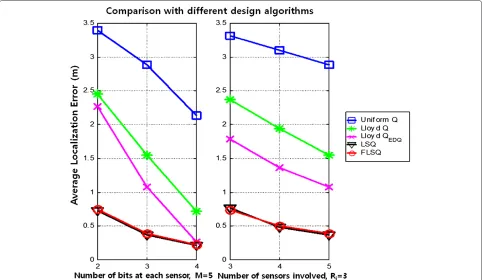
In this experiment, 100 different sensor configurations are generated forM=3, 4, 5. For each configuration, uniform quantizers, Lloyd Q, Lloyd QEDQ, LSQ, and FLSQ are
designed forRi=2, 3, 4 and evaluated by generating a test
Figure 1Comparison of FLSQ with different design algorithms.The average localization error is plotted vs. the number of bits,Ri, assigned to each sensor withM=5 (left) and vs. the number of sensors,M, withRi=3 bits (right).
andRi = 3 (or M = 5 and Ri = 4). Thus, it can be
said that the proposed algorithm operates about 10 times (or over 20 times) faster than the previous work and this advantage will become more obvious with increased rate and/or number of sensors. In addition, the Lloyd QEDQ
performs poorly even with a good initialization of EDQ, implying that typical standard designs are not suitable for our localization system, regardless of initialization.
4.2 Sensitivity analysis of design algorithms
We first investigate how the performance of the proposed design algorithm can be affected by the model parameter
perturbation. Although the quantizers are designed under the assumption that the source energy is known (a =
50) and sensor readings are noiseless (σ = 0), we fur-ther examine the design algorithms (uniform Q, Lloyd Q, and FLSQ) to understand how sensitive the localiza-tion results will be with respect to the presence of the measurement noise and the unknown source energy a. In the experiments where the source energy is unknown, the dynamic range for quantizer design is extended to accommodate the sensor readings generated from source energyarandomly drawn from [amin amax]=[ 0 100]
(see Section 2).
Table 1 Sensitivity to parameter perturbation
Mismatch type Simulation results
Decay factorα 1.8 1.9 2 2.1 2.2
LE (normal) 0.8189 0.5418 0.3644 0.6160 1.1880
LE (uniform) 0.8416 0.5557 0.3715 0.6222 1.1718
Gain factorgi 0.8 0.9 1 1.1 1.2
LE (normal) 0.7951 0.4859 0.3644 0.4330 0.5598
LE (uniform) 0.8008 0.4973 0.3715 0.4408 0.5762
Localization error (LE) of FLSQ withRi=3 due to variations of the model parameters. LE =1001 100
Figure 2Sensitivity to noise level.The average localization error is plotted vs. SNR (dB) withM=5,Ri=3, anda=50. SNR ranged from 20 to 80 dB by varyingσ.
4.2.1 Sensitivity of FLSQ to parameter perturbation
For each of 100 different five-sensor configurations, we design FLSQ withRi = 3 and modify one of the
param-eters with respect to what was assumed during quantizer training to generate a test set of 1,000 source locations witha= 50 under assumptions of both a uniform distri-bution and a normal distridistri-bution of source locations. In this setup, FLSQ is tested under various types of mismatch conditions. It is assumed that the true parameters can be estimated at the fusion node and used for localization. The simulation results are tabulated in Table 1. FLSQ shows robust performance in the mismatch situations where the parameters used in quantizer design are different from those characterizing the simulation conditions.
4.2.2 Sensitivity of design algorithms to noise level and
unknown source energy
For each of 100 different five-sensor configurations, Lloyd quantizers are designed with multiple initializations for comparison with FLSQs designed for Ri = 3. We first
investigate the sensitivity to noise level by generating a test set of 1,000 source locations for each configuration witha= 50 and signal-to-noise ratio (SNR) in the range from 20 to 80 dB by varyingσf. Note that the localization errorE( x− ˆxQ 2)is obtained by using the maximum
a posteriori(MAP)-based algorithm proposed in [22] for faster computation and averaged over 100 configurations. Figure 2 demonstrates that FLSQ performs better in all cases.
We also examine how the design algorithms will be affected by the unknown source energy. For each config-uration, a test set of 1,000 source locations is generated with σ = 0.05 and SNR ranging from 20 to 70 dB by varying the source energy. Figure 3 demonstrates that our
Figure 3Sensitivity to unknown signal energy.The average localization error is plotted vs. SNR (dB) withM=5,Ri=3, and
σ=0.05. SNR of 20 to 70 dB is obtained by varying the source energy.
proposed algorithm performs well with respect to Lloyd quantizers regardless of the initializations, some of which are considered efficient initializations for our localization system.
4.3 Performance analysis in a larger sensor network: comparison with traditional quantizers
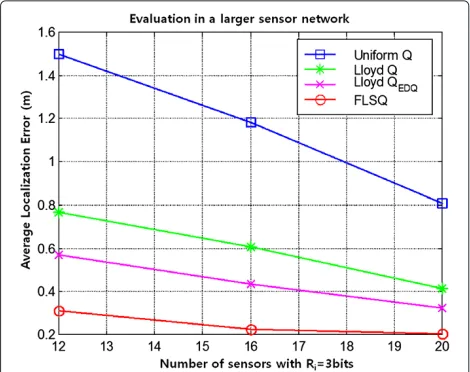
In this experiment, 50 different sensor configurations in a larger sensor field, 20 × 20 m2, are generated for
M = 12, 16, 20. For each sensor configuration, FLSQs are designed with a given rate ofRi = 3 and compared
with the standard designs in Figure 4. As expected, FLSQ
Figure 4Evaluation in a larger sensor network.Average localization error (m) vs. number of sensors(M=12, 16, 20)in a larger sensor field, 20×20 m2. FLSQ is designed withR
outperforms the typical quantizer designs in large sensor networks. It can be also seen from the experiment in a sensor network of 10×10 m2 (M = 3, 4, 5) that better
performance is achieved in larger sensor networks even with the same sensor density. Note that the sensor den-sity forM = 20 in 20×20 m2is equal to 20×2020 = 0.05 which is that for the case ofM = 5 in 10×10 m2. This
is because localization performance degrades around the edges of the sensor field, and thus, in a larger sensor field, there is a relatively smaller number of source locations near the edge, as compared to a smaller field with the same sensor density.
5 Conclusions
In this paper, we have proposed an iterative functional quantizer design algorithm for source localization in sen-sor networks. With the monotonicity of the distance in each sensor reading, we have suggested the average dis-tance error as a metric in the functional quantization to construct the regular quantization partition such that the metric is iteratively reduced in the generalized Lloyd algo-rithm framework. Since the goal is to design independent regular quantizers that minimize the localization error, we have proved that the localization error can be also reduced at each iteration by updating the codewords based on the proposed technique. Our proposed algorithm was shown to perform quite well in comparison with typical standard designs and operate fast due to its simple struc-ture and work robust to mismatches of the sensor model parameters. In the future, we will work on an extension of this algorithm that addresses nonregular quantization partitions to achieve further improvement.
Endnotes
a In [17], a high computational complexity is inevitable because a search forλincluding the MMSE estimation is iteratively conducted at each step.
b In this paper, we assume thatMsensors are activated prior to the localization process. However, selecting the best set of sensors for localization accuracy would be important in order to improve the system performance with limited energy budget [23-25].
c In this work, the nonlinear MMSE estimator is used for quantizer design.
d ˆrj
i is initially given by α
e The EDQ is shown to be simply designed by dividing uniformly the dynamic range of the distance. The EDQ design is verified through simulations in [15,17], showing that EDQ can be used as an efficient initialization for quantizer design because of its good localization performance.
fNote that the SNR computed by 10 log 10 a
2
σ2 is
measured at 1 m from the source and for practical vehicle target, it is often much higher than 40 dB. A typical value of the variance of measurement noiseσ2is 0.052 (= 60 dB) [19,21].
Abbreviations
ML: Maximum likelihood; CRB: Cramer-Rao bound; MMSE: Minimum mean square error; LE: Localization error; EDQ: Equally distance-divided quantizer; FLSQ: Functional localization-specific quantizer; LSQ: Localization-specific quantizer; MAP: Maximuma posteriori; SNR: Signal-to-noise ratio.
Competing interests
The author declares that he has no competing interests.
Acknowledgements
This study was supported by a research fund from Chosun University, 2012.
Received: 5 April 2013 Accepted: 18 September 2013 Published: 26 September 2013
References
1. F Zhao, J Shin, J Reich, Information-driven dynamic sensor collaboration for target tracking. IEEE Signal Process. Mag.19(2), 61–72 (2002) 2. R Niu, PK Varshney, inThe 38th Annual Conference on Information Sciences
and Systems. Target location estimation in wireless sensor networks using binary data (Princeton, 17–19 Mar 2004)
3. R Niu, PK Varshney, Target location estimation in sensor networks with quantized data. IEEE Trans. Signal Process.54(12), 4519–4528 (2006) 4. M Longo, TD Lookabaugh, RM Gray, Quantization for decentralized
hypothesis testing under communication constraints. IEEE Trans. Inf. Theory.36(2), 241–255 (1990)
5. TJ Flynn, RM Gray, Encoding of correlated observations. IEEE Trans. Inf. Theory.33(6), 773–787 (1987)
6. WA Hashlamoun, PK Varshney, Near-optimum quantization for signal detection. IEEE Trans. Commun.44(3), 294–297 (1996)
7. W Lam, A Reibman, Design of quantizers for decentralized estimation systems. IEEE Trans. Commun.41(11), 1602–1605 (1993)
8. S Marano, V Matta, P Willett, Asymptotic design of quantizers for decentralized MMSE estimation. IEEE Trans. Process.55(11), 5485–5496 (2007)
9. V Misra, VK Goyal, LR Varshney, inData Compression Conference. High-resolution functional quantization (Snowbird, 25–27 Mar 2008), pp. 113–122
10. X Shen, Y Zhu, Z You, An efficient sensor quantization algorithm for decentralized estimation fusion. Automatica.47, 1053–1059 (2011) 11. N Wernersson, J Karlsson, M Skoglund, Distributed quantization over
noisy channels. IEEE Trans. Commun.57, 1693–1700 (2009)
12. M Fleming, Q Zhao, M Effros, Network vector quantization. IEEE Trans. Inf. Theory.50(8), 1584–1604 (2004)
13. Y Huang, Y Hua, Multihop progressive decentralized estimation in wireless sensor networks. IEEE Signal Process. Lett.14(12), 1004–1007 (2007) 14. S Shah, B Beferull-Lozano, inIEEE International Conference on Distributed
Computing in Sensor Systems. In-network iterative distributed estimation for power-constrained wireless sensor networks (Hangzhou, 16–18 May 2012), pp. 239–246
15. YH Kim, A Ortega, inIEEE International Conference on Acoustic, Speech, and Signal Processing (ICASSP). Quantizer design for source localization in sensor networks (Philadelphia, 18–23 Mar 2005)
16. YH Kim, A Ortega, inIEEE International Symposium on Information Processing in Sensor Networks (IPSN). Quantizer design and distributed encoding algorithm for source localization in sensor networks (Los Angeles, 25–27 Apr 2005)
17. YH Kim, A Ortega, Quantizer design for energy-based source localization in sensor networks. IEEE Trans. Signal Process.59(11), 5577–5588 (2011) 18. YH Kim, A Ortega, Distributed encoding algorithms for source localization
in sensor networks. EURASIP J. Adv. Signal Process.2010, 781720 (2010) 19. D Li, YH Hu, Energy-based collaborative source localization using acoustic
20. AO Hero, D Blatt, inIEEE International Conference on Acoustic, Speech, and Signal Processing (ICASSP). Sensor network source localization via projection onto convex sets (POCS) (Philadelphia, 18–23 Mar 2005) 21. J Liu, J Reich, F Zhao, Collaborative in-network processing for target
tracking. EURASIP J. Appl. Signal Process.2003, 378–391 (2003) 22. YH Kim, A Ortega, inIEEE International Conference on Acoustic, Speech, and
Signal Processing (ICASSP). Maximun a posteriori (MAP)-based algorithm for distributed source localization using quantized acoustic sensor readings (Toulouse, 14–19 May 2006)
23. V Isler, R Bajcsy, inIEEE International Symposium on Information Processing in Sensor Networks (IPSN). The sensor selection problem for bounded uncertainty sensing models (Los Angeles, 25–27Apr 2005) 24. H Wang, K Yao, G Pottie, D Estrin, inIEEE International symposium on
Information Processing in Sensor Networks (IPSN). Entropy-based sensor selection heuristic for target localization (Berkeley, 26–27 Apr 2004) 25. YH Kim, Quantization-aware sensor selection for source localization in
sensor networks. Int. J. KIMICS.9(2), 155–160 (2011)
doi:10.1186/1687-6180-2013-151
Cite this article as:Kim:Functional quantizer design for source localiza-tion in sensor networks.EURASIP Journal on Advances in Signal Processing
20132013:151.
Submit your manuscript to a
journal and benefi t from:
7 Convenient online submission 7 Rigorous peer review
7 Immediate publication on acceptance 7 Open access: articles freely available online 7 High visibility within the fi eld
7 Retaining the copyright to your article