D i s c o u r s e S e m a n t i c s M e e t s Lexical Field S e m a n t i c s
B e a t e F i r z l a f f a n d D a n i e l a S. K u n z
G e r m a n N a t i o n a l R e s e a r c h C e n t e r f o r I n f o r m a t i o n T e c h n o l o g y ( G M D )
K O N T E X T N a t u r a l L a n g u a g e S y s t e m s
D o l i v o s t r . 15
D - 6 4 2 9 3 D a r m s t a d t , G e r m a n y { f i r z l a f f , k u n z } @ d a r m s t a d t . g m d . d e
A b s t r a c t
The focus of this article is the integra- tion of two different perspectives on lexi- cal semantics: Discourse Representation Theory's (DRT) inferentially motivated approach and Semantic Emphasis The- ory's (SET) lexical field based view. A new joined representation format is de- veloped which is exemplified by anal-
yses of German verbs. The benefits
thereof are on both sides. DI/T gains basic entries for whole lexical fields and, furtherlnore, a systematic interface be- tween semantic and syntactic argument structures. S E T profits both from the much larger semantic coverage and from the fine grained lexical analyses which reflect inferential behaviour.
1 I n t r o d u c t i o n
The construction of lexical entries is one of the
crucial and challenging tasks given in the field of computational linguistics. In the ideal case, lexi- cal entries fulfill, among others, two requirements. First, the representations are suitably fine grained such that they capture lexeme-speeific distinc- tions. Second, the lexical entries are sufficiently general, for reflecting similarities between single lexemes. Furthermore, the information they con- tain should systematically link various levels of description, e.g. syntax and semantics as well as referential and inferential potential. The latter is of special interest for text analysis as opposed to sentence analysis (eft for example (Haenelt, 1994); (Haenelt and KSnyves-Tdth, 1991)).
Corresponding to these requirements, we ex- ploit the specific strengths of two distinct seman-
tic theories. These theories are Discourse Rep-
resentation Theory (DRT) ((Kamp and Reyle,
1993); (FraCaS-DS, 1994)) and Semantic Empha-
sis Theory ( S E T ) ( ( K u n z e , 1991); (Kunze, 1993)).
However, our central goal is an integration of D113' and SET. It will be shown that this integration is possible and of benefit to both theories as well as to the construction of lexical entries. To achieve our overall objective, the following four points will be exemplified by joined representations of Ger- man verbs:
• DRT profits from SET's systematic deriva- tions of thematic roles and of morpho-syntaetic features on the basis of predicate-argument- structures. These features include both gram- matical and prepositional case.
• DRT gains a purely semantically motivated ori- entation towards lexical fields.
• Dll[l' covers much more semantic phenomena than SET. Therefore, DI{T offers S E T the pos- sibility to test its results against a semantic background that e.g. includes plurals, tenses, and attitudes.
• DRT's fine grained lexical analyses are
grounded in inferential behaviour. These lex- ical distinctions mark possible starting points for refining SET's representations.
The paper is structured as follows: DRT's and SET's basic motivations, principles and formal means concerning lexical semantics are retraced ~n sections 2 and 3. The new joined representation format is introduced in section 4 by analysing the
German verbs leihen (in its variant to lend) and
verschenken (in its variant to give as a present).
Moreover, section 4 provides evidence that the four main points stated above are backed up by the joined analyses. Finally, directions for further research are pointed out in section 5.
2 D R T - - I n f e r e n t i a l l y M o t i v a t e d
Discourse RepT~sentation Theory (DRT) is first and foremost a theory about discourse interpre- tation, i.e., it is essentially textually oriented
in natm'e. The meaifing of sequences of sen-
inferential behaviour. Therefore, work on lexi- eal seinantics in tile Dll2F frmneworl¢ ( ( K a m I) and Rofldeutscher, 1994a); ( K a m p and Rotldeutscher, 1994b); (ll.otadeutscher, 1994)) investigate.s the role of lexieal information in supporting infer-
ences. Consequently, lexical distinctions correlate
with non-equiwflent sets of associated inference.s. T h e following ('.xalnt)les illustrate t h a t the Ger-
m a n verb leihen (in its variant to lend) implies in
(:ontrast to the G e r m a n vert) versehenken (in its
variant to give as a present) the lending t)erson's
belief in a return of the involved
object,:
(la) Calvin lciht IIobbes eine Krawatte.
(Calvin lends Hob/)es a tie)
(lb) Calvin glaubt, daft [lobbes ihm die Krawatte
zuriick.qeben wird. ( C a l v i l , b e l i e v e s t h a t t h ) l ) l ) e s
him the tic will give t)ack)
(2a) Ualvi'n versehe'nkt ei'n Hueh a n Hobbes.
(Calvin giw'.s as a 1)resenl; a book to Hobbes) 777
(2b)
Calvin .qlaubt, daft Hobbes ihm alas Buchzuriickgeben wird. (Calvin believes that Hot)bes him the. I)ook will give 1)aek)
[n line with the ret)resentation format (Icy(lolled by Kanlt) and l/,ot.~deutseher, the corresl)onding lexieal entries are, twofohl stru('.tures: T h e y (',onsis(;
of a I)resul)l)ositional and an asserlx)ric Diseo'wrs("
l~cpresentation Structure (I)R,S). Th(; underlying anat)horie notion of presul)position was originally t)roposed by (Sand(, 1992). Presupl)ositional in- formation is embedded in the discourse eontext
by a process called justification, whi(:h (:omt)ines
1)inding (veriJication) with contextual (mri(:hment
(accommodation) in varying prol)ortions.
K a m p and I/.o].~dcutscher model the inl;erface l)e~ween syntactic and semanti(: al'glltrlents as a
list of t)airs. Each pair consists of tim general-
ized case information and the eorresl)onding the-. matic role of the m'gulnent slot under eonsi(lera- lion. This mapt)ing offers two starting points for an integration of D R T and SET.
Firstly, the representatioi~ f o r m a t fin' the gener- alized case information is only sketche(l, an algo-
r i t h m for case assignment is not given: With each
verb is associated a .(liven set of so-(ailed theta roles Oi. These theta roles are arran.qcd in a fixed hierarchy, the theta-hierarehy. [...] Those argu- m e n t phrases wh, ich get assigned a theta role also get assigned a particular case (Nora, Aec, (etc.).
[...] Case assignment is partially determined by
kit(', theta hierarchy in that the argument phrase which bears tit(" highest theta role (in th<' sense of this hierarchy) always gets nominative case.
( ( K a m p and l{ot.kleuts(:her, 1994a): Pl). 109f)
Secondly, the thematic roles are specified indi- vidually for each lexical entry, there in no get> eralization with respect to lexical fields. As an
example, the. interface list of verschenken is given
ill Figure 1, where the eompoimllts of each pair m'e displayed vertically.
e(:: v e r s e h e l l k e , n
< 0l) NOM > < 02, A()C > (< 0a, an + A(X; >)]
Agcnt&.Sourcc Theme Goal
Figure 1. lntcxfaee lint of verschenken.
The, discourse referent ec and the thematic roles
of the. interface, are. direct links to the DR, S ret)--
resenl;ing the hi(airing of the G e r m a n verb yew.
schenken (of. Figure 2). T h e event comi)lex ec, whi(:h stands tor the verb itself, in described as a process e, which is caused by an action e* of a person p. p tel)resents l;he one wit() gives the t)resent u to ;mot, her person q. T h e giving itself is
(:hm'aeterized by the concept (HIAN(IE-SIGN. T h e
signs changed are those of the disi)osal and owner-- ship relations So and sl: p looses the disposal and ownershi 1) of u and q gains them. T h e former cir- (:umstances of disposal mid ownershi t) (so and ,st
a b u t on ee: ,So ZXZ e.c .sl 73(2 eel m'e t)resut)t)osed ,
the t)ost, statcs (ce bC s2 ec ~ sa) are asserted.
12(: t) q 8 2 S 3 1l e e
(~* C A t J S E v e T , ~ c h c n k c ) ~ (! p a g ( m t ( e ' )
. _ _ ( . . . >: [ C H A N G E S l G N ( p ~ q , u
l ) (1 SO s l It s o l n ' c : e ( e )
u = t h e m e ( e )
Is,: ~ s ~ ~ . . . . ,g(,,,t ((,c)
SO X " (!C Sl X" (:(: I) := s o t l r e ( ~ ( e c ) L : ~ _ A: Z _ _ q := g o a l ( ( c )
i ( p R l,J ,q'
U : t, h e n l e ( ( ! c )
s , :
[ ~DISP&OWN(1),u)~
e l : ~ ( £ S2 eC ~ ( . 8,2 1( A,q'H
Figure 2. DRS of versehenke'n..
T h e (;xarnt)le inf('a'ences (la) to (lb) and (2a) to (21)) result froln differences in the lexical DlI.Ss of
leihen and verschenken. T h e main t)oint here is
t h a t t l l o . ( . ; e l I n a n v e i ' l ) leihen intt)lies the lending
t)crson's belief in a l'eturn of the involved object.
On the basis of (;his belief it in easy to inR.'r front
(la) to (lb). ltowever, there is no similm' SUl)I)ort
for inferring from (2a) to (2b). A detailed lexical
representation of leihe'n will be given in section 4.
3 S E T - -
L e x i c a l F i e l d B a s e d
Semantic Emphasis Th.eory (SET) has identified
princit)les t h a t allow to link a prototypical de-
[image:2.596.305.492.370.535.2]that; are suitable to refer to t h a t situation. The link is based on a set of well-defined and sys- tematically occurring mappings (cf. (Firzlaff and Kunze, 1995)) r a t h e r than on intuitive criteria.
Given a basic s e m a n t i c f o r m (BSF) as a cornmon
starting point, we derive semantic and syntactic case frames and construct prototypical meaning descriptions of concrete lexemes by refining the BSF. Additionally, the rule based interpretation of a BSF delivers a prototypical description of the corresponding situation.
T h e set of lexemes t h a t are suitable to refer to the same situation constitutes a lexical field. T h e field as a whole is characterized by a BSF. A BSF is a propositional description. It consists of a predicate and a n m n b e r of arguments, each of which is either a predicate-argument structure or an elementary argunlent. In general, elementary arguments are represented by variables t h a t have to be filled in by phrases which denote reference objects (participants of a situation).
The number of arguinents, as well as the de- cision whether the arguments are elementary or propositional, b o t h depend on tim predicate that,
directly takes these arguments. We derive the
p a r t i c i p a n t s ' ttminatic roles (deep cases) in a c c o f dance with a set of general rules. Semant;ically, each pair of a role and the predicate directly dom- inating an elementary a r g u m e n t demands partic- ular selectional features for t h a t argument. The BSF describing the field of change-of-possession (with one object to be transihrred) and the de- rived deep cases are given in Figure 3.
CAUSE r: (agens,act)
(ACT(r) p:<source,have)
ET q: (goal,have)
(BEC(NOT(HAVE(p,u))) u:(from-obj,have)
BEC(HAVE(q,u)))) u:(to-obj,have)
Figure 3. BSF and deel) cases.
From b o t h the syntactic and the semantic point of view, the BSF delivers the m a x i m u m case frame of the lexemes t h a t constitute the lexical field. Some of the roles of the m a x i m u m case frame can be put into the foreground; these are said to have cmphasis. Some roles nmst not be verbalized ex-
plicitly; these are said to be blocked. In the subset
of roles t h a t are not blocked there are, on the one hand, roles referring to obligatory actants and, on the other hand, roles referring to optional actants. Which roles have emphasis and which do not have emphasis, which are the ones t h a t must be verbal- ized, and which are the ones t h a t need not be ver- balized is determined according to general rules. Exploiting the field specific possibilities to make some variables denote the same reference object (by renaming of variables) results in more specific
BSFs. These then describe partial lexical fields
like, e.g. to give or to take.
By adding infbrmation about, emphasis and blocking of roles, a BSF is t r a n s f o r m e d into a num-
ber" of prototypieal m e a n i n g descriptions. We can
then derive systematically which are the suitable g r a m m a t i c a l realizations of each role. However, there are two i m p o r t a n t points concerning the determination of which g r a m m a t i c a l realizations are possible: Firstly, the predicate t h a t takes the corresponding elementary a r g u m e n t directly and, secondly, the choice of t h a t subset of roles of tim m a x i m u m case frame t h a t are not blocked. One of the three prototypical ineaning descriptiolm t h a t
constitute the partial field of to 9ire and tile gram-
rnatical case assiglmmnt of verschenke,n 1 is given
in Figure 4. (Those parts of l;he description t;hat have emphasis are written in bold face. Tile oc- curence of a variable preceded by "T" is blocked. The g r a m m a t i c a l realization of the optional actant (an+accusative) is put, in brackets, z)
C A U S E
( A C T ( p ) (agens,act>: nora E T
( B E C
( N O T ( H A V E ( T p , u ) ) ) (from-obj,have}: ac(:
BEC
(HAVE(q,Tu)))) (goal,have): (an+ace)
e.g.: Calvin vcrschenkt ein Buch an Itobbes .
(Calvin gives as a present a book ~o Hobbes )
[pnom uacc qan+acc ]
Figure 4. Prototypical ineaning description and g r a m m a t i c a l case assignments.
However, BSFs do not only provide the ground for the derivation of g r a m m a t i c a l features. T h e y
are also suitable to derive prototypieal situation
descriptions. In order to do so, instantiation rules must be applied to a BSF in a recursive way. The application of instantiation ruh;s has to be regarded as an interpretation of every partial de- scription in a BSF. Some of these p a r t s are, then represented by variables t h a t have to be filled in by objects referring to states or (;vents, and other parts deliver relationships between these states or events. In addition, some of the instantiation rules provide temt)oral a n d / o r spatial constraints t h a t are applicable to (tim corresponding parts of) a
prototypical situation description, e.g., etimc is a
m a p p i n g fl'om the set of events or states to the set of t e m p o r a l entities (etime: g -+ T ) .
In general, tile instantiation rules provide struc-
1Generally, this grammatical case assignment is
suitable for about 20 verbs of the partial field to give.
CAUSE
(ACT(p) ET
(BEC
(N()T(nAVE(p,.)))
BEC
(HAVE(q,u))))
Presul)l)ositions: (,.:
,,,: ,.(,f(f(p)): ~;ht,~.,+~(:~
(:,.,: ,.,f(f(p)): lo(:~t-h~lv,:
A ref(f(u)): thenteqtave
init(e~): nAV~,;(t),n) fin(e2~ ):
,,=: ,-0r(f(q)): ~,,c~-h~v,,
A ref(f(u)): them(.'-h~lv(,
init(e~.): -q~aw,:(q,u) fin(e~):
Assert:ions:
OAUSI.:(e, ,c~) A etime(el)--etinw.(e~):=(~.tinw.(e)
ACT(p)
(e2, ,e2~ ) A etinw.(e2,)--etime(e.22)=:ctmm(e2)
'rl(ANsrrioN (inii;(eua),fin(e~ ))
- ' I I A V E ( p J I )
T R A N S r r ~ O N ( i n i t ( e ~ ) , f i n ( ( ' , u ~ ) )
IIAVE(q,U)
Figure 5. llSF and l)rotoi;ypieal sil;uation (les(:ril)l;ion.
l u r i n g m e c h a n i s m s in tern~s of t)r('.supposii;ions
~ttl(1 assert,loire. As an ex;mq)le, (:onsi(lev the
t)redieate B E C : I1; has one m g m n e n t whi(:h is ~
t)redieate-.a.rgunw.nl,-strucl;ur(~. This sl;ru(:l;ur(~ is
1;o tie inl;ert)rel;e(1 &s the finnl sl;a.l;e of ;1 tra nsi- l;ion. Because of the insta.n|;iation rule of B E C the initial s t a t e ( i n i t ( e . ) ) o f the l:ra.nsition ( c ) i s l;he "()t)t)ositC' of the final s t a t e (fin(e)), i.e., B E C ( A ) is inl;erpreted as c: TII.ANSITION (~A,A). Accord- ing to (aUilg 3,1l(1 Kiistne.,', 1q90), init(c) (i.e. ,At is I;11(; 1)resul)t)osition of c, a n d " ," does not; ;ffl'e(:t A's t)resut)l)osition, e.g. seh~cA;iotm[ restrict;ions for A's elelnenl;&ry a r g u m e n t s . A m o r e (~xtensive ex-. mnl)le, of the d(wivation of t)i'ol;otyl)i(:;d sil;ua.tion des('.rit)l, ions is given in F i g u r e 5 ?
T h e situai;ion 1)rol;ol;yl)i(:Mly th~s(:ribe(t in Fig-
llre 5 (:all 1)e r e D r r e d to b y al)Otll; 65 ( ~ e r t m m verlts,
i.c.., the elements of the p a r t i a l fM(t to give includ-
ing our samph~ verbs vcrschc.nkcn (in its w~ri;mt
to .qivc as a p'rescnt;) and h:ih, cn (in its vm'iant
to h'.nd). As far as the degree of speeifieal;ion is
(:on(:erned the des(:rit)i;ion is at leas(; suil,able as (:ommon d ( m o m i n a t o r . Since S E T ' s l)rineipal ori- ental;toil is l;owaa'(ls the systemal, i(: des('ription of le~cical fields r a t h e r t h a n of single lexi(:al entries, it provides ret)resentations whit:h t e n d t;o 1)e mtder- sttecified with r e s p e c t to e.g. Dll[["s requirements.
However, due to SITI"s gener;,l eq)pr()ach mty fltr-
ther spe(:ification of its (h~s(:rif)l;ions lea(Is to an e n l a r g e m e n t of the ret)resental;ion r~ther t;h;m to tt change of the c o m m o n d e n o m i n a t o r . T h e (les(:ril)- lions i)rovided by S E T are suitable as the basis for fine g r a i n e d r e p r e s e n t a t i o n s . T h e r e t b r e , one can e x p m M the lexicM enl, ries r a t h e r (;turn (:onstrut:t-
ing l;heln ea(;h a n d every t i m e f l o m s(;ral;('h. TO
exentl)lify l;his, in the n e x t secl;ion, the ret)resen- tatioll of lcihe'n (in its w~ria,nt to Ic'nd) is e m i c h e d
by the hmding ltel'SOll'S belief in a r e t u r n of t, he
involved object.
aref(f(x)): V -~ .7 -+ 1). And 7) is the set of
rel~rence objec|;s.
4 T h e P u z z l e F i t s
Based on the h y p o t h e s i s that: S E T ' s proi;ol;ypical s i t u a t i o n descriptions ca.n be interl)reted in the s a m e way as 1)l/Ss we have l)ro(:ee(led to a new joined ret)resentation f o r m a t . Since w~riabh~s in a I{SI" have to 1)e filled in l)y r('.ferenc(~ o b j e c t s and,
fltrtherm()re, the rtR;llrsive ;q)t)li(:al;ion of insl.m>
tiation rules provides wu'iM)les of the stone kind [*Of eVOlI[;S &Ild SIALI;(~S, S]~r["S l'efereiIce o})je(',(;s }l.lt(l l)l{T's discourse referents are reg~r(ted as etlUiV- M(',nl; metals of (!Xl)ression. Tlmreli)re, the joined
l(~[)l(iSelll;aA;i()li fOl'llt3]; ltses I)I/[F's boxes, llow-
ever, it is enriched witih a m o n g others, n revised inLerI, tt:e I;() s y n t a x where the t h e m a t i c roles m'e derived according t;o lISFs.
T h e s a m p l e rel)resent&tions giwm in Lhis sec-
tion exploit Karat) a.nd ]{ofideutsc.her's idea of h'.x
ical axioms (of. (Karat) ~md l{.oB(h~uts(:her, ] 994a);
(Kaml) and l{oBde.uts(:her, 19(,)4t)); (Ro[/d(!ul,seher, 1994)). We (:~i1 ~ (lis(;inguish in a l);4ra, ltlet;ri(; fas]t- ion b e t w e e n I;11(; s('an;mti(: (:Oml)onenl;s of 1;t1(! en- Lries t h a t (:hma(:|;(wiz('. (pnrtia]) lexi(:al ['i(;l(ls and the (:on(:et)t si)e(:ific inf()rnt~tion in i;he axioms.
T h e first pair of a x i o m s introduc(;d below mir-- I'OI'S l;he fact tlud; the c o n f i g u r a t i o n a l)brevialxxl by eu: (cul ,cue) (ef. Figure 5 ) i s suitabh~ I:o spec ify a wlriety of h',xica.l f M d s wherein the s('ammti(:s of the (~lenw.nts inv()lves a sl)eeinl kind of '(:han/~e'.
S o m e exalnples of these f M d s are ch, angc-@placc
(e.g. to travel fro'm o'nc plat(" to another), cha'ngc-
of-class (e.g. to promol, c somebody to a certo, in
rank), ",rod changc-@posscssior~,. Ae(:()rdingly, we
t)roltose a predicate hierarchy, wheret)y the i)re(li-
(;~tes PI,ACI,;~ [SA~ [lAVE ~:~]e st)ecializations of the
I)re(ti(:ate STATE. Note, however, t h a t 1;his does not affect the ine(:hmdsm of role deriva.|;ion 1)re- seilte(l in section 3.
In the t)rototyI)ical sit;m~tion des(:rit)tion
((:f. Figure 5), (,'e inchMes eel a.nd c~2. F,a.(:h ()f'
Lhese (10,nol;es ;1~ TIIANSI'I'ION tl()IIl tttt initiM st, ate
to a. final state, i.e., f r o m init(s,e:L) a n d inil,(c.e2)
[image:4.596.58.507.63.187.2]assertion). Because of the t e m p o r a l identity of e21 and e2~, there are t e m p o r a l overlaps between the initial states as well as between the final states.
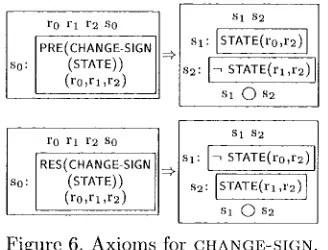
In the axiom defining CHANGE-SIGN's prestate,
so's consequences sl and s2 correspond to init(e21)
and init(e22). In the axiom defining CHANCE- SIGN's result state, s0's consequences st and s2 cor-
respond to fin(e~:t) and fin(e22). The axioms have
in common t h a t they involve the concept CIIANGE- SlC, N (cf. c2 in Figure 5). T h e axioms are given in Figure 6 ("O" denotes t e m p o r a l overlapping).
[image:5.596.316.529.62.244.2] [image:5.596.107.271.193.318.2]r _ _ _ _ r r l F2 ,SO i P 0
So: | (STATE)) S2: [ ~ ~ )
I (ro,rl,r2) II I
t l] [ 81 O S2
I r0 r l r2 s0 Sl s2
[STATE0"I,,'=) I
S2:
t ( r o , r j . , r 2 ) ij [ sl O s2
Figure 6. A x i o m s for CHANGE-SIGN.
T h e concepts defined by means of these axioms
are, then, used to specify the lexical entry of ver-
schenken (in its variant to (live as a present). The t h e m a t i c roles and the corresponding g r a m m a t i c a l realizations result from the derivation presented in
section 3. P R E ( C H A N G I , 2 - S I G N ) delivers the first
p a r t of verschenken's presupposition. T h e pa-
r a m e t e r STATE is filled in by DISP&OWN which is added to the predicate hierarchy sketched al- ready as a specialization of the predicate IIAVF. Thereby, it is possible to distinguish between the pure disposal and the disposal thai; is accompa- nied by ownership.
Furthermore, verschenken's presupposition in-
cludes the semantic roles delivered by its p r o t o t y p - ical meaning description. However, the selectional restrictions for discourse referents do not differ from the restrictions given in the prototypical sit- uation description (cf. Figure 5). W i t h respect to
the semantic interpretation, each of source-have,
goal-have, and locat-have just means is suitable as first ar.qument in a IIAVE-proposition. Generally, the predicate directly determines the selectional restrictions of its arguments, i.e., the discourse referents. Furthermore, for those predicates t h a t take more t h a n one argument, it is the order of the arguments which additionally determines the selectional restrictibns. 4
In accordance with the prototypical situation
description given in Figure 5 the DRS for ver-
seheuken is as follows:
4 C l e a r l y , t h e s e a r e .iust two p i e c e s o f i n f o r m a t i o n
for the seleetional restrictions.
ec: verschenken
N O V ACC (an + ACC) ]
< agens, act > < fi'om - obj, have > < goal, have >]
p q so u PRE(CHANGE-SIGN SO: (DISP&OWN))
( p , q , u )
So D(-- ec p -- a g e n s - a c t ( e c ) p = s o u r c e - h a v e ( e c )
q : g o a l - h a v e ( e c ) u - - f r o m - o b j - h a v e ( e e )
u -- t o - o b j . . h a v e ( c o )
ec p q s~ u
e e*
OC: e*:
CHANGE-SIGN(1) q u)
c:[ _____, , )~
e ~ CAUSE e
RES(CHANGE-SIGN
S l : (DISP&OWN))
( p , q , u ) e c 23(_ sl
KASS
Figure 7. Lexical entry for verschenken.
Figure 8 clarifies the correspondences between D R T ' s and S E T ' s representation:
DRT SET
e c e: C A U S E ( e l , e 2 ) e* e l : A C T ( p ) e e~: ( e ~ , , e ~ )
so init(e~l): HAVl,;(p,u) A init(e22): ~HAVl,:(q,u)
sl fin(e21): ~naVE(p,u) A fin(e22): ltAVF,(q,u)
Figure 8. tl.elevant correspondences.
T h e entities constituting ec (the action, the
transitions, and the causation) are located in a c o m m o n time span. Therefore, the transitions'
initial states precede ec (so ::)(7_ ee) and the tran-
sitions' final states follow ec (ec DC st).
T h e lexical entry of leihen (in its variant to
lend) consists of an interface list, whose thematic roles are based on SET, and of semantic struc-
tures, which include and extend versehenken's se-
mantic components. T h e inferential behaviom' of
leihen (exemplified in section 2) motivates a for- real description t h a t contains more t h a n the basic
distinctions provided by the partial lexical field to
give. Additionally, there is the lending person's belief in a return of the involved object, in other words, the belief t h a t the CHANGE-SIGN from s o
to s~ is temporary. Therefore, leihen's represen-
tat, ions make use of CIIANGE-SIGN's subconcept
CIIANGE-SIGN-TEMP. This subconcept entails ;t
t r a n s f o r m a t i o n of its superconcept's p r e s t a t e So
(so DC ec) to its superconcept's p o s t s t a t e s~ (ee
DC sl) as well as the new p o s t s t a t e s2 (ec ~ s.e),
i.e. the belief in a return of the involved object. ec: leihen
[ NOM DAT ACC ]
< agens, act > < goal, have > < to - obj, have >
Figure 9a. Interface list of leihen's entry.
To nmke the description of leihen complete, a
a t t i t u d e s t a t e s , e.g. beliefs or desires (of. ([q'aCaS- D 8 , 1994)). ~ p q ,, . ~ ,
e. e
p q S 0 tl e * :
,~o: (D,se)) / ~,: CHANGE SIGN WEMP(p,q,u)
( 1 ) , ( I , U ) ] e* CAUSE e
[image:6.596.63.272.64.217.2] [image:6.596.61.276.371.502.2]s 0 2X~ e c RES(CHANGE SIGN I
| .... ~go,,,~-~,,I;(,,,:) (.tsP)) I
l) : = s o u r c e - h a v e ( e c ) s t :
u -- f r o m - o b j - h a v e ( c c ) e(', DC sl
. : t o - o b > l . ~ v , + ~ ) I RES(C"^"GE-S~G"-rEu~
e c D ( - s 2
[<ASS
Figure 9b. Semantic structures of lcihcn's entry.
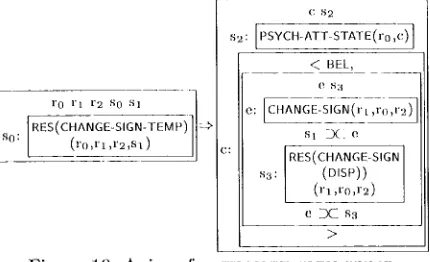
This possibility can be used to state the axiom which represents the specific semantic contribu-
tion of C[[ANGE-SI(IN-TEMI': it, s p o s t s t a t e ehara(>
terized by the state s2 of the person r0 being in an psychological a t t i t u d e state one of whose coin- ponents (c) is a certain belief. This belief con- sists of an inversed (]IIAN(;I,;-SI(-]N-eVeIIt C, i.e. a return, with its resulting disposal (:onfiguration sa. Thereby, the forlner circumstances of disposal Sl, t h a t result fl'om the CIIANGE-SI(IN-TEMP-evenL itself, are supposed to a b u t on the return event c.
c s 2
s u : [PSYCH-ATT STATE(ro,c)]
HEL,
o s 3
RES(CHANGE-SIGN
s3: (D'SP)) I
[ ( l'l ,,'0,1"2 ) e ~X2 Sa
>
Figure 10. Axiom for CHANOF-SIGN-TEMP. On the one hand, these results m a r k directions tbr the developme, nt of a comprehensive lexical theory, t h a t include, s, for example, an elaborated concept hierarchy with associated axioms. On the other hand, they (:an be used for a detailed recon- struction of the inferences inentioned in section 2.
5 C o n c l u s i o n a n d F u t u r e W o r k
In this article, we have first shown t h a t it is sen- sible and promising to comt)ine D R T ' s and S E T ' s perspectives on lexieal semanti(:s. We made use
of the theory-sI)e(:ifie strengths of the single ap-
proaches in order to overcome their specific weak-
n e s s e s a n d t o g a i n a p o w e r f i l l m e a n s o f e x p r e s - s i o n for modelling the semantics of lexical entries. Second, we have proposed t h a t and described how
joined representations ('.an be constructed by e,x-
p l o i t i n g tile merits of bo*h theories.
I%ltm'e work will concentrate on evaluating the benefits of this approach fl)r eomtml;ational text analysis. Tile joined representation format pro- posed he, re is likely to facilitate and improve lex- ieal modelling as well as the a u t o m a t i c construc-
tion of text representations, l%]rther investiga-
tions ill otller lexical fields and word classes are required in orde.r to aehieve~ a larger lexieal cove.r- age. In correspondence with the theory-specific
strengths, promising subtasks will be reference
resolution and the construction of conceptual rep- re, sentations.
R e f e r e n c e s
(looper, Robin et al. 1994. Describing the. J p -
pr'oachcs. FraCaS. A 1,5"anmwork for Conltm- tational Semantics, Deliveralfle 8. Edinburgll, University of l,;dinburgh: t)P. 8-79.
Firzlaff, Beate and Jiirgen Kunze. 1995. Auto-
matic Generation of Lcxical Fields. Working Papers of GMD, R e p o r t 892. St. Augustin, Ger- Illall Natiomd Research Cente, r for lnforlnation
Technology.
Haenelt, Karin. 1994. Das Textanalyse-
system KONTEXT. Konzeption und Anwen-
dungsm6glichkeiten. In Sp'rache und Datcnver-
arbcitung, 18: pp. 17-31.
Haenelt, Karin and Michael KSnyves-Tdth. 1991. T h e Textual Development of Non-Stereotypic
Concet)ts. In ProccediT!gs of the 5th Confl:rcncc
of the EACL. Berlin: pp. 263-268.
Jung, Uwe and H e r b e r t K{istner. 1990. Semw,,l,i-
sche Mechanismen dcr Ne.qation. studia gram- m a t i c a xxxi. Berlin, Akademie Verlag.
Kmnp, llans and Uwe Reyle. 1993. From Dis-
course to Lwic. l)ordrecht, Kluwer Academic Publishers.
Kmnp, tIans and Antje Rogdeutscher. 19943. l].e- marks on Lexieal Structure and DRS Construc-
tion. In 77u,oretical Linguistics, 20.2-3: 1)t)..(t7-
164.
Kmnp, Itans and Antic Rofideutseher. 19q4b.
DRS-Construction and Lexieally Driven ill-
f'erence. In Theoretical Linguistics, 20.2-3:
pp. 165-235.
Kunze, Jfirgen. 1991. Kasusrelatiorten und Se-
mantischc Emphasc. studia g r a m m a t i c a xxxii. Berlin, Akademie Verlag.
Kunze, ,liirgen. 11993. Scmemstrukturcn und Ii'eld-
strukturen, studia g r a m m a t i e a xxxvi. Berlin, Akademie Verlag.
l~.ofldeutscher, Antje. 1994. Fat Child Meets
DifF. A Semantic Representation for the Open- ing Lines of Kasehnitz' "Das dicke Kind". In
Th.c.oretical Linguistics, 20.2-3: pp. 237-305. Sandt, I{ob A. van der. 1992. Presupposition Pro-
jection as A n a p h o r a Resolution. In ,lournal of