47
Execute 5S Methodology in Small Scale Industry:
A Case Study
Swapnil Patil
1, Amar Sapkal
2, Mahesh Sutar
3Mechanical Engineering Department 1, 2, 3, U.G.Student 1, 2, Assistant Professor3, Annasaheb Dange College of Engineering and Technology Ashta, Maharashtra, India.
Email: [email protected]1 , [email protected]2 ,[email protected]
Abstract- Execution of 5S methodology in small scale industry is main focus of this paper. In order to achieve
main purpose of study, four specific objectives have been defined. First, to understand what is 5S? And theories of 5S. Second, observe the problems occurred in industries. Third, implement 5S technique which consists sorting, set in order shines, standardizes and sustain to solve that problems. Fourth, sustain the 5s and the last is the contribution of workers for implementation of 5s.
Index Terms- 5S, Housekeeping, Visual Management, Continuous Improvement
1. INTRODUCTION
To remain in business arena it is of upmost important to win hearts of customer though quality and cost of the product or service. It is also crucial to have sustainable production with continuous improvement. The present need of the organization is to deliver high quality product through continuous improvement [1]. Every problem is an opportunity to improve the process and environment and every problem is also an opportunity to develop people surround. In order to overcome these problems, 5S which is relatively simple and inexpensive technique for employers to assess the possibility of present and future mismatches between the skills of their own workers and their working area is proposed. Hirano (1995) explained that 5s framework was originally developed and introduced by international consultant and just-in-time expert Hiroyuki Hirano [2]. Conditions It is a process of creating more productive people even employer and employees and more productive companies through high education, motivation and good practice of 5S. It involves the creation of a strong corporate culture filled with the spirit of high productivity [3]. 5S was derived from the Japanese words; seiri, seiton, seiso, seiketsu and shitsuke. In English, they can be roughly translated as sort, set in order, clean, standardize and sustain [11], [12]. There is lacked of housekeeping in the workshop store room and high cost occurred because waste of defects. The main intention of this paper is to execute 5S methodology and measure the performance of workers in Asara and Girija Industries, a small scale industry situated at Palus, Maharashtra.
The 5S is very effective tool for cleaning, sorting, organizing and workplace improvement. This paper not only for implementing 5S but also shows the contribution of the workers in 5S.
2. PROBLEM STATEMENT
Nowadays small scale industries plays vital role in economy of India. 5S is very power full tool which improves performance of small scale industries but in our industry there is lot of obstacles for implementing the 5S. The main obstacle is the mindset of workers. They are not ready to accept the new things in industry. The same thing is happening in Asara and Girija industries. Workers are not ready to change their mindset. In this paper we are evaluating each worker, according to their performance.
3. LITERATURE REVIEW
48 an important approach in solving many potential
problems. In the other hand, the 5S practice is a technique used to establish; maintain quality environment in an organization effectively and promised the employees to be more self-discipline (Pheng, 2001). (3) The critical problems facing by small scale industries while selling their product. SSE (Small Scale Enterprise) is not having huge financial backup and therefore they are depending upon the revenue eared after selling their product. The product sales can only be increased by reducing the cost of the product (Chakraborty et al. 2011). (4) Chauhan et al. (2010) shows the problem to sustain in global market for an organization. Lean manufacturing is hymn of survival and success of any organization. The goal of lean manufacturing is to minimize all types of waste so cost of the product can be reduced. (5) Hudli and Inamdar (2010) described the development of key areas which could be used to assess the adoption and implementation of lean manufacturing practice also presented some of the key areas developed to evaluate and reduce the most optimal project so as to enhance their production efficiency.
3.1 Sort (seiri)
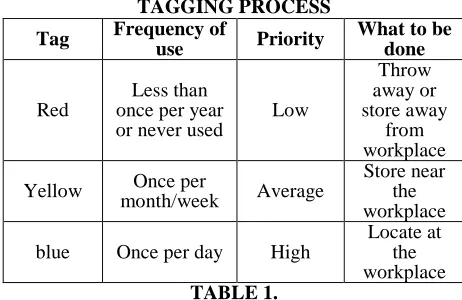
The first pillar of the visual workplace which focuses on eliminating and removing all unnecessary items from the workplace that are not needed for current production operations. Sorting the items is according to three categories such as useful, useless and unknown. The useless items are disposed immediately because they just jamming the workplace lead to loss of time. For items unknown, the frequency of using them not clear, they can be kept with monitoring in order to make a decision by red tag strategy. Through the suitable sorting it can be identified the materials, tools, equipment and necessary information for realization the tasks [13]. Instead of using one red colour tag we used three colours tags red, yellow and blue. The meaning of each tag is defined as per use.
3.2 Set in order (Seiton)
According to Chapman (2005), set in order process can be defined as essential material and items are organized in order to minimize wasted employee motion, walking and material movement. Besides that, set in order focuses on creating efficient and effective storage methods in order to arrange the items and parts, so that they are easy to use. Forming a regular workplace, avoiding time loss while searching for material and so improving the efficiency are the main objectives [14].
3.3 Shine (Seiso)
Once the clutter at work areas is eliminated and remaining items and parts are organized nicely, the next step is to thoroughly clean the work area. It is the component that emphasizes the removal of dirt, grime and dust from the workplace [2]. Cleaning should become a daily activity. Work place should be cleaned at regular intervals [15].
3.4 Standardize (Seiketsu)
It refers to the practice of standardizing in the working area by developing methods in order to maintain the achievements of the first three. The workers need to ensure their effort to tidy, organize, clean the work area and new found disciplines are not slowly lost. Hirano (1995) defined standardize as a result that exists when the first three pillars are properly maintained [2]. To establish standards of the best practice in the workplace and to ensure that the standards are compiled and to undertaking that the workplace is clean and tidy at all times [1].
3.5. Sustain (Shitsuke)
The last step of 5S program is covering the improvement of the methods directed to the adaptation of 5S activities as habits by all personnel. Hirano (1995) stated that sustain can be define as to make habit of properly maintaining with the correct procedures [2]. According to Mcbride (2003), the last pillar is requires discipline. Without discipline, it is really impossible to maintain consistent standards of quality, clean production, and safety and process operations at the workplace (10). The task here is undertaken by the leader directors. The directors should explain the importance of 5S to the personnel through various trainings and the knowledge of the personnel about 5S should be kept updated through the 5S boards to be formed at the workplace [17].
4. RESEARCH METHODOLOGY
The research method used is effective, exploratory, and illustrative. To study of 5S implementation of 5S we visit the industry. In this visit manager explained the current situation of workplace and the problem of sustaining the 5S.after that we started to implementing the 5S and proper plan to sustain the 5S. In this paper we focused on implementation of 5S and calculating contribution of each worker in 5S.We used the following steps:
1. We divide each S in five steps. 2. Each step has one point.
3. According to performance of each worker points has been given.
49 5. We had done this analysis for 4 weeks.
The performance of workers as well as 5s implementation is increases up to 80-90%.after analysis if the efficiency of worker is more than industry will give best worker award and if the efficiency of the worker is less then industry will give suggestions to them. We divide each S in five points and each point having 1 mark. Those points are as given bellow-
4.1 Sorting:
a) The tagging process is done or not?
b) The unwanted and breaking items (scrap) are discarded or not?
c) The required material is take place at particular quantity or not?
d) The required tools are properly sorted or not? e) The inspection tools are settled at proper
place with labeled (marked) or not?
TAGGING PROCESS
Tag Frequency of use Priority What to be done
Red
Less than once per year or never used
Low Throw away or store away from workplace
Yellow month/week Once per Average
Store near the workplace
blue Once per day High
[image:3.595.65.296.350.500.2]Locate at the workplace
TABLE 1.
4.2 Set in order
a) The positions, location of all m/c and components (work area, path ways mark with colour) are fixed or not? b) All items and places are labeled or not? c) The tools and material is properly set as per
frequency of use in cabinets and drawers or not?
d) Safety equipment can be easily accessible or not?
e) Floor is in good condition or not?
4.3 Clean/shine
a) Cleaning of m/c (per day)
b) Cleaning of tools, material handling equipment
c) Cleaning of process path, workplace d) Sweep dust, polishing, oiling is done or not? e) Consistency of cleaning (use of dustbins)
4.4 Standardize
a) 1S is implemented or not? b) 2S is implemented or not? c) 3S is implemented or not?
d) Any new methods or technique implemented to achieve the 5S?
e) Consistency of implementation of 3S.
4.5 Sustain
Sustain =
4.6 Formula
Efficiency = *100
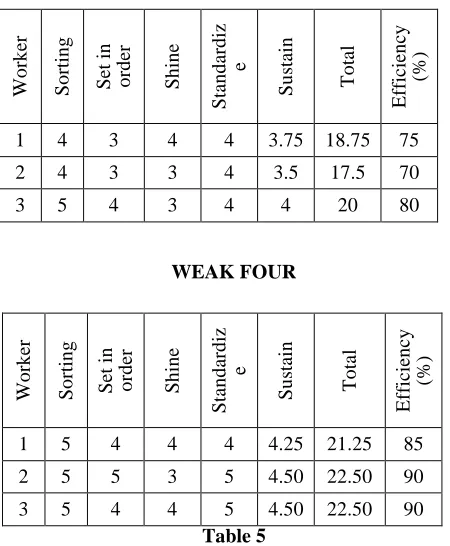
Each of S in 5S is implemented by workers step by step for four weeks and performance is measured which is given in following table-
WEEK ONE TABLE 2 WEEK TWO TABLE 3 WEAK THREE TABLE 4 W o rk er S o rt in g S et i n o rd er S h in e S ta n d ar d iz e S u st ai n T o ta l E ff ic ie n cy (% )
1 1 1 2 1 1.25 6.25 25 2 1 2 1 2 1.5 7.5 30
3 1 1 1 1 1 5 20
W o rk er S o rt in g S et i n o rd er S h in e S ta n d ar d iz e S u st ai n T o ta l E ff ic ie n cy (% )
1 2 2 3 2 2.25 11.25 45
50
[image:4.595.65.290.91.364.2]WEAK FOUR
Table 5
The following photographs show the conditions before and after implementing 5s respectively. In Asara and Girija industries, Palus
,
Maharashtra.Fig.1. Before implimentation of 5S.
W
o
rk
er
S
o
rt
in
g
S
et
i
n
o
rd
er
S
h
in
e
S
ta
n
d
ar
d
iz
e
S
u
st
ai
n
T
o
ta
l
E
ff
ic
ie
n
cy
(%
)
1 4 3 4 4 3.75 18.75 75 2 4 3 3 4 3.5 17.5 70
3 5 4 3 4 4 20 80
W
o
rk
er
S
o
rt
in
g
S
et
i
n
o
rd
er
S
h
in
e
S
ta
n
d
ar
d
iz
e
S
u
st
ai
n
T
o
ta
l
E
ff
ic
ie
n
cy
(%
)
1 5 4 4 4 4.25 21.25 85 2 5 5 3 5 4.50 22.50 90
[image:4.595.306.529.97.473.2]51 Fig.2. After implementation of 5S.
□
5. CONCLUSION
The outcome of this paper is execution of 5S in small scale industries as well as calculating the performance of worker. The efficient implementation of 5S technique leads to subsequent improvement in productivity of the manufacturing plant. The 5S improves environmental performance and thus relate primarily in reduction of wastes in manufacturing. It promotes neatness in storage of raw material and finished products. The 5S implementation leads to the improvement of the case company organization in many ways for instance. This paper shows how to sustain 5S by maintaining the continuity of worker
Acknowledgments
We are heartily thankful to the Asara and Girija industry palus, Maharashtra for sharing and giving us an opportunity to execute 5S methodology.
REFERENCES
[1] Chauhan et al., “Measuring the status of Lean manufacturing using AHP” International journal of Emerging technology vol.1 no.2, pp.115-120. 2010.
[2] Hirano, H., 1995. “5 Pillars of the Visual Workplace, Productivity Press”, Portland, OR.
[3] Lean Man, 2011. Benefits of 5s; Is 5s Lean Manufacturing Just Housekeeping? Hub pages [Online] Available at: http://leanman.hubpages.com/hub/5S_Lean [Accessed: October 20, 2011].
[4] Pheng, L.S. and Khoo, S.D., 2001. Team performance management: Enhancement through Japanese 5-S principles. Team Performance Management, 17(6) pp. 105-111.
[5] Pheng, L.S., 2001. Towards TQM-integrating Japanese 5-S principles with ISO 9001:2000 requirements. The TQM Magazine, 13(5), pp. 334-341.
[6] Chakraborty et al. “Internal obstacles to quality for small scale enterprises”’, International Journal of Exclusive management research, vol. 1, no. 1, pp. 1-9, 2011.
52 of science, engineering and technology vol.
69, 2010
[8] Chapman, C.D., 2005. Clean house with lean 5S. Quality Progress, 38(6), pp. 27-32. [9] Mcbride, D., 2003. 5S Implementation. EMS
Consulting Group [Online].Available at: http://www.emsstrategies.com/dm103103arti cle.html [Accessed: August 20, 2011]. [10]Ho, S.K., Cicmil, S. and Fung, C.K., 1995.
The Japanese 5-S practice and TQM training. Training for Quality, 3(4), pp. 19-24.
[11]Ho, S.K., 1997. Workplace learning: The 5S way. Journal of Workplace Learning, 19(6), pp. 185-191.
[12]Prof. S. B. Khedkar, Prof. R. D. Thakre, Prof. Y. V. Mahantare, Mr. Ravi Gondne, Study of Implementing 5S Techniques in Plastic Molding , International Journal of Modern Engineering Research, Vol.2 (5), Sep.-Oct. 2012, 3653-3656.
[13]P. M. Rojasra, M. N. Qureshi, Performance Improvement through 5S in Small Scale Industry: A case study, International Journal of Modern Engineering Research (IJMER). Vol.3 (3) May - June 2013, 1654-1660. [14]HarshaLingareddy, G.Sahitya Reddy,
K.Jagadeshwar, 5S as a tool and strategy for improving the work place, International Journal of Advanced Engineering Technology, Vol.4(2),April-June, 2013, 28-30.
[15]Shahryar Sorooshian, Meysam Salimi, Shanthi Bavani, Hasti Aminattaheri, Experience of 5S Implementation, Journal of Applied Sciences Research, 8(7), 2012, 3855-3859.