Creating a Verb Synonym Lexicon Based on a Parallel Corpus
Zde ˇnka Urešová, Eva Fuˇcíková, Eva Hajiˇcová, Jan Hajiˇc
Charles University, Faculty of Mathematics and PhysicsInstitute of Formal and Applied Linguistics Malostranské nám. 25
11800 Prague 1, Czech Republic
{uresova,fucikova,hajicova,hajic}@ufal.mff.cuni.cz
Abstract
This paper presents the first findings of our recently started project of building a new lexical resource called CzEngClass, which consists of bilingual verbal synonym groups. In order to create such a resource, we explore semantic ‘equivalence’ of verb senses (across different verb lexemes) in a bilingual (Czech-English) setting by using translational context of real-world texts in a parallel, richly annotated dependency corpus. When grouping semantically equivalent verb senses into classes of synonyms, we focus on valency (arguments as deep dependents with morphosyntactic features relevant for surface dependencies) and its mapping to a set of semantic “roles” for verb arguments, common within one class. We argue that the existence of core argument mappings and certain adjunct mappings to a common set of semantic roles is a suitable criterion for a reasonable verb synonymy definition, possibly accompanied with additional contextual restrictions. By mid-2018, the first version of the lexicon called CzEngClass will be publicly available.
Keywords:Lexical Resource, Parallel Corpus, Semantics, Syntax, Synonymy, Valency
1.
Introduction
While synonym lexicons, such as the Roget’s thesaurus (Associates, 1988),1or WordNet (Miller, 1995; Fellbaum, 1998) are well-known resources, used in both research and NLP applications, we believe that there is a significant gap in these resources (which concerns mainly verbs). We see two orthogonal problems: first, a granularity problem– current synonym classes (synsets, entries, frames, ...) as found in these resources are usually too broad (contain words which can be considered synonyms only in very specific contexts), or they use too fine-grained sense dis-tinctions, such as in WordNet, which often distinguish too many and too close verb senses (Palmer et al., 2007); sec-ond, a coverage problem - simply there are not enough verbs covered or some verb senses are missing.2
In our project, we attempt to introduce criteria, based mainly on valency or predicate-argument structure (taking into account both semantic and morphosyntactic proper-ties of verbs) to help define both the granularity of verb senses as well as the synonym classes themselves. Along with (Levin, 2013), we refer to predicate-argument struc-ture as to those strucstruc-tures that involve the realization of lexical item’s arguments, including morphosyntactic prop-erties that affect the morphosyntactic realization of argu-ments. This is similar to our valency approach, the FGD Valency Theory (FGDVT), first described in (Panevová, 1974). As (Levin, 2014) notes, the meaning of a verb may be characterized via the relations that its arguments bear to it and “Semantic Roles” (SRs) can be seen as labels for certain recurring predicate-argument relations.
In addition, we have chosen to use multilingual, rather than monolingual-only evidence to help with both the sense
dis-1http://www.roget.org
2It is left for future investigation whether other parts of speech,
especially nouns, would be subject to similar problems, but now we concentrate on verbs since they are generally considered the core of every sentence (clause). We will extend our approach to nouns and adjectives later.
tinctions and the synonymy relation proper. We have started with Czech and English, since there are resources (both lex-ical and textual) that allow us to do so.
The goal of the project is thus to group verbs used as syn-onyms in Czech and English into (cross-lingual) synonym classes representing a cross-lingual meaning of the state or event expressed by the set of verbs assigned to that class. We call the resulting lexicon CzEngClass.
For the purpose of this work, we use the term “synonym” in the “loose” interpretation (Lyons, 1968), i.e., the necessary semantic equivalence takes also wider context into account. We proceed strictly “bottom-up”, i.e. from the corpus and existing lexical resources towards the new lexicon. The novel feature is the use of a richly annotated bilingual cor-pus (Sect. 2.) to achieve deeper insight into the usage of verbs (together with their arguments) in translation. The results reported in our paper are based on a sample of 60 classes manually processed and entered into the CzEng-Class lexicon. We also describe their linkage to additional existing resources, the relevant features of which are de-scribed, too (Sect. 3.). The tool used for creating this sam-ple is described elsewhere in this volume (Urešová et al., 2018).
Our approach to synonymy, meaning and sense is captured in Section 4.. Section 5. deals with the design of CzEng-class lexicon. In Section 6., we exemplify the main (albeit first) findings. We comment on the CzEngClass’ criteria for grouping synonymous, based on samples that have been an-notated and processed while creating the first entries. Sec-tion 7. summarizes our approach and points to future work.
2.
Corpus Resources
an-notation in The Prague Dependency Treebank (PDT 2.0) style (Hajiˇc et al., 2006; Hajiˇc et al., 2018), which is in turn based on the Functional Generative Dependency (FGD) framework (Sgall et al., 1986). The PDT annotation uses a “stratificational” (layered) approach containing multiple layers (morphology, surface syntax and deep syntax). The main annotated phenomena are (surface) dependency struc-ture and (deep) syntactico-semantic labeling of predicate-argument structure. For the purpose of our study, it is im-portant that the annotation contains interlinked surface de-pendency trees and deep syntactico-semantic (tectogram-matical) trees, both vertically and also horizontally across the two languages on sentence and node levels. At the deep layer, each verb node (occurrence) is additionally linked to the corresponding valency frame in the associated valency lexicons, PDT-Vallex and EngVallex (Sect. 3.), effectively providing also word sense labeling for all verb occurrences in the bilingual corpus.
3.
Lexical Resources
PDT-Vallex (Urešová et al., 2014), (Urešová, 2011) is a Czech valency lexicon, manually created in a bottom-up way during the annotation of the PDT/PCEDT 2.0. Each entry in the lexicon contains a headword (lemma) with as-sociated valency frames. A valency frame typically cor-responds to one sense of the verb, even though for close verb senses3and identical valency frames only one valency frame may exist in the lexicon. Each valency frame in-cludes labeled valency frame members, or valency “slots” (i.e., ACT for Actor, PAT for Patient, ADDR for Addressee, etc.), semantic “obligatoriness” attribute, and subcatego-rization information, i.e., required surface form(s) of the dividual valency frame members. Most valency frames in-clude a note or an example explaining their meaning and us-age. The version of PDT-Vallex used here contains 11,933 valency frames for 7,121 verbs.
EngVallex(Cinková et al., 2014), (Cinková, 2006) is a va-lency lexicon of English verbs created on the same princi-ples as PDT-Vallex by an automatic conversion from Prop-Bank frame files (Palmer et al., 2005) which was manually refined afterwards.4EngVallex was used for the annotation of the English part of the PCEDT 2.0. Currently, it con-tains 7,148 valency frames for 4,337 verbs. For the most part, EngVallex does not contain explicitly formalized sub-categorization information.
CzEngVallex(Urešová et al., 2015), (Urešová et al., 2016) is based on the treebank annotation of the PCEDT 2.0 cor-pus, covering about 86,000 aligned verbal pairs. It is a manually annotated Czech-English valency lexicon linking verbal entries of PDT-Vallex and EngVallex. Over 66% of English verbs and 72% of Czech verbs5in the PCEDT 2.0 have a verbal translation covered by the CzEngVallex mapping. CzEngVallex builds links not only between cor-responding verbal frames but also between corcor-responding verb arguments for each pair of verb senses, providing an
3For explanation of the term “sense”, as it is used in this paper,
please see Sec. 4..
4EngVallex preserves most of the links to PropBank. 5The remaining pairings are verb-noun or verbs translated as
structurally different constructions.
interlinked database of argument structures available for each verb and documenting a cross-lingual comparison of Czech and English valency behavior.
VALLEX6 (Lopatková et al., 2016) is closely related to PDT-Vallex because it is built on the same theoretical framework. This lexicon is much more elaborated, how-ever it is not based on the PDT data.
Among other resources we use, there areFrameNet(Baker et al., 1998; Fillmore et al., 2003), FrameNet+ (Pavlick et al., 2015),VerbNet(Schuler, 2006),SemLink(Palmer, 2009; Bonial et al., 2012),PropBank(Palmer et al., 2005) andEnglish WordNet7(Miller, 1995; Fellbaum, 1998) as well asCzech WordNet(Pala et al., 2011), (Pala and Smrž, 2004). These resources have been used for an initial set of semantic roles (taken mostly from FrameNet and Verb-Net),8and their entries will be referred to explicitly from all the corresponding entries in the CzEngClass lexicon, if pos-sible to the exact lexical units/frames/sense groups/synsets.
4.
Synonymy
Before we address synonymy, we make a short digression to the term “meaning” and term “sense” as we interpret them in our work, due to sometimes wildly different un-derstandings of these terms.
We understand the term “sense” in the same way as e.g., (Hofmann, 1993) saying “when a form has several different concepts associated with it, we sometimes call them differ-ent senses or readings of the word.” (Wierzbicka, 1996) has the same approach, explaining the term “sense” on four different senses of the wordspring. We also differentiate a single verb (type, lemma, possibly multiword) into one or more “senses,” represented by its valency frame; in our lexical valency resources (PDT-Vallex and EngVallex) the individual senses (i.e., the valency frames) of a verb are technically represented by a unique ID. The term (lexical) “meaning” is understood here with regard to a context, i.e., syntactic and semantic surroundings of the word; similarly to Wittgenstein’s understanding that “the meaning of an ex-pression is a function of its use in a particular context” (Frawley, 1992). In our use of the terms “meaning” and “sense”, the following holds:
• “sense” is used only to distinguish different meanings within one verb type (lemma), e.g., the verbleavehas (at least) two senses,leave sth somewhere(leave book on the table) and leave someplace [for some other place](leave Paris [for London]),
• “meaning” is not applied to verbs (lemmas, verb types), but only to their distinguished senses (lexical units), and can be compared across such units: e.g., leave in the sense leave someplace [for some other place]has similar meaning todepartin its sense de-part from somewhere,
• consequently, two senses of the same verb can never be totally equivalent, i.e., they never have the same
6http://ufal.mff.cuni.cz/vallex/3.0/ 7https://wordnet.princeton.edu/
8The current theories of SRs are reviewed in more detail in
meaning (they would not be separated if they were equivalent),
• meanings can thus only be (non-trivially) compared acrossverbs (more precisely, across lexical units de-fined for (“within”) different verbs).
In the working definition for establishing the CzEngClass entries, we use“contextually-based”synonymy. For two verbs (verb senses) to be considered contextually synony-mous, and therefore be members of the same class, they have to convey the same or similar meaning, both mono-lingually and cross-mono-lingually, and they must share the same Semantic Roles (SRs), albeit they can be expressed by dif-ferent morphosyntactic realizations as well as subject to ad-ditional restrictions.
5.
Structure of CzEngClass Lexicon
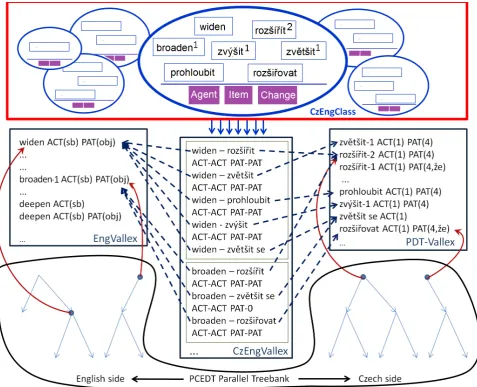
For our study, the following lexicon structure (Fig. 1) has been designed.The CzEngClass lexicon builds upon the existing resources, as described above: CzEngVallex, PDT-Vallex and Eng-Vallex and the PCEDT parallel corpus. In addition, the other lexicons listed (VALLEX, FrameNet, VerbNet, Prop-Bank and WordNet(s)) are used as additional sources, and links will be kept between their entries and the CzEngClass entries.
At the core of the CzEngClass lexicon, there are Synonym Classes, which are, for the purpose of this project, defined as (multilingual, or rather cross-lingual)9 groups of verb senses (of different words) that have the same meaningand the arguments of which can be mapped to a common set of SRs (cf. the purple boxes Agent, Item, Change in Fig. 1). SRs have been reviewed (with FrameNet’s core roles for the linked-to entry(ies) providing inspiration) and determined for all the members of the group, and mapped to arguments from EngVallex (and PDT-Vallex for Czech verbs), using also the pairings from the CzEngVallex lexicon, which is in turn linked to the PCEDT parallel Czech-English corpus (lower part of Fig. 1).
6.
CzEngClass Examples
We capture the common background information of one synonym class realized through a set of common SRs in one “frame,” called SynSemFrame (synonym semantic frame). We present two examples here.
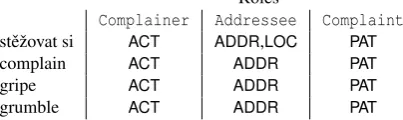
In the relatively straightforward synonym verb class in Ta-ble 1, exemplified in the three sentences below, we consider all verbs to be synonyms and group them in the SynSem-Frame COMPLAIN, since the valency pattern of the source verbs complain, gripe, grumblecorrelates (for almost all arguments) 1:1 with the valency pattern of the translational equivalent, i.e., verbstˇežovat si(lit.complain). The excep-tion is the Czech verb itself, where both ADDRandLOC
can be mapped to the roleAddressee. The reason is, how-ever, simply the conventions applied in the FGDVT to cases where the surface expression is location rather than (= in place of) a (true) addressee (as an animate agent); typically, this happens for offices (to the clerk.ADDRvs.at the court
9For the time being, bilingual: in Czech and English.
office.LOC), government seats (to the governor.ADDR vs. in Annapolis.LOC), etc. Consequently, in all these cases, functors from the valency lexicons and the deep dependen-cies can easily be mapped to a common set of SRs, taken from FrameNet in this case.
Examples (Czech translations double as examples for the Czech verbstˇežovat siin the class):
En: Mrs. Yeargin.Complainer/ACTnever complained to school officials.Addressee/ADDR [that the standardized test was un-fair.].Complaint/PAT
Cz: Yearginová.Complainer/ACT si nikdy na škol-ském úˇradu.Location/LOC nestˇežovala na nespravedl-nost.Complaint/PATstandardizovaných test˚u.
En: [“For $10 million, you can move $100 million of stocks,”].Complaint/PATa specialist.Complainer/ACT... gripes. NULL.Addressee/ADDR
Cz: [“Za 10 milion˚u dolar˚u m˚užete pˇresunout akcie za 100 milion˚u dolar˚u,”].Complaint/PAT stˇežuje si ... odborník..Complainer/ACTNULL.Addressee/ADDR
En:Soviet consumers.Complainer/ACTgrumble at the exorbitant black-market prices.Complaint/PATNULL.Addressee/ADDR Cz: Sovˇetští spotˇrebitelé.Complainer/ACT si stˇežují na ne-horázné ceny.Complaint/PAT za takové zboží na ˇcerném trhu. NULL.Addressee/ADDR
Roles
Complainer Addressee Complaint stˇežovat si ACT ADDR,LOC PAT
complain ACT ADDR PAT
gripe ACT ADDR PAT
grumble ACT ADDR PAT
Table 1: Mappings for COMPLAINclass
Table 2 shows the class OFFER, with additional complex examples. While the verbsoffer,bid,profferandtender, as well as the Czech verbnabídnoutdo not pose any problem in mapping their valency arguments to the four SRs associ-ated with this class, the other aligned translations, described below, are more complex.
The verbextend(in the sense “extend an offer”) seems not to fit the pattern; without theEntity Offered/PATbeing a noun phrase meaning exactly what the class is about, namelyoffers, bids, aid, etc., its meaning is more similar to “hand over” than to “offer”. However, looking up all the possible deep objects to this meaning of extend, it is clear that it cannot be complemented by a direct objectnot being an offer, bidor something similar. If such a noun is further modified, one of its dependents might describe theEntity Offered(e.g.,employment: employment offer oroffer of employment). If it is not present, this construc-tion simply says that there was anofferwhile not specifying anything more specific about it, unless the wordofferor its equivalent is left out and theEntity Offeredis specified as a dependent directly on the verbextenditself, as inthe banks ... extended [company] up to $90 million in revolv-ing loans. Therefore, both thePATas well as the restric-tive attribute of thePAT(denoted asPAT(RSTR) can be the
Entity Offered.
Figure 1: CzEngClass lexicon & other resources
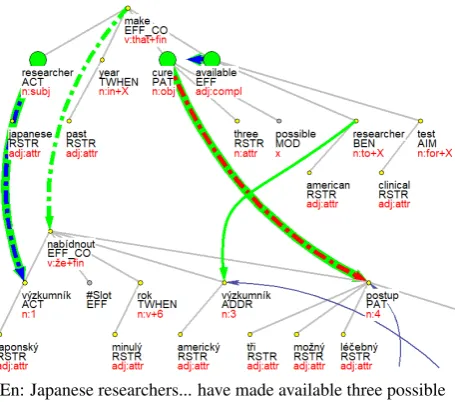
arguments (mostlyACT) and “pushes” some other ones to the nominal part. In this case, the situation is similar, with-out makebeing considered a light verb (otherwise, a dif-ferent functor would have been used foravailable). From the example below, it is clear that the translation was quite adequate and thusmake availableshould be kept in the syn-onym class OFFER(see the deep dependency annotation of this example captured in Figure 2) where theRecipientis annotated with the relationBENas a dependent on avail-able, denoted asEFF(BEN) in Table 2:
En: Japanese researchers.Offerer/ACT ... have made avail-able.EFFthree possible cures.Entity Offered/PATto American researchers.Recipient/BEN....
Cz: Japonští výzkumníci nabídli ... americkým výzkumník˚um tˇri možné léˇcebné postupy...
Last translation used for nabídnout was place (a value), e.g., in the sentence:
En:... buyers who place the highest value on them. Cz:...kupujícím, kteˇrí za nˇe nabídnou nejvyšší hodnotu.
However, this is considered pure nominalization (other sen-tences have been found whereoffer, bid, etc. as a head of a noun phrase is aligned with a Czech content verb), even if there was no other equivalent word forplacein the Czech
translation. This is an example where the translated text probably does not have the same effect on the target reader: the translator simply added content to a sentence based on her/his understanding of the context. Therefore, the verb placewas, at present, not included in the OFFERsynonym class. This also demonstrates the difference between inter-lingual synonymy(which defines the CzEngClass lexicon) andtranslational equivalence(not necessarily represented).
Roles
Entity Entity Offerer Recipient Offered Received
nabídnout ACT ADDR PAT EFF
offer ACT ADDR PAT EFF
bid ACT ADDR PAT EFF
proffer ACT ADDR PAT SUBS
tender ACT ADDR PAT SUBS
extend ACT ADDR PAT, SUBS
PAT(RSTR)
make ACT EFF(BEN) PAT SUBS available Restriction:EFF[EXCHANGE]
En: Japanese researchers... have made available three possible cures to American researchers.
Cz: Japonští výzkumníci nabídli ... americkým výzkumník˚um tˇri možné léˇcebné postupy.
Figure 2: Dependency tree annotations for English sentence rooted inmake availableand its Czech translation.
7.
Conclusions and Future Work
The CzEngClass lexicon is a contribution to a set of lexical resources important for many NLP tasks, such as event de-tection and linking, semantic relation extraction, etc. While these tasks often use unlabeled data for training, there is always a need for human-annotated data for evaluation, tuning, etc. Importantly, we believe that such a resource is currently missing in the offerings of lexical resources. In addition, it contains links to all the relevant related re-sources, such as VALLEX, FrameNet, VerbNet, PropBank and WordNet, making it suitable for comparative studies. We have based our study on the assumption that mapping syntactic structure (verb arguments) of verbs to semantic roles (with some added restrictions) helps us discover their meaning affinity through which we can group these verbs into synonym classes. To help avoid single-language bias, we have used a parallel corpus and the alignments of verbs, previously manually checked and extracted. In such a cor-pus, aligned translations of a single verb should in prin-ciple be, in most cases, synonymous. The resulting sets of cross-lingual synonyms including the explicit mappings be-tween the FGDVT valency functors and the semantic roles assigned to each synonym set are captured in the CzEng-Class lexicon. So far, the roles used in FrameNet and Verb-Net seem to form a suitable set for each synonym class and the mapping. However some adjustments, e.g., merging the roles, adding non-core roles, have to be made.
Once the lexicon reaches reasonable size (approx. 500 classes), we will compare the results with automated syn-onym discovery methods, such as (van der Plas et al., 2011; van der Plas et al., 2014), either using Deep Learning (look-ing, e.g., at embeddings based on argument-role mapping) or other previously well-researched methods, such as the LDA which has been already used for Czech, e.g., in (Ma-terna, 2012).
Finally, we plan to publish the resulting CzEngClass lexi-con as an open source dataset.
Acknowledgments
This work has been supported by the grant No. GA17-07313S of the Grant Agency of the Czech Republic, and it uses resources hosted by the LINDAT/CLARIN Research Infrastructure, projects No. LM2015071 and CZ.02.1.01/0.0/0.0/16_013/0001781, supported by the Ministry of Education of the Czech Republic. The last co-author has also been supported in part by the project VIA-DAT, No. DG16P02R019, of the Ministry of Culture of the Czech Republic.
8.
Bibliographical References
Associates, P. S. I. . (1988).Roget’s thesaurus of synonyms and antonyms. P.S.I. & Associates.
Baker, C. F., Fillmore, C. J., and Lowe, J. B. (1998). The Berkeley FrameNet Project. InProceedings of the 36th Annual Meeting of the Association for Computa-tional Linguistics and 17th InternaComputa-tional Conference on Computational Linguistics - Volume 1, ACL ’98, pages 86–90, Stroudsburg, PA, USA. Association for Compu-tational Linguistics.
Bonial, C., Feely, W., Hwang, J. D., and Palmer, M. (2012). Empirically Validating VerbNet Using SemLink. In Sev-enth Joint ACL-ISO Workshop on Interoperable Seman-tic Annotation, Istanbul, Turkey, May.
Cinková, S. (2006). From PropBank to EngValLex: adapt-ing the PropBank-Lexicon to the valency theory of the functional generative description. In Proceedings of LREC 2006, Genova, Italy.
Fellbaum, C. (1998). WordNet: An Electronic Lexical Database. Language, Speech, and Communication. MIT Press, Cambridge, MA.
Fillmore, C. J., Johnson, C. R., and L.Petruck, M. R. (2003). Background to FrameNet: FrameNet and Frame Semantics. International Journal of Lexicogra-phy, 16(3):235–250.
Frawley, W. (1992). Linguistic Semantics. Lawrence Erl-baum, Hillsdale.
Hofmann, T. R. (1993). Realms of Meaning. An Introduc-tion to Semantics. Longman, Oxford.
Levin, B. and Hovav, M. R. (2005). Argument realization. Cambridge Univ. Press, Cambridge.
Levin, B. (2013). Argument Structure. Oxford Bibliogra-phies in Linguistics.
Levin, B. (2014). Semantic roles. Oxford Bibliographies in Linguistics.
Lopatková, M., Kettnerová, V., Bejˇcek, E., Vernerová, A., and Žabokrtský, Z. (2016). Valenˇcní slovník ˇceských sloves VALLEX. Nakladatelství Karolinum, Praha, Czechia.
Lyons, J. (1968). Introduction to Theoretical Linguistics. Cambridge University Press.
Materna, J. (2012). LDA-Frames: An Unsupervised Ap-proach to Generating Semantic Frames. In Proceed-ings of the 13th International Conference on Computa-tional Linguistics and Intelligent Text Processing - Vol-ume Part I, CICLing’12, pages 376–387, Berlin, Heidel-berg. Springer-Verlag.
Miller, G. A. (1995). WordNet: A Lexical Database for English. Commun. ACM, 38(11):39–41, November. Pala, K. and Smrž, P. (2004). Building Czech Wordnet.
Romanian Journal of Information Science and Technol-ogy, 7(1-2):79–88.
Palmer, M., Gildea, D., and Kingsbury, P. (2005). The Proposition Bank: An Annotated Corpus of Seman-tic Roles. Computational Linguistics, 31(1):71–106, March.
Palmer, M., Dang, H., and Fellbaum, C. (2007). Making Fine-grained and Coarse-grained sense distinctions, both manually and automatically. Journal of Natural Lan-guage Engineering, 13(2):137–163.
Palmer, M. (2009). Semlink: Linking PropBank, VerbNet and FrameNet. InProceedings of the Generative Lexicon Conference, page 9–15.
Panevová, J. (1974). On verbal Frames in Functional Gen-erative Description. Prague Bulletin of Mathematical Linguistics, 22:3–40.
Pavlick, E., Wolfe, T., Rastogi, P., Callison-Burch, C., Dredze, M., and Van Durme, B. (2015). Framenet+: Fast paraphrastic tripling of framenet. In Proceedings of the 53rd Annual Meeting of the Association for Com-putational Linguistics and the 7th International Joint Conference on Natural Language Processing (Volume 2: Short Papers), pages 408–413, Beijing, China, July. As-sociation for Computational Linguistics.
Schuler, K. K. (2006). VerbNet: A Broad-Coverage, Com-prehensive Verb Lexicon. Ph.D. thesis, University of Pennsylvania.
Sgall, P., Hajiˇcová, E., and Panevová, J. (1986).The mean-ing of the sentence in its semantic and pragmatic aspects. D. Reidel, Dordrecht.
Urešová, Z., Fuˇcíková, E., and Šindlerová, J. (2016). CzEngVallex: a bilingual Czech-English valency lexi-con. The Prague Bulletin of Mathematical Linguistics, 105:17–50.
Urešová, Z., Fuˇcíková, E., Hajiˇcová, E., and Hajiˇc, J. (2018). Tools for Building an Interlinked Synonym Lexicon Network. InProceedings of the 11th Interna-tional Conference on Language Resources and Evalua-tion (LREC’18), Miyazaki, Japan, May. European Lan-guage Resources Association (ELRA).
Urešová, Z. (2011). Valenˇcní slovník Pražského závislost-ního korpusu (PDT-Vallex). Studies in Computational and Theoretical Linguistics. Ústav formální a aplikované lingvistiky, Praha, Czechia.
van der Plas, L., Merlo, P., and Henderson, J. (2011). Scaling up cross-lingual semantic annotation transfer. In Proceedings of ACL/HLT, pages 299–304, Portland, US. van der Plas, L., Apidianaki, M., and Chen, C. (2014). Global methods for cross-lingual semantic role and pred-icate labelling. InProceedings of the 25th International
Conference on Computational Linguistics (COLING), pages 1279–1290, Dublin, Ireland.
Wierzbicka, A. (1996). Semantics: primes and universals. Oxford Univ. Press, Oxford & New York.
9.
Language Resource References
Cinková, S., Fuˇcíková, E., Šindlerová, J., andHa-jiˇc, J. (2014). EngVallex - English Valency Lexicon. LINDAT/CLARIN PID: http://hdl.handle.net/11858/00-097C-0000-0023-4337-2.
Hajiˇc, J., Hajiˇcová, E., Panevová, J., Sgall, P., Cinková, S., Fuˇcíková, E., Mikulová, M., Pajas, P., Popelka, J., Semecký, J., Šindlerová, J., Štˇepánek, J., Toman, J., Urešová, Z., and Žabokrtský, Z. (2012). Prague Czech-English Dependency Treebank 2.0, https://catalog.ldc.upenn.edu/LDC2004T25. Institute of Formal and Applied Linguistics, LINDAT/CLARIN PID: http://hdl.handle.net/11858/00-097C-0000-0015-8DAF-4.
Hajiˇc, J., Bejˇcek, E., Bémová, A., Buráˇnová, E., Ha-jiˇcová, E., Havelka, J., Homola, P., Kárník, J., Ket-tnerová, V., Klyueva, N., Koláˇrová, V., Kuˇcová, L., Lopatková, M., Mikulová, M., Mírovský, J., Nedoluzhko, A., Pajas, P., Panevová, J., Poláková, L., Rysová, M., Sgall, P., Spoustová, J., Straˇnák, P., Synková, P., Ševˇcíková, M., Štˇepánek, J., Urešová, Z., Vidová Hladká, B., Zeman, D., Zikánová, Š., and Žabokrtský, Z. (2018). Prague Dependency Treebank 3.5. Institute of Formal and Applied Linguistics, LIN-DAT/CLARIN, Charles University, LINDAT/CLARIN PID: http://hdl.handle.net/11234/1-2621.
Hajiˇc, J., Panevová, J., Hajiˇcová, E., Sgall, P., Pa-jas, P., Štˇepánek, J., Havelka, J., Mikulová, M., Žabokrtský, Z., Ševˇcíková Razímová, M., and Ure-šová, Z. (2006). Prague Dependency Treebank 2.0. LDC, number LDC2006T01, LINDAT/CLARIN PID: http://hdl.handle.net/11858/00-097C-0000-0015-8DAF-4.
Pala, K., Capek, T., Zajíˇcková, B., Bart˚ušková, D.,ˇ Kulková, K., Hoffmannová, P., Bejˇcek, E., Straˇnák, P., and Hajiˇc, J. (2011). Czech WordNet 1.9 PDT. LINDAT/CLARIN PID: http://hdl.handle.net/11858/00-097C-0000-0001-4880-3.
Urešová, Z., Štˇepánek, J., Hajiˇc, J., Panevová, J., and Mikulová, M. (2014). PDT-Vallex: Czech Valency lexicon linked to treebanks. LINDAT/CLARIN PID: http://hdl.handle.net/11858/00-097C-0000-0023-4338-F.