359
Construct Validity And Reliability Test On Burnout
Fifi Indrayani Abd Wahab, Fatwa Tentama
Abstract: This research aims to analyze the construct validity and reliability of the burnout scale, and to determine the aspects and indicators that form the construct of burnout scale. The burnout scale can be measured with three aspects, namely emotional exhaustion, depersonalization, and low self-esteem. The subjects of this research consist of 60 teachers who work at school ―X‖. The data were collected using burnout scale and then analyzed using Structural Equation Modeling (SEM) SmartPLS 3.2.8 with reflective construct through CFA 2nd Order. Based on the results of the analysis of the construct validity and reliability, the aspects and indicators making up the burnout on the teachers are declared valid and reliable. It shows that all aspects and indicators are able to reflect and form the burnout. Thus, the model can be accepted because the theory describing the burnout is in accordance with the empirical data obtained.
Keywords: Burnout, Construct Reliability, Construct Validity, Depersonalization, Emotional Exhaustion, Esteem, Partial Least Square
—————————— ——————————
1.
INTRODUCTION
Teacher is a profession with great burden and workloads. The great workload will likely cause stress and pressure that teachers often feels exhausted. The exhaustion makes them feel frustrated, being imprisoned by the tasks they have to do, and not satisfied. Thus, they show apathetic attitudes toward work and cynical behavior to students. Various difficulties experienced by teachers are also known as burnout [1. Burnout causes individuals to experience disharmony with coworkers and feel stress while working [2], [3]. Burnout can also worsen stress at the workplace [4]. Individuals who experience low burnout will likely to feel satisfied with their work and are able to lower stress [5]. Other researches stated that burnout can make an individual loathes his work [6]. People who experience chronic stress at the workplace are considered to suffer from burnout [7].
Teachers’ existence will support the success of an education. So, a teacher should have proper qualifications. In a week, a teacher has a minimum workload of 18 teaching-hours. In addition, a teacher needs to do administrative tasks such as making syllabus that will be used for 1 year. The syllabus consists of, for example, learning materials, annual programs, quarter programs, and semester programs which refer to the established curriculum. Those workloads may trigger psychological and physical pressure. Among teachers, burnout is also associated with stress and symptoms of depression [8]. Burnout contributes to the low organizational citizenship behavior (OCB) and work satisfaction [9], [10]. Furthermore, burnout in teachers contributes to affect the work commitment [11], work capability [12] organizational citizenship behavior and work experience [13].
Casserley and Maginson [1] explained that burnout is a multi-aspect syndrome. Burnout causes emotional exhaustion, loss of empathy and impersonal response to customers, low work-achievements, and low productivity [15], [16], as well as symptoms of emotional and physical exhaustion [17]. Burnout is a fatigue that refers to the feeling of stress, especially chronic exhaustion due to excessive workloads. Empirical studies of burnout continue and focus on the context of work [18]. In teaching process, burnout can affect the work system [19], and emotional intelligence [20]. The term burnout initially emerged as a form of social problem happening amidst the
society. At first, the concept of burnout focused on clinical field. It was then followed by empirical phase where research on burnout have been conducted systematically and were in accordance with the social phenomena [21]. In 1974, Freudenberger introduced the concept of burnout, which was then followed by Maslach in 1976 in USA. Freudenberger was a clinical psychologist who handled teenagers’ problems who volunteered in a social service institution. His observations found that many volunteers experienced mental exhaustion, low motivation, and loss of commitment over time. Next, Freudenberger provided an illustrative example that a person who suffers from burnout syndrome will feel like a burned-out building. A building which at first looks luxurious with all the activities inside, then catches fire till only the outer structure remains [22]. Maslach and Jackson [23] mentioned three aspects of burnout, namely emotional exhaustion, depersonalization, and low self-esteem. 1) Emotional exhaustion is the depletion of emotional resources within the individual; it is marked by feelings of frustration, despair, sadness, loathe, irritable, tired, depressed, and being trapped at work. 2) Depersonalization is an individual’s tendency to keep distance from his social environment, being cynical, apathetic, heartless, and not caring about the environment and the people around. This aspect illustrates burnout exclusively for work in the field of humanitarian/human services. 3) The low self-esteem means the tendency of an individual to evaluate his work negatively. An individual who underestimates himself often experience dissatisfaction towards his work and feel that he has never done anything useful. Burnout affects the teachers’ work in the teaching process, therefore, it is necessary to measure teachers’ burnout. Maslach and Jackson [23] carried out a research on burnout by using a Burnout Inventory Measurement scale. Qiaou and Schaufeli [24] used the Olendenburg Burnout Inventory (OLBI). The OLBI has the latest features of exhaustion and release scales. The OLBI measurement has a balanced arrangement of positive and negative words. Furthermore, Maslach and Leiter [25] conducted a research on burnout by using the Burnout Inventory Measurement scale.
———————————————— Fifi Indrayani Abd Wahab, Faculty of Psychology Ahmad Dahlan
University, Yogyakarta, PH-082239901656. E-mail: [email protected]
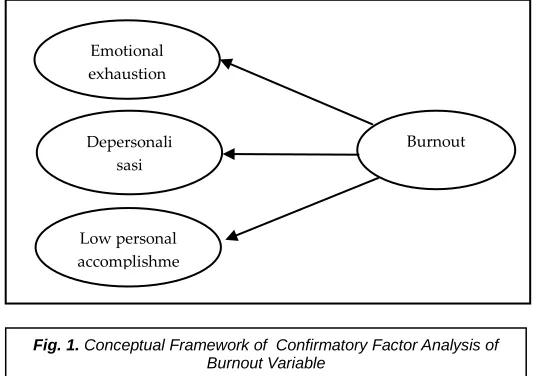
Base on picture 1 is arranged research hypothesis as below: H: The burnout aspects are emotional exhaustion, depersonalisasi, and low pesonal accomplishment which form burnout.
One of the approaches used to test the construct of a measuring tool is the Confirmatory Factor Analysis (CFA). CFA is one of the main approaches in the factor analysis. The CFA can be used to test the aspects of a construct. This test is used to measure the model so that it can describe the aspects and indicators of behavior in reflecting the burnout by observing the loading factor of each aspect that forms a construct. Confirmatory Factor Analysis (CFA) is also used to test the construct validity and reliability of the indicators (items) that form a latent construct [26]. The CFA used in this research is the second order confirmatory factor analysis (2nd Order CFA). It is a two-level measuring model. The first level of analysis is done from the aspects’ latent construct to the indicators’ latent construct [26]. Based on the above explanation, it can be inferred that burnout is an important thing. Considering its importance, the problem statements of this research will be: 1) Is the burnout’s construct valid and reliable? 2) Are the aspects of emotional exhaustion, depersonalization, and low self-esteem able to form burnout’s construct?; This research aims to: 1) Test the burnout’s construct validity and reliability; 2) Analyze the aspects that reflect burnout.
2
RESEARCH
METHOD
2.1 Research Subject
The subjects of this research consisted of 60 teachers of Junior High School ―X‖ in Yogyakarta.
2.2 Research Design
The research design is semi-constructional, where a scale designing will be done using theoretical collaborative studies with information directly obtained from the field data. The benefit of using semi-constructional design is that it supports the existing theories and multiplies the behavioral indicators as many as possible. Then, the process is followed by psychometric properties test, which include content validity, discriminating power, confirmatory factor analysis, and validity concurrent/external [27].
2.3 Data Collection Method
The data of this research were collected using semantic
differential scale. The scale refers to the aspects of burnout according to Maslach and Jackson [23] which consist of emotional exhaustion, depersonalization, and low self-esteem. The examples of statement items of those aspects are shown in the table 1 below.
TABLE 1
THE EXAMPLE OF WORK ASPECT ITEM
I feel that I am... at work Praised 1 2 3 4 5 Humiliated
Useful 1 2 3 4 5 Treated miserably
The blueprint used as a reference for making items can be seen in table 2.
TABLE 2
BLUEPRINT OF BURNOUT SCALE
Aspects Indicators No. Item Total
Emotional Exhaustion
a) Frustrated b)Despair c) Loathed feeling d)Irritable
e) Easily angry without any cause f) Tired
1,2,3,4,5 ,6
6
Depersonal ization
a) Keep distance from social environment
b)Act cynically c) Apathetic d)Heartless
e) Not caring about the environment and the people around
7,8,9,10, 11,12
6
Low Self-esteem
a) Individual evaluates performance negatively
b)Individual who has low self-esteem often experience dissatisfaction with his-own work c) Individual feels that he/she has
never done anything useful
13,14,15 ,16,17,1
8
6
Total 18 18
2.4 Validity and Reliability
This research aims to test the construct validity and reliability of burnout scale by using outer model test. The construct validity test is confirmatory, aiming to show how well the results obtained from the scale user by referring to the theory used in defining the construct. The construct validity test includes convergent validity, which refers to the result of factor loading > 0.5, average variance extracted (AVE) value of > 0.05, and the discriminant validity is done by comparing the root of the AVE, where its value has to be higher than the correlation of the existing aspects. Furthermore, reliability test is done in order to show the internal consistency of the measuring instrument used. It is done by observing the composite reliability and cronbach’s alpha, in which according to Cooper, the value should be > 0.7 [28].
2.5 Data Analysis
The data of this research were analyzed using SmartPLS 3.2.8 software with reflective construct through 2nd Order CFA. According to Hartono and Abdillah [29], PLS is a variance-based structural equation modeling analysis that can simultaneously carry out tests of measurement models in Fig. 1. Conceptual Framework of Confirmatory Factor Analysis of
Burnout Variable
Burnout
Low personal accomplishme
nt Depersonali
361 order to examine the validity and reliability.
3 RESULT
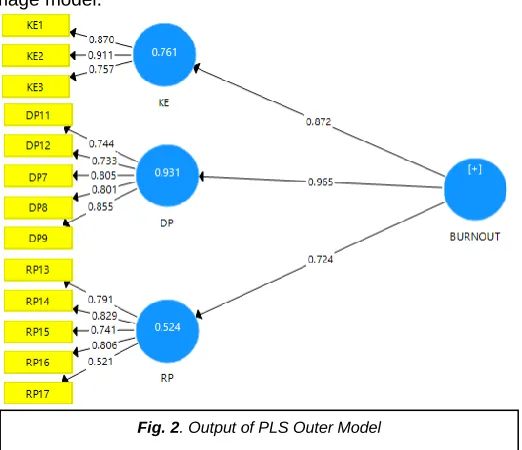
Based on the outer model test results, the burnout’s construct has been valid and reliable, as shown in the following outer image model.
3.1 The Validity Test Result
3.1.1 Convergent Validity
Based on the convergent validity test on the outer model, it is found that the factor loading of the variable to the aspects has a value of > 0.5, as shown in table 3.
TABLE 3
LOADING FACTOR VALUES (VARIABLE-ASPECT)
Aspects Loading factor Annotation
KE 0.872 Valid
DP 0.965 Valid
RP 0.724 Valid
Based on the convergent validity test on the outer model, it is found that the factor loading of the aspects to the indicators has a value of > 0.5, as shown in table 4.
TABLE 4
LOADING FACTOR VALUE (DIMENSION-INDICATOR)
Dimension Loading factor Annotation
KE1 0.870 Valid
KE2 0.911 Valid
KE3 0.757 Valid
DP7 0.805 Valid
DP8 0.801 Valid
DP9 0.855 Valid
DP11 0.744 Valid
DP12 0.733 Valid
RP13 0.791 Valid
RP14 0.829 Valid
RP15 0.741 Valid
RP16 0.806 Valid
RP17 0.521 Valid
The value of convergent validity test shows the average variance extracted (AVE) of the burnout construct of 0.523. The average variance extracted (AVE) value in each of the aspects can be seen in table 5.
TABLE 5
AVERAGE VARIANCE EXTRACTED (AVE) VALUE OF BURNOUT’S
CONSTRUCT
Aspect AVE Annotation
KE 0.720 Valid
DP 0.623 Valid
RP 0.557 Valid
3.1.2 Discriminant Validity
The value of discriminant validity test shows that the root of the Average Variance Extracted in each aspect is higher than the root of the AVE in other aspects. So, the discriminant validity criteria are met. The value of AVE root of burnout’s construct can be seen in table 6.
TABLE 6
AVERAGE VARIANCE EXTRACTED (AVE)ROOT VALUE OF BURNOUT
Aspect PN GA SP
PN 0. 848 0.794 0.521
PM 0.744 0.789 0.645
RK 0.521 0.645 0.746
The construct validity in SEM (Confirmatory Factor Analysis/CFA) shows that the three indicators are valid with a factor loading of (λ) ≥ 0.5
3.2 The Construct of Reliability Test
Based on the results of the construct reliability test, there found the Composite Reliability and Cronbach’s Alpha value of > 0.7. So, the items used in this research are stated variable.
TABLE 7
THE VALUE OF COMPOSITE RELIABILITY AND CRONBACH’S ALPHA OF
BURNOUT’S CONSTRUCT
Variable Composite Reliability
Cronbach
alpha Annotation
Burnout 0.922 0.905 Reliable
The results of construct reliability test with confirmatory analysis (Confirmatory Factor Analysis 2nd Order) in the above table show that the construct has a good reliability and it indicates that the aspects measuring the burnout’s construct/latent variable fulfill the unidimensional criteria [30]. It is shown by the Composite Reliability value of 0.961 and Cronbach’s Alpha of 0,957. The construct validity and reliability test provides valid and variable items that can reflect the burnout’s aspect, namely items number 1, 2, 3, 7, 8, 9, 11, 12, 13, 14, 15, 16, and 17. Meanwhile, items number 4, 5, 6, 10, and 18 cannot reflect the burnout. The results of the analysis on burnout’s aspects formed using the 2nd Order Confirmatory Factor Analysis show that the model is acceptable, because all aspects are able to reflect the variables/constructs formed.
4 DISCUSSION
Based on the analysis results of the construct validity and reliability, the aspects and indicators that formed the burnout are valid and reliable. It shows that all aspects and indicators are able to reflect and form the burnout. Depersonalization is the most dominant aspect that can reflect the burnout, it has a factor loading value of 0.855. Depersonalization is described by not caring about the environment and the people around. Apathetic individuals are less motivated and not passionate with their environment. The findings of depersonalization on the Junior Hig-School teachers in Yogyakarta show that apathetic environment influences burnout. Low self-esteem is the least factor that can reflect burnout, it has a factor loading of 0.521. The low self-esteem is illustrated by the feeling of never doing anything useful. Individuals evaluate their work and performance negatively. The results of this research are supported by Maslach dan Jackson’s research [31] which show that the highest reliability value is emotional exhaustion (α = 0.84). In this research, depersonalization has the highest reliability value with a loading factor of 0.855. Meanwhile, emotional exhaustion has the lowest reliability value. Yet in other research, the low self-esteem has the lowest reliability value with a factor loading value of 0.521 [32]. Mukherjee, Tennant and Beresford [33] found different results, where depersonalization has the highest reliability value (α = 0.65). Meanwhile in this research, depersonalization also has the highest reliability with a factor loading of α = 0.855. Maslach and Jackson’s research [28] showed that emotional exhaustion is the highest aspect with a factor loading value of 0.84. The results of this research are expected to provide an overview of the construct validity and reliability of the burnout on the teachers of Junior High Schools in Yogyakarta, so that this research can be used as a reference for further researches related to burnout.
5 CONCLUSION
Based on the analysis and discussion, it can be concluded that burnout’s construct has good validity and reliability. All aspects and indicators can significantly form the burnout’s construct. Depersonalization is the most dominant aspect that can reflect burnout. It has a factor loading of 88.5%. Thus, the findings of this research are able to provide theoretical implications in the development and practical implications of burnout on teachers of Junior High School. Further researches can study the burnout and its relation to other variables, in order to expand different researches so that the results can be generalized.
ACKNOWLEDGMENT
The author would like to thank Ahmad Dahlan University and the Master of Psychology Programe University of Ahmad Dahlan for supporting the implementation of this research.
REFERENCES
[1] S.C. Smeltzer, B.G. Bare, J.L. Hinkle, K.H. Cheever, Textbook of Medical-Surgical Nursing. Nedherland: Wolters Kluwer Health, 2008.
[2] C. Maslach and M.P. Leiter, Burnout Organizzazione. Trento: Edizioni Erickson, 2019.
[3] I.Y. Pratiwi, N.M.D. Ratnadi, H. B. Suprasto, and I.K. Sujana, The Effect of Role Conflict, Role Ambiguity, and Role Overload in Burnout Government Internal Supervisors with Tri Hita Karana Culture as Moderation,‖ International Research Journal of Management, IT and Social Sciences, vol. 6, no. 3, pp. 61-69, 2019.
[4] N. Embriaco, E. Azoulay, K. Barrau, N. Kentish, F. Pochard, A. Loundou, and L. Papazian, ―High Level of Burnout in Intensivists: Prevalence and Associated Factors,‖ American Journal of Respiratory and Critical Care Medicine, vol. 175, no. 7, pp. 686-692, 2007.
[5] M. Hätinen, U. Kinnunen, A. Mäkikangas, R. Kalimo, A. Tolvanen, and M. Pekkonen, ―Burnout During a Long-Term Rehabilitation: Comparing Low Burnout, High Burnout– Benefited, and High Burnout–Not Benefited Trajectories,‖ Anxiety, Stress & Coping, vol. 22, no. 3, pp. 341-360, 2009. [6] X. Jin, I.Y. Sun, S. Jiang, Y. Wang, and S. Wen, ―The Impact of
Job Characteristics on Burnout among Chinese Correctional Workers,‖ International Journal of Offender Therapy and Comparative Criminology, vol. 62, no. 2, pp. 551-570, 2018. [7] R.A. Baron and L. Greenberg, Behaviour in Organization:
Understanding and Managing The Human Side a/Work. New York: Allyn & Bacon, 1990.
[8] M.A. Steinhardt, S.S.E. Jaggars, K.E. Faulk, and C.T. Gloria, ―Chronic Work Stress and Depressive Symptoms: Assessing The Mediating Role of Teacher Burnout,‖ Stress and Health, vol. 27, no.5, pp. 420-429, 2011.
[9] H. Sesen, F. Çetin, and N.H. Basim, ―The Effect of Burnout on Organizational Citizenship Behaviour: The Mediating Role of Job Satisfaction,‖ International Journal of Contemporary Economics and Administrative Sciences, vol. 1, no. 1, pp. 40-64, 2011.
[10]D. Gharakhani and A. Zaferanchi, ―The Effect of Job Burnout on Turnover Intention with Regard to the Mediating Role of Job Satisfaction,‖ Journal of Health, vol. 10, no. 1, pp. 109-117, 2019.
[11]N.P. Appelbaum, N. Lee, M. Amendola, K. Dodson, and B. Kaplan, ―Surgical Resident Burnout and Job Satisfaction: The Role of Workplace Climate and Perceived Support,‖ Journal of Surgical Research, vol. 234, pp. 20-25, 2019.
[12]S. Viotti, G. Guidetti, I. Sottimano, M. Martini, and D. Converso, ―Work Ability and Burnout: What Comes First? a Two-Wave, Cross-Lagged Study among Early Childhood Educators,‖ Safety Science, vol. 118, pp. 898-906, 2019.
[13]J.B. D'souza, ―A Study Of Teachers'Burnout in Relation to Organizational Citizenship Behaviors and Teaching Experience,‖ AU Journal of Management, vol. 2, no. 2, pp. 20-27, 2004.
[14]T. Casserley and D. Magginson, Learning from Burnout: Developing Sustainable Leaders and Avoiding Career Derailment. UK : Elsevier, 2009.
363 Burnout,‖ Research Companion to Organizational Health
Psychology, vol. 544, no. 36 , 2005.
[16]G. D’Alleo and A. Santangelo, ―Organizational Climate and Burnout in Call-Center Operators,‖ Procedia-Social and Behavioral Sciences, vol. 30, pp. 1608-1615, 2011.
[17]W.B. Schaufeli, A.B. Bakker, K. Hoogduin, C. Schaap, and A. Kladler, ―On The Clinical Validity of The Maslach Burnout Inventory and the Burnout Measure,‖ Psychology & Health, vol. 16, no. 5, pp. 565-582, 2001.
[18]J.R. Halbesleben, and M.R. Buckley, ―Burnout in Organizational Life,‖ Journal of Management, vol. 30, no. 6, pp. 859-879, 2004. [19]J. Jyoti and A. Rani, ―Role of Burnout and Mentoring between High Performance Work System and Intention to Leave: Moderated Mediation Model,‖ Journal of Business Research, vol. 98, no. 166-176, 2019.
[20]S.A.M. Akinsulure, A. Espinosa, T. Chu, and R. Hallock, ―Secondary Traumatic Stress and Burnout among Refugee Resettlement Workers: The Role of Coping and Emotional Intelligence,‖ Journal of Traumatic Stress, vol. 31, no. 2, pp. 202-212, 2018.
[21]W.B. Schaufeli, I.M. Martinez, A.M. Pinto, M. Salanova, and A.B. Bakker, ―Burnout and Engagement in University Students: a Cross-National Study,‖ Journal of Cross-Cultural Psychology, vol. 33, no. 5, pp. 464-481, 2002.
[22]H.J. Eckleberry, H. Kirkpatrick, and T. Barbera, ―The Problems with Burnout Research,‖ Academic Medicine, vol. 93, no. 3, pp. 367-370, 2018.
[23]C. Maslach and S.E. Jackson, ―The Measurement of Experienced Burnout,‖ Journal of Organizational Behavior, vol. 2, no. 2, pp. 99-113, 1981.
[24]H. Qiao, and W.B. Schaufeli, ―The Convergent Validity of Four Burnout Measures in a Chinese Sample: a Confirmatory Factor‐Analytic Approach,‖ Applied Psychology, vol. 60, no. 1, pp. 87-111, 2011.
[25]C. Maslac and M.P. Leiter, Burnout In Stress: Concepts, cognition, emotion, and Behavior. Cambridge: Academic Press, 2016.
[26]H. Latan, Structural Equation Modeling Concepts and Applications using LISREL 8,80 (in Indonesia). Bandung: Alfabeta, 2012.
[27]T.R. Hinkin, J.B. Tracey, and C.A. Enz, ―Scale Construction: Developing Reliable and Valid Measurement Instruments,‖ Journal of Hospitality & Tourism Research, vol. 21, no. 1, pp. 100-120, 1997.
[28]H.M. Jogiyanto, The Concept and Application of Variance-Based Structural Equation Modeling in Business Research (in Indonesia). Yogyakarta: UPP STIM YKPN, 2011.
[29]W. Abdillah, and J. Hartono, Partial Least Square (PLS): Alternative of Structural Equation Modeling (SEM) in Business Research (in Indonesia). Yogyakarta: Penerbit Andi, 2015. [30]Jr.J.F. Hair, G.T.M. Hult, C. Ringle, and M. Sarstedt, A Primer on
Partial Least Squares Structural Equation Modeling (PLS-SEM). New York: Sage Publications, 2016.
[31]V.J. Fornés, G.G. Banda, F.D. Navarro, and P.M. Soler, ―Longitudinal Study Predicting Burnout in Spanish Nurses: The Role of Neuroticism and Emotional Coping,‖ Personality and Individual Differences, vol. 138, pp. 286-291, 2019.
[32]P. Argentero, D.B. Olivo, S.M. Ferretti, and W.G. Burnout, ―Staff Burnout and Patient Satisfaction with The Quality of Dialysis Care,‖ American Journal of Kidney Diseases, vol. 51, no. 1, pp. 80-92, 2008.
[33]S. Mukherjee, A. Tennant, B. Beresford, ―Measuring Burnout in Pediatric Oncology Staff: Should We Be Using the Maslach