Volume 3, No. 3, May-June 2012
International Journal of Advanced Research in Computer Science
RESEARCH PAPER
Available Online at www.ijarcs.info
ISSN No. 0976-5697
Motion Detection and Estimation in Fused Video by Using Optical Flow Technique
with Fuzzy Application
Gunjan Mukherjee
Regent Education and Research Foundation,Barackpore, Kolkata,India
Abstract In this paper we describe an accurate and efficient way of making the fused video and hence detection and estimation of motion of any object to be slow or fast in the fused video. The algorithm is developed on the basis of Fuzzy logic. Our approach is based on Fuzzy measure theory and aggregation and we investigate it’s suitability for the problem of image and video fusion. According to the algorithm, we first register the video in appropriate size buffers. Video is then disintegrated into frames and suitability of the image fusion is checked. Then if required, pre-processing algorithm is applied on the frames of the Video. After pre-pre-processing algorithm, we apply pixel wise fusion using fuzzy measure and aggregation concept. Frames are reassembled back for the video display. Lucas Kanade methodology has been used to detect motion of moving object in the fused video by means of the optical flow technique. Later on Fuzzy logic has been used to estimate the motion to be either slow or fast by comparing the average fuzzy value with respect to the specified threshold value The algorithms have been implemented using Matlab and it can be easily extended to C language for embedded system implementation. Some tests have been followed with fused videos. This algorithm successfully finds the motion in fused video and estimate nature of the motion by means of an adaptive technique using the fuzzy rule sets. This algorithm has performed better compared to other algorithms in terms of computational complexities.
Key Work: image fusion, multifocal, multiview, multitemporal, multimodal fusion, image registration; wavelet based fusion, fuzzy measure, fuzzy integral, adaptive, threshold value, Fuzzy Rule Sets Motion Detection Motion Classification.
I. INTRODUCTION
The work is all about making the fused video and hence finding the motion of any body like human being in the fused video along with estimating the motion using the fuzzy logic. Recently a number of studies have shown motion detection technique by finding the blob or by applying the optical flow technique. In the blob based detection different pixel values having the same intensity values has been grouped together into the blob(see [1] and references therein)The blob based approach for finding motion of any object is not performing well in fused video. In the fuzzy based approach for detection of motion vectors , texture weight and ellipse fitting. Among the optical flow based technique, one method has been proposed to be based on the background modelling. This paper shows the underexposed video footage by fusing the same with some simultaneously captured video from no visible sensors (see [2-4] and references therein).
The captured video from no visible sensors, such as short wave IR or near IR also. Although IR sensors can capture video in low-light for night-vision applications, they lack the colours and the relative luminance of visible spectrum sensors. RGB sensors capture colours and correct relative luminance’s, but are underexposed, noisy, and lack fine features due to the short exposure time necessary for the video. Our fusion technique raved the noises from the RGB sources and then introduces the IR sources details. By enhancing the RGB instead of IR, our result contains the proper relative luminance and colours. The relative luminance difference between the RGB and IR videos are due to differing materials reflectivity and sensor responses. In our process, we extract the IR details and fuse them with the RGB. This dual camera arrangement enables both daytime visible-spectrum capture and night-time fused multispectral capture, and may be useful for surveillance
applications. Our fusion algorithm, which utilizes both temporal and spatial filtering, ensures coherency from frame-to-frame of our supplemental video. On the basis of Fuzzy logic, a new algorithm has been proposed for IR/Visual image and video fusion. There are number of ways of determining motion in the fused video. We have adopted the optical flow method for finding motion of the object(see [5-8] and the references therein) A new algorithm has been proposed on the basis of fuzzy techniques for estimating motion of different objects relatively. Optical flow is the apparent velocities of movement of brightness patterns in an image. Optical flow can arise due to the relative, motion between the objects and the viewer. Optical flow can give us some important information regarding spatial arrangements viewed and the rate of change of this arrangement. Lucas Kanade methodology has been followed for detection of motion in optical flow method (see [9-18] and the references therein).
Three important assumptions have been made in implementing the Lucas Kanade method First one is the brightness constancy which implies that brightness or the image intensity over the small region will remain uniform. Second one is the temporal persistence which implies slow image motion of the surface patch. The validity of the assumption depends upon the frame rate of the camera and the speed of the object to be tracked. Third one is the spatial coherence that implies neighbouring points in a scene belong to the same surface and similar motion. The fuzzy technique has been used to estimate the motion to be either slow or first. The trapezoidal rule for fuzzification has been applied and centroid method for defuzzification has been applied to get the defuzzified values. Different sample motion has been tested for the algorithm to work.
decided by taking into consideration magnitudes of the motion vectors and hence finding their fuzzy equivalent expression using triangular fuzzy technique (see [19-21] and the references therein). In the fused video, Secondly motion has been estimated to be fast or slow for different objects on the basis of the Fuzzy techniques Fuzzy rule sets have been written for the fuzzy classification of motion to be fast, moderate or slow. Lucas Kanade methodology segregated each of the vectors from the captured frame. Magnitudes of the vectors thus calculated are classified into different classes as slow , medium and fast one then fuzzy rule sets are used to estimate the motion. This research work has focus on detection of the motion in the fused video where as the other one are not meant for the fused video more over the fuzzy based algorithm work successfully on the images of low and degraded intensity. This work elevates also the morphological problems of the other algorithm .An adaptive technique to calculate the mean for threshold has been taken under consideration.
The problem of motion detection can be tackled in different ways. a) Block matching technique b) Optical technique. We have applied optical technique to detect the motion in the fused video. Fuzzy rule sets are being used to estimate the motion as slow, medium or fast. In this algorithm defined on such images which are low intensity and degraded. Generally proposed algorithm fused those images and produced an image which contains more information than source images. Initially we have used bilateral filter for denoisification of sources image. After removal of noise from images we continuing several process such as resolution resampling, image registration, fuzzy measure, fuzzy aggregation then we used fuzzy theory on those registered images for fusion. In the following sections we will briefly describe the bilateral filter and fuzzy concepts before presenting a fusion scheme for image restoration.
The organisation of the paper is according to the following manner. Section 2 gives the brief overview of the related works. Section 3 gives us about the overall algorithm flow .Section 4 gives us procedure for the formation of fused video. In section 5, the technique of extracting images from the fused video has been discussed. Section 6 discusses about motion estimation on the basis of fuzzy rule sets. Experimental results and the comparative studies have been discussed in the section 7 and 8. Concluding remarks appears in section 9.
II. RELATED WORKS
This technique captured the scene background and updating it through time. Two frames difference motion detectors is based upon amount of differences between two consequent frames.
Our technique is fully based upon optical flow based approach using Lucas Kanade technique using the fuzzy logic and is applied to the fused video. Here motion vectors have been produced with the help of Lucas kanade technique. Magnitudes of the motion vectors are calculated. Estimation of the motion to be slow or fast has been determined by using the fuzzy technique. The adaptive mean value has been chosen as the threshold value to determine nature of motion to be slow or fast.
III. ALGORITHM FLOW
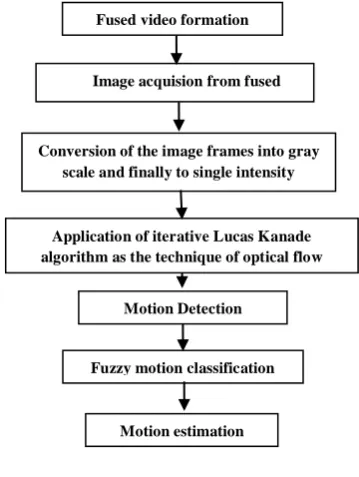
The proposed algorithm consist of stages - Fused video formation, Image acquisition from the fused video, conversion of the image frames into gray scale and finally to single intensity format. Application of the iterative Lucas Kanade algorithm as the technique of optical flow,and then finally fuzzy motion classification and motion estimation. Figure 1 shows the process flow of the proposed motion detection and estimation algorithm. Each of these stages will be discussed in detail in section.
[image:2.595.333.513.193.432.2]
Figure 1. Proposed Algorithm Flow
IV. FUSED VIDEO FORMATION
In our scheme of the formation of the fused video, the methodology is based on the Fuzzy measure and Fuzzy aggregation scheme. Firstly, the frame from the infrared and visual video has been extracted. Secondly the frames have been denoisified by means of the bilateral filtering technique , Thirdly, image frames are registered using the affine linear interpolation. At the fourth step the fuzzy measurement and aggregation of the fuzzy data has been carried out. The block diagram, given below depicts each of the steps involved in the whole algorithm.
Figure 2. Image Fuzzification
Fused video formation
Image acquision from fused
Conversion of the image frames into gray scale and finally to single intensity
Application of iterative Lucas Kanade algorithm as the technique of optical flow
Fuzzy motion classification
[image:2.595.319.555.605.777.2]In our technique, we used histogram-based gray level fuzzification technique. The shape of membership function of infra-red image and normal visual image defined as follow
max
1 ((
)) / )
IR
G
LI
inputs
µ
= −
−
Where
µ
IRis membership value of infra-red image and s is scaling factor whose value defined as 1200<S<1500 andG
Lmax,I
inputare maximum intensity value and inputimage respectively. Similarly we also define membership
function for normal visual image as
max
1 ((
)) / )
visual
G
LI
inputs
µ
= −
−
Where
µ
visualis membership functional value of visual image and s is scaling factor whose value defined as 400<S<600. We implement above defined function for our technique by Matlab.A. Fuzzy measure:
Let Y be an arbitrary set, and H be a Borel Field of Y.A set function g defined on B is a fuzzy measure if it satisfies the following conditions:
( )
( )
( )
( )
1. Boundary conditions : g 0, g Y 1.
2. Monotonicity : g A g B if A B, and A, B H.
φ = =
≤ ∈ ∈ A
g-fuzzy measure is also proposed by Sugeno which satisfies another condition known as the λ-rule (λ >-1):
(
)
( ) ( )
( ) ( )
g AUB g A g B g A g B
Where A, B H.
λ
= + +
∈
Let Y=
{
y , y ,1 2 , yn}
and the fuzzy density of the gλ -fuzzy measure be defined as a function[ ]
g : y ∈ Y→ 0,1 such
thatg gi= λ
(
{y } , ii)
=1, 2 ,…, m. With boundary condition g(Y) =1, the constant can be determinedBy solving the following equation:
1
1 (1 )
m
i i
g
λ λ
=
+ =
∏
+For a fixed set of gi∈[0<gi <1 there exists a unique root ] of
λ>-and
λ
∈
((-/sup g ( ), ) {0}
λA
∞
.V. IMAGE ACQUISION FROM FUSED VIDEO
Image acquisition is the common basic step of converting the video into number of frames by means of stationary or moving cameras or multiple cameras. Usually a frame grabber is used to grab frames from the fused video. Generally the video sequences are having high frame rates(10-30 fps) or low frame rates(<10fps).Each of the frames thus captured are stored in separate memory areas.
A. Conversion of the Image Frames into Gray Scale and Finally to Single Intensity Format:
Any image is comprised of millions of pixels and each pixel consists of 3 colours Red, Green and Blue. Any colour can be obtained by just adjusting these 3 colours. A hex triplet is a six-digit, three- byte hexadecimal number used in HTML, CSS, SVG, and other computing applications, to represent colours. The bytes represent the red, green and
blue components of the colours. One byte represents a number in the range 00 to FF (in hexadecimal notation), or 0 to 255 in decimal notation. This represents the least (0) to the most (255) intensity of each of the colours components. The frames, extracted from the video has been converted to grey scale format here each pixel carries the colours value varying from black at the weakest intensity to white at the strongest. This conversion helps in reducing the different intensity levels to lower number of levels. Finally the image is converted into single intensity format having only two colours intensities like black and white. This reduces the number of intensity levels to two.
B. Application of Iterative Lucas Kanade Algorithm as the Technique of Optical Flow:
In our method, The Optical Flow technique has been adopted. Optical flow is the apparent motion of brightness patterns in the image. Generally, optical flow corresponds to the motion field, but not always. In implementing the concept of Optical flow some assumption has been made, they are
a. Brightness Constancy: This implies that brightness or the image intensity over the small region will remain uniform i.e.,
(
,
,
1)
( , , )
I x u y v t
+
+
+ =
I x y t
b. Spatial Coherence: The neighbouring points all belong to the same surface and is having the same motion.
c. Temporal Coherence: Image motions of the surface patch gradually change over time. Lucas Kanade iterative technique for finding motion vectors is the full proved algorithm. This algorithm has been applied to the respective frames created out of the fused video.
C. Lucas Kanade Algorithm:
Lucas kanade algorithm has been applied using the pyramid of level 4. Density of 10 has been used in plotting the motion vectors[14][15]. At first the image frame, those captured, has been broken into no of rows and columns. The algorithm has been run on all levels of rows and columns at the pyramid steps. That gives rise to the optical vectors. A morphological operation has been carried out through erosion and dilation technique. The algorithm has been described below.
a. Iterative Refinement Approach:
Velocity at each pixel position is calculated by solving Lucas Kanade equation. Warp I (t-1) towards I(t) using the estimated forced field. The above steps have been repeated until the convergence occurs.
b. Motion Detection:
of any object, So the algorithm detect magnitude of vectors from every frame under consideration. If it find at least any frame to have the sum of the magnitude of all vectors to be greater than one(1),motion is considered to take place. If none of extracted frames from the fused video is found to have result(sum of magnitude of all the individual vectors) more than one(1)then no motion is said to take place in the scene.
VI. FUZZY MOTION CLASSIFICATION
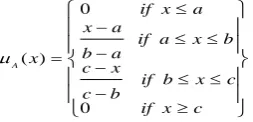
[image:4.595.321.544.61.201.2]Fuzzy logic has been implemented too classify the motion [17][18][19][20] as slow , fast or medium paced. For every frame the motion vectors are extracted by applying Lucas Kanade method .Magnitudes of the vectors are estimated and hence vectors are classified into three groups depending upon magnitudes thus estimated. The groups are named as slow, medium and fast. Corresponding to each of the individual set of vectors the fuzzy logic has been implemented. Membership function has been calculated by using Fuzzy triangular function for every set of vectors. Following equation from fuzzification is shown below
Figure 3. Fuzzy Membership Function
The membership functions µslow µmedium & µfast is
calculated based on the above equation. For the range from 0 to 10 µslow, for the range 10 to 100 µmedium and for the
range 100 to 300, µfast
i. 1) if µ
is calculated. The ranges are selected according to the magnitudes of the vectors available. The parameters a is the lower range , c is the upper range and mean of their values is the value for b. The fuzzy rule sets for determining the motion to be fast, slow or medium are as follows.
slow is high and µmedium is low and µfast
ii. 2) if µ
is low then the motion is low.
slow is low and µmedium is low and µfast
iii. 3) if µ
is high then the motion is high.
slow is low and µmedium is high and µfast
iv. 4) if µ
is low then the motion is moderate.
slow is low and µmedium is high and µfast
v. 5) if µ
is high then the motion is moderately high.
slow is high and µmedium is high and µfast
vi. is high then the motion is moderate.
vii. 6) if µslow is high and µmedium is high and µfast
viii. 7) if µ
is low then the motion is moderately slow.
slow is high and µmedium is low and µfast
ix. 8) if µ
is high then the motion is moderately high.
slow is low and µmedium is low and µfast
x. 9) if µ
is low then the motion is slow
slow is zero and µmedium is zero and µfast
The fuzzy triangular function is shown below:
is zero then the no motion is detected
[image:4.595.76.203.316.377.2]Slow Medium Fast
Figure 4. I vs X graph
A. Defuzzification:
Order fuzzy numbers are defined that make it possible to deal with fuzzy inputs quantitatively, exactly in the same way as with real numbers. An approximation formula is given for a defuzzification functional that plays the main role when dealing with fuzzy controllers and fuzzy inference systems. Defuzzification is the main operation of fuzzy controllers and fuzzy inference systems, where fuzzy inference rules appear. If the consequent parts of fuzzy rules are fuzzy, a defuzzification process is required, in the course of which real numbers are attached to membership functions. A number of defuzzification procedures for convex fuzzy numbers can be found in the literature [22, 23], and some of these defuzzification procedures are indeed applicable to ordered fuzzy numbers when the ordered fuzzy number is a proper one, i.e. when its membership relation is a function. However, when the number is non-proper, i.e. the relation is by no means of the functional type, the situation is quite different.
In our image and video fusion technique, we used gray-scale level defuzzification. Defuzzification model defined for this method as follow
, ,
1 (
max L max L* (1 / (1
e));
H
= −
G
−
G
−
R
Where Gmax, L
( )
*
( )
i
i
x x dx
x
x dx
µ
µ
=
∫
∫
maximum gray level of image and e is scaling factor of membership function, whose value belongs 1<e<2 and in the motion detection and motion classification, we have used the defuzzification technique Centroid Defuzzification technique which can be expressed as
Where x* is the defuzzified output, µi
B. Motion estimation:
(x) is the aggregated membership function and x is the output variable
Average of fuzzy values associated with each of the frames have been calculated. This average fuzzy value has been utilized to determine motion to be slow or fast. Threshold for determination of nature for the motion has been chosen to be 0.5.The adaptive mean technique has been applied to find the threshold value by taking into consideration fuzzy values of all the motion vectors arising out of the individual videos. Firstly the mean value of all the fuzzy values for the respective video has been computed .Secondly, mean of all the means has been calculated out to find the threshold. The result in our case is 0.48.We have taken the value as 0.5 approx. It has been experimentally found that motion of the object in fused video was slow in case the average of the
0 10 100 300
0 ( ) 0 A
if x a
x a
if a x b
b a
x
c x
if b x c
c b
if x c
corresponding fuzzy value came below the threshold chosen and for other fused video the motion is found to be fast with their corresponding fuzzy value staying above the threshold chosen. The experiment has been done with several numbers of videos.
VII. EXPERIMENTAL RESULTS
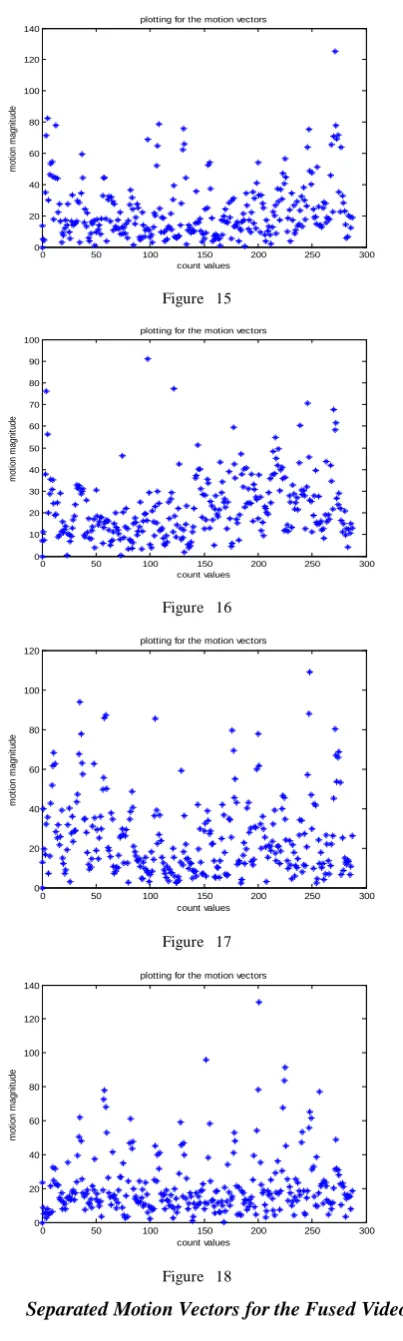
The entire algorithm has been developed using Matlab software on windows platform.. After the fused video has been formed, frames are extracted from the video shown in the Figure 6 and Figure 12. Figure 5 and Figure 11 shows the RGB and it’s mean value for the two fused video in plotting The corresponding grey scale format expression of the frames are shown in Figure 7 and Figure 13 .That contains less intensities .Final representation of the image is in black and white form i.e. in 0 and 1 shown in Figure 8 and Figure 14 form. Figure 9 to Figure 10 and Figure 15 to Figure 18 show few of the generated motion vectors. Magnitudes of the motion vectors are plotted for a few numbers of frames for respective two videos under consideration. In both case of plotting, which is chosen for the random frames, concentration of the dots seems to varying which shows the fact that some motion is slow ,some are moderately slow, moderately high or high depending on the less concentration to more concentration. This classification has been done on the basis of the fuzzy rule sets, shown above in section-6. The graphs have been plotted by taking the magnitudes of motion vectors with respect to the count values which implies the total numbers of reading of the values.
Figure 5. RGB Values and it’s Mean for the Fused Video1
Figure 6 Image Frames in RGB format
Figure 7. Image Frames in Gray Scale format
Figure 8 Image Frames in Single Intensity Forrmat
0 50 100 150 200 250 300 0
10 20 30 40 50 60 70 80 90
count values
m
ot
ion m
agni
tude
plotting for the motion vectors
Figure 9
0 50 100 150 200 250 300 0
10 20 30 40 50 60 70 80 90 100
count values
m
ot
ion m
agni
tude
plotting for the motion vectors
Figure 10
A. Separated Motion Vectors for the Fused Video1:
Figure 11. RGB values and it’s mean for the fused video2
Figure 12. Image Frames in RGB Format
Figure 13. Image Frames in Gray Scale Format
0 50 100 150 200 250 300 0
20 40 60 80 100 120 140
count values
m
ot
ion m
agni
tude
[image:6.595.59.261.50.722.2]plotting for the motion vectors
Figure 15
0 50 100 150 200 250 300 0
10 20 30 40 50 60 70 80 90 100
count values
m
ot
ion m
agni
tude
plotting for the motion vectors
Figure 16
0 50 100 150 200 250 300 0
20 40 60 80 100 120
count values
m
ot
ion m
agni
tude
plotting for the motion vectors
Figure 17
0 50 100 150 200 250 300 0
20 40 60 80 100 120 140
count values
m
ot
ion m
agni
tude
plotting for the motion vectors
Figure 18
B. Separated Motion Vectors for the Fused Video2:
VIII. COMPARATIVE STUDIES
We applied our proposed method to the fused video frames, produced from the IR sensors. Although as many fusion algorithms, as yet no universally accepted standard
has emerged for evaluating image fusion performance and detection and estimation of the motion in the fused video. In this work, we use both qualitative and quantitative methods. The qualitative methods are acceptance and verification tests which are accepted or rejected by a possible user, which determine visually the relative perceived image quality based on the contribution that the fusion makes to it and the motion detection strategy. Quantitatively, blob detection in the fused video has not yet produced ant good result.
Adaptive finding of the mean is more flexible and customizable unlike the other algorithm. Moreover the above mentioned algorithm is detecting and estimating the motion in fused video as well on the basis of same set of the fuzzy values which is mentioned in fig 4 and fig 14.In this respect the above laid algorithm is much efficient and accurate. Compared to other algorithm, We have classified the motion into three partition and then applied Fuzzy rules to find the motion to be either fast , medium or slow.
IX. CONCLUSION
In this study, we have implemented an algorithm for fusing video followed by detection of motion of any object in the fused video by means of the Lucas Kanade method. The nature of the motion that is whether the motion is fast or slow had been predicted by the fuzzy rule base by means of the adaptive strategy. Our experimental results show how effectively our algorithm can detect motion and tell about the nature of motion to be fast or slow. Some other algorithm could be merged to find the exact estimate of the motion.
X. REFERENCES
[1]. Mandeep Singh Improved Morphological Method in
Motion Detection, International Journal of Computer
Applications (0975 – 8887) Volume 5– No.8, August 2010
[2]. Jian Li, Stavri G Nikolov, Christopher P Benton and
Nicholas E Scott-Samuel University of Bristol, Motion-Based Video Fusion Using Optical Flow Information.
[3]. L. Mihaylova, A. Loza, S. G. Nikolov, J. J. Lewis, E.-F.
Canga, J. Li, T. Dixon, C. N. Canagarajah and D. R. Bull, The Influence of Multi-Sensor Video Fusion on Object Tracking Using a Particle Filter
[4]. B. D. Lucas and T. Kanade. An iterative image registration
technique with an application to stereo vision. Proc 1th Intl Joint Conf on Artificial Intelligence (IJCAI), pages 674– 679, 1981.
[5]. B. K. P. Horn and B. G. Schunck. Determing optical flow.
Artificial Intelligence, 17:185–203, 1981.
[6]. Kui Liu, Qian Du, He Yang, and BenMa, Optical Flow and
Principal Component Analysis-Based Motion Detection in Outdoor Videos EURASIP Journal on Advances in Signal Processing Volume 2010, Article ID 680623, 6 pages.
[7]. A. A. Shafie, Fadhlan Hafiz, and M. H. AliMotion
Detection Techniques Using Optical Flow World Academy of Science, Engineering and Technology 56 2009
[8]. D. J. Fleet and K. Langley. Recursive filters for optical
[9]. Jang, S.-W., Pomplun, M., Kim, G.-Y., and Choi, H.-I., “Adaptive robust estimation of affine parameters from block motion vectors,” Image and Vision Computing, 1250–1263 (August 2005).
[10]. Bird, N.D., et al. (2005) “Detection of Loitering
Individuals in Public Transportation Areas”, IEEE Transactions on Intelligent Transportation Systems.
[11]. Bodor, R., B. Jackson, & N.P. Papanikolopoulos, (2003)
“Vision-Based Human Tracking and Activity Recognition”, 11th Mediterranean Conference on Control and Automation.
[12]. Niu, W., et al. (2004) Human Activity Detection and
Recognition for Video Surveillance”, IEEE International Conference on Multimedia and Expo.’
[13]. Iocchi, L. & R.C. Bollees occurred, (2005) “Integrated
Plan-View Tracking and Color-based Person Models for Multiple People Tracking”, International Conference on Image Processing.
[14]. Li, J., C.S. Chua, & Y.K. Ho, (2002) “Color-based
Multiple People Tracking”, 7th International Conference on Control Automation, Robotics and Vision ICARCV.
[15]. ANDR´ES BRUHN AND JOACHIM WEICKERT and
CHRISTOPH SCHNO¨ RRLucas/Kanade Meets
Horn/Schunck: Combining Local and Global Optic Flow Methods.
[16]. Lucas and T. Kanade, “An iterative image registration
technique with an application to stereo vision,” IJCAI,pp. 674–679, 1981.
[17]. J.R. Bergen, P. Anandan, K.J. Hanna, and R.
ingorani,“Hierarchicalmodel-basedmotion estimation,” in ECCV, Italy, May 1992, pp. 237–252.
[18]. M. Irani, B. Rousso, and S. Peleg, “Computing occluding
and transparent motions,” IJCV, vol. 12, no. 1, pp. 5–16, January 1994.
[19]. Johansson, G. 1975. Visual Motion Perception. Sci
American 232(6):76-88.
[20]. Aggarwal, J.K. and Cai, Q. 1997. Human Motion Analysis:
A Review. In Proceedings of IEEE Non-rigid and Articulated Motion Workshop, 90-102.
[21]. John See, Lee Sze Wei , Madasu Hanmandlu, Human
Motion Detection Using Fuzzy Rule-base Classification Of
Moving Blob Regions
[22]. Buckley J J and Eslami E 2005 An Introduction to Fuzzy
Logic and Fuzzy Sets, Physica-Verlag, A Springer-Verlag Company, Heidelberg.
[23]. Kosiński W 2006 Defuzzyfication Functionals of Ordered